Introduction
Publicity has emerged as a widespread trend in modern socio-economic development across the globe, with openness to society serving as a critical factor for successful transformations. Publicity in the public administration system refers to the involvement of society in state administration. Digitalization of public administration pertains to alterations in the state administration system. The realization of such a shift is a priority for national policies around the world. In the case of countries with a transitioning economy, the execution of a digitalization policy is the consequence of political pressure from international financial institutions. This action is taken in response to the widespread extension of democratic methods in the public administration sector. In the case of countries with a transitioning economy, the execution of a digitalization policy is the consequence of political pressure from international financial institutions. Appropriate implementation of digital transformations in public administration enables the management system to generate profit, known as digital dividends. The term digital dividends are multifaceted and extensively explained in World Bank (2016).
Over recent years, digital transformation has emerged as a prominent topic of research. Cortet et al. (Reference Cortet, Rijks and Nijland2016) examine the potential for the Payment Services Directive 2 (PSD2) to expedite changes to the financial sector’s structure via digitalization across the European Union. Concomitantly, banks are creating and installing application programming interfaces (APIs). Huang et al. (Reference Huang, Henfridsson, Liu and Newell2017) demonstrate that a considerable number of national governments are not capitalizing on the opportunities presented by digitalization. The authors define digital government as the use of information and communication technologies to support state functions, services, and citizen participation in socio-economic development, political processes, and general quality of life. According to Mergel (Reference Mergel2018), public sector digitalization is becoming increasingly prevalent. Thus, it is recommended to review policies, processes, and services to simplify communication opportunities for both citizens and workers. It was observed that early digitization endeavours concentrated on transitioning from analogue to digital services, with the intention of enhancing the efficacy of public services. Contemporary public administration aspires to revamp and re-engineer public services in response to evolving user requirements.
Mergel et al. (Reference Mergel, Edelmann and Haug2019) demonstrate through empirical evidence that digital transformation is a continual process that necessitates adapting procedures, amenities, and commodities to external demands. The outcome of this process is a better quality of relations between state institutions and stakeholders, an elevated satisfaction level of citizens, and changes to bureaucratic and organizational culture within state and regional administrations.
Schenk and Dolata (Reference Schenk and Dolata2020) examine the potential for public administration universities to aid in digital transformation by collaborating with local authorities. Raso (Reference Raso, Hertogh, Kirkham, Thomas and Tomlinson2021) examines digitization initiatives in administrative services through the cases of Great Britain, Canada, and Australia. Digitization improves and virtualizes the interaction between officials and the public, whilst the immense amount of human labour required to support such initiatives is not readily apparent. Mergel (Reference Mergel2019) investigates the impact of digitalization on national governments in developed countries and observes that E-governance is creating an information space between centralized and decentralized IT departments. This is driven by large-scale IT failures and the necessity to discontinue IT projects which traditional IT offices could not manage.
Hliborob (Reference Hliborob2022) examines the European principles of digitalization in the public sector, including openness, transparency, technological neutrality of data, user orientation, accessibility, security, privacy, administrative simplification, preservation of information, and performance evaluation. The research highlights the necessity of regulating digital transformation in public services and devising a strategy based on the concept of ‘people-centeredness’ in state authorities’ operations. At the same time, Castillo (Reference Castillo2021) observes the intricacies involved in researching the digitization of the public sector. He contends that public administration is not uniform in terms of magnitude or extent. Consequently, research highlights the need to address intricate institutional factors, economic, and fiscal limitations in the country.
In a study conducted by Alvarenga et al. (Reference Alvarenga, Matos, Godina and Matias2020), the digitization of public administration is evaluated in terms of knowledge management by analysing survey data within this sector. According to the study’s results, knowledge management and public perception of digital government were found to be weak. Furthermore, the conclusion suggests that this area of research is being further explored due to a lack of understanding of the issue at hand.
Collington (Reference Collington2021) contends that, drawing on Denmark as an exemplar, digitalization within the public sector has resulted in significant infrastructure responsibilities being bestowed upon private entities. The implemented reforms aimed not only to enhance efficiency within the public sector, but also to nurture nascent digital technology industries in alignment with a comprehensive export growth approach. At the same time, Schiavi and Behr (Reference Schiavi and Behr2018) posit that digitalization alters the organizational activities of the public sector. As a result, managers of public organizations and structures necessitate a greater openness to innovation.
Fischer et al. (Reference Fischer, Heuberger and Heine2021) investigated different theoretical approaches to digitalization, including social value theory, economic evaluation of information systems and found a lack of a holistic perspective to study the impact, particularly with regards to the societal values of the digitalization process within public administration. Alenezi’s (Reference Alenezi2022) study found that a government’s digital transformation provides value, strengthens relations, fulfils citizens’ requests, develops the economy, accelerates economic activity, boosts citizen engagement, improves policy implementation and effectiveness, and positively impacts business growth.
In general, assessments of digital economic development, particularly in public administration, involve the use of various indices. The United Nations assesses digital transformations through the E-Government Development Index (EGDI), which comprises three sub-indices: online services, telecommunications infrastructure, and human capital (UN E-Government Knowledgebase n.d.). The Global Open Data Index offers the most complete view of the current status of open government data release (Global Open Data Index n.d.). The Networked Readiness Index, proposed by the World Economic Forum in 2001, measures various aspects of information and communication technology (ICT) including its development, the readiness of citizens, entrepreneurs, businesses, and government institutions to use it, the level of ICT adoption in society, business, and government, and the economic impact of information technologies (Networked Readiness Index 2022). The International Telecommunication Union’s Global Cybersecurity Index assesses the extent of ICT usage and the degree of technology safeguarding against cybercrime (International Telecommunication Union n.d.). Meanwhile, the Digital Economy and Society Index (DESI) amalgamates pertinent metrics on the efficacy of digital technologies in Europe and monitors the development of EU member states in the realm of digital competitiveness (European Commission 2022). The OURdata Index from the Organisation for Economic Co-operation and Development (OECD) evaluates the open data policies of public administrations based on three pillars: data availability, data accessibility, and government support for data reuse (Rivera Perez et al. Reference Rivera Perez, Emilsson and Ubaldi2020). This index provides a means of assessing the effectiveness of using information and communication technologies to improve government-citizen interaction.
Notably, the EGDI is the primary indicator used to measure government usage of ICT for providing public services at a national level (UN Department of Economic and Social Affairs 2022a). It is based on a review of the online presence of all 193 UN member states. In addition, such a study allows us to evaluate the technical characteristics of public service websites (Malodia et al. Reference Malodia, Dhir, Mishra and Bhatti2021). Since the index is a comparative tool, a high score indicates best practices, not perfection (Alenezi et al. Reference Alenezi, Tarhini and Sharma2015). This index evaluates the efficacy of the government in implementing novel governance practices. A low score suggests little observable advancement during the survey timeframe and can serve as a dependent variable in research (Lynn et al. Reference Lynn, Rosati, Conway, Curran, Fox and O’Gorman2022). It can be used as a dependent variable in a study. But the development of E-government itself is an independent variable in this case (Manoharan et al. Reference Manoharan, Melitski and Holzer2022), as it is a component of the organization of public authorities for accessible communication with citizens, legal entities, and non-governmental organizations that represents E-government (Bose and Rashel Reference Bose and Rashel2007).
These indices cover a wide range of public administration development factors and certain digitalization aspects. However, the use of indices does not provide an assessment of the impact of digitalization on national economic development and governance effectiveness. The study aims to evaluate the digital transformation of public administration in transitioning countries and to ascertain its influence on the indicators of living standards, welfare of the populace in the countries, and the effectiveness of governance.
This article uses a generalized approach when ‘living standards’ and ‘well-being’ are approximated with GDP, taking into account the works of Gallup Global Well-Being (2010) and Helliwell et al. (Reference Helliwell, Layard, Sachs, De Neve, Aknin and Wang2023). This approach is used to analyse digital transformations in the society of developing countries (Howell and Howell Reference Howell and Howell2008). More reliable answers are obtained through a people survey, which will be the subject of the following studies. This approach recognizes that individuals’ direct perception of reality provides better results than the analysis of reports. For instance, it includes evaluations of healthy life expectancy, social support, and purchasing power (Kushlev et al. Reference Kushlev, Radosic and Diener2021).
This study (Helliwell et al. Reference Helliwell, Layard, Sachs, De Neve, Aknin and Wang2023) offers a 10-year analysis period encompassing not only the measurement of the ‘happiness index’, but also the onset of active social network development. In 2010, open data for practical ‘infusion models’ (Debb Reference Debb2021) became available, facilitating the examination of people’s attitudes towards digital transformations and the factors influencing positive sentiment in specific countries.
According to the goal, the following hypotheses are proposed.
-
(1) The digitalization of public administration in countries with transitional economies increases the living standards of their populations.
-
(2) The implementation of digitalization in the public administration system ensures governance effectiveness in countries with a transition economy.
Methods
The study’s country classifications were based on the approach of the United Nations Secretariat’s Department of Economic and Social Affairs (UN Department of Economic and Social Affairs 2022b) for analysing the World Economic Situation and Prospects (WESP) and identifying global economic trends. The UN categorizes all countries worldwide into one of three groups for their WESP analysis: developed economies, countries with transitioning economies, and developing countries. Such analytical groups reflect the primary economic conditions of the countries’ development and are not grounded on regional classifications. The UN observes that some countries with economies in transition exhibit traits that allow for their inclusion in multiple categories simultaneously, yet the groupings were rendered as mutually exclusive for analytical purposes. Thus, countries with transitional economies comprise the following: Republic of Albania, Bosnia and Herzegovina, Montenegro, Republic of North Macedonia, Republic of Serbia, Republic of Armenia, Republic of Azerbaijan, Republic of Belarus, Georgia, Republic of Kazakhstan, Republic of Kyrgyzstan, Republic of Moldova, Russian Federation, Republic of Tajikistan, Republic of Turkmenistan, Ukraine, and Republic of Uzbekistan.
The study used the E-Government Development Index, which measures the level of digital transformation in UN member states’ public administrations. The EGDI evaluates the website development patterns in a country and factors in the access characteristics, such as infrastructure and education levels, to gauge how effectively a country uses information technology to foster access and promote inclusion for its citizens. Mathematically, the EGDI represents a weighted average of three normalized scores for the most critical dimensions of E-government: (1) scope and quality of online services (Online Service Index, OSI), (2) development status of telecommunication infrastructure (Telecommunication Infrastructure Index, TII), and (3) inherent human capital (Human Capital Index, HCI) (UN E-Government Knowledgebase n.d.).
The correlation analysis examined the relationship between the E-Government Development Index (x) and the GDP per capita (y 1) and government effectiveness index (y 2) to evaluate the digital transformation efficiency of public administration in transition economies. To confirm the dependencies between (x) and (y 1), the UN methodology was employed, and estimation tables and conclusions were generated (UN Department of Economic and Social Affairs 2022a). Similar research methodologies have been used by Heeks (Reference Heeks, Irani and Love2008) and Azoeva et al. (Reference Azoeva, Nurasheva and Shim2022).
The Government Effectiveness Index was selected as a reliable metric of government effectiveness, as it assesses the calibre of public services, civil service, policymaking, policy implementation, and confidence in the government’s commitment to sustaining or enhancing these standards. This index encompasses 200 countries with a rating ranging from –2.5 (less efficient) to 2.5 (more efficient), and was formulated by the World Bank (Kaufmann and Kraay Reference Kaufmann and Kraay2022).
Results
Digital transformations in the realm of state regulation and management have emerged as a prevalent global trend. The digitization movement gained momentum in tandem with business cycles, as corporate entities channelled private investments towards the advancement of computer technology. Subsequently, the shift to electronic payments signified the next stage of investment development, facilitating the seamless transfer of capital across the world. The latest infrastructure upgrade involves migrating the global internet to the 5G platform.
The further combination of computer technology and financial information technology started the era of digitalization. This era defines a new specificity of the management system, which begins to function remotely, by using the transmission of information on the management object. This makes it attractive and a necessary and sufficient condition for the functioning of public administration.
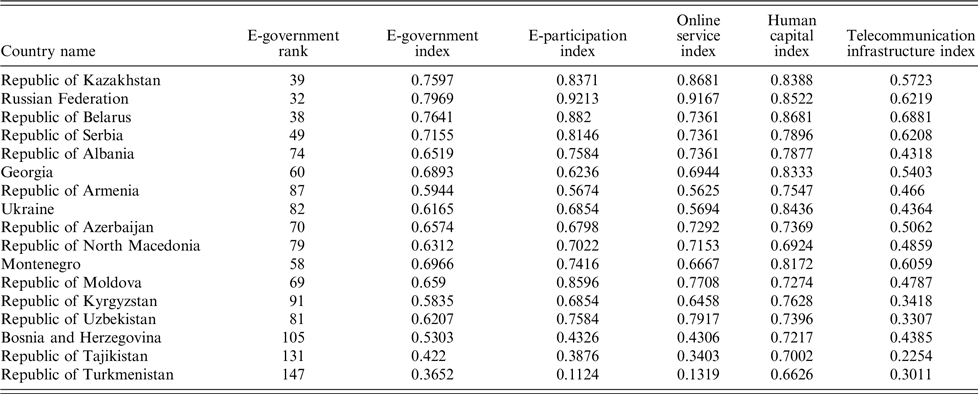
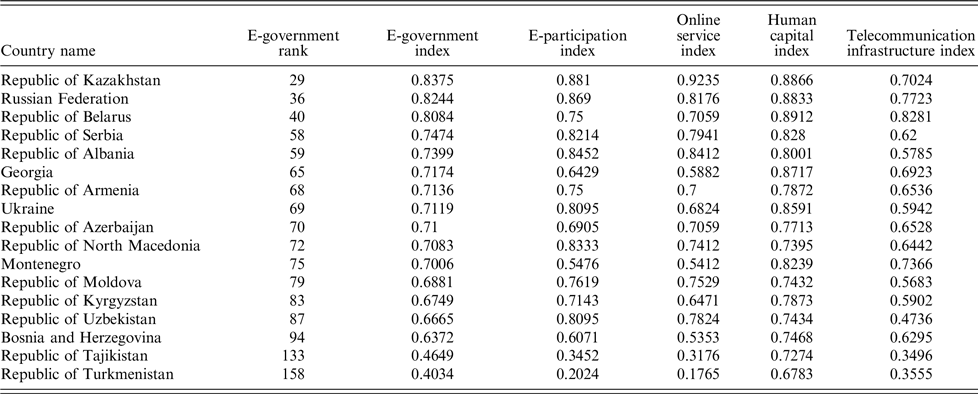
World statistics provide numerous data in the form of rating indices regarding the digitalization of the world’s countries. Let’s examine the studied countries’ ranking in terms of the digital transformation of public administration, as measured by the E-Government Development Index (Tables 1–3).
E-Government Development Index of countries with transition economies in 2016 (compiled by the authors on the data from UN E-Government Knowledgebase 2022).

E-government development index of countries with transition economies in 2018 (compiled by the authors on the data from UN E-Government Knowledgebase 2022).

E-government development index of countries with transition economies in 2020 (compiled by the authors on the data from UN E-Government Knowledgebase 2022).

The countries under study hold low rankings in the E-Government Development Index for public administration digital transformation. This index updates data biennially. To evaluate interactive services, the E-Participation Index is used. Its three main components – e-information, e-consultation, and e-decision-making – are challenging to measure but may be evaluated when taking citizens’ satisfaction with the standard of living provided by their government into account (UN E-Government Knowledgebase n.d.). The latter is not feasible without the creation of online services that permit swift communication and feedback with government agencies. This can be investigated using the Online Service Index. And this index, in turn, is related to the pace of telecommunications infrastructure development, which is reflected in the Telecommunications Infrastructure Index. All of the above is closely related to the development of society, its readiness for the digitalization of life, which is reflected in the Human Capital Index. Among the 193 countries whose data are studied by the UN, the Republic of Kazakhstan has the highest level of digitization, and the Republic of Turkmenistan has the lowest.
Taking into account Helliwell et al. (Reference Helliwell, Layard, Sachs, De Neve, Aknin and Wang2023), further research on digital transformations in transition economies is considered for the period 2010–2020. It can be noted that the digital transformation level in public administration has significantly improved in recent years in almost all the studied countries, as evidenced by the data shown in Figure 1.
E-Government Development Index in countries with transition economies for 2010–2020 (compiled by the authors on the data from UN E-Government Knowledgebase 2022).

To investigate the influence of digital transformations in public administration on GDP per capita and governance efficiency, we will examine the results of statistical indicator processing as presented in Table 4. We conducted this analysis through correlation analysis.
Source data for the analysis of the impact of the E-Government Development Index of countries with transition economies on GDP per capita and the Government Effectiveness Index in 2020 (Compiled by the authors on the data from UN E-Government Knowledgebase 2022, World Bank n.d., Kaufmann and Kraay Reference Kaufmann and Kraay2022).

In our study, the Pearson correlation coefficient between the E-Government Index (x) and GDP per capita (y 1) is approximately 0.39. This falls within the range of 0.3 to 0.5, indicating an average level of linear dependence between the studied indicators. Thus, our findings suggest an average direct relationship between the E-Government Development Index and GDP per capita. The study’s coefficient of determination, R 2, is approximately 0.15 and explains the percentage of variation in the dependent variable accounted for by the model. This value is reasonable given the multitude of objective factors influencing GDP per capita. Furthermore, the determined coefficient value confirms the direct relationship existing between the E-Government Development Index and GDP per capita in countries with a transitioning economy.
For a comprehensive evaluation of the impact of digitization on public administration’s transformational changes, we will conduct a study to examine how E-Government Development (x) influences the Government Effectiveness Index (y 2) using the data in Table 4. The pairwise correlation results indicate a positive and significant relationship (R = 0.54). The regression equation is formulated as follows:
 $y_2 =1.22a + 2.93x$
which allows establishing the existence of direct dependence of the Government Effectiveness Index (y 2) on E-Government Development (x).
To determine the trends and possibilities of digital transformations of public administration in countries with a transition economy, we will group the studied countries according to the level of the E-Government Development Index (Table 5).
Grouping of countries with transition economies by the level of the E-Government Development Index in 2020 (compiled by the authors on the data from UN E-Government Knowledgebase 2022).

The calculation enables the grouping of countries with transitional economies by their level of Electronic Government Development Index. This index indicates the digital transformation level of public administration in a particular country. The results suggest that countries within the same cluster exhibit similar GDP per capita values. For instance, the first group comprises Kazakhstan and the Russian Federation with current US$9122 and US$10,126, respectively. Similarly, the third cluster includes Serbia, Montenegro, and Turkmenistan with respective values of US$7730, US$7677, and US$7612 in current US$. Additionally, there are no significant gaps between the studied countries within the same cluster in terms of the level of digital transformation in public administration and GDP per capita. However, the Government effectiveness index displays significant fluctuations within certain groups. Therefore, the actual situation in some countries highlights the inadequate effectiveness of digitalization in enhancing the quality of public administration services, public service, and the development and implementation of public policies, and fulfilling the government’s obligation to enhance or sustain these standards.
Electronic government extends beyond the state-citizen relationship. It has an internal manifestation as well, whereby the use of electronic technologies facilitates interaction between various levels and branches of public administration in the provision of public services.
The digital transformation of public administration began in the 1990s and 2000s with the introduction of electronic documentation via computer equipment. This was followed by the development of databases and public access information centres through the implementation of information technology, enabling the growth of the public open government concept. During this period, the concept of E-Governance was developed, currently defined as a system for organizing state power that enables real-time communication between authorities and citizens, legal entities, and non-traditional organizations via the global information network. The introduction of digital technology in the public administration system aims to promote the conditions for Digital Governance and, ultimately, GovTech – a comprehensive government strategy for modernizing the public sector. This strategy encompasses three goals: providing accessible public services for citizens, implementing a statewide strategy for digital government transformation, and developing streamlined, effective, and transparent government systems (see Figure 2).
Digital transformation of the public sector (World Bank 2020).

Discussion
The main assessment of digital transformations of public administration in scientific research is carried out through indicators that are formed by international institutions. These indices are based on the general macroeconomic indicators of countries (Kraus et al. Reference Kraus, Jones, Kailer, Weinmann, Chaparro-Banegas and Roig-Tierno2021; Raso Reference Raso, Hertogh, Kirkham, Thomas and Tomlinson2021; Nañez Alonso et al. Reference Nañez Alonso, Reier Forradellas, Pi Morell and Jorge-Vazquez2021). However, the assessment of digital transformations does not reflect the impact of the studied processes on the development of the national economy and the governance effectiveness, nor does it take into account the peculiarities of countries with a transition economy.
As for digital public administration implementation, countries with transitional economies share similarities in their approaches and concepts. This is confirmed by the survey of E-Government Development Index for 2010–2002 and the results of cluster analysis, and the specific terms of digital public administration implementation are similar to the experience of developed countries (Alt et al. Reference Alt, Beck and Smits2018; Mergel et al. Reference Mergel, Edelmann and Haug2019). At the same time, we agree with the opinion of Matthess and Kunkel (Reference Matthess and Kunkel2020) regarding the differences between developed and developing countries in the opportunity to benefit from digitalization. The findings of this investigation align with the conclusions drawn by Stavytskyy et al. (Reference Stavytskyy, Kharlamova and Stoica2019), who posit that a nation’s digital advancement is closely linked to its past accomplishments, a factor that holds particularly true for developing countries. Such countries rely heavily on technological, social, institutional, economic, political, and cultural factors, making it unrealistic to anticipate rapid and substantial digital progress.
There are no noteworthy disparities among the transition economies sharing the same cluster about the level of digital transformation in public administration and GDP per capita. However, the study reveals a significant gap between these economies and developed countries despite significant enhancements in digital public administration indicators. As per the UN’s survey of 193 countries, the Republic of Kazakhstan has the highest rating among transition economies. From 33rd place in 2016, the country ranked 29th in 2020. Turkmenistan holds the lowest position in terms of digital governance among the studied countries. The pace of information and communication technology development in public administration has significantly declined as the country moved from 140th place in 2016 to 158th place in 2020. Tajikistan ranks 133rd out of 139 countries in terms of digital transformation indicators, showcasing sluggish progress in the implementation of digital solutions and information and communication technologies in governance. This indicates the authorities’ low interest in using information technology and the population’s reluctance to adopt digital innovations. Among the analysed Asian countries, Kazakhstan exhibits the strongest performance and undisputed leadership in digital transformation within the state. It holds the subregional lead, second only to Korea (UN E-Government Knowledgebase 2022).
As for the transition economies in the European region, all of the countries analysed are consistently in the middle of the rankings in terms of the use of information and communication technologies in public administration. There is little acceleration or decline in the digitalization of governance. For example, Ukraine moved from Rank 62 in 2018 to 69th place in 2020. The Republic of Albania improved its performance by 15 points between 2016 and 2020, while the Republic of Serbia deteriorated by 9 points. The Russian Federation’s indicators remained almost unchanged in the study period (by 1 point). The pace of digitalization in Belarus has slightly decreased (9 points). Researchers attribute such processes to the growing authoritarianism in the government (Geddes et al. Reference Geddes, Wright and Frantz2018; Guriev and Treisman Reference Guriev and Treisman2019; AFP and Reuters 2022).
The largest cluster, consisting of nine countries with advanced economies (Belarus, Bosnia and Herzegovina, North Macedonia, Albania, Georgia, Armenia, Azerbaijan, Moldova, and Ukraine), has the highest average level of digitization according to the E-Government Development Index. Such features for post-Soviet countries, some of which refer to countries with economies in transition, are emphasized in Kuldosheva’s (Reference Kuldosheva2021) study. The research provides evidence that the development of E-government in developing countries or economies in transition does not necessarily conform to stages and theoretical concepts of digital government maturity. In these countries, the author notes a tendency for faster adoption and implementation of E-government best practices compared with developed countries that have already achieved a certain level of digitalization.
The results show that a direct relationship exists between the E-Government Index and GDP per capita. Digitalization of public administration in countries with a transitioning economy increases the living standards indicator of the countries. However, the low determinacy coefficient suggests that there are other factors that influence the value of GDP per unit. A similar methodology was employed in Ilter’s (Reference Ilter2017) study, using regression analysis to investigate the social and economic factors that affect GDP per capita, which is a measure of economic development, across a sample of 40 countries. The results also confirm Helliwell et al. (Reference Helliwell, Layard, Sachs, De Neve, Aknin and Wang2023) and Gallup Global Well-Being (2010). While satisfaction surveys are contentious, examining citizens’ happiness levels as a percentage of GDP provides more valuable insight, especially for developing nations. This was proposed in Howell and Howell (Reference Howell and Howell2008) and has since been substantiated. This method of evaluating the E-Government Index not only demonstrates government efficiency, but also establishes a framework for evaluating citizens’ attitudes towards advances that enhance their quality of life.
Digitization in society is not a singular objective, but it has broader implications, including the enhancement of public service value and empowerment of citizens, businesses, or other stakeholders for more equitable society and governance (Kuldosheva Reference Kuldosheva2021). This association is substantiated by the evident correlation between the Government Effectiveness Index and the progress of E-Government Development.
Conclusion
Digital transformations of public administration have become a global trend and have completely covered almost all countries of the world. Such processes were initiated in developed countries of the world and intensified in countries with transition economies.
The processes of digitalization of public administration have a rapid tendency towards active implementation and expansion during the last ten years. According to the conducted research, the digital transformation level of public administration, according to the E-Government Development Index, has significantly improved in almost all countries with transition economies during the period under study.
Despite positive assessments of digital transformations of public administration and the absence of significant gaps between countries with transition economies, such processes are characterized by a significant lag behind the level of developed countries. At the same time, such features for countries with a transition economy provide an opportunity to quickly adapt and develop at an accelerated pace using the positive experience and practices of developed countries that have already reached a certain digitalization level.
The digitization of public administration can enhance the standard of living and well-being of populations in countries with transitioning economies. This is due to a direct impact on GDP per capita and improved governance effectiveness resulting from enhanced quality of state administration services, public service, and policy formation and implementation. It can also build trust in the government’s commitment to maintain or improve these qualities.
The implementation of digitization in the public administration system should promote conditions for digital governance in countries with a transitional economy, leading to GovTech. This innovative approach is recognized by international organizations as a comprehensive strategy for modernizing the public sector, consisting of three components: publicly accessible, citizen-focused public services; a nationwide initiative for digital government transformation; and streamlined, effective, and transparent state management systems.
The proposed method for assessing the efficacy of digital advancements in public administration is applicable for comparative analysis across countries of differing levels of development, as well as to ascertain digitalization’s influence on populace living standards and administrative effectiveness indicators.
It is advisable to focus further research on the digital transformations of public administration in certain countries with a transition economy that are candidates for joining the European Union (in particular, Republic of Albania, Montenegro, Republic of North Macedonia, Republic of Serbia, Bosnia and Herzegovina).
Conflict of interest
The authors state no conflict of interest.
About the Authors
Oleksandr Karpenko is a Doctor of Science in Public Administration, Associate Professor and Head of the Department of National Economy and Public Administration at the Kyiv National Economic University named after Vadym Hetman. His research interests are information policy, information wars, strategic communications, digital transformations, service activities of public authorities.
Tetiana Zaporozhets is a Doctor of Science in Public Administration, Associate Professor and Professor in the Department of National Economy and Public Administration at the Kyiv National Economic University named after Vadym Hetman. Her research interests are public management and administration, digital transformations, information policy, communication activities, intellectual management in the activities of state authorities.
Mariia Tsedik is a PhD of Sciences in Public Administration, and Head of the International Relations Department at Kyiv Business School. Her research interests are public management and administration, and foreign language communication in public administration.
Nataliia Vasiuk is a PhD of Sciences in Public Administration, and Associate Professor in the Department of National Economy and Public Administration at the Kyiv International Economic University named after Vadym Hetman. Her research interests are public management and administration, digital transformations, public health policy, social and humanitarian policy, and public service.
Anton Osmak is a PhD in Public Administration, Associate Professor in the Department of National Economy and Public Administration at the Kyiv National Economic University named after Vadym Hetman. His research interests are public management and administration, digital transformations, interoperability of information systems, and service activities.