INTRODUCTION
Recently, a dog (Canis lupus familiaris) native to Quesnel, British Columbia (BC), Canada was diagnosed with alveolar hydatid disease, the larval stage of the cestode Echinococcus multilocularis (Peregrine et al. Reference Peregrine, Jenkins and Barnes2010; Jenkins et al. Reference Jenkins, Peregrine, Hill, Somers, Gesy, Barnes, Gottstein and Polley2012). Molecular analysis identified this strain as European-type (Jenkins et al. Reference Jenkins, Peregrine, Hill, Somers, Gesy, Barnes, Gottstein and Polley2012). There was no history of travel outside of BC for the dog, suggesting that the parasite was locally acquired; however, BC was not considered an endemic region, with the nearest report of this parasite in North America 600 km to the east in Alberta, Canada. How this dog came in contact with eggs of European origin was unanswered (Jenkins et al. Reference Jenkins, Peregrine, Hill, Somers, Gesy, Barnes, Gottstein and Polley2012). Furthermore, the dog was serving as an aberrant intermediate host (harbouring the larval or metacestode stage) rather than the typical carnivore definitive host with adult worms in the intestines. The normal intermediate hosts for this parasite are rodents, which develop alveolar hydatid cysts upon ingesting eggs shed in the faeces of an infected carnivore; the life cycle is completed when a carnivore consumes an infected intermediate host. If this dog was exposed locally, it implies that the infective eggs of the parasite were present in the environment, shed in the faeces of wild or domestic carnivores, and that people were potentially at risk from the same source.
The identification of a European-type strain of E. multilocularis in Canada is a potential public health concern as strains of the parasite present in Europe are suspected to have an increased zoonotic potential, compared with strains established in central North America (Nakao et al. Reference Nakao, Xiao, Okamoto, Yanagida, Sako and Ito2009). In 2010 alone, 67 human cases were reported in the European Union (EFSA, 2012), while only two autochthonous cases have ever been reported in Canada and the lower 48 US states (James and Boyd, Reference James and Boyd1937; Gamble et al. Reference Gamble, Segal, Schantz and Rausch1979). This may be a reflection of the pathogenic differences among haplotypes as intraspecific variation has already proved responsible for differences in larval development and host response (Bartel et al. Reference Bartel, Seesee and Worley1992).
People affected by this parasite often experience a prolonged preclinical period of 10–25 years during which larval growth may cause extensive and often irreparable liver damage (Rausch and Wilson, Reference Rausch and Wilson1985). Without early and extensive surgical resection of the affected tissue and long-term cestostatic drug therapy, life expectancy is reduced to 10 years post diagnosis for more than 90% of patients (Kern et al. Reference Kern, Bardonnet, Renner, Auer, Pawlowski, Ammann, Vuitton and Kern2003). In the past and even with aggressive surgical resection, the average post-surgery survival time was only 19 years (Rausch and Wilson, Reference Rausch and Wilson1985). However, if the disease is properly diagnosed and treated in its early stages, life expectancy may be dramatically improved (Torgerson et al. Reference Torgerson, Schweiger, Deplazes, Pohar, Reichen, Ammann, Tarr, Halkik and Müllhaupt2008). Echinococcus multilocularis is emerging (increasing in prevalence and range) across its circumpolar distribution as a result of anthropogenic and environmental alterations (Romig et al. Reference Romig, Thoma and Weible2006). This is reflected in the range expansion of infected red foxes in Europe, which has increased from four to 21 affected countries since the 1980s (WHO, 2001; Davidson et al. Reference Davidson, Romig, Jenkins, Tryland and Robertson2012). In Switzerland, for example, the occurrence of human infections has more than doubled in 12 years (Schweiger et al. Reference Schweiger, Ammann, Candinas, Clavien, Eckert, Gottstein, Halkic, Muellhaupt, Mareike Prinz, Reichen, Tarr, Torgerson and Deplazes2007). Determining if E. multilocularis was present in wildlife in the Quesnel region and therefore ruling out recent importation with an infected dog from Europe, as well as determining the possibility of local sylvatic transmission with concomitant risks of human exposure, was considered to be of the utmost importance.
MATERIALS AND METHODS
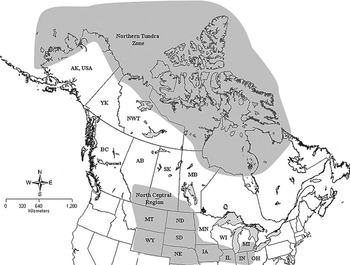
In the summer of 2010, rodents and small mammals (n=156) were captured by Victor® Mouse Snap Traps (#M325: The Woodstream Corporation, PA, USA) between the communities of Williams Lake (52°07′46″N; 122°08′18″W) and 100 Mile House (51°38′30″N; 121°17′50″W), 120 to 210 km south of Quesnel, BC (permit no. 78470.25) (Fig. 1). Species trapped included 72 deer mice (Peromyscus maniculatus), 59 meadow voles (Microtus pennsylvanicus), 16 North American jumping mice (Zapus hudsonius), 7 shrews (Sorex spp.), 1 red squirrel (Tamiasciurus hudsonicus), and 1 weasel (Mustela frenata altifrontalis). All of these species are considered common in the area. Intact carcasses were kept cool, shipped to the Zoonotic Parasitology Research Unit (ZPRU) at the University of Saskatchewan in Saskatoon, Saskatchewan, Canada, and frozen at −20 °C. Carcasses were thawed and abdominal contents were visually inspected for the presence of alveolar hydatid cysts of E. multilocularis by trained personnel under level 2 conditions in a biosafety cabinet (although this stage of the parasite poses no human risks, deer mice are known carriers of zoonotic hantaviruses in western Canada).
Newly endemic area in the Quesnel region of British Columbia (BC), as well as US states and Canadian provinces/territories endemic for Echinococcus multilocularis in western North America (based on WHO/OIE manual). In the Northern Tundra zone: Alaska (AK), Yukon Territory (YT), Northwest Territories (NWT) and Nunavut (NU). In the North Central Region: Alberta (AB), Saskatchewan (SK), Manitoba (MB), Montana (MT), Wyoming (WY), North Dakota (ND), South Dakota (SD), Nebraska (NE), Minnesota (MN), Iowa (IA), Wisconsin (WI), Illinois (IL), Michigan (MI), Indiana (IN) and Ohio (OH).

In the winter of 2011–2012, wild canids (27 coyotes, Canis latrans, and 6 red foxes, Vulpes vulpes) were trapped within 40 km of Quesnel, BC, Canada (52°58′42″N; 122°29′35″W), as part of a legal fur harvest by trappers licensed in BC (Fig. 1). The intestinal tracts were removed intact and frozen at −20 °C until transport to the ZPRU. Samples were frozen at −80 °C for a minimum of 7 days to inactivate any eggs of E. multilocularis before processing (WHO, 2001). Adult cestodes were recovered from the intestines using the scraping filtration and counting technique (SFCT) (Gesy et al. Reference Gesy, Pawlik, Kapronczai, Wagner, Elkin, Schwantje and Jenkins2013), a modified sedimentation and counting technique (WHO, 2001; Eckert, Reference Eckert2003), in two 10% aliquots of total intestinal contents. Echinococcus adults were morphologically identified and differentiated based on the shape of the uterus and the placement of the genital pore. Echinococcus multilocularis has a sac-like uterus and a mid to anterior placement of the genital pore, as opposed to the fluted uterus and mid to posterior placement of the genital pore, found in Echinococcus granulosus. Three representative Echinococcus adults from each of the 7 coyotes that harboured fully intact cestodes were prepared for molecular characterization. Adult cestodes were lysed using previously described techniques (Catalano et al. Reference Catalano, Lejeune, Liccioli, Verocai, Gesy, Jenkins, Kutz, Fuentealba, Duignan and Massolo2012).
Molecular characterization
Adult cestode lysate was used as template in a simplex PCR amplification of a 395 bp region of the mitochondrial gene encoding NADH dehydrogenase subunit 1 (nad1) using the E. multilocularis specific primers Cest1 and Cest2 (Trachsel et al. Reference Trachsel, Deplazes and Mathis2007). PCR was performed with 23 μL containing: 1×PCR buffer (20 mm Tris-HCl (pH 8·4), 50 mm KCl), 200 μ m dNTP, 4 mm MgCl2, 200 μ m forward and reverse primers (10 mm), 0·3 U Taq (AccuStart™, Quanta Biosciences), dH2O and 2 μL adult lysate for a total of 25 μL (Catalano et al. Reference Catalano, Lejeune, Liccioli, Verocai, Gesy, Jenkins, Kutz, Fuentealba, Duignan and Massolo2012). PCR was performed in duplicate using neat and dilute lysate (diluted 1 : 20 in sterile water) using previously described thermocycling parameters (Trachsel et al. Reference Trachsel, Deplazes and Mathis2007). Samples displaying the expected 395 bp amplicon were further characterized at 3 mitochondrial loci; NADH dehydrogenase subunit 2 (nad2), cytochrome b (cob) and cytochrome oxidase subunit 1 (cox1) as previously described using E. multilocularis specific primers and a PCR reaction mix of 25 μL (Nakao et al. Reference Nakao, Xiao, Okamoto, Yanagida, Sako and Ito2009). All amplicons were purified and sequenced using the amplification primers.
RESULTS
Adults of Echinococcus spp. (based on morphology) were found in 10 of 27 (37%) coyotes and in 1 of 6 (17%) red fox, for an overall prevalence of 33% in 33 carnivores. The mean number of Echinococcus adult cestodes in the 10% aliquots was 488 (range 2–4145 cestodes per coyote), extrapolating to a total mean intensity of 4880 per animal (range 20–41 450 per animal). No alveolar hydatid cysts were found in any of the 156 rodents and small mammals surveyed from south of Quesnel, BC.
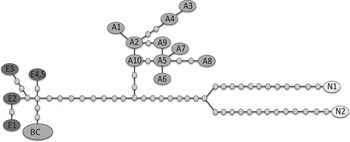
Four E. multilocularis-positive samples were detected by PCR amplification of neat worm lysates not detected using the 95% dilute samples. Additionally, one positive was detected in the 95% dilute PCR that was not recognized by neat amplification. This highlights the benefit of PCR amplification using dual lysate concentrations. Sequence of a 395 bp (nt 158–553) region of the nad1 gene of 19 adult cestodes from 7 coyotes was 99–100% identical to the partial E. multilocularis sequence representing the European M1 genotype (Genbank Accession AJ237639). Sequences for all 4 loci (nad1, nad2, cob, and cox1) were available from 6 cestodes from 4 coyotes, and were 100% identical to the sequence from the alveolar hydatid cysts in the BC dog (accession nos JF751034, JF751033, JF751035 and JF751036) (Jenkins et al. Reference Jenkins, Peregrine, Hill, Somers, Gesy, Barnes, Gottstein and Polley2012). Sequence analysis also confirmed the presence of an additional nucleotide difference at position 663 of the nad2 gene unique to the BC haplotype (Jenkins et al. Reference Jenkins, Peregrine, Hill, Somers, Gesy, Barnes, Gottstein and Polley2012). In a haplotype network of E. multilocularis based on published sequences for mitochondrial genes nad2, cob and cox1, the sequences from the coyotes in BC (and the original sequence from the dog) grouped with the European haplotypes (Fig. 2).
Haplotype network of Echinococcus multilocularis based on statistical parsimony, showing the position of the sequences from a dog and coyotes from BC in the European cluster. Network is based on the mitochondrial genes nad2, cob and cox1. Haplotypes are named according to Nakao et al. (2009). Labelled ovals indicate previously published sequences representing haplotypes and small, unlabeled circles indicate hypothetical haplotypes as represented by a single nucleotide change from adjacent sequences. The large oval, labelled BC, indicates the position of the new found haplotype in relation to Nakao defined haplotypes. The network was constructed from the alignment of cox1, cob and nad2 PCR product sequences.

DISCUSSION
Our results confirm the presence of a European-type strain (haplotype) of E. multilocularis in wildlife in a region of northwestern North America where it was not previously reported. In addition, this region is a forested habitat where this parasite was not thought to be able to establish due to low density of rodent intermediate host populations (Schantz et al. Reference Schantz, Chai, Craig, Eckert, Jenkins, Macpherson, Thakur, Thompson and Lymbery1995). The haplotype is identical to that previously identified in the alveolar hydatid cysts found in a domestic dog in this region (Jenkins et al. Reference Jenkins, Peregrine, Hill, Somers, Gesy, Barnes, Gottstein and Polley2012) and suggests that this dog acquired the parasite from local wildlife and not from a recently introduced domestic dog or cat. Although this strain was only identified in carnivore definitive hosts in the immediate area, and not in rodent intermediate hosts 120–210 km to the south, distribution is not necessarily limited to the area surrounding Quesnel. It is not uncommon for rodent intermediate hosts to have a prevalence of infection of 0–10%, even in regions where 100% of wild canids are infected (Fay and Williamson, Reference Fay and Williamson1962).
In this study 33% of carnivores examined were Echinococcus-positive, with a mean intensity of more than 4800 adult cestodes. The infection prevalence in coyotes was 37% (10/27), whereas in red foxes it was 17% (1/6). A recent study in Alberta, Canada provided evidence of infection with adult Echinococcus in 25% of urban-associated coyotes with an average infection intensity of 1400 adult cestodes/host (Catalano et al. Reference Catalano, Lejeune, Liccioli, Verocai, Gesy, Jenkins, Kutz, Fuentealba, Duignan and Massolo2012). Therefore, the prevalence and mean intensity of infection in coyotes in the current study was higher than that reported in the recent Alberta study, suggesting that the parasite is well established in central BC.
Coyotes may be the primary host for E. multilocularis in central North America, as compared with fox species elsewhere in the circumpolar North (Samuel et al. Reference Samuel, Ramalingam and Carbyn1978). As in Canada, the infection rate in the USA reflects a difference in host species infection rate with a recent study citing 29% (2/7) in coyotes (Storandt and Kazacos, Reference Storandt and Kazacos2012). While resident coyotes may only have a mean annual home range of approximately 11 km2, transient coyotes can roam more than 100 km2 and have dispersed up to 300 km from their natal range sites (Gese et al. Reference Gese, Rongstad and Mytton1988; Harrison, Reference Harrison1992). Given the extensive range sizes of transient coyotes and the limited scope of the current study, there may well be a risk for human infection outside the immediate surroundings of Quesnel, BC. This is particularly alarming in light of growing evidence to support the establishment of infected coyote populations in urban areas of North America (Catalano et al. Reference Catalano, Lejeune, Liccioli, Verocai, Gesy, Jenkins, Kutz, Fuentealba, Duignan and Massolo2012; Liccioli et al. Reference Liccioli, Catalano, Kutz, Lejeune, Verocai, Duignan, Fuentealba, Hart, Ruckstuhl and Massolo2012). This may increase the risk of alveolar hydatid disease for humans and other animals (including, rarely, domestic dogs) who ingest infective eggs in contaminated environments. As well, the presence of wildlife definitive hosts shedding eggs in urban areas will also increase the prevalence of infection in intermediate rodent hosts. These bridging hosts serve to increase the risk of human infection when they are consumed by domestic dogs and cats with access to the outdoors.
The haplotype present in wildlife in the Quesnel area of BC is distinct from North American strains of E. multilocularis established in Indiana, South Dakota and Alaska (Nakao et al. Reference Nakao, Xiao, Okamoto, Yanagida, Sako and Ito2009), as well as from the haplotypes present in coyotes in Alberta (Catalano et al. Reference Catalano, Lejeune, Liccioli, Verocai, Gesy, Jenkins, Kutz, Fuentealba, Duignan and Massolo2012) and rodents in Saskatchewan (unpublished data). Sequence results indicate a close relation to the haplotypes present in the core endemic region for this parasite in Europe (Austria, Belgium, France and Germany) (Nakao et al. Reference Nakao, Xiao, Okamoto, Yanagida, Sako and Ito2009; Jenkins et al. Reference Jenkins, Peregrine, Hill, Somers, Gesy, Barnes, Gottstein and Polley2012). It is not known how long this haplotype has been established in BC, although a complex history of red fox introductions as well as lack of requirement for anthelmintic treatment of imported domestic dogs offer appealing hypotheses for introduction. In the last century, red fox of European origin (UK, France and Scandinavia) were introduced in the Pacific coastal USA and in the eastern USA, from which they subsequently moved north and west across North America (Kamler and Ballard, Reference Kamler and Ballard2002). As well, foxes of unknown origin may have escaped from fur farms in southern BC (McTaggert Cowan and Guiguet, Reference McTaggart Cowan and Guiguet1956). To date the BC haplotype of E. multilocularis has not been detected east of the Rocky Mountains (Catalano et al. Reference Catalano, Lejeune, Liccioli, Verocai, Gesy, Jenkins, Kutz, Fuentealba, Duignan and Massolo2012; Gesy et al. unpublished data); however further research is needed to determine the full extent of the distribution, diversity, prevalence and public health significance of this pathogenic parasite in the rest of North America.
ACKNOWLEDGEMENTS
Special thanks to Jon Katzman, Michael Pawlik, Mani Lejeune, Brent Wagner, Richard Klafki, Gordie Roy and other BC hunters and trappers. This research has been approved by the Animal Research Ethics Board at the University of Saskatchewan (20090126 and 2011005) and by the British Columbia Ministry of Forests, Lands and Natural Resource Operations (WL10-65638).
FINANCIAL SUPPORT
Funding sources include the Canadian Foundation for Innovation Leaders Opportunity Fund, Public Health and the Agricultural Rural Ecosystem strategic training initiative as supported by the Canadian Institutes of Health Research, Saskatchewan Health Research Foundation, Saskatchewan Ministry of Health, University of Saskatchewan College of Graduate Studies and Research devolved scholarship, and the Western College of Veterinary Medicine Wildlife Health Research Fund.