1. Introduction
In English, verbs of motion can combine with directional phrases specifying the path: A directional PP, a satellite to the verb, expresses paths of motion. Because of this property, English is referred to as a satellite-framed language (see, for example, Son & Svenonius Reference Son, Svenonius, Abner and Bishop2008:388). Some examples are presented in 1.
- (1)
a. He ran to the store.
b. They moved away.
c. She got up from her chair.
In 1a, the path of the motion is expressed by the directional PP to the store, in 1b by the directional particle away, and in 1c by the directional particle up followed by the PP from her chair that indicates the source of the path.
The motion verbs in 1 are all intransitive, but transitive motion verbs may combine with a directional PP as well. Consider the transitive par-ticle verb in 2.
(2) She pushed the chair away from the desk.
In Present-Day English (PDE), a defining characteristic of transitive particle verbs is the word order alternation, as in She pushed the chair away (predicate word order) versus She pushed away the chair (particle word order). This word order alternation is also available for examples such as in 2, where the particle combines with a directional PP. In ad-dition to the predicate order in 2, the particle word order option is also available: She pushed away the chair from the desk. The tendency, however, is for particles to be placed immediately before the directional PP (as in 2), and the alternative word order is less acceptable (see Bolinger Reference Bolinger1971:162, Fraser Reference Fraser1976:17, Cappelle Reference Cappelle2001:318). Cappelle (Reference Cappelle2001: 318) notes that the presence of a directional PP “seriously hinders the positioning of a particle to the left of the object.” With out of sequences, this option is, in fact, not available at all (see, for example, Bolinger Reference Bolinger1971, Cappelle Reference Cappelle2001, Svenonius Reference Svenonius and Svenonius2004). This is illustrated by the examples in 3 (from Svenonius Reference Svenonius and Svenonius2004:224).
- (3)
a. We threw the orc out of the window.
b. *We threw out the orc of the window.
Bolinger (Reference Bolinger1971:34) considers the strict adjacency of out of as evi-dence of fusion that “produces a new preposition.” Cappelle (Reference Cappelle2001) and Svenonius (Reference Svenonius and Svenonius2004), however, treat out as a particle. As mentioned above, Cappelle (Reference Cappelle2001) notes that the distributional restriction is due to the presence of a directional PP and that the ungrammaticality of examples such as 3b therefore does not mean that out is not a particle. He suggests that the effect may be stronger with of PPs because “of cannot express direction in itself but needs ‘support’ from the particle out” (Cappelle Reference Cappelle2001:318). Svenonius (Reference Svenonius and Svenonius2004) accounts for the word order alternation of particle verbs through the operation of particle shift and offers an explanation for why particle shift is blocked in examples such as 3b (for a discussion of Svenonius’ analysis, see section 3).
Examples such as 3b, in which the particle out and the of PP are nonadjacent, are in fact attested in earlier English. An example is pre-sented in 4.
(4) And he broȝt out þe water of þe ston, … and he brought out the water from the stone ‘And he brought the water out of the stone, …’
(CMEARLPS, 94.4102)
Like the PDE examples in 3, the Middle English (ME) example in 4 has a particle verb with the particle out combining with an of PP. Evidence for the particle verb status of broȝt out ‘brought out’ comes from ex-amples such as 5, in which the particle verb bring out occurs without an of PP.
(5) and to-deled þat ryver in þre chanelles and stremes, and pref-divided that river in three channels and streams
so þat þe Danes myȝte nouȝt brynge out here schippes; so that the Danes might not bring out their ships
‘and divided that river into three channels and streams, so that the Danes could not bring out their ships; …’
(CMPOLYCH, VI,393.2879)
Examples such as 4 contrast with the ungrammatical PDE example in 3b and suggest that the syntax of out of PP sequences has undergone change. This article studies the diachrony of these directional expressions in order to find out how the syntactic flexibility of out of PP sequences changed, and why the syntactic flexibility of other Prt PP combinations was not affected (for example, She pushed away the chair from the desk).
The organization of this article is as follows: Section 2 looks at the characteristics of directional out of. Section 3 presents the diachronic study of directional out of. In section 4, I propose a grammaticalization and reanalysis account of the historical development of directional out of. In section 5, I briefly discuss recent work on the syntax of directional PPs and review Svenonius’ analysis of directional out of (section 5.1). I then propose an alternative syntactic analysis that accounts for both the synchronic and diachronic facts (section 5.2). Section 6 presents the con-clusions.
2. The Status of Out Of
The strict adjacency of out of PP sequences in PDE means that out of is often treated as a unit of some sort, or indeed as a (complex) preposition (for example, Bolinger Reference Bolinger1971). The OED Online, for example, has a separate entry for out of, labeling it a preposition. Two primary senses are given for out of: ‘Of motion or direction. Opposed to into’, illustrated in 6a, and ‘Of position. Opposed to in’, illustrated in 6b.
- (6)
a. The bag is then pulled out of the abdomen.
(OED Online, Globe and Mail (Toronto) 24 Jan. 1994 a18/5)
b. Ye are coming to my house till yeer mother is out of the hospital.
(OED Online, F. McCourt Angela's Ashes 1996 (1997) x. 277)
Example 6a represents the out of sequences I am focusing on in this article: the ones that express direction, or, to be more precise, a Source Path (for example, I took it out of the box, Huddleston & Pullum Reference Huddleston and Pullum2002:648–649). This includes metaphorical uses of directional out of, as in She dragged him out of his bad mood (example from Goldberg Reference Goldberg, Sutton, Johnson and Shields1991:371).Footnote 1 I am not concerned with nondirectional out of sequences, such as in 7a from Huddleston & Pullum Reference Huddleston and Pullum2002:731 and 7b from Cappelle Reference Cappelle2001:315.
- (7)
a. He said it out of sheer spite.
b. She acted out of pity.
Huddleston & Pullum note that out of sheer spite in 7a can be the answer to a why question, and that this type of out of conveys reason (the same is true of out of in 7b). These instances of out of cannot be interrupted, and the of PP cannot be omitted (note that out does not form a particle verb with the verb in such cases, for example, *say out).
Cappelle (Reference Cappelle2001) discusses the status of out of in PDE and gives the three structural possibilities in 8 (from Cappelle Reference Cappelle2001:323; he uses the label Adv for particles).
- (8)
a. [PP [Prep out of] NP]
b. [AVP [Adv out]] [PP [Prep of] NP]
c. [AVP [Adv out] [PP [Prep of] NP]]
Cappelle discusses a number of properties of out of that appear to warrant its treatment as a complex preposition, as in 8a. He notes, for example, that out of can be pied-piped, just like other prepositions. This is illustrated in 9 (example 9a is Cappelle's Reference Cappelle2001:318 example 7a).
- (8)
a. Desmond took the pistol out of his pocket.
b. Out of which pocket did Desmond take the pistol?
c. Which pocket did Desmond take the pistol out of?
d. *Of which pocket did Desmond take the pistol out?
In addition to allowing pied-piping, as illustrated in 9b, out of can also be stranded, again like other prepositions, as illustrated in 9c. Moreover, out cannot be stranded on its own, as illustrated in 9d, which is, again, a preposition-like behavior (complex prepositions cannot be broken up).
Cappelle argues, however, that these facts do not provide conclusive evidence for the preposition status of out of, showing that its behavior is different from that of the complex preposition into. He notes, for ex-ample, that pied-piped out of (as in 9b) is significantly less frequent than pied-piped into, as in into which (Cappelle Reference Cappelle2001:319). He further notes that the ungrammaticality of examples such as 9d could be due to the semantically impoverished status of of, which makes it unsuitable for pied-piping (see section 4, where I propose that the status of the pre-position of played a role in the syntactic development of out of sequences). Cappelle therefore rejects a complex preposition analysis (see 8a) of directional out of in PDE.
Huddleston & Pullum (Reference Huddleston and Pullum2002:624–625) also argue against treating out of as a complex preposition. Although “[o]ut of shows a high degree of fossilisation” and “[i]t is virtually impossible to separate the two com-ponents or to repeat of in coordination” (for example, *He threw the orc out of the window and of the house), they provide syntactic evidence against a complex preposition analysis. They note, for example, that when the complement of the preposition of is dropped, of itself must be omitted too. This is illustrated in 10 (from Huddleston & Pullum Reference Huddleston and Pullum2002: 625).
- (10)
a. They came out of the building.
b. *They came out of.
c. They came out.
Example 10b shows that the complement of (out) of cannot be omitted, a characteristic of prepositions. Example 8c provides evidence against the complex preposition status of out of, however, because the possibility of omitting of is unexpected under a complex preposition analysis. Note that into (the semantic opposite of out of) follows the pattern in 10 as well, as illustrated in 11.
- (11)
a. They walked into the building.
b. *They walked into.
c. They walked in.
Yet, into is generally considered a complex preposition (see, for example, Huddleston & Pullum Reference Huddleston and Pullum2002:625). This suggests that the alter-nation between 11a and 11c involves two different items: Example 11a contains a complex preposition into, while 11c contains a particle in.
In the case of out of, it is less clear that different items are involved. Out of is not a complex preposition: Out in examples such as 10a is a particle, just like out in 10c, even though out in out of does not take part in the word order alternation. Note that the complex preposition into, as in 12a, is different from the particle in followed by to, as in 12b (see Cappelle Reference Cappelle2001:319).
- (12)
a. He went in to the counter to pay.
b. *He went into the counter to pay.
Cappelle (Reference Cappelle2001:319) observes that “the preposition into is not simply the sum of the particle in plus the preposition to.” Historically, the preposition into originates from in to (OED Online), and the difference between out of and into is the result of distinct diachronic paths (see section 5).
In PDE, directional out of has a variant outta, in which the preposition of is phonologically reduced, as in 13a, and a variant in which the preposition of is left out entirely in certain contexts, as in 13b.
- (13)
a. He threw it outta the window.
b. He threw it out the window.
The form outta in 13a is described by the OED Online as an originally and chiefly American English (AmE) variant. Unlike the full form out of, the form outta clearly warrants a complex preposition analysis (see 8a above). According to Huddleston & Pullum Reference Huddleston and Pullum2002:639, omitting of alto-gether, as in 13b, is “primarily AmE (or informal).” They note that it is allowed only when its complement is introduced by the definite article the (for example, *He jumped out bed, *I took it out my pocket). The option of omitting of may be related to the fact that, as Huddleston & Pullum (Reference Huddleston and Pullum2002:658) put it, “[o]f is the most highly grammaticised of all prepositions,” although this does not explain why the option is found mainly in AmE. The option was apparently available in early English as well, as shown in 14 (from the OED Online).
(14) He wende forht wel hasteli / þe wuyrtene forto gaderi./
he went forth very hastily the herbs forto gather
In þat leiȝhtone, þare he was,/
in the meadow where he was
þare cam An Naddre outþe gras
there came an adder out the grass
‘He went forth very hastily to gather the herbs. In the meadow where he was, there came an adder out of the grass.’
(c1300 Childhood Jesus (Laud) 1622–1625 in C. Horstmann Altengl. Legenden (1875) 1st Ser.)
In this example, however, the omission of the preposition of is induced by the metre. Elsewhere in the same text, there are several instances of out of, as shown in 15.
(15) þe Bestes Mankene and eke wilde/
the beasts savage and also wild
Comenout of wodes and of felde;
come out of woods and of fields
‘the savage beasts, and wild ones too, come out of the woods and the fields; …’
(c1300 Childhood Jesus (Laud) 57–58 in C. Horstmann Altengl. Legenden (1875) 1st Ser.)
Note also the omission of out in the second conjunct in 15, which shows that out and of were independent elements in early ME.
Directional out of sequences are often excluded from diachronic studies that concentrate on (the role of) particles (see, e.g., Elenbaas Reference Elenbaas2007, Pintzuk & Haeberli Reference Pintzuk and Haeberli2008) because it is uncertain whether out in such sequences is really a particle. Pintzuk & Haeberli (Reference Pintzuk and Haeberli2008:405, note 9), for example, exclude cases like the one in 16 (their example i).
(16) þa seo fæmne ut of þan carcernegelæd wæs
when the woman out of the prison led was
‘when the woman was led out of the prison’
(comargaC, LS 14 [MargaretCCCC_303]: 17.2.275)
Pintzuk & Haeberli (Reference Pintzuk and Haeberli2008:405) observe that “particles like ut ‘out’ in this example could be analyzed as occupying the specifier position of the PP.” As the diachronic study reported in this article (section 3) shows, examples such as 16 can, in fact, be counted as particle verbs, since the combination gelædan ut ‘lead out’ is attested without an of PP. The lat-ter, as well as the existence of nonadjacent out of in earlier English, also undermines an analysis of ut ‘out’ as the specifier of the PP as suggested by Pintzuk & Haeberli (Reference Pintzuk and Haeberli2008). Having discussed the status of directional out of in PDE, I now examine more closely the diachronic development of directional out of in section 3.
3. The Diachrony of Directional Out Of
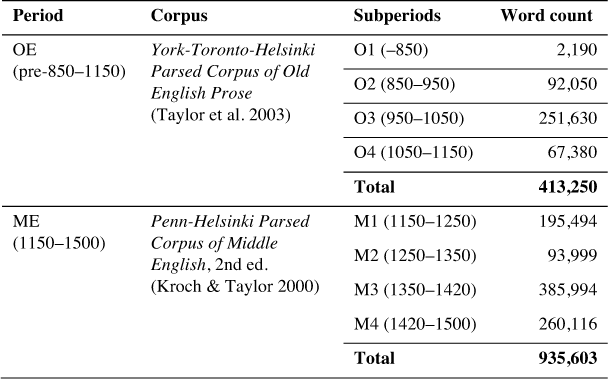
This section presents data from Old English (OE), ME, Early Modern English (EModE), and Late Modern English (LModE). The four histor-ical corpora from which the data were drawn are listed in table 1. The data were collected with the help of CorpusSearch2 (Randall et al. Reference Randall, Taylor and Kroch2005), and the queries used to obtain the data are given in appendix 1. Spelling variants of out and of were obtained using the lexicon function of CorpusSearch2 and are given in appendix 2. The structures of interest have a transitive verb, an object, and an adjacent or nonadjacent out of with directional semantics.
Corpora of historical English used.

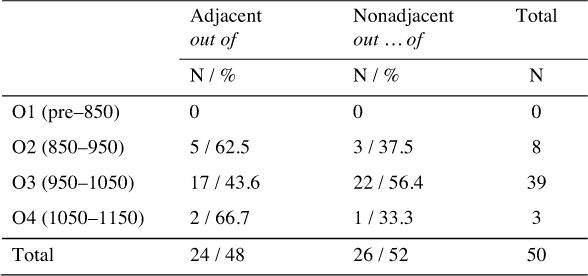
In OE, directional PPs are found on both sides of the verb. The OE directional PPs headed by of could occur adjacent or nonadjacent to ut ‘out’. Examples of the adjacent pattern are presented below in 17, and examples of the nonadjacent pattern are presented in 18. Table 2 shows that the number of examples with adjacent and nonadjacent out of is almost equal.
Adjacent and nonadjacent out of in OE.

- (17)
a. and a-teoð þæt atter ut of ðisum dryum.
and pref-drew the poison out of these sorcerers
‘and drew the poison out of these sorcerers.’
(cocathom2, ÆCHom II, 38:283.129.6395)
b. he draf þone ælþeodigan ut of his inne,
he drove the strangers out of his dwelling
‘he drove the strangers out of his house,’
(cochdrul, ChrodR 1:84.27.1121)
- (18)
a. and þu locast þonne þæt þu of ðines broþor Eagan
and you behold then that you from your brother's eye
þæt mot ut a-teo.
the mote out pref-pull
‘and then you see that you pull out the mote from your brother's eye.’ (coaelhom, ÆHom 14:31.2024)
b. þonne þu ut a-lætst min folc of Egypta lande,
when you out pref-let my people from Egypt's land
ðu offrast Gode uppan þisse dune.
you offer God upon this hill
‘when you let out my people from Egypt's land, you offer to God on this hill.’ (cootest, Exod:3.12.2363)
c. Eft, læcedom se þæt yfel ut tihð of þam milte
again medicine which the illness out draws from the spleen
‘Again, medicine that draws the illness out of the spleen.’
(colaece, Lch II [2]: 44.1.1.3002)
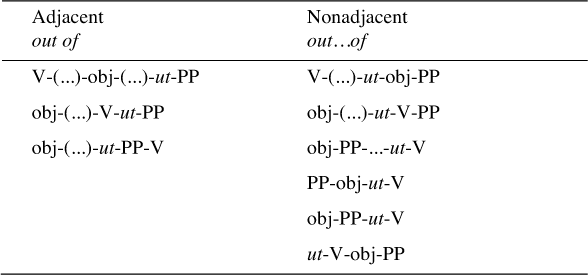
Many of the OE examples represented in table 2 display finite verb movement. This is illustrated by the examples in 17, where the finite verb has undergone verb-second (V2) movement and the object is followed by the ut of PP sequence, forming a small clause (SC): In 17a, the poison is out of these sorcerers, and in 17b, the strangers are out of his house. The examples in 18 show that in OE, ut ‘out’ could be separated from the of PP by the direct object, as in 18a, by the verb and the direct object, as in 18b, and by the verb, as in 18c. In 18a, the PP of ðines broþor eagan has been preposed. In 18b, the particle has incor-porated into the finite verb and undergone V2 together with the verb. In 18c, the PP of þam milte has been extraposed, instantiating PP-over-V movement, which is known to be possible with Source PPs but not with Goal PPs (see, for example, Nam Reference Nam, Ettlinger, Fleisher and Doob2004:306, Koopman Reference Koopman, Cinque and Rizzi2010). The adjacent patterns and the nonadjacent patterns are listed in table 3.
Adjacent and nonadjacent out of patterns in OE.

Table 3 shows that there are more nonadjacent than adjacent patterns. The particle ut ‘out’ is preverbal in most patterns. Note that the pattern obj-PP-ut-V is counted as nonadjacent: Even though the PP and ut appear next to one another, the PP precedes ut, which means ut and of are not adjacent. The pattern is found in two examples presented in 19.
- (19)
a. & soðlice Ælfstanes abbodes ræd
and indeed Ælfstan abbot counsel
wæs mid þam mannan þe hit
was with the men who it
of Cristes cyrcean ut ge-ræddon.
from Christ.gen church out pref-took
‘and indeed Abbot Ælfstan's counsel was behind the men who took it from Christ Church.’
(codocu3, Ch 1467 [Rob_91]:24.166)
b. And seo hell þa Satan of hys setlum ut a-draf
and the hell then Satan from his dwellings out pref-drove
‘And Hell drove Satan out of his dwellings.’
(conicodA, Nic [A]:21.1.9.482)
Note that in the examples in 17a, 18a,b, and 19b, the verb in the verb-particle combination has the prefix a- (ateoð, ateo, alætst, adraf). The prefix a- in these examples expresses the meaning ‘out, away’, which is reinforced by the particle ut ‘out’.Footnote 2 There are also examples in which the prefixed verb combines with an of PP only (without the par-ticle ut ‘out’). An example is presented in 20 (from the OED Online entry for of prep., I.1.a.).
(20) Hie þa Demetrias of þæm rice a-drifon.
they then Demetrius from the kingdom out-drove
‘Then they drove Demetrius out of the kingdom.’
(Orosius Hist. (BL Add.) iii. xi. 82)
In 20, of in of þæm rice expresses the directional meaning ‘(away) from’, specifying the direction/path of the motion conveyed by the verb adrifon. Over time, this directional meaning became bleached and of no longer expresses a directional meaning in PDE (see Cappelle Reference Cappelle2001, Huddleston & Pullum Reference Huddleston and Pullum2002; see also section 4). The directional of PP functions as a SC predicate, predicating over the SC subject Demetrias. The of PP occurs without the particle ut in 20, which suggests that it is independent from the particle ut. This is further supported by the nonadjacency of the particle ut and the of PP (see examples 17–19).
The independence of the of PP and the particle ut is also suggested by examples where the particle ut ‘out’ occurs without an of PP, as illustrated in 21.
(21) & manega deofolseocnyssa he ut a-draf;
and many demoniacal-possessions he out pref-drove
‘and he drove out many demoniacal possessions;’
(cowsgosp, Mk [WSCp]:1.34.2248)
In this example, the particle ut reinforces the bleached meaning of the prefix a-. There is no of PP. The particle ut ‘out’ functions as a SC predicate, and the NP manega deofolseocnyssa ‘many demoniacal pos-sessions’ functions as the SC subject. In sum, three SC patterns are found in OE, as illustrated in 22.
- (22)
a. [VP V [SC NP PP]]
b. [VP V [SC NP [Prt PP]]]
c. [VP V [SC NP Prt]]
Pattern 22b represents examples in which out combines with an of PP. In both OE and PDE, the of PP can be left unexpressed, but the difference is that the SC predicate could be interrupted in OE but not in PDE.
Nonadjacency of out and the of PP continues to be an option in ME, as 23b illustrates.
- (23)
a. And therewith he drew the truncheon of the speare
and therewith he drew the fragment of the spear
oute of hys body,
out of his body
‘And with that he drew the fragment of the spear out of his body,’ (CMMALORY, 645.4135)
b. & put out his eyen of his heuede,
and put out his eyes of his head
‘and put his eyes out of his head,’ (CMBRUT3, 127.3843)
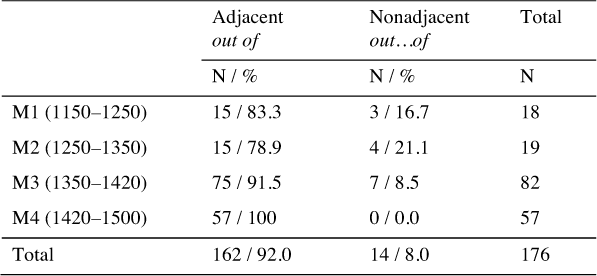
Table 4 shows that the adjacent pattern is predominant in ME (compare with OE in table 2).
Adjacent and nonadjacent out of in ME.
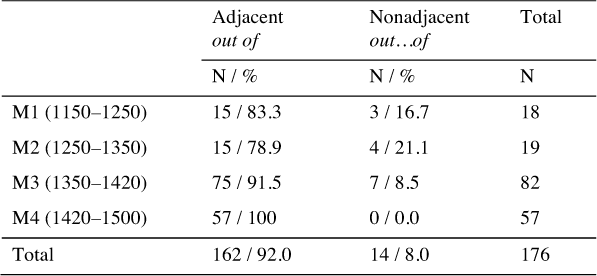
The numbers in table 4 reflect examples of transitive particle verbs con-sisting of the particle out that combines with an of PP. The particle verb status of the V out-string is suggested by the occurrence of the same V out combination in examples lacking an of PP. This is illustrated in 24.
- (24)
a. forto caste oute Sarasynes of þis lande,
for-to cast out Saracens of this country
‘to cast Saracens out of this country,’ (CMBRUT3, 45.1353)
b. and he heþ alle his uelþes y-kest out:
and he has all his impurities pref-cast out
‘and he has cast out all his impurities:’ (CMAYENBI, 109.2106)
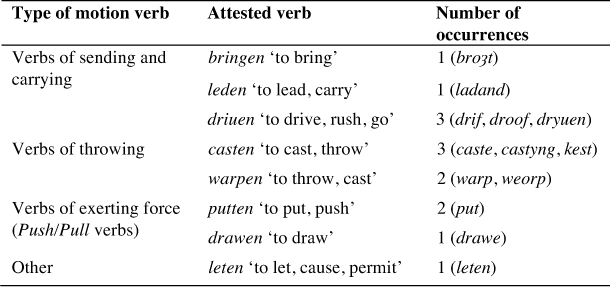
The verbs that combine with the directional particle out and a directional of PP are typically motion verbs. It is well known that non-directed motion verbs can appear with directional phrases (see, for example, Levin Reference Levin1993:105–106). The types of motion verbs attested in examples with nonadjacent out of are listed in table 5.
Types of motion verbs in examples with nonadjacent out of.
In 35 examples of adjacent out of not included in table 4, the combination of the verb and out does not form a particle verb (that is, it is not attested as a particle verb). The verb in such examples may be a motion verb, but nonmotion verbs are also attested. The examples in my data include the following verbs: deliver, translate, receive, remove, withdraw, banish. Two examples are presented in 25.
- (25)
a. a symple creature hath translatid the bible out of Latyn into English.
‘a simple creature has translated the bible from Latin into English.’ (CMPURVEY, I,57.2278)
b. so ded sir Galahad delyver all the maydyns
so did Sir Galahad deliver all the maidens
oute of the woofull castell.
out of the woeful castle
‘in the same way, Sir Galahad delivered all the maidens from the woeful castle.’ (CMMALORY, 651.4322)
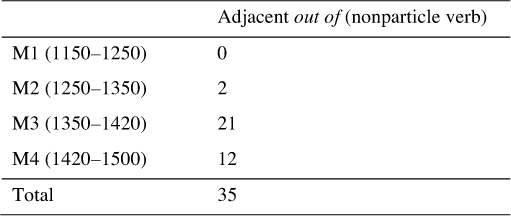
The fact that these verbs combine with out of but are not attested in particle verb combinations with the particle out suggests that this in-stance of out of is different from the directional out of in 24, for example. In 25, out and of form a semantic unit meaning ‘from’, expressing a change of state rather than motion (path/direction). Interestingly, as table 6 shows, such examples were especially frequent in the second half of the ME period (subperiods M3 and M4), when nonadjacent patterns were infrequent. The change-of-state out of is likely to have developed from the adjacent directional out of.
Adjacent out of in ME, nonparticle verb examples.
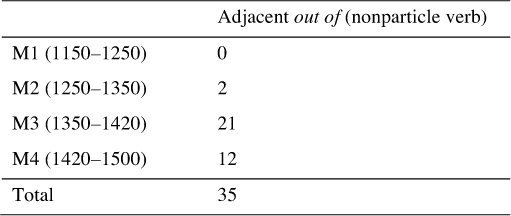
The numbers presented in table 6 were excluded from the data set be-cause the (transitive) verbs and out in these examples are not attested as particle verbs.
The decrease in examples of nonadjacent directional out of correlates with an increase in examples where a transitive particle verb combines with an out of PP sequence. Examples containing particle verbs with out are presented in 26, and examples containing particle verbs with a particle other than out are given in 27.
- (26)
a. By his help Albericus the markys
by his help Albericus the marquis
put out þe Sarsyns out of Irlond.
put out the Saracens out of Ireland
‘With his help marquis Albericus put the Saracens out of Ireland.’ (CMPOLYCH, VI,417.3045)
b. And if I may fynde such a knyght
and if I may find such a knight
that hath all thes vertues he may draw oute
who has all these virtues he may draw out
thys swerde oute of the sheethe.
this sword out of the sheath
‘And if I may find such a knight who has all these virtues he may draw this sword out of the sheath.’ (CMMALORY, 45.1498)
- (27)
a. And in wreche of his of puttynge he made hem
and in vengeance for his off putting he made them
take up Formosus þe pope out of his grave,
take up Formosus the pope out of his grave
‘And in vengeance for his reproving he made them exhume pope Formosus from his grave,’ (CMPOLYCH, VI,409.2996)
b. And therfore, if ye governe yow by sapience,
and therefore if you govern yourself by wisdom
put awey sorwe out of youre herte.
put away sorrow out of your heart
‘And therefore, if you govern yourself through wisdom, remove sorrow from your heart.’ (CMCTMELI, 218.C1.33)
As table 6 shows, these examples were most frequent in the second half of the ME period, which coincides with a decrease in examples of nonadjacent out of.Footnote 3 It points to a possible increase in cohesion between out and of, which is also suggested by the coordination examples in 28.
- (28)
a. and lad me out of þe stenche of uices
and led me out of the stench of vices
and fram þe pynes of helle.
and from the torments of hell
‘and led me out of the stench of vices and from the torments of hell.’ (CMEARLPS, 48.2072)
b. and Ulphuns and Brastias bare the two knyghtes
and Ulphuns and Brastias thrust the two knights
oute of their sadils to the erth
out of their saddles to the earth
‘… and Ulphuns and Brastias thrust the two knights out of their saddles to the earth’ (CMMALORY, 15.465)
In 28a, there are two structural possibilities: A PP headed by out of and a PP headed by fram ‘from’ are coordinated, or a PP headed by of and a PP headed by fram ‘from’ are coordinated. In the latter case, out takes scope over these two PPs (out of/out from), and the status of out of in 28a is therefore unclear. The asyndetic coordination in 28b does not allow a reading in which out takes scope over the second coordinate (*out to the earth) and thus lends more support for out of as a unit than 28a does.
Table 4 shows that there are 14 ME examples in which out is non-adjacent to the of PP (the intervening element being the direct object). The three M1 examples are given in 29, the four M2 examples in 30, and the seven M3 examples in 31. There are no examples of nonadjacent out of in M4 texts.
- (29)
a. & sahtlede sua ðat me sculde letenut þe king
and agreed thus that I should let out the king
of prisun for þe eorl & teeorl for þe king:
of prison for the earl and the-earl for the king
‘and thus agreed that I should let the king out of prison for the earl and the earl for the king:’ (CMPETERB, 58.564)
b. Ich hit am þt weorp ut adam & eue;
I it am who threw out Adam and Eve
of paraise selhðe.
of Eden joy
‘It is I who threw Adam and Eve out of the joy of Eden.’
(CMJULIA, 109.226)
c. Hie warp ut Adam of paradise;
he cast out Adam of paradise
‘He cast Adam out of paradise;’ (CMVICES1, 105.1276)
- (30)
a. for he shal drawe out myn feet of þe gnare.
because he shall draw out my feet from the snare
‘because he shall draw my feet out of the snare.’
(CMEARLPS, 28.1142)
b. And he broȝt out þe water of þe ston,
and he brought out the water from the stone
‘And he brought the water out of the stone,’
(CMEARLPS, 94.4103)
c. He his ladand out cloudes of þe last ende of þerþe,
he is bringing out clouds from the last end of the-earth
‘He is bringing clouds out of the last end of the earth,’
(CMEARLPS, 163.7263)
d. And þanne hit is of-tyened: he kest out his eles of his
and then it is irritated he cast out his awls of his
bodye: a-riȝthalf and a-lefthalf.
body pref-right and pref-left
‘And then it is irritated: he cast his awls out of his body, right and left.’ (CMAYENBI, 66.1239)
- (31)
a. And whanne he hadde maad as it were a scourge
and when he had made as it were a scourge
of smale cordis, he droof out alleof the temple,
of small cords he drove out all from the temple
and oxun, and scheep;
and oxen and sheep
‘And when he had made, as it were, a scourge of small cords, he drove all the people out of the temple, and oxen and sheep as well;’ (CMNTEST, 2,1J.144)
b. forto caste oute Sarasynes of þis lande,
for-to cast out Saracens of this country
‘to cast Saracens out of this country,’ (CMBRUT3, 45.1353)
b. þe Britons ordeynede a grete host to drif out Engist
the Britons ordained a great army to drive out Hengist
and his company of þe lande,
and his company of the country
‘the Britons ordained a great army to drive Hengist and his company out of the country,’ (CMBRUT3, 53.1557)
d. and after þat, he ne lefte nyȝt ne day til he hade
and after that he not left night nor day till he had
dryuen out Engist and all his peple of þe lande.
driven out Hengist and all his people of the country
‘and after that, he did not leave night or day until he had driven Hengist and all his people out of the country.’
(CMBRUT3, 53.1565)
e. & put out his eyen of his heuede,
and put out his eyes of his head
‘and put his eyes out of his head,’ (CMBRUT3, 127.3843)
f. & þere put out boþe his eyne of his heued,
and there put out both his eyes of his head
‘and there put both his eyes out of his head,’
(CMBRUT3, 127.3838)
g. þe story telluþ how Iesu was castyng owt
the story tells how Jesus was casting out
a feend of a man,
a fiend of a man
‘the story tells of how Jesus was casting a fiend out of a man,’
(CMWYCSER, 407.3251)
All examples in 29–31 contain motion verbs combined with directional out of. Note that the instances of nonadjacent out of in these examples have a literal directional meaning. Indeed, one would expect to find only metaphorical (and idiomatic) meanings when out and of form a unit.
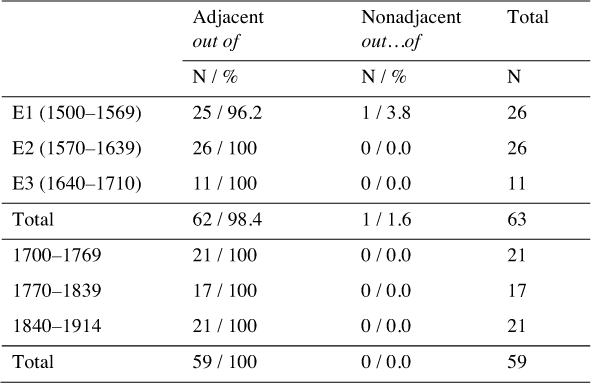
In EModE (1500–1710), there is only one example of nonadjacent out of, from the earliest EModE subperiod (E1). It is presented in 32.
(32) and plucked oute the same of a lytle pursse.
and pulled out the same of a little purse
‘and pulled the same out of a small purse.’
(HARMAN-E1-P2, 54.327)
In LModE (1700–1914), nonadjacent out of is no longer attested. The figures for EModE and LModE are presented in table 7.
Adjacent and nonadjacent out of in EModE and LModE.
Table 7 shows that by EModE, out of PPs had become obligatorily adjacent. Some EModE and LModE examples of adjacent out of are presented in 33 and 34, respectively.
- (33)
a. & thrust hym out of the dorys by vyolence.
‘and thrust him out of the doors violently.’
(MERRYTAL-E1-P2, 60.15)
b. He did carry some 100 barrels of powder out of the ship,
‘He carried some 100 barrels of powder out of the ship,’
(PEPYS-E3-P2, 8,328.185)
- (34)
a. A Body of Spaniards and Italians were landed in Ireland, to drive the English out of that Kingdom;
(KIMBER-1742, 267.C1.213)
b. The Lecturer here poured the carbonic acid out of the glass in which it was being generated into the vessel suspended on the balance… (FARADAY-1859, 17.166)
Thirty-nine out of the 62 EModE examples have a pronominal object (62.9%), as in 33a, as well as 28 out of the 59 LModE examples (47.5%). The position of the particle out is invariable in such examples due to its well-known distributional property: In English transitive particle verbs, the particle must follow a pronominal direct object (this property was established in late ME). Such examples may have fed a reanalysis of out of PP as obligatorily adjacent.
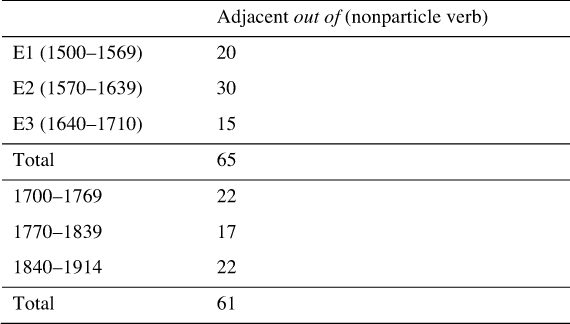
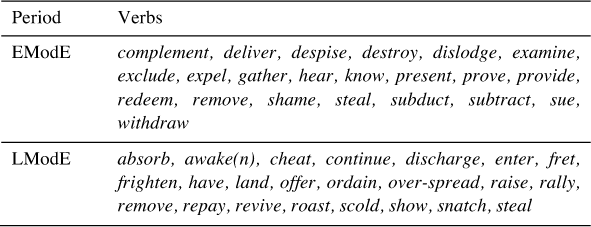
In EModE and LModE, as in ME, there are examples of adjacent out of where out does not form a particle verb with the transitive verb (such examples are not included in the data in table 7). The numbers are given in table 8.
Adjacent out of in EModE and LModE: Nonparticle verb examples.

The numbers in table 8 include only verbs that are not attested as a particle verb with out. These verbs are presented in table 9.
Nonparticle verbs followed by out of in EModE and LModE.
EModE and LModE examples are given in 35 and 36, respectively. In 35–36, out does not form a particle verb with the verbs.
- (35)
a. These wordes maye be taught of some to perteyne only vnto the tyme of the Iewes which dyd expell the apostles out of theyr synagoges.
‘These words may be taught by some to pertain only to the time of the Jews who expelled the apostles out of their synagogues.’
(FISHER-E1-P2, 340.111)
b. And deliuered him out of all his afflictions,
(AUTHNEW-E2-P2, 7,1A.77)
- (36)
a. The design of this and other like prophesies was to awaken that proud luxurious people out of a state of unwarranted security.
(BURTON-1762, 1,2.11)
b. When the Day begins to lengthen, and the Influence of the Sun is reviving them out of their half-dead Condition,
(MAXWELL-1747, 18.156)
As in ME (see examples 26–27), evidence for the unit status of out of in LModE comes from examples where out of combines with the particle out, as in 37, or with another particle, as in 38 (the numbers in table 8 include these examples).
- (37)
a. and with his right hande powreth out water out of his potte,
‘and with his right hand he pours out water out of his pot,’
(BLUNDEV-E2-P2, 161R misnumbered as 158R.373)
b. when the Bee endeavours to thrust out the top of the sting out of the sheath again,
(HOOKE-E3-P2, 164.153)
c. The boys did swear against one of them, that he had made it his part to pull out the plug out of the engine while it was a-playing;
‘The boys did swear against one of them, that he had made it his part to pull out the plug out of the engine while it was running;’
(PEPYS-E3-P2, 8,320.5)
- (38)
a. And as Hipocrates draue away ye pestilence out of Athens wt great fires made of spice woods, and swete floures,
‘And as Hippocrates drove away the pestilence out of Athens with great fires made of spice-wood and sweet flowers,’
(TURNER-E1-P2, F1V.54)
b. and thou forget the Lord thy God which brought thee foorth out of the land of Egypt, from the house of bondage,
(AUTHOLD-E2-P2, 8,1D.683)
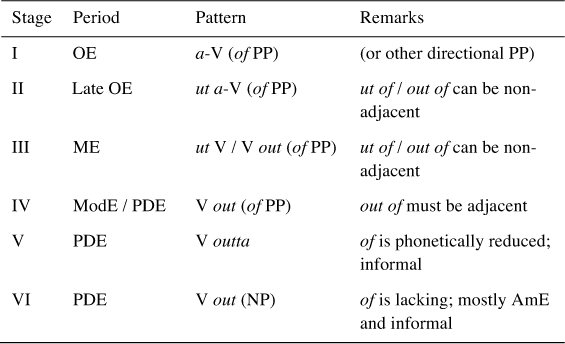
To conclude, the findings for OE, ME, EModE, and LModE presented in this section show that nonadjacent out of was possible roughly until the end of the ME period. A number of different stages for the development of the directional/Source Path out of can be put forward, as shown in table 10 below. In table 10, the brackets ( ) around of PP indicate that its expression is optional. Note that this is true for all stages. What changes is the adjacency of out and of when the of PP is present: They can be nonadjacent before ModE (stages I–III) and become strictly adjacent from ModE onwards (stages IV–VI). Stages V–VI are charac-terized by advanced grammaticalization of the preposition of: In stage V, it is phonetically reduced (to outta); in Stage VI, it is absent altogether. Examples representing each stage are given in 39.
Stages in the development of directional out of.

- (39)
a. Stage I: a-V (of PP)
Hie þa Demetrias of þæm rice a-drifon.
they then Demetrius from the kingdom out-drove
‘Then they drove Demetrius out of the kingdom.’
(Orosius Hist. (BL Add.) iii. xi. 82)
b. Stage II: ut a-V (of PP)
and þu locast þonne þæt þu of ðines broþor Eagan
and you behold then that you from your brother's eye
þæt mot ut a-teo.
the mote out pref-pull
‘and then you see that you pull out the mote from your brother's eye.’ (coaelhom, ÆHom 14:31.2024)
c. Stage III: ut V / V out (of PP)
forto caste oute Sarasynes of þis lande,
for-to cast out Saracens of this country
‘to cast Saracens out of this country,’ (CMBRUT3, 45.1353)
d. Stage IV: V out (of PP)
which the maidens perceiuing, pulled the gag out of his mouth.
(DELONEY-E2-P2, 51.296)
e. Stage V: V outta
You take the fun outta everything, sweetie.
(COCA, On Rickety Thistlewaite,
Michael F Flynn, January/February 2010)
f. Stage VI: V out (NP)
the fun thing about American politics is that we often throw conventional wisdom out the window.
(COCA, ABC ThisWeek, 5 June 2011)
Examples with nonadjacent out of attested in OE and ME show that of PPs were syntactically independent from the particle out in those periods. The ungrammaticality of the nonadjacent pattern in ModE and PDE indicates that of PPs lost their syntactic independence. In section 4, I propose that the loss of nonadjacent out of can be linked to the semantic bleaching of the preposition of. In section 5, I offer a syntactic analysis.
4. Grammaticalization and Reanalysis
In section 3, I showed that, by the beginning of the EModE period, the particle out was forced to occur following the object (predicate order) when an of PP was present. Given that the alternation between particle order and predicate order was well established at this time (see, for example, Elenbaas Reference Elenbaas2007 and Los et al. Reference Los, Blom, Booij, Elenbaas and van Kemenade2012), the question is why the particle order stopped being available when the particle out was followed by an of PP.
I propose that the loss of nonadjacent directional out of is connected to the semantic status of the preposition of (see Cappelle Reference Cappelle2001:318). As mentioned in section 2, Huddleston & Pullum (Reference Huddleston and Pullum2002:658) note that “[o]f is the most highly grammaticised of all prepositions.” The original directional meaning ‘(away) from’ is now obsolete and most of the senses of of are weakened. The OED Online entry for the preposition of describes its semantic development as follows:
The primary sense was ‘away’, ‘away from’, a sense now obsolete, […]. All the existing uses of of are derivative; many so remote as to retain no trace of the original sense, and so weakened as to be in themselves the expression of relatively indefinable syntactic relationships.
As the directional meaning of of became more and more bleached, the particle out became the primary semantic locus of the directional/ Source Path expression.Footnote 4 When the of PP is present, further specifying the Source (Talmy's Reference Talmy and Greenberg1978 Ground), it has to be adjacent to the particle out, with which it forms a semantic unit. In sum, the sequence out of PP has changed from a loose semantic unit with syntactically independent elements, as in 40a, to a tight(er) semantic unit with syntactically depen-dent elements, as in 40b.
- (40)
a. [PathP out] [PP of NP]
b. [PathP out [PP of NP]]
The structure in 40a represents the situation in earlier English, when the SC predicate (consisting of a particle and a PP) could be interrupted, due to the modifier function of the PP. The structure in 40b represents the situation in ModE/PDE, when the SC predicate can no longer be inter-rupted because the PP has been reanalyzed as part of the particle's projection. The proposed structural reanalysis is illustrated in 41.
(41) Reanalysis
[PathP [Path out]] [PathP [Path of] NP] > [PathP [Path out] [PP [P of] NP]]
As argued above, this structural reanalysis was fed by the semantic bleaching of the preposition of, which ceased to express a directional meaning. The loss of syntactic independence is a further step in the grammaticalization of the preposition of. Stages V and VI in table 10 provide evidence of further grammaticalization: Stage V involves phono-logical reduction that yields the form outta (as in He took the pizza outta the oven), and in stage VI, of is absent altogether (as in He took the pizza out the oven).
Once the of PP had lost its syntactic independence and become part of the particle's phrasal projection, the particle out and the of PP could no longer be nonadjacent. In other words, the structural reanalysis results in a change in syntactic ordering (the option of nonadjacent out of is lost). This is unexpected under the generally accepted definition of re-analysis as “a mechanism which changes the underlying structure of a syntactic pattern and which does not involve any modification of its surface manifestation” (Harris & Campbell 1995:50). However, as I show in section 5.2, the change in syntactic ordering results from a combination of the structural reanalysis and the specific morphosyntactic properties of particles, not from the reanalysis per se.
This analysis correctly predicts the ungrammaticality of PDE ex-amples such as 42a, without the particle out, and the grammaticality of such examples in OE, as in 42b (repeated from example 20 above).
- (42)
a. *She threw her ring of the car window.
b. Hie þa Demetrias of þæm rice adrifon.
(Orosius Hist. (BL Add.) iii. xi. 82)
In OE, the preposition of expressed a directional meaning ‘from, away’ and was less grammaticalized, and as a result an of PP could occur independently as a directional expression. This analysis also explains why other directional expressions (such as away from in She pushed the chair away from the desk / She pushed away the chair from the desk, see 2 above) can still be interrupted: In contrast to of, the preposition from has not undergone semantic bleaching and thus remained syntactically independent.
There has been some debate in the literature on the relation between grammaticalization and reanalysis. For Meillet (Reference Meillet1912), the two were indistinct, and this view is also held by Campbell (Reference Campbell2001), who reduces grammaticalization to reanalysis and considers grammaticalization as an epiphenomenon. A similar view is put forward by Roberts & Roussou (Reference Roberts and Roussou2003), who adopt a Minimalist approach, according to which gram-maticalization is understood as “upward reanalysis”.
Other researchers view grammaticalization and reanalysis as distinct processes. This group can be further subdivided into those who believe grammaticalization does not necessarily involve reanalysis (for example, Haspelmath Reference Haspelmath1998) and those who believe that grammaticalization always involves reanalysis (for example, Hopper & Traugott Reference Hopper and Traugott1993/Reference Hopper and Traugott2003, Heine et al. Reference Heine, Claudi and Hünnemeyer1991). The historical development of directional out of proposed here involves semantic change (bleaching of the directional meaning of the preposition of), which leads to a structural reanalysis, which in turn leads to the phonological reduction of the preposition of.Footnote 5 This develop-ment fits with both Campbell's (Reference Campbell2001) view, in which grammatical-ization is the epiphenomenal result of these changes, and Hopper & Traugott's (Reference Hopper and Traugott1993, Reference Hopper and Traugott2003) view, in which grammaticalization always involves reanalysis.
5. Syntactic Analysis
5.1. The Syntax of Directional PPs: Svenonius (Reference Svenonius1996, Reference Svenonius and Svenonius2004)
Much recent work assumes a layered structure for spatial and directional PPs, containing a number of different functional projections (for ex-ample, van Riemsdijk & Huijbregts Reference van Riemsdijk, Huybregts, van Oostendorp and Anagnostopoulou2001, Helmantel Reference Helmantel2002, den Dikken Reference den Dikken2003, Svenonius Reference Svenonius and Svenonius2004, Gehrke Reference Gehrke2008). The basic structure, presented in 43, contains a PathP and a PlaceP (for example, den Dikken Reference den Dikken2003, Svenonius Reference Svenonius and Svenonius2004).Footnote 6
(43) [PathP [PlaceP [DP]]]
The structure in 43 mirrors the conceptual semantics of directional PPs (Jackendoff Reference Jackendoff1983 and subsequent work). Particles (up, down, out, in, away, etc.) lexicalize the Path projection. In the literature on adpositions, out of is often referred to as a transitional Path or Source Path (for example, Lestrade Reference Lestrade2010, Pantcheva Reference Pantcheva2011), which is a reversed Goal Path, illustrated in 44 (from Pantcheva Reference Pantcheva2011:30).
(44)

For the Goal Path into, den Dikken (Reference den Dikken2003) and Svenonius (Reference Svenonius and Svenonius2004) have proposed the derivation given in 45, in which the Place element in incor-porates into the Path element to.
(45)
This analysis accounts for the complex preposition status of into in PDE, but it is not plausible from a diachronic point of view. In earlier English, in expressed motion and was a Path element, just like out in out of. The to PP further specified the (Goal) Path expressed by in. The OED Online entry for into (prep. and adj.) gives the following information:
Originally the two words, in adv., to prep., as in the similar collocations out to, up to, down to, away to, off to, on to, in from, out from, away from, out of, etc., in which the adv. expresses the general direction of motion, and the prep. specifies or has reference to a particular point or place. In the case of in to, the two words may refer to the same space, as in ‘he went in to the house’, or the to may refer to something which is in the space entered, as in ‘he went in to the patient’; it is from the former of these that the combined into has arisen; in the latter the words are still written separate.
The sequence in to (written as separate words) also expresses movement toward a goal that cannot itself be entered, as in He went in to/*into the counter to pay (see 12).Footnote 7 The complex preposition into arose from the fusion (reanalysis) of two Path elements, in and to, and became reserved for the expression of Path. The preposition in became reserved for the expression of Place.Footnote 8 The historical scenario suggests that the in of into was a Path element when it fused with to, and was never a Place element, contrary to what the analysis in 45 suggests. In section 4, I pro-posed a reanalysis scenario for the historical development of out of as well, with the important difference that the outcome was not a complex preposition.
In his analysis of the Source Path out of, Svenonius (Reference Svenonius1996, Reference Svenonius and Svenonius2004) treats the particle out as an intransitive preposition heading a SC.Footnote 9 The basic SC structure is schematized in 46b.
- (46)
a. He threw the garbage out.
b. He [VP [V threw] [SC [DP the garbage] [PP [P out]]]]
The SC is the complement of the verb (threw in 46); it consists of a subject (the DP object of the verb threw) and a predicate (the particle). The DP (the garbage in 46) is the Figure, that is, “the entity in motion or at rest which is located with respect to the Ground” (Svenonius Reference Svenonius, Dahl, Bentzen and Svenonius2003: 432, based on Talmy Reference Talmy and Greenberg1978). The Ground is “a location with respect to which the Figure is located” (Svenonius Reference Svenonius, Dahl, Bentzen and Svenonius2003:433, again based on Talmy Reference Talmy and Greenberg1978). Prepositions relate an entity (the Figure) to a certain location (the Ground), as illustrated in 47a,c, whereas particles typically denote the end state of an entity (the Figure), leaving the Ground unexpressed, as illustrated in 47b (the examples are from Svenonius Reference Svenonius and Svenonius2004:433).
- (47)
a. The helicopter flew [the firefighters]Figure up [the mountain]Ground.
b. The helicopter flew [the firefighters]Figure up.
c. The helicopter flew up [the mountain]Ground.
Svenonius (Reference Ramchand, Svenonius, Mikkelsen and Potts2002:3) proposes three subtypes of the category P:
(48)
Transitive prepositions select a Figure and a Ground, as shown in 48a, intransitive prepositions (that is, particles) select a Figure, as shown in 48b, and unaccusative prepositions select a Ground, as shown in 48c. The Ground may be the Source, the Path, or the Goal of motion.
Svenonius (Reference Svenonius1996) assumes that the SC headed by the particle has a functional layer (FP) endowed with an EPP feature. The SC structure is presented in 49.Footnote 10
(49) [FP [Fepp] [PP Figure [P particle] (Ground)]]
Svenonius proposes that the EPP feature can be checked in two ways: Either the Figure moves from SpecPP to SpecFP, as illustrated in 50a, or the particle (P) moves to F, as shown in 50b.
- (50)
a.
b.
When the Figure checks the EPP feature by moving to SpecFP, as in 50a, the predicate order in 51a is derived. When the particle checks the EPP feature by moving to F, as in 50b, the particle order in 50b is derived.
- (51)
a. He pulled the wrong tooth out.
b. He pulled out the wrong tooth.
In Svenonius’ analysis, particles have the ability to check the EPP feature when there is no overt Ground. Svenonius assumes that the Ground is incorporated in the particle if the Ground is not expressed overtly. Particles with an incorporated Ground have nominal features (see also Hale & Keyser's Reference Hale, Keyser, Hale and Keyser1993 incorporation analysis of intransitive verbs). In 51, the particle out contains an incorporated Ground (for ex-ample, of his mouth) and therefore has nominal features that enable it to check the EPP feature on F.
Building on Svenonius Reference Svenonius1996 and Ramchand & Svenonius Reference Ramchand, Svenonius, Mikkelsen and Potts2002, Svenonius (Reference Svenonius and Svenonius2004) explains why the option of particle shift is unavailable when an of PP is present, as illustrated in 52 (repeated from 3 above).
- (52)
a. We threw the orc out of the window.
b. *We threw out the orc of the window.
Svenonius proposes that particle shift is blocked in 52b because the par-ticle and the of PP are part of the same extended P-projection. The structure adopted by Svenonius (Reference Svenonius and Svenonius2004) is given in 53.
(53) [RP [R] [pP Figure [p] [PP [P out] [PP [P of] NP]]]]
In 53, RP corresponds to FP in 49 and represents the SC; p is a Figure-introducing head (parallel to the Agent-introducing v head). Svenonius (Reference Svenonius and Svenonius2004) follows Svenonius Reference Svenonius1996 and Ramchand & Svenonius Reference Ramchand, Svenonius, Mikkelsen and Potts2002, and suggests that the particle out cannot move to R to check the EPP feature because an overt Ground is present (the of PP), and therefore out has no nominal features. Note that particle shift (in Svenonius’ terms) is avail-able in examples such as He threw down the orc from the battlements, which must mean that the from PP is outside the particle's P-projection, as indicated in 54.
(54) [RP [R away/up] [pP Figure [p taway/up] [PP [P taway/up]]]] [PP from NP]
Svenonius’ analysis implies that no (overt) Ground is present in 54: The particles in such examples can undergo particle shift to check the EPP feature, which is only possible if they acquire nominal features as a result of incorporating the Ground. This seems to be empirically incor-rect, however, as from PPs clearly denote Path and Ground.
Another problem with Svenonius’ analysis is of a theoretical nature and concerns the two options of EPP-feature checking (either the Figure moves or the particle moves). It is unclear how language users choose between the two options of EPP-feature checking or why this optionality should exist in the first place.
Although it is not intended to account for diachronic data, Svenonius’ analysis cannot explain earlier English examples, where the particle out and the of PP are separated by the direct object. A ME example is presented in 55 (repeated from 4).
(55) And he broȝt out þe water of þe ston, …
and he brought out the water from the stone
‘And he brought the water out of the stone, …’
(CMEARLPS, 94.4102)
Svenonius’ analysis predicts examples such as 55 to be ungrammatical: The particle out does not have nominal features because the Ground of þe ston has not been incorporated into it, and the particle is therefore not able to check the EPP-feature in F. It is not clear how Svenonius’ ana-lysis could be modified to account for 55. One possibility would be to say that in earlier English, the particle moved to F for reasons other than EPP-feature checking, but it is not immediately clear what these reasons might have been. There is also no reason to assume that SCs in earlier English were any different from SCs in PDE.
In section 5.2, I propose an alternative analysis following Svenonius’ (Reference Svenonius and Svenonius2004) suggestion that directional PPs may appear inside or outside the particle's P-projection. However, it gives a different account of the syn-tax of particle verbs that straightforwardly explains the synchronic and diachronic facts.
5.2. An Alternative Analysis
In this section, I show that an analysis of English particles as optionally projecting elements straightforwardly accounts for both the synchronic and diachronic facts. In the syntactic literature on PDE, particle verbs have received many different analyses. They are variously treated as words (see, for example, Johnson's Reference Johnson1991 complex verb analysis) or as phrases (see, for example, the SC analyses put forward in Kayne Reference Kayne, Guéron, Obenauer and Pollock1985 and den Dikken Reference den Dikken1995). There are also treatments of particle verbs that make use of the notion of optional projection (for example, Neeleman Reference Neeleman, Dehé, Jackendoff, McIntyre and Urban2002, Toivonen Reference Toivonen2003). The analysis I adopt here, proposed in Elenbaas Reference Elenbaas2007 and Los et al. Reference Los, Blom, Booij, Elenbaas and van Kemenade2012, builds on the latter idea.
Elenbaas (Reference Elenbaas2007) and Los et al. (Reference Los, Blom, Booij, Elenbaas and van Kemenade2012) propose a syntactic analysis of English particles as heads by default (following an Economy Principle) that project a phrase only when forced to do so for syntactic reasons (modification) or information-structural reasons (focus). When particles do not project a phrase, they obligatorily merge with the verb to form a complex verb and move along with the verb to v, as illustrated in 56a below.Footnote 11 This yields the particle order V−Prt−Obj. When particles do project a phrase, they are syntactically independent and do not merge with the verb, as illustrated in 56b. This yields the predicate order V−Obj−Prt. These two options are standardly available for PDE tran-sitive particle verbs, but not, as I have shown, when the particle out is followed by an of PP. In that case, option 56a is not available and the particle obligatorily projects a phrase, as in 56b. In section 4, I proposed that this is because the of PP is part of the particle's projection in PDE. By contrast, as shown in section 3, in OE and ME both options were available for out of examples. In section 4, I proposed that this is because the of PP was not part of the particle's projection in these periods (see 57a). Once of PPs had become part of the particle's projection, as illus-trated in 57b, the particle out is forced to project a phrase when an of PP is present, confining it to the postobject position (yielding the predicate order).
- (56)
a. Particle does not project (default)
b. Particle projects
- (57)
a. OE and ME (before the reanalysis)
[Path(P) out] [PP of]
b. ModE and PDE (after the reanalysis)
[PathP out [PP of]]
The analysis proposed in this section is both descriptively and ex-planatorily adequate, and does not rely on optional movement/checking operations, as opposed to Svenonius’ (Reference Svenonius1996, Reference Svenonius and Svenonius2004) analysis. In addition, this analysis explains why other directional expressions that consist of a particle and a PP can be interrupted, as in She pushed away the chair from the desk. The PP in this example is headed by a nongrammati-calized preposition from and is syntactically independent, as in 57a, that is, not part of the particle's projection.
6. Conclusion
This article has shown that the change from nonadjacent to adjacent directional out of is interrelated with the grammaticalization of the preposition of. In OE and ME, the preposition of expressed a directional meaning ‘from, away’ and headed a PP that was syntactically indepen-dent. The bleaching of the directional meaning of the preposition of led to a structural reanalysis by which the of PP became part of the particle's projection. This loss of syntactic independence, a further step in of’s grammaticalization process, meant that the particle became fixed in post-object position when an of PP was present. This was shown to follow straightforwardly from an analysis of particles as optionally projecting elements. Before the reanalysis (when the of PP was syntactically in-dependent), both options were available: A nonprojecting particle out yielded nonadjacent out of, while a projecting particle out yielded ad-jacent out of. After the reanalysis (when the of PP had lost its syntactic independence), the particle out was forced to project a phrase when an of PP was present and therefore could no longer be nonadjacent to the of PP. Unlike of, prepositions such as from (as in He pulled the books down from the shelf) are not semantically bleached and express a directional meaning. Such PPs therefore did not undergo a reanalysis and remain syntactically independent. It was also suggested that the syntactic status of out of is different from that of its semantic opposite into, which is a complex preposition. This is the result of different diachronic paths.
APPENDIX 1: QUERIES
In the queries below, out and of represent all the spelling variants that were used in the actual queries (see appendix 2).
Examples of adjacent out of:
(1) node: IP*
query: (NP-OB1 iPrecedes [1]PP)
AND ([1]PP iDoms RP)
AND (RP iDoms out)
AND ([1]PP iDoms P)
AND (P iDoms of)
(2) node: IP*
query: (NP-OB1 iPrecedes PP)
AND (PP iDoms [1]P)
AND ([1]P iDoms out)
AND ([1]P iPrecedes [2]P)
Examples of nonadjacent out of:
(3) node: IP*
query: (RP iDoms out)
AND (RP iPrecedes NP-OB1|NP)
AND (NP-OB1|NP iPrecedes PP)
AND (PP iDoms P)
AND (P iDoms of)
APPENDIX 2: SPELLING VARIANTS