The development of wireless telecommunication system relies heavily on tunable microwave devices, including tunable mixers, delay lines, filters, and phase shifters for steerable antennas.Reference Fiedziuszko, Hunter, Itoh, Kobayashi, Nishikawa, Stitzer and Wakino1, Reference Tagantsev, Sherman, Astafiev, Venkatesh and Setter2 Ferroelectrics with electrically tunable dielectric constant have attracted significant interest as active elements of such tunable microwave devices.Reference Feteira, Sinclair, Reaney, Somiya and Lanagan3–Reference Zhou, Boggs, Ramprasad, Aindow, Erkey and Alpay6 Barium strontium titanate (BST, Ba1−xSrxTiO3) is one of the most promising tunable materials due to its high dielectric tunability and low loss above Curie temperature (T C). For tunable devices, materials are required to have a low permittivity (ε′), high tunability (T), and low loss tangent.Reference Zhang, Zhai, Zhang, Qi, Yu and Yao7, Reference Chung, Elissalde, Maglione, Estournes, Pate and Ganne8 However, dielectric loss and tunability of ferroelectrics are typically proportional to their permittivity.Reference Tagantsev, Sherman, Astafiev, Venkatesh and Setter2
It has been shown that high tunability and low permittivity, as well as a minimal dispersion in dielectric properties, over a large temperature interval, can be achieved by doping various ions (Mg2+, La3+, etc.) in BST matrix.Reference Chang and Sengupta9, Reference Wang, Lu, Liu, Zhou and Zhou10 Varma and SebastianReference Varma and Sebastian11 found that dopants with ionic radius close to that of B site ions can improve microwave dielectric properties of ABO3 ferroelectrics. Since W6+ and Ti4+ ions have close values of ionic radii, it is expected that W6+ ion should substitute for Ti4+ in BST, which lead to enhanced dielectric properties.Reference Wu, Limmer, Chou and Nguyen12–Reference Coondoo, Jha, Aggarwal and Soni14 Recent studies indicated that substitution of Ti4+ with W6+ could eliminate oxygen vacancies and thus reduced the dielectric loss tangents of BaTiO3 ceramicsReference Devi and Jha15 and films.Reference Liang and Wu16 Similar observation was reported by Zhang et al.Reference Zhang, Zhai and Yao17 However, no reports on microstructural, dielectric, and electrical characteristics of W-doped BST ceramics have been found in the literature until now.
In the present study, microstructure and microwave dielectric properties of Ba0.5Sr0.5Ti1−3y/2WyO3 ceramics were investigated. The reason for the variation of quality factor (Q value) was also explored. As stated above, W6+ will substitute for Ti4+ due to their close values of ion radii and electronegativity. Such a substitution will introduce an excess amount of positive charge, and Ti vacancies will be formed for the requirement of electrical neutrality. Therefore, the doped ceramics can be expressed as Ba0.5Sr0.5Ti1−3y/2Vy /4WyO3, where V represents Ti vacancies. In addition, a second phase BaWO4 was found in the samples with high content of W. The presence of BaWO4 had a positive effect on dielectric properties of the material since BaWO4 has a very low dielectric loss tangent at microwave frequencies.Reference Yang, Gao and Bian18
Ba0.5Sr0.5Ti1−3y/2WyO3 ceramics were prepared by the conventional solid-state ceramic route using high purity BaCO3 (99.8%), SrCO3 (99.0%), TiO2 (99.9%), and WO3 (99.99%) powders. Mixtures of the starting materials based on the compositions of Ba0.5Sr0.5Ti1−3y/2WyO3 (y = 0, 0.005, 0.01, 0.02, 0.05 and 0.1) were ball milled with zirconia media in ethanol for 24 h and then dried at 110 °C for 12 h. The dried powders were calcined at 1200 °C for 4 h and then remilled for 24 h. The calcined powders, mixed with 8 wt% polyvinyl alcohol, were pressed into disk-shaped pellet at 100 MPa. The green pellets were burned out at 550 °C for 6 h in air to remove the solvent and binder, and then sintered at 1300-1400 °C in air for 4–10 h.
Phase compositions of the sintered ceramics were examined by using an x-ray diffractometer (XRD, Bruker D8 Advanced, Karlsruhe, Germany) with Cu Kα radiation. Scanning electron microscope (SEM, JSM EMP-800, Tokyo, Japan) was used to characterize their microstructures. Temperature dependent permittivity (ε′) and loss tangent (tan δ) of the samples were measured over 173–373 K at 10 kHz by using an Agilent E4980A precision LCR meter (Agilent, Palo Alto, CA). Room temperature permittivity versus direct current (DC) bias voltage was measured at 10 kHz by using a Keithley model 2410 (Cleveland, OH) high voltage source coupled with a LCR meter (TH2816A, Changzhou, China). Permittivity and loss tangent at microwave frequencies were measured by using the resonance methodReference Hakki and Coleman19 with a vector network analyzer (Agilent E5071C, Santa Clara, CA).
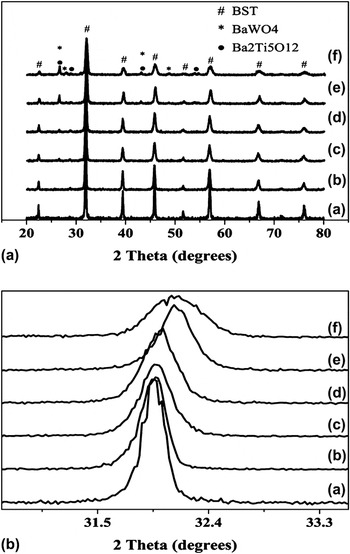
XRD patterns of the Ba0.5Sr0.5Ti1−3y/2WyO3 (y = 0, 0.005, 0.01, 0.02, 0.05, and 0.1) ceramics are shown in Fig. 1. The samples with low levels of W (y ≤ 0.02) possess single phase of perovskite. At high contents of W (y ≥ 0.020), two second phases, BaWO4 (PDF Card No. 43-0646) and Ba2Ti5O12 (PDF Card No. 17-0661), are detected. A solution limit of W6+ substitute for Ti4+ was determined at y = 0.02. Therefore, the BaWO4 and Ba2Ti5O12 generated when the W6+ did not substitute for Ti4+ in the samples with high contents of W during the sintering at high temperatures. At low contents of W, BST diffraction peaks do not shift. However, as the content of W continuously increased, the perovskite diffraction peaks shift gradually towards high angles, meaning a decrease in lattice constant. This can be readily attributed to two factors: on one hand, the ionic radius of W6+ is (0.600 Å) slightly smaller than that of Ti4+ (0.605 Å),Reference Shannon20 and on the other hand, the formation of the second phases, especially BaWO4, causes the reduction of Ba/Sr ratio of the BST.Reference Shannon20
X-ray diffractometer patterns of the Ba0.5Sr0.5Ti1−3y/2WyO3 ceramics with (a) y = 0, (b) y = 0.005, (c) y = 0.01, (d) y = 0.02, (e) y = 0.05, and (f) y = 0.1.

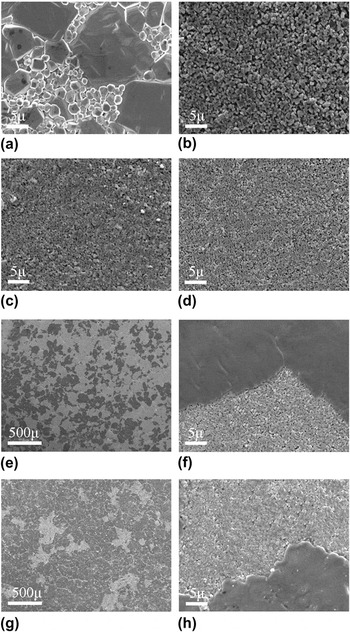
SEM images of the Ba0.5Sr0.5Ti1−3y/2WyO3 (y = 0, 0.005, 0.01, 0.02, 0.05 and 0.1) ceramics are presented in Fig. 2. All samples exhibit quite dense microstructures. It is also demonstrated by the SEM images that the doping of W effectively restrained grain growth of the BST ceramics. Similar observation was reported in donor-doped BaTiO3 ceramics.Reference Chan, Harmer and Smyth21 Moreover, the restriction in grain growth is more pronounced in the samples with low contents of W than those with high W concentrations. This suggests that solute drag effectReference Chiang, Birnie and Kingery22 on the impediment to grain boundary migration was more important in this system than the secondary phase inclusion effect. The sample with y = 0.005 possesses a homogeneous microstructure with grain size of about 1 μm, while those with high contents of W (y ≥ 0.05) exhibit a bimodal microstructure consisting of agglomerate conglomeration and fine grains with size of 0.5–1.0 μm. The bimodal microstructures could be an evidence for the formation of multiphase, which corroborates the XRD result. The extensive phase located between regular-shaped grains should be attributed to the occurrence of liquid phase during sintering at high temperatures, accompanied by a secondary recrystallization during cooling process.
Scanning electron microscope images of the Ba0.5Sr0.5Ti1−3y/2WyO3 ceramics with (a) y = 0, (b) y = 0.005, (c) y = 0.01, (d) y = 0.02, (e) y = 0.05 at 50 times, (f) y = 0.05, (g) y = 0.1 at 50 times, and (h) y = 0.1.

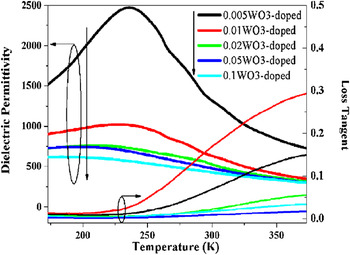
Temperature dependence of dielectric permittivity and loss tangent of all samples measured at 10 kHz are displayed in Fig. 3. Compared with undoped BST ceramics (not shown here), the dielectric peak of cubic-tetragonal phase transition for the W-doped BST ceramics is suppressed and broadened with increasing content of W. The inhomogeneous microstructure and small grain size contribute to the flattened dielectric peaks. Neighboring domains that have different compositional ordering give rise to a broad transition temperature distribution instead of a narrow one. The reduction in ε max can be explained in terms of increasing fraction of low dielectric permittivity grain boundaries and the domain clamping effect caused by the significant reduction of grain size.Reference Xiang, Dong, Feng, Zhong and Guo23 In addition, the increase in the amount of second phases (BaWO4 and Ba2Ti5O12) also contributes to the reduction of ε max. Meanwhile, the temperature at maximum permittivity T m (T C) of the Ba0.5Sr0.5Ti1−3y/2WyO3 ceramics is decreased. At low contents of W (y ≤ 0.02), the decrease in T C, as shown in Fig. 3 and Table I, may be induced by the increase in internal stress caused by the reduction of the grain sizeReference Chen, Dong, Liang, Li and Wang24 accompanied by both the deterioration of spontaneous polarization of Ti4+ and the destruction of ferroelectric long-range order caused by the replacement of Ti by W.Reference Yu and Ye25 However, for the samples with y ≥ 0.05, the decrease in T C was attributed not only to the incorporation of W6+ into BST lattice but also to the reduction in Ba/Sr ratio caused by the formation of BaWO4 and Ba2Ti5O12. Loss tangent increases from 0.0010 for the sample with y = 0.00 to a maximum value of 0.1522 for that with y = 0.01, decreases with further increase in the content of W to a minimum value of 0.0079 for that with y = 0.05, and finally increases to 0.015 for y = 0.1. This variation in dielectric loss can be understood as follows. There are two ways for the incorporation of W6+ ions into a BST lattice.Reference Li, Zhang, Zou and Bergman26 At low content, the incorporation of W6+ into BST lattice can be described as:

Temperature dependence of dielectric permittivity and loss tangent of the Ba0.5Sr0.5Ti1−3y/2WyO3 (y = 0.005, 0.01, 0.02, 0.05, and 0.1) ceramics measured at 10 kHz.

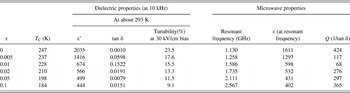
Microwave and dielectric properties of the Ba0.5Sr0.5Ti1−3y/2WyO3 (y = 0, 0.005, 0.01, 0.02, 0.05, and 0.1) ceramics.

The increase in loss tangent of the samples with low content of W is attributed to the rising donor concentration. At high contents of W, the dopant can be compensated by Ba/Sr vacancies, which results in a decrease in concentration of conductor band electron and thus a decrease in loss tangent. It can be expressed as:

At the same time, electron trap (two Ti3+ as an electron trap) could also compensate the positive W6+. The second increase in dielectric loss tangent was caused by the continuous increase in the amount of the vacancies.Reference Wu, Limmer, Chou and Nguyen12
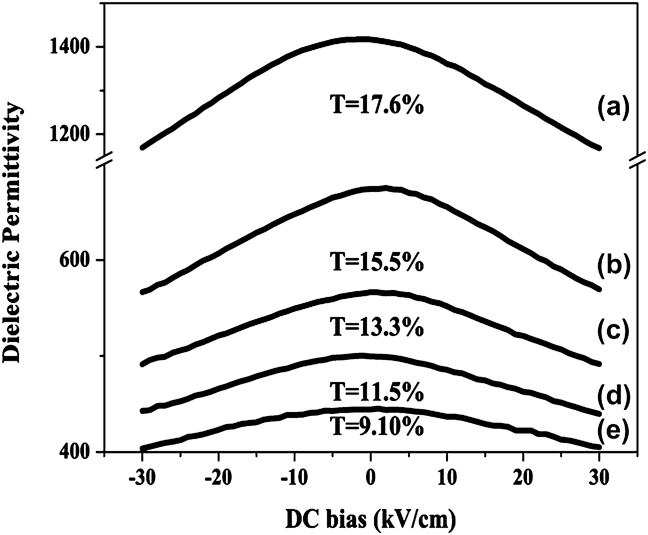
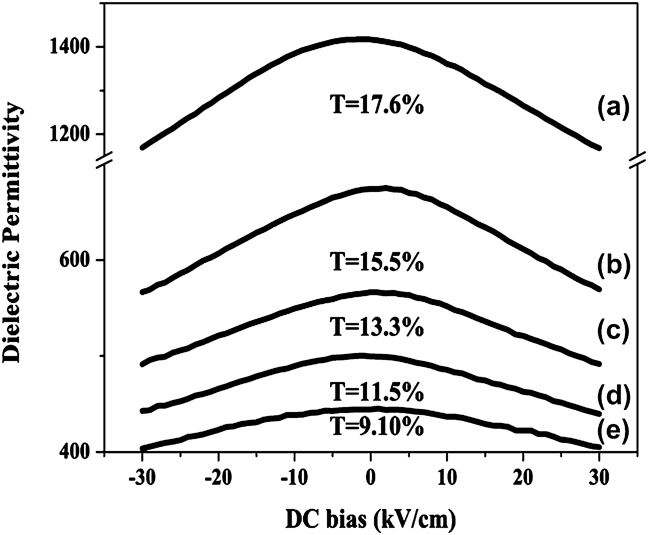
DC bias field dependences of dielectric permittivity of the Ba0.5Sr0.5Ti1−3y/2WyO3 ceramics at 393 K and 10 kHz are shown in Fig. 4. Their dielectric properties and calculated tunabilities are summarized in Table I. Compared with undoped BST, the doped samples exhibit lower tunability. The tunability monotonically decreases with increasing content of W, with a trend similar to that of T C, which may be attributed to the presence of residual polar clustersReference Zhang, Zhai, Jiang and Yao27 and nonferroelectric BaWO4 and Ba2Ti5O12.
Direct current bias field dependent dielectric permittivity of the Ba0.5Sr0.5Ti1−3y/2WyO3 ceramics measured at 10 kHz and room temperature with (a) y = 0.005, (b) y = 0.01, (c) y = 0.02, (d) y = 0.05, and (e) y = 0.1.
Microwave dielectric properties measured at room temperature are also listed in Table I. Permittivity of the Ba0.5Sr0.5Ti1−3y/2WyO3 ceramics is slightly decreased at microwave frequencies compared to that at low frequencies (at 1 MHz). As shown in Table I, Q value decreases from 424 for y = 0.00 to 68 for y = 0.01 and then starts to increase with further increasing content of W. For the samples with y ≤ 0.01, the reduction in Q value may be attributed to the deterioration of the ferroelectric long-range order which is due to the replacement of Ti by W,Reference Zhang, Zhai, Jiang and Yao27, Reference Kong, Li, Zhang, Zhai, Boey and Ma28 whereas for those with y > 0.05, the increase in Q value is mainly due to the formation of BaWO4.Reference Yang, Gao and Bian18 These fairly good microwave properties indicate that the Ba0.5Sr0.5Ti1−3y/2WyO3 composite ceramics could be promising candidates for tunable microwave devices.
Ba0.5Sr0.5Ti1−3y/2WyO3 ceramics with y ≥ 0.01 have a multiphase composition of BST, BaWO4, and Ba2Ti5O12. T C peaks of the Ba0.5Sr0.5Ti1−3y/2WyO3 ceramics are markedly suppressed, broadened, and shifted to low temperature with increasing W substitution. The samples with y = 0.05 and y = 0.10 have good microwave dielectric properties, with ε of 431 and 402, Q of 297 (at 2.111 GHz) and 365 (at 2.567 GHz), and T of 11.5% and 9.1%, respectively. The dramatic decrease in dielectric permittivity, the slight decrease in Q value, and the acceptable tunability of the Ba0.5Sr0.5Ti1−3y/2WyO3 ceramics make them promising candidates for potential tunable microwave devices in wireless communication applications.
ACKNOWLEDGMENTS
This research was supported by the Ministry of Sciences and Technology of China through 973-project under grant 2009CB623302, the Cultivation Fund of the Key Scientific and Technical Innovation Project.