INTRODUCTION
Parabetaeus Coutière, Reference Coutière1896 is a little-known alpheid genus, containing at most four species, two of which are in need of a taxonomic revision (Nomura & Anker, Reference Nomura and Anker2001). The main diagnostic features of Parabetaeus are the posterior margin of the telson produced into a median triangle, with a subacute distal point; the presence of short, distally blunt to subacute orbital teeth; the presence of spiniform setae on the meri and ischia of the third, fourth and fifth pereiopods; and the equal and symmetrical chelipeds, with serrated cutting edges of chela fingers (Coutière, Reference Coutière1896; Nomura & Anker, Reference Nomura and Anker2001; Anker, Reference Anker2007). Until now, Parabetaeus was known to occur in the Indo-West Pacific, eastern Pacific, western and central Atlantic (Banner & Banner, Reference Banner and Banner1985; Nomura & Anker, Reference Nomura and Anker2001; Anker, Reference Anker2007), but not in the eastern Atlantic. The Atlantic species, P. hummelincki (Schmitt, Reference Schmitt1936), was originally described from Bonaire, and subsequently reported from only a few localities in the southern and central Caribbean Sea, Bermuda, north-eastern Brazil, as well as the isolated Ascension Island in the central Atlantic (e.g. Schmitt, Reference Schmitt1936; Manning & Chace, Reference Manning and Chace1990; Anker, Reference Anker2007).
During extensive sampling of alpheid shrimps along the coasts of São Tomé Island, Gulf of Guinea, in February 2006, three specimens of P. hummelincki were collected at depths ranging from 1 to 12 metres. Another specimen of P. hummelincki was collected in the shallow waters of Cozumel Island, off Mexico's Yucatan Peninsula, in July 2010. These specimens constitute the first records of P. hummelincki and the genus Parabetaeus for São Tomé and Mexico's Atlantic coast. More importantly, the São Tomean specimens represent the first record of Parabetaeus in the eastern Atlantic, thus filling the gap in the now fully pantropical distribution of this genus.
Specimens used in this study are deposited in the collections of the Muséum national d'Histoire naturelle, Paris, France (MNHN), Naturalis – Nationaal Natuurhistorisch Museum, Leiden, the Netherlands (RMNH), Oxford University Museum of Natural History, Oxford, UK (OUMNH), and Colección Nacional de Crustáceos, Universidad Nacional Autónoma de México, Ciudad de México, Mexico (UNAM). Carapace length (CL, in mm) was measured from the tip of the rostrum to the posterior margin of the carapace. The abbreviation ‘fcn’ stands for field collection number.
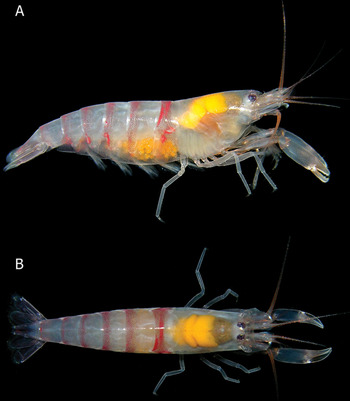
Parabetaeus hummelincki (Schmitt, Reference Schmitt1936): ovigerous female (CL 6.0 mm) from São Tomé, RMNH D53458, (A) lateral view; (B) dorsal view.

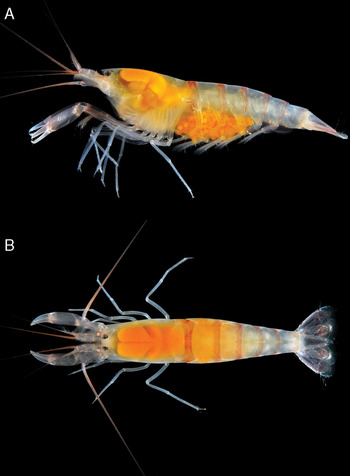
Parabetaeus hummelincki (Schmitt, Reference Schmitt1936): ovigerous female (CL 8.2 mm) from Cozumel, UNAM-CNCR 26482, (A) lateral view; (B) dorsal view.

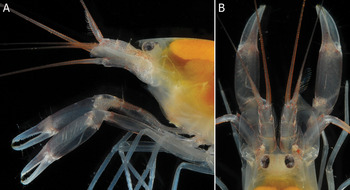
Parabetaeus hummelincki (Schmitt, Reference Schmitt1936): ovigerous female (CL 8.2 mm) from Cozumel, Mexico, UNAM-CNCR 26482, (A) lateral and (B) dorsal views of frontal region and chelipeds.

Alpheopsis hummelincki Schmitt, Reference Schmitt1936: 364; Nomura & Anker, Reference Nomura and Anker2001: 52.
Neoalpheopsis hummelincki – Chace, Reference Chace1972: 78; Rodríguez, Reference Rodríguez1980: 137; Parabetaeus hummelincki – Anker, Reference Anker2007: 34.
Neoalpheopsis euryone (not De Man, 1910) – Manning & Chace, Reference Manning and Chace1990: 17.
Neoalpheopsis sp. – Rodríguez, Reference Rodríguez1986: 176.
MATERIAL EXAMINED
São Tomé: 1 ovigerous female (CL 6.0 mm), RMNH D53458, 4 km west of Lagoa Azul, rocky bottom off sandy beach, depth 1–2 m, under large rocks, underside of rocks covered with encrusting sponges, ascidians etc., coll. A. Anker, 17 February 2006 [fcn 06-249, photo voucher]; 1 male (CL 5.7 mm), MNHN-IU-2011-5179, Sete Pedras, depth 12 m, under rocks, coll. P. Wirtz, 15 February 2006 [fcn 06-222]; 1 male (CL 3.2 mm), OUMNH.ZC. 2011-06-018, Praia das Conchas, off relatively exposed pebble beach, on sand under rocks covered partly with mud, underside of many rocks with encrusting sponges, ascidians etc., depth 0.5–1 m at low tide, coll. A. Anker, 15 February 2006 [fcn 06-228, photo voucher]. Mexico: 1 ovigerous female (CL 8.2 mm), UNAM-CNCR 26482, Quintana Roo, Isla Cozumel, 1 km south of Playa Corona, shallow sand flat with sea grass, algae, overgrown coral bommies, some fan corals and abundant rubble, coll. A. Anker, 9 July 2010 [fcn COZ3-017, photo voucher].
DESCRIPTION
For a description and figures of P. hummelincki see Schmitt (Reference Schmitt1936, as Alpheopsis hummelincki); see also Anker (Reference Anker2007) for figures of the Atol das Rocas specimen. In addition, Figure 3 shows the anterior region of the ovigerous female from Cozumel.
SIZE
The present specimens range from 3.2 mm CL (immature male from São Tomé) to 8.2 mm CL (ovigerous female from Cozumel), the latter being one of the largest specimens known for this species.
COLOUR PATTERN
Semitransparent, with yellowish or pinkish tinge; each abdominal somite with broad transverse red bands; carapace with more diffuse transverse red band dorsally; numerous red chromatophores on tail fan, antennules, antennae, and chelipeds; antennular and antennal flagella golden-orange; eggs bright-yellow; specimens from São Tomé and Cozumel generally very similar (Figures 1–3); see also colour photographs in Anker (Reference Anker2007, figure 8b–d).
DISTRIBUTION
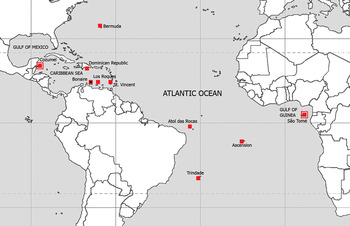
Amphi-Atlantic (Figure 4). Western Atlantic: Bonaire (Schmitt, Reference Schmitt1936); Venezuela: Los Roques Archipelago (Rodríguez, Reference Rodríguez1986); St Vincent; Dominican Republic: Bayahibe; Bermuda; Brazil: Atol das Rocas and Trindade (Anker, Reference Anker2007); Caribbean coast of Mexico: Cozumel (present study). Central Atlantic: Ascension Island (Manning & Chace, Reference Manning and Chace1990). Eastern Atlantic: São Tomé (present study).
Known distribution of Parabetaeus hummelincki (Schmitt, Reference Schmitt1936). Red squares, previous records, including type locality (marked with central black square); framed red squares, new records.

ECOLOGY
Shallow subtidal, known depth range 1–12 m; rock and mixed sand-rock bottoms, apparently preferring clean and well-oxygenated waters, for instance, on more exposed areas on offshore islands (most known records of P. hummelincki are from offshore islands, see Figure 4).
REMARKS
The specimens from São Tomé and Cozumel generally agree with the specimens from Trindade, Atol das Rocas and the Dominican Republic reported by Anker (Reference Anker2007). They have blunt orbital teeth, similar to those illustrated by Schmitt (Reference Schmitt1936) and Anker (Reference Anker2007) (Figure 3B). In the two ovigerous females, the cheliped fingers are serrated along almost the entire length of the cutting edges (Figure 3A).
ACKNOWLEDGEMENTS
The field trip to São Tomé was supported by Nancy Knowlton (National Museum of Natural History, Washington DC, USA) and the National Geographic Society. Peter Wirtz (Universidade do Algarve, Portugal) collected an additional specimen of P. hummelincki in São Tomé. Julio Duarte Gutiérrez (UNAM-Sisal) assisted the author during the Cozumel field trip. This study was also supported by the Brazilian governmental research funding agency CAPES (Coordenação de Aperfeiçoamento de Pessoal de Nível Superior) in the form of a postdoctoral fellowship. Charles Fransen (RMNH) and Sammy de Grave (OUMNH) kindly refereed the manuscript.