Introduction
Positive ageing and innovative approaches to health, wellbeing, and the valuing of older people in the context of structural ageing and increasing individual longevity, are a critical focus for New Zealand Government strategies, and research funders (Office for Senior Citizens, 2014; Associate Minister of Health, 2016; Ageing Well National Science Challenge, nd). In addition, recognition of the need for culturally based interventions, particularly within Indigenous communities, continues to grow internationally; various researchers have argued for and engaged with Indigenous and minority groups to better develop and deliver culturally based health and wellbeing interventions (Ramsden and Spoonley, Reference Ramsden and Spoonley1993; Dutta, Reference Dutta2007; Minkler et al., Reference Minkler, García, Williams, LoPresti and Lilly2010; Peterson, Reference Peterson2010; Wallerstein and Duran, Reference Wallerstein and Duran2010). One critical driver for such developments is health inequities between Indigenous and other cultural groups (Dwyer et al., Reference Dwyer, Boulton, Lavoie, Tenbensel and Cumming2013; Anderson et al., Reference Anderson, Robson, Connolly, Al-Yaman, Bjertness, King, Tynan, Madden, Bang, Coimbra, Pesantes, Amigo, Andronov, Armien, Obando, Axelsson, Bhatti, Bhutta, Bjerregaard, Bjertness, Briceno-Leon, Broderstad, Bustos, Chongsuvivatwong, Chu, Deji, Gouda, Harikumar, Htay, Htet, Izugbara, Kamaka, King, Kodavanti, Lara, Laxmaiah, Lema, Taborda, Liabsuetrakul, Lobanov, Melhus, Meshram, Miranda, Mu, Nagalla, Nimmathota, Popov, Poveda, Ram, Reich, Santos, Sein, Shekhar, Sherpa, Skold, Tano, Tanywe, Ugwu, Ugwu, Vapattanawong, Wan, Welch, Yang, Yang and Yap2016), including between MāoriFootnote 1 (New Zealand Indigenous peoples) and non-Māori (Ministry of Health, 2016).
In Aotearoa New Zealand, Māori, and especially kaumātua (elders), have experienced negative outcomes stemming from ‘distal effects of colonisation’ (Dulin et al., Reference Dulin, Stephens, Alpass, Hill and Stevenson2011: 1420). Such outcomes include health inequalities, disproportionate levels of chronic and acute illness, and poor social determinants of health (Dulin et al., Reference Dulin, Stephens, Alpass, Hill and Stevenson2011; Ministry of Health, 2016). Kaumātua are likely to be more disadvantaged and negatively impacted in their potential to age positively than non-Māori elders (Baker et al., Reference Baker, Zhang, Blakely, Crane, Saville-Smith and Howden-Chapman2016). These health and social factors impact on the capacity to manage life transitions experienced in older age such as changes in employment, independent living, mobility and losing a spouse (Hayman et al., Reference Hayman, Kerse, Dyall, Kepa, Teh, Wham, Wright-St Clair, Wiles, Keeling, Connolly, Wilkinson, Moyes, Broad and Jatrana2012; Kendig et al., Reference Kendig, Browning, Thomas and Wells2014). Critically, as New Zealand's population ages, health inequities experienced by Māori will impact on population health (Dulin et al., Reference Dulin, Stephens, Alpass, Hill and Stevenson2011).
Despite such inequities, Māori draw on strength and resilience to maintain culture and work tirelessly to resist non-Māori categorisation (e.g. Durie, Reference Durie2003). In this context, within te ao Māori (‘the Māori world’), or Māori epistemic knowledge, kaumātua are ‘carriers of culture, anchors for families, models for lifestyle, bridges to the future, guardians of heritage, and role models for younger generations’ (Ministry of Social Development, 2010: 14). As kaumātua age, they pass on mātauranga (knowledge; Kēpa et al., Reference Kēpa, Kēpa, McPherson, Kameta, Kameta, Port, Loughlin, Smith and Reynolds2014) and often experience increased expectations, roles and responsibilities within whānau (kin), hapū (subtribe) and iwi (tribal group; Durie, Reference Durie2003). Such participation contributes to kaumātua ageing well, even when they experience ongoing health problems (Kēpa et al., Reference Kēpa, Kēpa, McPherson, Kameta, Kameta, Port, Loughlin, Smith and Reynolds2014). For older people across cultures, healthy ageing includes personal growth, age-related adaptations, spirituality and outlook (Hung et al., Reference Hung, Kempen and De Vries2010). Similarly, ageing well for kaumātua means maintaining tino rangatiratanga (self-determination) and mana motuhake (identity, autonomy). Yet, the dominant culture fails to recognise such aspirations and roles, and prevents kaumātua from reaching their full potential (Hokowhitu, Reference Hokowhitu, Ka'ai, Moorfield and Reilly2003).
The dynamics of cultural, health and ageing factors for kaumātua call for innovative, culture-centred approaches to meet their health and wellbeing needs during life transitions. Culture-centred approaches start within the culture, working with people to identify and develop responses to issues of most concern to members. In this way the status quo is interrogated rather than adapted to (Dutta, Reference Dutta2007). In regard to Māori kaumātua, culture-centred approaches privilege their voices in identifying health, wellbeing and life transition-related issues.
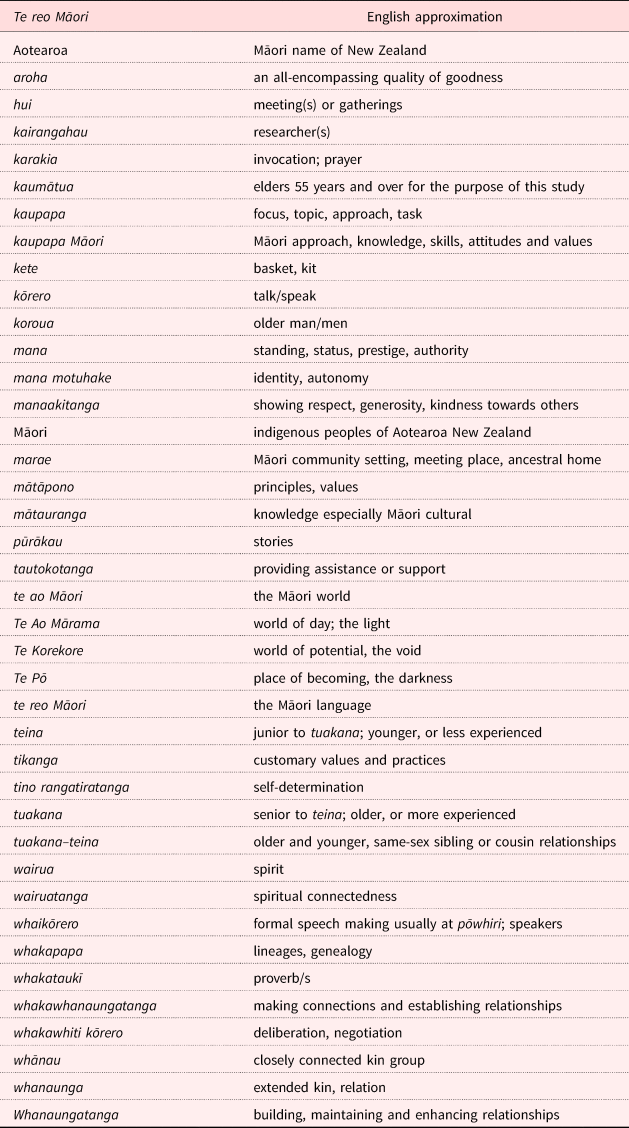
Glossary of Māori language terms used twice or more within the article

The purpose of the study is to describe the culture-centred development of an intervention involving kaumātua working as peer educators for other kaumātua using Māori concepts of ‘tuakana’ and ‘teina’ (elder sibling and younger sibling). Taking a strengths-based approach to highlight the potential of ‘kaumātua mana motuhake’ – kaumātua independence and autonomy in self and collective determination (Hokowhitu, Reference Hokowhitu, Hokowhitu, Kermoal, Andersen, Reilly, Rewi and Petersen2010) – the study expands understandings of wellbeing for kaumātua by having them adopt peer educator roles.
Literature review
To explore how to develop a culture-centred Māori tuakana–teina/peer support programme with kaumātua, we introduce the culture-centred approach and then Māori epistemic knowledge as expressed within dimensions of te ao Māori. We then discuss tuakana‒teina/peer relationships and peer education.
Culture-centred approaches
Culture-centred approaches are more than ‘cultural sensitivity’ and ‘cultural competence’ (Kearns and Dyck, Reference Kearns and Dyck1996; Dutta, Reference Dutta2007). Cultural sensitivity emphasises adapting evidence-based interventions, developed elsewhere, to fit the cultural values and behaviours of a community (Kearns and Dyck, Reference Kearns and Dyck1996; Resnicow et al., Reference Resnicow, Braithwaite, Dilorio, Glanz, Glanz, Rimer and Lewis2002). Cultural competence emphasises the ability of health workers to communicate in ways that are culturally appropriate and effective (Tervalon and Murray-García, Reference Tervalon and Murray-García1998). Both approaches have been criticised for trying to fit outside knowledge structures to given communities and for ignoring issues of unequal power relations and racism (Dutta, Reference Dutta2007). Thus, both approaches impose an external agenda that may not be sustainable once the outsiders leave, and fail to change health inequities (Dutta, Reference Dutta2007).
In contrast, culture-centred approaches privilege the experiences, voices and agency of those impacted by a health issue. Community members are able to understand and develop local solutions informed by their own cultural world-views and everyday experiences (Basu and Dutta, Reference Basu and Dutta2009; Peterson, Reference Peterson2010; Dutta et al., Reference Dutta, Anaele and Jones2013). Lived experiences and participation are at the heart of culture-centred approaches; experience informs problem definition and helps to identify key information that can explain problems (Ramadurai et al., Reference Ramadurai, Sharf and Sharkey2012). Participation involves researchers listening to local voices and seeking local understandings of health and health problems, so that together the parties co-construct interventions in line with local logics (Taylor, Reference Taylor2003; Smith, Reference Smith2009; Masters-Awatere, Reference Masters-Awatere2015).
Culture-centred approaches share common ground with cultural safety (Ramsden, Reference Ramsden, Whaiti, McCarthy and Durie2002) which takes a health service user's perspective (Ramsden and Spoonley, Reference Ramsden and Spoonley1993). It aligns with culture-centred approaches by showing ‘Māori resistance to dominant western ways of thinking, seeing and carrying out health care’ (Kearns and Dyck, Reference Kearns and Dyck1996: 371), and concerns rethinking and transforming approaches to health needs of marginalised groups so that the ‘we’ talk more with and less about ‘them’ (Kearns and Dyck, Reference Kearns and Dyck1996). For health service users to feel culturally safe, health workers need to engage reflexively with dimensions of power and privilege in their role, and adopt new practices (Ramsden and Spoonley, Reference Ramsden and Spoonley1993; Ramsden, Reference Ramsden, Whaiti, McCarthy and Durie2002). Such culture-centred initiatives in Aotearoa New Zealand include Whānau Ora (Ministry of Social Development, 2010) as well as the work of urban Maori authorities, non-governmental organisations and local marae (community setting, meeting place) which actively support kaumātua in ageing well.
Just as cultural safety uses reflexivity to question hidden dimensions of power and privilege within health-care provider practice, culture-centred approaches use reflexivity to question taken-for-granted understandings of power and privilege of outsiders in the assessment of health problems and the development of solutions (Dutta, Reference Dutta2007, Reference Dutta2008). Reflexivity is critical to ensuring that those most impacted by given health issues partner in the co-construction of interventions to address those issues.
Culture-centred approaches emphasise local determination and ways of knowing that enable greater community voice, that challenge power imbalances, and fundamentally change the way in which health interventions are developed and implemented (Dutta, Reference Dutta2007; Dutta et al., Reference Dutta, Anaele and Jones2013). This is consistent with the importance of Māori self-determination and mātauranga (knowledge) in defining problems and developing solutions (Ramsden, Reference Ramsden, Whaiti, McCarthy and Durie2002; Mane, Reference Mane2009). This knowledge is addressed in the next section.
Māori epistemic knowledge
Taking a culture-centred approach to health and wellbeing of kaumātua in Aotearoa New Zealand means accounting for and engaging Māori epistemic knowledge. Three domains of Māori epistemic knowledge relevant to the current study are: te ao Māori in shaping change, mātāpono (principles, values) and communication.
Te ao Māori and the creation story are integral to shaping change. All spiritual and material being comes from Te Korekore (world of potential, the void), with wairua (spirits) travelling from there to Te Pō (place of becoming, the darkness), to Te Ao Mārama (world of day, the light) and back again after death (Marsden, Reference Marsden and King1992: 130–134). When Tāne, the god of forests and birds, stood on his hands and pushed up with his feet to separate his mother, Papa-tū-ā-nuku (earth mother), and his father, Rangi-nui (sky father), he not only brought into being Te Ao Mārama, he also connected the three realms (Marsden, Reference Marsden and King1992). These three realms form the woven world (Marsden, Reference Marsden and King1992) with their relationships offering an engaging cultural resource to approach processes involved with learning, development and significant life transitions: Te Korekore, acknowledging kaumātua knowledge and its potential; Te Pō, engaging kaumātua knowledge and mana (charisma, power, authority or status) in becoming tuakana; and Te Ao Mārama, kaumātua being tuakana and providing peer support.
Te ao Māori is woven into tuakana‒teina/peer support relationships through mātāpono Māori, the principles or values that guide interactions and inform outcomes. Several mātāpono are identified within Māori tuakana‒teina/peer mentoring models from education (Rawlings and Wilson, Reference Rawlings and Wilson2003; MacFarlane et al., Reference MacFarlane, Glynn, Cavanagh and Bateman2007; Winitana, Reference Winitana2012) and work contexts (e.g. Hook et al., Reference Hook, Waaka and Raumati2007; Ratima and Grant, Reference Ratima and Grant2007). One example of mātāpono is wairuatanga (spiritual connectedness) which acknowledges the spiritual aspect of wellbeing that is enacted through various tikanga (practices) including mihimihi (greet, pay tribute) and karakia (invocation, prayer), as well as whakataukī (proverbs). Another example is mana (status) which is central to all relationships in te ao Māori. Mana is maintained for givers and receivers through manaakitanga (generosity), utu (reciprocity) and aroha (love). Any event, process or activity involving people is ‘geared towards the preservation and the uplifting of the mana of participants’ (Ratima and Grant, Reference Ratima and Grant2007: 2). Within mentoring relationships, this concerns the mana of teina and tuakana.
Thirdly, te reo Māori (the Māori language) and kanohi ki te kanohi (face-to-face) kōrero (talk) are fundamental communication elements to a Māori epistemology (Mead, Reference Mead2003). Less than 25 per cent of Māori and 4 per cent of all New Zealanders can speak te reo Māori in a conversation about everyday things (Statistics New Zealand, 2013). However, Māori communication preferences and concepts remain practised and understood. Therefore, using te reo Māori and Māori concepts is critical to a culture-centred approach to communication. Using Māori communication forms is critical in health settings involving Māori (Levack et al., Reference Levack, Jones, Grainger, Boland, Brown and Ingham2016), kaumātua (Oetzel et al., Reference Oetzel, Simpson, Berryman, Iti and Reddy2015) and research (Elder and Kersten, Reference Elder and Kersten2015). Three such forms important to a tuakana‒teina/peer support intervention are: rituals of hui (meetings), whakawhiti kōrero (exchanging ideas in talk) and pūrākau (stories).
Rituals of connection are key in hui because whanaungatanga (relationships) are fundamental in Māori culture (Mead, Reference Mead2003). Hui protocols promote engagement with the kaupapa (focus, topic, approach or task) through the process of whakawhanaungatanga which makes connections to establish relationships (McClintock et al., Reference McClintock, Mellsop, Moeke-Maxwell and Merry2012). Whakawhiti kōrero (the exchange of ideas in discussion and deliberation) has been used as a cultural tool to increase ease of Māori participation in health research (Elder and Kersten, Reference Elder and Kersten2015). Pūrākau reflect the inter-connectedness of people with te ao Māori, the natural environment and each other (Lee et al., Reference Lee, Hoskins and Doherty2005). Pūrākau reflect the holistic approach of Māori to wellbeing (Durie, Reference Durie1985).
Tuakana‒teina/peer support: concepts and roles
The tuakana‒teina (senior‒junior) connection is an important cultural relationship between older and younger, same sex, sibling and cousin relationships (Mead, Reference Mead2003). Within education, where tuakana‒teina/peer support has been used extensively (Rawlings and Wilson, Reference Rawlings and Wilson2003; Hook et al., Reference Hook, Waaka and Raumati2007; MacFarlane et al., Reference MacFarlane, Glynn, Cavanagh and Bateman2007; Kensington-Miller and Tatima, Reference Kensington-Miller and Tatima2015), the tuakana is the senior and ‘experienced person’, and teina is the junior ‘in-experienced person’ (Winitana, Reference Winitana2012: 34). Critically the focus is on creating meaningful relationships and enhancing mana of both tuakana and teina (Winitana, Reference Winitana2012). Tuakana‒teina/peer support relationships differ from everyday whānau and community support networks, where people help each other because of existing relationships, and from organisation-driven, para-professional support (Dennis, Reference Dennis2003). Finally, parties need to enable individuals to retain ‘peer-ness’ to establish effective peer relationships (Dennis, Reference Dennis2003), even where peer support relationships are created by third parties.
While younger people may seek and give support among their peers informally, as well as formally through education-based peer support programmes, support exchange opportunities for older people centre largely on their families and intergenerational relationships (Antonucci et al., Reference Antonucci, Birditt, Sherman and Trinh2011). Older people without family or informal peer networks may be disadvantaged – especially at points of transition such as the loss of a spouse (Isherwood et al., Reference Isherwood, Luszcz and King2015). These situations suggest that older people may value and benefit from support exchange opportunities offered by formal peer support programmes.
In regard to older people, peer support and education programmes have been used successfully for transitions in later life, as well as health and social issues (Kocken and Voorham, Reference Kocken and Voorham1998; Layne et al., Reference Layne, Sampson, Mallio, Hibberd, Griffith, Krupa, Flanagan and Castaneda-Sceppa2008; Erickson, Reference Erickson2009; Seymour et al., Reference Seymour, Almack, Kennedy and Froggatt2011; Khong et al., Reference Khong, Farringdon, Hill and Hill2015; Stevens et al., Reference Stevens, Barlow and Iliffe2015). In addition, peer support/education programmes have been used with success with different minority and Indigenous communities (Pérez-Escamilla et al., Reference Pérez-Escamilla, Hromi-Fiedler, Vega-López, Bermúdez-Millán and Segura-Pérez2008; Philis-Tsimikas et al., Reference Philis-Tsimikas, Fortmann, Lleva-Ocana, Walker and Gallo2011).
The many studies show that peer support programmes differ widely in orientation, kinds and levels of intervention, and organising (Dennis, Reference Dennis2003). One definition of peer support or education is assistance given by someone who possesses experiential knowledge of a health or social situation and shares this with another who is going through a similar experience, where both share characteristics such as age and culture (Dennis, Reference Dennis2003). The extent of peer-to-peer similarity is critical to improving wellbeing outcomes (Layne et al., Reference Layne, Sampson, Mallio, Hibberd, Griffith, Krupa, Flanagan and Castaneda-Sceppa2008).
Even though research is slim in relation to Māori kaumātua and their wellbeing, Māori (Levack et al., Reference Levack, Jones, Grainger, Boland, Brown and Ingham2016) and other Indigenous approaches (Rowan et al., Reference Rowan, Poole, Shea, Gone, Mykota, Farag, Hopkins, Hall, Mushquash and Dell2014) to managing health issues demonstrate the potential of culture-centred peer support programmes. The value of tuakana‒teina/peer support for kaumātua is found in health interventions where attending to cultural factors positively improves participation rates and programme effectiveness for adult Māori (Levack et al., Reference Levack, Jones, Grainger, Boland, Brown and Ingham2016). Thus, a culture-centred, te ao Māori-driven kaumātua tuakana‒teina/peer support programme may improve kaumātua wellbeing through promoting cultural connections.
In summary, this paper discusses the development of a culture-centred, Māori tuakana‒teina/peer support programme involving kaumātua approaching transitions in later life. The research question was:
• What makes for a culture-centred approach to developing tuakana‒teina/peer support intervention for kaumātua experiencing life transitions?
This meant identifying critical cultural concepts, processes and factors that informed the intervention.
Methods
The development of the tuakana‒teina/peer support programme integrated kaupapa Māori methodology and community-based participatory research (CBPR). Kaupapa Māori research normalises Māori perspectives, principles and practices (Kennedy and Cram, Reference Kennedy and Cram2010) and creates space for building relationships, establishing trust, and empowering Māori to focus on issues important to them and their experiences (Hokowhitu, Reference Hokowhitu, Hokowhitu, Kermoal, Andersen, Reilly, Rewi and Petersen2010). This study's kaupapa Māori approach centralised kaumātua mana motuhake so that kaumātua simultaneously had value and responsibility (Wyeth et al., Reference Wyeth, Derrett, Hokowhitu, Langely and Hall2010). This approach is captured in the for-kaumātua-by-kaumātua principle that recognises the value of kaumātua contributions to society.
CBPR is a collaborative approach to research that concerns something that matters to a given community, and is driven by the community's self-determination, working together with others and co-designing the research. Self-determination enhances research quality because all ways of knowing are respected, learning is expansive and strengths are built together (Wallerstein and Duran, Reference Wallerstein and Duran2010). In this study, integration of kaupapa Māori and CBPR is a function of a long-term relationship, based on trust, care and knowledge sharing, between Rauawaawa Kaumātua Charitable Trust (Rauawaawa), and Te Whare Wānanga o Waikato/The University of Waikato Māori studies and health communication researchers.
Kaupapa Māori research and CBPR are attuned to ethics of promoting human rights, informing methodology, and ensuring the integrity of both research and researchers. This position ensures a commitment to a kaumātua-centred approach: that is, kaumātua mana motuhake kaupapa guides the mātāpono in developing a tuakana‒teina/peer support programme. Critically, the research is co-led by Rauawaawa which is a for-kaumātua-by-kaumātua urban Māori community agency and, therefore, tino rangatiratanga remains in the hands of kaumātua themselves.
Project procedures and data sources
This study reports on the development of an intervention to illustrate how culture-centred processes were adopted. These processes included three key elements: (a) establishing the foundational systems; (b) developing the Tuakana Orientation Programme (TOP) and supporting systems; and (c) running a pilot of the TOP.
The foundational systems began with university researchers and Rauawaawa agreeing to go into partnership to undertake joint research. Rauawaawa provides health and social wellbeing services for kaumātua within a Māori cultural framework. The foundational systems comprised Board and Expert Advisory Groups (BAG and EAG), the research team and TOP development team meetings and processes. The research began with the research team meeting to discuss ways of working with a specific focus on culturally appropriate and ethical processes of kaupapa Māori. Consistent with kaupapa Māori and CBPR principles, in January 2017 we set up the BAG and EAG. The BAG comprised ten trustees (nine aged over 70 years) who gave oversight, guidance and input into research methods, procedures, data collection, analysis processes and the TOP development, via eight monthly, minuted meetings (30–120 minutes). The trustees had previously served in this advisory role in research and applied for-kaumātua-by-kaumātua principles.
The EAG comprised 12 members (aged 55–70 years) from government departments, and specialist health, social and Māori services for older people, and offered advice and feedback to ensure the TOP aligned with best practices in life transitions for kaumātua. The EAG and team met four times (60–120 minutes each) with recorded minutes.
The TOP development team met 12 times (February to August 2018) and comprised seven kairangahau (researchers): Māori community Co-Principal Investigator; Maori community researcher; two Māori university researchers; one Pākehā university researcher (who had collaborated with Rauawaawa before); and two Māori doctoral candidates associated with the project. Members took part in all meetings, kaumātua focus groups and research training.
The TOP development team's first task was reviewing the tuakana‒teina, peer education and health literature related to ageing, Māori and Māori kaumātua, as well as simultaneously consulting kaumātua and community health workers. The second was developing a TOP manual that incorporated the Culture, Health and Safety plan (CHS plan), and resources for kaumātua to use during and after the TOP.
To support the development of the TOP, the kairangahau held five 50–65-minute focus groups to hear kaumātua insights about life transitions and key elements to be included in a TOP. The focus groups were organised around the five life transitions identified at the research outset by kaumātua: loss of a spouse, change in health, loss of independence (e.g. moving into care), loss of driver's licence and adjusting to retirement. Each group focused on two life transition topics and was facilitated by one or two researchers, of whom at least one was Māori and one a Māori community health worker. Kaumātua chose their focus group, with three to five taking part in each. In all, 21 kaumātua (58–79 years) took part, of whom 19 identified as Māori, seven as koroua (older men) and 14 as kuia (older women).
Five focusing statements guided the discussions and centred on: key life transitions kaumātua had faced; information they wanted before facing transitions; what people should know before they talk to someone facing a life transition; what to include in a training programme about life transitions; what kaumātua may find hard when acting as tuakana in this situation; and ideas they wanted to offer. All of these focus groups were audio recorded (287 minutes).
The TOP manual, resource kete (basket, kit) and CHS plan were created in setting up the pilot. The TOP manual included te ao Māori-informed rationale for choices, overall structure of the programme, and detailed components and instructions for each wānanga (session), and was trialled in the pilot. The resource kete used in the pilot was a booklet of information and available services developed in response to the five kaumātua focus groups. The CHS plan was a legal requirement and drew on Rauawaawa's Health and Safety plan and the university's guidelines for ethical research. Feedback was sought from the BAG and EAG.
Running the TOP pilot
In order to run the pilot, the team had first to identify a group with a good number of kaumātua (20 or more), suitable facilities and the infrastructure to support organising the pilot. Rauawaawa has a long-standing relationship with another Māori community agency, which we term Pilot Agency, in another area. Rauawaawa had helped them to set up a kaumātua programme seven years previously. This second agency offered health and social wellbeing services, including those for kaumātua, and therefore was an ideal pilot partner.
The TOP pilot was held over three days with sessions of four hours each. The kaumātua were aged 57–81 years with 18 women and three men. The first day involved recruiting as well as a wānanga (meeting with information), and kaumātua completed a draft pre-test questionnaire (in te reo Māori or English). Of the 21 engaged, 18 took part in all three days, with three taking part in two days. To recognise their contribution to the TOP, all received grocery vouchers.
The programme began with a pōwhiri: a formal welcome following Māori protocol and rituals to uphold the mana of the hosts. This was particularly important for the research team, as it was the first visit to the Pilot Agency for most of them. The TOP team was led by a Rauawaawa trustee and BAG member kaumātua. The TOP pilot ran from 10 am to 2 pm each day, with morning tea and lunch being offered. The wānanga finished with kaumātua talking about the day and ended with karakia: a closing prayer acknowledging the kaumātua and their contribution to the wānanga and blessing all in their return home. Participants completed an evaluation at the end of the third day (N = 21).
Six members of the TOP development team were involved in the pilot (the community Co-Principal Investigator was not present). The two Māori researchers were the main facilitators with others in support roles such as connecting with kaumātua, writing observation notes and creating visual records (e.g. whiteboard, paper, photographs). The TOP team held debriefing sessions (30–60 minutes) after each wānanga, with follow-up face-to-face and email conversations each week.
Data analysis
The data-set included BAG, EAG and TOP team meeting minutes; kaumātua focus group recordings and notes; TOP pilot observation and debriefing notes; the CHS plan; and TOP participant documents. Data analysis combined two approaches: thematic and culture-centred analysis.
Firstly, the BAG, EAG and TOP meeting notes and kaumātua focus group data were analysed thematically (Braun and Clarke, Reference Braun and Clarke2006) with one Māori and one Pākehā researcher coding independently. With regard to the kaumātua focus groups, thematic analysis helped to organise kaumātua insights about transitions in later life and the elements to include in the TOP. The coders overlapped with eight of the initial 12 themes; each coder identified two themes which the other did not. The initial themes were then discussed and clarified with eight over-arching themes resulting. With regard to the BAG, EAG and TOP minutes, the thematic analysis focused on documented key points and discussion summaries taken during meetings. All themes were reviewed by the coders, research team and both advisory groups. This first analysis was followed by an explicitly culture-centred approach that attended to cultural concepts, constructs, relationships and practices within the identified themes.
Secondly, for analysing the TOP pilot observation and debriefing notes, the CHS plan and the TOP participant documents, we adopted a culture-centred approach. This approach incorporated Māori concepts such as mātāpono and practices that focused on Māori communication protocols (e.g. Simpson et al., Reference Simpson, Berryman, Oetzel, Iti and Reddy2016) and emphasised relationships (Mead, Reference Mead2003). Also included were principles of kaumātua mana motuhake and tino rangatiratanga, and of tuakana‒teina/peer support: wairuatanga, whanaungatanga, and so on (Hook et al., Reference Hook, Waaka and Raumati2007; MacFarlane et al., Reference MacFarlane, Glynn, Cavanagh and Bateman2007; Rawlings and Wilson, Reference Rawlings and Wilson2003; Winitana, Reference Winitana2012). The approach concentrated on themes and critical moments related to te ao Māori from across the data that (a) showed immediate effects and whose fuller meaning(s) became clearer on reflection; or that (b) initially appeared minor, but were symbolically important in terms of larger issues (Patton, Reference Patton2002). Our culture-centred analysis meant we attended to kaumātua voices, the nature of feedback and recommendations from advisory groups, and ways the research team responded to critical moments and emerging issues.
Findings
The purpose of the study was to investigate the culture-centred development of a Māori tuakana‒teina/peer support programme involving kaumātua. This section addresses the research question: what makes for a culture-centred approach to developing tuakana‒teina/peer support intervention for kaumātua experiencing life transitions? The presentation and discussion is structured around three stages: (a) foundation of BAG and EAG; (b) the process of the TOP pilot; and (c) the outcome of the TOP model. The findings map to each of these stages, and centre on: (a) te karanga me te paepae: the call and guidance of the kaupapa; (2) he kaupapa hei ārahi i TOP: a pilot to guide the TOP; and (3) he pou tarāwaho: a Māori culture-centred framework for tuakana‒teina/peer support. Within each stage, where applicable, the critical moments are discussed first, followed by the main themes identified in our analysis.
Te karanga me te paepae: the call and guidance of the kaupapa
The Board of Trustees made the initial karanga (call) for, and whaikōrero (formal speeches and speakers) about, the research to focus on kaumātua life transitions. The analysis revealed two critical moments and two themes: kaumātua mana motuhake and inclusiveness.
The first critical moment concerned naming the TOP itself (BAG-05; EAG-05Footnote 2). During the proposal phase the working name had been ‘Tuakana Training Programme’. BAG and EAG members questioned the word ‘training’, which in their view implied new learning for kaumātua. Instead they suggested ‘orientation’ as it offered a new way for kaumātua to apply their lifetime of skills and knowledge. In this way, the advisory groups wanted the programme to recognise the mana of kaumātua in the lifetime of skills they had, and therefore to ensure that the programme was mana enhancing. To be mana enhancing meant paying attention to words and phrasing when talking about key ideas. One example that illustrates this comes from the EAG: ‘It is appropriate that our language acknowledges that kaumātua come with mana; that we're supporting their knowledge in a way that they can express it’ (EAG-05). The name ‘Tuakana Orientation Programme’ was therefore adopted.
The second critical moment centred on use of the term ‘tuakana’ within the TOP. At the beginning, the tuakana‒teina/peer support idea was adopted from the Māori cultural concept of senior‒junior relationships (e.g. Winitana, Reference Winitana2012). In response to questions during the pilot TOP about the term ‘tuakana’ (TOP-122 to TOP-130), the TOP team identified four alternatives not previously considered. These four alternatives were presented to the BAG and EAG (TOP-06 to TOP-18): (a) whakaruruhau, which as a noun means protector, advisor or mentor; (b) kaimanaaki, which links to one of the primary values for the programme, manaakitanga; (c) kaitautoko, which recognises the centrality of tautokotanga (providing assistance or support) to the role of a mentor; and (d) mata whakahau maru, which means urging or providing instruction in order for others to be safe, risk-free or sheltered. The EAG recommended ‘Mata whakahau maru … if the term [was] used in place of tuakana’. However, the BAG (BAG-08), in its role as host speaker or whaikōrero, determined that ‘tuakana’ should remain in use where the TOP used the definition of tuakana as an ‘experienced person’ working with a teina who was ‘in-experienced’ (Winitana, Reference Winitana2012: 34). In this decision, the BAG stressed the need for simplicity and inclusiveness of language, and ‘ease of use by all kaumātua in the project’ (BAG-08). In this way, the needs and mana of kaumātua were privileged.
The first main theme centred on privileging kaumātua mana motuhake was evident across BAG and EAG deliberations. Both groups emphasised the importance of acknowledging the different kinds of mana of kaumātua, and ensuring the TOP used mana-enhancing processes and practices. For instance, ‘Acknowledging types of mana allows us to have a platform to enhance mana in our communication processes e.g. mana whakatō [that] has been placed on you, [and] mana tuku iho [that] is inherited through whakapapa’ (EAG-05). It was expected that kaumātua would have one or more kinds of mana (see Mead, Reference Mead2003), and both BAG and EAG offered mana-enhancing processes and practices to the TOP.
One such practice centred on framing the idea of retirement as opportunity more than as loss and negative ageing. The BAG offered that: ‘retirement needs … to be acknowledged for the benefits (i.e. time spent with mokopuna [grandchildren], whānau activities … as well as the challenges’ (BAG-09). This may be seen as focusing on enjoyable aspects of later life that link to Durie's (Reference Durie2003) comment that kaumātua cultural and whānau roles and responsibilities increase with age. In addition, the advisory groups asked for headings in the TOP document to better reflect ‘becoming’ so that the focus shifted from ‘being in the state of retirement, to having tools to move forward in retirement’ and ‘to allow kaumātua to anticipate moving forward, getting prepared and expecting to be able to handle the life transitions’ (EAG-05). Both requests were mana enhancing in that they offered choice to kaumātua, and positioned kaumātua as being able to develop and grow in later life.
The second main theme, centred on the value of inclusiveness, was evident across the BAG and EAG deliberations. Both groups stressed that the TOP needed to be inclusive of those who were fluent speakers of te reo Māori, and those who were not. This was to ‘ensure [kaumātua] don't lose confidence, feel isolated, or hold back trying to help less knowledgeable kaumātua participate’ (EAG-05). While inclusiveness was at first about tuakana‒teina pairing in the implementation phase, it also applied in the design of the pilot. Finally, inclusiveness was seen in the advisory groups’ request that the TOP team ask kaumātua for feedback on resources, and check for understanding so as to encourage ‘them to share what they bring to the kaupapa’ (EAG-05) and to enable the TOP team to adapt sessions to meet kaumātua needs and aspirations.
He tauira hei arahi i te hōtaka whakangungu tūturu: a pilot to guide the programme
The second set of findings feature two critical moments, and two themes emerging during the TOP pilot that illustrate culture-centredness in the process. The themes centred on the importance of tikanga and the role of pūrākau (stories) in building inclusiveness. The strength of the relations between Rauawaawa and the university, and Rauawaawa and the Pilot Agency, was foundational to the culture-centredness in the pilot processes and outcomes.
The first critical moment concerned kaumātua completing the pre-test survey (DB-1). First, during completion of the survey, the TOP team members offered support by way of reading the questions out loud, or assisting in writing responses to the questions. Approximately half the kaumātua were assisted in writing the answers for them. Comments made by kaumātua to the TOP kairangahau suggested that ‘writing the answers themselves, was an additional chore to thinking about the questions and answering them’ (DB-1). In addition, kaumātua commented that the questions did not represent their daily lives because their ‘lives were not static’ (WA-1). The outcome was that the TOP team resolved to explain the survey purpose more carefully for kaumātua, and to modify the pre-test survey to take account of the feedback.
The second critical moment for the TOP team centred on their use of the term ‘whakawhiti kōrero’ (TOP-91, TOP-122, TOP-130, TOP-132). The TOP team started using this term to capture the talking and listening between tuakana and teina/peers. However, pilot participants questioned the term, saying it was ‘a reciprocal conversation between two people where both participants engage in conversation and discussion’ (TOP-122) and ‘where people actually exchange ideas’ which was ‘not quite what we were doing’ (TOP-125). The TOP kairangahau (TOP research team) was using the term to promote open-ended conversational questions in tuakana‒teina conversations – in part to avoid tuakana offering direct solutions for teina. This situation led to the TOP team asking themselves the question: ‘What was the point of tuakana having prior experience if we [say] “don't give solutions”?’ (DB-2). This led to a change by the team.
As one TOP kairangahau said, ‘this made me reflect on what we were doing in the pilot and the terminology in the pilot because what we're wanting to do was for the programme to be kaumātua-led. We want kaumātua to lead’ (TOP-126). Similarly, another offered, ‘What we were doing in the pilot was to use a particular communication tool rather than allowing kaumātua to determine the nature of the role and the type of communication they would use’ (TOP-129). The team resolved to develop a model which was much more inclusive of different communication modes, and one that ‘better reflects kaumātua mana motuhake in terms of enabling kaumātua to engage and relate with their peers’ (TOP-135).
The first theme of the pilot process was the importance of tikanga (values and practices). This was reflected in kairangahau comments about the tikanga of the pilot such as: one TOP kairangahau acknowledged ‘[Kaumātua A] for his invaluable contribution to tikanga being upheld’ (TOP-54) and ‘[Kaumātua B], in his position as … foundation kaumātua coordinator, enhanced the cultural safety of the pilot in ways to which we [TOP] could only aspire. He was the go-to in heart for both the kaumātua and ourselves’ (TOP-105). The words ‘go-to in heart’ capture the wairua (spirit) that this particular kaumātua brought to the pilot.
Kaumātua comments also supported the notion of tikanga making the experience culturally safe: ‘[the] wairuatanga [spirituality] was good’ (WA-150); ‘the whanaungatanga is powerful because it allows you to hear yourself and after that whanaungatanga it is very comforting and needed at the start’ (WA-1); and the ‘the beautiful whakataukī [proverb]’ and ‘Ka āwhina koutou i a mātou [you help us all]’ (WA-2). Each of these comments captures the cultural and spiritual comfort, and feelings of safety and support within the experience.
The second theme, which connected to the desire to develop a more inclusive model, was the observation that kaumātua used pūrākau in responding to topics raised in the TOP. As one TOP kairangahau noted: ‘kaumātua often told their own story of health before … talking about the topic or issue or concept that was the focus of that moment … kaumātua seemed to need to link the new thing with their own experience first’ (TOP-138, TOP-139). Kaumātua comments illustrate this point: ‘listening to different people who have different issues, ways of doing things. Thank you everyone’ (WA-3); and ‘we don't get the opportunity to partake in this kind of kōrero’ (WA-3). In sharing their stories, the kaumātua participants connected with the content and with each other, as they heard others tell stories of their experiences.
As a result of being challenged in using whakawhiti kōrero, seeing the importance of tikanga, and noticing how kaumātua used their own stories to connect with new information and each other, the TOP team reviewed practices and understandings of genuine exchange of ideas in talk and other modes of communication within te ao Māori. The team identified alternatives, supported by tikanga that offered a better fit for different communication styles and roles of kaumātua within the tuakana role, and promoted inclusiveness (TOP-132).
He pou tarāwaho: a culture-centred framework
The final set of findings concern developments within the process of working up to and running the pilot: the outputs of the CHS plan, TOP manual and resource kete, and the conceptual model of tuakana‒teina/peer support. Together these components comprise a culture-centred framework for a programme of tuakana‒teina/peer support.
Cultural health and safety plan
Aotearoa New Zealand law (https://worksafe.govt.nz/) requires organisations to have health and safety plans. These plans commonly focus on identifying hazards and actions and procedures to remove, manage and minimise the potential impact of those hazards. The purpose of the CHS plan was to ensure the safety of all involved in the programme. The plan was initially informed by Rauawaawa's Health and Safety plan and the university's guidelines for ethical research, and drew on the research design and commitment to kaumātua mana motuhake, and on the vision and values of participating organisations. It identified potential cultural, health and safety risks associated with recruitment and participation, and managing potential hazards for kaumātua and researchers.
The TOP team viewed health and safety as ‘holistically [inclusive] of cultural, emotional, social etc well-being’ (TOP-152), and therefore aimed to keep kaumātua front and centre of the plan in attending to cultural, legal, ethical and practical dimensions of health and safety. Critically, cultural safety for kaumātua and researchers was made evident in the CHS plan in three clauses that ensure: (a) tikanga is followed; (b) cultural safety of participants and programme staff; and (c) kaumātua-led processes. These clauses show that the CHS plan was more than managing hazards, and instead attended to the core value of cultural safety by focusing on kaumātua perspectives (Ramsden and Spoonley, Reference Ramsden and Spoonley1993).
The initial plan for the TOP pilot incorporated risk management plans of both Rauawaawa and the Pilot Agency, as well as risks identified in the application for ethical approval lodged with the university. The revised CHS plan (after the TOP pilot) incorporated additional safety procedures stated in the original application for ethical approval, and identified, more explicitly, areas to address to ensure cultural, emotional, social and physical safety of kaumātua and researchers.
One addition was the potential hazard identified in the ethics application: ‘that kaumātua may experience some discomfort as the research covers changes that occur in later life [and] some people may [be] uncomfortable to talk about’ (EAG-02). Another addition was a new procedure: to recognise that ‘possible referral to Rauawaawa should situations arise that may benefit from support, services, or other intervention’ (TOP-109).
TOP manual and resource kete
Going into the pilot, the TOP manual comprised three sessions: Te Korekore: acknowledging the potential of kaumātua; Te Pō: engaging the knowledge and mana of kaumātua in becoming tuakana; and Te Ao Mārama: kaumātua as tuakana‒teina/peer educators in action. The programme and session plans were based on hui protocols including karakia and whakawhanaungatanga, and used whakataukī and pūrākau to guide the session, promote engagement, and enable kaumātua to draw on and share their own experiences in relation to each topic. It became apparent in the pilot that kaumātua needed more time at the beginning to learn about the programme, and more chance to engage with each other and the researchers (DB-1 to DB-3).
To support the kaumātua to participate, the team prepared handouts and gave out notebooks and pens, and the resource kete. The resource kete was well received by participants. One kaumātua described the resource kete as ‘all-inclusive of what there is out there for all of us’ and ‘I would find benefit [using it] in support and conversations with kaumātua about life transitions’ (WA-157).
Conceptual model for tuakana‒teina/peer support
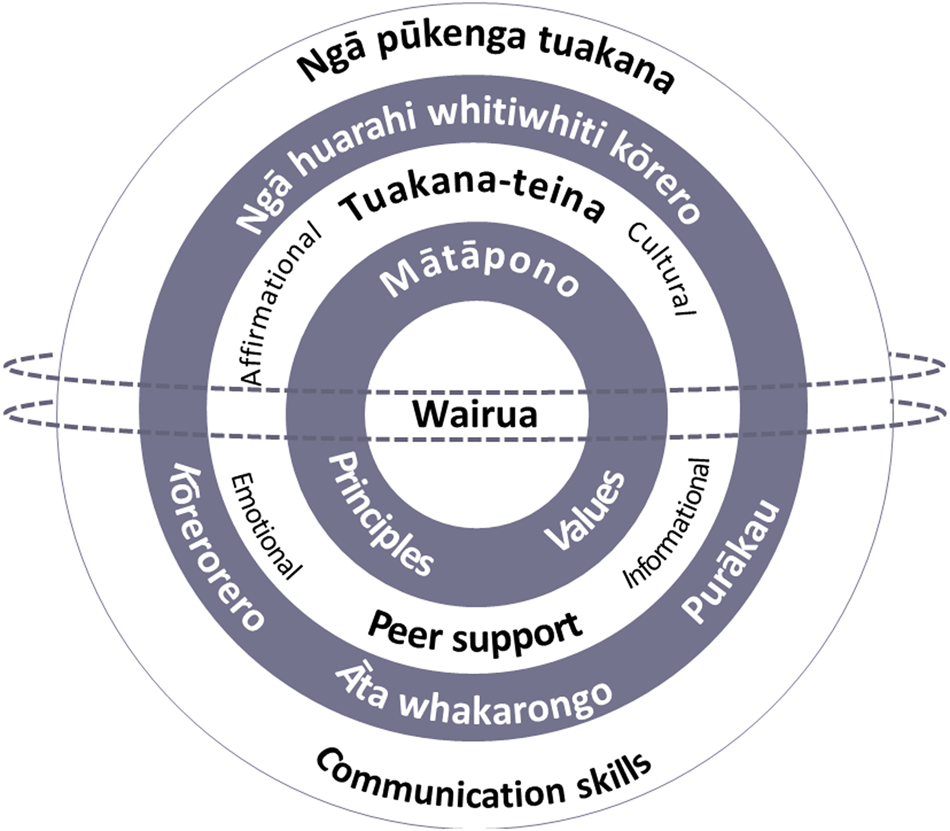
The model (Figure 1) takes a culture-centred, kaumātua-focused approach to depicting connections visually between Māori concepts and values, and practical communication skills, of kaumātua tuakana‒teina/peer support. Each of these aspects is outlined below.
Conceptual model for tuakana‒teina/peer support.

First, ‘wairua’ (spirit) was spoken of frequently in kaumātua focus groups, advisory group and TOP meetings, and the pilot. The BAG discussion (BAG-05) of the penultimate version of the model resulted in wairua being central and all-encompassing and infusing all other dimensions. Wairua is both the heart of the tuakana‒teina/peer support relationship and the ‘wrap-around’ (TOP-21 and TOP-11) protection of the relationship.
Second, ‘mātāpono’ were seen as the pou (poles) of the relationship to guide the tuakana‒teina/peer support relationship. Wairuatanga acknowledges the spiritual aspect in relation to wellbeing, and is enacted through various cultural practices including karakia and whakataukī (proverbs). Manaakitanga is enacted through showing respect, generosity, kindness and support, with whanaungatanga being connected with others and building, maintaining and enhancing relationships, through the practice of values such as manaakitanga. Mana is central to all relationships in te ao Māori, with an activity being concerned with maintaining and uplifting of the mana of those involved. Aroha means having a genuine interest in others and acting in ways that support their wellbeing. Rangatiratanga (self-determination) directly aligns with kaumātua mana motuhake as foundation in this intervention. Kotahitanga concerns solidarity and unity of purpose, and within tuakana‒teina/peer support means having shared goals and acting to promote unity and harmonious relationships. Tautokotanga concerns providing emotional, informational, cultural or other support as needed. Importantly, tuakana and teina identify their own values and principles to connect them with, and guide them in, the role and purpose of tuakana‒teina/peer support. This then enables them to connect with the wairua of the role and mahi (work) as tuakana, and use their skills in a way that best supports teina.
Third, ‘tuakana‒teina/peer support’ embodies the relationship. The four kinds of support offered by tuakana are affirmational, emotional, informational (see Dennis, Reference Dennis2003) and cultural support. Together, these different kinds of support fulfil and realise the tuakana‒teina/peer support relationship.
Fourth, ‘ngā huarahi whitiwhiti kōrero’ (communication skills) bind the tuakana‒teina/peer support relationship. The TOP pilot experience with ‘pūrākau’ and ‘whakawhiti kōrero’ resulted in the inclusion of more forms of communication to better support the tuakana‒teina/peer support relationship. Four different ways of talking, listening, sharing and conversing that facilitate and enable the relationship were identified. First was ‘kōrerorero’: the conversation, talking together, understanding and checking. Second was ‘pūrākau’: sharing stories, experiences, knowledge and feelings. Third was ‘āta whakarongo’: listening with reflective deliberation (Pohatu, Reference Pohatu2004). ‘Āta’ is a cultural concept that helps to set boundaries and create safe spaces for respectful relationships. ‘Whakarongo’ helps to focus the tuakana and teina on listening. Thus, āta whakarongo helps to remind tuakana and teina how to act and be in the tuakana‒teina/peer support situation, and to guide their perceptions within that relationship.
Finally, ‘ngā pūkenga tuakana’ comprise a set of specific communication tools that strengthens the skills, knowledge and experience that the tuakana and teina each brings to the peer support relationship. These include the tuakana checking their understanding of what the teina says, asking permission and asking inviting questions.
In summary, kaumātua tuakana‒teina/peer support relationships are guided by wairua and supported by mātāpono, which are foundational to the four support roles (affirmational, cultural, emotional and informational). The four ngā huarahi whitiwhiti kōrero offer tuakana choices in how to enact peer support, and ngā pūkenga tuakana offer specific conversational tools for tuakana to use.
Discussion
The purpose of this study was to describe the culture-centred development of an intervention involving kaumātua working as peer support for other kaumātua through the Māori concepts of ‘tuakana’ and ‘teina’. The tuakana‒teina/peer support programme focused on kaumātua experiencing life transitions and was co-designed with kaumātua-centred approaches that privileged kaumātua mana motuhake. The findings demonstrate how this strengths-based approach relies on clear culturally founded processes comprising central Māori cultural concepts and communication processes and kaumātua centredness.
The first set of findings centred on the source and guidance of the TOP. This set demonstrates the criticality of responding to health and wellbeing issues identified by the group for whom an intervention is desired (see Dutta, Reference Dutta2007, Reference Dutta2008). In working with advisory groups and kaumātua themselves, the TOP kairangahau were able to engage with local Māori understandings of health and wellbeing and transitions in later life. They were also able to explore understandings and application of Māori concepts, principles and values to support meeting the needs of kaumātua. Consistent with calls for greater community voice in such interventions (Dutta, Reference Dutta2007; Dutta et al., Reference Dutta, Anaele and Jones2013), kaumātua self-determination and ways of knowing enabled a strong community voice in the TOP development. Kaumātua and advisory group leadership in the TOP development is an example of researcher–community partnership that is consistent with calls for better ways to build community capacities in decision-making, advocacy and self-determination in community interventions (Dutta et al., Reference Dutta, Anaele and Jones2013; Wallerstein et al., Reference Wallerstein, Duran, Oetzel and Minkler2018).
The second set of findings centred on the TOP pilot. These findings demonstrate the importance of the ability and responsibility to respond culturally, in the development of an intervention, and reflexivity of those involved in that development. In acknowledging, encouraging and responding to cultural input and preferences of kaumātua during the pilot, the programme developers ensured that the TOP retained its culture-centredness in the present and therefore for the future. Reflexivity is embedded in culture-centred approaches (Dutta, Reference Dutta2007, Reference Dutta2008) and was evident in the TOP kairangahau interrogating their role in their initial use of the concept whakawhiti korero, and their subsequent changes.
In noticing that they had got stuck on a particular communication tool, and needed to allow kaumātua to determine the nature of communication, the TOP kairangahau acknowledged the taken-for-granted nature of power in their position (see Dutta, Reference Dutta2007, Reference Dutta2008). This change in stance aligns directly with calls from advocates of cultural safety to rethink approaches to needs of marginalised groups (Kearns and Dyck, Reference Kearns and Dyck1996: 374) so as to ‘speak less about and more with “them”’. In engaging reflexively with dimensions of power and privilege (Ramsden and Spoonley, Reference Ramsden and Spoonley1993; Ramsden, Reference Ramsden, Whaiti, McCarthy and Durie2002) in their role, and by re-evaluating and expanding understandings of communication, the TOP kairangahau rebalanced power towards the kaumātua and the necessary Māori cultural knowledge for developing interventions (Ramsden, Reference Ramsden, Whaiti, McCarthy and Durie2002; Mane, Reference Mane2009).
The third set of findings highlights the outcomes of a culture-centred framework comprising the CHS plan, resource kete and the (visual) conceptual model. The framework is the result of researcher–community partnership and an example of what can happen when researchers work with community members to develop culture-centred and life-stage relevant interventions. Specifically, in working with kaumātua for kaumātua, at the various stages throughout the period of developing the TOP, the kairangahau privileged and engaged Māori epistemic knowledge.
The team envisioned tuakana‒teina/peer support through the Māori woven world (Marsden, Reference Marsden and King1992) where kaumātua knowledge and its potential, and the mana of kaumātua and their knowledge, are engaged together to facilitate becoming tuakana. The outcome was that kaumātua could be tuakana and give peer support to other kaumātua in the lived world. The significance of tuakana‒teina/peer support as different from everyday whānau and community support networks became evident in kaumātua comments about the TOP giving them the chance to take part in this kind of conversation, and their engagement with Māori concepts, tikanga, mātāpono and pūrākau during the pilot. The outcome was a co-constructed framework informed by cultural world-views and everyday experiences of Māori kaumātua. The process and outcome aligns with calls for local solutions to locally identified needs (Ramsden, Reference Ramsden, Whaiti, McCarthy and Durie2002; Basu and Dutta, Reference Basu and Dutta2009; Mane, Reference Mane2009; Peterson, Reference Peterson2010; Dutta et al., Reference Dutta, Anaele and Jones2013).
Together the findings suggest that culture-centred programmes such as the TOP may help to counter for kaumātua, the negative health outcomes that stem from ‘distal effects of colonisation’ (Dulin et al., Reference Dulin, Stephens, Alpass, Hill and Stevenson2011: 1420) such as unconscious bias and discrimination at structural and interpersonal levels. The for-kaumātua-by-kaumātua approach in the programme design, kaumātua partners within the BAG, and input from experts in health and social services for kaumātua and other older people more widely, helped to surface the cultural and experiential knowledge of those most impacted by the TOP: kaumātua. The TOP programme appears to enable kaumātua to pass on mātauranga (Kēpa et al., Reference Kēpa, Kēpa, McPherson, Kameta, Kameta, Port, Loughlin, Smith and Reynolds2014) to other kaumātua, and increase support exchange opportunities (Antonucci et al., Reference Antonucci, Birditt, Sherman and Trinh2011) especially at points of life transitions (Isherwood et al., Reference Isherwood, Luszcz and King2015). In this way, the programme supports kaumātua to continue to contribute within whānau, hapū and iwi groups (Durie, Reference Durie2003), as well as non-traditional collectives such as urban marae and community agencies, in explicitly peer-to-peer ways. This culture-centred programme supports kaumātua aspirations to maintain tino rangatiratanga and mana motuhake so that they may reach their full potential, and be able to experience culture-centred ageing well.
In summary, the findings show that the key components for a culture-centred approach to develop tuakana‒teina/peer support intervention for kaumātua experiencing life transitions are partnership and communication processes that support that partnership. It is within those components that the Maori concepts, processes and factors that inform the intervention are sought out, offered, explored and applied.
Conclusion
The purpose of this study was to describe the culture-centred development of an intervention involving kaumātua working as tuakana‒teina/peer support educators for other kaumātua. The study has implications for theory, practice and future research.
In terms of theory, the study highlights the benefits of applying Indigenous epistemic knowledge to a critical issue affecting Māori kaumātua: that is, engaging Māori epistemic knowledge and the experience of kaumātua as carriers of cultural knowledge (Ministry of Social Development, 2010; Kēpa et al., Reference Kēpa, Kēpa, McPherson, Kameta, Kameta, Port, Loughlin, Smith and Reynolds2014) in a programme to help with managing transitions, health and wellbeing in later life. In this way, the study extends what is known about culture-centred approaches to issues of health and wellbeing in older age, and offers a response to calls for Indigenous and minority groups to be partners in the development and delivery of culture-centred health and wellbeing interventions (Ramsden and Spoonley, Reference Ramsden and Spoonley1993; Dutta, Reference Dutta2007; Minkler et al., Reference Minkler, García, Williams, LoPresti and Lilly2010; Peterson, Reference Peterson2010; Wallerstein and Duran, Reference Wallerstein and Duran2010) to help address health inequities experienced by, in this case, Māori kaumātua (Ministry of Health, 2016).
In terms of practice, the full study once completed has the potential to offer a published manual, resource kete and CHS plan. As we go into the implementation phase, these resources will continue to be refined and developed. The TOP is offered as an example of how culture-centred approaches to health and wellbeing in later life may be developed; it is not a prescription. Thus, within the context of structural ageing and increasing individual longevity in society, the study offers a theoretical framework comprising values and practices that value and engage the knowledge, experience and cultural world of not only Māori kaumātua, but also potentially older people of other cultures. Engaging kaumātua as co-designers of the TOP may help to improve their potential to age more positively than is currently the case when compared to non-Māori elders (Baker et al., Reference Baker, Zhang, Blakely, Crane, Saville-Smith and Howden-Chapman2016).
The study's limitations are largely related to the small number of participants. However, the study was designed to be illustrative of what is possible in taking a culture-centred approach to developing an intervention. While we have been able to demonstrate some value in taking this approach, the implementation process will help to gauge the full value of the approach. Furthermore, in terms of future research, our study offers theoretical and practical approaches that may be interrogated further.
Finally, the study demonstrates the value in a strengths-based approach that centralises Māori culture and kaumātua potential, capacity and ability, and recognises the continuing value and contributions of kaumātua to society. In this way, the study helps shift the focus from dominant stereotypes of ageing as a burden on society, with evidence of a culture-centred intervention that shows the value of kaumātua supporting kaumātua during transitions in later life. The proverb, ‘Nāu te rourou, nāku te rourou, ka ora ai te iwi; With your basket and my basket the people will live’, underpins the principle of culture-centredness. In relation to Māori kaumātua, and other older people, this proverb speaks to valuing their knowledge and experience in finding collaborative ways to address needs associated with health and wellbeing in later life.
Author ORCIDs
Mary Louisa Simpson, 0000-0002-3915-4897.
Acknowledgements
We are deeply grateful for the support and guidance from the Rauawaawa Kaumātua Charitable Trust Board of Trustees and the Expert Advisory Group in carrying out this valuable work. We also thank Ageing Well National Science Challenge for funding the research. Finally, we express our gratitude to the staff and participating kaumātua without whom this study would not have been completed.
Author contributions
All named authors have made a substantial contribution to: (a) the conception and design, or analysis and interpretation of data; (b) the drafting of the article or revising it critically for important intellectual content; and (c) approval of the version to be published.
Financial support
This work was supported by the Ageing Well National Science Challenge, Kaumātua Mana Motuhake: Kaumātua Managing Life-transitions Through Tuakana–Teina/Peer-education, 1 January 2016 to 30 June 2017 (contract number UOOX1508). The funder played no role in the research itself.
Ethical standards
Ethical approval was granted by the University of Waikato Human Research Ethics Committee on 28 March 2017.