Kawasaki disease is an acute systemic medium-sized vasculitis that causes not only coronary artery aneurysms as late cardiac sequelae but also systemic artery aneurysms. Reference Kato, Sugimura and Akagi1 In patients with severe acute Kawasaki disease vasculitis of less than 8 months, bilateral, multiple, and symmetric systemic artery aneurysms can occur. Reference Ichinose, Akagi and Inoue2,Reference Heran and Hockley3 Systemic artery aneurysms developed in about 10% of the patients with giant coronary aneurysms. Reference Tsuda, Hamaoka and Suzuki4–Reference Hoshino, Tsuda and Yanada6 Therefore, we investigate systemic artery aneurysms in patients with giant coronary artery aneurysms by two-dimensional echocardiography at the initial visit. In Kawasaki disease patients with systemic artery aneurysms, the brachial and internal iliac arteries are the most commonly affected. Reference Cura, Haskal, Weintraub and Benvenisty7,Reference Hirota, Miyakoshi, Yamakawa and Tomita8 Further, occlusions of both arteries in the late period are often found. The fate of systemic artery aneurysms resembles that of coronary artery aneurysms and depends on their acute phase diameters. Small systemic artery aneurysms regressed and large systemic artery aneurysms persisted in the late period. However, the long-term fate of large common iliac artery aneurysms remains unknown, because their prevalence is very low. Reference Amano, Hazama and Hamashima9,Reference Naoe, Shibuya, Takahashi, Wakayama, Masuda and Tanaka10 The aim of this report was to present the clinical course of large common iliac artery aneurysms of more than 20 years after Kawasaki disease in four patients.
Patient 1
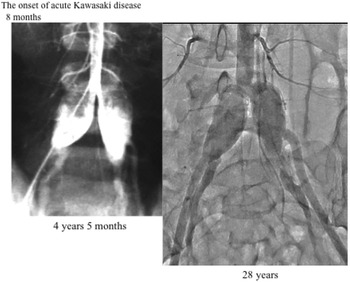
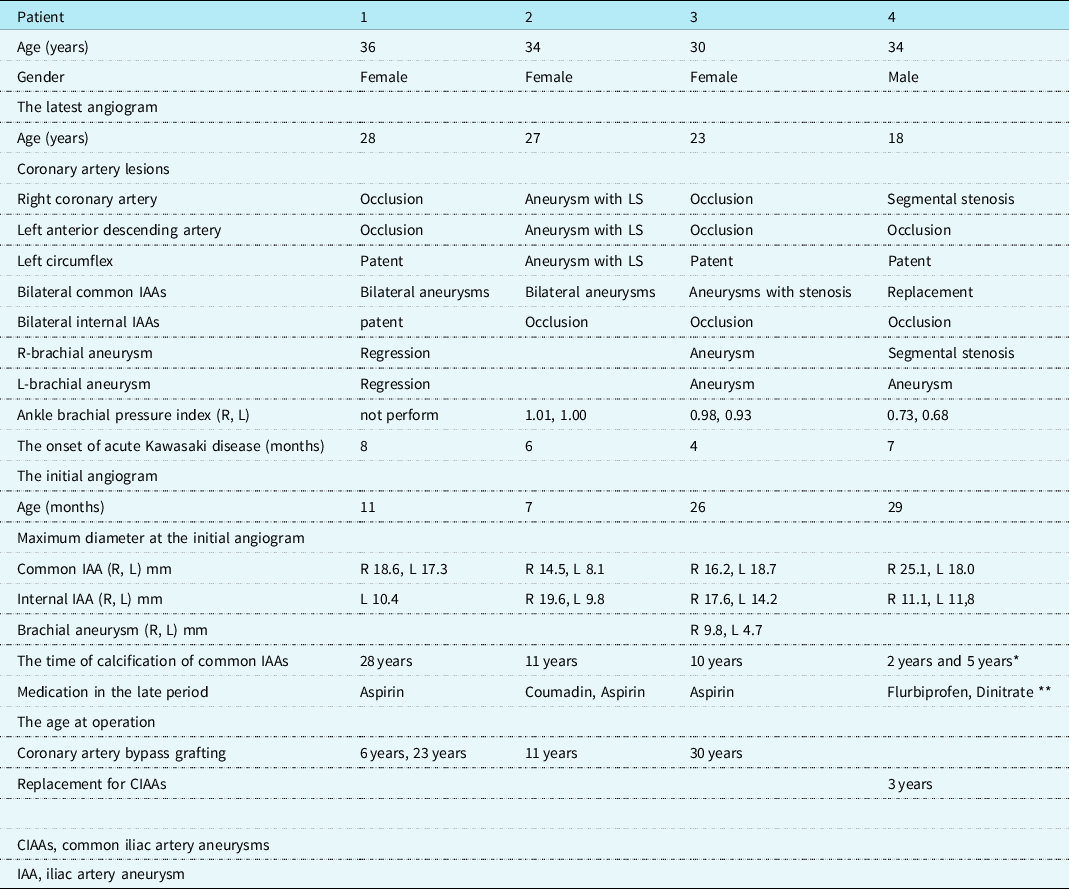
An 8-month-old girl had a fever for 24 days due to acute Kawasaki disease. On her angiograms at the age of 11 months, bilateral giant coronary artery aneurysms and common iliac artery aneurysms were found (Table 1 and Fig. 1 left). Localised stenosis of the left anterior descending artery was detected at the age of 2 years, and she was referred to our hospital. She underwent coronary artery bypass grafting of the left anterior descending artery and an endarterectomy of the left main trunk. One month after the operation, the internal thoracic artery graft was occluded on the angiogram. However, good collateral arteries to the left anterior descending artery developed. Furthermore, complete occlusion of the right coronary artery was also detected. She has had no symptoms. Angiograms revealed complete occlusion of the left anterior descending artery and the right coronary artery at the age of 28 years old. She underwent re-coronary artery bypass grafting. Bilateral common iliac artery aneurysms with calcification also persisted (Fig. 1 right). No significant stenosis of the bilateral common iliac arteries was detected.
. Abdominal aortic angiograms (Patient 1). (Left) At 4 years and 5 months of age. (Right) Bilateral calcified common iliac artery aneurysms persisted at 28 years of age.

Characteristics in patients with large common iliac artery aneurysms caused by Kawasaki disease

* The wall calcification of the IAA was detected on CT.
** The medicine was taken until at the age of 31 years old.
Patient 2
In a 6-month-old girl weighing 8 kg, a fever remitted on the 9th illness day of acute Kawasaki disease after aspirin (30 mg/kg/day) and intravenous immunoglobulin (1 g/day) were administered on the 5th illness day. She had a recurrent fever two times on the 15th illness day and the 30th illness days. She developed acute heart failure and bilateral giant coronary artery aneurysms. On admission to our hospital, a 2/6 systolic heart murmur was heard. Two-dimensional echocardiography showed moderate mitral regurgitation, slight aortic regurgitation and pericardial effusion, and bilateral giant coronary artery aneurysms. The maximum diameter of both coronary arteries on selective coronary angiograms at 7 months of age was 16 mm. An abdominal angiogram also showed bilateral common iliac artery aneurysms and bilateral internal iliac artery aneurysms. When she was 7 years old, localised stenosis of 25% of the right common iliac artery and calcification of the bilateral common iliac artery aneurysms and internal iliac artery aneurysms were seen. Her bilateral internal iliac arteries were occluded at the age of 17 years old. The ankle brachial pressure index (the ratio of the blood at the ankle to the blood pressure in the upper arm) on the right and left were 1.01 and 1.00, respectively. She had been asymptomatic. Coumadin and aspirin were also continued for their antithrombotic action. She had no events during the follow-up in the outpatient clinic. She underwent coronary artery bypass grafting of the right coronary artery, the left anterior descending artery, and the left circumflex artery at 30 years of age, because of localised stenosis. Her left ventricular end-diastolic dimension and left ventricular ejection fraction on two-dimensional echocardiogram at the age of 33 years were 49 mm (102% of normal) and 61%, respectively. Slight mitral regurgitation and trivial aortic regurgitation were also detected on two-dimensional echocardiogram.
Patient 3
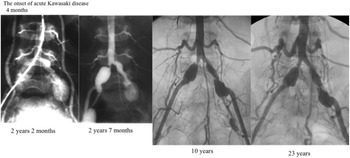
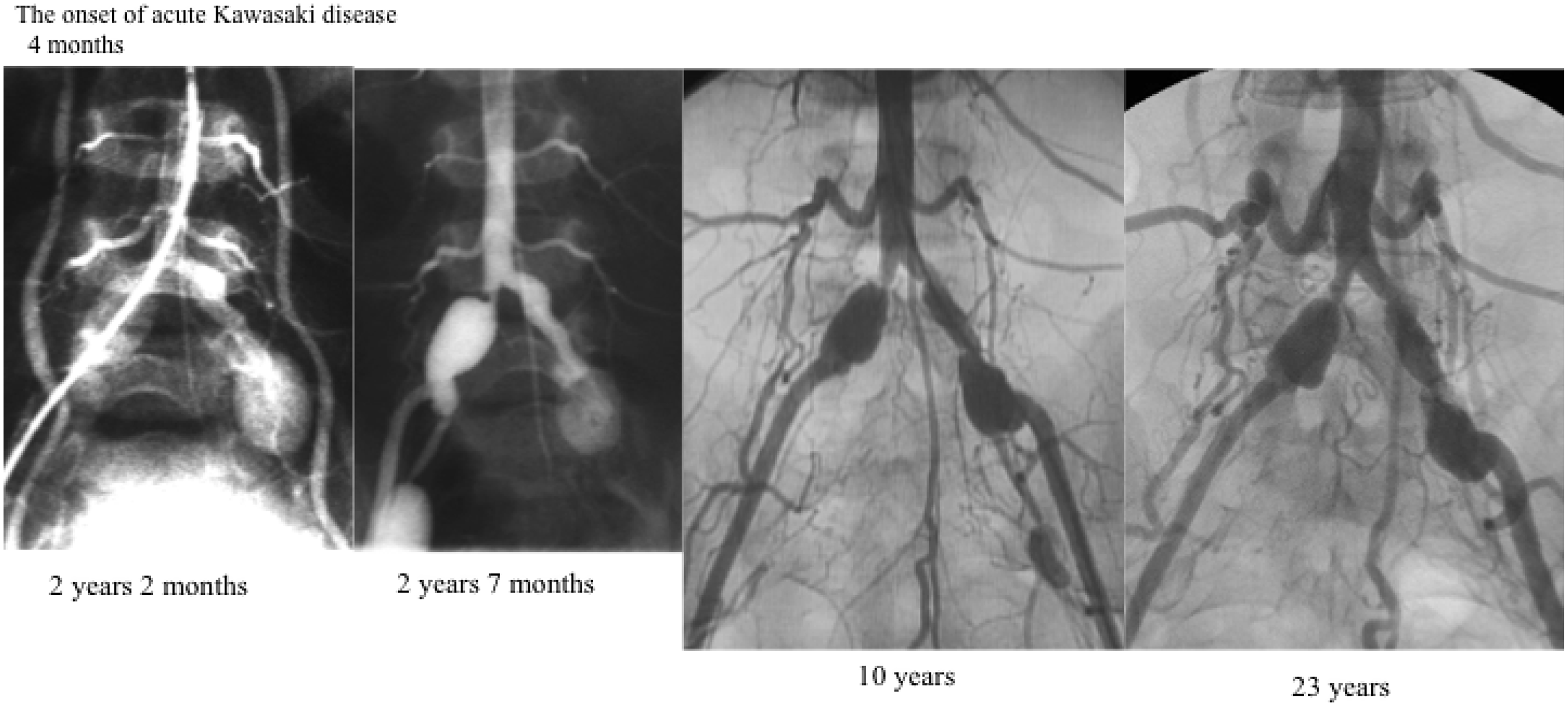
A 2-year-old girl was referred to our hospital. Acute typical Kawasaki disease was diagnosed at 4 months of age. Aspirin and intravenous immunoglobulin (400 mg/kg/day) were given for 5 days. Bilateral giant coronary artery aneurysms were detected on two-dimensional echocardiogram. On the initial angiograms at the age of 2 years, bilateral common iliac artery aneurysms and internal iliac artery aneurysms were found (Fig. 2, left). Furthermore, 75% localised stenosis of the right common internal iliac artery, occlusion of the right internal iliac artery, and the localised stenosis of the left internal iliac artery were found at the age of 2 years and 7 months (Fig. 2, middle). She underwent coronary artery bypass grafting for localised stenosis of the left anterior descending artery at the age of 10 years old. Calcification of the bilateral common iliac artery aneurysms appeared at the age of 10 years old. She had no symptoms due to the localised stenosis of the right common internal iliac artery. Although 75% localised stenosis of the right common iliac artery was detected, there were well developed collateral arteries seen at the age of 23 years old (Fig. 2, right). The same findings were non-invasively detected by magnetic resonance angiogram at the age of 30 years old. Ankle brachial pressure index values on the right and left were 0.98 and 0.93, respectively. She was maintained on aspirin. She has been doing well for 20 years.
Abdominal aortic angiograms (Patient 3). (Left) The angiograms at the age of 2 years and 7 months shows localised stenosis of the right common iliac artery. (Middle) At the age of 10 years, the right internal iliac artery aneurysm was occluded. (Right) At the age of 23 years, the right internal iliac artery aneurysm was occluded. Localised stenosis with calcification of the right common iliac arteries and the collateral arteriesis detected at 23 years of age.
Patient 4
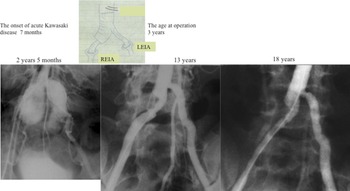
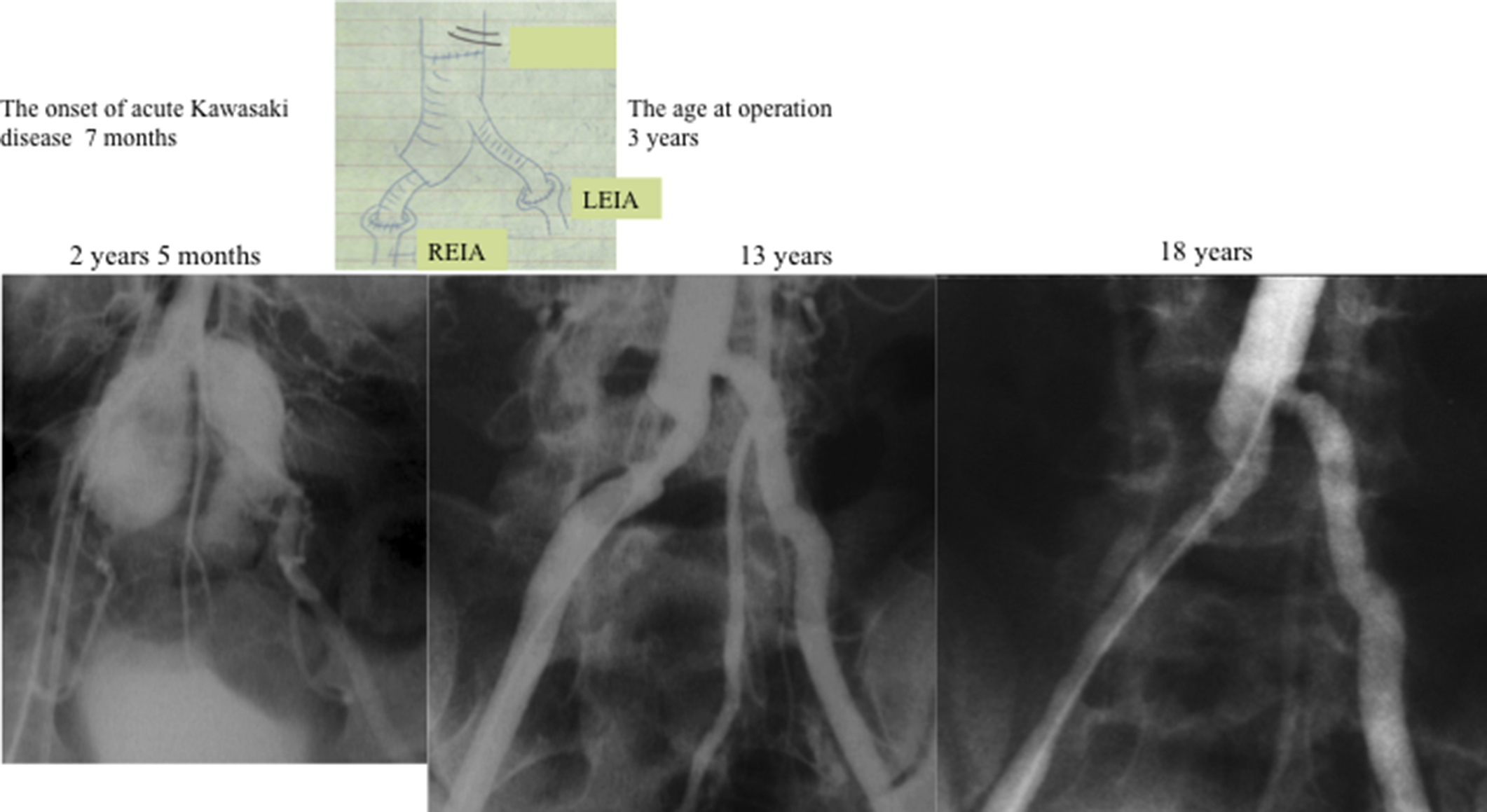
A 7-month-old boy, body weighing 9 kg, had acute typical Kawasaki disease, and aspirin (50mg/kg/day) was given. A pericardial effusion was found on two-dimensional echocardiogram. A gallop rhythm, low voltage and ST-T depression in the right chest leads were detected on the electrocardiogram were detected. On the 19th day, bilateral coronary artery aneurysms were detected on two-dimensional echocardiogram, and a left internal iliac artery aneurysm was suspected. Aspirin and coumadin were taken for 2 months after the acute Kawasaki disease. One year after Kawasaki disease, he sometimes had faintness. An abdominal aneurysm was found on digital subtraction angiography, and the cerebral vessels were normal (Fig. 3, left). He was referred to our hospital at the age of 2 years. Coronary angiograms at 2 years and 5 months showed a complete occlusion of the right coronary artery and left anterior descending artery. Bilateral brachial aneurysms, common iliac artery aneurysms, internal iliac artery aneurysms, and femoral artery aneurysms were found on the abdominal angiogram. Thrombi in the internal iliac artery aneurysms and an occlusion of the right internal iliac artery aneurysm were detected on computed tomography, and calcification of the iliac and femoral artery walls were also detected. He underwent replacement using artificial vessels at 3 years of age, however, he had no symptoms. The angiograms after surgery at the ages of 13 years and 18 years showed no stenoses (Fig. 3, middle, right). The left femoral artery was occluded at 13 years old of age. The pulsations of the bilateral dorsal pedis arteries and right radial artery were not palpable at 18 years of age, but he was asymptomatic. On the thermography, the temperatures of the upper and lower extremities were 34.5°C and 29.8°C, respectively. The ankle brachial pressure index values of the right and left were 0.73 and 0.68, respectively. The coronary angiograms at 18 years of age showed segmental stenosis of the right coronary artery and complete occlusion of the left anterior descending artery, and the collateral arteries to the right coronary artery and left anterior descending artery had developed. Although the right brachial artery was occluded, recanalisation of small vessels was detected on the angiogram. No ST-T changes were seen on the treadmill test. He had obesity, alcoholism, and hypercholesterolaemia from the age of 31 years. His height and weight were 169 cm and 76 kg, respectively. On 99mTc myocardial perfusion imaging at rest, mild hypoperfusion of the anteroseptal wall of the left ventricle was detected at the age of 31 years. His quantitative gated SPECT-left ventricular endo-diastolic volume and left ventricular ejection fraction were 76 ml and 67 %, respectively. He was removed to another area, and was followed-up at another hospital at the age of 31 years old. However, he stopped to visiting the hospital. He died suddenly and unexpectedly at the age of 34 years. Although a legally ordered autopsy was performed, the cause of death was unknown.
Abdominal aortic angiograms (Patient 4). (Left) Before operation (Middle and Right) After operation. REIA = right external iliac artery; LEIA = left external iliac artery.
Discussion
The diameters of brachial and internal iliac arteries are that of medium-sized arteries and are similar to that of the coronary arteries, and it has previously been established that aneurysms including coronary artery aneurysms due to acute Kawasaki disease involve the transitional zone from elastic to muscular arteries. Reference Amano, Hazama and Hamashima9,Reference Naoe, Shibuya, Takahashi, Wakayama, Masuda and Tanaka10 Because the size and histology of the arteries with systemic artery aneurysms resemble that of the coronary arteries, their outcomes appear to be the same as that of coronary artery lesions. Like coronary arteries, the late fate of systemic artery aneurysms also depends on the diameter in the acute phase. Reference Hoshino, Tsuda and Yanada6 A previous study indicated that the cut-off values of the diameters of brachial aneurysms, internal iliac artery aneurysms, and common iliac artery aneurysms in the acute phase leading to stenotic lesions in the late period were 6.8 mm (area under the curve (AUC) 0.96, p = 0.0003, n = 14), 9.4 mm (AUC) 0.75, p = 0.0339, n = 16), and 10.7 mm (AUC) 0.92, p = 0.0035, n = 12), respectively. Reference Hoshino, Tsuda and Yamada11 The occlusion rate of internal iliac aneurysms was the highest for systemic artery aneurysms. However, it seems that the progression of the stenosis is slower for common iliac artery aneurysms than in the coronary arteries and other systemic artery aneurysms; however, our experience is limited because of the small patient number. Reference Cabrera, Sridhar, Chessa and Carminati5 The common iliac artery is elastic artery, and the internal iliac artery is muscular artery. The difference in the progression of the stenosis between the common iliac arteries and the internal iliac artery may be caused by the histology, diameter, and function. Reference Takahashi, Oharaseki, Yokouchi, Hiruta and Naoe12
Regarding the long-term fate of common iliac artery aneurysms, those of greater than 10 mm persisted as calcified aneurysms. There were no symptoms caused by stenotic lesions in the common iliac artery aneurysms after more than 30 years in the present study. The ankle brachial pressure index was preserved, even if stenosis of the common iliac artery occurred in the late period. However, follow-up with ageing is needed in the future. On the other hand, the patient who underwent replacement using artificial vessels had had a low systemic blood pressure, but he had no symptoms. Therefore, the decision for the timing of the revascularisation of the common iliac artery is very difficult.
The cause of death in the fourth patient was unknown. Because he had obesity, hypercholesterolaemia, and alcoholism, in addition to multi-vessels coronary artery lesions, acute coronary syndrome due to atherosclerotic factors with ageing may have contributed to his death. Furthermore, a fatal arrhythmia due to myocardial involvement may have occurred. It was unfortunate that he had dropped out of the follow-up at the hospital. Patients with systemic artery aneurysms had severe coronary artery lesions, and the incidence of their cardiac events was high. Careful follow-up is mandatory.
All patients in this study were seen in the 1980’s and 1990’s, prior to the current advances in the treatment of acute Kawasaki disease. Today, the appearance of systemic artery aneurysms is very rare. However, screening for systemic artery aneurysms by physical examination of the brachial arteries and echocardiography in patients with giant coronary aneurysms is recommended. To confirm systemic artery aneurysms, non-invasive imaging modalities such as computed tomography angiography and magnetic resonance angiography of the extremities should be performed.
Conclusions
In the long-term, common iliac artery aneurysms greater of 10 mm persisted as calcified aneurysms. However, they had no symptoms due to common iliac artery aneurysms, and the ankle brachial pressure index was preserved because of the development of collateral arteries, even if the stenosis of the common iliac artery occurred in the late period. The progression of stenosis of the common iliac artery after Kawasaki disease was slower.
Acknowledgements
None.
Financial support
This research received no specific grant from any funding agency, commercial, or not-for-profit sectors.
Conflicts of interest
None.
Ethical standards
All procedures performed in studies involving human participants were in accordance with the ethical standards of the institutional committee with the 1964 Helsinki declaration and its later amendments or comparable ethical standards.