Significant outcomes
• ECT is a safe and effective treatment for depressive disorders arising post-CVA
• Maintenance ECT is effective in preventing relapse following an index ECT series.
Limitations
• There was no objective rating scales to quantify patient symptomatology or side effects from treatment.
• Patients' care was not uniform in terms of ECT dosing, schedule or lead placement.
• The authors were involved in the clinical practice and treated some of these patients, introducing a potential bias in data extraction.
• Need for prospective study utilising a non-ECT control group.
Introduction
Depressive syndromes are common in patients after cerebrovascular accident (CVA), affecting 20–50% of patients in the first year (Reference Robinson1). While antidepressants can be effective in treating some patients (Reference Paranthaman and Baldwin2), many do not respond or have symptoms so severe as to prompt more immediate intervention.
Electroconvulsive therapy (ECT) is a safe and rapidly effective treatment of depression in elderly patients and in those with medical comorbidities (Reference Nuttall, Bowersox and Douglass3), including those with central nervous system (CNS) lesions and vascular pathology (Reference Rasmussen, Perry, Sutor and Moore4,Reference Weintraub and Lippmann5,Reference Anwar and Brakoulias6,Reference Malek-Ahmadi and Hanretta7). Previous studies have shown ECT to be safe and effective in treating post-CVA depression. Murray et al. (Reference Murray, Shea and Conn8) reported improvement in 12 of 14 depressed patients, and Currier et al. (Reference Currier, Murray and Welch9) reported improvement in 19 of 20 depressed patients treated with ECT after CVA, and most patients in both the studies tolerated this treatment modality well.
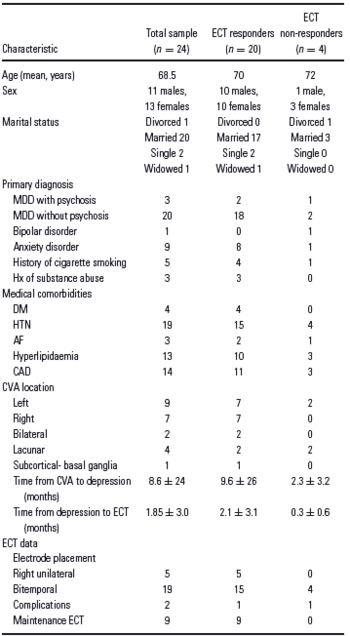
In this study, we report the outcomes of 24 post-CVA mood disorder patients treated with ECT. Our findings reinforce the previous studies, confirming that ECT is a safe, effective treatment of this patient group, and we suggest that ECT be considered as a viable treatment modality in patients with post-CVA depression (Table 1).
Patient's demographics and diagnosis

AF, atrial fibrillation; CAD, coronary artery disease; DM, diabetes mellitus; HTN, hypertension; Hx, history; MDD, major depressive disorder.
Materials and methods
This study is a retrospective chart review. All patients were hospitalised for mood disorder, most commonly unipolar or bipolar depression, on a Medical Psychiatry in-patient unit between 2000 and 2010, and each received a course of ECT as treatment for the depressive symptomatology that arose after a stroke. Using an electronic medical database query engine, we identified 24 patients with a history of CVA subsequently treated for a mood disorder with ECT between December 2000 and December 2010. Age, gender, anatomical location of stroke, psychiatric diagnosis, ECT parameters (electrode placement, number of treatments and seizure length) and clinical efficacy and side-effect data were extracted from the clinical notes.
The diagnosis of stroke was verified in the clinical records as having been made by a neurologist based on neuroimaging studies or review of outside medical records. Mood disorders were diagnosed by a psychiatrist using DSM-IV-TR (Reference Rasmussen, Stevens, Kung and Mohan10) diagnostic criteria.
Electroconvulsive therapy
Seizures were induced by a Thymatron system-IV device (Somatics, Inc., Lake Bluff, IL, USA) using a dose titration schedule with treatment at 1.5 times seizure threshold for bitemporal and bifrontal lead placement, and 6 times seizure threshold for right unilateral lead placement. Lead placement selection was determined at the clinical discretion of the treating physicians at the time of hospitalisation. Frequency of treatment and duration of treatment series were determined clinically on the basis of patient response and toleration of ECT treatments. Thiopental anaesthesia and glycopyrrolate were followed by succinyl choline for muscle relaxation.
Results
Patient population
Twenty-four patients (11 males and 13 females), 23 Caucasians and 1 Hispanic with a mean age of 68.5 years were identified as having received ECT for a mood disorder following CVA.
Psychiatric diagnoses
Twenty-four of 24 patients (100%) met DSM-IV-TR criteria for a mood disorder (23 with depressive disorders and 1 with catatonia secondary to bipolar disorder) based on clinical interview by a board-certified psychiatrist. Ten of these patients presented with suicidal ideation.
CVA data
All patients had experienced thromboembolic strokes, confirmed either by head imaging or by medical history and physical examination. Nine patients had left hemispheric strokes, seven had right hemispheric strokes, two had bihemispheric strokes, four patients had lacunar infarcts and one patient had bilateral basal ganglia strokes. One patient had middle cerebral artery stroke with no further details as to specific location.
Mean time interval from stroke to onset of depression was 8.6 months (SD = 24). At least nine patients developed depression in less than 1 month. For two patients, the exact date of depression onset was unknown.
Medical comorbidity
Mean comorbid medical diagnoses, 3.9 (range: 0–17); Diabetes mellitus, 4 patients; hypertension, 19 patients; coronary artery disease = 14 patients, hyperlipidaemia = 13 patients and atrial fibrillation = 3 patients.
Electroconvulsive therapy
The mean time interval from the onset of depression to first ECT treatment was 1.85 months (SD = 3.0). Patients received an average of 7.3 treatments (range: 2–15). Eight patients received ECT less than a month after stroke, nine received treatment from 1 month to 14 months after stroke, two patients after 30 months and one patient was treated 135 months after stroke. Nineteen patients were treated with bitemporal electrode placement and five patients were treated with right unilateral electrode placement.
Outcomes
Twenty patients (83%) experienced a positive response to the treatment. This group received between 2 and 15 treatments (mean: 7.6, SD = 3.2). Four patients (17%) showed little improvement, despite receiving three to nine treatments. None of the patients was described as experiencing any worsening of depression after the ECT.
Adverse reactions/complications
Three patients suffered from minor complications of ECT. Two experienced prolonged post-ECT confusion and later complained of short-term memory problems. One patient reported nausea. None experienced exacerbation of neurological sequela of post-CVA neurological deficits, and there were no observed new onset neurological symptoms after ECT.
Discussion
While several studies have shown the efficacy of antidepressants and stimulants in treating post-stroke depression, many study patients did not successfully respond to pharmacotherapy (Reference Paranthaman and Baldwin2). As post-CVA mood disorders are common, identifying efficacious treatment strategies is important in managing stroke patients. In this study, 20 of 24 patients (83%) with a mood disorder following CVA responded well to ECT, a finding consistent with previous studies. ECT was safe and well tolerated by the study patients, with few side effects despite advanced age and multiple medical comorbidities. Further underscoring the efficacy of ECT for this population, nine patients went on to receive maintenance ECT, which was effective in the prevention of relapse in all patients.
While our study found few significant ECT side effects, age, history of CVA and comorbid medical conditions place patients at greater risk of complications compared with general populations receiving ECT. As the majority of medical complications from ECT are cardiac related (11), and as most CVA patients have associated cardiovascular risk factors, there should be a strong emphasis on the evaluation and optimisation of cardiac status prior to treatment, in the treatment suite, and throughout the course of the ECT treatment series.
The American Psychiatric Task Force on ECT notes that while the risk of intracerebral infarct is small in patients with stable lesions, care should be taken to assure the hypertensive surge associated with seizure is pharmacologically blunted while assuring adequate blood pressure to maintain good CNS perfusion (11). Additionally, many post-CVA patients are on anticoagulants, necessitating careful monitoring of coagulation studies throughout the treatment course.
There is a growing body of evidence that ECT is a safe and effective treatment for mood disorders in patients with neurologic injury or disease. There is no clear evidence that ECT has a negative impact on long-term cognitive functioning even in young patient's population (Reference Walter, Robertson, Rey, Soh and Malhi12). This study supports the notions that ECT in stroke patients specifically, and in patients with neurologic injury generally, is a safe and effective treatment for mood disorders. Clinicians should strongly consider using ECT when treating these patient populations, particularly when symptoms are severe or medications have failed. Maintenance ECT should be considered for responsive patients, particularly if symptoms recur once the ECT series has been completed.
At the onset of this study, we had hoped to characterise ECT response related to stroke location. Our sample size was too small to delineate whether stroke location has an effect on clinical outcome. Pooled data sets or a larger future study may be informative in this regard. A potentially confounding factor in our study is that all patients were hospitalised for their depression on a psychiatric unit. The therapeutic milieu, support and unit activities may all have contributed significantly to patient outcomes. Additionally, the role of antidepressants in the therapy is very difficult to assess. With this being a naturalistic, retrospective study, medication changes occurred for many patients throughout the course of care, making it more difficult to conclude that ECT alone was responsible for the clinical improvement.