Introduction
Crabeater seals (Lobodon carcinophaga (Hombron & Jacquinot)) are circum-Antarctic and probably the second most abundant pinniped (after harp seals). Current estimates suggest that there are at least five million individuals, primarily distributed in the pack ice zone around Antarctica, and also, rarely, along the far southern margins of Australia, New Zealand, Africa and South America (Bengtson Reference Bengtson2009, Bengtson et al. Reference Bengtson, Laake, Boveng, Cameron, Hanson and Stewart2011). Despite their common name, it is well known that their diet is dominated by Antarctic krill, Euphausia superba Dana, which accounts for up to c. 95% of their food intake (Øritsland Reference Øritsland1977, Huckstädt et al. Reference Huckstädt, Burns, Koch, McDonald, Crocker and Costa2012), and which they catch using their multi-lobed teeth as a sieve. Individuals make repeated dives in feeding sessions lasting up to 44 hours during the summer foraging season (Bengtson Reference Bengtson2009).
It has been anecdotally suggested that crabeater seals forage cooperatively (Gales et al. Reference Gales, Fraser, Costa and Southwell2004). This paper reports on observations of a large group of crabeater seals engaged in protracted and clearly organized feeding behaviour at Pleneau Island (western Antarctic Peninsula). These observations were made during an expedition on the MV Polar Pioneer.
Observations
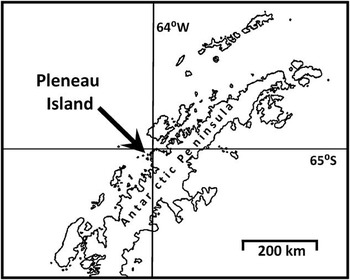
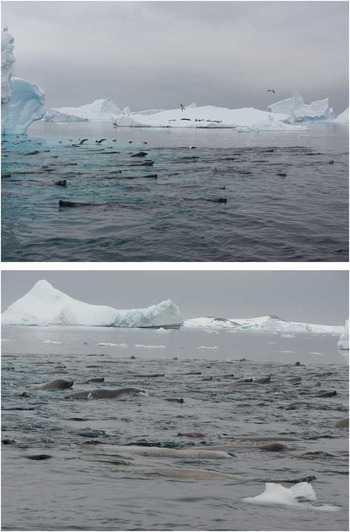
On the morning of 23 February 2012, the Polar Pioneer anchored off Pleneau Island (65°06′S, 64°04′W; Fig. 1), a popular site for ecotour visits owing to the large number of grounded icebergs in the shallow water immediately north and north-west of the island. The weather was calm and dry, with overcast skies, a temperature of 1–2°C and a large amount of brash ice present. While cruising in small inflatable boats, we observed a large group of crabeater seals, estimated at c. 300–350, surface in unison alongside a large grounded iceberg. The group continued to dive repeatedly and synchronously (Fig. 2). During each dive the entire group stayed submerged for 4–5 minutes, then all surfaced within several seconds of one another in a concentrated area and almost all with the same orientation (Fig. 2), staying on the surface for 4–5 minutes between dives. At times, the seals were subdivided into two groups separated by tens of metres, but continued diving in the same manner. We observed this behaviour occur repeatedly and cyclically over approximately one hour. We left the area, returned one hour later, and the seals were still engaged in synchronous, coordinated diving and resurfacing. The feeding behaviour was still continuing at the same intense level of activity c. 2.5 hours after initially sighting the seals.
Location of Pleneau Island along the western Antarctic Peninsula.

Two views of the cooperatively foraging group of crabeater seals (Lobodon carcinophaga) off Pleneau Island on 23 February 2012. Each view shows a portion of the group of seals shortly after surfacing following coordinated dives, note the aligned orientation of the seals. Kelp gulls (Larus dominicanus) can be seen around the seals. Photos taken by MDG.

Abundant krill were clearly visible, with some emerging above the surface. Several seals were seen feeding on the jumping krill. We also noted a large volume of brownish-pink faecal matter suspended in the water.
Speculation at the scene was that the seals were coordinating their efforts and feeding cooperatively. By diving together, the seals were collectively herding the krill against the submerged portions of icebergs, thereby concentrating the krill and maximizing feeding opportunities for the group.
Several dozen kelp gulls (Larus dominicanus Lichtenstein) were also actively feeding on krill at the surface alongside the seals or standing nearby on floating ice. Smaller groups of 5–15 seals were hauled out on icebergs in the immediate vicinity.
Discussion
Gales et al. (Reference Gales, Fraser, Costa and Southwell2004) suggested that L. carcinophaga may forage cooperatively at sites where krill are heavily concentrated. It is likely that this style of feeding occurs when krill are densely abundant and can be effectively concentrated against icebergs in a setting such as Pleneau Island. Other pinniped species are known to forage cooperatively, including leopard seals (Hydrurga leptonyx (de Blainville)) which have been observed cooperating to catch penguins (Heithaus & Dill Reference Heithaus and Dill2009). This behaviour that we observed at Pleneau Island more directly and firmly establishes that this is a feeding mode employed by crabeater seals. The behaviour indicates that crabeater seals are flexible in their feeding strategies and are able to opportunistically engage in cooperative foraging, featuring stylized, repetitive and synchronous activity, when such a strategy conveys an advantage to individuals in the group in catching Antarctic krill, their primary food source.
Acknowledgements
I thank Aurora Expeditions and Fathom Expeditions for the opportunity to be on the Polar Pioneer, and all the expedition staff, ship's crew and passengers who were on board. Thanks also go to J. Burns and R.E. Fordyce for their informative feedback, and to P. Boveng for his helpful review of this paper.