I. INTRODUCTION
The tariff debate between free trade advocates and protectionists at the end of the nineteenth century and at the beginning of the twentieth directed scholars’ attention particularly to anti-dumping policies and, consequently, to the need to systematize the theory of dumping.
The practice of export dumping on the part of many manufacturing industries of the industrial nations, especially those organized into producers’ trusts and combinations like Germany, increased systematically after 1890. This growing phenomenon brought with it a voluminous literature on dumping as a by-product of the study of action by industrial trusts.Footnote 1 It identified some salient features of dumping: a) protection and cartelization facilitate export dumping by limiting price competition in the domestic market; b) cartelization makes systematic and continued dumping possible; c) export dumping has as its predominant objective the maintenance of both full production and stable and profitable domestic prices, and, only secondarily, the development of export trade; d) predatory motives were not predominant, but they were a more important factor in German dumping than in the dumping of other countries; e) export dumping of raw materials practiced by cartels endangers the competitiveness of the industries that employ raw materials in their production process; it causes vigorous complaints, which induce the adoption of compensation policies. All the above points were central in the German literature on cartels’ practices.
In the history of economic thought, the first classic theoretical treatment of dumping in the literature is considered to be Viner (Reference Viner1923), which was welcomed in the English-speaking world as a substantial contribution to the literature on the theory and practice of dumping; and for many years it “remained the standard work in the field” (Bloomfield Reference Bloomfield1992, p. 2064). This remarkable and still relevant treatment of the subject overshadowed the work of some scholars prior to Viner who had contributed to such a theoretical systematization. The first theoretical attempt to systematize the subject was made at the beginning of the 1900s, principally by Taussig, Hobson, Dietzel, Pigou, and Shortt, who, between 1904 and 1906, highlighted some key questions concerning both the nature and the typology of dumping. In 1904, Frank Taussig,Footnote 2 in his presidential address to the American Economic Association devoted to the doctrine of free trade, defined dumping as sales of goods in foreign countries at less than normal price and considered the arguments against dumping. The objection against dumping centered on its temporary character, but, Taussig rhetorically asked, if it went on indefinitely, where was the harm? The key question, Taussig continued, concerned the temporal character of dumping: sporadic or continuous. In the same year, Hobson (Reference Hobson1904) referred to dumping as sales below costs by firms seeking to unload unmarketable production surplus at a profit in distant foreign markets, the purpose being to avoid the effects of output restrictions in their home market. Although Hobson considered the potential profitability of such action in a free competitive market, he maintained that “If dumping is regarded as anything other than a small causal incident, it requires either protection of the home market or closely concerned action of the body of manufacturers in a trade, or both, as indispensable conditions” (Hobson Reference Hobson1904, p. 52). Taussig and Hobson both considered dumping to be a form of price discrimination, and the reason for such discrimination was the problem to be theoretically solved. One year later, in a paper published by The Economic Journal in 1905, the German economist Heinrich Dietzel, who contributed greatly to the debate on the new aspects of competition at that time, defined two types of dumping—occasional dumping and trust-dumping, where the former is temporary and the latter is permanent: “The former occurs whenever, and as soon as, there is over-production in foreign countries; the latter forms a chronic phenomenon, due to the fact that trusts in protectionist countries are able to sell at lower prices to the foreigner and at higher prices to their countrymen” (Dietzel Reference Dietzel1905, p. 2). In the same journal, Arthur C. Pigou (Reference Pigou1905) criticized Dietzel for disregarding an important distinction between the effects of temporary dumping plus protection on the stability of production and the probability of temporary dumping alone; i.e., given any trade regime, to be beneficial at all in that respect. In 1906, in a paper published in the Quarterly Journal of Economics, the Canadian economic historian Adam Shortt differentiated between regular and continuous dumping, and temporary and exceptional dumping. Shortt, as opposed to Dietzel and in accordance with Taussig, saw evil in sporadic dumping rather than in permanent dumping.
The next step in the theoretical systematization was, as we will try to show, the most important contribution to dumping theory in the classic period before Viner. This was the analysis conducted by the Italian economist Pasquale Jannaccone (1872–1959) in two long articles both written in Italian in 1914: the first was entitled “Il dumping e la discriminazione dei prezzi” and published in a special issue devoted to dumping of Riforma sociale, an important Italian academic journal edited at that time by Luigi Einaudi; the second—a supplement, essentially, to the first, devoted to the effects of dumping on national and foreign markets—was entitled “Prezzi di guerra: a proposito di sindacati, di dumping e di protezione” and published in the Rivista delle società commerciali (then Rivista di Politica Economica). The first article was known to Viner, who listed the Riforma sociale symposium in his references, but he quoted it in the part of his volume (Viner Reference Viner1923, p. 64) where the empirical facts are discussed.
Jannaccone’s articles came to the attention of economists only more than twenty years afterwards, when they were reprinted in Jannaccone’s book Prezzi e mercati (1936) and reviewed in some leading international journals. When reviewing it in Economica, Marian Bowley (Reference Bowley1937) considered it “an important contribution to the literature on dumping” (p. 229):
Signor Jannaccone’s statement of the conditions under which discrimination is possible and his analysis of dumping simply as the particular case where markets happen to be divisible on geographical lines is admirable. So also is his classification of the types of dumping, distinguishing between dumping to get rid of temporary surpluses, to make possible a larger output and to force a rival to come to terms (pp. 229–230).
Twenty years later, in 1955, an English translation of Jannaccone’s first article (“Dumping and Price Discrimination”) was published in the fifth volume of a series edited by the International Economic Association, The International Economic Papers. In his review of the volume, Harry Johnson (Reference Johnson1956) called it a “brilliant precursor of imperfect competition theory.” In another review, Robert Solow (Reference Solow1956) maintained that it was an “excellent discussion of the condition and purposes of price discrimination,” but admitted he was unable to say “whether this sort of things was advanced for 1914” (p. 982). Since then, for the community of economists, Viner (Reference Viner1923) has represented the only reference to the early literature on dumping—its classic period. Also, Ethier (Reference Ethier1982), who made the first most important contribution to the revival of dumping theory in contemporary economics, although he recognized that “we have an enormous stock of pre-World War II publications on the subject” (p. 488), nevertheless referred solely to Viner (Reference Viner1923) and Haberler (Reference Haberler1936) in order to present the classic theory of dumping.
The formation of the classic theory of dumping is indeed a neglected topic in the literature, and contributions other than Viner’s have been largely forgotten. The aim of this paper is to show the relevance of Jannaccone’s theory. As we have just shown, there already existed a body of scientific literature on dumping before Jannaccone’s article was published. Indeed, his contribution was based on the previous rich German and English literature, which furnished him with empirical material and suggestions for theoretical connections. Nonetheless, his originality and novelty in respect to this literature are, according to us, indisputable: indeed, Jannaccone himself claimed recognition of his theoretical originality in the preface to Prezzi e mercati (1936):
A contribution to the theory of imperfect competition is represented by the two 1914 essays, where dumping is studied as a case of price discrimination; price discrimination … is considered as the characteristic of imperfect competition, and imperfect competition .... is considered the most appropriate configuration to reflect the situation of a real market. These are now common opinions, but I do not think that it was so at the time when these essays were written. Until then, the literature on dumping had been essentially practical and financial in nature, and only my distinguished opponent in the debate on the nature and effects of dumping [Cabiati] had previously transposed the issue to the field of pure theory [Un contributo alla teoria generale della concorrenza imperfetta sono I due saggi del 1914, nei quali il dumping è studiato come un caso di discriminazione dei prezzi; la discriminazione dei prezzi … è posta come la caratteristica della concorrenza imperfetta, e la concorrenza imperfetta … è considerate come la configurazione più confacente a rispecchiare la situazione di un mercato reale. Queste sono ora opinioni di pubblico dominio, ma non credo fossero tali quando quei due saggi furono scritti. La letteratura sul dumping era stata sin allora di carattere prevalentemente pratico e finanziario, e solo il mio insigne antagonista nella disputa sulla sua natura e I suoi effetti (Cabiati) aveva per la prima volta trasportato l’argomento nelle regioni della teoria pura] (pp. 21–22).
Section II presents the theoretical origins of dumping in Jannaccone’s essays: we first examine the most relevant aspects of the debate on the theory of dumping in Riforma sociale, March 1914; in particular, Attilio Cabati’s contribution and Jannaccone’s criticism. We then present Jannaccone’s theoretical propositions on imperfect competition and price discrimination, his taxonomy of dumping. Section III contains the analytical basis for a theory of price discrimination and its application to the profitability of dumping, as brilliantly outlined by the Italian economist. Section IV proposes his investigation on the effects of dumping in both domestic and foreign markets. Section V is devoted to a comparison between Jannaccone’s and Viner’s analyses in order to highlight the generality of the theory of dumping developed by Jannaccone. Section VI provides some final remarks.
II. A RECONSTRUCTION OF JANNACCONE’S DUMPING THEORY
Riforma sociale, March 1914: A Debate on Dumping Theory
Schumpeter wrote that Italian economics, independently of Pareto, “was second to none by 1914” (Schumpeter Reference Schumpeter1954, p. 855) and had “attained a high level in a variety of lines.” He considered Luigi Einaudi’s work to be representative of a school of thought that “really fertilized general economics” (ibid.). In the period around 1900, and until the 1930s, Einaudi was the leader and one of the masters, together with Attilio Cabiati and Pasquale Jannaccone, of the “Torino school of economics.” This was characterized by a liberal vision and a methodological-theoretical framework, which performed an essential mediating role between historical-empirical inquiry and economic theory in both Marshallian and Paretian perspectives.Footnote 3 In the years before the First World War, Luigi Einaudi and the group of liberal economists belonging to the Torino economic school conducted, in their journal Riforma sociale, a constant battle against monopolies and protectionism. In 1913, in agreement with his close friend and collaborator Cabiati, Einaudi decided to devote a special issue of the journal—that of March 1914—to a discussion of dumping. The symposium was entitled “Polemizzando intorno al dumping” (“Arguing about Dumping”), which was considered to be one of the most controversial problems in international political economy at that time and particularly important in discussions on Italy’s political and business milieu. Protectionists, and above all steel manufacturers, justified their claims for tariffs with the supposedly unfair dumping policy pursued by German firms in order to conquer the Italian steel market. In his editorial note, Einaudi described dumping as a complex phenomenon, a particular form of price discrimination that had not yet been studied with the attention warranted by its great theoretical interest and practical importance. These two points were discussed by three economists—Attilio Cabiati, Achille Loria, and Pasquale Jannaccone—and by the engineer and manager of steel firms, Rodolfo Ridolfi. From the point of view of this article, the most interesting aspects of the debate are contained in Cabiati’s and, above all, Jannaccone’s contributions. Their interaction consisted of a dialogue between one version of the theory of dumping in a general equilibrium framework and another version of it in an imperfect competition context.
Cabiati’s analysis was centered on the concept of general equilibrium and drew mainly on the work of Pareto in his Manuale. His point of view on dumping can be summarized by the following statements:
1. the hampering of international competition through the imposition of barriers is not a necessary condition for dumping;
2. the same applies to trusts;
3. dumping is an instance of price discrimination employed by industries characterized by decreasing costs of production; such industries seek to maximize “ophelimity”Footnote 4; the same does not hold in the case of both constant and increasing costs of production;
4. dumping is advantageous to both national and foreign consumers.
Cabiati assumed that the interpretation given by Pareto to variable costs and variable prices in time could be applied to variable costs and multiple prices in space: “dumping is simply an application of the principle of variable prices” (Cabiati Reference Cabiati1914, §2). Cabiati was, at least, misleading in treating the concept of multiple prices in space, in a certain time unit, as an instance of variable prices over time. If multiple prices could be set, this would mean that markets were somehow distinct. Thus, the analysis of Cabiati should be considered as a case of either a deviation from the law of one price (e.g., quality variety, obstacle against the free mobility of goods and demand) or other market imperfections (e.g., barriers, trusts). In this regard, as Jannaccone emphasized in his article (1914a), we cannot imagine that firms base their decisions about size on temporary, unstable reasons. The empirical evidence shows that dumping needs obstacles to arbitrage in order to be both advantageous and actually implemented. Such obstacles may originate either from other market imperfections or from tariffs and trusts, or from both. Jannaccone proved that the most natural scientific framework for dumping is imperfect competition (see below). He showed that the cost function changes convexity through the stages of a firm’s life cycle, and that dumping can be profitable for firms exhibiting decreasing, constant, as well as increasing costs of production (see section III).
The debate in the Riforma sociale was an outstanding occasion for reflection on dumping, and it paved the way, although this went apparently unnoticed, to a theory of dumping before Viner.
In the rest of the paper, we support this claim by reconstructing Jannaccone’s essay. Below, we discuss Jannaccone’s theoretical propositions about imperfect competition and price discrimination and the forms of dumping.
Unveiling the Theoretical Origins of Dumping
Dumping in the Theoretical Framework of Imperfect Competition
In his exposition, Jannaccone (Reference Jannaccone1914a) maintained that dumping is nothing but an instance of the more general phenomenon of price discrimination. He developed a theory of dumping in the theoretical framework of imperfect competition. His logical starting point was the law of one price: the price of each unit of a commodity at any instant of time cannot but be the same within the same market. Jannaccone stated the conditions that ensure the existence of such a law:
a. the units of a commodity are all identical and perfectly substitutable with each other;
b. free mobility of commodities across markets;
c. perfect transferability of demand;
d. commodities must be sold simultaneously;
e. both producers and consumers are price takers;
f. free negotiation;
g. free renegotiation/bargaining.
Discrimination and price diversification, and dumping as an instance of it, are possible only when at least one of the above conditions is altered. Indeed, any deviation from the law of one price that is not an alteration of the above conditions is destined to disappear because of arbitrage.
If none of the conditions a–g were altered and yet, at two different points of the market, or for two distinct groups of operators, two different prices should develop, arbitrage operations would immediately set in with the effect that a certain quantity of goods would be purchased at points of lower price and re-sold at those of higher price, until price equality be re-established [Infatti, se nessuna delle condizioni a-g venisse modificata, e tuttavia si stabilissero due prezzi differenti su due punti diversi del mercato e per due distinti gruppi di operatori, immantinente si farebbero operazioni di “arbitraggio”, per effetto delle quali una certa quantità di merce sarebbe comperata nei punti di minor prezzo e rivenduta in quelli di prezzo più alto sino a che l’uguaglianza del prezzo fosse ristabilita] (Jannaccone [Reference Jannaccone1914a] 1955, p. 104).
Thus, even though in principle there may be different prices for the same commodities, the instability and unreliability of such a deviation would prevent the implementation of dumping. Moreover, in a perfect competitive world, any temporary deviation from the law of one price would be counterbalanced by other opposing forces.
According to Jannaccone, price discrimination may take different forms. Whatever form it may take, however, price discrimination divides a market into two or more areas in order to impede the re-establishment of a unique price. Jannaccone proposed the following classification:
1. price discrimination among consumer classes (personal discrimination);
2. price discrimination within the same country (local discrimination);
3. price discrimination among different countries (international discrimination; e.g. dumping).
Discriminating among consumer classes is easily accomplished by a deviation from condition a. Any slight qualitative change of the product would capture different consumer classes. In this case, discrimination takes place through consumers’ will. However, it could also be realized by raising barriers: by denying consumers the chance to renegotiate (condition g); e.g., by hampering arbitrage. A deviation from both condition f, and consecutively g, can serve the same purpose (boycott). Finally, consumers should be free to choose the quantity to buy at a given price (condition e). When this is not the case, a different price will be charged to different consumer classes.
Price discrimination may take place because of an economic distance represented not only by transportation costs but also by the elasticity of demand and supply in different areas within the same country (alteration of condition b). There is also evidence of discrimination through changes in conditions e, f, and g jointly. However the same evidence shows that such discrimination can only be temporary. In order to be permanent, it must necessarily be accompanied by obstacles to free mobility. Finally, an occasional change in condition b could be counterbalanced by a change in condition c. Indeed, barriers raised through a deviation of condition b are often reinforced by thwarting the functioning of the transferability of demand.
Price discrimination between countries is hardly possible without permanent deviations from certain conditions. Those deviations are usually artificially reproduced by either tariffs or international trusts, or both. Jannaccone framed the phenomenon of dumping in the context of the great changes taking place in the economic system at that time (Jannaccone Reference Jannaccone1914b). He emphasized that the growing size of economic units was changing the subject-matter of economic theory and was influencing the issue of price formation. What emerged out of a thick network of international economic flows were both vertical integration, and the establishment of trusts, cartels, and unions. Through price discrimination, monopolistic power can influence the distribution of quantities and prices in both domestic and international markets. In its absence, market boundaries are set only by both the spatial validity of condition b and the interplay between free mobility of commodities (b) and perfect transferability of demand (c).
The more or less perfect transferability of individuals or firms exercising demand for finished goods or means of production is, on the contrary, considered by economic theory as the most important, if not the only, criterion of distinction between the internal market—comprising the points within which such transferability is or might be supposed to be perfect—and external market—comprising the points situated anywhere beyond the limit of perfect transferability from any point of the internal market [La trasferibilità più o meno completa di coloro (siano individui, siano aziende produttive), i quali domandano i prodotti finiti o i coefficienti di produzione, è invece considerata dalla teoria come il principale, se non l’esclusivo, criterio di distinzione tra mercato ‘interno’—comprendente i punti fra cui quella trasferibilità è o si può supporre concreta —e mercato ‘estero’, comprendente i punti situati in ogni senso al di là del limite della completa trasferibilità da qual si voglia punto del mercato ‘interno’] (Jannaccone [Reference Jannaccone1914a] 1955, p. 110).
Political frontiers only occasionally follow those boundaries. In the absence of a permanent deviation from condition b, price discrimination between countries can be implemented only if there are either tariffs or international trusts, or both. Neither tariffs nor export subsidies are a necessary condition for international price discrimination. However, if there is perfect free mobility of commodities across markets and borders, then other deviations from the law of one price are needed in order to discriminate.
If it is desired to find some criterion by which to distinguish the internal and external market more sharply and by which to identify the one with the National and the other with the foreign territory, it will be hard, given the present economic organization, to find a more adequate one than is afforded by protective tariff duties [Se si va in cerca di un qualche criterio di distinzione fra mercato interno e mercato estero, il quale più spiccatamente li separi e meglio di ogni altro serva a far combaciare l’uno col territorio nazionale e l’altro col territorio straniero, è difficile, nella presente organizzazione economica, trovarne uno più atto allo scopo di quello fornito dall’assistenza di una barriera doganale protettiva] (Jannaccone [Reference Jannaccone1914a] 1955, p. 111).
Jannaccone’s Taxonomy of Dumping
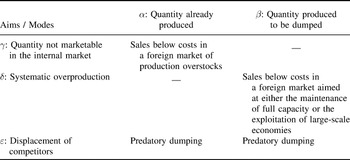
Jannaccone distinguished different forms of dumping according to both the way in which they are implemented and their scope. The modes of discrimination are:
α. price discrimination with respect to a given quantity of commodities already produced; both the size and cost structure of the firm are unaffected; discriminating means temporarily attributing some costs to certain units of product sold;
β. price discrimination with respect to a quantity of commodities inconsistent with a unique price; e.g., greater than what would have been produced under price uniformity; the size and structure of the firm change accordingly, the unit and marginal costs change as well.
The aims of discrimination are:
γ. sales below costs in a foreign market of an existing output left unsold in the internal market;
δ. sales below costs in a foreign market due to systematic overproduction;
ε . sales below costs in a foreign market aimed at displacing competitors.
The combinations αδ and βγ do not have to be considered: the elements composing these combinations cancel each other out. Any other combination of the above elements has the objective of maximizing the producer’s profit and can be defined as dumping. Jannaccone reproached scholars in general for paying too much attention only to cases of the types αε and βε , and Cabiati in particular for doing the opposite; i.e. for treating the case βδ as the only form of dumping:
It is a widespread logical error to ascribe to a genus attributes that should be ascribed only to species: thus, connotations particular to a certain form of price discrimination between the internal and external market, i.e. αε or βε , have been attributed to price discrimination in general, as if the other species, αγ and βδ did not exist. But one might fall into the same error ex adverso. This seems to be what happened to Cabiati who, having attributed to dumping the connotations of the species βδ, concluded that this was the only form of price discrimination between the internal and external market for which the term is appropriate [E’ comunissimo errore logico, quello per il quale I soli attribute di una specie sono assegnati al genere: così i connotati proprii di una certa forma di discriminazione di prezzi fra mercato estero e mercato interno, la forma αε o βε , sono stati attribuiti a quella discriminazione in generale, quasichè le altre specie, αγ e βδ non esistessero. Ma nello stesso errore si cade anche ex adverso, come appunto mi sembra che capiti al Cabiati, quando, avendo attribuiti al dumping i connottati della specie βδ, conclude esser questa la sola forma di discriminazione di prezzo fra mercato interno e mercato estero, cui quel nome convenga] (Jannaccone [Reference Jannaccone1914a] 1955, pp. 155–156).
Case αγ is an instance of sporadic dumping: the choice of selling an overstock of production abroad even at a cost lower than the average cost of production is made in order to prevent a decrease in domestic prices. The forms αγ and βδ could be defined as “pacific forms.” However, they differ in both the degree of risk and its duration. Case βδ is dependent on the trade-off between the benefit of changing the combination of production factors and the profitability of selling the additional output below costs abroad. As Jannaccone showed (see section III), the choice is determined by several variables and, in particular, by the structure of production costs along with the market structure.
Cases αε and βε are instances of predatory dumping. As said, dumping cannot be restricted to these forms alone. If it could, dumping should be defined as sales abroad at a price lower than the price set in the home market, the purpose being to crowd out competitors. Instead, these are particular cases of a more general phenomenon. Moreover, the aim of such actions is to establish trusts rather than displace competitors (see section III). In an international market characterized by free competition, the economic environment constantly changes. Thus, trusts and international agreements serve as means to overcome the resistance to price discrimination raised by international competition. A trust may be a substitute for tariffs. Dumping can be permanent only if it is accompanied by permanent deviations from the law of one price (such as those resulting from the raising of barriers and/or the establishment of trusts).
So far we have expounded Jannaccone’s theoretical propositions collected from his first article (Jannaccone Reference Jannaccone1914a). Jannaccone placed dumping in the theoretical framework of imperfect competition, and he classified it in its different forms. Empirical evidence and real events were widely cited by Jannaccone (Reference Jannaccone1914a) in order to support his thesis. Moreover, he continued his exposition by means of another language (mathematical), and laid the analytical basis for both price discrimination and the profitability of dumping, as we show in the next section.
III. JANNACCONE’S MATHEMATICAL FORMULATION
The analytical representation developed by Jannaccone was intended to criticize Cabiati on the links between production costs and firms’ life cycle, and between the profitability of price discrimination and the costs of production. Jannaccone showed that the cost function changes convexity through the stages of a firm’s life cycle. He also showed how price discrimination can be profitably implemented even by industries exhibiting both constant and increasing costs of production. He supported his critique by demonstrating the validity of the following two propositions:
P1 every production process is characterized by decreasing and then increasing costs of production; and
P2 the point of maximum profit for the firm lies on the line of increasing costs of production.
Jannaccone developed a static analysis of a firm’s life cycle. Although his aim was to support his arguments against Cabiati, his analytical representation laid the foundations for a theoretical model of both price discrimination and the profitability of dumping. We present the proof of P1 and P2 in the following two subsections, and, in the third subsection, we expound Jannaccone’s analysis on the profitability of dumping.
Production Costs and a Firm’s Life Cycle: A Static Analysis
We now present Jannaccone’s mathematical analysis, as he proposed it in his essay (Jannaccone Reference Jannaccone1914a).
Let us define as c = S/Q the average unit cost of production obtained by the ratio between the total cost of production at a certain unit of time and the total quantity produced with such a cost. Assume a firm can decide in isolation and that the variation on the quantity produced by the firm does not influence the price. Assume its net profit to be:

where P is the market price at which the quantity Q is sold. The market price P is constant because of the assumption of a perfectly competitive market. The objective of the firm is to maximize QP − S by varying Q and S accordingly. Let us define as h the incremental cost caused by a diverse combination of production factors, which, if added to S, will allow the firm to produce the quantity Q + d 1 (where d 1 is the incremental output) at the total cost S + h. If the firm finds the first additional increment profitable, then it will produce the quantity Q + d 1 + d 2 at the additional cost S + 2h; and so on. The firm substitutes the combination of production factors related to the total cost S to another displaying a total cost S + h if and only if the profit R 1 yielded by the latter is higher than the profit R yielded by the former:


where g 1 = h/d 1 is the marginal cost of production; i.e., the additional cost needed to produce d 1 (Jannaccone Reference Jannaccone1914a, §22).
The quantity will be thus increased to Q + d 1 + d 2 +... + d n−1 + dn until the additional cost of producing the last increment, gn, is equal to the price P. The additional partial cost h is constant by assumption as well as the market price. Thus, the marginal cost of production is a function of the marginal product, g = f(d). Marginal products may be increasing (or constant) at the beginning. However, above a certain threshold of output produced by increasing the amount of variable factors of production, it is also reasonable to assume diminishing (or constant) marginal products. Consequently, marginal costs will be first diminishing and then increasing. However, as long as the price is higher than the marginal cost, the firm will continue to raise output.
Consequently, if d is first increasing (or constant) and then necessarily decreasing, g is first decreasing (or constant) and then necessarily increasing. It does not matter for the entrepreneur that g increases, provided it remains below the unit sales price of the product; on the contrary, his pursuit of profit induces him to pass from the interval of decreasing marginal costs to that of increasing marginal costs until he arrives at the point at which marginal unit cost and unit price have become equal, which is where he obtains the highest possible profit [Dunque, se i d sono dapprima crescenti (o costanti) e poi necessariamente decrescenti, i g sono dapprima decrescenti (o costanti) e poi necessariamente crescenti. All’imprenditore non importa che i g vadano crescendo, purchè si mantengano inferiori al prezzo unitario di vendita del prodotto; il suo tornaconto, anzi, lo spinge a passare dal tratto in cui i costi marginali sono decrescenti a quello in cui sono crescenti, per arrivare sino al punto in cui costo unitario marginale e prezzo unitario sono divenuti uguali, nel qual punto egli ottiene il massimo guadagno possibile] (Jannaccone [Reference Jannaccone1914a] 1955, p. 122).
Let us now analyze the situation in which a firm competes with potential competitors attracted by the amount of profit Rn. On the one hand, the unit price will begin to decrease because of the increase in the total output of the economy. The cost of production factors increases as well: the marginal cost is increasing. In this environment, firms will face the moment in which the unit price is equal to the marginal cost sooner: firms will thus restrict their output to a quantity Q < Qn, where P(Q) = g(Q). Firms’ profit thus depends as much on the level of marginal costs (i.e., the price of production factors and the level of output) as on the unit price. Firms try to influence both these elements, and dumping is nothing but a way of doing it:
Since the variations in the profit of firms depend both upon the level of marginal costs, i.e. upon the price of the coefficients of production and the quantity of the product, and upon the sales price of the product, there will be a tendency to try and influence all three elements at once: and dumping, amongst others, is one of the expedients with which to influence quantity and price [Poichè le variazioni nel guadagno delle imprese dipendono tanto dall’altezza del costo marginale, cioè dal prezzo dei coefficienti di produzione dalla quantità di prodotto, quanto dal prezzo di vendita del prodotto, è su tutti questi tre elementi ad una volta che si cerca d’influire: e il dumping è, fra gli altri, uno degli espedienti per influire sulla quantità e sul prezzo] (Jannaccone [Reference Jannaccone1914a] 1955, p. 123).
Thus far, the expressions ‘constant’, ‘increasing,’ and ‘decreasing’ costs refer to marginal costs. Their meaning, Jannaccone emphasizes, differs from that in which they are usually applied: “Production at increasing or decreasing costs is neither a prerogative of certain industries … nor a peculiarity of certain categories of goods” (p. 123); on the contrary, it happens “in the life of any firm, whatever the branch of industry to which it belongs” (ibid.). In their turn, average unit costs can vary as well. Depending on the marginal cost of the additional unit produced and the average cost of the quantity produced until that moment, average unit costs may be constant, increasing, or decreasing:

or
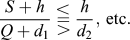
Or, given that  and
 ,

Average costs are constant as long as marginal costs are constant. Average costs are increasing if the marginal cost of the additional unit produced is greater than the average cost corresponding to the previous level of production. Otherwise, they are decreasing. Increasing average costs are consistent with decreasing marginal costs and vice versa; for average costs do not depend only on marginal costs, but also on the ratio between the initial total cost and the quantity produced at such a cost, S/Q: “There might, thus, be intervals where marginal costs decrease, while average costs increase, and viceversa [‘Si possono dunque avere dei tratti in cui i costi marginali sono decrescenti, mentre i costi medii sono crescenti, e viceversa.’]” (Jannaccone [Reference Jannaccone1914a] 1955, p. 124).
Jannaccone points out that marginal costs may begin to increase well before average costs. Indeed, the greater S is compared to Q, the sooner average costs begin to increase:
the greater the initial expenditure and the smaller the output obtained with this expenditure, the more rapidly arrives the moment at which the interval of increasing average costs succeeds that of decreasing costs; and viceversa [quanto più grande è la spesa iniziale e quanto più piccola la quantità di prodotto ottenuta con essa, tanto più presto arriva il momento in cui il tratto dei costi medii crescenti succede a quello dei costi decrescenti; e viceversa] (Jannaccone [Reference Jannaccone1914a] 1955, p. 124).
In Jannaccone’s analysis, therefore, constant, decreasing, and increasing costs of production represent stages in the life of a firm rather than a particular kind of firm, or industry, or even commodity:
There are no whole industries operating at a cost which can be termed constant, increasing or decreasing—except in the sense of classical economics, which concentrates attention on total production, in the long period, with all the factors of production (land, labour, capital).… However, when the object of inquiry is the production of separate firms during a given period, with given quantities and factor prices, then all we have to consider are firms operating at constant, increasing or decreasing costs [Non esistono industrie o merci a costi costanti, crescenti o decrescenti, se non nel senso dell’economia classica, la quale bada alla produzione totale, nel lungo corso del tempo, col complesso dei fattori di produzione (terra, lavoro, capitale).... Ma quando si tratti della produzione delle singole aziende, in un periodo di tempo dato, con certe quantità e prezzi dei coefficienti di produzione, esistono soltanto aziende a costi costanti, crescenti o decrescenti] (Jannaccone [Reference Jannaccone1914a] 1955, p. 125).
Increasing Costs of Production and Maximum Profit
Jannaccone supported the validity of P2 (i.e., the point of maximum profit for the firm lies on the line of increasing costs of production) with the following explanation. Suppose the firm is producing at its maximum profit at Qn: the firm has the incentive to increase its output until Rn − Rn −1 = 0. Rn −1 and Rn may be computed both by:
- adding to the profit of producing Q, those of producing the incremental units d 1,...,dn −1,dn,

and

- multiplying the total quantity produced Q + d 1 + ... + dn −1 + dn by the difference between the price P, constant by assumption, and the average unit cost cn (where n is the index of the last profitable increment of output),

and

The firm increases its output as long as the price of a unit is greater than the marginal unit cost of production or, in other words, until Rn − Rn −1 = 0:

On the one hand, if marginal costs were decreasing, then dn(P − gn) > 0. Hence, the firm would continue to increase output. At dn(P − gn) = 0, P = gn and gn > gn −1: the point of maximum profit lies on the line of increasing marginal costs. On the other hand, given that dn(P − cn) > 0, if Rn − Rn −1 = 0, then (cn − cn −1)(Q + d 1 + d 2 + ... + dn −1) must be greater than zero as well. This means cn > c n−1: the point of maximum profit lies on the line of increasing average costs.
Let us again assume that the firm is competing in a free market. We already know that a firm will be forced to produce a quantity Qi − Qn. However, if for the same commodity there were a separate, distant, foreign market, then the firm would be better off by selling the amount Qn − Qi abroad, even at a price lower than the average cost, and the quantity Qi in the home market. If a firm could adopt that strategy, it would have a chance to maximize its net profits. Thus, dumping is relatively more attractive to firms in their increasing production costs stage (see below).
The Profitability of Dumping to the Dumper
The Profitability of Predatory Dumping
Jannaccone showed through his taxonomy of dumping that dumping cannot be constrained only to those forms aimed at displacing competitors; i.e., predatory dumping (αε , βε ). However, his intention was not to disregard it. Although it is extremely difficult to pre-empt competitors in a free market, predatory dumping must, nonetheless, be included in a general theory of dumping. Indeed, the practice of predatory dumping exists in reality, but its aim is to establish international trusts rather than displacing competitors:
Nevertheless, if it is impossible or tremendously difficult to succeed, through dumping, in excluding competitors from an open market, one should not argue that dumping of type αε and βε does not exist, or that it is a phenomenon of quite a different kind. It does exist, but its objective is somewhat different. This objective is not the suppression of competitors, but their cartelization on an international scale [Tuttavia, riconosciuta la impossibilità o la enorme difficoltà di escludere col dumping i rivali da un mercato aperto, non se ne deve arguire che il dumping del tipo αε e βε non esista, o sia fenomeno di tutt’altra specie. Esiste, ma il suo obiettivo è alquanto diverso: non è la soppressione dei rivali, ma la costituzione di un sindacato internazionale] (Jannaccone [Reference Jannaccone1914a] 1955, pp. 116–117).
Being subject to the forces of free competition, recourse to dumping is hardly beneficial if it is not accompanied by a certain amount of monopolistic power. The establishment of international trusts serves this function: trusts make it possible to discriminate between national markets and to influence both the total quantity and the price of the market in which they act, thus making dumping profitable.
The Profitability of Systematic Dumping
Let us follow Jannaccone’s analysis on the profitability of dumping of type βδ. By definition, this is the case where the quantity produced by the firm is greater than the quantity that would be produced if the price were unique. An increase in output and the variation of the cost structure of firms always follow recourse to dumping of type βδ.
In a free market, where firms are constantly forced to restructure and adapt, the quantity Qi produced by each firm is less than what the firm would produce in isolation Qn: attracted by the profit Rn, many firms increase their output in order to maximize their profits. The price in the market falls at  . Firms approach the point at which the unit price is equal to the marginal cost sooner: Qi < Qn. Assume that an average or typical firm must restrict output to Qi < Qn (Jannaccone means that [p. 131, fn. 7] when the production of the average firm varies, total production varies accordingly). The firm wishes to influence either the quantity or the price in the market, or both, in order to escape the effects of competition.
According to equation [6] (and [7]), the firm’s net profit is given byFootnote 5:

But if the firm could sell abroad Qn − Qi at a price π, then its net profit would be:

The firm adopts the new combination of production factors only if it is profitable. Thus, the firm adopts the dumping strategy only if  .
Dumping of type βδ implies a change in both the quantity and the cost structure of the firm. Thus, in addition to the scope, it is necessary to account for those changes while computing its profitability.
Let us first consider the case of decreasing average costs, cn < ci. The firm’s profit in the home market at a production level Qn is higher than that at Qi. Thus the firm could:
- accept a decrease in the internal price; in particular, if competition gets stronger, there may be no other choice;
- sell a certain amount of output abroad at a price lower than its average cost, provided the gain in the home market is higher than the loss faced abroad; however, for this to be possible, the home market must exhibit some source of market imperfections (it would otherwise be impossible to stop the forces of competition on the level of the internal price);
- sell a certain amount of output abroad at a price higher than its average cost and add the profits realized abroad to the gains in the home market.
Let us now assume that the average costs are increasing (or constant), ci < cn (ci = cn). In this case the net profit realized in the home market when choosing to produce at a cost  (i.e.,
 ) would be either lower than, or equal to,
 . Hence,
 only if
 . In other words, when average costs are increasing (or constant), the firm has the highest incentive in gaining as much as possible from the sales abroad.
The Profitability of Sporadic Dumping
What is the profitability of dumping when it is practiced sporadically, for a short period and with the aim of disposing of an overstock of production (i.e., dumping of type αγ)?
The difference between dumping of type α and dumping of type β resides in the firm’s cost structure: fixed in the former; variable in the latter. If a firm’s maximum profit corresponds to a production level Qn (already produced) but, because of unexpected shocks, the quantity demanded decreases at  , then the firm has to choose whether to get rid of overproduction by accepting a decrease of the price in the home market, or whether temporarily to sell abroad at a price lower than its average cost. The cost structure of the firm, therefore, cannot be changed thus, as opposed to case βδ, in the case αγ the firm does not have to compare
 with
 (eq. [9] and [10]). The firm has instead to discriminate between
 and π in order to maximize the profit generated by sales in both the internal and the external markets, given the elasticity of demand at both home and abroad.
IV. JANNACCONE ON THE EFFECTS OF DUMPING IN BOTH DOMESTIC AND FOREIGN MARKETS
Jannaccone ended his first article (Jannaccone Reference Jannaccone1914a) with the following words:
Because the three forms of dumping studied here are different economic actions, their effects in domestic and foreign markets are different. This is true both from the consumer’s and producer’s points of view. Investigation of these economic effects of dumping will be the subject of an another artiche [Poichè le tre forme di dumping, qui studiate, sono tre operazioni economiche distinte … è chiaro che diversi sono gli effetti che l’una o l’altra hanno tanto sul mercato interno quanto sul mercato estero, e tanto dal punto di vista dei consumatori quanto dal punto di vista dei produttori sull’uno e sull’altro mercato. Lo studio di questi effetti economici del dumping sarà argomento di un altro articolo] (Jannaccone Reference Jannaccone1914a, §29).
Several months later, he published an article in the Rivista delle Società Commerciali (Jannaccone Reference Jannaccone1914b), in which he conducted, together with his analysis of the efficacy of tariffs and export subsidies, his investigation into the effects of dumping in both domestic and foreign markets. Jannaccone believed that detailed analysis of the forces operating in markets was necessary for investigation into the benefits of protectionism against dumping.
He assumed that a) dumping firms are organized into trusts; and b) dumping is practiced mainly by firms that produce production factors (both the assumptions were consistent with the empirical evidence at his time). If a trust resorts to dumping, then there will be two effects in its home market:
- the client industries employing that factor of production will be relatively more exposed to international competition;
- the price that those industries will have to pay will damage them in absolute terms if it is higher than the price corresponding to the ‘no dumping’ state.
The damaged industries will organize themselves into trusts and, through the action of those trusts, will react by asking for compensation: the biggest obstacle to dumping must be looked for in the home market. The economic subjects that initially resort to dumping will be forced to share part of their profits from dumping with their national opponents. This mechanism will drive the economic system into a vicious cycle, which both increases interdependence among industries/trusts and hands the market over to a regime of high domestic prices (see Lotz Reference Lotz1902, cited in Jannaccone Reference Jannaccone1914b). The above-listed disadvantages of dumping are often among the reasons for industrial integration. The best way to preserve the benefits and avoid the costs of dumping is, according to Jannaccone, vertical integration rather than the establishment of trusts (Jannaccone Reference Jannaccone1914a, p. 506). Empirical evidence showed increasing integration both in the United States and in Germany at the beginning of the twentieth century (see Martin Reference Martin1904 and Heymann Reference Heymann1904, cited in Jannaccone Reference Jannaccone1914b).Footnote 6
Let us look at the effects in the foreign market. In this case, too, Jannacconne distinguished two effects:
- dumping damages foreign firms belonging to the same branch of industry of the product dumped;
- all the other firms employing that product as a production factor are favored by the lower price.
Dumping decreases the profits of foreign firms that are direct competitors. The other firms employing the dumped product will import it if its price is lower. Is the cost of the former higher than the benefit of the latter? Empirical evidence had answered negatively: one of the main reasons for dumping is to locate overproduction in other markets in order to maintain a stable domestic price rather than to displace competitors (Jannaccone Reference Jannaccone1914a). However, Jannaccone continues, if it is true that predatory dumping is a theoretical possibility, though rarely experienced in reality, it is also true that the benefits from the lower price of the production factor must be compared with the costs of price instability. Indeed, the country dumped on might be temporarily favored by a lower price; however, this price is highly unstable and unlikely to be excessively low for the following reasons: the instability related to the economic conditions in the dumping country is at least as harmful as the variability of both international competition and the elasticity of foreign demand. For these reasons, the cost of uncertainty faced by foreign buyers should be subtracted from the benefits yielded by the lower price that they pay. The analysis on the costs and benefits of dumping, together with an investigation of the forms of protectionism current at his time (in Canada, the United States, and Germany) led Jannaccone to conclude that it might be wise for politicians to leave market forces free to operate as much as possible. If perfect competition is endangered, policy actions should be set according to each particular case under investigation. Assuming that dumping is practiced for predatory reasons, its static disadvantages must be compared with the dynamic advantages of economic unit integration aimed at decreasing the costs of production and increasing output.
V. JANNACCONE AS A PRECURSOR OF VINER
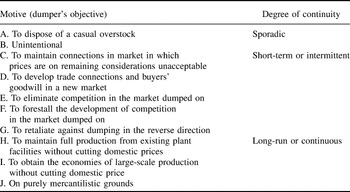
The origins of the theory of dumping lie in Jannaccone’s contribution. He defined and classified dumping (1914a). He proved that the most natural scientific framework for dumping is imperfect competition, and he definitively formalized dumping as an instance of price discrimination. Viner’s classification of dumping is remarkably reminiscent of Jannaccone’s taxonomy (a rapid comparison between tables 1 and 2 below will bear out this assertion).
Viner’s classification of dumping (as set out in Viner Reference Viner1923, ch. II, p. 23)

A sketch of Jannaccone’s taxonomy of dumping (extensively set out in section II)

Jannaccone differentiated dumping into three main forms: predatory dumping (i.e., αε , βε aimed at displacing competitors); systematic dumping (i.e., βδ aimed at escaping the forces of free competition); and sporadic dumping (i.e., αγ aimed at disposing of an overstock of production as the result of either wrong estimates of potential sales or temporary local depressions). In the α case, the cost structure of the firm remains unaffected. In the β case, both the cost structure and the quantity change, so that the analysis of the profitability of form β must account for the effects of those changes. It is not erroneous to define the former as short-term dumping and the latter as long-term; however, the definition must be made in terms of whether the cost structure of the firm can be changed. Viner did not specify the duration of dumping in exactly those terms. He focused more on the distinction among sporadic, intermittent, and continuous dumping, but essentially his classification is evocative of Jannaccone’s taxonomy. A firm’s ability to discriminate the price of its product depends on certain conditions related to the market structure (see section II). However, the profitability of such a practice depends on its specific scope, risk, and duration (Jannaccone Reference Jannaccone1914a, pp. 250–251). Or, in the words of Viner: “for the purposes of economic analysis probably the most serviceable bases for classification are according to the motives or the objectives of the dumper and according to the degree of continuity of the dumping” (Viner Reference Viner1923, p. 23).
Based on the development of a static analysis on the links both between production costs and firms’ life cycle and between the profitability of price discrimination and the costs of production, Jannaccone developed an analytical framework with which to investigate the profitability of dumping (section III). He generalized the theory of dumping to any form of market structure. Viner restricted his analysis of dumping to the cases in which there exists a certain degree of monopoly control exerted by either certain firms or groups of firms. Although he recognized that there might be other obstacles to free competition besides monopoly, his theory on the profitability of dumping was nonetheless based on this assumption:
it will be assumed throughout, except in the case of sporadic dumping or where the contrary is expressly indicated, that the dumping is being practiced by concerns or combinations in substantial monopoly control of their domestic markets. There is adequate reason to suppose that with the exceptions noted this assumption is in close harmony with the facts (Viner Reference Viner1923, p. 100).
Jannaccone, too, was aware that price discrimination between countries is hardly possible without permanent deviations from a perfect competitive environment. In particular, he referred to those deviations (usually artificially reproduced) as either tariffs or international trusts, or both. Indeed, his analysis on the profitability of predatory dumping—i.e., αε , βε —showed that the purpose of dumping of this type was to establish international trusts rather than to displace competitors; it is hardly possible to eliminate competition in a free market, and, for this reason, the best way to partition a market into different segments is to raise barriers through the action of international trusts. According to Viner, too, the objective of predatory dumping is to obtain a certain degree of monopolistic control over a market (unless it is made possible by other market imperfections). However, Jannaccone was convinced that dumping should not be confined solely to either predatory or monopolistic practices. Dumping may take other more pacific forms; e.g., βδ and αγ.
Systematic dumping is not explicitly defined by Jannaccone as a long-term form, however; the specific feature that characterizes it suggests that it is not certainly sporadic: the case βδ refers to changes in both the quantity and the cost structure of the firm; it refers to a quantity that is produced in order to be dumped; it refers to the analysis of the firm’s search for the best combination of production factors that guarantees the maximum profit. The type βδ thus includes what Viner defined as intermittent dumping aimed at exploiting full capacity,Footnote 7 because the firm that resorts to dumping changes its cost structure in order to produce the quantity to be dumped as well as what Viner defined as long-term dumping (exploitation of large scale economies, enlargement of the plant). Indeed Viner treated the analysis of the profitability of both in the same wayFootnote 8: “No fundamental change is made in the character of the problem where what is at issue is the profitability of enlarging the scale of production in order to dump instead of increasing production from already existent plants” (Viner Reference Viner1923, pp. 123–124).
Viner then defined long-term dumping as profitable only if practiced by firms characterized by both a certain degree of monopolistic control and decreasing costs. According to the static analysis developed by Jannaccone, systematic dumping is the means available to firms to avoid free competition in the home market. Obliged to restructure the production process in order to adapt to the increased production in a market where a positive profit is possible, firms must decide among restricting production (at a level that would not allow the best combination of production factors), selling the additional output at a lower price in the home market (if demand is elastic), or discriminating on the quantity left unsold at the current internal price. If a firm were of optimal size—i.e., if it produced the quantity that maximized its profit—there would be no reason to continue to increase its output. Thus, whether the firm is on the decreasing line of production costs does not depend on whether it is exploiting the existent plant or enlarging it, but rather on the extent to which the quantity currently produced is close to its optimum. In Jannaccone’s analysis, constant, decreasing, and increasing costs of production represent stages in the life of a firm: dumping can be profitable at any stage of a firm’s life cycle. He proved that the point of maximum profit lies on the line of increasing costs (both marginal and average—as shown in section III), and he demonstrated that firms have the highest incentive to dump when they approach the stage of increasing costs (section III). While it is true that in a perfect competitive environment, dumping is not always possible because the forces of competition in the internal market may be anyway strong enough to reduce the internal price, it is also true that monopoly control over the internal market is not always necessary. Depending on the elasticity of demand at home and abroad, the firm wants to find the best combination of production factors that yields the maximum profit (see eq. 9 and 10). If average production costs are decreasing, then the firm may either accept a decrease in the price in the home market or resort to dumping. Viner stated:
It will be profitable to enlarge a plant, if the added output must be sold abroad at a price lower than the average cost of production of the increased output, only if the volume of export sales multiplied by the excess of the average cost of the increased output over the export price is less than the domestic sales multiplied by the average reduction in cost resulting from the increase in output (Viner Reference Viner1923, p. 124).
In other words, as far as  (which follows from the condition
 ; see eq. 9 and 10 in section III). However, according to Jannaccone, if average production costs are increasing (or constant), the firm has the highest incentive to gain as much as possible from the sales abroad.
Monopoly control is also not necessary for dumping to be profitable if the objective is to dispose of an overstock of production (i.e., type αγ): when the cost structure of the firm cannot be changed, the firm has to discriminate between the price in the home market and the price abroad in order to maximize its profit. The stock of overproduction can be sold only by either decreasing the price in the home market (thus, given the elasticity of demand, increasing the quantity sold at home), or selling the additional quantity abroad, even if at a lower price (Jannaccone Reference Jannaccone1914a, p. 275). Sporadic dumping is the only form of dumping in which Viner relaxed the assumption of monopolistic power (Viner Reference Viner1923, p.100). If the firm’s objective is to get rid of an overstock of production, then short-term dumping is likely to be profitable (depending on the elasticity of demand):
There is a general agreement that under certain rather limited circumstances there is a clear case for the profitability of dumping to the dumper concern. When a producer, because of an overestimate of prospective demand, is left with an over stock which he cannot immediately dispose of in the domestic market without making a substantial reduction in his prices, it may be sound policy for him to make no change in his domestic prices and to dispose of his surplus stock at reduced prices in foreign markets (Viner Reference Viner1923, p. 110).
Despite the theoretical need strongly felt by Jannaccone to generalize his theory as much as possible, he backed down in his second article by reviving the assumption of a certain degree of monopolistic control. In a dynamic society where international trade was increasingly significant in each country’s balance of payments, individual economic units were reacting by either the establishment of trusts or vertical integration (Jannaccone Reference Jannaccone1914b). The formation of prices, and, therefore, any theory dealing with it, was strongly influenced by the increasing size of firms. While investigating whether the growing size of firms was increasing or decreasing national welfare, and whether it was improving or worsening the allocation of wealth, Jannaccone completed his exposition of the theory of dumping by adding his analysis on the effects of protectionism, and his investigation into the effects of dumping on both domestic and foreign markets.
When Jannaccone was writing his article, Italian trusts were demanding protection against the supposedly unfair practices of monopolistic power exerted by German cartels. Jannaccone suggested caution in regard to certain positions expressed by those who believed that dumping should be countered by protectionist interventions. Dumping is an extremely dynamic activity, which adapts to the continuous changes of the economic system. A protective tariff should contrast those changes in an opportune manner. But how can a threat that destroys the relation between price and cost be neutralized with an instrument that is based precisely on that relation? And even assuming it were possible, protective tariffs and import prices would run after each other and provoke an escalation of price levels. Nor is a system of countervailing duties the solution: a regime of countervailing duties would encourage covert agreements. It is unlikely that there exists a policy able to eliminate the static disadvantages of economic integration without undermining its dynamic advantages. Avoiding external interventions may be the best choice:
Is it therefore not more correct and more convenient for firms which believe themselves threatened by dumping to seek a remedy more effective for themselves and less costly for the collectivity? [Non è quindi più giusto e più conveniente che le industrie, le quail si credono minacciate dal dumping, cerchino un rimedio più efficace per sè stesse, meno costoso per la collettività?] (Jannaccone Reference Jannaccone1914b, p. 499).
Every case should be specifically analyzed: no rules of thumb are available to policy makers. Viner’s investigation touched extensively on this point, probably prompted by the same feelings. In the chapter devoted to the effects of dumping on the domestic market, Viner wrote: “no one formula exhausts all the possibilities. It is necessary once more to distinguish between the various types of dumping and the different circumstances under which dumping may arise” (Viner Reference Viner1923, p. 101). He reinforced the above statement in another chapter describing the effects of dumping on the country dumped upon: “The incident ... emphasizes the wisdom of avoiding unqualified generalizations concerning the economic effects of dumping and of acknowledging the probability that any general rule which applies in the majority of cases may nevertheless be inapplicable in some specific instances” (Viner Reference Viner1923, p. 143).
The costs and benefits of dumping should be carefully investigated from the point of view of both the internal and the external markets. Both when recourse is made to dumping in order not to disturb the internal market, and when it is practiced by monopolistic concerns that are already producing at the level of their maximum profit, it does not affect internal prices. Thus, the only damage is the loss in competitiveness suffered by internal industries employing the product subject to dumping (Viner Reference Viner1923, ch. VI). According to Jannaccone (Reference Jannaccone1914b), dumping firms/trusts face the main obstacles in the home market, because the damaged industries will organize themselves into trusts as well, and, through the action of those trusts, will react by asking for compensation. Not only do national industries lose competitiveness with respect to their foreign opponents, but they are directly harmed by a relatively higher price. Jannaccone thus admitted that dumping influences internal prices: the increasing interdependence between industries and trusts hands the market over to a regime of high domestic prices (Lotz Reference Lotz1902).
From the point of view of the foreign market, whether dumping is beneficial depends on the loss incurred by the industries dumped on, the costs of price instability, and the benefits of the temporarily lower price of the dumped product. The temporary lower foreign price paid by foreign consumers may later become higher: in any case, upsetting the current equilibrium in the foreign market may trigger price instability (Jannaccone Reference Jannaccone1914b). Viner, too, was much concerned with the dangers of temporary dumping: “the evil of dumping from the point of view of the importing country is its uncertain duration” (Viner Reference Viner1923, p. 139).
VI. FINAL REMARKS
Viner (Reference Viner1923) is considered to be the first classic treatment of dumping in the economic literature. His treatment overshadowed the contributions of other scholars who took part in the theoretical systematization of dumping at the beginning of the twentieth century. In this paper, we have focused on two relevant articles published by Pasquale Jannaccone in the special issue of Riforma Sociale, March 1914, and in the Rivista delle Società Commerciali, June 1914. We claim that Jannaccone’s contribution represents the most overarching analysis of the theory of dumping in its classic period before Viner. Jannaccone develops a theory of dumping and definitely contextualizes it in the framework of imperfect competition. He defines dumping as a form of price discrimination, and classifies it, according to both its scope and duration, as predatory, systematic, and sporadic. His analytical investigation of the profitability of dumping to the dumper makes several critical points.
a) Predatory dumping is not beneficial unless it is accompanied by a certain amount of monopolistic power. Thus, resort to predatory dumping aims at establishing international trusts.
b) Systematic dumping can be profitable at any point in a firm’s life cycle. However, firms have the highest incentive to dump when average costs are increasing.
c) Sporadic dumping may be the best way to dispose of an overstock of production while avoiding price reduction in the home market.
d) Finally, Jannaccone considers the effects of dumping in both domestic and foreign markets, and succinctly analyzes the costs and benefits of it, concluding that leaving market forces free to operate may be the best choice for a government when facing the trade-off between the social benefits of industrial integration and the social costs of international monopoly power.
Although Viner’s book will rightly remain the most comprehensive classic treatment of dumping, a comparison between Jannaccone’s and Viner’s contributions shows that: a) Viner’s classification of dumping is remarkably reminiscent of Jannaccone’s taxonomy; b) Viner’s analysis of the profitability of dumping is restricted to the case of monopoly, while Jannaccone’s theory is generalized to any form of market structure—although he recognizes that price discrimination between countries is impossible in a perfect competitive environment; and c) Viner’s investigation of the effects of dumping and policy implications is also evocative of Jannaccone’s analysis.