I. INTRODUCTION
Since the African Methodist Episcopal Church (AME), black America's eminent independent institution, solidified its merger with the South African Ethiopian Church in the 1890s, photography played a role in this transatlantic connection. As Levy J. Coppin, one of the first AME bishops, who supervised the South African field in the early 1900s, noted during a trip to the Northern Cape,
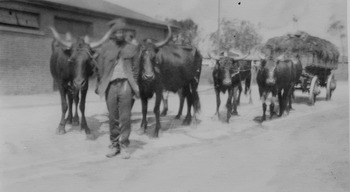
My traveling companion … is a photographer, and he brought with him his instruments and we remained the most of the day Monday that we might make photographs of the church, ox cart and the house occupied as Episcopal Residence at Green River, one of which – the ox cart scene – is being prepared for the A.M.E. Review. These are truly historic pictures and may be handed down to posterity as historical land [sic] marks [sic] in our South African work.Footnote 1 [See Figure 1]
AME missionary records rarely talk as explicitly as above about the making of their visual components, but a brief look through AME publications, scrapbooks, and letters to family and friends suggests that African American missionaries had access to cameras, photographers and pictures. Starting in the 1890s, they delivered several hundred photographs of places and people in Africa to the black American viewing public, thus making visuals a key site of the local and transatlantic encounters between Africans and African Americans.
The oxcart was a popular motif in AME missionary photography. As a nonmotorized vehicle, it symbolized the hardships of missionary travel in the interior and a hierarchy of colonial mobility that located “natives” outside modernity. The blurry contours in the photography here furthermore indicate the difficulty of photographing scenes in motion. Source: Box 2, Folder 25, Bishop William Tecumseh Vernon Collection, Kansas Collection, RH MS-P 529, Kenneth Spencer Research Library. All photographs are published with the courtesy of Dr. Johnny Barbour, president/publisher, AME Church Sunday School Union, Nashville, TN, and Dr. George F. Flowers, executive director of the AME Church Department of Global Witness and Ministry (Mission), Charleston, SC.

Despite the historical significance and impact that black missionaries themselves placed on photography in telling the story of their activities in South Africa, their visual records have been widely overlooked by historians. Studies that examine the influence that African American missionaries had on shaping the African American image of Africa focus on the notions they expressed in their writings, such as travelogues, articles, and letters. Here, James Campbell observes, African American missionaries liberally molded “imaginative foils” of Africans “depending on the demands of the situation,” as “parents or children, brethren or barbarians,” to define African Americans' identity and destiny.Footnote 2 Not much attention is given in this context to how African American views of Africa manifested in photographic representations, although pictures have long been discussed by scholars as sources to reveal this kind of self-referentiality.Footnote 3 A corresponding lacuna exists in the growing body of scholarship that examines colonial-era photography of Africa.Footnote 4 As Paul Landau notes, the field broadly focusses on Europeans' history of imagining themselves by recognizing Africans as “people from other societies.” Missionary photography features prominently in this narrative, however, with little regard for the African American contribution. Much of the historiography on photography of Africa centers on whites behind, and blacks – cast as exotic “types” of inferior others – before the camera to explore how photography bolstered colonial power relations.Footnote 5
This article seeks to revisit African American and European images of Africa from the perspective of the photographs that African American missionaries produced in, and circulated out of, South Africa during the decades around the turn of the twentieth century. Although the photography of African American missionaries constitutes an exceedingly small portion of the photographic representations that white missionaries and colonizers created of Africa in this era, it deserves consideration as a crucial building block of a new regime of transatlantic gazing. The novelty of this regime lay, on the one hand, in the development of a black photographic gaze at Africa. African American missionary photography, I argue, offers a rare opportunity to shed light on the ways in which subaltern populations – African Americans and Africans – appropriated and transformed photographic traditions that expounded their racial otherness to describe and represent themselves in a transatlantic perspective.Footnote 6 On the other hand, the AME mission's role as “the most important point of contact between black America and South Africa” fastened the eyes of black observers on the southern tip of Africa in particular.Footnote 7 This geographical focus marked an important expansion of the Afro-diasporic interactions that were prefigured by the transatlantic slave trade centering on West Africa, and heightened attention to the politics of racial segregation that characterized and distinguished colonial rule in South Africa in the African American image of Africa.Footnote 8 AME missionary photography, I aim to demonstrate, often drew parallels between blacks in South Africa and Jim Crow America by presenting Africans in the image of the “New Negro.” This trope developed in African American discourse around the turn of the twentieth century to assert that blacks were a proud, productive, and cultured race that left behind the stigma of enslavement.Footnote 9 The insights that emerge from the study of the visual record of AME missionaries go, accordingly, beyond considerations about how blacks challenged racist colonial stereotypes in their respective locations.Footnote 10 They reveal a “contact zone” in which subaltern subjects met and began to negotiate the extents to which they resembled, or did not resemble, one another by drawing on colonial otherness and the refined look by which African Americans expressed their racial uplift since emancipation.Footnote 11
To explore this contact zone, I provide a close analysis of the visuals that are contained in AME Church-related publications and the archival collections of AME institutions and individuals from the 1890s to the 1930s.Footnote 12 Altogether, my collection amounts to a body of about a thousand photographs encompassing colonial ethnographic, African vernacular, and AME amateur photography. The fragmented character of the AME photographic record locates it outside the “official” archives that recently acknowledge images as “an important potential scholarly resource.” As the International Missionary Photography Archive (IMPA) exemplifies, these efforts focus on pictures that are associated with “a particularly prolific and skilled photographer” or “a particularly important place, cast of characters, or set of historical events.”Footnote 13 Devoid of this kind of professionalism and thematic coherence, the historical significance of the AME photographic collection lies in the contributions it makes to the “other histories” of photography that move it away from the European American center of gravity.Footnote 14 As I will show in the first part of this article, the AME visual record preserved, amongst other things, long-lost visuals produced by African photographic studios and owners of cameras, adding to the notoriously scarce historical evidence that testifies to their activities.Footnote 15 These and other fragments, ranging from studio portraits to snapshots, that can be found in the AME photographic archive unfold a rich picture of the complex and episodic ways in which black missionary subjects approached photography in contexts of European domination.
The second step of my analysis shifts the attention from the composition of the AME photographic archive to a semiotic interpretation of AME missionaries' self-representations. Based on a selection of photographs that can be indisputably identified as being made by and for the South African AME mission, I will discuss how these images constructed black difference and regional similarity with the US South for recognition by black American observers. The theme of black difference can be exemplified with self-portraits that place AME missionaries and Africans in the same picture. Building upon the colonial convention of juxtaposing “exotic” Africans and “civilized” Europeans to display social Darwinist ideas of black racial inferiority, the appropriation of this strategy in AME self-representation constructed a visual repertoire that emphasized the otherness of Africans. The creation of regional similarity in AME self-representations, on the contrary, can be observed in photographs of African students of AME schools. These images foregrounded the capacity of AME missionaries to transform African lives not only by reducing visible markers of exoticism, but also by heralding the industrial education, as developed by black educators in the US South, available in the South African reserves.Footnote 16 While these two strategies of visualizing the AME mission complicate the notion that African Americans had a monolithic image of Africa, the repertoires of black difference and regional similarity constructed the US South as a transnational region in which African Americans and South Africans alike appeared as “New Negroes.”
II. THE VISUAL RECORD OF THE AME MISSION
The visual record of the AME mission emerged in a period that was marked by a rapid increase and diversification of photographic activities on the African continent. While photography had existed in Africa since the mid-nineteenth century, climatic conditions and cumbersome equipment had confined its use to studio settings until almost the turn of the twentieth century.Footnote 17 By the 1890s, technological innovations in devices such as handheld cameras, roll film and photographic development services helped cameras spread into the hands of a larger group of practitioners and shaped a variety of imperial, commercial, missionary, and scientific enterprises.Footnote 18 In South Africa, new possibilities for outdoor photography specifically fueled the emergence of native studies, a genre in which photographers documented the living conditions of black South Africans in segregated reserves, usually by constructing them as idylls of tribal life out of step with the trappings of Western civilization.Footnote 19 As AME Bishop Henry McNeal Turner, a key figure in the AME South Africa mission and advocate for black mass emigration, noted in 1895, photography had become so widespread that it began to “enable millions to sit in their homes and inspect the entire globe.”Footnote 20
As one of the first independent black African American mission bodies that self-consciously promoted campaigns “to imbue the Native's mind with correct ideas of civilization and Christianity,” AME missionaries were quick to probe the potentials of photography in their overseas activities.Footnote 21 Among the sites in which AME photographic efforts can be studied is the AME Church's missionary periodical, the Voice of Missions. Launched in 1892 by AME Bishop Turner, the paper considered the provision of “a continual graphic account of missionary activities” as its main purpose.Footnote 22 The AME Church's eminent periodicals, the Christian Recorder and the AME Review, also featured reprints of photographs of Africa, yet to much lesser extents. To this were added the accounts that AME missionaries themselves wrote. Between 1894 and 1940, pictures became a principal feature of a number of monographs and pamphlets that documented individuals' Africa travels, including Charles Spencer Smith's Glimpses of Africa (1895), Levy J. Coppin's Observations of Persons and Things in South Africa, 1900–1904 (1905), John A. Gregg's “The Land of the Southern Cross” (1910?), Emily T. Vernon's South Africa: An Open Door – A Story in Pictures (1925?), and Llewelyn L. Berry's A Century of Missions of the African Methodist Episcopal Church (1940). Most of the visuals in these accounts are available as reproductions in half-tone print, the technology that since the 1880s had made possible the mass reproduction and integration of photographs with text, by simulating continuous tone in dots with varying distances.Footnote 23 Initially, AME missionaries worked with a company called Levy Type in Philadelphia to obtain reproductions, while later publications seem to be fully prepared by the AME Church's own publishing houses, the AME Book Concern in Philadelphia, and the Sunday School Union in Nashville.Footnote 24
Alongside print media illustrations, the personal papers of individual missionaries offer an access point to the visual record of the AME mission. Finding aids that describe these papers give a first taste of the variety of photographic activities in which AME missionaries were engaging. They list items like “photographs,” “photo albums,” “flexible film (nitrate),” “glass negatives,” “panoramic photos,” “Kodak camera[s]” and “film strips/reel to reel.”Footnote 25 Particularly rich photographic material is contained in the papers of AME Bishops William T. Vernon and John A. Gregg, who served in South Africa in the 1920s. A number of images in these collections are carte de visite photographs, mounted on a standard size of card stock (2·5 × 4 inches) as well as the larger cabinet-sized photographs ( 4·25 × 6·5 inches). These were popular formats for portraits and for collecting and exchanging photographs with family and friends from the 1860s. Inscriptions or embossments on these cards reveal the rise of professional photographic studios in urban centers of South Africa, including Cape Town, Bloemfontein, and Kroonstad.Footnote 26
An even larger number (over five hundred in total) of photographs in Vernon's and Gregg's collections are unmounted snapshots, pointing to the immense popularity of the Kodak Brownie camera, a folding handheld device with roll film, since the 1900s. Kodak opened its first company in South Africa in 1913, and by the 1920s its magazines and manuals for amateur photography were on the market there in English and Dutch.Footnote 27 The impact of the Kodak camera on the AME mission is distinctly visible in large numbers of snapshots that were failures in Vernon's and Gregg's photographic collections. Outtake pictures resulted from shooting certain motifs several times in a row or attempts to bring them into focus, to adjust lighting, to avoid cutting off heads or feet, to find the right angle, and so on (for an example see Figure 1). These photographs suggest that AME missionaries had a deep fascination with and, at the same time, precautions against the new technology. “Photographic freak[s],” as Gregg labeled one of his failed images, ultimately reflect that AME amateur photographers had an understanding of, and an ambition to take, “good shots.”Footnote 28 In most cases, this understanding was expressed in snapshots that were selected for presentation in AME publications. Vernon's collection contains, for example, the series of shots and outtakes from which Emily T. Vernon's South Africa: An Open Door was later composed.Footnote 29 The overlap between private and published AME missionary photographic collections designates the absence of professional or commissioned photographers. In AME missionary photography, public campaigning emerged from a selection of suitable snapshots, often irrespective of their initial purpose or the skills of the photographer who took them.
AME missionaries' notions of “good shots” were further enhanced by their aspirations to prefigure these pictures' interpretation. The strategies that AME missionaries deployed to unfold the semiotic energies of photographs in a certain direction included their integration with other images (such as scrapbook pages, before–after schemes, or collages), as well as texts that ranged in size from scribbled notes on the photographic paper and explanatory captions to monograph-length manuscripts. Constructing certain visual and textual contexts allowed AME missionaries to achieve great leverage in directing the observers' attention. The portrait in Figure 2, for example, suggests its placement within the extensive binary categorization of “civilized” and “uncivilized” people. But the strategy of “making content visible in certain ways” by means of labels also worked in the opposite direction, highlighting seemingly trivial details such as “a bit of lawn.”Footnote 30 The remarkable dynamism that evolved around practices of image inscription was often attained by avoiding designations that revealed the exact provenance of a picture. Even as AME missionaries put great effort into labeling and arranging, they hardly ever provided the basic information, such as date, geographic location, or photographer, that would render their photographs historically specific.
Composition of two portraits in full-face and half-profile view. This form of representation was typical of ethnographical photography that emphasized racial features. Source: Charles Spencer Smith, Glimpses of Africa: West and Southwest Coast (Nashville: AME Church Sunday School Union, 1895), 80. Manuscripts, Archives and Rare Books Division, SCRBC, New York Public Library, Astor, Lenox and Tilden Foundations.

Overall, the several hundred photographs in these various collections were of course quite diverse in subject matter, including individual and group portraits, activities, techniques, material culture (such as “war implements”) and rituals (such as the rite of passage called “women-making”).Footnote 31 A key characteristic of the AME visual archive is, accordingly, the level of complexity it achieved in its texture, resulting from bringing together bodies of images from various and not always harmonious photographic traditions. These traditions range from images that follow the strict protocol of ethnographic depictions of Africans as racial others (Figure 2) to snapshots that mimic the rustic styles of amateur missionary self-representations that served to reinforce the notion of their pioneering efforts (Figure 3).
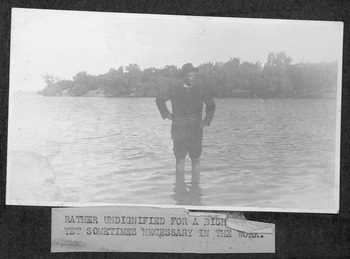
Snapshot of AME Bishop John A. Gregg. The caption reads “rather undignified for a bishop but sometimes necessary in the work,” thus evoking the pioneering spirit of missionaries as explorers at the frontiers of civilization. Source: Box 1, Folder 2, Bishop John A. Gregg Collection, Kansas Collection, RH MS P 1284 (f), KSRL.

The ethnographic photography of the AME mission's visual record was most closely aligned with the dominant imperial representations of Africa. Throughout the period between the 1890s and 1930s, AME missionaries composed this collection primarily by acquiring photographs from the commercial photographic studios that mushroomed in African port cities from the 1850s or the international photographic services that distributed them across the Atlantic from the 1890s. Predominantly run by Americans or Europeans, both of these facilities specialized in providing the sensationalist image of Africa that metropolitan audiences demanded. They catered to imaginations of wilderness, backwardness, and savagery by displaying nudity, frozen poses, and props like rocks, palm fronds, animal skins, and painted backgrounds.Footnote 32
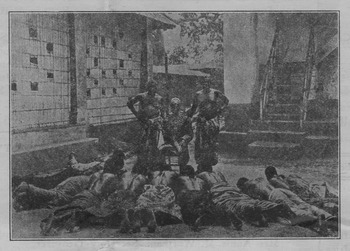
While such ethnographic-style visuals formed a standard component of illustrated AME publications and personal photographic collections, African American missionaries only sometimes marked them as imports from imperial image traditions. In a few instances, the Voice credited the “International Film Service” for pictures like “Natives and Objects of Their Handcrafts, Kamerun, Southwest Africa,” presumably referring to Randolph William Hearst's international picture service.Footnote 33 That AME missionaries stored and reused these ethnographic images over several decades further obscured their external point of origin. For example, an ethnographic image originally published in the Voice in 1920 and credited to the International Film Service reappeared on the publication's cover page in 1931 without any photographic credit (Figure 4).Footnote 34 Similarly, three illustrations in Coppin's Observations of 1905, first labeled “A High Class Native Girl,” “In Native Costume,” and “The Way Native Women Carry Their Children,” later reappeared without these descriptions in William T. Vernon's private photographic collection from the 1920s.Footnote 35 The ethnographic element within AME missionary records therefore underlines how traditional imperial depictions of Africa were not kept outside, but seamlessly incorporated into, the AME visual collection.
Commercial representation of Africa. Published in the Voice of Missions in March 1920, and in June 1931. Source: Voice of Missions, June 1931, cover page. The Burke Library at Union Theological Seminary, Columbia University, in the City of New York.

At the same time, AME missionaries' image collections included samples from the exceptionally rare photography of the earliest African photographic studios, which operated outside the purview of colonial image production. AME missionaries' far-reaching access to this infrastructure is exemplified in Smith's Glimpses of Africa (1895), the first illustrated travelogue published by an AME minister. Smith credited, among others, Gerhard and J. F. C. Lutterodt, two “native photographers on the West Coast of Africa,” as his chief suppliers.Footnote 36 The Lutterodt studios had from the 1870s a constant base in Accra, and expanded their photography by itinerant practices to Freetown (Sierra Leone), Duala (Cameroon), Clarence (present-day Bioko, Equatorial Guinea), Libreville (Gabon), and Loanda (Angola) in the 1890s. According to Erin Haney, their works were hardly available then and remain so now, as the Lutterodts used one-off glass plates that were heavy, hard to store, fragile, and often destroyed by them immediately after use.Footnote 37 Traveling quite precisely along the Lutterodts' routes, Smith's travelogue is likely a uniquely rich archive of their itinerant photographic activity.
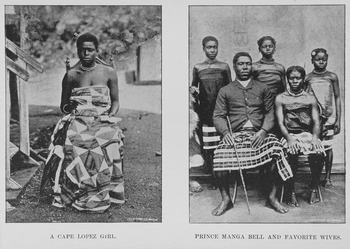
The portraits of “A Cape Lopez Girl” and “Prince Manga Bell and Favorite Wives” (Figure 5) serve to illustrate how the Lutterodts' photography was marked by the kind of potential to “rework certain European stereotypes into images of cultural heritage and pride” that scholars of African photography only tentatively assert in view of the scarcity of this type of visual record.Footnote 38 Both portraits show Africans facing the camera, in dignified poses and beautiful local garb, but also with Western lifestyle accessories, as the umbrella in the left picture and the prince's suit jacket in the right picture illustrate. The presence of African vernacular photography in AME collections reveals that their interest in photography was not bound either to confirm, or to challenge, colonial imaginations. Placed alongside pictures of “Feti[s]hes and Worshiper” or “Mpongwe Cannibals,” to name the most obvious examples presented in Smith's Glimpses, AME collections rather were distinguished by creating a patchwork of European and African studio productions that featured styles of photography from either side of the colonial “power differential.”Footnote 39
Two examples of portraits taken by the West African photographic studio of the Lutterodt brothers. The pictures confound African and Western fashion, props, and settings in ways that rework European stereotypes. Source: Charles Spencer Smith, Glimpses of Africa: West and Southwest Coast (Nashville: AME Church Sunday School Union, 1895), 176. Manuscripts, Archives and Rare Books Division, SCRBC, New York Public Library, Astor, Lenox and Tilden Foundations.

The greatest share of pictures that came together in the AME missionary visual record was the cluster of images that specifically documented AME missionary activities. Evident in several hundred unmounted snapshots, the bulk of which date to the “Kodak period” in the 1920s and 1930s, the photographic outlook of the AME mission in Africa can be attributed to owners of cameras who from the 1900s entered African AME congregations.
AME publications sometimes talk about who these amateurs were and what kind of pictures they had taken. Coppin's Observations identify the South African AME minister Francis McDonald Gow, who worked as a superintendent of the South African mission field from about 1906 until his death in 1931, and was known as a “photographer who brought with him his instruments.” According to Coppin, Gow photographed AME buildings and an “ox-cart scene” in the Northern Cape for publication in the AME Review, the church's well-regarded scholarly paper.Footnote 40 Emily T. Vernon, an African American woman who stayed with her husband William in South Africa from 1920 to 1924, claimed the authorship of the photographs she published in her photographic book South Africa: An Open Door. In her preface, she stated, “I took many pictures of the country and the people.”Footnote 41 In addition, Bishop John A. Gregg, who served in South Africa first in the 1900s and then in the late 1920s, was belatedly acknowledged by an AME historiographer as a “skilled photographer” who produced an “incredible photographic collection.”Footnote 42 Even though this list is far from comprehensive, it indicates that AME church members from across the social spectrum – men and women, African Americans and South Africans, bishops and local church members – combined their missionary work with taking pictures.
The image of the AME mission that these amateurs constructed forged links to the classic tropes of missionary photography. Among these tropes was the frontier spirit of a “muscular Christianity,” commonly associated with the bravery and tenacity of the legendary Victorian explorer David Livingstone.Footnote 43 We find this visual reference in hunting scenes, showing AME missionaries on horseback with rifles and a shot zebra, or with missionaries climbing rocks, or wading through rivers (cf. Figure 3). Another prevalent trope of missionary photography was the need for Africans' Christianization. AME amateurs constructed this need in images of African life in so-called kraals, enclosed forms of settlement in rural settings that black South Africans were forced to inhabit after the passage of the Native Land Act in 1913. These depictions typically featured thatched huts, exotic garments, water carriers, and oxcarts (Figure 1), as well as chieftainships and kinship systems that were at odds with Western Christian concepts of the nuclear family. Correspondingly, there are series of AME images that treated the advent of “Christian civilization.” These series typically traced the building of AME churches and schools from the laying of cornerstones over scaffolded construction areas to opening ceremonies, as well as the black South Africans who populated them.
Beyond a more or less explicit engagement with preconceived missionary themes, AME amateur photographers captured the social interplay that characterized the encounter between AME missionaries and the black South African population. One dimension of this interplay was, as a contemporary observer put it, the great “cordiality” with which “native Christians” joined AME congregations, often at the expense of the membership figures of white European and American mission churches.Footnote 44 In the realm of visuals, this cordiality is apparent in the wide range of local events and activities that AME photographers could follow with their camera without raising the photographed subjects' attention or being perceived as intruding. Among the pictures that showed South Africans, as Gregg put it, as “unawares,” were gatherings of “natives greeting the Prince of Wales in Johannesburg,” as well as the large crowds that AME ministers themselves tended to draw when they performed religious activities, as pastors who were “leading a recessional” or “laying the corner stone” of a new AME church.Footnote 45 To this are added a number of images that AME missionaries took of the indigenous communities they visited upon invitation. These photographs cherish a variety of celebrations, ceremonies or rituals that these communities performed in honor of AME ministers. As Gregg explained about a number of pictures that documented his trip to the Molebogo, they presented the teacher and children “who welcomed us,” as well as the “killing [of] an ox for our entertainment.”Footnote 46
The images that derived from moments in which the camera was unnoticed formed a striking contrast to photographs in which South Africans knew that their picture was being taken. A principle feature of visuals in the latter category was that the depicted looked at the photographer, a gesture that often unfolded into an ambiguous dynamic of conforming to preconceived photographic conventions and asserting African self-expression. The tension between following existing norms of posing in front of a camera, while at the same time expressing a sense of self-representation, was most obvious in AME group portraits. While these pictures reveal the great variety of social groups and affiliations that characterized AME missionary milieus, they all hypostasize social coherence by means of displaying a uniformity in the Africans' body posture and appearance. Groups of male or female AME missionaries, church congregations, school classes, or members of a certain tribe – sometimes amounting to several hundred people – hence were presented in the same dress and in stiff and submissive poses, for example with their feet together and arms straight to the side of the body. The rigidity of these arrangements certainly could blend into ethnographic conventions that aimed at foregrounding racial features rather than self-expression. Nonetheless, AME group portraits appear to be taken “for,” rather than “of,” the South Africans they are showing. As Christopher Morton argues, even courteous responses to cameras need to be acknowledged as a form of Africans' self-representation, as they indicate that Africans consciously adopted “already existing modes of public comportment, such as formalized greetings and spatial arrangements at social gatherings.” In AME amateur photography, conforming to formalized arrangements of group portraits became a way for South Africans to express their commitment and sense of belonging to a transatlantic black community.Footnote 47
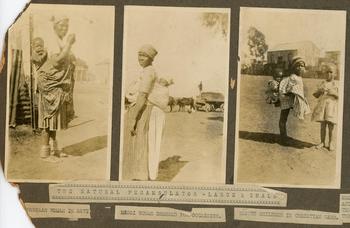
Gregg's photographic series “The Natural Perambulator” (Figure 6) provides hints at another way in which South Africans were prepared to pose in a formalized fashion for AME cameras. Gregg composed the series of three individual images of Africans who presented themselves in the same manner, each of them standing sideways to reveal the babies they carry on their backs, while turning their faces to the photographer. Grouped together, the series thus is shaped around the theme of African childcare, a staple subject of ethnographic photography that served to expose the otherness and backwardness of “native life.” Its visual coherence, however, does not seem to have been planned or intended by the photographer. Gregg's photographs clearly fail to apply pertinent ethnographic conventions. Each pictures is rather spontaneously taken, as indicated by a variation of dresses and angles, the cut of margins, and the capturing of random backgrounds. Gregg's failure to convey a sense of scientific exactness not only undermines the series' belated aspiration to mimic some form of “native studies.” It might also suggest that all three depicted Africans had responded to Gregg's camera, independently of each other, in an ethnographic style of posing, before Gregg had asked them to do so or was prepared to shoot them in this fashion.
An image series composed by a missionary in a private scrapbook, based on the similarity of the postures the depicted Africans took on. Source: Box 1, Folder 3, Bishop John A. Gregg Collection, Kansas Collection, RH MS P 1284 (f), KSRL, University of Kansas Libraries.

Finally, the AME photographic record contains documents that tell of the keen interest African American missionaries had in experimenting with styles and strategies to reconstruct the colonial fantasy of Africans' unchanging exoticism in their own photography. Vernon's papers indicate as much with contents such as the aforementioned picture “In Native Costume” that first appeared in AME publications in the 1900s, and a report from the 1920s that described the painstaking procedures in which European missionary photographers persuaded Africans to change their “white man's trousers” for “native witch doctor's dresses … with igwalagwala feathers.”Footnote 48
The awareness AME missionaries had of the problematic appeal that was to be gained from perpetuating long-standing ethnographic imaginations shone through most conspicuously in the photographs they staged for the purpose of overseas campaigning. One powerful example is Emily T. Vernon's photographic book South Africa: An Open Door. With its goal to offer African American viewers the spectacles of the “farthest mission field” and “a new vision of our responsibility for those who sit in darkness,”Footnote 49 this book was devised as an explicit juxtapositioning of ethnographic templates of “natives” and “heathens” from the turn of the century and self-made photographs of the same style from the mid-1920s.
Vernon's determination to closely emulate well-known visions of African exoticism revealed the power of ethnographical preconceptions. In Vernon's reenactment, the depicted South Africans followed the role model she suggested in terms of costumes and hairstyles. They presented themselves almost naked, wearing solely flamboyant bangles, chaplets, and loincloths. At the same time, Vernon's ethnographic pictures brought into view the extent to which the staging of this imagery required South Africans' cooperation. Perhaps inadvertently, the depicted South Africans transformed the message of the originals by altering their setting and posture. One image that Vernon designated as showing “Heathen Zulu Girls” had a modern stone building in the background, and thus rather contrasted with the long-standing photographic imagination “which could not conceive of Africans outside of rural settings.”Footnote 50 Unenergized body postures and indifferent facial expressions additionally undermined the idea that South Africans lived beyond the frame of any reference to engagement with the modern world. Rather than heathen savagery, their poses disclosed that South Africans were at best routinized, and at worst bored, performing this theme to meet the tastes of distant viewing publics. In this sense, the preconceived otherness that Vernon and other AME missionaries sometimes sought to construct was also a strong indication of the fairly relaxed and cooperative spirit that characterized the photographic encounters between racially similar subjects.
III. AME MISSIONARY SELF-REPRESENTATION: CONSTRUCTIONS OF BLACK DIFFERENCE AND REGIONAL SIMILARITY
Within the complex and highly variable domain of the black photographic encounter, a style of African photography emerged that might be considered specific to the AME mission. The formation of this style had to do with the peculiar difficulty that was involved with visualizing the African American missionary presence in Africa. Significantly, AME missionaries could not draw upon race, the most important rule of both colonial difference and pan-African identity, to make themselves visible in the African context. The development of visual markers that distinguished African Americans and Africans from one another, and that thereby allowed black viewers in the US to recognize themselves in AME self-representations, was a central building block of the regime of gazing that AME photography established among the two subaltern populations.
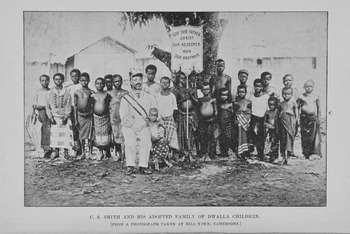
The development of rubrics that designated the difference between African Americans and Africans can be exemplified with a close analysis of AME self-portraits. Most of these portraits used the strategy of placing African American missionaries and Africans in the same picture. The photograph that started this tradition in the AME mission dates back to 1894, when Charles Spencer Smith undertook his explorative travels through West and South West Africa (Figure 7). During his travels, Smith took a self-portrait that showed him in a Knight Templar uniform that was, he asserted, “resplendent with the rays of the tropical sun, and in striking contrast with the surroundings.”Footnote 51 By surroundings Smith meant a group of young black children that bordered his shiny appearance in the center of the picture. Smith's intention to construct this contrast is indicated also on the material level. His uniform and face have been retouched to appear brighter and clearer than the blurred outlines of the chaotic group of youngsters.
The oldest self-portrait of an AME missionary in Africa. Source: Smith, Glimpses, 179. Schomburg Manuscripts, Archives and Rare Books Division, SCRBC, New York Public Library, Astor, Lenox and Tilden Foundations.

The arrangement mimics, at first sight, well-known categories of colonial difference: light versus dark, civilized versus backward, and Christian versus heathen. In addition, Smith exerts a warm yet strong grip on the smallest and presumably weakest child, thus translating notions of dominance into a gesture of obligation of the superior toward the primitive “other.” This was a style of representation that European bourgeois subjects used to secure their innocence in the face of the brutal forms of imperial conquest that had preceded their arrival in Africa, while at the same time asserting their political and cultural hegemony.Footnote 52 However, Smith's self-portrait did not function as a symbol of colonial power relations. He was a black man, and – now cast into the role of the superior subject – he removed the usual link between whiteness and colonial rule from the picture.
The caption makes the complication of the colonial order more explicit. It stated that Smith was shown with his “adopted family of Dwalla children.” The geographical location of the Dwalla in Cameroon and some of the props used in the picture (for instance the umbrella similar to the one in Figure 5) suggest that this was a Lutterodt portrait, and thus not intended to expose African inferiority. Text and image rather captured the ambiguity that was characteristic of the African American perspective on Africa. On the one hand, the caption references the Christian discourse on human diversity, which aimed at reconciling racial theorizing with notions of human sameness by conceiving of Africans as a “race of children.”Footnote 53 On the other hand, Smith called the Africans his family, as was usual for African Americans' vague sense of their African ancestry. His notion of adoption, then, marks the actual point of his intervention. African American viewers were prompted to consider the picture neither a representation of the all-encompassing human family, nor an assertion of their African heritage. Instead, Smith proposed that the African American–African relationship was based on cultural adoption – a nonhereditary, benign, and yet hierarchical relationship that depended on the adoptive parents' mercy.
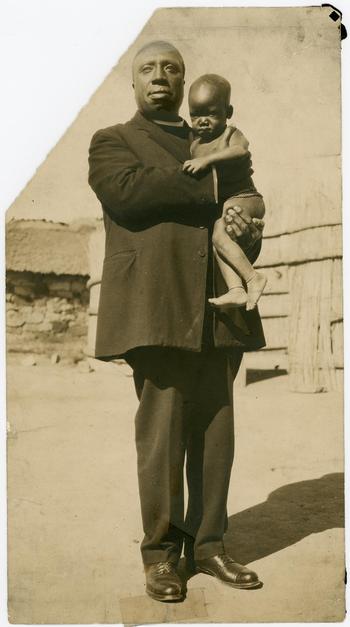
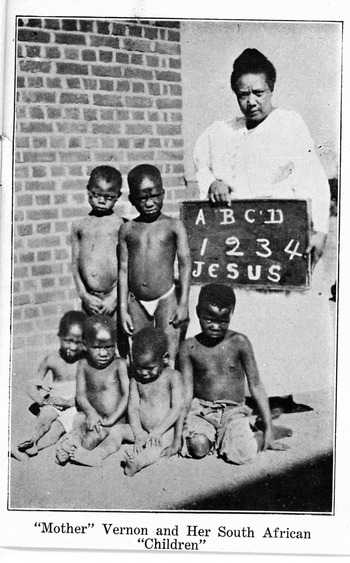
Smith's categories of black difference, bridged by adoptive gestures, formed the starting point of a tradition in AME self-representations that emphasized that African Americans were more culturally refined than Africans. The expanding, and increasingly gendered, application of this scheme of differentiation can be exemplified by comparing the self-portraits of William and Emily T. Vernon from the mid-1920s (Figures 8 and 9). Both pictures contrast the well-dressed African American subjects with nude, small, and sexless African children as their fundamental others. Their superiority and benign authority was visibly enhanced by their gesturing as patrons who extended the promises of Christian charity. William carried the baby child, thus elevating and protecting it from the surroundings. Emily held a blackboard that offered literacy and the story of “Jesus” to the African children.
Example of a male AME missionary self-portrait in the 1920s. Source: Box 2, Folder 5, Bishop William Tecumseh Vernon Collection, Kansas Collection, RH MS-P 529, KSRL, University of Kansas Libraries.

Example of female AME missionary self-portrait in the 1920s. Source: Emily T. Vernon, South Africa: An Open Door – A Story in Pictures (n.p., 1925?), 10.

While Emily and William were staged in similar poses, the captions underlined the gendered message of the image. In Emily's picture, the theme of adoption was created by quotation marks around the terms “Mother” and “Children.”Footnote 54 This way, the image made clear that the family concept was used metaphorically, defying the condescending idea of the African American single mother who gave birth to numbers of children far beyond the well-ordered nuclear family. William's image was published in the AME Review with a caption that stated that he “found” the lamb “in a Basuto Kraal.”Footnote 55 This variant of the adoption theme cast him into the role of a discoverer and a Christian shepherd, which asserted his masculinity while avoiding the infamous notions of black fatherhood that since American slavery was associated with promiscuity and rape. By projecting African otherness along the lines of showing close and caring interactions with black children that were at the same time clearly marked as not being their own, AME missionaries thus not only designated an intra-racial hierarchy. They also created a visual outlook of the middle-class values by which emancipated “New Negroes” in the US asserted their racial refinement and respectability: monogamy, education, and Christianity.
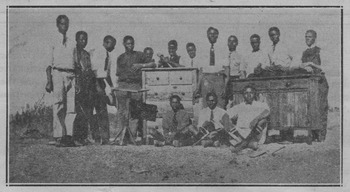
But defining rubrics of black difference was not the only way in which AME missionary photography asserted the African American presence in Africa. Another version of AME self-representation was marked by the absence both of African American bourgeois selves and of African exoticism, in favor of portraying Africans' visual resemblance to the African American role model. A cover of the Voice from 1931 illustrates the construction of this theme in a photograph that showed black male subjects who were wearing school uniforms and were posed dynamically around wooden furniture (Figure 10). The caption locates the scene in Evaton, a black township in the Transvaal. The location is important here, as the picture itself does not offer indications of an African setting. It goes on to explain that it showed “Students of the Carpentry Department, Wilberforce Institute … South Africa, and Some of Their Work.”Footnote 56 Wilberforce Institute was the AME mission's flagship school, founded in 1908. The institute was dedicated to the training of the “Head, the Heart and the Hand,” the philosophy of industrial education that was commonly associated with Tuskegee Institute in Alabama headed by the black pedagogue Booker T. Washington.Footnote 57 In the US South, industrial training was known as a form of education that paved the way up from slavery for African Americans by teaching skills and crafts that allowed freedmen to be economically independent and thus safe from white exploitation. As the AME photograph visibly demonstrated, South Africans now underwent a similar development. Corresponding to the school's requirement that male students devote a portion of every day to carpentry and cabinetmaking, the picture featured the furniture as evidence of the success of this curriculum.Footnote 58
Male students of AME carpentry in South Africa. The image elides visual references to African exoticism. Source: Voice of Missions, June 1931, cover page. The Burke Library at Union Theological Seminary, Columbia University, in the City of New York.

The construction of this parallel between blacks in the US South and in South Africa was further enhanced by its placement in a before–after scheme. The scheme used the carpentry students as emblems of the “new” Africa, and contrasted it with an “old” image that showed Africans lying on the ground in front of a chief and two guards, in a dark and confusing setting. The caption framed the second picture as “A School of Obedience: Africans Paying Homage to Their Chief” (Figure 4). This was indeed an old photograph, which the Voice had published already ten years earlier, then designating it a picture of “The King in a Cabinet Session, Porto Novo, Dahomey” from the International Film Service. In the original framing, the picture thus told the story of one of the most important African kingdoms in West Africa that had been centrally involved in the transatlantic slave trade. In the before–after scheme, this reference was decidedly absent. Instead, it stressed the difference between Africans who admired tribal authorities with Africans who followed the African American lead towards emancipation by industrial training.
This framing merits further unpacking. As the before–after scheme located both scenes in the South African setting, it might also be seen as complex engagement with the colonial politics of segregation and retribalization that marked the 1920s and 1930s (enforced by the Native Land Act of 1913, the Native Urban Areas Act of 1923, and the Native Administration Act of 1927). Many South African photographers in this period became interested in photographing black life in native reserves, in part to criticize the deteriorating living and working conditions, and in part to express a nostalgic longing for traditional African ways of life that then seemed to be passing.Footnote 59 The “school of obedience” picture might align with the critical version of this tradition, as it refutes tribalism as an inculcation of submissiveness, rather than an African heritage. The “new” Africa, however, proposes an unusually positive image of native reserves. Here, South Africans were neither exploited by the white economy nor idealized as “noble savages.” AME photography incorporated this scene into a transnational geography of the US South, as conceived through the lens of African American achievements.
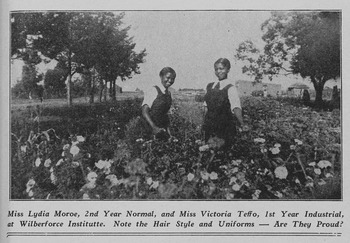
The visual codes that defined this African American vision of the transnational South as the region in which they yielded their transformative powers can be exemplified further with another photography of Wilberforce Institute (Figure 11). Like the Dahomey picture, this image was published in the Voice several times, thus suggesting its popularity and acceptance in the African American viewing public.Footnote 60 The picture was, indeed, powerful in both visual composition and the degree of direct engagement with the viewer the caption asserted. The visual composition showed two young, beautiful, tidily dressed African women in dynamic poses with bright smiles turned to the camera. Lines of trees on both sides, and a ripe cotton field that takes up most of the picture, center the observer's attention on their self-possession, underscored by spontaneous gestures of twiddling with the ripe blossoms. The arrangement evoked black plantation labor in the US South with its reference to the cotton industry, but merely as a past that was now distant. The oppressive character of manual labor waned in favor of a cash crop that could be grown now even by women, forming the building block of their economic independence and participation in global networks of trade and consumption. The depiction of the women as “modern girls,” a form of female racial respectability that developed in the US and in South Africa alongside black print media that aimed at contesting notions of African exoticism by encouraging women to participate in beauty contests, underscored this transatlantic connection. The caption made explicit the social acceptance of the women's appearance by prompting the viewer to “Note the Hair Style and Uniforms”: in the picture, the features that typically signaled African looks – like curly hair and tribal attire – were exchanged for African American hair products and textiles. The question “Are They Proud?” further developed what African Americans were supposed to take away from the image. South Africans too regained self-respect from adopting African American role models.Footnote 61
Female students of AME normal and industrial education in South Africa. The setting constructs similarities to cotton plantations in the US South, while the straightened hair and school uniforms reference African American styles. Source: Voice of Missions, April 1939, 9. The Burke Library at Union Theological Seminary, Columbia University, in the City of New York.

In view of these two variants of African American self-recognition in Africa, AME missionary photography comes to the fore as a close engagement with the divided and shared history of black emancipation in the southern regions of the black Atlantic. AME self-portraits told the ambiguous story of the New Negro who had risen from slavery and cotton plantations in the US South in contrast to the supposedly “backward” state of Africans, as well as by inscribing the same story into South African settings. To be sure, both visual languages were complicit in idealizing African Americans as leaders of South African programs of regeneration, and, more broadly speaking, in advancing narratives of African American exceptionalism. While the construction of this hierarchy among black subjects was still often at the expense of a self-determined representation of black South Africans, AME missionary photography was an important example of the agency that black subjects had in devising the look both of black superiority and of other subalterns. In this sense, African American missionary photography created a complex image of Africa beyond the ethnographic othering that supported white supremacy in systems of racial segregation.
IV. CONCLUSION
In the analysis above, I have reconstructed a history of African American missionary photography of Africa. Based on the fragmented and often elusive visual records of the AME mission, this history reveals how colonial, missionary, and African image traditions shaped a visual sphere that connected African Americans and Africans. Within this transatlantic sphere, African American missionaries developed a new visual language to describe themselves. This photography did not contest the visual truths and evidences that whites produced to impart systems of black oppression. It highlighted the authority that African Americans claimed, based on their self-image as an uplifted race, in devising the visual history of black South Africa.
On a broader scale, the unrestricted nature of the AME photographic record paves the way for more subjective and layered accounts of both colonialism in Africa and American Jim Crowism. Including both traditional ethnographic pictures and rare forms of African photography, the African American missionary photographic archive presents an important clue to the ways in which historical photographs of Africa refused to be blended into a dualist regime of black versus white gazing. The photographs that AME missionaries collected, staged, failed to take, strove to imitate, sorted out, arranged, relabeled or kept hidden from public sight also constituted narrative interruptions. They belong to the other history that subalterns shaped of the oppressive conditions under which their photographs were taken.