Introduction
Approximately 6.5% of Australians over the age of 65 have dementia and it is the greatest single contributor to burden of disease due to disability in older age groups (Australian Institute of Health and Welfare, 2004). The number of Australians living with dementia is predicted to increase from 245,000 in 2009 to 591,000 in 2030 (Access Economics, 2009). Dementia has a considerable impact on the psychological and physical health and quality of life of people living with dementia, including their carers (McConaghy and Caltabiano, Reference McConaghy and Caltabiano2005). Interventions such as carer education have been reported to improve the physical and psychological health of carers and care recipients (Brodaty et al., Reference Brodaty, Green and Koschera2003). The only significant feature associated with success in these interventions is the involvement of both people in care relationships, that is, the person living with dementia and their carers or family (Brodaty et al., Reference Brodaty, Green and Koschera2003).
Memory Lane Cafés are social support services for people living with dementia and their carers. They are based on the “Alzheimer Café” model first implemented in 1997 in The Netherlands (Miesen and Blom, Reference Miesen and Blom2001). A distinctive feature of the Café service is that both the person with dementia and their carer, family member or friend attend the service. In 2002, Alzheimer's Australia Vic adapted the model to create and implement Memory Lane Cafés in Victoria Australia. At the time of this evaluation, there were three Memory Lane Cafés coordinated by Alzheimer's Australia Vic: two located in metropolitan Melbourne and one in a regional city approximately 100 kilometers from Melbourne. The cafés have continued to operate in these three Victorian locations since their establishment in 2002.
Research suggests that there are substantial individual and societal benefits to be gained from both Alzheimer Café style support services and other social interventions for people with dementia and their families and carers (Cooke et al., Reference Cooke, McNally, Mulligan, Harrison and Newman2001; Brodaty et al., Reference Brodaty, Green and Koschera2003; Smits et al., Reference Smits, de Lange, Dröes, Meiland, Vernooij-Dassen and Pot2007). However, research into the Alzheimer Café model, and specifically the Memory Lane Café service, is limited and further investigation was considered necessary to provide evidence on the efficacy of the model. Previous evaluations have provided qualitative evidence of benefits of this type of service. Capus (Reference Capus2005) evaluated a British Alzheimer Café by holding a group discussion with carers of people with dementia who attended the service. The study found the Café helped participants “normalize” their experience and emotions in relation to dementia. The service also provided attendees with a new social network. These results were supported by Morrisey (Reference Morrissey2006) in his personal reflective account of an Alzheimer's Cafe experience in Hampshire, U.K. and Mather (Reference Mather2006), who described the success of Memory Lane Cafés in Australia as indicated by ongoing popularity with attendees.
The purpose of this paper is to describe an evaluation of the Memory Lane Café service run by Alzheimer's Australia Vic. This evaluation was conducted by the National Ageing Research Institute of Australia in 2008–9 on behalf of the Victorian Department of Health, which funded both the Memory Lane Café service and the evaluation.
Methods
Service description
The Alzheimer's Australia Vic Memory Lane Café model aims to:
• promote social inclusion and prevent isolation;
• facilitate communication and sharing of experiences between families and carers, thereby fostering peer support;
• improve understanding of dementia and related issues;
• provide a forum for informal advice and consultation with counseling and support staff;
• promote and facilitate access to the broader service system within the community.
The Alzheimer's Australia Vic's Living With Memory Loss Program is the access point for entry to Memory Lane Cafés. To be eligible to attend the Living With Memory Loss Program and hence Memory Lane Cafés, a person living with dementia has to have early stage dementia. Potential attendees are assessed and referred to the program by one of the Alzheimer's Australia Vic counselors. The Living With Memory Loss Program is a six-week group program that aims to help people to acknowledge and discuss dementia in a supported environment, through provision of education, opportunity for discussion and orientation to dementia. Experiences are shared amongst those in attendance with the intention of fostering a strong element of trust where significant disclosures can occur. Following completion of the Living With Memory Loss Program, participants are provided with details of the Memory Lane Café closest to their homes and details of the next session. It is up to individuals whether or not they choose to participate in the Memory Lane Cafés.
Café sessions occur every four to eight weeks, depending on venue availability and public holidays. There are between six to ten Memory Lane Café sessions annually in each location. Café sessions include a speaker or entertainer and afternoon tea served during a two-hour period. Entertainment is varied, often including musical entertainers singing songs popular during the 1940 and 50s or a speaker providing educational information about social support services or recreational services. Taxis are provided to people with dementia and their carers who require transport and they pay AUD$3 each to attend the Café service.
Program evaluation
The program evaluation consisted of focus groups and surveys with people with dementia and their carers, staff consultation, service provider interviews, and researcher observation. The Melbourne Health Mental Health Human Research Ethics Committee approved the project.
Attendee focus groups
Three focus groups were held with people with dementia and their carers using a semi-structured group interview method. Groups were held at a venue near the location of the Cafés. Everyone with dementia and their carers on the Alzheimer's Australia Vic Memory Lane Café mailing list (n = 402) were sent a letter of invitation, and researchers also attended Cafés to recruit participants. In the focus groups one of the research team asked open-ended questions about attendees' experiences of the Cafés: what they liked and disliked about them, their impact on issues such as attendees' ability to manage dementia and to access services; and suggestions for improvement. Focus groups were audio-taped and transcribed with permission of the participants.
Survey of people with dementia and their carers
A survey, developed for evaluation of the program, was sent by Alzheimer's Australia Vic to everyone with dementia and their carers on the Memory Lane Café mailing list (n = 402), with a reply paid envelope. The survey included demographic questions and questions about access, attendance, experience, and satisfaction with the Cafés. Suggestions for improvement were also requested. One purpose of the survey was to capture views of people who did not attend Memory Lane Cafés, including those who had stopped attending and those who had never attended.
Staff consultation
A meeting with all staff was conducted to seek their views on aims, benefits, and areas for improvement for the Cafés. The staff included counselors and administrative staff from Alzheimer's Australia Vic directly involved in running the Cafés. Discussion was digitally recorded and transcribed with permission from participants who were later provided with a summary of the discussion for comment. Feedback from staff on the summary was collated by an Alzheimer's Australia Vic staff member and forwarded to the research team.
Service provider consultation
Interviews were conducted with those service providers that the researchers considered likely to be providing services to Café attendees, referring people to the Cafés or receiving referrals from Café services. Service providers included staff working with people with dementia and their carers, such as representatives from local government, ethnic organizations, memory clinics, and aged care assessment services. Semi-structured interviews included questions about service provider knowledge and experience of the Café service, perceptions of benefits of the Café service, and suggestions for improvement. Service providers in each Café location were categorized according to the type of service they represented; for example, local government, ethnic organization, memory clinic, or aged care assessment service. One person from each category was randomly selected to participate in an in-depth interview, including a longer series of questions designed to provide more detailed information. Seven in-depth interviews were conducted. Notes were taken during interviews and service providers were offered the option of checking notes for accuracy before they were analyzed.
Researcher observations
Three researchers attended a Café session in each location. Alzheimer's Australia Vic staff introduced the researchers at the beginning of the Café session, and researchers spoke briefly to Café attendees about the evaluation. Researchers sat and talked with attendees for the duration of each Café session, and collected expressions of interest from people with dementia and their carers wanting to participate in focus groups. During Café sessions, researchers observed and talked informally with attendees about the Café environment, their interactions with staff, their responses to the entertainment, and the general atmosphere of Cafés.
Data analysis
Qualitative data from the survey of people with dementia and their carers, consultations with Alzheimer's Australia Vic staff, Café attendees, and relevant service providers were subject to content and thematic analysis (Miles and Huberman, Reference Miles and Huberman1994). Quantitative data were analyzed using the Statistical Package for the Social Sciences Version 17. Descriptive statistics were used to analyze demographic information and frequency of attendance data, which were collected via the survey.
Results
Focus groups of people with dementia and their carers
Thirty-seven people with dementia and their carers participated in focus groups, with 7, 12 and 18 people attending the groups in each of the three Cafés. Three people attended by themselves. The following themes were derived from analysis of focus group transcripts.
Enjoyment
People with dementia and their carers reported they enjoyed attending Memory Lane Cafés. They emphasized the social benefits of the service, with participants at all focus groups mentioning their appreciation of the outing, company, and fellowship, meeting people, and making friends.
“The socializing. It's nice to get out and have a cuppa and catch up with . . . the same people.”
“There's definitely time for both the carer and the one who's cared for, it's definitely a time-out where you . . . just have fun.”
Social inclusion and peer support
Cafés provided an opportunity for social inclusion and peer support. People with dementia and their carers stated that looking after and supporting each other was a valuable aspect of attending the Café.
“. . . looking forward to it which is a big thing because I'm on my own and it's a big thing to come here. And as I said before, that they're the same as me and I don't feel embarrassed.”
“. . . feeling good because you're with people who are in the same type of situation as you are, and no matter what they tell you, how to look after the person you're with, . . . it just doesn't work out. And then you, you hear stories from other people and it, it really does put you on a level playing field and you feel a lot better. You go home resolved. . .”
Many Café attendees socialized outside the Café environment, and discussed going on outings and holidays together with people they had met through the Living With Memory Loss Program and Memory Lane Café. The support network formed at Cafés was increasingly important when someone in a care relationship entered residential care or died.
Education and information
Focus group participants, particularly carers, family members or friends, provided mixed views as to whether they would like Cafés to adopt a more educational approach. Some preferred the current social focus as they were able to meet their education and information needs elsewhere. However, some were looking for more information about dementia, particularly those who did not live close to Alzheimer's Australia Vic.
Some expressed interest in obtaining information about latest research findings, suggesting a six-weekly fact sheet. Café attendees stated “information doesn't need to be provided at every session but perhaps every second, as Hawthorn [the location of Alzheimer's Australia Vic] is over the other side [of Melbourne].”.
However, most carer, family member or friend attendees found informal information sharing to be beneficial.
“There's also very often useful information, things I haven't heard about before. So they have guest speakers and I find just by going to Memory Lane Café . . . helpful hints, things that can be done, other contacts, things like that.”
Consultation with counseling and support staff
Participants in each of the three focus groups appreciated staff being present at Café sessions, describing them as welcoming and approachable. There was variability in understanding the role of the Café staff and the extent to which Café attendees consulted with them as counselors, depending on the Café. One Café provided private spaces for private discussion with counselors as well as access at any stage via telephone. At another Café, people with dementia and their carers were not aware that staff present were counselors. Focus group participants requested the role of staff be emphasized to Café attendees, with staff sitting and mingling with them. Focus group participants said they would like the opportunity to talk to staff without feeling they were imposing on them.
Clarification of Café attendance criteria
The majority of focus group participants reported regularly attending Memory Lane Cafés for many years, and hoped they would be able to continue attending if they or the person they attended with moved to residential care, or if they no longer had someone to attend with. However, they were unsure whether they could continue attending if their circumstances changed, and expressed uncertainty and concern as to whether they could attend alone or if in residential care.
“Maybe, they may no longer be eligible to go once their partner either dies or goes into permanent nursing homes and things like that. You don't go after that, do you?”
“I think they'd like to continue if there was permission because you're amongst people that you've known for a long time and it's hard to cut yourself off totally from them because you can't go there anymore.”
Frequency
Cafés are run every four to eight weeks. At two focus groups, some participants stated that they would prefer the Cafés to be run more frequently as they looked forward to the experience. However, others at all three focus groups were satisfied with the frequency of Cafés.
Input into service planning and evaluation
Focus group participants stated they did not have an opportunity to give feedback on sessions or contribute suggestions for future sessions. There were mixed views in all focus groups about how feedback could work; for example, many did not want extensive surveys to complete at the conclusion of every Café. Some stated they liked a “surprise” and were happy to leave session planning to Alzheimer's Australia Vic. Other participants commented they thought formal evaluation would be helpful. Although staff did not ask for feedback, focus group participants felt the opportunity was there if they wanted to provide comments.
Across the three focus groups, most participants agreed they would like a formal feedback mechanism to be established so they had an opportunity to express their views. For those who did not agree, it was generally because they were unsure how this would happen and were concerned they would be asked to provide feedback as they were rushing out of the door to their taxis.
Survey of people with dementia and their carers
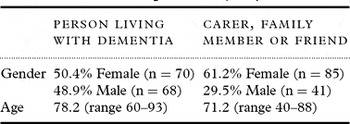
A total of 402 survey forms were distributed to everyone with dementia and their carers on the Memory Lane Café mailing list. The letter inviting completion of the survey requested the opinions of both the person living with dementia and their carer, family member or friend. A total of 139 survey forms were returned, representing a 34.6% response rate. As Table 1 illustrates, 50.4% (n = 70) of respondents living with dementia were female, as were the majority of family members or friends. The average age of respondents living with dementia was 78.2 years (SD = 6.8, age range = 60–93 years) and average age of carers, family members and friends was 71.2 years (SD = 11.2, age range = 40–88 years).
Gender and age of survey respondents

As demonstrated in Tables 2 and 3, the majority of survey respondents living with dementia and their carers, families or friends were born in Australia or other English-speaking countries, and English was their preferred language.
Country of birth of survey respondents with dementia

Country of birth of survey respondents who are carers, family members or friends

Of the respondents, 82% (n = 114) had attended at least one Memory Lane Café. Almost half (48.2%, n = 55) of those who attended did so as often as they could and a smaller proportion attended every Memory Lane Café (15.8%, n = 18).
Fourteen percent (n = 20) of survey respondents had stopped attending Memory Lane Cafés. This was often due to multiple reasons, including other commitments (25%, n = 5), the person with dementia being too unwell (25%, n = 5) or lack of interest (25%, n = 5). A smaller proportion of respondents who had stopped attending indicated it was due to travel distance (15%, n = 3), or death of the person with dementia (10%, n = 2).
Twenty-five respondents (18%) had never attended a Café. Reasons for never attending included: travelling distance (32%, n = 8) other commitments (28%, n = 7) or the person with dementia was too unwell (24%, n = 6). A smaller proportion of survey respondents had never attended as they were not interested in attending Memory Lane Cafés (20%, n = 5) and comments indicated some people would not feel comfortable attending such a social event. A number of survey respondents commented they had never attended a Memory Lane Café as the person with dementia, carer, family member or friend lived in residential care, indicating a misconception that this made them ineligible.
Eight percent (n = 9) of survey respondents with dementia who had attended a Memory Lane Café were aged below 65 years (indicating younger onset dementia), as were 4% (n = 1) of survey respondents who had not attended.
Staff consultation
Eight staff, representing all counselors, administration and management staff involved in the Cafés from Alzheimer's Australia Vic, were consulted regarding Memory Lane Cafés. Staff believed attending Memory Lane Cafés improved social and emotional well-being of people with dementia and their carers. The staff stated that the service helped to prevent social isolation and reduce carer stress in a supportive environment respecting the care relationship. The service provided an environment where behavioral and psychological symptoms of dementia were accepted.
Staff viewed the link with the Living With Memory Loss Program as an important component of Cafés. They were concerned that if people who had not attended the Living With Memory Loss Program were to attend Cafés, they may not have experienced education, relationships, opportunity for discussion and orientation to dementia provided by the program and may feel isolated within larger Memory Lane Cafés. Staff advised that experiences shared throughout the Living With Memory Loss Program fostered a strong element of trust where significant disclosures occurred.
“. . . the aim is to continue on a group process that's commenced, with Living With Memory Loss, to provide that continuity of the group and of the group's connection with the counselor. . . who can understand what the experience is like for them, and who they've already got to know through an existing group.”
Staff viewed the service as “an opportunity to provide continued information and support as the journey through dementia continues”, though staff reported exposure to other services was a “secondary benefit” of Memory Lane Cafés. Counselor and volunteer presence at Memory Lane Cafés was seen as an important aspect of the service model, providing an opportunity for people with dementia and their carers to take a proactive approach in accessing counselors. Staff also stated that the service enables people with dementia and their carers to learn informally from each other.
“Someone (for example a person with dementia) might have had an experience with a particular planned activity group or with a respite location or might be considering residential care and has explored some options – it is one thing for staff to be able to talk to people about those options but they can also get it from their peers.”
In regard to the profile of people with dementia and their carers attending Memory Lane Cafés, staff noted that people from culturally and linguistically diverse (CALD) backgrounds (referring to those who are from countries where English is not the main language) may be less likely to attend, as they are less likely to access the Living With Memory Loss Program. This observation was supported by findings of the survey of people with dementia and their carers, described above.
Staff suggested that people with dementia stopped attending with their carers once they started living in residential care, although they advised that a carer, family member or friend may continue to attend if the person with dementia is no longer able to. They commented that individuals decided when to cease attending, and there were no specific guidelines regarding attendance.
Alzheimer's Australia Vic staff reported that they conduct annual monitoring of Memory Lane Cafés. People with dementia and their carers were asked to rate their satisfaction with aspects of the program – such as access to venue, parking, catering, speakers, and being able to talk to counselors. Their ideas are considered in developing the next year's program. This contrasted with the perception of the focus group participants, who reported that they do not currently have any formal feedback mechanism.
Service provider consultation
A total of 24 interviews, including seven in-depth, were conducted with service providers. Interviews were conducted with staff from seven different service types including: Aged Care Assessment Services; Cognitive, Dementia, and Memory Services; community health services; migrant resource centers; planned activity groups; and respite services. Interviews were also conducted with local government aged care managers and a policy officer from the Victorian Government Department of Health (then Human Services).
The majority of service providers interviewed had limited awareness and knowledge of Memory Lane Cafés. Those that knew of the service knew of individuals who attended. As it could only be accessed via the Living With Memory Loss Program, and therefore service providers could not refer people with dementia and their carers directly, it had not been broadly advertised. Some knew of the Living With Memory Loss Program, but many were unaware it was the access point for Memory Lane Cafés.
Those service providers who had knowledge of Memory Lane Cafés found them to be of benefit to people with dementia and their carers and believed they promoted shared compassion and helped people with dementia and their carers experience the journey of dementia together in a relaxed and comfortable environment.
In line with staff consultation and survey findings, service providers also noted that people from culturally and linguistically diverse backgrounds were less likely to attend Memory Lane Cafés, because they were less likely to access the Living With Memory Loss Program. Service providers further suggested that linguistic barriers may make it difficult – or indeed prevent –such people from accessing both the Living With Memory Loss Program and subsequently Memory Lane Cafés.
Researcher observations
Three researchers from the National Ageing Research Institute attended a Memory Lane Café session in each location. They noted that people with dementia and their carers seemed to enjoy the Cafés, particularly the opportunity to talk to others with similar experiences and afternoon tea. There was a high level of interaction between people with dementia and their carers, with joking and laughter, and Café attendees were willing to engage with the researchers and talk about their experiences. Researchers also noted new attendees tended to sit with people they knew from the Living With Memory Loss Program, supporting observations by staff that Cafés provided an opportunity for continuity in group cohesion and relationships formed in the Living With Memory Loss Program. Researchers also noted some access and environmental issues at venues. Two venues were located in areas that were difficult to access by public transport, were difficult to find, and involved a considerable distance between the car park and entrance. There was also a lack of ramps and toilets for people with a disability in all three venues, and at one venue the temperature was too cold and seating was cramped. The external environment for all venues was very pleasant as they were located in parkland settings.
Discussion
Results of the evaluation suggest that Memory Lane Cafés were largely successful in achieving the aims of the service model, which were to:
• promote social inclusion and prevent isolation;
• facilitate communication and sharing of experiences between families and carers, fostering peer support.
• improve understanding of dementia and related issues;
• provide a forum for informal advice and consultation with counseling and support staff; and
• promote and facilitate access to the broader service system within the community.
However, results also indicate that the service model could be improved, for example by clarifying expectations and roles, engaging people with dementia and their carers in planning and evaluation, and broadening access for those not currently attending.
Consultation with people with dementia and their carers and staff illustrated social inclusion and peer support were key benefits of the Cafés. They provided a rare opportunity for people with dementia and their carers to socialize with others who shared similar experiences in an environment where behavioral symptoms of dementia were accepted. In some cases, people with dementia and their carers socialized outside Cafés as well. This included going on holidays and outings together, outside of Café time.
Cafés provided a venue for attendees to receive informal education from Alzheimer's Australia Vic staff and other people with dementia and their carers, and to share information and experiences, hence improving understanding of dementia and related issues. Staff were also able to educate people with dementia and their carers about other services. Although staff reported exposure to other services was a “secondary benefit” of the Cafés, there were benefits in people with dementia and their carers being linked with local service providers. The service system can be overwhelming and complex to navigate. People with dementia and their carers may be reluctant to contact services and therefore fail to benefit from the diverse support available. One Café was addressing this by inviting relevant service providers to Café sessions to describe briefly the services they provide, and to circulate informally among those attending.
Although many people with dementia and their carers reported they found contact with staff at Café sessions beneficial, a number were not aware that the Alzheimer's Australia Vic staff present were counselors. Café sessions are relatively infrequent and often have new people attending. People with dementia who have cognitive and memory impairments may not recall staff and information from previous sessions. They need to be regularly informed of the role of counselors so they can maximize benefits from the service. It has been suggested that staff should introduce themselves, reinforce their role at the beginning of every session, and circulate among Café attendees. For example, some focus group participants specifically requested that the role of staff be emphasized to attendees at each Café.
For people with dementia and their carers attending Cafés, there were opportunities to learn about and gain access to the broader service system. However, as Cafés were not directly accessible from other parts of the service system, such as Aged Care Assessment Services and Cognitive, Dementia, and Memory Services, links between Cafés and these services were limited.
People with dementia and their carers were not aware of any opportunities for them to participate in planning and evaluation of the service. Ideally, services should be planned to meet needs and preferences of people with dementia and their families and carers. Creating an active role for people in the care relationship promotes autonomy and self-esteem (Martin and Younger, Reference Martin and Younger2000; Clare, Reference Clare2002). The perspective of people with dementia and their carers should be used to inform service planning and evaluation. An annual review, including feedback from Café attendees, was recommended to enable Cafés to meet their changing needs. Some participants commented that they thought formal evaluation would be helpful.
Whilst Memory Lane Cafés were seen as beneficial to those attending, there are many more people living with dementia and their carers who are not accessing the service. One group comprised those who knew of the Cafés and had chosen not to attend. For this group, travel distance was the main reason for non-attendance, suggesting that location of future services should be an important consideration.
For others not attending Cafés, the main barrier to access, as reported by service providers, was the current single access point via the Living With Memory Loss Program. This limited the service to those who had been assessed as eligible for that program – i.e. people who were diagnosed at an early stage of dementia and referred to Alzheimer's Australia Vic and judged potentially to benefit from the program.
This requirement also potentially restricted access for people from culturally and linguistically diverse backgrounds. This is of particular concern as this group of people are amongst those who may encounter additional disadvantages living with dementia, and may have diverse needs warranting consideration in service planning and provision (Alzheimer Scotland, 2003). It also appears that there were few or no Aboriginal people attending the Cafés. Data provided by Alzheimer's Australia Vic indicated 16.3% of people who participated in an Early Intervention Program, including the Living With Memory Loss Program, were born overseas (Mocelin et al., Reference Mocelin, Scholes and Velakoulis2008). Overall 32% of Australians living with dementia were born overseas (Australian Institute of Health and Welfare, 2007). Alzheimer's Australia Vic staff and service providers noted that people from culturally and linguistically diverse backgrounds were less likely to attend Memory Lane Cafés, as they are less likely to access the Living With Memory Loss Program. This may be due to this group of people being more likely to be diagnosed later in the progression of their illness (LoGiudice et al., Reference LoGiudice, Hassett, Cook, Flicker and Ames2001), and therefore unable to benefit from early intervention programs. It might also highlight the fact that services need to be diverse, and culturally appropriate and sensitive, to meet individual needs. Service providers further suggested linguistic barriers may make it difficult for people from culturally and linguistically diverse backgrounds to access both the Living With Memory Loss Program and Memory Lane Cafés in their current formats.
Alzheimer's Australia Vic staff viewed completion of the Living With Memory Loss Program as an important precursor to attending Cafés. Staff advised that experiences shared throughout the Living With Memory Loss Program fostered a strong element of trust. Researchers also observed that Café attendees tended to sit with people they knew through the Living With Memory Loss Program, and this was particularly important in their initial contact with the Café.
A number of recommendations were made to Alzheimer's Australia Vic and to the Victorian Government as a result of this evaluation. It was strongly recommended that existing Cafés should be continued, as there were clear benefits for those attending. A number of changes were recommended, such as addressing environmental issues; making roles of counselors and eligibility criteria known to attendees on a more regular basis; providing programs, entertainment and activities to suit attendees' needs and preferences; catering to meet dietary and nutrition requirements; and including people with dementia and their carers in service planning and evaluation. It was also recommended that the Victorian Government explore the possibility of setting up additional Cafés for people living with dementia and their carers in geographical areas not covered by current services, as funding permits. Another recommendation was that the Victorian Government explore needs of groups currently under represented, such as those from culturally and linguistically diverse backgrounds and from Aboriginal backgrounds. An adapted service model was suggested to extend the existing single access point; the Cafés are currently only accessible via the Living With Memory Loss Program. However, it was noted that it would be important to monitor the impact of any new service models on those who are accessing them.
This study was limited by lack of a point of comparison for the Cafés and lack of objective measures with which to evaluate outcomes for the people who attend Memory Lane Cafés. However the mainly qualitative method used provided a rich account of experiences of people with dementia and their carers who were users of Memory Lane Cafés. The limitation of this approach is that findings are specific to those already involved in Cafés and cannot be generalized to other populations. Furthermore, all informants were aware that the evaluation would provide information to the Victorian Government Department of Health to inform decision-making regarding ongoing funding of Cafés. This may have biased responses to researchers' questions.
In conclusion, the evaluation found that Alzheimer's Australia Vic Memory Lane Cafés appear to be achieving their stated aims, and people living with dementia and their carers who attend Cafés are benefiting from the service. Memory Lane Cafés promoted social inclusion and prevented isolation, improving the social and emotional well-being of attendees. Cafés fostered peer support, as people formed friendships providing a valuable support network beyond Cafés. It was recommended that the existing Café services should be continued and possibilities for extending the Cafés should be explored.
In line with these recommendations, the Department of Health Victoria has since provided additional funding for four pilot Café-style support services to be developed in four different regions of Victoria. The guidelines for the pilot services are based on the recommendations from this evaluation, and include:
• a range of entry points to services;
• accessible and usable venues for people with dementia and their carers;
• partnerships of organizations, including dementia expertise, to develop and deliver services;
• meeting diverse needs including cultural and linguistic diversity and those of Aboriginal people;
• entertainment, information and refreshments to meet the needs and preferences of attendees;
• clarification of staff roles; and
• the involvement of people with dementia and their carers in annual evaluation of the services.
Conflict of interest declaration
Because the editor-in-chief of International Psychogeriatrics is the Director of the National Ageing Institute, where some of the authors of this paper work, the review process for this paper was conducted through the office of one of the journal's deputy editors, without involving the editor-in-chief in any way.
Description of authors' roles
Briony Dow oversaw the writing of the paper with sections written, edited and reviewed by each of the authors. The evaluation was conceived by Diane Calleja and the methodology designed in consultation with the other authors and a project reference group. The study was conducted by Briony Dow, Betty Haralambous, Courtney Hempton and Susan Hunt.
Acknowledgments
The authors would like to thank Alzheimer's Australia Vic staff, Memory Lane Café participants and key stakeholders who participated in the evaluation. Professor David Ames and Dr Dina LoGiudice provided invaluable advice, as project advisers, as did the project reference group. The Victorian Department of Health funded the project.