Introduction
Agriculture, in the past dominated mainly by productivity, now also has to consider other objectives like the quality of crop products, the low cost of production and the environmental impact of crops and cropping systems, and hence increased nitrogen (N) use efficiencyReference Gastal and Lemaire1. Improved nitrogen management has become essential in recent years because of increased levels of nitrate in groundwater associated with high rates of N applied to crops. The application rates, timing, and methods of both N fertilization and irrigation are ways to improve N managementReference Li and Yost2. During the past 50 years, global N fertilizer applications have increased steadily, rising almost 20-fold to the present rateReference Glass3 of 1011 kg yr−1. Horticultural crop species such as sweet pepper are traditionally supplied with high levels of chemical fertilizers, contributing to increased contamination in aquifers, rivers or lakes. In vegetable crops, the yield response to nitrogen can be dramatic, and the cost of the fertilizer often small compared with the cost of lost yield. Therefore, farmers usually over-fertilize with nitrogen, rather than risk under-fertilizing and suffering lost revenueReference Tremblay, Scharpf, Weier, Laurence and Owen4.
Organic fertilization could be a useful tool to minimize soil contamination while improving fruit quality. However, it is often difficult to identify and measure the easily mineralizable fraction, which arises from the effects of temperature and moisture supply on N-cycle processesReference Mulvaney, Khan, Hoeft and Brown5. Organic farming has therefore to develop protocols to determine the minimum rates for different types of organic fertilizer in order to optimize plant growth and fruit quality compared with other agricultural production methods. Differences in the management of soil fertility affect soil dynamics and plant metabolism, which result in differences in plant composition and nutritional qualityReference Worthington6. Many studies have pointed out the effect of soil management on fruit quality. Recently, BenbrookReference Benbrook7 reported that organic farming elevated antioxidant levels in about 85% of the cases studied to date and, on average, levels are about 30% higher compared to food grown conventionally. However, many studies have pointed out significant variation in the results, both within and among studies, due to maturity at harvest, temperature or surface bruisesReference Bourn and Prescott8. Our study has been developed to control for theses issues, by using the same greenhouse, in separate individual lysimeters, controlled climate conditions, and minimizing external factors that might affect the treatments. The aim of this work was to characterize and to evaluate, under the same climate conditions, the yield and fruit quality of sweet pepper under organic fertilization management, compared to integrated and conventional systems in which chemical fertilizer was added at different dosages through the crop cycle to avoid nutrient depletion.
Materials and Methods
Plant material and growth conditions
Sweet pepper plants (Capsicum annuum L.) cv. Requena, California type, were transplanted from a commercial nursery on 18 December 2003. Plants were grown in a plastic greenhouse which was divided into eight independent lysimeters. The use of lysimeters avoids any interference or contamination from each irrigation water or drainage. Each lysimeter was 7.6 m long and 6.5 m wide, with seven lines of drip irrigation and its own fertilizer and water control unit. The lysimeter contained a total of 126 plants with a 4 l h−1-dripper per plant. The irrigation schedule was applied according to the US Weather Bureau Class A evaporation pan which was placed inside the greenhouse. Total water applied per lysimeter was 29±0.6 m3. Each lysimeter received, before transplanting, 4 kg m−2 of horse manure with the following characteristics, on a dry weight basis: organic material: 44.3%; C/N: 19.8; P2O5: 1.4%; total N: 1.3%; K2O: 1.9%. This dosage was the common amount used in greenhouses to improve soil characteristics and allows bio-fumigation at the end of the crop cycle, whatever crop method was applied. The conventional treatment consisted of the application of the local farmers' fertilizer dosage (g m−2) N: 30.7; P2O5: 28.3; MgO: 10.5; K2O: 54.7; CaO: 27.5, to each lysimeter throughout the crop cycle. The integrated treatment received half of the fertilizer dosage of the conventional treatment. No chemical fertilizers were added to the organic treatment. The greenhouse had automated control of relative humidity, by a fog system.
Growth analysis and nitrate determination
Forty-eight plants were harvested at each sampling time: 5, 57, 104, 152 and 186 days after transplanting (DAT). Total plant stem and leaves were weighed. Dry weight was determined after a minimum of 72 h at 70°C. Nitrate concentration was calculated in the dry matter of leaves, stem and roots (only the upper part). Nitrate was extracted from 0.5 g of ground material using 25 ml of deionized water, with centrifugation for 30 min. Five milliliters of extract were mixed with 5 ml of 2 M (NH4)2SO4, to adjust ionic strength, before nitrate determination with a Thermo-ORION 950 ion selective electrode.
Fruit analyses
Marketable fruit quality was determined from the three central rows of plants in each lysimeter, avoiding two edge rows due to the environmental ‘edge’ effect. Fruit harvesting was performed at the fully mature green stage of ripening. Marketable characteristics for California peppers were defined as: Extra: uniform color, good health state, square shape, and weight >190 g; class I: uniform color, good health state, non-square shape and weight >225 g; class II: uniform color, good health state, non-square shape and weight of 224–170 g; class III: uniform color, good health state, non-square shape and weight of 100–170 g; non-marketable: remaining fruits rotten, fruits with more than 20% of their surface having blossom-end rot (BER) or lighter than 100 g.
Forty-eight fruits were weighed, washed with deionized water and seeds removed. Antioxidant activity was determined in the liquefied and centrifuged fruit sample using ABTS [2,2′-azinobis(3-ethylbenzothiazoline-6-sulfonic acid)] according to the method proposed by Miller et al.Reference Miller, Sampson, Candeias, Bramley and Rice-Evan9. The method is based on the ability of antioxidant molecules to quench the long-lived ABTS+, a blue–green chromophore with characteristic absorption at 734 nm, compared with that of Trolox (6-hydroxy-2,5,7,8-tetramethychroman-2-carboxylic acid), a water-soluble vitamin E analog. The addition of antioxidants to the preformed radical cation reduces it to ABTS, the decolorization being determined. Carotene and chlorophylls were determined following the method of Nagata and YamashitaReference Nagata and Yamashita10: 1 g of fruit was homogenized with 15 ml of acetone/hexane (4:6) and the two fractions were separated by centrifugation at 5000 rpm for 7 min. The supernatant was collected for determination of pigment content in a spectrophotometer at 663, 645, 505 and 453 nm. β-Carotene was quantified according to the equation: β-Carotene (mg/100 ml)=0.216A 663−1.22A 645−0.304A 505+0.452A 453; chlorophyll A (mg/100 ml)=0.999A 663−0.0989A 645; chlorophyll B (mg/100 ml)=−0.328A 663+1.77A 645. The fruit firmness was determined on fruit with intact skin by using a Bertuzzi FT011 penetrometer, fitted with an 8-mm-diameter probe. Total soluble solids (TSS) content was measured in an Atago N1 refractometer and expressed as °Brix.
Statistical analyses
The experimental design consisted of three treatments (conventional, integrated and organic farming). Conventional and integrated treatments had three blocks (lysimeters), while the organic treatment had two blocks (the greenhouse had eight lysimeters). Each block had 126 plants. Each conventional and integrated treatment consisted of 378 plants and 252 plants in the organic treatment. In order to obtain enough replicates, each complete row of plants was considered a replicate. Biomass variables were transformed to their logarithms before analysis and were judged to be normally distributed and homoscedastic by the Kolmogorov–Smirnov–Lilliefors and Levene tests. The SPSS v. 7.0 statistical package (SPSS Inc., Chicago, Illinois) was used to calculate significant differences by analysis of variance (ANOVA), and means were compared at probability P<0.05.
Results and Discussion
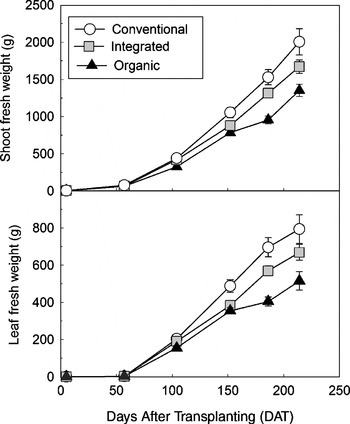
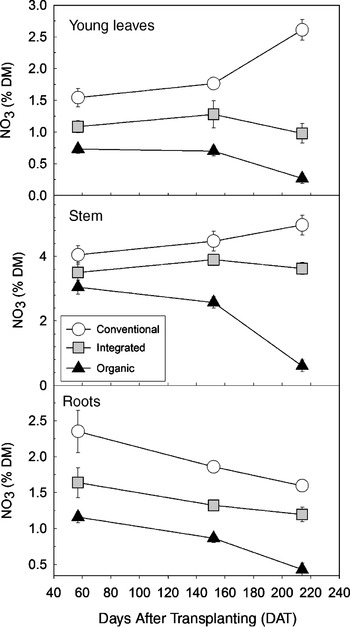
As a result of only the initial pre-planting addition of manure, plant growth was not limited by nutrient availability in the soil during the first stages of growth in the organic treatment (Fig. 1). However, as plant biomass increased, the organic treatment reduced growth, and at the end of the crop cycle shoot fresh weight and total leaf fresh weight were reduced by 32.6 and 35%, respectively, compared to the conventional treatment. Organic N management requires knowledge of the response of crop growth processes to N. Therefore, depletion and/or shortage of N indicates that either the crop cannot maintain its leaf area expansion rate or cannot maintain its leaf and plant N concentrationReference Van Delden11. The effect on leaf expansion of canopies is brought about in a large part by N supply. The significant effect of N supply on leaf expansion and on branching appears a general response in many cropsReference Gastal and Lemaire1 and its effects on plant growth differ from those of KReference Del Amor and Marcelis12 or CaReference Del Amor and Marcelis13. In the organic plots, only a small percentage of the soil-derived N would be available at any given point in time because it must first be mineralized by microbes to a plant-available form such as NH4+ or NO3− and the amount mineralized may not be enough to meet crop N needs during later growth periods. On the other hand, limited N sources in the soil at a late stage of the crop cycle could be a key factor for reducing N lossesReference Dinnes, Karlen, Jaynes, Kaspar, Hatfield, Colvin and Cambardella14 and reducing nitrate contamination. Our data showed the effect of different fertilization strategies on nitrate concentration in leaves, stems and roots (Fig. 2). In these organs, nitrate concentration was decreased in both the integrated and, especially, the organic treatment. At the end of this study (214 DAT) plant nitrate concentrations in the organic treatment were almost negligible; thus, nitrate concentration in the stems was reduced by 80.2% with respect to the initial concentration while nitrate concentrations in leaves and roots were reduced by 60 and 62% respectively. This agrees with experiments of Martinez et al.Reference Martinez, Del Amor and Marcelis15 and Starkey and AnderssonReference Starkey and Andersson16. Thus stems can act as storage organs for nitrogen and play an important role in adjustment to N limitation17,18.
Comparison of the sensitivity of plant fresh weight and leaf fresh weight to the cultivation method. Vertical bars represent the standard error of the mean.

Effect of the fertilization method on nitrate concentration in leaves, stem and roots. Vertical bars represent the standard error of the mean.

Despite the important effect on plant growth in the organic treatment, total marketable fruit yield was affected by the fertilization treatment only to a minor extent (Table 1). The organic treatment did not show a significant difference (P⩽0.05) with respect to the conventional treatment, even though no chemical fertilizer was added during the crop cycle. As has been pointed out previously, nitrate pools in the stems could act to regulate and maintain fruit yield at the expense of vegetative growth. On the other hand, higher nutrient availability in the conventional treatment (increased nitrate concentration in both leaves and stem) could contribute more to the vegetative components (leaves and stems) of the plant than the generative components (fruits). These results also agree with many studies showing that high rates of nitrogen induce vigorous vegetative growth to the detriment of fruit productionReference Papadopoulos19. Siddiqi et al.Reference Siddiqi, Kronzucker, Britto and Glass20 also pointed out that reduction of macronutrient concentrations to 50 or 25% of the control levels had no adverse effect on fruit yield, highlighting the enormous buffer capacity of plants to store nitrogen. The lack of yield response to an additional fertilization is consistent with other studies which found that pepper requires low N fertilization rates for near-maximum production21,22. The integrated treatment (half the fertilizer dosage of the conventional treatment) showed the highest amounts of the extra and first-class fruit categories but no differences between treatments were observed for the second, third and the non-commercial fruits.
Effect of the fertilization method on total marketable fruit yield and fruit quality category of sweet pepper.

Within each column, different letters following the means indicate significant differences at P⩽0.05.
ns, **, Non-significant differences or significant differences at P⩽0.01 respectively.
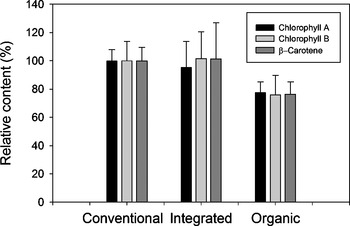
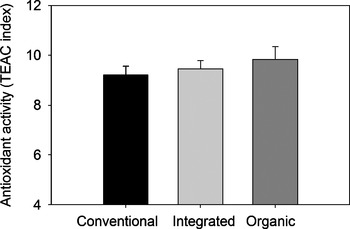
The organic treatment showed significantly (P⩽0.05) lower levels of chlorophyll A and β-carotene compared with the conventional and integrated treatments (Fig. 3). Thus, chlorophylls A and B and β-carotene were reduced by 22.5, 24 and 23.8% respectively. As much as 75% of the total nitrogen in a plant is required for normal chloroplast formationReference Kutik, Lubomir, Demmers-Derks and Lawlor23. Therefore, N content is often highly correlated with leaf chlorophyll concentration and the reductions in the organic treatment are likely related to the corresponding decrease in the soil N availability. The total antioxidant activity in organic fruits increased slightly (3.8%) compared with the conventional treatment (Fig. 4) and was similar to the values reported by Pellegrini et al.Reference Pellegrini, Serafini, Colombi, Del Rio, Salvatore, Bianchi and Brighenti24. Plant antioxidants are vital constituents in foods, promoting both plant and human well-being. They promote human health by neutralizing cell damage caused by free radicals and dioxygen or peroxide moleculesReference Benbrook7. The consumption of fruits and vegetables has been inversely associated with morbidity and mortality from degenerative diseasesReference Gey, Puska, Jordanand and Moser25. Although it is not known which dietary constituents are responsible for this association, antioxidants appear to play a major role in the protective effect of plant foodsReference La Vecchia, Altieri and Tavani26. The carotenoid pigments in fresh peppers have been widely studied, and shown to improve color retention during processing and storageReference Markus, Daood, Kapitany and Biacs27. Thus, the green color of the fruit is due principally to the presence of chlorophyll and the carotenoids typical of the chloroplast, as well to β-caroteneReference Hornero-Mendez, Guevara and Minguez-Mosquera28. It has been found that β-carotene is the predominant pigment for green peppersReference Marin, Ferreres, Tomas and Gil29.
Relative contents of chlorophylls A and B and β-carotene in fruits from different cultivation methods. Vertical bars represent the standard error of the mean.

Antioxidant activity, expressed as the Trolox equivalent antioxidant capacity (TEAC) index of fruits, as affected by the cultivation method. Vertical bars represent the standard error of the mean.

Nitrogen levels in production systems have been negatively correlated with antioxidant content while yields typically are positively correlated. This relationship has been labelled the ‘dilution effect’Reference Davis and Riordan30 and, according to this relationship, vitamin, mineral and antioxidant levels in food often decline as crop yields increaseReference Benbrook7. Our data show a small increase in the antioxidant capacity in the organic fruits; likely related to N depletion. That depletion in N could lead to a significant growth reduction and to a minor effect on the antioxidant capacity of the fruit; mainly due to a stress condition rather than the dilution effect, as fruit dry matter and total yield were not affected. Fruit firmness, pericarp thickness, pH and TSS showed higher values in the organic treatment but these differences were not significant (P<0.05) with respect to the conventional treatment (Table 2).
Effect of the cultivation method on fruit dry matter content, fruit firmness and pericarp thickness and on the pH, electrical conductivity (EC) and TSS of fruit juice. ns, Non-significant differences at P⩽0.05.

Our data show that, with the proper manure dosage, chemical fertilizers could be reasonably avoided in sweet pepper cultivation, lowering production costs and reducing ground water pollution without decreasing fruit yield and with only a minor effect on fruit quality.
Acknowledgements
This research was supported by project RYC-2003-004806 from the Spanish Ministry of Science and Technology. We thank D.J. Walker for English revision of the manuscript, P. Marín, J. Navarro and C. Marín for valuable assistance with the measurements and J.M. Navarro for assistance in the antioxidant determination.