


Does access to arms promote violent crime? And if so, under what conditions? Previous work has addressed the first question, predominantly by analyzing how local gun laws affect homicide rates in jurisdictions within the United States. Yet, this approach faces the shortcoming that regulations may be passed in response to local criminality, instead of causing changes in crime. Moreover, the literature has ignored the idea that gun supply may induce larger effects on violence depending on the political environment, which can shape the organizational structure of criminal syndicates and thus influence the degree to which a region is violence prone. As such, past studies face flaws in their design and have been narrow in scope for neglecting the role of political conditions.
This article addresses both the methodological and substantive gaps within the literature. We do this by exploiting a unique natural experiment that enables us to examine how an exogenous change in access to arms affected violent crime in Mexico over 2002–2006. We focus specifically on the 2004 expiration of the U.S. Federal Assault Weapons Ban (FAWB), which lifted the prohibition on domestic sales of military-style firearms in America. We identify effects on homicides in Mexico using the resultant cross-border spillover on gun supply, which is important given the extent of gun trafficking across these two nations.Footnote 1
Two additional features of the legislation enable us to develop a credible empirical strategy. The timing of the expiration was predetermined by a 10-year sunset provision in the original 1994 law banning assault weapons, which ensures that it did not arise in response to violence in Mexico. In addition, the policy did not affect all U.S. states equally: some—including California (CA)—retained their own state-level bans on assault weapons, while others—including Texas (TX), Arizona (AZ), and New Mexico (NM)—had no equivalent state-level laws. The lifting of the federal ban thus made it plausibly easier to obtain assault weapons in Mexican locations closer to ports of entry into this latter group of states, providing geographic variation across municipios in resultant arms flows.
We use a difference-in-differences type strategy to examine whether violence increased disproportionately in Mexican municipios located closer to entry ports in AZ, NM, and TX, versus closer to CA, after 2004. We find substantial increases in homicides as well as homicides tied specifically to guns. Homicides rose by 60% more in municipios at the non-California entry ports, as compared to municipios 100 miles away, suggesting that the policy change induced at least 238 additional deaths annually in the area located within 100 miles of the border ports. It is not obvious that the policy change should have exerted such substantial effects, since, in principle, alternative weapons markets could have been used to satisfy the unmet demand for assault weapons in the pre-2004 period.Footnote 2
In addition, we document increases in crime guns seized by the Mexican military, specifically for the gun category that includes assault weapons, but not handguns, which further supports our hypothesis. We consider and rule out a number of alternative explanations, including an intensification of the drug trade, the deterioration of economic conditions, and changes in legal enforcement, by incorporating time-varying controls on drug seizures, income, and enforcement patterns on both sides of the border.
Beyond the average effect, we also expect the consequence of gun supply increases to be more pronounced in areas with marked instability, which may be influenced by political conditions. The second half of the article therefore explores the political antecedents of the relationship between weapons availability and crime. Mexico is an ideal setting for exploring this question given the interaction of drug trafficking and electoral politics in shaping the industrial organization of crime. Although a substantial amount of narco-trafficking has been present in the country since the mid 1980s, it has been marked by a dramatic intensification in violence over the last 10 years, contributing to a near doubling of the homicide rate over this time (INEGI 2011).Footnote 3 During this period, the nation also underwent a notable democratic transition culminating in the 2000 loss of the presidency by the Institutional Revolutionary Party (PRI, by its Spanish acronym), which had dominated Mexico's elections since 1929.
Extant academic work and journalistic accounts have both drawn a connection between this increase in electoral competition, drug-trafficking, and resultant violence. Rising political competition reduced the ability of drug cartels to bribe PRI mayors in exchange for selective enforcement, fueling fighting with rival cartels and the state (Astorga 2005; Escalante 2011; Snyder and Duran Martinez, 2009a). Osorio (2012) shows that competitive municipios experienced more drug-war related violence in the post-2006 period. Similarly, Dell (2011) documents that violence increased after mayors from the conservative National Action Party (PAN, by its Spanish acronym) were elected to office. Villarreal (2002) also contends that the democratic transition fueled violence by disrupting long-standing patronage networks.
We conjecture that in a political environment where bribes and informal agreements help maintain order, an influx of arms is most likely to increase violence in the presence of greater electoral competition—competitiveness undermines the pre-existing system of exchange, and guns are particularly valuable given the resultant instability. We present several pieces of evidence to support this hypothesis. First, we undertake a period-based falsification: we show that the passage of the FAWB in 1994 led to no decreases in homicides south of the border. This supports the idea that assault weapons access affects crime disproportionately in environments marked by instability, as was the case for Mexico in the 2000s, but not in the early 1990s.
However, these two periods may differ along other political economy dimensions, and there may be asymmetric effects from the enactment versus expiration of gun control. As a more direct test, we show that the 2004 FAWB expiration led to a differential rise in homicides in municipios that were more electorally competitive prior to the policy change, as measured by the effective number of political parties contesting local elections. These differential effects were also larger in areas with more drug trafficking, which is consistent with competition mattering due to its effect on implicit arrangements between local authorities and drug traffickers. While other studies have examined the relationship between competition and violence in Mexico, our results are the first to highlight the interaction of political competition and access to arms in determining violence.
Most closely related to our analysis is a recent working paper by Chicoine (2011)Footnote 4 which also attempts to assess how the FAWB expiration affects violence in Mexico, but by comparing homicides across states with and without drug cartels, with annual data over 1995–2008. However, this approach is problematic since homicide differences across cartel vs. noncartel states cannot be attributed solely to changes in U.S. gun policy.Footnote 5 In contrast, we utilize finer-grained municipal variation in proximity to particular border states, which corresponds more closely to arms flows. Moreover, we focus our analysis tightly around the law change, over 2002–2006, prior to an intensification of the drug war marked by numerous government military operations. As an additional check on our annual results, we also look specifically at the quarters before and after the law change, showing that homicides rose almost immediately—within a quarter of the ban's expiration—and persisted thereafter. In addition, Chicoine (2011) does not examine political or other institutional mechanisms in his account.
The vast majority of previous gun-crime studies have examined the effect of U.S. gun laws on U.S. crime rates. Analyses of the original 1994 FAWB enactment tend to find either small crime-reducing effects (Koper and Roth 2001), or mixed results (Lott 1998) in the American context. However, these studies utilize pre-enactment variation in state-level assault weapons bans, which may be correlated with changes in local crime rates, potentially confounding the estimates. Other studies have also reported small crime-reducing effects of legislation requiring background checks on handgun purchases (Ludwig and Cook 2000), and mixed results around the impact of laws that give individuals the right to carry concealed weapons (CCW).Footnote 6 Relatedly, Duggan et al. (2011) finds that gun shows—which allow vendors to sell firearms without background checks in some states—exert no significant effects on homicides within three weeks in or near the zip code where the show takes place.
Overall, the relatively small or mixed effects observed in the U.S. context suggest that access to weapons may exert larger effects in environments displaying greater instability in the industrial organization of violence, as with current cartel in-fighting in Mexico, which has been fueled in part by the changing nature of electoral politics. Previous failure to examine the role of political conditions may reflect the literature's singular focus on the United States, as electoral dynamics are less likely to influence crime in established democracies (Villarreal 2002).
The proximity-based effects we document are also consistent with the idea that there are substantial costs associated with weapons smuggling. Evidence of such costs has also been shown in Knight (2011) for crime gun movements across U.S. states. In part, these costs reflect the risk of detection entailed in transporting illegal weapons. In Mexico, smuggling costs also arise from the spatial segmentation of the drug-trafficking organizations (DTOs): particular cartels control certain ports of entry, which makes it costly to obtain weapons via border areas in rival cartel territory. Finally, while the results in our article highlight the conflict-related consequences of arms trafficking, DellaVigna and La Ferrara (2010) shows its profitability, pointing to the economic benefits accruing to weapons-making companies.
In the political science literature, most previous work on arms have focused on their potential effects on civil wars, with the country as the unit of analysis. For example, conflicts in neighboring countries have been held to increase risk of insurgency due to the greater availability and lower price of weapons (Gleditsch 2007).Footnote 7 Additionally, past work has shown how weapons flows from the major powers in the form of military interventions influence the resolution of civil wars (Regan 2000).
Our focus is not on civil war violence, but on criminal homicides, many of which are connected to the drug trade.Footnote 8 Thus our analysis sheds light on the determinants of a new and growing form of violence around the globe—nonstate actors using insurgent tactics to fight for profits in illegal markets rather than political power. The socioeconomic consequences of this type of criminality have been documented extensively in the Mexican context, as manifest in the pervasiveness of drug gangs and their interlinks with civil society (Díaz-Cayeros et al. 2011); the role of drug money in spurring businesses and promoting a new type of consumer culture (McDonald 2005); and drug war violence exerting negative effects on female labor force participation and the informal sector (Dell 2011).
Although violence of this form doesn't aim to overthrow the state, it has arguably become more politically targeted, as reflected in the rising homicide of politicians and journalists in the post-2000 period (Ríos and Shirk 2011). More generally, it has been posited that state destabilization resulting from large-scale homicides represents a blurring of lines between criminal violence and civil war in Latin America (Killebrew and Bernal 2010), although there is a debate about the extent to which such criminality represents a threat to democracy in the region.Footnote 9 The review by Blattman and Miguel (2010) suggests that common factors such as access to illicit drugs, state weakness, and poverty influence both criminality and civil conflict.Footnote 10
The remainder of the article is structured as follows. We first outline the mechanisms linking political competition, access to guns, and violence. Next, we provide background on U.S. gun laws and weapons trafficking to Mexico. We then state the hypotheses we are testing, describe the data, and explain our empirical strategy. We subsequently present the main results on violence and the political competition mechanism. The final section concludes.
MECHANISMS
Access to Weapons, Instability, and Violence
Our article contains two main conjectures. The first posits that increased access to guns leads to more violence. The second contends that increased gun access exerts larger effects on violence in areas facing higher levels of instability—i.e., guns act as tinder in regions characterized by lawlessness and in-fighting among criminal organizations.
While many factors contribute to instability, we focus on the notion that the political environment, including electoral competition, can play a key role. This is particularly true of settings where patronage relationships between politicians and crime syndicates help maintain order (Villarreal 2002)—including cases in which state officials selectively enforce the law in exchange for bribes financed by an illegal activity, which Snyder and Duran-Martinez (2009a) describe as state-sponsored protection rackets.
In such settings, agreements exchanging bribes for selective enforcement are easier to sustain when political authorities are from a hegemonic, long-ruling political party. Consistent with this idea, a large body of literature has shown that a lack of competition facilitates bribery (Ades and Di Tella 1999; Alt and Lassen 2003; Nyblade and Reed 2008; Rose-Ackerman 1978). The timeline is important because when politicians are in power over a longer horizon, there is greater scope for repeated interactions, which promotes the credibility of commitments by generating trust and a reputation for compliance (Snyder and Duran-Martinez 2009a). As such, stable pacts emerge when the shadow of the future is long.
Correspondingly, a rise in electoral competition can undermine implicit agreements between politicians and criminal organizations by generating uncertainty over who is in power, and over what period of time. Turnover among elected officials reduces both sides’ incentives to form long-term contracts. In addition, greater competition increases officials’ incentives to increase legal enforcement targeting crime, since such enforcement garners electoral support.
The decay of implicit agreements stemming from political competition will therefore reduce bribery, but may also inadvertently destabilize the organization of criminal activity. Such destabilization can escalate violence, especially if criminal groups are involved with highly profitable illegal markets such as narco-trafficking. The absence of contracted state protection for particular criminal syndicates will encourage rivals to contest control over illegal activities. Moreover, increased state targeting of all criminal syndicates can lead to more violent confrontations with the state. In short, large-scale increases in political competition may promote instability and in-fighting in environments where criminal organizations have protection agreements with politicians.
Given the prevalence of patronage relationships between political authorities and armed nonstate actors, the political environment is likely to influence instability in a number of national contexts. For example, in Colombia, protection agreements were formed between parts of the state and the Cali drug cartel, but these were difficult to maintain owing to the presence of electoral competition (Snyder and Duran-Martinez 2009a). In contrast, the Burmese military government and the Communist Party of Burma were able to form long-term agreements over opium production which could be sustained since the authoritarian regime faced a long time horizon and no threat of political competition; in turn, these implicit contracts were held to have stemmed insurgency and violence during the 1990s (Snyder and Duran-Martinez 2009b).
We posit that in these types of settings, an influx of weaponry increases violence more in areas that have been destabilized owing to changes in political conditions—as when rising electoral competition eliminates implicit agreements between politicians and criminal groups.
Electoral Competition, the Drug Trade, and Violence in Mexico
Mexico serves as an ideal laboratory for testing the relationship between access to guns and violence under varying political conditions. Patronage relationships between political authorities and drug-trafficking organizations existed starting in the 1940s, until they were destabilized in the context of a large-scale political transformation during the 1990s, which encompassed a dramatic rise in electoral competition. Prior to that time, the PRI had dominated Mexico's electoral arena for nearly seven decades. Within the period of PRI hegemony, the drug trade burgeoned in the 1960s with rising U.S. demand for marijuana, and then escalated further in the 1980s when Mexican and Colombian traffickers began operating together to meet the rising demand for cocaine (Astorga 2005; Toro 1995). Nonetheless, violence remained relatively restrained during these decades, owing in part to consolidated patron-client relationships between drug traffickers, the police, and local elected officials. In essence, implicit arrangements allowed particular cartels to operate in particular municipalities with relative impunity, in exchange for bribes funded through the drug trade. These agreements defined the rules of the game for traffickers, and ensured that prosecution efforts never reached the leaders of these criminal organizations (O'Neil 2009).
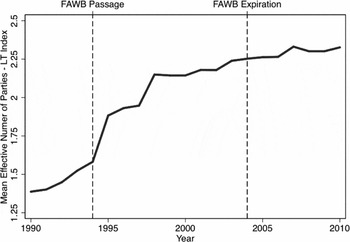
However, beginning in the late 1980s, and peaking in the mid-1990s, the country experienced a process of growing electoral competition (Merino 2003) which was centripetal in nature (Hiskey and Bowler 2005): opposition victories first occurred in local elections, culminating ultimately in a national national-level democratic transition in 2000. Figure 1 shows the rise in political competition at the municipal level during the 1990s and 2000s. This is measured as the effective number of political parties contesting mayoral elections using the canonical Laakso-Taagepera index, defined as
 $N_{LT}=\frac{1}{\sum \nolimits _{i}s_{i}^{2}},$
where si
is party i’s vote share (Laakso and Taagepera 1979).Footnote
11
Political Competition over Time
Notes: This graphs the mean Laakso-Taagepera (LT) index of the effective number of political parties contesting municipal-level mayoral elections. For a given year, the index is based on the most recent mayoral election.

Scholars have noted that this marked rise in political competition had the inadvertent consequence of escalating drug-related violence. As Astorga (2005) documents qualitatively, the dispersion of political power resulting from the democratic transition weakened the state's mechanisms of control and coercion over the drug cartels, which were born under an authoritarian regime that controlled, protected, or tolerated them. The entry and victory of other political parties in local elections undermined implicit agreements between the DTOs and the political establishment (O'Neil, 2009; Bartra 2012), and the consequent rise in uncertainty escalated violence sharply. Electoral turnover required traffickers to negotiate with the new political establishment, while encouraging their rivals to expand into areas where they previously did not operate. Thus, the organization of cartel activity became destabilized, resulting in greater territorial contestation and fighting among rival cartels (Osorio 2012). In addition, politicians’ incentives to increase enforcement against cartels increased (Astorga and Shirk 2010), resulting in greater violence between cartels and the state (Osorio, 2012). In short, given the interlocking roles of the drug trade and PRI hegemony, electoral competition is linked to cartel destabilization in Mexico.
While the average level of electoral competition increased over these two decades, there was considerable variation in the extent to which some municipios had become competitive by the time the U.S. FAWB expired in 2004. This is shown in Panel B of Online Appendix Figure A I. Given the variation in the degree of competition both over time, and across municipios, this institutional context is well suited for examining both the overall impact of gun accessibility on violence, as well as its impact conditional on instability related to political conditions.
U.S. GUN LAWS AND WEAPONS TRAFFICKING TO MEXICO
Assault Weapons Ban in the U.S
On September 13, 1994, the United States Congress passed the Violent Crime Control and Law Enforcement Act, which placed a first time restriction on the manufacture, transfer, and possession of semiautomatic weapons. The law focused on a group of firearms considered particularly dangerous for their capacity to rapidly fire multiple shots, which makes them useful for criminal applications.Footnote 12 The act was signed into law by then President Clinton for 10 years. However, as a consequence of a sunset provision, it was set to—and did—expire in September 2004. During the decade the law was in place, a handful of U.S. states had their own restrictions on assault weapons. This included California, which already had an assault weapons ban in place as of 1989, that remained in place after the federal law sunset.Footnote 13 Thus, while other states bordering Mexico experienced a change in the assault weapons control regime, the same was not true for California.
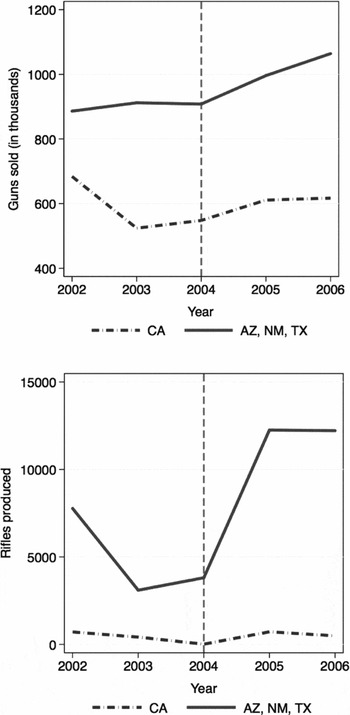
We can assess the extent to which CA gun control laws were binding, and the degree to which the FAWB affected the gun control regime in TX, AZ, and NM by evaluating gun sales and production data.Footnote 14 Panel A of Figure 2 shows that there was approximately a 15% increase in combined gun sales in AZ, TX, and NM as compared to a 5% rise in CA after 2004. The divergence is larger when we are able to look specifically at rifles, the gun category that includes assault weapons. For example, firearms production data from the U.S. Bureau of Alcohol, Tobacco and Firearms (BATF) is displayed in panel (B), and shows that rifle production more than doubled after 2004 in the non-California states, while remaining unchanged in California. While we cannot attribute increases in TX, AZ, and NM entirely to the policy change, the differential increase compared to CA indicates that the FAWB expiration had an impact on gun sales and production.
Gun Sales and Production—California versus Other Border States. Panel A: Estimated Annual Total Gun Sales. Panel B: Annual Total Production of Rifles
Notes: Panel A: total number of gun sales (in thousands) is approximated by the number of FBI NICS firearm background checks originating in the relevant state. Data source: http://www.fbi.gov/about-us/cjis/nics/reports/state_totals_2011. Panel B: data on the annual production of rifles is from the BATF's Annual Firearms Manufacturing and Exportation Reports.

Gun Flows to Mexico
The combination of tough gun laws in Mexico, weak gun laws in the United States, and proximity across the border makes it optimal for Mexican drug cartels and crime syndicates to source their firearms from the U.S.Footnote 15 Mexico has highly restrictive gun laws. Possession of high-caliber guns is essentially prohibited for citizens.Footnote 16 In addition, there is only one legally authorized retail outlet for firearms in Mexico, which is operated by the Ministry of National Defense. As a comparison, there were 7,240 federally licensed firearms outlets in California, Arizona, New Mexico, and Texas in 2010, the earliest year for which these data are available (BATF 2010). The number of outlets by ZIP code in these four border states is mapped in panel A of Online Appendix Figure A II.
Indeed, the vast majority of crime guns seized in Mexico originate from the United States. As of 2006, around 90% of the weapons confiscated in Mexico and submitted to BATF's eTrace program could be linked back to the U.S. (GAO 2009).Footnote 17 The fraction traced to the U.S. also rose between 2004 and 2006. While traced gun data would be ideal for examining how gun flow patterns respond to policy changes, they do not exist for the pre-2004 period, and neither the BATF nor the Mexican authorities have released the data for the post-2004 period. Therefore, we instead utilize publicly available statistics from eTrace and other sources to examine gun trafficking patterns over this period.
Most of the guns traced to the U.S. come from the border states, and to a greater degree from the non-California states. As indicated by Online Appendix Figure A III, between 2004 and 2008, 49% of guns traced to the U.S. originated from either Texas or Arizona. In contrast, 20% were traced to California. If we normalize these flows by population, the “export rate” of the other two states are nearly three times as large as that of California.Footnote 18
While we do not have information about exports by state going back to the pre-2004 years, the combination of larger sales in the non-CA states after 2004 along with the pattern of aggregate flows to Mexico suggests that there was a sizable increase in guns going to Mexico as a result of the FAWB expiration. We analyze this hypothesis directly, by assessing effects of the gun law change on both violence and gun seizures in Mexico.
Why Proximity Matters: Drug Cartels, Entry Ports, and Limited Arbitrage
Our empirical strategy tests for differential effects of gun access based on Mexican municipios’ proximity to non-CA entry ports. This is based on the idea that gun price differentials across municipios are not fully arbitraged away through the transport of illicit weapons. In this subsection we detail why this holds.
First, Mexican DTOs are heavily involved in gun smuggling across the U.S.-Mexico border (Chu and Krouse 2009), and assault weapons are a common choice (Freedman 2011; Violence Policy Center 2009). Guns are driven through major ports of entry (GAO 2009), one to three at a time (Chu and Krouse 2009), to obscure their presence amidst other legal merchandise and high traffic flows.
Second, cross-border smuggling is costly along the entire U.S.-Mexico border, and costs rise when guns have to be transported over a greater distance on either the U.S. or Mexican side. While time and material transport costs increase with distance in shipping all products, for illicit goods, these costs are compounded due to risk of apprehension. This is reflected in large profit margins of 300–500% associated with selling a gun across the border (Chu and Krouse 2009; Freedman 2011), which varies by distance.Footnote 19
Third, we also expect transport costs to vary specifically based on distance to non-California entry ports after 2004 owing to state laws: the price of purchasing assault weapons should be higher in CA, where it is illegal to do so, compared to other border states. Qualitative accounts suggest substantial variation in the price of selling illicit weapons based on the stringency of laws in U.S. states (Mayors Against Illegal Guns 2008).Footnote 20 Enforcement risks related to state law explain why it would be costly to source guns from other states, transport them west within American territory, and bring them across the border into Mexico via California.Footnote 21
Of course, there will be some assault weapons smuggling that occurs near California, in part due to spillovers from nearby gun shops in Arizona. However, as shown in Panel A of Figure A II, this spillover is likely to be limited since gun shops are more concentrated in eastern Arizona, owing to greater population density in that part of the state. Moreover, a spillover near CA would lead our empirical strategy to underestimate the true effect of how the FAWB expiration affects violence.
Finally, geographic segmentation among Mexican drug traffickers, with particular cartels controlling key entry ports, also add turf-based costs for cartels to arbitrage arms availability across different segments of the border. Panel B of Figure A II shows the approximate areas of influence and headquarter locations of the Tijuana, Sinaloa, Juárez, and Gulf cartels over 2002–2006. As indicated by the map, enforcers from the Tijuana cartel would have to cross into Juárez or Gulf cartel territory to obtain weapons from border ports in Arizona, New Mexico, or Texas. Entering rival cartel territory can have direct violence-related costs by initiating clashes. Moreover, Mexican cartels work with particular U.S. street gangs on the American side of the border, suggesting that it is costlier to smuggle weapons across ports that are not under a cartel's control, where such alliances are missing.Footnote 22
HYPOTHESES
In examining the relationship between guns and violence, we take advantage of the fact that U.S. assault weapons policies induced exogenous changes to gun supply in Mexico. To investigate whether this relationship varies based on political conditions, we utilize variation in political competition over time and across municipios. We test the following three hypotheses:
Hypothesis 1. The 2004 expiration of the U.S. FAWB led to a rise in homicides in Mexico, over the 2002–2006 period.
Hypothesis 2. The 1994 passage of the U.S. FAWB led to relatively small homicide changes over 1992–1996, when electoral competition was low.
Hypothesis 3. The expiration of the U.S. FAWB led to relatively larger homicide increases among Mexican municipios that had become more electorally competitive prior to 2004.
We focus our main analysis over the 2002–2006 period since this constituted a relatively homogenous phase of the Mexican drug war. First, violence escalated sharply in 2001, when the leader of the Sinaloa cartel, Joaquín “El Chapo” Guzmán, escaped from prison and attempted to take over important drug routes near Texas and California. Fighting subsequently spiraled in drug production areas and crossing points along the U.S.-Mexico border (Luhnow and de Cordoba 2009). We therefore avoid comparing across the periods before and after 2001. Second, in December 2006, President Felipe Calderón launched an aggressive military campaign against the drug cartels. These operations were phased in geographically, and resulted in dramatic and haphazard violence increases throughout the country.Footnote 23 Thus, we exclude all years after 2006 from our sample, since violence increases triggered by the campaign may confound our distance-based empirical strategy.
DATA
This section presents a brief overview of key data used to test our hypotheses.Footnote 24 Our main dependent variables are annual and quarterly counts of total and gun-related homicides over 2002–2006. These are based on mortality statistics covering the universe of officially registered deaths, from the Instituto Nacional de Estadística y Geografía (INEGI). We look at both types of dependent variables since gun homicide is a more direct measure of violence arising from gun law changes, but may also underestimate actual gun killings, since cause is unknown for 15% of the homicides in our sample. We also generate counts for subgroups based on demographic characteristics, available for 88% of the observations, as well as counts of nongun homicides and nonhomicide deaths.
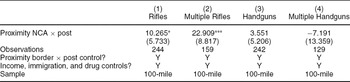
Data on crime gun seizures come from the Mexican military, the Secretariat of National Defense (SEDENA), and represent approximately 30% of total gun seizures over this period (Calderón 2009).Footnote 25 We examine annual counts of handguns separately from rifles, the gun category that includes assault weapons. We also analyze seizures from events where more than one gun was seized in a given municipio in a given day, and call these variables multiple rifles and multiple handguns.
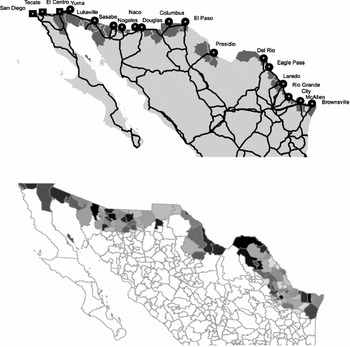
We define ports of entry on the U.S.-Mexico border as two border crossings that are more than 20 miles apart (see Table A I in the Online Appendix). The 18 ports are shown in Figure 3.Footnote 26 Distance NCA is the centroid-to-centroid distance (in thousands of miles) between a municipio and the nearest non-CA port.Footnote 27 ProximityNCA is defined as 1-distanceNCA. Distance border and proximity border are analogously defined, but based on distance to the nearest of any border port. Segment NCA is an indicator that equals 1 if a municipio lies adjacent to TX, AZ, and NM (the “non-CA segment”), as opposed to the “CA segment” of the border.
Ports of Entry and Political Competition in Mexican Municipios. Panel A: Ports of Entry and Highways in the U.S.-Mexico Border. Panel B: Political Competition in Mexican Municipios
Notes: In Panel A, black lines represent highways, and darker gray shading denotes the sample of municipios on the border with highways. Ports in California are marked by squares, and ports in other U.S. states are marked by circles. Panel B shows the mean LT index of the effective number of political parties contesting mayoral elections in each municipio, for the pretreatment sample period prior to the FAWB expiration. Darker shading indicates higher levels of political competition as given by the LT index, which ranges from 1 to 3.5, with a median of 2.1. Municipios in white do not appear in the 100-mile sample.

Control variables for Mexican municipios come from several sources. SEDENA provides measures of the following: major drugsFootnote 28 seized (valued at international prices); marijuana and heroin poppies eradicated (in hectares);Footnote 29 and individuals detained during drug-war operations (scaled by population). INEGI data on narcotics crimes per capita over 2002–2004 are also used to designate municipios with above mean values of this variable as the high drug-trafficking subsample.
INEGI data also provide annual municipal expenditures and population, and log income per capita and the school enrollment ratio in 2000. Municipal-level data on party vote shares from the Center of Research for Development (CIDAC 2011) is also used to construct four measures of the effective number of political parties contesting mayoral elections. The canonical LT index is our primary competition measure, but we also use the Molinar (1991), Dunleavy-Boucek (2003), and Golosov (2010) indices for robustness, as these address some drawbacks in the case when there is one dominant party.Footnote 30 All measures are averages of the pretreatment sample period based on elections prior to the 2004 policy change.Footnote 31
U.S. port controls include the following: major drugs seized (and valued at international prices) from the El Paso Intelligence Center; the number of police stationed from the Federal Bureau of Investigation (FBI); the number of undocumented immigrants from the Department of Homeland Security (DHS); and average earnings and employment from the Quarterly Census of Employment and Wages (QCEW).
Since gun law changes in the U.S. are likely to affect violence differentially in regions close to the border, we also define two distance-based samples. The border sample includes 38 municipios that lie along the U.S.-Mexico border, of which 35 fall along the non-CA segment and 3 fall along the CA segment. The 100-mile sample includes municipios whose geographic centroids lie within 100 miles of the nearest of the 18 ports. There are 106 municipios in this sample.
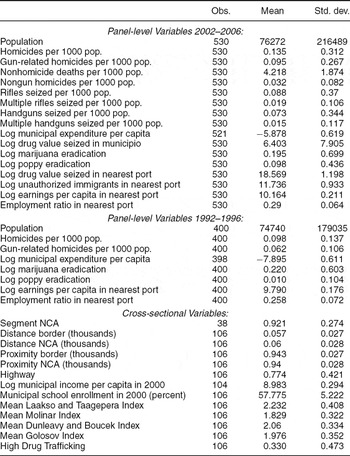
Table 1 presents the descriptive statistics of our key variables for municipios within the 100-mile sample. We show the key dependent variables in per capita terms since our estimation strategy essentially scales the outcome variables by population. The means demonstrate that approximately 70% of total homicides, on average, were gun related, over 2002–2006.
Descriptive Statistics

Notes: Descriptive statistics are shown for the 100-mile sample.
EMPIRICAL STRATEGY
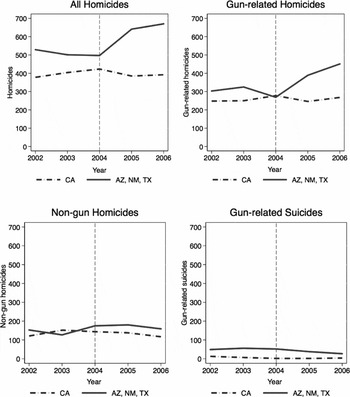
To test Hypothesis 1, our empirical strategy examines whether violence increased more in Mexican municipios closer to the non-California ports, relative to the California ports, following the expiration of the FAWB in 2004. We focus our analysis on municipios near the border, which are most likely to be affected by an influx of weapons from the U.S. Panel A of Figure 4 captures the essence of our approach: the sum of total homicides and gun-related homicides stayed constant within the CA segment over 2002–2006, but both variables rose sharply after 2004 in the non-CA segment. A simple difference in means across the two segments before and after 2004 suggests a differential rise of 160 total homicides and 123 gun-related homicides owing to the gun law change.
Violence in Municipios Bordering California versus Other Border States. Panel A: Homicide Outcomes. Panel B: Falsification Outcomes
Notes: The plots show the sum of the variables in the CA segment versus the non-CA segment.

Our empirical estimation builds on this suggestive comparison in a number of ways. We use a difference-in-differences type specification with municipio fixed effects, which sweep out time-invariant characteristics correlated with homicide rates and proximity to various border areas. Year fixed effects also control for year-to-year differences in killings common across all municipios. We specify a conditional fixed effects Poisson model with population exposure, since counts of homicides are bunched around a few integers: 47% of observations have no homicide, while 81% have five or fewer, as shown in Panel A of Figure A IV of the Online Appendix. This bunching makes count regressions a more appropriate alternative relative to Ordinary Least Squares (OLS).Footnote 32 Finally, we use cluster-robust standard errors as recommended by Cameron and Trivedi (2009) to control for possible violations of the Poisson assumption that the conditional mean and variance are equal.Footnote 33
We begin by presenting a simple, motivational specification which just exploits the non-CA segment indicator. Here, the log of the expected counts is specified as follows:
 \begin{eqnarray}
\ln E(y_{jt}\,|\,Z_{jt})&=&\alpha _{j}+\beta _{t}+( {\text{segment}\,\text{NCA} }_{j}\times \mathit {\ \text{post}}_{t})\lambda\nonumber\\
&& +\,X_{jt}\phi +\ln ( \text{pop}_{jt}),
\end{eqnarray}
Since a municipio's exposure to the gun law change should vary based on proximity to major ports in CA vs. TX, NM, and AZ, our primary specification exploits distance-based variation. In this case, the log of the expected counts is defined as
 \begin{eqnarray}
\ln E(y_{jt}\,|\,Z_{jt})&=&\alpha _{j}+\beta _{t}+( \text{proximity\,NCA}_{j}\times \text{post}_{t}) \theta\nonumber\\
&&+\, ( \text{proximity\, border}_{j}\times \text{post}_{t}) \gamma \nonumber\\
&& +\, X_{jt}\delta +\ln (\text{pop}_{jt}),
\end{eqnarray}
To test Hypothesis 2, and examine if there is heterogeneity in violence effects across time periods, we investigate whether violence decreased differentially in Mexican municipios closer to the non-California ports following the passage of the FAWB in 1994. We re-estimate Equations (1) and (2) for the 1992–1996 period, redefining post t such that it equals 1 for each of the two years after 1994.
To test Hypothesis 3, which focuses on heterogenous effects of the FAWB expiration based on municipal competition as of 2004, we introduce three-way interactions between proximity NCA j × post t and various indices of the effective number of political parties. For the 2002–2006 period, we estimate
 \begin{eqnarray}
&&\ln E(y_{jt}|Z_{jt})\nonumber\\
&&\quad =\left( \text{proximity\,NCA}_{j}\times \text{post}_{t}\right) \theta _{1}\nonumber\\
&&\qquad +\,\left( \text{proximity\,NCA}_{j}\times \text{post}_{t}\times \text{index}_{j}\right) \theta _{2}\text{\textit {\ }} \nonumber\\
&&\qquad +\,\left( \text{proximity\,border}_{j}\times \text{post}_{t}\right) \gamma _{1}\nonumber\\
&&\qquad +\,\left( \text{proximity\,border}_{j}\times \text{post}_{t}\times \text{index}_{j}\right) \gamma _{2} \nonumber\\
&&\qquad +\,\left( \text{post}_{t}\times \text{index}_{j}\right) \gamma _{3}+X_{jt}\delta\nonumber\\
&&\qquad +\,\ln \left( \text{pop}_{jt}\right) +\alpha _{j}+\beta _{t},
\end{eqnarray}
MAIN RESULTS
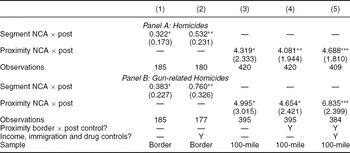
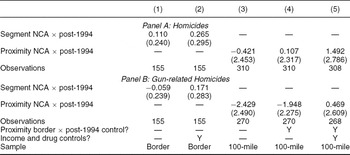
In this section, we present results examining Hypothesis 1, which posits a relationship between the 2004 FAWB expiration and violence outcomes. Panel A of Table 2 presents the results for total homicides, with column (1) showing estimates of Equation (1). The coefficient indicates that Mexican municipios lying along the non-California segment of the border experienced an additional 0.32 log point (or 38%) increase in homicides after 2004, compared to municipios along the California segment. The average annual homicides in the non-CA segment was 656 over 2005–2006, implying an additional 181 deaths per year in the border segment near Texas, Arizona, and New Mexico.Footnote 34 This is very similar to the simple estimate of 160 differential deaths calculated on the basis of Figure 4 Panel A.
The FAWB Expiration and Violence in Mexican Municipios

Notes: Variables not shown include municipio and year fixed effects. Robust standard errors clustered at the municipio level are shown in parentheses. Income, immigration, and drug controls include the following: log municipal per capita income in 2000 and the schooling ratio in 2000, interacted with a post-2004 indicator; log municipal expenditures per capita; log value of municipal drug seizures plus 1; log hectares of marijuana and heroin poppies eradicated in each municipio plus 1; as well as the employment ratio, log average earnings, log unauthorized immigrants and log value of drugs seized in the nearest U.S. port. *** Significant at the 1% level; ** significant at the 5% level; * significant at the 10% level.
Next, we address and rule out a number of potential alternative accounts with the inclusion of other controls in column (2). First, observed homicide increases may be related to an intensification of the drug trade near the non-California ports after 2004.Footnote 35 To account for time-varying determinants of the drug trade, we control for the value of major drugs seized, both in the nearest U.S. port of entry and in Mexican municipios. We also control for eradication of illicit crops, which likely reflects both drug crop cultivation as well as enforcement by the Mexican government.Footnote 36
Additionally, poverty rates may fuel greater homicides by lowering the opportunity cost of joining criminal organizations such as DTOs in Mexico. We thus control for the interaction of municipal income per capita and the school enrollment ratio in 2000 with post-2004 indicators, as well as log per-capita municipal expenditures, which accounts for the differential provision of basic services such as health, education, and local security. To account for cross-border spillovers in crime stemming from economic conditions in the U.S., we control for the employment-to-population ratio and average earnings in the county of the nearest U.S. port. Finally, violence increases may mirror immigration patterns, as drug cartels are increasingly involved with trafficking migrants across the border. We therefore control for the (log) number of unauthorized immigrants apprehended near the closest U.S. port. In addition, we verified that there were no other major changes in immigration policies at the national or state level during this period.Footnote 37 The inclusion of these control variables increases the magnitude of the estimated coefficients in column (2), raising the estimate of implied annual deaths to 270.
Panel B of Table 2 presents the results for gun-related homicides. The coefficient of 0.38 in column (1) suggests a 46% increase in this outcome. Given an average of 420 gun murders in the post-treatment period, this implies an additional 132 gun homicides in the non-California border segment due to the policy change. Again, this is quite similar to the simple estimate of 123 based on Figure 4 Panel A. Accounting for covariates in column (2) raises the annual estimate of such deaths to 224.
Columns (3)–(5) present estimates of Equation (2), our proximity-based specification, using the sample of municipios that lie within 100 miles of ports on the U.S.-Mexico border. Column (3) includes no controls. Column (4) controls for overall proximity to the border ports, hence accounting for other factors that may be correlated with our treatment and with violence near the border. Column (5) additionally includes the full set of income, immigration, and drug controls in column (2). The coefficients remain quite similar across these alternative specifications, although the precision of the estimate improves with additional covariates.
For the specification with all controls (Panel A, column (5)), the coefficient of 4.7 implies that going 100 miles toward the U.S.-Mexico border leads to a 0.47 log point (or 60%) increase in homicides. The average municipio in our sample (which lies 57 miles from the nearest border port) is thus predicted to experience a 26% rise in homicides.Footnote 38 Since the actual average number of homicides was 1,153 in the sample over the post-2004 period, the estimate suggests an additional 238 deaths per year in the set of municipios within 100 miles of the border.
For gun-related homicides, the relevant coefficient is 6.84 (Panel B, column (5)), implying a 42% (0.97 × 0.43) rise in gun-related homicides in the average sample municipio. Given an annual average of 738 gun deaths in the post-2004 period, we estimate an additional 235 such deaths due to the U.S. policy change. The similarity of the effect on total homicides (238) and gun-related homicides (235) verifies that most of the killings attributable to the FAWB expiration were gun-related. These figures serve as our preferred estimates, since we view the proximity-based approach with full controls as our primary specification. However, they also accord closely with estimates from the segment specification in column (2), thus bolstering the internal validity of the estimates. Overall, our preferred estimates indicate that the annual additional deaths due to this policy change represent around 21% of all homicides and 30% of all gun-related homicides in the post-intervention sample, which are sizable magnitudes.
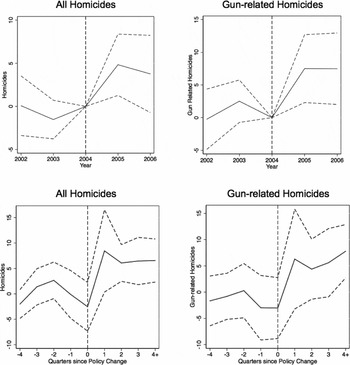
Panel A of Figure 5 shows the effects of the change in law by year: we interact proximity NCA with year dummies (instead of post) using 2004 as the omitted category, and plot the annual coefficients. The controls include overall proximity to border interacted with year dummies, along with our full set of income, immigration, and drug controls. For total homicides there is a clear, sharp rise between 2004 and 2005 and the effect mostly persists through 2006. The results for gun-related homicides is noisier, but the same pattern is reproduced here as well.
Time Paths of Violence Using Annual and Quarterly Data. Panel A: Effect by Year. Panel B: Dynamic Response Using Quarterly Data
Notes: Panel A: the solid line plots the Poisson regression coefficients for proximity NCA interacted with each year. All regressions include municipio and year fixed effects; proximity border interacted with each year; and other annual control variables from Table II. Panel B: the solid line plots the running sum of four quarterly lags and leads of Poisson regression coefficients for proximity NCA × post. The treatment date is the fourth quarter of 2004. All regressions include municipio and quarter fixed effects; proximity border × post; and quarterly interpolated values of the annual controls from Table 2. Both panels: municipio-cluster-robust standard errors are used to calculate the 95% confidence intervals in dashed lines.

Our main estimates use annual data since most of the control variables are only available at the yearly level. However, we also present estimates with quarterly counts, imputing quarterly values for annual controls using linear interpolation. The quarterly data allow us to exclude the fourth quarter of 2006, which saw the beginning of major military operations, and more precisely define the treatment as beginning in the fourth quarter of 2004. Our estimation is based on a symmetric 16-quarter window beginning in the fourth quarter of 2002 and ending in the third quarter of 2006.
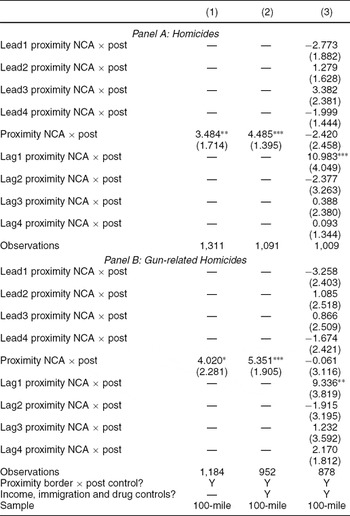
Table 3 presents the quarterly results. Column (1) includes the overall distance control, while column (2) additionally includes the imputed income, immigration, and drug controls. The coefficients from column (2) are 4.5 and 5.4 for homicides and gun-related homicides, respectively. Overall homicide effects accord closely with our annual results, while the coefficient for gun-related homicides is slightly smaller; however, both are statistically significant at the 1% level. Column (3) also includes four leads and lags in the treatment variable (proximity NCA × post). This specification shows that the coefficient on the first lag is substantial and significant for both total and gun homicides, indicating a clear treatment effect in the quarter following the expiration of the assault weapons ban. None of the leading terms are statistically significant, which is reassuring. Panel B of Figure 5 visually traces the time path of the treatment, which is obtained by successively summing the leading and lagging terms. The figure shows the unmistakable jump in the outcomes after a one period lag. The last coefficient (labeled “4+”) represents the long-term effect of the policy, and confirms that the increase in violence was persistent. The size of these last period coefficients (6.6 and 7.8 for homicides and gun-related homicides, respectively) are somewhat larger than those from the contemporaneous specifications using either quarterly or annual data, implying an additional 330 homicides and 248 gun-related homicides from the policy change. Overall, these results present strong evidence favoring Hypothesis 1.
The FAWB Expiration and Violence—Quarterly Effects

Notes: Variables not shown include municipio and quarter fixed effects. See Table 2 for remaining notes.
In addition, in Online Appendix Table A II, we show that our estimated effect is larger for homicides of young men with relatively little education. Since this is the group most likely to be employed by drug cartels, this additional result supports the idea that observed violence increases reflect increased activities by organized crime.
Robustness Checks
In the Online Appendix, we additionally establish the robustness of our results to the following: negative binomial estimation; alternative definitions of ports; measuring distance to municipal edge; as well as including controls for municipal area, linear trends by proximity NCA, nongun homicides, and nonhomicide deaths, and enforcement measures such as drug-war detentions and police officers stationed in port cities.
By examining the effect of homicides in neighboring areas, we also show that there is no evidence of violence spilling across municipios spatially. Moreover, we demonstrate robustness across various samples including municipios with highways, various distance bands, and dropping municipios most proximate to each of the non-CA border states. Finally, we present several falsification tests using accidents, nongun homicides, and suicides. Panel B of Figure 4 also visually corroborates that there are no differential changes in nongun homicides and gun-related suicides across the CA vs. non-CA segments.
Gun Seizures
If the FAWB expiration is causally related to violence through increased proliferation of assault weapons, we should expect to observe increased seizures of rifles, but not handguns in Mexico. Table 4 displays this very pattern. Strikingly, the coefficient is largest for multiple rifle seizures, while negative and insignificant for multiple handgun seizures. These results suggest that the killings associated with greater gun supply reflect increased activity by organized criminal groups such as DTOs, which were best positioned to take advantage of permissive U.S. gun regulations in trafficking weapons to Mexico.

THE MEDIATING ROLE OF ELECTORAL COMPETITION
In this section, we examine whether political conditions related to Mexico's democratic transition determine the extent to which gun supply changes increase violence. We explore whether the impact on violence varies across time periods and municipios displaying different degrees of electoral competition.
First, we test Hypothesis 2, which encompasses a period-based falsification: if competition plays a mediating role, we should observe relatively small homicide effects associated with the passage of the FAWB in 1994, when PRI remained relatively hegemonic, as compared to 2004, when political competition was greater. For example, Figure 1 shows that there was a clear difference in the effective number of political parties contesting mayoral elections within our 100-mile sample, in 1994 vs. 2004. Online Appendix Figure A I shows that the mean of the LT index was 1.7 for the sample period prior to the 1994 treatment and 2.2 for the sample period prior to the 2004 treatment. It also shows the full distribution of these indices during the two pretreatment sample periods.Footnote 39 These figures establish that the two time spans with relatively greater access to assault weapons—prior to 1994 and subsequent to 2004—were qualitatively different in terms of the competitiveness of the political regimes.
Since California already had a state-level ban in place from 1989, the passage of the federal ban should have reduced the flow of weapons differentially out of the other border states. Table 5 shows the results for this reverse policy experiment over the 1992–1996 period, using the same specifications as in Table 2. The estimates indicate that the FAWB passage exerted no significant effects on total or gun-related homicides. Columns (1), (3), and (4) exclude the additional control variables related to drugs and socioeconomic conditions. Columns (2) and (5) include the subset of these controls accessible for the earlier period—municipal expenditures, drug eradication, and employment and earnings in U.S. port cities.Footnote 40
Early Period Falsification: The 1994 FAWB Passage and Violence in Mexican Municipios

Notes: Income and drug controls include: log municipal expenditures per capita; log municipal hectares of marijuana and heroin poppies eradicated plus 1; and the employment ratio and average earnings in the nearest U.S. port. See Table 2 for remaining notes.
The null effect in Table 5 supports Hypothesis 2: reduced gun availability did not diminish violence in the two years after 1994, since this was a low-competition period when informal agreements between drug traffickers and PRI mayors limited the extent of fighting among DTOs, and between DTOs and the state. In contrast, the 2002 policy change took place in an environment marked by greater competition: by this time, many municipios had experienced turnover in PRI mayorships, which undermined these informal sanctions. The contrasting findings in the two periods provide suggestive evidence that the political environment plays a mediating role in the gun-crime relationship.
However, one limitation of this comparison is that the effect of shutting off gun supply may be different than the effect of suddenly making guns available.Footnote 41 In addition, the two periods with easier access to assault weapons, before 1994 and after 2004, differed in some other key political-economic dimensions. For example, trade between the two countries was more limited in the earlier period. NAFTA was not implemented until 1994, which may have increased trade in illegal as well as legal goods (Andreas 1996). Second, by the 2000s, the near disappearance of the major Colombian cartels led to the dominance of Mexican cartels in the drug distribution network,Footnote 42 which is likely to be important in determining how gun supply affects violence, quite apart from the democratic transition in Mexico.
Given these potential alternative reasons for heterogenous effects across the two periods, we further examine the competition mechanism by testing Hypothesis 3: we assess whether the FAWB expiration induced differential increases in homicides among municipios that had become more electorally competitive by 2004.
Panel B of Figure 3 maps the mean LT index for the pre-2004 sample period. The average number of effective parties competing in mayoral elections ranges from 1 to 3.5, with 2.1 representing the median of the distribution. The figure shows that there is spatial variation in the extent of pre-2004 competition across municipios near the non-California ports, which enables us to identify differential effects based on this measure. It also demonstrates that the high competition locations are not concentrated south of any particular U.S. state but distributed along the border. This suggests that estimates of differential effects will not be driven by municipios located in any one part of the border segment, bolstering the validity of this approach.
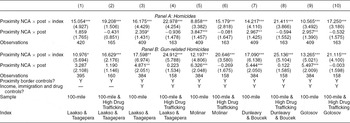
Table 6 presents the results from estimating Equation (3). For ease of comparison between the two-way and three-way interaction specifications, we have demeaned the indices, so the coefficient on the two-way interaction term (proximity NCA × post) can be interpreted as the effect in a municipality with the mean effective number of parties (index).Footnote 43 Column (1) shows the LT interaction in the entire 100-mile sample, controlling solely for proximity to border. The large, positive estimate of θ2 highlights that the FAWB treatment led to significantly larger increases in overall and gun-related homicides among municipios with a larger number of effective political parties.
The FAWB Expiration and Violence—Heterogeneous Effects by Electoral Competition and Drug Trafficking

Notes: See Table 2.
If political competition played this mediating role between guns and violence because it contributed to drug cartel destabilization, then these competition-based differentials should themselves be larger in areas where drug trafficking was more prevalent. Therefore, column (2) examines the interaction effects in the high drug trafficking subsample. Estimates of θ2 are even larger in this column. This evidence is consistent with the idea that competition matters owing to its interlocking relationship with drug trafficking related instability.
Columns (3) and (4) reproduce the same results with the LT index including our full set of income, immigration, and drug-related controls, and confirm that the implied differential effects are substantial. In Panel A of column (3), the marginal effect of the policy is 2.4 at a municipio with average competition (as given by the mean of the LT index). However, the size of the effect is nearly four times as large in a municipio with competition that is one standard deviation above the mean.Footnote 44
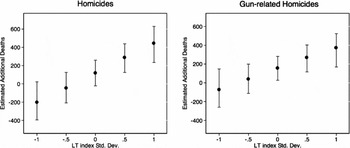
Based on estimates from column (3), Figure 6 plots the predicted number of annual additional deaths that would have prevailed if the entire 100-mile sample were composed of municipios at varying levels of competition. Since the actual average number of killings was 1,153 in the 100-mile sample over the post-2004 period, a one standard deviation above the mean level of political competition suggests 444 additional homicides, versus 118 additional homicides at the mean competition level. The equivalent comparison is 371 versus 157 additional gun-related homicides, given actual average gun deaths of 738. In addition, the 5% confidence interval bars indicate that the treatment effect is statistically significant at higher values of the index, highlighting the role of competitive municipios in influencing the overall relationship between the FAWB expiration and violence outcomes.
Estimated Additional Deaths by Electoral Competition
Notes: Black dots plot the predicted number of annual additional deaths induced by the FAWB expiration within the 100-mile sample at different levels of the LT index (measured in standard deviations from the mean). The predicted values are based on Poisson estimates of Equation (3), including the full set of income, immigration, and drug-related controls. Municipio-cluster-robust standard errors are used to calculate the 95% confidence intervals indicated by vertical bars.

Columns (5)–(10) of Table 6 show that the same pattern of results—differential effects based on competition which are larger in high drug trafficking areas—also holds with the other three measures of the effective number of political parties.Footnote 45 Overall, the null effects of the 1994 policy change, along with varying effects of the 2004 expiration based on competitiveness, indicate that the political environment conditions the extent to which greater access to assault weapons translate into rising violence.
CONCLUSION
We find that the reach of U.S. gun laws extends beyond its borders. Our analysis shows that the expiration of the U.S. FAWB led to immediate violence increases within areas of Mexico located close to American states where sales of assault weapons became legal. The estimated effects are sizable, and unrelated to the idiosyncratic influence of specific border states, trends in socioeconomic conditions, legal enforcement patterns, and drug-trafficking along the border.
The baseline estimates suggest that municipios neighboring entry ports into Texas, Arizona, and New Mexico saw total homicides rise by 60% as compared to municipios 100 miles away. This implies an additional 238 homicides in the area within 100 miles of the border, in each of the two years after the 2004 policy change. To put the size of the effect into perspective, the additional homicides stemming from the FAWB expiration represent 21% of all homicides in these municipios during 2005 and 2006. Similarly, the additional gun related homicides represent 30% of all such deaths over this period.
Our findings also demonstrate that political competition plays an important role in determining the impact of gun access on violence: estimated homicide increases were greater in municipios with a larger number of effective political parties contesting elections, and these differentials were more pronounced in high drug trafficking areas. These results are consistent with the notion that increased competition associated with Mexico's democratic transition disrupted implicit agreements between DTOs and the long-ruling PRI, which had previously enabled drug cartels to operate with relative impunity in particular municipalities. They also suggest that political institutions help forge relationships between the state and nonstate actors such as drug cartels, which ultimately shape the industrial organization of crime.
Our analysis of the 2002–2006 period holds the policy implication that stricter control of guns in the U.S. could help curb rising violence in Mexico, particularly over the long run. However, reinstallation of the FAWB may not exert immediate effects on crime since Mexico now has a stockpile of weapons, which will only diminish gradually with depreciation and gun seizures. This suggests that shutting off American weapons supply may need to be combined with increased enforcement measures to deliver more rapid reductions in homicide rates over the short run. These implications tie directly into the current contentious debate on weapons trafficking along the U.S.-Mexico border. Within this discussion, the Mexican government has repeatedly asked for assistance from the United States in reducing weapons flows. In May 2010, Mexican President Felipe Calderón urged the U.S. Congress to reinstate a ban on assault weapons. He stated, “I will ask Congress to helpus . . . and to understand how important it is for us that you enforce current laws to stem the supply of these weapons to criminals and consider reinstating the assault weapons ban (Nicholas 2010).” In July 2011, President Obama approved a new regulation that requires firearms dealers in California, Arizona, New Mexico, and Texas to inform the BATF about multiple sales of certain types of semiautomatic rifles. However, this law has been described as “insufficient” by Mexican congressmen (El Universal, July 12, 2011) and been strongly contested by U.S. gun-rights advocates such as the National Rifle Association. Frustration over the U.S. response has also led the Mexican government to explore suing American manufacturers and distributors of weapons flowing into Mexico (CBS News, April 21, 2011).
The potential cross-border benefits arising from U.S. gun control policy also apply more generally, beyond Mexico. The combination of its size and the fact that it has one of most permissive regulatory regimes in the world implies that U.S. gun laws can have large regional or even global consequences. For example, most crime guns seized in Jamaica over this past decade have also been traced back to the U.S., specifically to the state of Florida (Leslie 2010). Up to 80% of the guns in Central America may also originate from the U.S. (Meléndez 2011): some were transferred during past civil wars, while others have arrived more recently in conjunction with the drug trade (World Bank 2010). The diffusion of these arms appear to be exacerbating gang-related violence in the previously conflict-affected nations of Guatemala, El Salvador, and Nicaragua (Seelke 2011), while spreading to the previously peaceful nations of Costa Rica and Panama (Godnick et al. 2002).
By documenting the adverse consequences of such cross-border arms flows, we provide evidence of a positive relationship between gun supply and violence. In demonstrating that this effect varies by institutional context, our analysis suggests that political economy factors should be directly integrated into future studies of crime.




Comments
No Comments have been published for this article.