Many patients with Clostridium difficile infection (CDI) become asymptomatic carriers after successful treatment, with continued shedding of spores for several weeks.Reference Sethi, Al-Nassir, Nerandzic, Bobulsky and Donskey 1 – Reference Jury, Sitzlar and Kundrapu 3 Although these asymptomatic carriers have a relatively low burden of C. difficile in stool compared with CDI patients with diarrhea, skin and environmental contamination with spores is common.Reference Sethi, Al-Nassir, Nerandzic, Bobulsky and Donskey 1 – Reference Jury, Sitzlar and Kundrapu 3 Thus, these patients might present a risk for transmission in settings where contact precautions are discontinued after symptoms resolve and alcohol-based hand sanitizers are used for hand hygiene. To address this concern, the current CDI prevention guidelines recommend the extension of contact precautions until patient discharge as a special approach if basic control practices are not effective.Reference Dubberke, Carling and Carrico 4 Here, we tested the hypothesis that the hands of healthcare personnel are frequently contaminated while they care for patients with recently resolved CDI no longer under contact precautions. For comparison, we assessed the acquisition of C. difficile on hands during care of patients still under contact precautions for CDI and patients with remote CDI.
METHODS
The Cleveland VA Medical Center’s Institutional Review Board approved the study protocol. During the study period, contact precautions were discontinued 2 days after completion of CDI treatment as long as diarrhea resolved with treatment. Frequently touched surfaces in CDI rooms were disinfected with bleach wipes daily while the patient was under contact precautions and at discharge or when contact precautions were discontinued.
During a 4-month period, we identified inpatients in the hospital or affiliated long-term care facility (LTCF) with a diagnosis of CDI within the prior 24 weeks. CDI patients were classified as having current CDI (ie, on treatment for CDI and under contact precautions), recent CDI (ie, from 2 days to 6 weeks after the end of CDI treatment with no recurrence), or remote CDI (ie, 6–24 weeks after CDI treatment).
During the study, we cultured the hands of a convenience sample of healthcare personnel for toxigenic C. difficile before and after providing care for patients with current, recent, or remote CDI. Hand cultures were obtained only if the personnel made contact with the patient with or without environmental contact. For comparison, we included patients with no history of CDI on wards with no CDI patients within the prior 4 weeks. Cultures after providing care were collected after glove removal and prior to hand hygiene. To obtain cultures, personnel wiped the entire surface of both hands with a sterile 4×4-cm gauze pad (Curity Gauze Sponges, Covidien, Mansfield, MA) premoistened with sterile water and placed it in a sterile specimen cup. The specimens were cultured by broth enrichment as previously described.Reference Nerandzic and Donskey 5 Acquisition of C. difficile on hands was defined as a negative culture before and a positive culture after the interaction.
Research personnel observed the patient care episodes to determine the type of personnel and the duration of the interaction and to determine whether contact occurred with the patient and/or the environment. Fisher’s exact test was used to compare the acquisition of hand contamination after caring for patients with active versus recent or remote CDI. Spearman’s ρ test was used to determine the correlation between the time of the patient interaction and acquisition of spores on hands. Data were analyzed using R statistical software version 3.0.3.
RESULTS
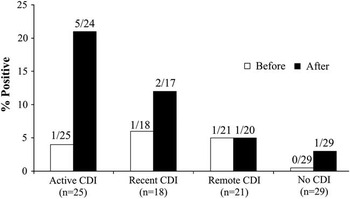
Hand cultures were obtained during 93 encounters with 53 patients (1–3 healthcare personnel interactions per patient). As shown in Figure 1, 4%–5% of healthcare personnel caring for patients with current, recent, or remote CDI had C. difficile hand contamination prior to patient contact. Acquisition of hand contamination occurred as frequently during the care of patients with recently resolved CDI as during the care of CDI patients (12% and 21%, respectively; P=.20), but acquisition of contamination was significantly less common when caring for patients with remote or no CDI (5% and 3%, respectively; P<.05). Gloves with or without gowns were worn by personnel for all interactions with current CDI patients under contact precautions, whereas gloves were worn in only 3 of 18 (17%) interactions with patients with recent CDI and in none of the interactions with patients with remote or no CDI.
Acquisition of Clostridium difficile on hands of healthcare workers caring for patients with current, recent, or remote C. difficile infection (CDI) or with no history of CDI. Current CDI included patients on treatment for laboratory-confirmed CDI and under contact precautions. Recent CDI included patients from 2 days to 6 weeks after the end of CDI treatment with no recurrent CDI symptoms. Remote CDI included patients from 6 to 24 weeks after completion of CDI treatment. Control patients had no history of CDI and were on wards with no patients with current CDI or a diagnosis of CDI within the prior 4 weeks.

The frequency of acquisition of spores on hands was similar for nurses, physicians, and ancillary personnel (7 of 74; 10% vs 1 of 7, 14% vs 1 of 13, 8%, respectively; P=.89). There was a moderate positive correlation between the time spent interacting with the patient and acquisition of hand contamination (ρ=.39; n=93; P<.0001).
DISCUSSION
In a facility where contact precautions and daily bleach disinfection of frequently touched surfaces are discontinued 2 days after completion of CDI treatment, we found that C. difficile was acquired on hands during 12% of care interactions with patients with recent CDI. Because an alcohol-based hand sanitizer is used for hand hygiene in this setting, such contamination could represent a significant risk for transmission. These findings support the extension of the duration of contact precautions until discharge as a supplemental approach in settings where CDI rates remain elevated despite the implementation of basic practices.Reference Dubberke, Carling and Carrico 4 Because contact precautions may have an adverse impact on patient care and shedding of spores may occur for several weeks, more modest approaches (eg, use of gloves, soap and water hand washing, and daily disinfection of high-touch surfaces) may be reasonable in LTCF settings.
Another notable finding of our study was that personnel acquired C. difficile on hands during 21% of interactions with CDI patients despite the use of gloves. Similarly, Landelle et alReference Landelle, Verachten, Legrand, Girou, Barbut and Brun-Buisson 6 found that 14% of personnel who consistently wore gloves had hand contamination after caring for CDI patients. In that study, 24% of personnel had hand contamination overall, but 44% of contamination occurred in personnel with at least 1 contact without gloves. High-risk contact (ie, exposure to fecal soiling) and at least 1 contact without gloves were independent risk factors for contamination.Reference Landelle, Verachten, Legrand, Girou, Barbut and Brun-Buisson 6 Others have found that even when gloves and gowns are worn, 2%–5% of personnel caring for patients colonized with multidrug-resistant organisms have acquired the pathogens on their hands after glove removal.Reference Morgan, Liang and Smith 7 , Reference Tomas, Kundrapu and Thota 8 In contrast, McFarland et alReference McFarland, Mulligan, Kwok and Stamm 9 found that glove use was protective against acquisition of C. difficile spores on hands; however, cultures were collected for only 4 interactions with the use of gloves.
Our findings and those of Landelle et alReference Landelle, Verachten, Legrand, Girou, Barbut and Brun-Buisson 6 suggest that hand washing with soap and water should be preferred over alcohol hand hygiene after care of CDI patients. Because the efficacy of hand washing for removal of C. difficile spores from hands is limited (~1–2 log reduction),Reference Edmonds, Zapka and Kasper 10 there is also a need to reduce the frequency of contamination of the hands of personnel during removal of contaminated gloves.Reference Tomas, Kundrapu and Thota 8 Such contamination occurs frequently during simulations of contaminated glove and gown removal and can be significantly reduced through interventions that improve the glove removal technique.Reference Tomas, Kundrapu and Thota 8
Our study has some limitations. The study included a small sample size and was conducted in 1 hospital with a predominantly male population. Because the facility had a policy of discontinuing contact precautions 2 days after completion of treatment, it is possible that our findings may underestimate the potential for transmission by patients with resolved CDI in facilities where contact precautions are discontinued when diarrhea resolves. We did not perform molecular typing to confirm that the isolates acquired from hands were identical to the isolates recovered from patients’ skin or the environment. We were unable to determine whether the source of the hand contamination was the environment or the skin of patients. Finally, we did not record whether patient interactions involved activities associated with exposure to fecal soiling. Landelle et alReference Landelle, Verachten, Legrand, Girou, Barbut and Brun-Buisson 6 found that such exposures were an independent risk factor for hand contamination.
ACKNOWLEDGMENTS
Financial support. This study was supported by the Department of Veterans Affairs.
Potential conflicts of interest. Dr. Donskey has received research grants from Cubist, Clorox, EcoLab, and AvidBiotics.