The process by which countries accede to the World Trade Organization (WTO) has become the subject of considerable debate. Critics charge that insufficient deference is given to developing country entrants,Footnote 1 that the process is growing ever longer and more costly,Footnote 2 and that current standards imposed on acceding countries are higher than what even highly developed states agreed to during the Uruguay Round.Footnote 3 Some countries, such as China, are said to have been given very stringent terms,Footnote 4 whereas other countries, such as Nepal, were reportedly successful in obtaining the terms they initially demanded.Footnote 5
Meanwhile, countries keep gathering at the institution's door: as of June 2011, twenty-nine countries were in talks for accession. Together with the 152 existing WTO members, this would effectively represent all of world trade. The result of such ubiquity is that whereas the debate over membership in most international institutions is shaped around who joins and who does not, the more relevant question in the case of the WTO concerns the terms that entrants obtain upon accession. In other words, why do some countries make deeper commitments than others?
While institutionalist scholars have spent much time asking why sovereign countries would bind themselves legally at the international level,Footnote 6 they have stopped short of examining why some countries end up committing to more, and some to less. To be sure, Downs, Rocke, and Barsoom long ago drew attention to the notion of depth of agreements, which they defined as “the extent to which [the treaty] requires states to depart from what they would have done in its absence.”Footnote 7 They did not, however, attempt to explain why depth of integration would vary among members of the same institution.
The source of such variation can be attributed either to the domestic or to the international level. It could be that lesser bargaining power vis-à-vis special interest groupsFootnote 8 would provide greater incentives for states to bind their hands domestically.Footnote 9 Or it could be that greater liberalization results from more exacting demands on the part of trade partners pursuing their own interests.
With these two possibilities in mind, this article considers depth of integration by distinguishing between the constraints imposed on an entrant by the institution (“de jure depth”), and the adjustments that the country subsequently makes (“de facto depth”) given those constraints. Since countries may face different (and indeed, opposite) pressures over trade from the international and the domestic levels, disentangling these motivations is essential to getting an unbiased picture of the “deal” countries obtain upon accession.
Owing to the decentralized quality of the WTO and of its accession procedures, this article claims that the variation in the accession terms offered to entrants is attributable to the domestic interests of existing member states. The design of accession proceedings is a key component of the argument. The one-sided nature of negotiationsFootnote 10 means that the logic of reciprocity, which underlies much of the trading system,Footnote 11 is suspended. Entrants have no means of altering the market access they receive, and existing members have no way of offering any additional concessions, short of renegotiating with the remainder of the membership on a most-favored-nation (MFN) basis. The only element at issue is thus the price of entry, that is, the required concessions over market access demanded of the entrant. These, in turn, are driven by domestic interests within members' constituencies. The more valuable a sector or a country appears to be to export-oriented interests, the more likely these groups are to mobilize and exert pressure on their governments, and the greater will be the requirements that governments will impose on entrants. This contrasts with expectations during multilateral trade rounds, where valuable market access is a bargaining chit leading to better, rather than worse, terms.
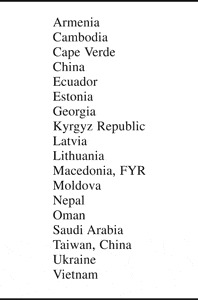
The empirical evidence supports these assertions. Looking at the tariff schedules of eighteen recent entrants at the six-digit product level, I find that controlling for applied protection rates on a given product prior to accession, as well as a host of country-specific variables, the value of imports prior to accession is the most powerful predictor of entrants' terms of accession for a given sector. These findings hold when I use an alternate measure of valuable sectors, by looking at preferential margins.
The design of the accession process has opposite implications for the entrant side: import-competing industries in acceding countries cannot do much to affect de jure depth, but they can push their governments to subsequently max out their applied duties relative to the bound rates. Importantly, and as per the literature, democratic institutions leave governments more vulnerable to such domestic industry pressure. The result, which finds strong support in the data, is that more democratic states may commit to deeper bindings overall, yet their most valuable industries, from the point of view of members' export interests, do not exhibit markedly different protection rates post-accession, given this offsetting behavior: they display negligible de facto depth. They do, however, become more tightly constrained: tariff flexibility, and the unpredictability it results in, is thus lowest precisely in these industries.
Finally, while some scholars have criticized the process of accession for imposing adjustments on poor countries that are disproportionate to their level of development,Footnote 12 the analysis suggests that these fears are mostly unwarranted, at least with regards to tariff schedules. Using a semi-parametric analysis that allows for nonlinearity, and controlling for a host of factors, I show that as per existing norms of differential treatment toward developing countries, the poorest countries are required to make the smallest relative adjustments. Indeed, it is the middle-income countries in the sample that fare the worst: benefiting neither from the bargaining capacity of the richest countries, nor from the norm of restraint vis-à-vis poor countries, these entrants end up having to make the deepest liberalizing concessions.
The Process of Accession
In this section, I take a brief look at the design of the WTO accession process. In doing so, I put forward three claims, which later guide this study's theoretical expectations. First, few formal guidelines or criteria exist around accession. As a result, the process is largely based on state interests, rather than the observance of predetermined rules. Second, owing to its design, the WTO accession process cannot be viewed through a traditional bargaining lens. In this respect, it is fundamentally different from multilateral bargaining that took place during the Uruguay Round, and one should not be surprised that negotiation outcomes following accession differ from what they might have been under multilateral bargaining. Third, there is a cost to members for imposing or seeking to impose too stringent constraints upon new entrants. In the alternative, the expectations would be far simpler: in equilibrium, incumbent members would impose maximum stringency on all new entrants across the board. Yet this is not what one observes; I outline some of the reasons why.
The process of accession is formally covered by Article XII of the WTO Agreement. The article is short on specifics: a country is said to accede to the institution “on terms to be agreed between it and the WTO.”Footnote 13 In other words, there are no pre-established criteria for the level of market access required of entrants; accession decisions are taken by consensus within a dedicated working party, followed by a supermajority vote at the WTO General Council.
The institution has been working to remedy this lack of clear guidelines since the WTO's inception. An early note by the WTO secretariat sought to go beyond Article XII in clarifying the procedural aspects of accession.Footnote 14 This note, for all intents and purposes, has become the default set of instructions for entrants. It states that applicants looking to join the institution must start by submitting an application to the WTO Director General, who, in concert with the General Council, then establishes a working party to examine the application. Importantly, all interested existing members may join the working party.Footnote 15 The next part of the process starts when the applicant country submits a detailed description of its trade regime, including a full current tariff schedule, to the working party, the members of which then submit questions to the applicant “with a view to clarifying the operation of the Applicant's foreign trade régime.”Footnote 16 To illustrate the intricacy of this fact-finding exercise, the case of Saudi Arabia resulted in 3,500 questions by members, and 7,600 pages of documentation submitted by Saudi Arabia over ten years.Footnote 17
The negotiations per se begin with the applicant country submitting its proposed Schedule of Concessions and Commitments, which specify the bound tariff levels the applicant offers to commit to as a WTO member.Footnote 18 Based on this submission, bilateral negotiations take place with all interested parties (usually limited to members of the working party). Importantly, if the proposed terms are not to its liking, the working party can immediately send the applicant country back to the drafting table. Indeed, when countries have offered bound rates too far above their current applied rates, leading to prospective “binding overhang” and resulting unpredictability in their tariff regime, members have refused to even consider the entrant's offer.Footnote 19 This occurred, notably, in the case of Mongolia and some former Soviet republics.Footnote 20 Once the biggest hurdle of bilateral negotiations is cleared, the outcome is compiled and reviewed by the working party, and annexed to the draft protocol of accession, which is then submitted to the General Council. If a two-thirds majority of the membership approves the protocol of accession, it enters into force thirty days after the applicant country signs it, or, if legislative approval is required domestically, once the country ratifies it.
While clarifying procedural aspects of accession, the 1995 note by the secretariat in no way specifies the levels of bindings required of entrants, nor does it provide any guidelines for setting these levels, save for the mention that tariff bindings should be “at commercially viable levels and reflect the general benefits the Applicant will enjoy upon membership.”Footnote 21 This, if anything, indicates a minimum rather than a maximum level.
Little wonder, then, that policymakers and scholars alike have expressed concern over the role of power politics in the accession process. As one study puts it, there are thus “no clear rules governing the ‘price’ of membership.”Footnote 22 Given how the working party reaches its decisions by consensus, the fact that all states with whom the applicant enters into bilateral negotiations have an effective veto over its accession further decreases the bargaining power of applicant countries.Footnote 23 This is especially true of small, poor countries that possess little bargaining leverage to start with. Samoa's senior trade consultant voiced this very complaint during Samoa's accession talks: “They [WTO members] can ask for all sorts of commitments which Samoa isn't in a position to offer. If they insist, there are two options: we will never become a member or we have to give in to that request.”Footnote 24 This reaction speaks to the fundamental difference between accession negotiations and multilateral talks during trade rounds. Whereas in the latter case, countries exchange reciprocal commitments, obtaining better terms by offering better terms, this process of exchange is absent from accession talks. The logic of reciprocity, the bedrock of the international trade system,Footnote 25 is thus suspended during accession bargaining. To be sure, the benefits that the entrant receives from membership are originally reached through reciprocal commitments with other members, but the entrant cannot influence those benefits through the concessions it offers. The institution thus effectively presents the entrants with a “take-it-or-leave-it” offer.Footnote 26 It is worth noting that this one-sided aspect of talks was not present during the earlier years of the General Agreement on Tariffs and Trade (GATT), when accession negotiations took place multilaterally, and often in the context of an ongoing trade round.Footnote 27 Bilateral accession negotiations became the norm only in the GATT's later years, a change formalized with the passage to the WTO. In 1990, the United States went as far as to argue that “the discussions between a contracting party and an acceding country should not be considered to be ‘tariff negotiations’,”Footnote 28 so as to allow members to exercise an opt-out clause if they were dissatisfied with the concessions offered by an entrant during accession talks. The end result is that the current design of accession proceedings, which has seen considerable change since the days of the GATT, should lead to very different bargaining outcomes from those expected under multilateral talks.
Recognition of this fact has led to growing concern that WTO accession proceedings lead to unfair accession terms, where entrants are imposed adjustments that appear stringent even by the standard of highly developed countries. Some scholars thus worry that the process may have created “a ‘second class’ of citizens in the WTO,”Footnote 29 beholden to tighter rules than what the original members must abide by.
Importantly, the one-sided nature of the negotiations does not do away with differences in power among applicant countries. It is accepted that wealthier entrants have better knowledge of the proceedings,Footnote 30 greater legal capacity,Footnote 31 and more skilled negotiators than do poorer countries, who are thus at a greater disadvantage. For these reasons, Evenett and Braga are left wondering whether “current WTO members wring commercial advantage out of weaker economic partners.”Footnote 32 Indeed, all applicants face the one-sided nature of the negotiations, but poor countries are particularly ill prepared for the power politics that emerge from the design of the proceedings. This lack of legal and negotiating capacity is precisely why critics have called on greater technical assistance to developing and least-developed countries (LDCs) during accession negotiations.Footnote 33
Accession outcomes cannot be reduced, however, to state interests and negotiating ability. Indeed, there exists a long-standing norm at the WTO dictating differential treatment for developing countries and LDCs. This norm has been formally recognized in the context of accession on a number of occasions since the WTO's inception, when members have taken steps to “facilitate and accelerate negotiations” with LDC entrants.Footnote 34 In 1997, a WTO high-level meeting concluded with a hortatory commitment for further support to LDCs in preparing their accession documentation and negotiations. A far more explicit statement to this effect was then made when the General Council reached a decision on the matter of LDC accession in December 2002. There, it was determined that “WTO Members shall exercise restraint in seeking concessions and commitments on trade in goods and services from acceding LDCs.”Footnote 35 Such unprecedented language indicates a real effort on the part of the institution to adjust accession terms to the development level of country applicants, albeit one that falls short of enforceable reform.
The two factors affecting terms of accession thus appear at odds with one another. On the one hand, members have the ability to coerce countries, especially poor countries with little bargaining capacity or knowledge of the stakes of the negotiations, as a means of increasing their own market access.Footnote 36 On the other hand, there exists a widespread norm of differential treatment toward these very countries, and that norm is formalized in WTO texts calling on members to match concession demands with the development level of entrants. The existence of these competing considerations leads to a methodological challenge. If country wealth both increases expected adjustments required of entrants and lowers them, one must allow that its effect on the terms of accession may be nonlinear. I explicitly test for this possibility in my analysis.
The existence of norms favoring differential treatment for LDCs is also the first step in answering a worthwhile question: since reciprocity is suspended, what keeps members from simply demanding maximum concessions from all states? The WTO is an institution that has long had concerns over its legitimacy, and one of the common ways of enhancing perceived legitimacy is to increase representativeness; enlarging the membership is one way of achieving this. The more countries that are represented, the greater the perceived procedural legitimacy of the institution's policy outcomes.Footnote 37 Expanding the membership also has more immediate material benefits. Though it is known that commitments are harder to make with a higher number of actors at the bargaining table,Footnote 38 which may account for the slowdown in trade-round negotiations since the earlier days of the GATT, a growing membership also helps the institution achieve its primary objectives: lowering the barriers to world trade and rendering them more predictable. Simply put, the more countries commit to lower barriers, the greater the possible gains from trade provided by the institution.
Crucially, demanding too high a price for accession risks forfeiting these benefits by pushing away potential entrants who become unable to sell the benefits of membership to their domestic audiences. This happened in the case of Vanuatu, which finally withdrew its accession bid following a ten-year accession process.
Vanuatu had much to gain from membership, since all its trading partners were WTO partners and seeking membership was thus an expected defensive move aiming to prevent trade loss.Footnote 39 Moreover, it would have been the first LDC to join since the WTO's inception, an important symbolic success for the institution. But the accession proceedings were shelved because of the two factors at the center of this article's argument: the entrant lacked legal and negotiating capacity, and members exploited the take-it-or-leave-it design of the accession process by asking for too much from a country unable to sell drastic adjustments domestically.Footnote 40 While it is by no means the only factor behind Vanuatu's decision, it is generally agreed both by observers and by the WTO itself that the United States “extracted the maximum concessions possible”Footnote 41 from the country, thus undermining the protrade forces within Vanuatu and decreasing domestic support for accession in the first place.Footnote 42 Even four years later, once Vanuatu eventually voiced its intent to reinitiate proceedings, its representative stated that “there are many doubters back home in Vanuatu who believe that we should not play our part in the multilateral trading system or the global economy.”Footnote 43 The burden that accession negotiations placed on such a small country was thus a major factor in that country's decision to walk out on accession talks. It is difficult to assess the impact of the decision for the WTO's perceived legitimacy, but it appears likely that given the attention the event has drawn, it was hardly worth a marginal increase in market access to a small least-developed Pacific island nation. Not coincidentally, the year following Vanuatu's exit from accession talks, the WTO formalized the requirement on members to exercise restraint during accession talks with LDCs.Footnote 44
Another reason for which members may exercise restraint in the demands they make on entrants, and a somewhat more subtle one, is that it may not be optimal, from the point of view of prospective compliance, to impose adjustments that are too burdensome for a developing economy to implement and abide by. Recent work has shown that exogenously raising a country's trade commitments drastically increases its likelihood of using trade remedies and offering protection through other means, both legal and not.Footnote 45 In fact, the very concept of the depth of integration, in Downs, Rocke, and Barsoom's seminal article, was conceived to explain why countries would breach their obligations: the deeper their commitments, the more profitable noncompliance becomes.Footnote 46 Since the whole institution would suffer from an increase in noncompliance, if only through the unpredictability it creates, not to mention possible “contagion effects,” demanding overly ambitious adjustments from entrants may destabilize the institution.
The result is that demanding too high an entry price, in terms of market access, can backfire against incumbent members, who thus need to be selective in the demands they make. Accession to the WTO, as with any international treaty, leads to distributional effects and thus never enjoys full support domestically: state leaders seeking entry into the institution need to sell the move to their constituencies. If the required adjustments are too high, or perceived as unfair, this task is made more difficult, and accession less likely.
The Benefits of Accession
Whether states gain or lose from WTO membership is the subject of a separate debate,Footnote 47 and outside the scope of this article. Here, I address the question only summarily to demonstrate that there exist benefits counterbalancing the adjustments required of new entrants, especially in the realm of market access, despite entrants' lack of bargaining leverage.
Members apply to join the institution of their own volition, and yet, there is much skepticism about whether the benefits of membership, especially in terms of market access, are real. This skepticism is founded on the knowledge that many WTO members, the United States among them, extend MFN treatment to nonmembers as well.Footnote 48 These authors argue that in terms of market access, the benefits of accession are reducible to increased certainty of existing concessions: the status quo gets locked in, rather than improved upon.Footnote 49 To be sure, greater predictability of concessions, and thus decreased volatility of trade flows, are undoubtedly a key function of multilateral trade institutions.Footnote 50 Furthermore, stability is also achieved through another channel that evades nonmembers: by entering the institution, states acquire the ability to challenge the trade actions of their trading partners when the latter run afoul of their obligations. Ecuador is said to have rushed its accession to the institution as a means of joining legal proceedings in the bananas dispute against the European Communities.Footnote 51 Finally, the ability to bring violations to court, by itself, works as a deterrent, decreasing the likelihood that a country's rights will be flouted in the first place.Footnote 52
Contrarily to recent claims,Footnote 53 however, the advantages of membership are by no means limited to greater predictability and access to a dispute settlement panel, no matter how important these may be. A simple test reveals that despite the great powers often extending MFN status to nonmembers, not all trading partners do so. Again, this test remains agnostic about whether these reciprocal policy changes lead to increased trade; this article's interest is in policy alone. As can be seen in Table 1, which shows effective applied trade-weighted tariffs for countries before and after accession, market access is on average much improved as a result of joining the institution. This, it turns out, is also true of China, which is usually taken as the example of the country that bought itself only greater predictability, rather than better terms, by joining the WTO.Footnote 54
The change in market access flowing from accession

Entrants thus gain real market access when they join, though they do not gain any more (or less) of this market access if they offer more (or fewer) concessions of their own. They are faced with a “price” of accessionFootnote 55 that has no direct relationship to what they gain as a result. The remainder of this article examines variations in this price across entrants.
De Jure Versus De Facto Depth
The notion of depth of integration, as per Downs, Rocke, and Barsoom, is based on a counterfactual: How does a state's behavior within an institution differ from how it would have behaved in the absence of that institutional commitment?Footnote 56 This question is empirically difficult to tackle for reasons that are quickly apparent.
In the case of human rights treaties, for instance, it becomes nearly impossible to judge what a country's behavior toward its citizens would have been had it not signed a given treaty. Yet the concept of depth remains useful. It leads one to consider treaties as imposing varying adjustment costs on their signatories. All institutional commitments are not created equal, and so compliance should not mean the same thing across different institutions. While the original Downs, Rocke, and Barsoom work differentiated only among treaties, the same concept can be readily applied to different members of the same international organization. Some members may be forced to make greater and more costly adjustments than others. In the case of multilateral negotiations, where everyone's commitments are set simultaneously, countries are wary of making relatively greater adjustments than their trade partners. Variation in the price of entry is thus minimized. Those for whom the same absolute level of commitment is cheaper, for any reason, are often expected to make greater commitments.Footnote 57 The debate between developed and developing countries over the curbing of carbon dioxide emissions, where the level of commitments may differ according to the level of industrialization and technology, is a case in point.Footnote 58 The current process of WTO accession, however, does not lead to this natural leveling of commitments. There is, in other words, no baseline setting the price of entry, which is shaped in an ad hoc fashion by the interests of the working party countries for the case at hand.
The case of multilateral trade institutions offers an apt proxy for the counterfactual to membership.Footnote 59 Indeed, and contrarily to other issue-areas such as human rights, in trade there exist highly disaggregated, product-level data charting countries' behaviors prior to entry.Footnote 60 Looking at per-product tariff protection before accession thus offers the most reliable estimate of the type and level of protection a country would have been applying after the point of accession, had it not been for the institution. There may be some concerns about countries adjusting their tariff regime in view of accession; I address this issue at some length in the analysis section below.
For now, the concern is to relate the depth of an agreement to what scholars of WTO accession have been calling the price of entry. Indeed, even as there is growing consensus that countries benefit from membership only if they liberalize themselves,Footnote 61 the price of entry must be viewed in political terms. Accession has distributional consequences, favoring some interest groups over others, and the price of entry is commensurate with the total level of adjustment required of these domestic groups. The greater the tariff abatement demanded of a country, the greater the short-term costs it imposes on its constituency. Countries join the institution of their own volition precisely to facilitate and lock in domestic market reforms and to gain market access in turn. Yet, given interest group dynamics, it remains that the price of entry is viewed in terms of how great an adjustment to its trade regime a country is required to make. That is why reciprocity is regarded as such a fundament of the multilateral trade regime. Owing to domestic political economic dynamics, only by getting can a country offer in turn, rather than the other way around. The complaints of developing country accession negotiators, as in the case of the Samoan negotiator,Footnote 62 support this belief. The price of entry becomes too high when the required adjustments become too burdensome.
However, in this case, depth is not one dimensional. It turns out that the commitments the WTO asks of entrants, as well as of existing members during the Uruguay Round, does not necessarily equate with the subsequent behavior of those countries. The effective outcome of accession negotiations (and trade rounds) is a list of bound tariff rates, which function as the ceiling for protection on a given product. However, countries need not, and most often do not, apply protection at that maximum level. Indeed, in more than 69 percent of all tariff lines in the sample, the maximum allowable rate of protection is not reached,Footnote 63 leaving a gap referred to as “binding overhang.” Hence, there are two ways of measuring depth in the case of accession, each with a different interpretation. The first is the difference between the applied rate on a given product prior to accession, and the bound level for that same product following accession. I refer to this as de jure depth, or the extent to which legal commitments curb behavior. The second measure, which I refer to as de facto depth, corresponds to the effective change in behavior: the difference between the applied rate on a given product before accession, and the applied rate on that same product following accession. Figure 1 provides a useful illustration.
Distinguishing between de jure and de facto depth

Naturally, the two measures of depth are not unrelated: Ecuador was given such lax treatment by the institution (an average de jure depth of −9 percentage points in the data, compared with −2 percentage points for the average country) that it could afford to “raise its applied tariffs across the board in the years after WTO accession.”Footnote 64 Low de jure depth may thus allow for low (and in this case, negative) de facto depth.
Theoretical expectations, however, need not be analogous in both cases. If members expect that a country would apply a low rate whatever the bound level, they have less incentive to press hard on the country to bind its tariff for that product, given that exerting pressure on an entrant is not costless. Conversely, if a country is made to cut its tariffs a great deal, it may have an incentive to levy applied duties as close to that maximum level as possible, to recoup tariff revenue, and minimize the adjustment required of domestic groups. Both these dynamics are examined in the analysis.
Institutional Design and Domestic Interests
Accession has distributional effects on both the entrant and the membership side. In both cases, some domestic groups gain, and others lose. Yet the design of the WTO accession process qualifies the extent to which these different interests can be expressed: if the process leaves no room to improve accession terms from an interest group's point of view, then the interest group is unlikely to mobilize to exert such change. I argue that given the design of accession proceedings, de jure depth is shaped mostly by exporter interests in member countries, while de facto depth is likely to be shaped mostly by import-competing industries on the entrant side. Other interest groups are effectively kept out of the process. Whereas there is not much variation across domestic institutions on the member side—since the working party is most often made up of the same countries—there is great variation in domestic institutions on the entrant side.Footnote 65 Given how democracies are more vulnerable to pressure from domestic groups, such variation should affect the extent to which preferences from these domestic import-competing groups is heeded. Specifically, while more democratic entrants commit to greater depth overall, I expect democracies to exhibit greater resistance to adjustment in the case of their most valuable industries.
Mobilization on the Membership Side
The accession of an entrant is never without consequence for members. Even those states that already extend MFN status to nonmembers must suddenly keep to those low rates of protection, at the risk of being brought to dispute settlement. They no longer have unilateral control over their trade policy vis-à-vis the entrant. In this way, just as the entrant country must sell membership to its constituents, so too must existing members sell the new entrant to their constituents. Little can be done by members to directly alleviate the concerns of industries fearing a surge of cheap imports from a new entrant. Members' import-competing industries thus have little over which to mobilize, since they cannot change the content of the MFN access automatically granted to entrants.
Yet the GATT/WTO has featured a built-in “opt-out clause” since its very beginning, precisely to address concerns over the impact of new entrants on members' trade policy.Footnote 66 Article XXXV of the GATT allowed members to suspend its obligations vis-à-vis a new entrant, such that a member was not bound by the agreement with regards to that country, and could not be taken to dispute settlement by the entrant for failing to honor those commitments. A number of countries exercised this option throughout GATT history for both economic and political reasons.Footnote 67 Japan's accession, for example, was met with opt-outs by fourteen GATT members. In the WTO, the equivalent provision exists in the form of Article XIII, which the United States has exercised at one time or another with regards to six countries.Footnote 68 Indeed, in the case of the United States, the passage to Permanent [as opposed to conditional] Normal Trading Relations (PNTR) most often requires approval from Congress, a process that is not covered by fast track, and that can thus result in significant amendments. The special safeguard measures imposed on China, for instance, were a result of congressional amendments to the legislation covering China's passage to PNTR.Footnote 69
Though similar in content, one difference between GATT Article XXIII and WTO Article XIII is worth highlighting, since it supports this article's initial claim that the current design of the accession process, in comparison with that under the GATT, favors the incumbent membership in terms of bargaining power. In the GATT, the opt-out provision could only be used by a country if no tariff negotiations had been initiated with the entrant. This provision kept members from using the threat of the opt-out provision as a bargaining tool during negotiations over market access. This clause was stripped from the WTO agreements, mostly as the result of pressure from the United States,Footnote 70 which argued that decisions over the opt-out clause should “be taken in the light of the results of tariff negotiations.”Footnote 71 Countries thus no longer forfeit the option of exercising the opt-out clause once they begin bilateral negotiations with an entrant. The United States has gone on to exploit the resulting possibility, for example by negotiating bindings with Mongolia, which became part of Mongolia's accession protocol, and then using Article XIII to opt out of its obligations vis-à-vis Mongolia for two years following its accession.
The greater point is that accession of a new country leaves no member indifferent, a fact that the existence of the opt-out clause testifies to. Though to be sure, concerns are more likely to arise over the accession of a “country of major importance to international trade,”Footnote 72 this need not necessarily be so; it suffices that some of an entrant's industries display a comparative advantage over import-competing industries in member countries. Short of a country exercising Article XIII, which remains a rare event, import-competing industries will likely be negatively affected by permanent access for foreign exporters, yet they can do nothing about it. The terms granted to the entrant—permanent MFN status—are known in advance. This fact has a symmetrical equivalent on the applicant side: exporters are likely to benefit greatly from increased, predictable access following accession, yet they can do nothing to improve those terms.Footnote 73
What member governments can do, however, is balance the discontent on the part of import-competing sectors by touting the benefits of increased market access to their export-oriented industries. Indeed, the winners of the process of accession are the exporters within existing member countries that now gain access to the entrant's domestic market. The more valuable that market access, then, the more export interests it will mobilize, and the higher the domestic pressure on members to push for greater adjustments on the part of the entrant. Hence, and counter to expectations in a classic bargaining setting, the more one has to offer, the more one is required to give, since no reciprocal mechanism exists to balance the value of what one has to offer with the value of what one gets for it. In sum, pressure from members to adjust tariff rates downward is expected to be increasing in the size of a sector's imports market.
Not all export industries potentially benefiting from increased access will successfully overcome collective action problems to lobby for their interests. This is despite the fact that the bar for policy action is lower than in the usual context. Trade scholars often think of mobilization in terms of lobbying for import protection or dispute settlement. In the case of accession, while demands made of entrants are not costless, some demands are sure to be made. By contrast, no trade protection would be granted if industry did not lobby for it. The question is thus not whether any pressure will be applied on entrants, but where, and how much. Nonetheless, mobilization of any sort requires a critical size and a high degree of industrial concentration.Footnote 74 Such collective action becomes increasingly likely as the value of potential market access rises; it is this rising likelihood that the argument's expectations hinge on. Moreover, since all concessions during bilateral talks apply to all members through MFN, the likelihood of mobilization aiming at opening valuable markets is increasing in the number of negotiating members: it suffices that an industry from a single contracting party successfully mobilize for its lobbying to affect an entrant's final accession terms.
Mobilization on the Entrant Side
Importantly, entrants' trade policy is not wholly dictated by the institution upon accession. Both in the case of existing members and new entrants, countries retain considerable flexibility in their setting of protection rates, despite their WTO commitments. To wit, looking at the data, the bound rate for a given product is on average 2.1 percent higher than the applied rate on that product prior to accession. In other words, de jure depth is on average negative. This is not to say that accession deals have little meaning, or that they are easy to comply with. Some tariff lines—and as the argument entails, the choice of these is endogenous—are significantly cut by bound rates. But more to the point, and in keeping with recent literature, a key function of institutional commitments in trade is the provision of stability, and the reduction of trade volatility.Footnote 75 There is evidence to show that the lack of such certainty acts as a tax on trade, just as a tariff might.Footnote 76 Ensuring “security and predictability”—an objective enshrined in the WTO texts—is thus as important a goal for trade institutions as is reducing average imports barriers. Credible commitments serve to imbue a country's trade regime with certainty, which is a boon for traders and investors.
What this means in practice, however, is that within the constraints imposed on them by the institution, acceding countries have some wiggle-room in which to operate. They can choose to maximize their levels of protection within the allowable bounds of the accession deal, or they can keep their applied rates lower than the bound rate, and retain some flexibility for dealing with unexpected future circumstances. The theory presented in this article thus also allows one to conjecture about which countries and industries are most likely to resist required adjustments by exercising (or “spending”) their flexibility and raising their applied rates to the bound rates.
Demands for such resistance to adjustment are filtered by domestic institutions.Footnote 77 As I have argued, import-competing interest groups, negatively affected by the country's trade opening, can do little to modify the bound rates that result from negotiations with the working party, given the take-it-or-leave-it character of the proceedings.Footnote 78 What they can do is resist the required adjustments by pushing to increase applied rates up to the bound levels, thus minimizing de facto depth.
Their success is likely to be determined in large part by domestic institutions. Indeed, there is ample evidence demonstrating that democracies are more vulnerable to interest group pressure in setting their trade policy than nondemocracies, which do not rely as much on the political support of industries to stay in power.Footnote 79 In this way, one would expect democracies to be far more likely than nondemocracies to resist adjustment on behalf of their industries by increasing applied rates within the bound levels for high import sectors. The upshot is that democracies may commit to deeper bindings overall, yet their most valuable industries, from the point of view of members' export interests, will not exhibit markedly different protection rates post-accession, given this offsetting behavior. In other words, they will display negligible de facto depth.
Since the literature demonstrates that one of the main functions of trade institutions is not only to liberalize, but also to lock in existing commitments, this does not necessarily constitute a negative development. Member country exporters may not get as big a drop in tariffs as they would desire in import-reliant sectors within democratic countries, but they will face far greater certainty in these sectors. In other words, flexibility will be “spent” by democratic entrants most frequently in those industries that are most valuable as export markets, and the wiggle-room that leads to unpredictabilityFootnote 80 will be lowest in those industries as a result.
This reasoning leads to the two following hypotheses:
H1. If a country, or an industry within a country, is a valuable export market prior to accession, then it will face higher de jure liberalization.
H2. In an effort to compensate for the required adjustments, more democratic countries will raise the applied rates closer to the bound rate for those sectors that are most valuable as export markets: these sectors will exhibit lower de facto liberalization following accession.
A corollary of these two hypotheses is that binding overhang, that is, the degree to which a tariff rate can be raised within the legal confines of an agreement, is likely to be lowest in the case of industries that are valuable as export markets and are found in democratic countries. Indeed, binding overhang is equivalent to the difference between de facto depth and de jure depth.Footnote 81 If both hypotheses are correct, then one should expect these key sectors to exhibit low binding overhang.
Operationalizing the Dependent Variable: Depth of Integration
This article proxies for depth of integration by comparing pre-accession and postaccession policy and behavior. This operationalization of depth is an improvement over Downs, Rocke, and Barsoom's measure of depth in trade,Footnote 82 which simply looked at changes in a country's trade flows following the inception of a trade agreement. While trade flows may be an apt measure of the benefits wrought by an institution, it falls short of a satisfactory measure of the depth of commitments.Footnote 83 Agreements may increase enforcement, credibility, and predictability, and could thus very plausibly increase trade flows without changing commitments in the least. The approach taken here thus constitutes a marked improvement, by looking at changes in policy rather than its effects; yet it is not without its own flaws. Cattaneo and Braga, for instance, claim that in some cases, liberalization efforts are undertaken in preparation for accession, rather than solely as a result of it.Footnote 84 If this were there case, then it is unclear what the “pre-accession” reference period ought to be. The concern is a legitimate one, yet taking a closer look at the data can serve to dispel it in great measure.
To begin with, this is the type of issue that is alleviated by employing more data. The longer the reference period prior to accession, the lesser the potential bias caused by any pre-emptive liberalization. Here, I use a maximum number of pre-accession and post-accession years to account both for pre-emptive liberalization, and post-accession implementation delays.Footnote 85 In this way, more recently available data allows me to present a fuller picture than was possible before.
More to the point, however, one has good reason to believe that the degree of pre-emptive liberalization has been negligible. Indeed, comparing pre-accession terms and post-accession terms, one notices a highly statistically significant difference across the board, suggesting that despite possible anticipatory reforms, a big drop in protection rates does occur at the point of accession. Looking at the data employed in the analysis, the average drop in the level of protection during accession is 17.6 percent (16.3 percent, 18.7 percent).Footnote 86 Moreover, since the analysis is concerned with variation in depth of integration among different countries all going through the same process—and thus facing similar incentives to anticipate accession talks with early reforms (or not)—there should be less concern that there is any systematic bias in the data. In other words, the importance of factors influencing depth of integration is examined strictly in reference to other entrants.
Finally, the very notion of pre-emptive abatement is questionable. If anything, the incentives of countries point in the opposite direction: to improve negotiating outcomes, a country would leave its barriers high and abate them only as a condition of gaining entry. The lack of a baseline level for post-accession rates reinforces this incentive, since entrants benefit from portraying any liberalization as directly resulting from the accession deal.Footnote 87
The case of China may be an exception in this regard, since China faced an uphill battle in convincing apprehensive members that its accession would be beneficial in the first place. As such, it had to demonstrate goodwill in abating barriers in the run-up to its accession negotiations. Yet even here, looking at the data, China's depth, in both de jure and de facto measures, is the highest in the sample of eighteen countries, which matches what one knows anecdotally of its accession deal. In other words, any pre-emptive liberalization China offered does not appear to significantly reduce the observable depth of integration it displays, as defined in this article, relative to other entrants.
Overall, then, the availability of more data and our knowledge of the accession process should serve to dispel some of these concerns. The data remain imperfect, but appear, in all respects, useful to the task at hand, which is to explain variation in the price of accession paid by different WTO entrants.
I thus average tariff rates across a pre-accession and post-accession reference period, producing what is reducible to a cross-sectional data set. The main reason to ignore the time dimension is that the final bound rates set in tariff schedules do not change over time. Though the applied rates may change subsequent to accession, the analysis calls for a snapshot of an entrant's trade policy immediately following accession in order to convey the true impact of joining the institution. The further away one gets from accession, the more applied rates are likely to be influenced by events taking place in the meantime: changes in parties, ideology, technology, etc. Finally, by using a cross-section, I also do away with small differences in the number of years of data available across the countries in my sample. The year of accession itself is not counted in either period.
Throughout, I use simple (unweighted) tariff rates in order to avoid the downward bias that occurs when using tariffs weighted by trade flows: in the case of prohibitive tariff, imports would be nil, and the tariff line would receive no weight in the aggregation.Footnote 88 Importantly, however, using weighted tariffs instead does not substantively affect any of the findings. The data cover thirteen years of accession deals since the WTO's inception, from 1995 to 2008. Cape Verde is the most recent entrant, among a total of 18 countries. The unit of analysis is the six-digit product level tariff line, making for a usable sample of 98,722 observations, with small variation in size due to missing values for control variables. It is also worth noting how the WTO's ubiquity alleviates self-selection concerns.Footnote 89 With 153 members, and 29 more countries currently going through accession proceedings, a negligible number of countries have “opted out” of the multilateral trade regime altogether. Whether a country joins or not is thus more a matter of economic criteria and incumbent member interests than a question of willingness on the part of potential entrants themselves.
Analysis
I test my first two hypotheses using ordinary least squares (OLS) regressions with robust standard errors clustered by country. I then rely on a generalized additive model (GAM) to test for potential nonlinearity in the results. In the case of the first hypothesis, I thus estimate the OLS model:

for industry j in country i, with X i a vector of controls for country i.
I test the second hypothesis by adding two interaction terms, between regime and product imports, and regime and product exports, looking especially at de facto depth as the dependent variable:

The main explanatory variable of interest is a measure of the value of imports for a given country-product. I measure this as the log of product imports at the six-digit HS level in constant 2000-level U.S. dollars. The trade flows data come from the UN's Comtrade database. To ensure that the imports variable is not merely catching the extent of overall trade activity, I separately control for exports (coded as the log of product exports in constant 2000-level U.S. dollars); the argument remains agnostic as to the sign of the coefficient. As is often the case, the export data are spottier than the import data (which also tend to more reliable, since countries levy duties on their imports, and thus have an incentive to keep good records). As a result, I construct a country's export data by summing imports from all its trade partners.
The reference period for imports and exports data, as well as for all control variables, is the year prior to accession, to reflect conditions at the time a final deal was achieved. Using an averaged measure across all reference years for the “pre-accession” period instead, however, does not affect any of the results. The data on both gross domestic product (GDP) per capita and trade flows come from the World Bank's World Development Indicators (WDI).Footnote 90
The second explanatory variable of interest, first as a control variable, and second as a test of H2, is regime type. Much scholarship sees a correlation between democracies and international cooperation writ large, both in the likelihood of joining international organizations, and the extent of their subsequent commitments.Footnote 91 As a result, one would expect that both in de jure and de facto terms, democracies would exhibit greater depth of integration, and that the coefficient would thus be consistently positive. The data on regime come from Polity IV, and are coded on a scale from 0 to 20.Footnote 92 H2 also predicts that democracies will see more “resistance to adjustment,” since they are beholden to more powerful domestic interests. Interaction terms are used in the second part of the analysis to test this belief.
The most important control variable throughout corresponds to the applied rate of protection prior to accession, MFNpre. Whenever looking at depth of integration, I control for the “starting point” from which an adjustment was required. Beyond getting at the intuitive notion that high rates will be cut the most in absolute terms, and that bound rates and the prior applied rates are not independent,Footnote 93 the inclusion of this variable also seeks to remedy the main drawback of proxying for valuable market access using existing imports. Indeed, in the case of a prohibitive tariff, protection rates would be so high as to block imports altogether. Controlling for the rate prior to accession gets at these prohibitive tariffs; it is also the reason why the rate used here is a simple, rather than a trade-weighted average. One would thus expect the sign on MFNpre to be positive. The data on all tariff rates come from the World Integrated Trade Solution (WITS).Footnote 94
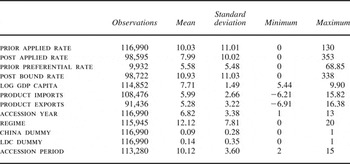
I also ensure that all regressions are robust to the inclusion of a dummy for China, since all scholarship to date agrees that the case of China's entry stands apart, and was beholden to different norms. This dummy is coded as 1 for all observations with China as the country, and 0 otherwise. Knowing what one knows of China's accession process, one would expect the coefficient on this dummy to be consistently positively signed.Footnote 95 Finally, I consider the effect of the number of years into the WTO at which a country entered, to test the belief that the terms of accession are getting progressively more stringent.Footnote 96 Further variables are included in robustness checks. A summary of all variables used is presented in Table 2.
Descriptive statistics

Findings
This article's main hypothesis considers the effect of an entrant's value as an export market for existing members on the degree of adjustment required of that country during accession negotiations. In this case, the belief is that given the design of accession negotiations, the more one has to offer, the more one is asked to concede.
I first test this hypothesis looking at imports at the country level, using an ordinary least squares regression with robust standard errors clustered by country. My dependent variable is de jure depth, or the extent to which legal limits negotiated during accession require a country to cut its pre-accession protection rates for a given product. The main variable of interest is the logged value of country-product imports. I control for the MFN applied rate prior to accession, as well as logged GDP per capita, logged exports, and regime type.
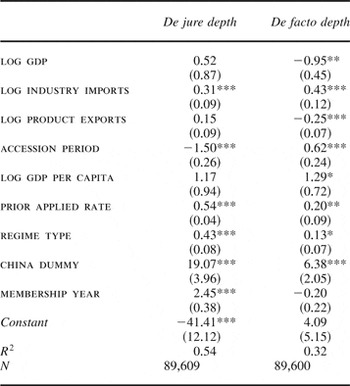
The results, shown in the first column of Table 3, bear out this study's expectations. Industries exhibiting high import levels and thus representing valuable export markets for existing members show greater average de jure depth. In substantive terms, raising imports of a given product from its sample mean to its maximum, while holding all other variables at their sample averages, raises de jure depth of integration for that product from −0.77 percent (meaning bound rates do not, on average, cut into prior applied rates at all) to 2.16 percent on average, a considerable increase.Footnote 97 In this specification, GDP does not have a significant effect on depth. As per the literature, democracies are required to make significantly greater commitments, on average. China is associated with significantly greater de jure depth. Interestingly, the longer a country's accession period, the better its terms become. Offering support for recent observers' claims, it seems that later entrants are required to make significantly deeper commitments: for every year past 1995 at which a country joins, its de jure depth increases by 2.5 points.
The effect of the imports sector on de jure versus de facto depth

Notes: Table shows ordinary least squares (OLS) regressions. Robust standard errors are clustered by country in parentheses.
*** p < .01;
** p < .05;
* p < .10.
Column (2) of Table 3 runs the same specification on de facto depth. Here, the picture looks slightly different. GDP now shows a negative relationship, while per capita wealth remains insignificant. This may be due to nonlinearity, a possibility I examine later. The effect for imports remains positive and significant, while that of exports becomes negative. The remaining variables behave similarly, except for the accession year, which is no longer significant, suggesting that latecomers act to offset the extra demands they face by hiking rates closer to the bound.
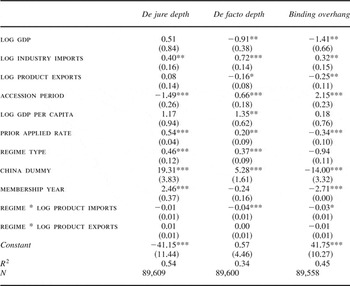
The interesting comparison between de jure and de facto depth is found in Table 4. There, I rerun the above specifications with two interaction terms, one between regime type and product imports and the other between regime type and product exports. In the first column, where the dependent variable is de jure depth, I show that both terms are not significantly different from zero: democratic countries do not face greater or lesser demands on their valuable sectors than nondemocracies. The remaining variables, including logged imports and regime, are unchanged. Results in the second column, however, where the dependent variable is de facto depth, strongly support H2. The interaction term between regime type and industry imports is substantively and significantly negative. I verify that the marginal effect remains negative and significant over the relevant range of the data.Footnote 98 Democracies still display far greater de facto depth across all products looking at the regime coefficient, but those industries that are most valuable to members, and that have thus faced the greatest pressure during talks, exhibit considerable push-back in the form of hiked tariffs. Democratic countries, more vulnerable to interest group pressure, are observed “spending” their flexibility in these key industries.Footnote 99 As a result, binding overhang is significantly decreased for these valuable democratic industries, as can be seen in the third column. This finding is especially striking given how democracies show greater de facto depth overall, which should lead us to look more closely into where the greater cooperation exhibited by democratic countriesFootnote 100 is taking place.
The effect of regime type on resistance to adjustment

Notes: Table shows OLS regression. Robust standard errors are clustered by country in parentheses.
*** p < .01;
** p < .05;
* p < .10.
An industry's current import reliance is the best available proxy for its future potential value from the point of view of members' export interests, but it remains imperfect. Specifically, it conveys little about the degree to which pre-accession policy accounts for the level of imports. Here, I test the main hypothesis using an alternative variable: the preferential margin, that is, the difference between the lowest tariff imposed on a preferential trade agreement (PTA) partner and the tariff imposed on the rest of the world. The literature on PTAs tells us that these divert trade away from nonpartners: the greater the difference between internal barriers and the external barriers, the more of this diversion one can expect. As a result, a high preferential margin indicates a potentially valuable market where trade can be “regained” through negotiation.Footnote 101 In most cases, this would constitute a bargaining chip for the entrant. Yet because of the design of accession procedures, it follows from the argument that the industries and countries concerned will be asked to concede more, not less. One would thus expect preferential margins to be positively correlated with de jure depth.
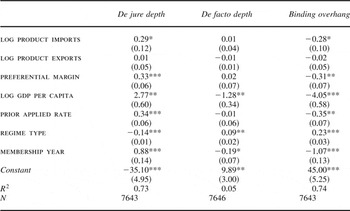
To test this belief, I look at all entrants for whom there exist product-level data on PTA rates prior to their accession to the WTO.Footnote 102 There are four such countries: Cambodia, Lithuania, Ukraine, and Vietnam. By chance, these represent a good cross-section of average de jure and de facto depth.Footnote 103 As before, on the right-hand side I include the log of product imports, log of product exports, log of GDP, the prior applied rate, regime type, and how late a country joined.
Here too, the findings offer strong support for the hypothesis. As seen in column (1) of Table 5, industries with a high preferential margin face considerably greater demands from members during negotiations. Here too can be seen a familiar pattern between de jure versus de facto depth. The difference between the effect of the preferential margin in column (1) and column (2) conveys the extent to which countries “spend” their flexibility exactly on the products with high preferential margins. The conclusion is that those sectors preserve their preferential margin to a high degree, yet their flexibility is eroded, as shown when looking at column (3) of Table 5, where the dependent variable is binding overhang. In other words, rates of protection (and thus protection margins) change little, yet the predictability of the very sectors of most value to exporters, in terms of “regained trade,” is greatly increased as a result of accession. Importantly, an industry's reliance on imports retains a positive effect on depth when restricting to this four-country sample and controlling for preferential margins.
The effect of the preferential margin on de facto versus de jure depth

Notes: Table shows OLS regression. Robust standard errors are clustered by country in parentheses. Sample is made up of observations for Cambodia, Vietnam, Lithuania, and Ukraine.
*** p < .01;
** p < .05;
* p < .10.
I also verify whether the article's findings stand when looking at import reliance on a national level. Controlling for the same factors, the higher a country's imports, the more, on average, that country is required to bind itself during accession negotiations.
Additionally, I rerun all the above specifications after adding an indicator variable for LDCs, which in the sample include Cambodia and Nepal. As expected, the variable shows a negative relationship, which becomes highly significant when the logged GDP variable is dropped, suggesting that LDCs do obtain more lenient terms. The other findings are entirely unaffected, except for the effect of valuable sectors in democracies on binding overhang (the third column of Table 4), which becomes more significant.
Finally, it may be that members consistently put pressure on the same products across all entrants. To make sure that this does not affect the results, I include product-fixed effects in the above specifications. Doing so does not change any of the findings: it only increases the substantive effect of import reliance and the R-squared term.
Accounting for Nonlinearity
A corollary of the argument is that the effect of wealth may be nonlinear. This expectation flows from the way in which GDP per capita could have both a positive effect on de jure depth (through the lower negotiating and legal capacity of poor countries)Footnote 104 and a negative one (through the formalized norm against demanding overly burdensome concessions of poor countries). If both effects do not offset each other perfectly, then one may expect some nonlinearity. Here I evaluate this possibility further, both as a way of checking the robustness of the findings to such curvilinearity, and of uncovering the true effect of wealth on depth of integration, which has been the topic of much debate in the literature. To do so, I first quickly verify the effect of adding a GDP per capita quadratic term as a plausibility probe (not shown). When added to the basic regression with de jure depth as the dependent variable (since I am interested in the demands put on the entrant by the working party), the quadratic term is negative and highly significant, and increases model fit, while none of the other variables are affected. Since this first approximate test supports the possibility of nonlinearity, I go on to test the true effect of wealth using a GAM. GAMs are valuable in that they allow us to relax the linearity assumption without forsaking interpretability of the results.Footnote 105
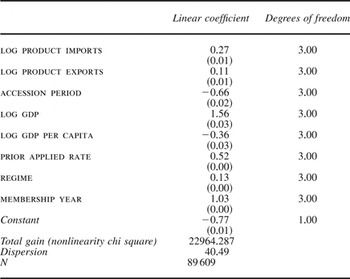
Once again, de jure depth is the dependent variable, and I control for the usual set of variables. The results are shown in Table 6. First, allowing for nonlinearity, the average effect (the “linear coefficient” of the GAM) of imports is positive and significant, as per all previous findings. The same is true for GDP per capita, but that variable, together with logged GDP, also exhibits the largest “gain” of any variable in the model, which corresponds to the normalized difference between an ordinary linear model and the GAM for that specific predictor. In other words, the linearity assumption is most severely violated in the case of wealth. The nonlinear effect becomes most apparent in the graph drawn from this specification, shown in Figure 2, which charts de jure depth on the vertical axis, and wealth on the horizontal axis. The results follow the interpretation of the quadratic term I mentioned earlier. The first thing to note is that the poorest countries do seem to be benefiting from restraint on the part of members, and this norm of behavior appears to hold in the face of the negotiating weakness of those countries at the lowest development level. Indeed, slightly wealthier countries, no longer benefiting from the norm of restraint, but nonetheless lacking the negotiating acumen and legal expertise of the wealthiest countries within the sample, appear to be given greater adjustment costs than anyone else. These results should serve to ease the fears of critics who worry that members may be “wring[ing] commercial advantage out of weaker economic partners.”Footnote 106 The sample's poorest countries, such as Nepal, Cambodia, and the Kyrgyz Republic, do not appear to be exploited more than others, in spite of their limited bargaining capacity. Counterintuitively, it is countries that are somewhat better off, such as Ukraine, that are being imposed the highest relative adjustment costs, controlling for other factors.Footnote 107
Semi-parametric model of de jure depth following WTO accession

Notes: Table shows generalized additive model (GAM) specified with three degrees of freedom. Deviance = 3637200. All coefficients are significant at .01.
The effect of GDP per capita on de jure depth of integration

Conclusion
As multilateral institutions undergo what has been described as a crisis of legitimacy,Footnote 108 there has been growing interest in the conditions put on countries acceding to these institutions. In this way, the price of entry may be what determines whether the WTO will be viewed as a “country club,”Footnote 109 or as a legitimate tool of global governance. Looking at depth of integration through the tariff rate adjustments required of countries upon entry, this article enters the debate by asking why some countries emerge from accession negotiations with a better deal than others.
An important caveat should be made about the scope of the findings. This study deals only with the price of entry countries pay in terms of tariff concessions. Yet in the post-Uruguay trade regime, accession negotiations cover a breadth of issues beyond tariffs. It thus remains up to future research to examine whether the effects identified in this study would hold for concessions over export subsidies, intellectual property standards (under TRIPS), or services (under the General Agreement on Trade in Services).Footnote 110
In trying to explain variation in the price of accession among entrants, the first step of the argument is to examine how the design of WTO accession negotiations suspends reciprocity, which is at the basis of the international trading system. As a consequence, the shape of accession deals is driven largely by the domestic interests of the WTO members who enter into bilateral negotiations with applicant countries. Specifically, the greater the value of market access from the point of view of export-oriented interests in members' constituencies, the more pressure these interest groups are likely to exert on their own governments, and the greater will be the requirements the latter will impose on entrants. Outcomes from negotiationsare thus in stark contrast with what they would likely have been under multilateral bargaining during a trade round. In the case of accession, the more a country has to offer, the greater the concessions required of it.
One way entrants can react to demands made on them is by utilizing the flexibility in their terms, raising applied rates closer to the bound rates. Democratic countries, more vulnerable to pressure from domestic groups to resist liberalizing adjustments, are shown to be most likely to “spend flexibility” in this fashion. As a result, among these valuable sectors in democratic countries, the net effect of accession is negligible in terms of additional market access, but very significant in terms of the increased predictability of that access.
Finally, the analysis allows for nonlinearity in the effect of wealth on the depth of liberalization. Though some scholars have been voicing concerns to this effect, this imbalance has gone untested; here I show the first statistical evidence to bear on the question. Despite the way in which accession proceedings at the WTO allow for a reinsertion of state power through a suspension of reciprocity, it does seem that members exercise restraint in the demands they make of the poorest entrants. In this respect, the fears of critics appear to have been overstated.
List of entrant countries included in the data