Introduction
The Assyrian Distanzangaben have previously been studied comprehensively by scholars.Footnote 1 The present contribution differs from most of those studies in that it does not reconstruct the periods indicated by the Distanzangaben (i.e. it does not propose an absolute chronology), nor does it compare the Distanzangaben with each other. It rather focuses on every Distanzangabe in se (though reference to other Distanzangaben might, of course, be made) and explores how every Distanzangabe was calculated. Obviously, the Assyrians did not make the subtraction of two absolute dates to obtain a Distanzangabe, but they rather added up the individual reigns between two moments to derive a Distanzangabe. The lengths of these reigns were recorded in the Assyrian King List (henceforth AKL).Footnote 2 The composition of a Distanzangabe can be traced by studying the chronological data in that list.
The available data
The Distanzangaben
The Assyrian inscriptions record the following Distanzangaben:
1) 720 years between Ilušuma's and Tukulti-Ninurta I's work on the temple of Ištar in Aššur (RIMA 1 A.0.78.11, ll. 15–27, an inscription of Tukulti-Ninurta I).
2) 126 years (RINAP 4 no. 57, iii 20–26, an inscription of Esarhaddon) and 159 years (RIMA 1 A.0.77.1, ll. 117–120, an inscription of Shalmaneser I) between Erišum I's and Šamši-Adad I's work on the temple of Aššur.
3) 580 years between Šamši-Adad I's and Shalmaneser I's work on the temple of Aššur (RIMA 1 A.0.77.1, ll. 119–121, and A.0.77.2, ll. 9–11, inscriptions of Shalmaneser I).
4) 434 years between Šamši-Adad I's and Shalmaneser I's restorations of the temple of Aššur (RINAP 4 no. 57, iii 24–32, an inscription of Esarhaddon).
5) 132 years between [Shalmaneser I]'s and [Aššur]-reša-iši I's restorations of the temple of Aššur (RIMA 1 A.0.86.11, ll. 3′–4′, an inscription of – possibly – Aššur-reša-iši I).Footnote 3
6) 641 years between the building of the temple of Anu-Adad by Šamši-Adad III and its demolition by Aššur-dan I (RIMA 2 A.0.87.1, vii 60–66, an inscription of Tiglath-pileser I).
7) 60 years between the demolition of the temple of Anu-Adad by Aššur-dan I and its reconstruction by Tiglath-pileser I (RIMA 2 A.0.87.1, vii 66–70, an inscription of Tiglath-pileser I).
8) 600 years between Tukulti-Ninurta I's and Sennacherib's conquests of Babylon (RINAP 3.2 no. 156, ll. 5–7, an inscription of Sennacherib).
9) 418 years between the removal of the statues of Adad and Šala by the Babylonian king Marduk-nadin-aḫḫe (during the reign of Tiglath-pileser I) and their return by Sennacherib following the latter's conquest of Babylon (RINAP 3.2 no. 223, ll. 48–50, the Bavian inscription of Sennacherib).
10) 580 years (RINAP 4 no. 57, iii 33) and 586 years (RINAP 4 no. 58, iii 8–iv 4, and no. 59, i 19–ii 1) between Shalmaneser I's and Esarhaddon's restorations of the temple of Aššur (inscriptions of Esarhaddon).
The recensions of the Assyrian King List
The lengths of the reigns of the Assyrian kings are recorded in the AKL. There are three main recensions: the Nassouhi list (Istanbul A. 116 [Assur 8836]; henceforth Nass.), the Khorsabad list (IM 60017; henceforth Khors.) and the Seventh Day Adventist Seminary list (IM 60484; henceforth SDAS). The standard editions are:Footnote 4 Nass. = Nassouhi Reference Nassouhi1927 (with photographs, a facsimile and a transliteration of the tablet); Khors. and SDAS = Gelb Reference Gelb1954 (with photographs, transliterations and translations of the tablets). There are also two further fragments:Footnote 5 VAT 11554Footnote 6 and BM 128059.Footnote 7
Nass. ends with Tiglath-pileser II (iv 27–28),Footnote 8 and Khors. ends with Aššur-nirari V (iv 31–32).Footnote 9 Tiglath-pileser III and Shalmaneser V are added in SDAS (iv 24–27).Footnote 10 Beginning with Sargon II, the lengths of the reigns are to be reconstructed on the basis of other Assyrian and Babylonian documentation, until the end of the Assyrian kingdom.
The variants between the recensions of the Assyrian King List
Several types of variants exist between the recensions of the AKL (e.g. the renditions of personal names and filiations).Footnote 11 The present undertaking considers only the chronological variants. Those preserved regard four kings:Footnote 12
(i) Puzur-Aššur III is given 14 years (Nass. ii 34–35) and 24 years (SDAS ii 29).Footnote 13
(ii) Aššur-nadin-apli is given 4 years (Nass. iii 29–31) and 3 years (Khors. iii 21–22; SDAS iii 11–12).
(iii) Ninurta-apil-Ekur is given 13 years (Nass. iii 36–40) and 3 years (Khors. iii 27–30; SDAS iii 15–17).
(iv) Aššur-dan I is given 36 years (Nass. iii 41–42) and 46 years (Khors. iii 31; SDAS iii 18).
The counting principles of the Distanzangaben
To study the composition of a Distanzangabe, one must not only dispose of the individual reign lengths, but also understand the counting principles that are applied, i.e. from which and to which particular moment a period is reckoned.
Na'aman (Reference Na'aman1984: 119) argues that: (i) The starting point of a Distanzangabe is the beginning of the reign of the first king mentioned in the Distanzangabe (with the possible exception of the Distanzangaben recorded by Shalmaneser I). (ii) The endpoint of a Distanzangabe is a specific regnal year of the last king (the issuer of the inscription), the actual year in which the reported activity took place.
Janssen (Reference Janssen2006: 68–69; Reference Janssen2009: 79–80; Reference Janssen2012: 14–15) argues that: (i) The starting point of a Distanzangabe is the beginning of the reign of the first king mentioned in the Distanzangabe if no further Distanzangabe follows, while it is the beginning of the reign of the second king if a consecutive Distanzangabe follows. (ii) The endpoint of a Distanzangabe is a specific regnal year for the later kings (possibly beginning with Tukulti-Ninurta I); the earlier kings do not include their own reign in the count. Janssen (Reference Janssen2012: 15 [no. 5]) further argues that reigns of predecessors are always counted in their entirety (i.e. they are not reckoned beginning from a precise year during their reign).
With regard to the differing viewpoints, the present study supposes that (see also Conclusions): (i) The reign of the first king mentioned in a Distanzangabe might or might not be included in the count. (ii) In the case of inclusion, the Distanzangaben between building activities count from the beginning of the first reign, while the Distanzangaben between campaigns count from the year of the first campaign. (iii) Part of the reign of the last king might be included in the count, though not in the case of earlier kings.
A further issue is the ṭuppi periods. The word ṭuppi in the AKL has often been interpreted as denoting a period of less than a year.Footnote 14 Freydank (Reference Freydank2007: 226) proposes that ṭuppi expresses “besides, furthermore, in addition, also” and that it indicates a further or a parallel reign. Janssen (Reference Janssen2007: 104) proposes that ṭuppi represents the period (i.e. the months and/or days) that a king rules during his last regnal year. Gasche et al. (Reference Gasche, Armstrong, Cole and Gurzadyan1998: 53–54) and Bányai (Reference Bányai2015: 10 n. 7) suggest that it regards the portion that concludes that last regnal year, i.e. the months and/or days that follow the king's death (cf. CAD 19, 129 [no. d]). Baker (Reference Baker2010) argues that ṭuppi denotes a one-year period.
For the Distanzangaben, two ṭuppi periods are concerned: (i) In the time of Aššur-dugul (Khors. ii 4–5), six kings (Aššur-apla-idi, Naṣir-Sîn, Sîn-namir, Ipqi-Ištar, Adad-ṣalulu and Adasi) rule at bāb ṭuppišu (at “the beginning of a ṭuppi”,Footnote 15 ii 6–11). (ii) Ninurta-tukulti-Aššur (iii 32–33) and Mutakkil-Nusku (iii 34–36) both rule during a ṭuppišu following the rule of Aššur-dan I (iii 31).
How these ṭuppi periods are dealt with in the Distanzangaben has to be considered: (i) As for the six kings who rule in the time of Aššur-dugul, their reigns are obviously not counted separately (as an extra six years), but they are included in the six years of Aššur-dugul.Footnote 16 (ii) The study of the Distanzangaben below will show that the ṭuppi periods for Ninurta-tukulti-Aššur and Mutakkil-Nusku could be counted as either zero years (thus in the Distanzangaben of 60 years [no. 7] and 641 years [no. 6]) or as one year each (i.e. two years in all, thus in the Distanzangaben of 132 years [no. 5] and 580/586 years [no. 10]).Footnote 17
On the basis of the regnal years recorded in the AKL and the possible counting principles applied in the Distanzangaben, it becomes clear that some Distanzangaben can be analysed as (nearly) sums of the individual reigns recorded in the AKL. Others cannot. The present study will first analyse the five Distanzangaben that (almost) match the data in the AKL, and proceed to the five that require further investigation.
The Distanzangaben in agreement with the Assyrian King List
No. 1: The 720 years between Ilušuma and Tukulti-Ninurta I
There are 720 years between Ilušuma's and Tukulti-Ninurta I's work on the temple of Ištar in Aššur. This period was formerly considered to be too long,Footnote 18 but since the discovery of the eponyms for Erišum I (Ilušuma's son, Khors. i 27) and his immediate successors on the copies of the Kültepe Eponym List (henceforth KEL), the time span proves to be possible.Footnote 19
The AKL records no years for Ilušuma. From Erišum I until Tukulti-Ninurta I (excluded),Footnote 20 a total of 660 years can be reconstructed:
40 years (Erišum I, Khors. i 27–28) + 126 (Ikunum until Erišum II; see no. 2) + 33 (Šamši-Adad I, i 39–ii 1) + 40 (Išme-Dagan I, ii 2–3) + 6 (Aššur-dugul, ii 4–5)Footnote 21 + 10 (Belu-bani, ii 12–13) + 17 (Libaya, ii 14–15) + 12 (Šarma-Adad I, ii 16–17) + 12 (ib-tar-Sîn, ii 18–19) + 28 (Bazaya, ii 20–21) + 6 (Lullaya, ii 22–23) + 14 (Kidin-Ninua,Footnote 22 ii 24–25) + 3 (Šarma-Adad II, ii 26–27) + 13 (Erišum III, ii 28–29) + 6 (Šamši-Adad II, ii 30–31) + 16 (Išme-Dagan II, ii 32–33) + 16 (Šamši-Adad III, ii 34–35) + 26 (Aššur-nirari I, ii 36–37) + 24 (Puzur-Aššur III, SDAS ii 29)Footnote 23 + 13 (Enlil-naṣir I, Khors. ii 39–40) + 12 (Nur-ili, ii 41–42) + 1 month (Aššur-šaduni, ii 43–44) + 0 (Aššur-rabi I, ii 45–46) + 0 (Aššur-nadin-aḫḫe I, ii 47)Footnote 24 + 6 (Enlil-naṣir II, iii 1–2) + 7 (Aššur-nirari II, iii 3–4) + 9 (Aššur-bel-nišešu, iii 5–6) + 8 (Aššur-rem-nišešu, iii 7–8) + 10 (Aššur-nadin-aḫḫe II, iii 9–10) + 27 (Eriba-Adad I, iii 11–12) + 36 (Aššur-uballiṭ I, iii 13–14) + 10 (Enlil-nirari, iii 15) + 12 (Arik-den-ili, iii 16) + 32 (Adad-nirari I, iii 17–18) + 30 (Shalmaneser I, the predecessor of Tukulti-Ninurta I, iii 19)
= 660 = 11 x 60 years
Ilušuma would rule for 720 – 660 = 60 years. Given that the length of Ilušuma's reign was in all probability unknown in the days of Tukulti-Ninurta I,Footnote 25 the redactor himself had to assign a period to Ilušuma. He might have proposed the basic numeral 60 (1 šūši).Footnote 26 In this way, the total of 11 x 60 was extended into 12 x 60.Footnote 27
No. 2: The 126 years and 159 years between Erišum I and Šamši-Adad I
There are 126 years and 159 years between Erišum I's and Šamši-Adad I's work on the temple of Aššur. The difference between the two intervals is 33 years. Given that this number exactly corresponds to the time span of Šamši-Adad I's reign (33 years, Khors. ii 1), the 126 years last until the beginning of Šamši-Adad I's reign, while the 159 years include his reign.Footnote 28
The ex/inclusion finds a plausible explanation. The 126 years exclude the 33 years because these 33 years are included in the period of 434 years that immediately follows the 126 years in the same inscription of Esarhaddon: the 434 years begin with the 33 years of Šamši-Adad I (see no. 4). In the inscription of Shalmaneser I, the 159 years are followed by a Distanzangabe as well, a period of 580 years. Yet, unlike the 434 years, the 580 years do not follow the 159 years in time. Both the 159 and the 580 years begin with the reign of Erišum I (see no. 3). Since the Distanzangabe of 159 years lasts until Šamši-Adad I and since it is not followed by a period beginning with that reign, the 33 years of Šamši-Adad I were included.
The 126 years from Erišum I until Šamši-Adad I (excluded) are the sum of several individual reigns. The regnal years of Erišum I are preserved in the AKL, 40 years (i 27–28). Between Erišum I and Šamši-Adad I, five kings are mentioned in the AKL, for whom the regnal years are not preserved: Ikunum, Sargon I, Puzur-Aššur II, Naram-Sîn and Erišum II (Khors. i 29–38). The eponym list KEL A Footnote 29 fills the lacunae. It assigns 40 eponyms to Erišum I, 14 eponyms to Ikunum, 40 eponyms to Sargon I and 8 eponyms to Puzur-Aššur II, and it records the reign of Naram-Sîn until the 27th eponym. Other copies of the KEL (KEL B, KEL D and KEL E)Footnote 30 reveal that KEL A skips one eponym: Šuli (eponym no. 41) is absent from KEL A.Footnote 31 In consequence of the insertion of this extra eponym, the numbers proposed for the kings are:Footnote 32 Erišum I 40 eponyms, Ikunum 15 eponyms (or Erišum I 41 eponyms, Ikunum 14 eponyms),Footnote 33 Sargon I 40 eponyms, Puzur-Aššur II 8 eponyms and Naram-Sîn at least 27 eponyms. Given that the total of 40 + 15 + 40 + 8 + 27 = 41 + 14 + 40 + 8 + 27 = 130 eponyms (with still extra eponyms for Naram-Sîn and Erišum II) exceeds the figure of 126 years, the 126 (and 159) years apparently exclude Erišum I's reign of 40 years.Footnote 34 The house of Erišum I would thus rule for 126 + 40 = 166 years.
The KEL shows, however, that it cannot be that long.Footnote 35 Šamši-Adad I dies during the eponymy of Ṭab-ṣilli-Aššur,Footnote 36 eponym KEL 196.Footnote 37 Subtraction of Šamši-Adad I's 33 regnal years from year 196 leaves 163 years for the house of Erišum I, in contrast to the 166 years reconstructed above. The data on the conquest of Ekallatum confirm that the reign of Erišum II ends in year 163 rather than in year 166:
Khors. i 39–ii 1 (trans. Glassner): Śamśī-Addu (I), son of Ilā-kabkabû, went to Karduniaš [in the t]ime of Narām-Sîn. During the eponymy of Ibni-Addu, [Śamśī]-Addu [went up] from Karduniaš. He took [Ekallātum]. For three years he resided at Ekallātum. During the eponymy of Ātamar-Ištar, Śamśī-Addu went up [from Ekallātum]. He drove [Ērišum (II), son of Narām-Sîn,] from the throne. He took the throne. He reigned 33 years.
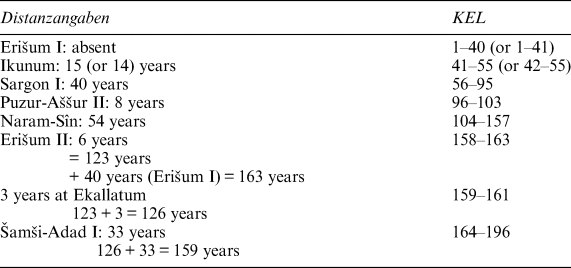
The eponymy of Ibni-Addu (when Šamši-Adad I took Ekallatum) is probably the eponymy of Inbi-Ištar (KEL 158); the three years at Ekallatum are apparently the eponymies of Aššur-bel-malki, Belanum and Sukkallum (KEL 159–161); and the eponymy of Atamar-Ištar (when Šamši-Adad I went up from Ekallatum) is likely the eponymy of Amur-Aššur (KEL 162).Footnote 38 The final conquest might have taken place during the next eponymy, that of Aššur-nišu (KEL 163).Footnote 39 The reign of Erišum II ends in that year 163. The three-year difference between the KEL and the AKL (163/166 [126 + 40] and 196/199 [159 + 40]) can be attributed to the interpretation of the three years that Šamši-Adad I resided at Ekallatum (Khors. i 44). The Distanzangaben apparently insert the three years between the reign of Erišum II and Šamši-Adad I's 33 years (163 + 3 + 33 = 199), whereas, in reality, the three years are part of the reign of Erišum II (163 + 33 = 196; see Table 1 below).
The Distanzangaben of 126 and 159 years in relation to the KEL.

The end of Erišum II's reign has been set in KEL 163. The year of his accession can be established by the year that his predecessor, Naram-Sîn, dies. Nass. i 34 indicates that the regnal years of Naram-Sîn end on the number 4.Footnote 40 Because of this number 4, and since Naram-Sîn rules for at least 27 years (the point where KEL A ends), 34, 44 or 54 years have been proposed for Naram-Sîn.Footnote 41 If Naram-Sîn rules for 54 years, his reign lasts until KEL 157 (40 + 15 + 40 + 8 + 54) and Erišum II becomes king in KEL 158, the eponymy of Inbi-Ištar. This is a likely setting since it makes Erišum II's accession contemporary with Šamši-Adad I's conquest of Ekallatum. Both kings assume power at the same moment. The context of Naram-Sîn's death causes Šamši-Adad I to attack Ekallatum. If so, Erišum II rules in years 158–163, i.e. for 6 years.
Evidence for this reconstruction might be found in the fact that, according to Khors. i 39–41, Šamši-Adad I went to Babylonia “[in the t]ime of Narām-Sîn” ([i-na t]ar-ṣi mNa-ram- d30). This has been interpreted as Naram-Sîn of Ešnunna driving away Šamši-Adad I.Footnote 42 However, the father of Naram-Sîn of Ešnunna, Ipiq-Adad II, still appears in the eponymy of Inbi-Ištar (KEL 158, Mari Eponym Chronicle B 25 = S.24.1 obv. 13′),Footnote 43 such that Naram-Sîn of Ešnunna did not reign before that eponymy, whereas “the time of Naram-Sîn” precedes the eponymy of Ibni-Addu/Inbi-Ištar in Khors. i 40–41. Hence Naram-Sîn of Ešnunna cannot be concerned in i 40. The AKL does not indicate any difference between the Assyrian king Naram-Sîn in i 35, 37 and the ruler Naram-Sîn in i 40. All instances apparently regard the same king, Naram-Sîn of Aššur.Footnote 44 The expression “in the time of Naram-Sîn” indicates that, during the reign of the Assyrian king Naram-Sîn, Šamši-Adad I went to Babylonia. As soon as that reign had ended, Šamši-Adad I returned to the region of Assyria. The Distanzangaben of 126 and 159 years can be reconstructed as in Table 1.
No. 3: The 580 years between Erišum I and Shalmaneser I
There are 580 years between Šamši-Adad I's and Shalmaneser I's work on the temple of Aššur. However, the sum of the regnal years between Šamši-Adad I and Shalmaneser I in the AKL is far less than 580 years. The inscription of Esarhaddon (no. 4) counts the same period between Šamši-Adad I's and Shalmaneser I's restorations as 434 years, i.e. 146 years less. This shows that the period of 580 years is too long. The 580 years apparently include the 159 years (no. 2) that are mentioned immediately before in the same inscription, i.e. both the 159 and the 580 years are reckoned from Erišum I.Footnote 45 From Erišum I (excluded, as with the 159 years) until Shalmaneser I (excluded), a total of 580 years can be reconstructed:
159 years (Ikunum until Šamši-Adad I; see no. 2) + 40 (Išme-Dagan I, Khors. ii 2–3) + 6 (Aššur-dugul, ii 4–5) + 10 (Belu-bani, ii 12–13) + 17 (Libaya, ii 14–15) + 12 (Šarma-Adad I, ii 16–17) + 12 (ib-tar-Sîn, ii 18–19) + 28 (Bazaya, ii 20–21) + 6 (Lullaya, ii 22–23) + 14 (Kidin-Ninua, ii 24–25) + 3 (Šarma-Adad II, ii 26–27) + 13 (Erišum III, ii 28–29) + 6 (Šamši-Adad II, ii 30–31) + 16 (Išme-Dagan II, ii 32–33) + 16 (Šamši-Adad III, ii 34–35) + 26 (Aššur-nirari I, ii 36–37) + 14 (Puzur-Aššur III, Nass. ii 34–35)Footnote 46 + 13 (Enlil-naṣir I, Khors. ii 39–40) + 12 (Nur-ili, ii 41–42) + 1 month (Aššur-šaduni, ii 43–44) + 0 (Aššur-rabi I, ii 45–46) + 0 (Aššur-nadin-aḫḫe I, ii 47) + 6 (Enlil-naṣir II, iii 1–2) + 7 (Aššur-nirari II, iii 3–4) + 9 (Aššur-bel-nišešu, iii 5–6) + 8 (Aššur-rem-nišešu, iii 7–8) + 10 (Aššur-nadin-aḫḫe II, iii 9–10) + 27 (Eriba-Adad I, iii 11–12) + 36 (Aššur-uballiṭ I, iii 13–14) + 10 (Enlil-nirari, iii 15) + 12 (Arik-den-ili, iii 16) + 32 (Adad-nirari I, iii 17–18, the predecessor of Shalmaneser I)
= 580 years
No. 5: The 132 years between Shalmaneser I and Aššur-reša-iši I
The 132 years between [Shalmaneser I]'s and [Aššur]-reša-iši I's restorations of the temple of Aššur agree with the data in the AKL:
In Khors. and SDAS:
30 years (Shalmaneser I, Khors. iii 19; SDAS iii 9) + 37 (Tukulti-Ninurta I, SDAS iii 10; ˹3˺7 in Khors. iii 20) + 3 (Aššur-nadin-apli, Khors. iii 21–22; SDAS iii 11–12) + 6 (Aššur-nirari III, Khors. iii 23–24; SDAS iii 13) + 5 (Enlil-kudurri-uṣur, Khors. iii 25–26; SDAS iii 14) + 3 (Ninurta-apil-Ekur, Khors. iii 27–30; SDAS iii 15–17) + 46 (Aššur-dan I, Khors. iii 31; SDAS iii 18)
= 130 years
In Nass.:
[30] years (Shalmaneser I 20 + [x], iii 25–26) + 3[7] (Tukulti-Ninurta I 30 + [x], iii 27–28) + 4 (Aššur-nadin-apli, iii 29–31) + 6 (Aššur-nirari III, iii 32–33) + 5 (Enlil-kudurri-uṣur, iii 34–35) + 13 (Ninurta-apil-Ekur, iii 36–40) + [3]6 or [4]6 (Aššur-dan I [x] + 26,Footnote 47 iii 41–42)
= 131 or 141 years
If the reigns of Ninurta-tukulti-Aššur (a ṭuppi period, Khors. iii 32–33) and Mutakkil-Nusku (a ṭuppi period, iii 34–36) – which separate Aššur-dan I from Aššur-reša-iši I – are reckoned as one year each, one obtains a total of 132 years for Khors. and SDAS.Footnote 48
No. 7: The 60 years between Aššur-dan I and Tiglath-pileser I
There are 60 years between the demolition of the temple of Anu-Adad by Aššur-dan I until its reconstruction by Tiglath-pileser I. Since the relevant inscription reports the period from Tiglath-pileser I's accession year until his year 5 (RIMA 2 A.0.87.1, vi 44–45), the inscription was apparently issued in year 6 of Tiglath-pileser I. The 60 years would consist of 36 years for Aššur-dan I (Nass. iii 41–42)Footnote 49 + 18 years for Aššur-reša-iši I (Nass. iv 4–5; Khors. iii 37–38; SDAS iii 23–24) + 6 years for Tiglath-pileser I.Footnote 50 In this interpretation, the ṭuppi periods for Ninurta-tukulti-Aššur and Mutakkil-Nusku are reckoned as zero years.
Janssen (Reference Janssen2006: 66–67; Reference Janssen2009: 80 and n. 20; Reference Janssen2012: 3), on the other hand, assigns one year to each ṭuppi period (i.e. two years in all). The 60 years would be reckoned until year 4 of Tiglath-pileser I (the year that ends the 60 years is thus dissociated from the year of the inscription's redaction): 36 years for Aššur-dan I + 1 year for Ninurta-tukulti-Aššur + 1 year for Mutakkil-Nusku + 18 years for Aššur-reša-iši I + 4 years for Tiglath-pileser I = 60 years.Footnote 51
The fact that the Distanzangabe of 641 years in the same inscription apparently counts the ṭuppi periods for Ninurta-tukulti-Aššur and Mutakkil-Nusku as zero years (see no. 6) favours the first option.
The Distanzangaben in disagreement with the Assyrian King List
Five Distanzangaben cannot be explained as mere summations of the regnal years recorded in the AKL. Possible explanations for their compositions are offered below.
No. 4: The 434 years between Šamši-Adad I and Shalmaneser I
There are 434 years between Šamši-Adad I's and Shalmaneser I's restorations of the temple of Aššur. This period is too short.Footnote 52 According to the lowest count (with 14 – and not 24 – years for Puzur-Aššur III), there are at least 454 years between both reigns:
33 years (Šamši-Adad I, Khors. i 39–ii 1)Footnote 53 + 40 (Išme-Dagan I, ii 2–3) + 6 (Aššur-dugul, ii 4–5) + 10 (Belu-bani, ii 12–13) + 17 (Libaya, ii 14–15) + 12 (Šarma-Adad I, ii 16–17) + 12 (ib-tar-Sîn, ii 18–19) + 28 (Bazaya, ii 20–21) + 6 (Lullaya, ii 22–23) + 14 (Kidin-Ninua, ii 24–25) + 3 (Šarma-Adad II, ii 26–27) + 13 (Erišum III, ii 28–29) + 6 (Šamši-Adad II, ii 30–31) + 16 (Išme-Dagan II, ii 32–33) + 16 (Šamši-Adad III, ii 34–35) + 26 (Aššur-nirari I, ii 36–37) + 14 (Puzur-Aššur III, Nass. ii 34–35) + 13 (Enlil-naṣir I, Khors. ii 39–40) + 12 (Nur-ili, ii 41–42) + 1 month (Aššur-šaduni, ii 43–44) + 0 (Aššur-rabi I, ii 45–46) + 0 (Aššur-nadin-aḫḫe I, ii 47) + 6 (Enlil-naṣir II, iii 1–2) + 7 (Aššur-nirari II, iii 3–4) + 9 (Aššur-bel-nišešu, iii 5–6) + 8 (Aššur-rem-nišešu, iii 7–8) + 10 (Aššur-nadin-aḫḫe II, iii 9–10) + 27 (Eriba-Adad I, iii 11–12) + 36 (Aššur-uballiṭ I, iii 13–14) + 10 (Enlil-nirari, iii 15) + 12 (Arik-den-ili, iii 16) + 32 (Adad-nirari I, iii 17–18, the predecessor of Shalmaneser I)
= 454 years
The 454 years can be reduced to 434 years on the suppositions that: (i) Išme-Dagan I is given 10 years in the Distanzangabe, while 40 years in the AKL; (ii) Puzur-Aššur III is given 24 years in the Distanzangabe (in accordance with SDAS ii 29) instead of 14 years (Nass. ii 34–35).Footnote 54
The latter is a mere recension variant, whereas the former alters the record.Footnote 55 The reason why Išme-Dagan I is given 10 instead of 40 years could be that the 40 years in the AKL include the reigns of four kings: Išme-Dagan I, Mut-Aškur, Rimuš and Asinum. The latter three rulers are the immediate successors of Išme-Dagan I, but they are not mentioned in the AKL since they rule in parallel to the line of Aššur-dugul (who is called a “son of a nobody” in Khors. ii 4–5). The AKL omits their names but includes their regnal years into the reign of Išme-Dagan I. The four kings together rule for 40 years.Footnote 56 The actual time spans of the four individual reigns were probably no longer known in the time of Esarhaddon. The 40 years might have been interpreted as a quadruple of 10 years, with the four kings being “ideally” assigned 10 years each. This number of 10 years is close to the actual duration of Išme-Dagan I's reign.Footnote 57
In assigning 10 years to Išme-Dagan I and 24 years to Puzur-Aššur III, the required total of 434 years is reached:
33 + 10 + 6 + 10 + 17 + 12 + 12 + 28 + 6 + 14 + 3 + 13 + 6 + 16 + 16 + 26 + 24 + 13 + 12 + 1 month + 0 + 0 + 6 + 7 + 9 + 8 + 10 + 27 + 36 + 10 + 12 + 32
= 434 years
No. 6: The 641 years between Šamši-Adad III and Tiglath-pileser I
There are 641 years between the building of the temple of Anu-Adad by Šamši-Adad III, son of Išme-Dagan,Footnote 58 and its demolition by Aššur-dan I. Since this time span is too long, one supposes that: (i) Šamši-Adad I (rather than Šamši-Adad III) is intended;Footnote 59 (ii) the 60 years between Aššur-dan I and Tiglath-pileser I (mentioned immediately after the 641 years in the same inscription; see no. 7) are included in the 641 years.Footnote 60
It is, however, hard to explain how the inscription could have erred in the identification of the king called Šamši-Adad. Many exemplars of the inscription exist,Footnote 61 such that the supposed erroneous identification cannot be ascribed to a copying error. And if the original composition made a mistake, it is hard to assume that it was never rectified. Moreover, even if related to Šamši-Adad I, the 641 years remain problematic given that the sum of the regnal years between Šamši-Adad I and Tiglath-pileser I does not reach 641 years.Footnote 62 An explanation which retains the identification as Šamši-Adad III should be sought.Footnote 63
Such an explanation might be found in the historical context. In the days of Tukulti-Ninurta I, the political situation of Mesopotamia changed drastically in consequence of Tukulti-Ninurta I's conquest of Babylon. Babylonia was henceforth under Assyria's sway. In the Distanzangabe of 641 years, Tiglath-pileser I might have wanted to mark Tukulti-Ninurta I's conquest of Babylon, given the impact of that victory. The periods before and after Tukulti-Ninurta I might have been clearly distinguished. One solution is to propose that this was done by counting the regnal years until Tukulti-Ninurta I twice in the Distanzangabe. The period from Šamši-Adad III until Shalmaneser I would thus constitute:
32 years (Šamši-Adad III 16 years, Khors. ii 34–35) + 52 (Aššur-nirari I 26, ii 36–37) + 28 (Puzur-Aššur III 14, Nass. ii 34–35)Footnote 64 + 26 (Enlil-naṣir I 13, ii 39–40) + 24 (Nur-ili 12, ii 41–42) + 2 months (Aššur-šaduni 1 month, ii 43–44) + 0 (Aššur-rabi I 0, ii 45–46) + 0 (Aššur-nadin-aḫḫe I 0, ii 47) + 12 (Enlil-naṣir II 6, iii 1–2) + 14 (Aššur-nirari II 7, iii 3–4) + 18 (Aššur-bel-nišešu 9, iii 5–6) + 16 (Aššur-rem-nišešu 8, iii 7–8) + 20 (Aššur-nadin-aḫḫe II 10, iii 9–10) + 54 (Eriba-Adad I 27, iii 11–12) + 72 (Aššur-uballiṭ I 36, iii 13–14) + 20 (Enlil-nirari 10, iii 15) + 24 (Arik-den-ili 12, iii 16) + 64 (Adad-nirari I 32, iii 17–18) + 46 (Shalmaneser I 23)Footnote 65
= 522 (261 x 2) years
Beginning from Tukulti-Ninurta I, the years are no longer doubled:
37 years (Tukulti-Ninurta I, Khors. iii 20) + 4 (Aššur-nadin-apli, Nass. iii 29–31)Footnote 66 + 6 (Aššur-nirari III, Khors. iii 23–24) + 5 (Enlil-kudurri-uṣur, Khors. iii 25–26) + 13 (Ninurta-apil-Ekur, Nass. iii 36–40)Footnote 67 + 36 (Aššur-dan I, Nass. iii 41–42) + ṭuppi (Ninurta-tukulti-Aššur, Khors. iii 32–33) + ṭuppi (Mutakkil-Nusku, Khors. iii 34–36)Footnote 68 + 18 (Aššur-reša-iši I, Khors. iii 37–38)Footnote 69
= 119 years
522 + 119 years total 641 years. The reason why the regnal years before the conquest of Babylon are reckoned twice is intriguing. The relevant Distanzangabe was composed in year 6 of Tiglath-pileser I (see n. 50 above), i.e. shortly before Tiglath-pileser I's conflict with Marduk-nadin-aḫḫe (see no. 9). In the context of the impending Assyrian-Babylonian encounter, Tiglath-pileser I might have recalled Tukulti-Ninurta I's victory over Babylon to enforce Assyria's claim on the region.Footnote 70 In the Distanzangabe, he added the years of the contemporary Babylonian kings to those of the Assyrian kings in order to indicate that there are two powers (Assyria and Babylonia) ruling Mesopotamia before Tukulti-Ninurta I's conquest of Babylon. Beginning from that conquest, only the years of the Assyrian kings are counted in order to indicate that, henceforth, there is only one power predominant in the region, Assyria.
No. 8: The 600 years between Tukulti-Ninurta I and Sennacherib
There are 600 years between Tukulti-Ninurta I's and Sennacherib's conquests of Babylon. Sennacherib reckons the period between Tiglath-pileser I's reign and his own conquest of Babylon as 418 + 8 years (see no. 9), and there are ca. 120 years between Tukulti-Ninurta I and Tiglath-pileser I (excluded; see no. 10): 37 + 3 (or 4) + 6 + 5 + 13 + 36 + 2 ṭuppi + 18. The 600 years (i.e. 10 times the basic numeral 60) are apparently a round number for 418 + 8 + ca. 120 = ca. 546 years.Footnote 71
The relevant inscription is preserved on a small clay tablet that copies three inscriptions found on a royal seal. The seal originally belonged to the Kassite king Šagarakti-Šuriaš and was later usurped by Tukulti-Ninurta I and finally by Sennacherib. The fact that this is not a monumental inscription might account for the lack of precision in the count.
No. 9: The 418 years between Tiglath-pileser I and Sennacherib
There are 418 years between the time when King Marduk-nadin-aḫḫe of the Isin II dynasty took away the statues of Adad and Šala during the reign of Tiglath-pileser I and the moment that Sennacherib brought them back following his conquest of Babylon. Sennacherib took Babylon on 1 Kislimu 689, which falls in his 16th regnal year (Nisan 704–689/688).Footnote 72 In assigning 16 years to Sennacherib, a total of 426 years is reached:
39 years (Tiglath-pileser I, Khors. iii 39–40) + 2 (Ašared-apil-Ekur, iii 41–42) + 18 (Aššur-bel-kala, iii 43–44) + 2 (Eriba-Adad II, iii 45) + 4 (Šamši-Adad IV, iv 1–4) + 19 (Aššurnaṣirpal I, iv 5) + 12 (Shalmaneser II, iv 6–7) + 6 (Aššur-nirari IV, iv 8) + 41 (Aššur-rabi II, iv 9) + 5 (Aššur-reša-iši II, iv 10–11) + 32 (Tiglath-pileser II, iv 12–13) + 23 (Aššur-dan II, iv 14–15) + 21 (Adad-nirari II, iv 16–17) + 7 (Tukulti-Ninurta II, iv 18) + 25 (Aššurnaṣirpal II, iv 19–20) + 35 (Shalmaneser III, iv 21–22) + 13 (Šamši-Adad V, iv 23–24) + 28 (Adad-nirari III, iv 25–26) + 10 (Shalmaneser IV, iv 27–28) + 18 (Aššur-dan III, iv 29–30) + 10 (Aššur-nirari V, iv 31–32) + 18 (Tiglath-pileser III, SDAS iv 24–25) + 5 (Shalmaneser V, SDAS iv 26–27)Footnote 73 + 17 (Sargon II) + 16 (Sennacherib)
= 426 years
The 426 years can be reduced to 418 years in supposing that 8 years less are given to Tiglath-pileser I, i.e. 31 instead of 39 years. The Distanzangabe might be reckoned from the moment of Marduk-nadin-aḫḫe's attack instead of from the beginning of Tiglath-pileser I's reign. No. 9 is the only Distanzangabe that counts beginning from a campaign (except for the approximate count of 600 years in no. 8). The other Distanzangaben all count from building activities. Constructions generally take several years, and they are often not explicitly dated in the sources. The precise regnal year/s of destructions and constructions were probably no longer known to later generations. Therefore, the Distanzangaben connected to building activities always reckon from the beginning of the first king's reignFootnote 74 (except for the end of Erišum I's reign; see Conclusions). In Sennacherib's case, however, the Distanzangabe is reckoned from a campaign, such that the exact year (i.e. the eponym) of the event might have been known.
If so, the relevant Distanzangabe provides information on the chronology of Tiglath-pileser I's campaigns. The attack by Marduk-nadin-aḫḫe is generally situated in year 29 of Tiglath-pileser I,Footnote 75 based on a combination of data:Footnote 76 (i) There are 129 years between the end of the reign of Kaštiliašu IV (i.e. the conquest of Babylon by Tukulti-Ninurta I) and the accession of Marduk-nadin-aḫḫe.Footnote 77 (ii) A kudurru dated to 28 Ululu in year 10 of Marduk-nadin-aḫḫe (BM 90840, i 27–28)Footnote 78 mentions Marduk-nadin-aḫḫe's victory over Assyria (ibid. i 5). Marduk-nadin-aḫḫe is therefore supposed to have defeated the Assyrians in year 9 or 10.Footnote 79 His victory thus comes ca. 129 + 10 = 139 years after Tukulti-Ninurta I's conquest of Babylon. (iii) Tukulti-Ninurta I's conquest of Babylon is set in the eponymy of Ina-Aššur-šuma-aṣbat, which is equaled to year 18 of Tukulti-Ninurta I.Footnote 80 There are 19 (37 minus 18, Tukulti-Ninurta I) + 4 (Aššur-nadin-apli) + 6 (Aššur-nirari III) + 5 (Enlil-kudurri-uṣur) + 13 (Ninurta-apil-Ekur) + 46 (Aššur-dan I) + 1 (Ninurta-tukulti-Aššur) + 1 (Mutakkil-Nusku) + 18 (Aššur-reša-iši I) = 113 years between Tukulti-Ninurta I's conquest of Babylon and the beginning of Tiglath-pileser I's reign. Given that the early Middle Assyrian calendar is supposed not to intercalate, and that ca. 33 lunar years equal 32 solar years, the 113 lunar years would represent 110 solar years. (iv) The 139 years on the Babylonian side parallel 110 + 29 years on the Assyrian side. Marduk-nadin-aḫḫe thus campaigned in year 29 of Tiglath-pileser I.
Another calculation can, however, be made: (i-ii) The 139 years between Tukulti-Ninurta I's conquest of Babylon and Marduk-nadin-aḫḫe's campaign are maintained. (iii) A recent study sets the conquest of Babylon in the accession year of Tukulti-Ninurta I instead of in year 18.Footnote 81 Hence there are 37 + 4 + 6 + 5 + 13 + 46 + 1 + 1 + 18 = 131 years between Tukulti-Ninurta I's conquest of Babylon and the beginning of Tiglath-pileser I's reign. Another study shows that the Middle Assyrian calendar does intercalate.Footnote 82 It follows that the 131 years in the AKL correspond to 131 solar years. (iv) The 139 years on the Babylonian side parallel 131 + 8 years on the Assyrian side. Marduk-nadin-aḫḫe thus campaigned in year 8 of Tiglath-pileser I.
Year 8 exactly corresponds to the 8 years absent from the Distanzangabe of 418 years. The Distanzangabe of 418 years omits the first 8 years of Tiglath-pileser I's reign because the relevant campaign took place in year 8, the starting point of the count.
If the present interpretation is correct, the conventional chronology of the Assyrian-Babylonian relations should be revised. Marduk-nadin-aḫḫe's campaign no longer comes after Tiglath-pileser I's campaign but before. Tiglath-pileser I defeated Marduk-nadin-aḫḫe in the eponymies of Aššur-šumu-eriš and Ninu'ayu (RIMA 2 A.0.87.4, ll. 49–50). The order of Tiglath-pileser I's eponyms is still disputed, but the first seven eponyms (Tiglath-pileser I until Šadanayu) are known,Footnote 83 such that Aššur-šumu-eriš cannot come before year 8 of Tiglath-pileser I. Tiglath-pileser I's attack was thus a response to Marduk-nadin-aḫḫe's campaign in year 8.Footnote 84 As with Marduk-nadin-aḫḫe's predecessor Nebuchadnezzar I, who attacked the territory of Aššur-reša-iši I (Synchronistic History ii A2′′–13′′),Footnote 85 the initiative was on the Babylonian side.Footnote 86
A detailed revision of the chronology of Tiglath-pileser I's campaigns is beyond the scope of the present study, but at least three arguments can be advanced for the revised setting. First, on the basis of the reconstruction of the calendar adaptation in Tiglath-pileser I's days it has been shown that the eponym Aššur-šumu-eriš comes earlier than the conventional proposal (i.e. before the eponyms Apliya and Ninurta-aḫa-iddina).Footnote 87 This earlier setting for the Assyrian campaign in Aššur-šumu-eriš’ eponymy speaks in favour of an earlier setting for Marduk-nadin-aḫḫe's campaign, possibly in year 8 of Tiglath-pileser I.
Second, tablet A.1123, dated to 20 ša-kēnāte in the eponymy of Aššur-šumu-eriš, records two garments for two sons of the (Assyrian) king who had been killed in a great attack (i-na ti-bi-te gal-e) of Karduniaš.Footnote 88 The Babylonian attack thus preceded the Assyrian campaign that took place in the eponymy of Aššur-šumu-eriš. The Broken Obelisk (BM 118898, RIMA 2 no. A.0.89.7) – which likely belongs to Tiglath-pileser I (not to Aššur-bel-kala)Footnote 89 – might mention the eponym Aššur-šumu-eriš in ii 13, as the eponym Aššur-[ ].Footnote 90 In the month Sivan of that eponymy, the temple of Anu-Adad was rebuilt (ii 13–15). This reconstruction might have been a consequence of Marduk-nadin-aḫḫe's attack, involving the removal of the statues of Adad and Šala, shortly before.
Finally, after the death of Marduk-nadin-aḫḫe (ll. 8′–9′), Tiglath-pileser I still campaigned against the Arameans (ll. 10′–13′, Chronicle of Tiglath-pileser I).Footnote 91 Marduk-nadin-aḫḫe reigned 18 years (Babylonian King List C l. 6; Chronicle of Tiglath-pileser I l. 9′). If Marduk-nadin-aḫḫe's attack is set in his regnal year 10 and in year 29 of Tiglath-pileser I, he died in year 37 of Tiglath-pileser I (i.e. 8 years after year 10). This leaves only two years (39 minus 37) for the subsequent campaigns of Tiglath-pileser I, who died in his regnal year 39. On the contrary, if Marduk-nadin-aḫḫe's attack is set in year 8 of Tiglath-pileser I, he died in year 16 of Tiglath-pileser I, with still 23 years (39 minus 16) for Tiglath-pileser I's subsequent campaigns.Footnote 92 This longer time span is more likely, particularly since Tiglath-pileser I lived for at least two years more after Marduk-nadin-aḫḫe's death.Footnote 93 Moreover, a setting of the Assyrian-Babylonian conflict in the second half of Tiglath-pileser I's reign faces the difficulty that Tiglath-pileser I's reign had been considerably weakened by that time owing to the Aramean campaigns. Tiglath-pileser I would hardly endeavor a campaign against the South in such a context.Footnote 94 He more likely campaigned against Babylonia early in his reign when it had not yet suffered that much from the Arameans.
No. 10: The 586 years between Shalmaneser I and Esarhaddon
There are 586 years between Shalmaneser I's and Esarhaddon's restorations of the temple of Aššur. The restoration by Esarhaddon occured in his regnal year 2,Footnote 95 and the Distanzangabe is reckoned until that year 2.Footnote 96 A total of 586 years can be reconstructed on the basis of the AKL:
30 years (Shalmaneser I, Khors. iii 19) + 37 (Tukulti-Ninurta I, iii 20) + 3 (Aššur-nadin-apli, iii 21–22)Footnote 97 + 6 (Aššur-nirari III, iii 23–24) + 5 (Enlil-kudurri-uṣur, iii 25–26) + 3 (Ninurta-apil-Ekur, iii 27–30) + 46 (Aššur-dan I, iii 31) + ṭuppi (Ninurta-tukulti-Aššur, iii 32–33) + ṭuppi (Mutakkil-Nusku, iii 34–36) + 18 (Aššur-reša-iši I, iii 37–38) + 39 (Tiglath-pileser I, iii 39–40) + 2 (Ašared-apil-Ekur, iii 41–42) + 18 (Aššur-bel-kala, iii 43–44) + 2 (Eriba-Adad II, iii 45) + 4 (Šamši-Adad IV, iv 1–4) + 19 (Aššurnaṣirpal I, iv 5) + 12 (Shalmaneser II, iv 6–7) + 6 (Aššur-nirari IV, iv 8) + 41 (Aššur-rabi II, iv 9) + 5 (Aššur-reša-iši II, iv 10–11) + 32 (Tiglath-pileser II, iv 12–13) + 23 (Aššur-dan II, iv 14–15) + 21 (Adad-nirari II, iv 16–17) + 7 (Tukulti-Ninurta II, iv 18) + 25 (Aššurnaṣirpal II, iv 19–20) + 35 (Shalmaneser III, iv 21–22) + 13 (Šamši-Adad V, iv 23–24) + 28 (Adad-nirari III, iv 25–26) + 10 (Shalmaneser IV, iv 27–28) + 18 (Aššur-dan III, iv 29–30) + 10 (Aššur-nirari V, iv 31–32) + 18 (Tiglath-pileser III, SDAS iv 24–25) + 5 (Shalmaneser V, SDAS iv 26–27) + 17 (Sargon II) + 24 (Sennacherib) + 2 (Esarhaddon)
= 584 years
The two ṭuppi periods for Ninurta-tukulti-Aššur and Mutakkil-Nusku are reckoned as one year each: 584 + 2 = 586 years. Instead of 586 years, another inscription of Esarhaddon reads 580 years (RINAP 4 no. 57, iii 33). The 586 years are generally preferred to the 580 years.Footnote 98 The difference might, however, be intentional, with one of the kings being accorded 6 years less. Janssen (Reference Janssen2018) proposes that the 6 omitted years represent the period between Sargon II's conquest of Babylon and Sargon II's death. The period of Sargon II's Babylonian (and contemporary Assyrian) reign would have been left out. The reason for the omission would be political. The account “The Sin of Sargon” (K.4730 + Sm 1876), composed during the reign of Esarhaddon,Footnote 99 states that Sargon II met an infamous death because he had offended the gods. This offence is in all probability Sargon II's violation – at the time of Babylon's conquest – of the peace treaty that had formerly been established between Sargon II and Marduk-apla-iddina II, a treaty sworn by the name of the god Aššur. Sargon II's transgression of the treaty offended this same god.Footnote 100 Esarhaddon omitted the 6 years that followed Sargon II's offensive conquest of Babylon from the Distanzangabe in order to atone for Assyria's misconduct.Footnote 101
Conclusions
General observations
Following the analysis of the composition of the Assyrian Distanzangaben, some general observations can be made with regard to the principles applied therein:
1) The reign of the first king mentioned for a Distanzangabe is omitted in the count of the 126, 159 (no. 2) and 580 years (no. 3), while it is included in the count of the 60 (no. 7), 132 (no. 5), 418 (no. 9), 434 (no. 4), 580/586 (no. 10), 641 (no. 6) and 720 (no. 1) years.
2) The reign of the last king is omitted in the count of the 126, 132, 434, 580, 641 and 720 years, while partly included in the count of the 60, 418 and 580/586 years, and completely included in the count of the 159 years.
3) The six kings ruling contemporaneously with Aššur-dugul at bāb ṭuppišu are excluded from the count.
4) The ṭuppi periods for Ninurta-tukulti-Aššur and Mutakkil-Nusku are counted as zero years in the totals of 60 and 641 years, but as two years (together) in the totals of 132 and 580/586 years.
5) The reigns of Aššur-rabi I and Aššur-nadin-aḫḫe I are reckoned as zero years in the Distanzangaben.
Divergences occur for nos. 1–2 and 4. These varying counting principles exhibit particular characteristics.
The ex/inclusion of the first king in a Distanzangabe
The first king of a Distanzangabe is omitted only in the case of the 126 and 159 years between Erišum I's and Šamši-Adad I's work on the temple of Aššur (no. 2: inscriptions of Esarhaddon and Shalmaneser I) and in the case of the 580 years between Šamši-Adad I's and Shalmaneser I's work on the temple of Aššur (no. 3: inscriptions of Shalmaneser I). The 580 years are reckoned beginning from Erišum I (i.e. from the same starting point as the 126 and 159 years). One might thus conclude that the Distanzangaben always include the reign of the first king, except for those beginning with Erišum I.Footnote 102
Some further specifications can be made for the Distanzangaben that include the reign of the first king. If these regard time spans between building activities, they count from the beginning of the reign of the first king, thus in the case of the 60, 132, 434, 580/586, 641 and 720 years. If they regard time spans between campaigns, they count from the year of the first campaign, thus in the case of the 418 years.
The ex/inclusion of the last king in a Distanzangabe
The Distanzangabe of 159 years is the only case in which the reign of the last king is entirely included. The period represents the time span between Erišum I's and Šamši-Adad I's work on the temple of Aššur, and is recorded together with the 580 years between Erišum I's (rather than Šamši-Adad I's) and Shalmaneser I's work on that temple (nos. 2–3). Since Šamši-Adad I is a predecessor of Shalmaneser I, and since the 159 years are not followed by the 580 years in time, Shalmaneser I includes Šamši-Adad I's 33 regnal years in the 159 years.
The last reigns are partly included in the Distanzagaben of 60, 418 and 580/586 years, redacted under Tiglath-pileser I, Sennacherib and Esarhaddon, respectively.Footnote 103 Only “late” kings count Distanzangaben until a specific moment during their reigns. Earlier kings count until the beginning of their reigns. A transition period might be the reign of Tiglath-pileser I, who seems to omit his reign from the 641 years and to include part of it in the 60 years, in the same inscription.
The ex/inclusion of the ṭuppi periods for Ninurta-tukulti-Aššur and Mutakkil-Nusku
The ṭuppi periods for Ninurta-tukulti-Aššur and Mutakkil-Nusku are omitted from the 60 and 641 years (nos. 7 and 6: an inscription of Tiglath-pileser I) and are reckoned as two years in the totals of 132 years (no. 5: an inscription of – possibly – Aššur-reša-iši I) and 580/586 years (no. 10: inscriptions of Esarhaddon). Given that Aššur-reša-iši I (on the condition that the attribution is correct) counts the ṭuppi periods as separate entities, whereas his successor Tiglath-pileser I does not, both possibilities exist contemporaneously. Aššur-reša-iši I might have decided to count the ṭuppi periods separately in order to reach a total of 132 = 6 x 22 years (a multiple of 6); Tiglath-pileser I might have excluded them in order to reach the basic numeral 60.
The successive Distanzangaben
Three inscriptions contain successive Distanzangaben:
1) 159 years and 580 years (nos. 2–3: RIMA 1 A.0.77.1);
2) 641 years and 60 years (nos. 6–7: RIMA 2 A.0.87.1);
3) 126 years, 434 years and 580 years (nos. 2, 4 and 10: RINAP 4 no. 57).
The first two cases contain two Distanzangaben each and therefore could apply an inclusive counting: the 580 years include the 159 years, and the 641 years include the 60 years. The third case has three successive totals, such that no inclusive counting is applied.
The relationship with the Assyrian King List
The variants of the Assyrian King List.
With regard to the variants among the AKL recensions,Footnote 104 Nass. aligns with the numbers used by the following two kings: (i) Shalmaneser I: 14 years for Puzur-Aššur III in the total of 580 years (no. 3); (ii) Tiglath-pileser I: 14 years for Puzur-Aššur III and 4 years for Aššur-nadin-apli in the total of 641 years (no. 6), and 36 years for Aššur-dan I in the total of 60 years (no. 7). Khors. and SDAS align with (i) Tukulti-Ninurta I: 24 years for Puzur-Aššur III (absent from Khors.) in the total of 720 years (no. 1); (ii) (possibly) Aššur-reša-iši I: 3 years for Aššur-nadin-apli in the total of 132 years (no. 5); (iii) Esarhaddon: 24 years for Puzur-Aššur III in the total of 434 years (no. 4), and 3 years for Aššur-nadin-apli in the total of 580/586 years (no. 10).
It is remarkable that Shalmaneser I seems to align with the Nass. recension, while his successor Tukulti-Ninurta I seems to align with the SDAS recension. Similarly, Aššur-reša-iši I (if the attribution is correct) seems to align with the Khors. and SDAS recensions, while his successor Tiglath-pileser I aligns with the Nass. recension. Thus one might hypothesise that the (Vorlagen of the) AKL recensions seem to have circulated contemporaneously. The option for one or the other recension might sometimes be conditioned by a preference for using the sexagesimal system. Thus Tukulti-Ninurta I prefers to assign 24 (rather than 14) years to Puzur-Aššur III in order to reach a total of 12 x 60 years. Similarly, Tiglath-pileser I assigns 36 (rather than 46) years to Aššur-dan I in order to reach a total of 60 years.
The regnal years deviating from the Assyrian King List
Most of the Distanzangaben apply the regnal years recorded in the AKL. In three instances, the lengths are altered:
1) Išme-Dagan I is given 10 instead of 40 years in the total of 434 years recorded by Esarhaddon (no. 4).
2) The reigns from Šamši-Adad III until Shalmaneser I are doubled in the total of 641 years reconstructed by Tiglath-pileser I (no. 6).
3) Sargon II is given 11 instead of 17 years in the total of 580 years mentioned by Esarhaddon (no. 10).
The first case divides the 40 years of the AKL among Išme-Dagan I and his successors who are absent from the AKL (Mut-Aškur, Rimuš and Asinum). The two latter cases manifest ideological purposes: Tiglath-pileser I marks the period of Assyrian supremacy in Mesopotamia beginning with Tukulti-Ninurta I, while Esarhaddon excludes Sargon II's Babylonian (and contemporary Assyrian) reign because of Sargon II's offence against the god Aššur at his conquest of Babylon.
To conclude, rather than providing data for reconstructing an absolute chronology, the study of the Distanzangaben above all sheds light on the Assyrian principles of time counting and on the reception tradition of particular rulers.