Introduction
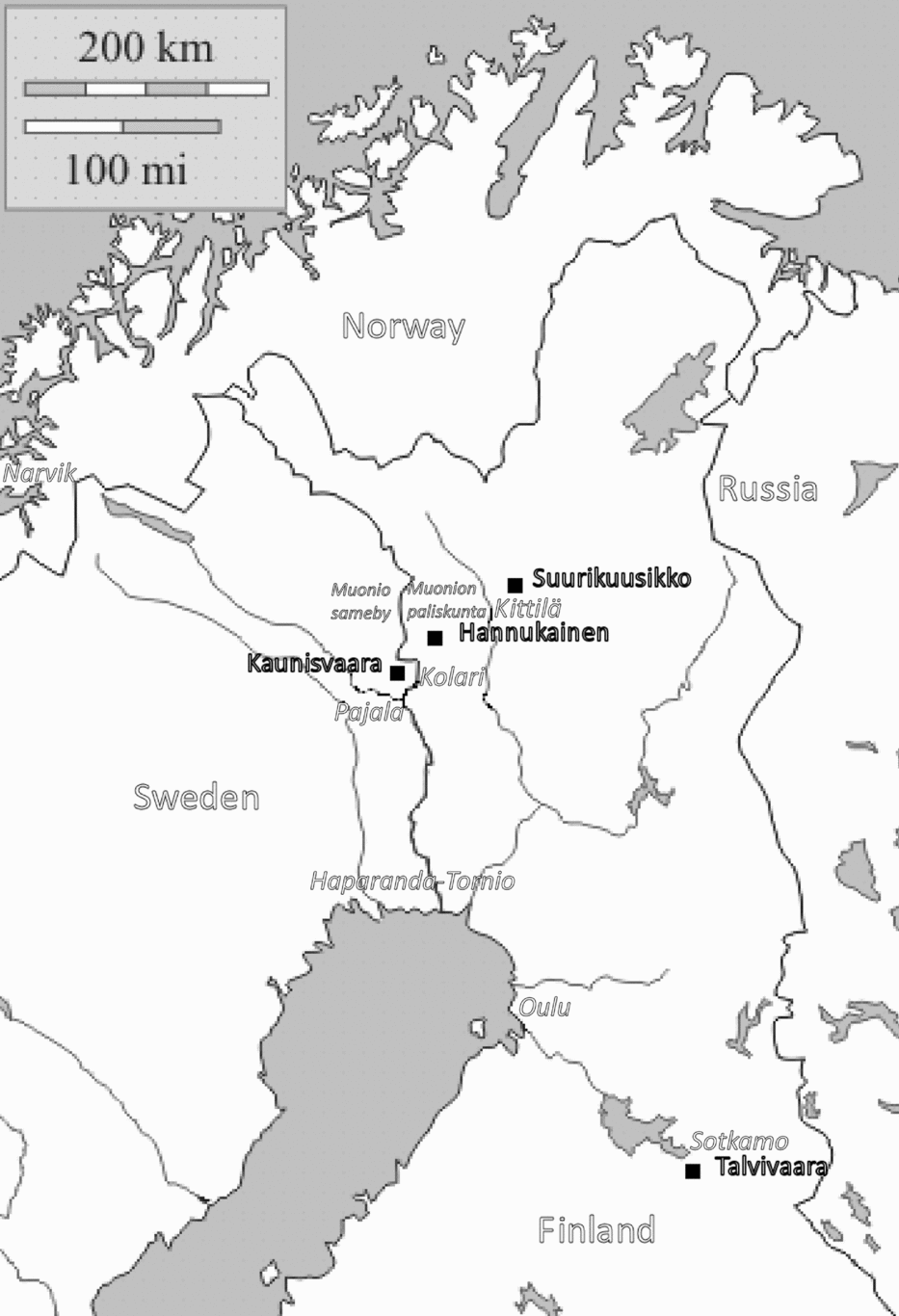
People are sitting in a classroom-like order in Kolari, Finnish Lapland on 16 of March 2011. The regional environmental administration has summoned a public hearing concerning the environmental impact assessment (EIA) procedure of the proposed open-pit iron mine Hannukainen. Environmental administrators are leading the hearings; in front of them are sitting the leaders of the mining company Northland Mines Oy, and on their right a group of environmental consultants. The official target is to comment on the issues that should be studied during the EIA procedure. Three off-the-record questions arise. The first concerns the relationship of the proposed mine with another mine operated by the same company across the border in Sweden. The second question concerns how the new mine is related to the old mine ruins in Kolari, a side product of the previous mining cycle from the 1960s to 1980s. The third question concerns the possibility of finding uranium as a side product. The uranium discussion tends to suffocate all the other topics. People refer to Talvivaara, another new Finnish mine, and their plans to mine uranium even the original EIA addressed only the mining of nickel (see Fig. 1). The administration replies that these concerns are outside the purpose of the meeting. The audience disappointment is palpable. However, the mining company representatives try to respond to the people's worries. Later on, we hear that their aim is to gain a undeniable local acceptance to mine, also referred to as a social licence (SL) to mine (Shepard Reference Shepard2008; Hamann Reference Hamann2003; Render Reference Render2005; Shepard Reference Shepard2008; Thomson and Boutilier Reference Thomson, Boutilier and Darling2011), instead of just the environmental licence required by law.
These issues raised during the EIA meeting indicated an interesting question regarding social licencing: even though mining operations are planned as single site operations, often acknowledging local socio-environmental impacts, they are still tied to developments in other localities, which are taken up in discussions and are part of the people's concerns. Therefore, the linkages of mining operations to other localities and across spatial and temporal scales have an effect on social licencing whether those are officially required to be acknowledged or not. Our target here is to examine these linkages and relations in gaining a SL to mine.
Our short excursion to Finnish Lapland probably tells a familiar story from many places all over the world. It also makes a reference to the entanglement of scales, both spatial and temporal, in real-world environmental disputes, in which the worries of people hardly follow the neat policy frames set by the environmental administration. This excursion has also revealed how, in our time, the greater world is embedded even in the smallest locales and how various localities are interlinked by global phenomena.
This is the case in the circumpolar area and one of its manifestations is the recent mining boom. The driving forces are, in the first place, the global discourses on climate change, particularly those concerning potential new resources that might become accessible due to the melting of the Arctic ice cover (ACIA 2005). These potentials are associated with the predicted improvement of seafaring conditions along the northern sea routes, which would shorten the cargo routes to the rapidly developing markets of Asia (Roach Reference Roach2007). Hence, another driving force relates to the global markets as illustrated in the mining industry promotion video Lapland: our heart is gold and other minerals of the Regional Council of Lapland in 2011.
A new dawn of the mining industry began in the turn of the millennium following the worldwide metal price rise. This led to a prompt recovery of mining (Hobbs Reference Hobbs2011). Already in 2006, there were six metallic ore deposits, 17 carbonate mines and 16 industrial mineral operations in Finland (Heikkinen and others Reference Heikkinen, Noras and Salminen2008). The difference with previous mining cycles is that it represents the general neoliberal turn, which means that the national government is no longer directly involved in company decision making but sets the legal framework within which mining companies operate. The societal benefits of this setting are expected to be gained through taxation and economic multiplier impacts. The neoliberal turn concerns also the involvement of international mining companies or international capital in the form of substantial stock holdings in the few remaining and newly-established national mining companies (Tuna Ta and Baeten Reference Tuna Ta and Baeten2012; Lindahl Reference Lindahl2011).
In addition to the global markets, both international and national policies as well as civil society have a role to play in the governance of mining operations (see EBRD 2013; Equator principles 2013; IIED 2013; compare Northland Mines Oy 2013: 59). In Finland, mining operations have to adapt to both the European Union's directives and national legislation. Moreover, new information and communication technologies create pressures for gaining social acceptance to mine, especially because the interested civil society has easy access to global forums and knowledge (Sarkki and Heikkinen Reference Sarkki and Heikkinen2010; see NO for Talvivaara Mining Company Plc. 2013). As a consequence, environmental governance, including mining, must be examined considering interactions between policy actors, market actors and civil society (for example local communities) in a multi-scale setting (Hooghe and Marks Reference Hooghe and Marks2003; Eckerberg and Joas Reference Eckerberg and Joas2004; Paavola Reference Paavola2007; Rauschmayer and others Reference Rauschmayer, Paavola and Wittmer2009; Andonova and Mitchell Reference Andonova, Ronald and Mitchell2010).
It has been emphasised that scales are socially constructed (Herod and Wright Reference Herod and Wright2002). Swyngedouw (Reference Swyngedouw2004: 132–133) considers ‘scalar configurations as the outcome of socio-spatial processes that regulate and organize social power relation’. The idea of the construction of a scale entails power relationships between the state, market actors and civil society. These continuous redefinitions include social struggles and have political implications (Smith Reference Smith, Doherty, Elspeth and Mo1992; Leitner and Miller Reference Leitner and Miller2007). For example, scale construction in participatory planning processes impacts on who is considered a relevant stakeholder and what is the scope of the discussions (compare Sarkki Reference Sarkki2011; Bond and Pope Reference Bond and Pope2012; Esteves and others Reference Esteves, Franks and Vanclay2012). Our article complements this by examining emerging multisite linkages in single site mining projects. We do not examine construction of scale as such, but rather construction and emergence of linkages between various actors at multiple scales and we hold that understanding such linkages is crucial for comprehending how mining companies secure (or fail to secure) a SL to operate. The construction of linkages between different locales and across scales entails power battles. Here we examine their relationship to acquiring a SL, which is the outcome of negotiations between companies, communities and policy actors. We argue that this dynamic nature of real-world connections sets both new challenges and opportunities regarding the SL to mine.
The objective of this article is to examine what kinds of scalar linkages mining operations have and how these linkages affect the acquisition of a SL by mining companies. We approach these linkages by applying Marcus's (1995; 1998) theories concerning the necessity of, and methods, for applying multi-sited ethnography in the modern world system. This means that we proceed from a traditional single locale to embrace a broader problematic through tracing the linkages concerning how the global level, such as the capitalist world system, appears and is connected with our case sites, and how various locales are connected with each other, thereby influencing the SL. This is important because the connectedness of mining and its relevance for social licencing is not fully recognised in the current planning procedures, such as the EIA, by literature on SL, policy and management processes, mining companies’ PR strategies or citizen discourses.
After presenting the main conceptual basis, we show how the linkages are manifested in two case studies from Finnish Lapland, the Suurikuusikko gold mine of Agnico-Eagle Mines Limited in Kittilä and the Hannukainen iron mine project of Northland Mines Oy in Kolari. The selection of the case studies allows us to examine, firstly, the fuzziness of the concept of social license by describing how the scales and interconnections emerged during the planning process of the Hannukainen iron mine. Secondly, we use the Suurikuusikko gold mine and the corporate social responsibility (CSR) policies and strategies of Agnico-Eagle Mines Limited to reveal company approaches to the SL to mine in different but interlinked societal settings. These cases allow us to examine the scalar linkages related to real-world mining operations. Finally, we discuss the lessons learnt from our study, focusing on how study of the scalar linkages can lead to proposals for improving the sustainability of mining from both company and community perspectives.
Location map

Social licence to mine
During our fieldwork, the company representatives stated that international financers often insist on the social and environmental sustainability and SL of the financed projects. This is related to whether local residents are satisfied with the mining projects; if there is negative publicity surrounding the mine, it is a sign that a SL has not been obtained. In brief, the acquisition of a SL to mine does not rest on legal facts but is dependent on a clear acceptance from the wider public (Hamann Reference Hamann2003; Shepard Reference Shepard2008). From a company perspective, the primary objective in gaining the informal SL is to minimise the risks that threaten their operations and investment (Thomson and Boutilier Reference Thomson, Boutilier and Darling2011), meaning that a mine must be supported by the affected communities in order to ensure access to resources (Render Reference Render2005). Therefore, companies operating in different countries must gain the local communities’ trust in order to earn the SL (World Bank 2004). This means not only maintaining a positive corporate reputation or educating local stakeholders about the mining projects but also understanding the culture, language, history and habits of the affected communities (Thomson and Boutilier Reference Thomson, Boutilier and Darling2011).
Nowadays, the transparency of operations seems important because ’companies are simultaneously, intensely local and intensely global’ (Swyngedouw Reference Swyngedouw2004:38). In literature, this form of globalisation is referred to by the concept of glocalisation, which according to Swyngedouw (Reference Swyngedouw2004: 37) means the restructuring of scales from local to global. The motto ‘think globally, act locally’ emphasises the necessity of considering specific local requirements in order to be successful in global business (Robertson Reference Robertson and Inoue1997: 4), but it should also include the need for the transparent disclosure of risks and the negotiation of possible solutions. As our cases demonstrate, transparency is important, because both good and, particularly, bad news have a tendency to come under public discussion.
In Finland, people have a constitutional right to participate in decision making which touches their living environment. However, a large number of involved actors makes participation challenging. People may also have problems in following the technoscientific information involved. According to Wilson (Reference Wilson2009: 83–87), transparency is often called for in order to make decision making open for civil society, and an increase in the number of ‘observers’ would lead to better accountability relating to various values. However, large numbers of involved actors representing different backgrounds, interests and scales makes transparency challenging for companies. Transparency may also enhance the local acceptance of negative impacts (Dahlberg and Burlando Reference Dahlberg and Burlando2009).
The SL to mine is connected to both the environmental and social impacts of mining. The two common ways to grasp these issues are by formulating corporate social responsibility (CSR) policies and by increasing transparency via public reporting (Jenkins Reference Jenkins2004; Jenkins and Yakovleva Reference Jenkins and Yakovleva2006). CSR policies have become conventional in recent years (Vintró and Comajuncosa Reference Vintró and Comajuncosa2010) due to the increased discontent on the environmental and social local impacts of the extracting industries (Jenkins Reference Jenkins2004). CSR is defined by two essential characteristics: it comprises activities that allow the maximisation of the benefits of mining projects – directly linked to business competitiveness and shareholder interests (Jones and others Reference Jones, Marshall and Mitchell2007), and the minimisation of negative societal and environmental impacts. It is important to underline that CSR comprises voluntary practices that go beyond the existing legal obligations (Natural Resources Canada 2003). By applying CSR, corporations want to enhance their reputation and show that they are actively promoting social and environmental standards and are ahead of their competitors (Auld and others Reference Auld, Bernstein and Cashore2008: 415). In this study, we pay special attention to CSR promises and SL problems in practice.
Globalisation is often connected to the argument that global issues have causal power on local practices (Marston and others Reference Marston, Jones III and Woodward2005). However, relations between scales are not self-evident (Swyngedouw Reference Swyngedouw2004: 34). Particularly important are the relations between different localities and the connections of mining sites to the global markets. In short, while planning a mining project, companies need to be locally and globally sensitive, that is glocal in the recently coined expression. They need to convince the global financial sector that their project would be profitable but also the local authorities and communities of the benefits of the mine. The tool for reaching both targets is CSR, the success of which is conceptualised as a SL to mine. For that matter, our two case studies, the Suurikuusikko and Hannukainen mines, shed light on the complexities of CSR policies and of gaining a SL to mine.
Studying multi-site mining
Our general study setting derives from applied anthropology and follows the orientation of participatory action research, because the main aim is to improve the sustainability of mining from the company and local community perspectives in cooperation with both interest groups (Trotter and Schensul Reference Trotter, Schensul and Bernard2000: 723–724). Project partners include both operating mining companies as well as the local community administration of the two primary mining cases: Suurikuusikko in Kittilä and Hannukainen in Kolari. Including mining companies as partners is critical when the goal is to follow the actual planning processes and to improve mining practices.
Our primary methods are literature study on national and international mining cases, media analysis of mining-related public discussions and related academic papers, and stakeholder interviews and participatory observation in planning processes. We paid particular attention to the companies’ public CSR papers, comparing them with their practical policies. For this article, particularly English-language media coverage on mining dilemmas in Finland was gathered and analysed.
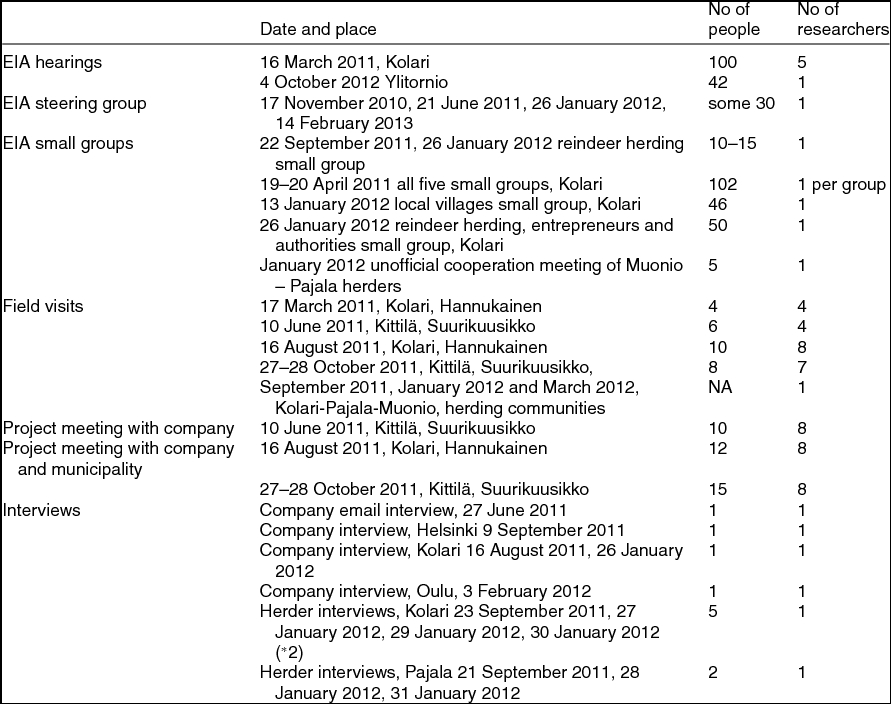
The participatory fieldwork involved, for example, five field visits to the mining sites and two meetings with the companies’ representatives and representatives of the municipalities of Kolari and Kittilä (see Table 1). During these meetings a wide range of topics related to mine planning was addressed, such as the role of media publicity, citizen movements, the influence of the finance sector and the negative and positive impacts of current and historical mining projects in Finland and abroad.
Main field research activities of the project.
Regarding the Hannukainen mine in Kolari, two company and two reindeer herding leaders were interviewed both in Finland and Sweden. In addition, seven local herder interviews were conducted. Our research group also took part in the local EIA hearings as well as followed the work of all small group workshops in Kolari during the EIA process in 2011, for example small groups for tourism, reindeer herding and local villages.
In the case of the Suurikuusikko mine in Kittilä, we took part in two field visits to the mining site and one arranged stakeholder meeting. One director level interview was arranged focusing on the company's CSR policy formulations and the company's efforts in different countries to acquire a SL for their operations. In media analysis, we paid particular attention to the company's CSR policies in comparison with related public discussions and the continuing EIA assessment procedure for expanding the production of the mine. A practical problem with participating in actual planning meetings was that the expansion EIA of Suurkuusikko mine and EIA of Hannukainen mine were arranged partially at the same time
As a result of the participatory research, we began to pay close attention to the cross-scale linkages and the interaction between the different site-specific processes. Our analytical strategy follows Marcus's (1995: 103–114) methodological instructions for using multi-sited ethnography and tracing the linkages between single locations and episodes connected with other localities and larger complexes such as the capitalist world system. In analysing the interviews and field notes, we paid special attention to following the argumentation, contradictions and interlinkages of the scales defined by the stakeholders. In practice, we let the stakeholders’ arguments lead us to new problems and potential solutions, and also to other relevant ethnographic sites and episodes of potential importance for social licencing in practice. For example, the development of the Finnish mine Talvivaara in Sotkamo turned out to have a great importance for the development of our primary mining cases as well as the whole mining industry in Finland. In this article, we focus on analysing these episodes in the form they were brought up during our case studies.
The mining cases in context
Most mines in northern Finland are located in peripheral areas suffering from declining population and services (Haveri and Suikkanen Reference Haveri, Suikkanen, Massa and Snellman2003). In the media, national discussions have firstly focused on the estimation of economic benefits. Accordingly, the arguments for mining projects refer to the fact that the mining boom can break the vicious circle of rural societal erosion by creating jobs, improving the local and regional economy and strengthening public services. However, there are obvious uncertainties regarding a proposed mine's life-cycle length and post-closure restorations in the case of, for instance, a sudden bankruptcy (SRK Consulting 2007), a global recession or a decrease in metal prices. In addition, there are also local worries, such as the way that mining might have a long-term effect on nature-based livelihoods such as tourism and reindeer herding. Involved environmental changes have also been debated. Occasionally, these debates pertain to the international nature of the current mining industry. People are worried that the land's riches would be exported and only spoiled landscapes would remain (Newspapers Helsingin Sanomat (Helsinki) 22 October 2010; Lapin Kansa (Rovaniemi) 3 November 2011; Maaseudun tulevaisuus (Helsinki) 17 January 2012.).
Our first Finnish case mine, Hannukainen, is an open-pit iron mine project, which will replace a smaller closed mining siteFootnote 1. It is managed by the European exploration and development company Northland Resources S.A., which operates in the Tornio–Muonio river valley approximately 100 kilometres north of the Arctic Circle. Since 2004, the company has been exploring the Kaunisvaara area on the other side of the border in the municipality of Pajala in Sweden, which belongs to the same ironstone belt as Hannukainen. This project begun earlier, and the first mine has started operations. The current transportation plan is to use combined truck–railroad connections northwest to the deep Norwegian seaport of Narvik in order to reach the global markets. On the Finnish side of the border, Northland Mines Oy is still planning to reopen and extend the historical open-pit mine of Hannukainen and to transport the ore southward via a railway to the Baltic ports in order to reach the European markets. The Hannukainen mine is located 25 km northeast of the municipal centre of Kolari and 10 km from the tourism centre of YlläsFootnote 2. Situated on the Swedish border, the municipality of Kolari currently has approximately 3,900 inhabitants, and its main livelihood is tourism. However, its mining history is significant due to the employment directly engendered by it (Alajärvi and others Reference Alajärvi, Suikkanen, Viinamäki and Ainonen1990), but on the other hand, traces of previous mining cycles are quite heavily present and unrestored in the local nature. Kolari is a good example of a resource community cycle in which the local community rises and declines together with the opening and closing of mines (Lockie and others Reference Lockie, Franettovich, Petkova-Timmer, Rolfe and Ivanova2009).
Our second case mine, Suurikuusikko, is an open-pit gold mine that is expanding to underground operations with an expected lifespan of 13 years approximately 150 km north of the Arctic Circle. It is one of the largest known gold deposits in Europe. The deposits in Suurikuusikko were discovered in 1986 by the Geological Survey of Finland. In April 1998, the Swedish company Riddarhyttan Resources claimed rights to the Suurikuusikko deposit. In 2004, the Canadian mining company Agnico-Eagle Mines Limited became Riddarhyttan's shareholder, and a year later, it acquired the remaining shares of the company (Agnico-Eagle Mines Limited, SRK Consulting 2006). In 2006, the mine construction began. The first gold was bored in 2009, and underground mining started in 2010. In 2011, the company arranged a feasibility study and a new EIA of potential for a 50% expansion of production. The Suurikuusikko mine is located 35 km northeast of the municipality of Kittilä and the tourism centre of Levi. Kittilä has about 5,800 inhabitants. Agnico-Eagle Mines Limited is a gold producing company with mining and exploration activities in Canada, Finland and MexicoFootnote 3.
The complex international economic networks behind our case mines as well as the history of changing companies give us a background to understand the present local worries.
Hannukainen, emerging connections of a single site mining project
Northland Resources S.A. has been working in the Pajala/Kolari cross-border region since 2005. The ore belongs to the same geological deposit and, according to a company representative, they thought that they (company Northland Resources SA) could operate both mining sites as single two mine operation. Also, some of the employees work on both projects. Since the beginning, it has become apparent that Sweden and Finland have crucial differences even though the EIA legislation is implemented on the basis of the same EU directive (European Union 1985). Moreover, municipal administration and planning work differently and towards their own separa te targets. In this article, special attention is paid to the relationships between mining and reindeer herding, since the herders form a key stakeholder group whom the negative impacts of mining may directly affect. The management of reindeer herding varies from the privileges of the indigenous Sámi reindeer villages in Sweden to the more open reindeer herding cooperative system of Finnish reindeer husbandry [paliskunta]. In this case, the Sámi herders belong to the Muonio Sameby and the Finnish herders to the Muonio Reindeer Herding Cooperative (RHC).
Despite a satisfactory EIA procedure, the later development of the Kaunisvaara project in Sweden has left the herders with a feeling of frustration. In our interviews, the Sámi reindeer herders from the Muonio Sameby described their situation by stressing that they are still, after seven years of negotiations, without any compensation agreement with Northland Resources S.A. The overall negotiation process has created mistrust and disappointment among the reindeer herders towards the company. They feel that the company has not negotiated with them about all intended constructions which might affect them and finally, in 2011, they lost contact with the company.
[. . .] it has now been on a halt, to be honest, all the discussions and the agreement. . . That is, we hear nothing from them anymore. It may be that they have now started the work and they don't really have time. But we hear nothing from there. Now we have to remake our case. Because we have heard so much about that they are going to build this motorway right away, and they began the construction work, and they have not talked with us, and now they are also digging a pipe from here [pointing at a map]. They haven't asked about that from us either [. . .] (Personal communication, Reindeer herder, Pajala, Sweden, 21 September 2011, translated by authors).
The herders’ interpretation of the situation was that after receiving the official environmental licences to build the mine, the company lost interest on them. The situation reached a point where the herders were ready to talk to the media about being neglected unless the company arranges the continuation of the negotiations. During the interviews made later on, in the winter of 2012, it was stressed that the negotiations with the company had restarted and the herders were feeling more content about their situation. Also, the change of the contact person in the company was thought to have improved communications between the herders and the company. After these changes, the herders were cautious but hopeful towards the future.
In Finland, the EIA process has been carried out in a way similar to that in Sweden. According to our interviews, the Finnish reindeer herders from the Muonio RHC felt that the company was co-operative and willing to take their needs into account. They felt that their point of view had had at least some effect on the proposed mining project and especially on the suggested ore transportation technologies. However, the actual construction of the mine has not yet been started, so the herders’ attitude remains reserved. Also, the fear that the company will not actually redeem its promises is evident, and it has been strengthened by the news they have heard about the Sámi herders’ problems in Sweden. This is creating a strain on their trust towards the company.
It is interesting that Swedish and Finnish herders travel across the border on a frequent basis following their herds. In previous decades, cross-border commuting to the mines of Northern Sweden and Finland was also widespread, but more recently travelling has been more common to the flourishing tourism centres of western Finnish Lapland. Since Finland and Sweden joined the European Union in 1995, the national border has become highly obsolete for the average citizen (see Prokkola and Ridanpää Reference Prokkola and Ridanpää2011). Regarding our mining case, the neighbouring Muonio Sameby and Muonio RHC organised an unofficial meeting in 2011–2012 to gain a better understanding of the situation on the other side of the national border and to make their voice better heard during local negotiations. The talks concerned concrete experiences with the arranged EIA procedures, communications between stakeholders and pondering about the possible effect of a mine on local reindeer herding. To some extent, this can also be considered as a tactical manoeuvre for connecting local solutions across the border. This highlights the way that the acquisition of a local SL can be connected to processes in other countries as well.
Expanding connectedness of mining in Finland
During the EIA procedure of the Hannukainen mine, a national episode emerged in the spring of 2011, the importance of which has been cumulative for the environmental concerns of mining in general. Some months before, the Talvivaara nickel mine, located 500 km southward, surprised the general public by requesting a licence procedure for processing uranium, whose mere existence had not been publicly recognised. This was almost immediately followed by the suggestion to expand production above the granted environmental permission. The situation with the local community in the municipality of Sotkamo was already tense due to the restriction of public discussion by the local authorities. The unpleasant odours and possible threats to the local tourism were clearly expressed to be unwanted topics. Questions concerning the Talvivaara mine were asked to be directed at the leader of the municipality and the director of the mining company (Uusi Suomi (Helsinki) 9 February 2010; Kaleva (Oulu) 10 July 2010).
The situation in Talvivaara has worsened since with subsequent accusations of remarkable stockholdings of both the family of the former Minister of the Environment as well as the environmental consultant responsible for the original and misleading emission estimations. These discussions expanded when it became apparent that the measured emissions clearly surpassed the estimated levels. Finally, a crime investigation was launched in 2011 because of polluted downstream waters. The terrible peak of this turmoil occurred in 2012 when one employee died of poisoning; the episode was followed by a crime investigation and the discovery of tens of dead birds in a process liquid pool and finally two major leakages in gypsum pond (see for example Helsingin Sanomat, international edition (Helsinki) 14 April 2012). Our intention here and our expertise do not extend as far as evaluating the actual episodes which occurred in Talvivaara, but the effects of the adverse publicity for the mining sector obviously touch our case mines. This episode seems to be leading, for instance, to the tightening of the EIA procedures and environmental licence requirements in Finland. There have also been suggestions for new taxation modes for mining companies and for increasing the reserved emergency and remediation funds to be used after mine closure.
In the spring of 2011, this development had immediate effects on the Hannukainen mine project. During the first EIA hearings in Kolari, referred to above, the audience was quite nervous about the potential discovery of uranium and the company representatives had to explain several times that they had not found uranium during drillings and hoped not to find any, because it would make the building of the mine much more complex. In any case, the local scepticism was so strong that the assessment of potential uranium was added to the EIA procedure, even though there was no scientific evidence of its existence (Luoteis-Lappi, (Kolari), 24 March 2010; Yhteysviranomaisen lausunto [Statement of the Environmental Authority] 2011: 95).
It seems obvious that the environmental administration has in general become more alert, and the tightening of licensing procedures, required assessments and research as well as supervision are increasing. This was the clear message for example in the Finnish television interview of the Environmental Minister Ville Niinistö on 4 April 2012. Besides, the local worries have not disappeared, but instead, people are even more aware of other nearby deposits and the involved chemicals, such as cyanide in gold production. There are also fears about the worst case scenarios for example potential bankruptcies of high-pollution mines.
In summary, the Hannukainen EIA process has not been limited to a definite EIA assessment area, but it is connected to other mining-related developments in Finland and even in a neighbouring country. The cornerstone of these linkages was the free media.
Capital connecting scales and the SL
Another, probably even more confusing linkage that has been recognised to affect modern mining projects is connected to the role of the international financial sector and the huge capital needs of modern mining. This relationship was pointed out directly during our meetings with the partner mining companies and in director interviews. The amount of capital needed depends on the mining project, but in general it was estimated that it takes years before any mine makes profit because of the huge investments before production even begins. This emphasises the importance of keeping the financers satisfied and trustful, but it is not limited to trust in the profit-making potential but also in the environmental and societal responsibility of the company at hand. This is why many companies acknowledge the importance of publicly defined corporate social and environmental responsibility policies. These can also be seen as investments in public relations and in media and stock release activity.
The problem with the concept of SL is its fuzzy reference to the general acceptability of a specific project without clear indicators or contents. During our meeting with Agnico-Eagle Mines Limited on 10 June 2011, the concept was defined by a company representative that you can ‘read it in the newspapers’. If there is continuous negative publicity, it is a sign that the requirements for a SL are not being met. Another mining company leader pointed out that if an undeniable SL is not obtained, then the kickback can come from financial bodies which have clear rules for socially and environmentally responsible business and are particularly vulnerable to adverse publicity. This kind of company can probably be found among semi-public or public financers, such as pension funds and politically directed financers (see EBRD 2013). However, it is difficult to determine when changes in the stock markets result from economic, social or environmental issues, because economic decision making is not open for publicity.
In any case, the accountability of mining companies to local residents is represented by the concept of SL, and the media is the forum which reveals its state. Furthermore, if the local residents report negative practices, adverse publicity may affect the financers who do not want to fund mining operations having a negative image. This neoliberal viewpoint emphasises the role of the markets and civil society in environmental governance. It creates local stakeholders an entirely new way to connect scales compared to the state-based procedures including formal legal complaints or EIA procedures with hearings. The media is a potential forum through which stakeholders can monitor, and possibly also sanction, corporations in order to encourage them to meet the requirements for acquiring a social license (Kokko and others Reference Kokko, Oksanen, Hast, Heikkinen, Hentilä, Jokinen, Komu, Kunnari, Lépy, Soudunsaari, Suikkanen and Suopajärvi2013: 41). This is related to a new situation for local residents regarding adaptation to the context of globalisation. In this kind of setting, assumptions of the hierarchy between greater and lower scales do not seem to hold (Cox Reference Cox1997; Escobar Reference Escobar2001), and the media links local residents to financers thus giving them potential power in the neoliberal political economy.
Gaining, utilising and keeping up a SL, the Suurikuusikko case
Even if the concept of SL is fuzzy, it clearly refers to a conceptual platform for maintaining a positive corporate reputation. To ensure access to resources, companies have to establish a relationship between the mine and the affected communities by an effective consultation and participation process (Thomson and Boutilier Reference Thomson, Boutilier and Darling2011). A good example is the Suurikuusikko mine, which has reached relatively widespread local acceptance even though the gold production is connected with two publicly sensitive chemicals, arsenic and cyanide. According to an interviewee ‘SL to mine’ is ’a phrase [. . .] [his] understanding is that you get the approval of the local people only by actively communicating your intentions and plans and what the impact of your business will have on the surrounding community. People learn to know who you are, they accept you and hopefully they also welcome you. The SL to operate is all about good communication, and more importantly a dialogue between parties’ (interview 9 September 2011). Examining the strategies of Agnico-Eagle Mines Limited for gaining a SL reveals some interesting scalar linkages. During our fieldwork, some representatives of the company acknowledged the sensitive nature of their business especially due to the economic importance of the nearby tourism centre Levi. A company representative stressed that for the mining to reach undeniable local acceptance, the company organised from the early stage of the exploration project regular meetings with the stakeholders two or three times a year and later on once or twice a year to inform people about the company's actions and future plans.
The glocal CSR strategy of Agnico-Eagle Mines Limited
The approach of Agnico-Eagle Mines Limited is presented as being the same for all of their mining sites: employing as many local residents as possible. The company has developed three main objectives related to social responsibility and community engagement: (1) each mine has a community engagement plan from publishing community newsletters to visiting local schools to inform students of future job opportunities; (2) continuous involvement in community projects in the mining locations including support for the development of sports-related facilities and for educational and health initiatives; (3) continuous skills training programmes at all mining operations in order to hire as many local residents as possible. ’Good Neighbour’, a CSR report (Agnico-Eagle Mines Limited 2010: 36–38) emphasises that ‘Worldwide, 78.8% of our employees, including most levels of management, are from the regional area where the mine is located’. The proportion of the mine workforce, including contractor employees, that is hired from the local region was quite high for most of the mining sites: 100% for Goldex and Lapa, 99% in Canada, for Pinos Altos in Mexico, 93% for LaRonde in Canada 90% for Kittilä and 38% for Meadowbank in Canada. The mine management teams are 100% composed of local people for all mining sites except Kittilä (50%) and Meadowbank (0%).
Agnico-Eagle Mines Limited is a good example of a company operating with a glocal strategy: its approach is global but its action is local, different from site to site and depending on the socioeconomic context of each region where the mines are located. In terms of company involvement in community projects, the comparison between Pinos Altos, Meadowbank and Kittilä is meaningful. As explained by a company representative, the support to the local community is more necessary in Mexico and northern Canada, where the unemployment rates are quite high and the educational level relatively low compared to Finland, and where the infrastructure and basic services are considered to be state responsibility. In Pinos Altos, the company has participated in the construction of schools and a health centre and has investigated different programmes for helping families with economic difficulties. In Nunavut, the major problems to cope with are the immensity of space, the harshness of the climate and the lack of infrastructure in the mining areas. The mining company had to build everything from the start and has organised transportation for employees living in the nearest traditional community of Baker Lake 110km away from the mining site. The needs in Finland are different. The infrastructure is already settled and the company mainly supports local activities that benefit the communities where the workers live, such as sports and cultural projects. Moreover, the salaries are comparatively high as are the employees’ income taxes, which are used for maintaining public services. These differences emphasise the fact that to gain a SL and to deliver local benefits, the ‘one size fits all’ approach does not work but context-sensitivity is necessary. Thus, scalar linkages between the company–local nexus have to be constructed differently according to location when aiming at a local SL.
Transparency and trust in the Social licence to mine – a double-edged sword
The SL has two important and interconnected dimensions that are characteristic of the multi-sited nature of modern mining: transparency and trust. Transparency can build trust on a long-term basis and even contribute to the promotion of new mining sites even if negative episodes are reported. On the other hand, non-transparent practices and communication can quickly shake the grounds of an already acquired SL to mine.
Today, public relations policies include reporting on the production and industrial activities of companies, assessing the social and environmental impacts of their activities and evaluating the overall functioning of their CSR programmes. For instance, the Agnico-Eagle Mines Limited corporation website contains information not only about the company's mining production but also about its social and environmental operations. Each year, the company publishes an annual report of social and environmental issues while also producing financial reports, summaries on health and safety, the company's environmental policies as well as the code of business conduct and ethics, which are all available on the company website. Press releases are nowadays conventional, but the company also utilises the new social media to spread information about the activities of the company by writing releases and posting pictures of the mining sites and of locally organised social events. In addition, company news and videos about other mining sites are continuously broadcasted, for example, in the restaurant of the Suurikuusikko mine. The company also promotes all of its mining sites through a multimedia gallery which represents all of the mining projects but focuses on advertising the benefits for the local population. The stress is on local economics which is apparent from the emphasis and the concepts the company uses in their CSR report. The company promotes itself as a ’good neighbour’ because it is a good company which contributes to regional economies, a ’good business’ towards the local suppliers and contractors, as well as a ’good employer’ which hires employees from the region and a ’good corporate citizen’ which makes donations to local communities, and the core values of which are to ’treat people and communities well’.
An important starting point is that according to our research material, including fieldwork, a literature survey and media analysis, before the spring of 2012, no major criticism occurred in Finland against the Suurikuusikko mine. Instead, the company seemed to be quite aware of their success and actually utilised their investments to the SL in Suurikuusikko by using it as an example when promoting a new mining project in Nunavut, Canada. The Meliadine gold mine is an advanced-stage project located 290km southeast of the existing Meadowbank mine near the western shore of Hudson Bay. The Rankin Inlet community located several kilometres away from the mining site expressed its worries about the future mining development on their land for which the Inuit are very respectful. The company's concern was to convince the local community and the province of Nunavut of the benefits of building a mine. Since the mining development in Meliadine would be similar to the one in Suurikuusikko in terms of spatiality and landscape disturbance, the mining company organised a tour to Kittilä for approximately 50 leaders and residents of Nunavut in March 2011 (Interview 9 September 2011; see also Nunatsiaqonline (Iqaluit) 3 April 2011).
The company's idea was to show the representatives of the government of Nunavut and the other participants of the tour a good example of mining development and of the good cooperation reached with the local community. According to a company representative, the impression received by the visitors from Nunavut was surprisingly positive, since they expected a bigger footprint in the landscape of the Kittilä region. The local journal of Nunavut, Nunatsiqonline, entitled one of its articles ’Nunavut digs into Finland for mining knowledge’(Nunatsiqonline (Iqaluit) 3 April 2011), even though it must be noted that the local voice of Kittilä residents was represented by the economic and technical leaders of the municipal administration, which probably made the image given more positive than it otherwise would have been.
The use of Suurikuusikko as an exemple for a socially and environmentally sustainable operation seems to have been a success. According to Nunatsiqonline (21 March 2012), the construction of a new all-weather road linking the future Meliadine mine to the village of Rankin Inlet began in March 2012. Even if we take a critical stance towards the information value of the different kinds of news releases and public relation events of both the involved local authorities and the company, it seems certain that the positive use of success stories can bestow economic benefits on socially and environmentally responsible companies. However, as we learned from the story of Talvivaara, negatives spread their influence to other places as well. This connectedness of the modern world could strengthen the commitment of companies to adhere to their CSR policy promises, because as easily as success stories can be used for promoting new business, so socially and environmentally reckless implementation of mining in practice can throw the whole industry into turmoil.
It is evident that transparency is important in gaining a SL and also for its long-term maintenance. Relevant for our case is that, particularly in other countries, Agnico-Eagle Mines Limited, has released many kinds of news. For example, the 2011 Annual Report starts with: ‘2011 was a disappointing year for Agnico-Eagle. A fire disrupted production at our Meadowbank mine, and geotechnical issues compelled us to suspend operations at Goldex’ (Agnico-Eagle Mines Limited 2011: 1). Also, photos of this disastrous event were posted on one of the company's social media web pages.
In Finland, a parallel episode related to the Suurikuusikko mine became public in the early summer of 2012 with news concerning excess in measured cyanide levels in the effluent waters of the mine during 2011. According to the newspaper Tekniikka & Talous (Helsinki, 8 June 2012), the levels were recorded in the company's annual report for the Suurikuusikko mine. In addition, the news reported about the concern of local fishermen and politicians but also about discussions of the legal grounds of the current temporary cyanide tailing ponds particularly in the context of the company having applied for an environmental licence for expanding their gold production. The response of the mining company was evasive, putting the blame on wrong measurements. In the sensitive situation of the mining industry in Finland and in light of the company's CSR policy promises, a more open, transparent and constructive response would have been expected. Our examinations imply that there have already been too many negative examples of denying problems out of hand without further investigation of the episode in question (see also Frankental Reference Frankental2001). Furthermore, an immediate denial easily expands into generalised distrust and rumours of even more crucial problems. This is particularly the case if the negative issues are proved to be true afterwards. Our main argument is that insufficient transparency obviously reduces the local long-term acceptance of mining by increasing mistrust, conspiracy rumours and prejudices (see also Smith and others Reference Smith, Shepherd and Dorward2012).
Instead, it seems that transparency, even concerning negative issues, can work positively in the long term by building the stakeholders’ trust. However, informing the public with false or misleading messages can be beneficial for companies only on a short-term basis until something happens which cannot be denied. A more secure SL enhancement strategy for mining companies might be to admit possible negative effects when building their CSR practises and communicating to the various stakeholders (Frankental Reference Frankental2001; Slack Reference Slack2012).
What we can learn from multi-locale mining sites
This research began from the mining site of Hannukainen, Finland, but expanded in space and time to cover unpredictable connections in which the world systems are simultaneously in and out of the original ethnographic target, as Marcus (Reference Marcus1995) wrote when explaining how and why to engage in multi-sited ethnography. History was already present in the form of old unrestored ruins of previous mining cycles. Local stakeholders already had both positive and negative examples from other mining sites of how mining, once approved, could develop into unpredictable dimensions. Also, the global was present in the form of international companies, mineral markets and foreign capital. The companies’ press releases mostly address the wider audience and try to convince the financial markets instead of local residents, even if from time to time the releases discussed the locals. This connectedness forms the sensitive multi-local grounds for today's single-site mining. But then the question arises, how can sustainability be improved from both the community and company perspectives?
First, from the reindeer herding experiences from Pajala of Sweden and Muonio of Finland, we have learnt the importance of the continuance of local involvement past the legally obligatory EIA procedure. Nature-based livelihoods are essentially dynamic, and currently, their changes are bound to both societal and natural changes. Mining is a dynamic industry, and its changes are also bound to non-local influences such as changes in processing technologies and the global markets. Between two changing industries there cannot be a single definitive solution. The power relations between reindeer herding communities and the mining company are essentially uneven. However, the local communities of today are not weaponless and, as our case illustrates, their weapon is the media. The media can cause adverse publicity and alert the environmental administration and financers. Evidently, the SL to mine seems to be connected, even if fuzzily, to the sustainable and fair public image of mining.
Secondly, this connectedness of mining sites and their failures and successes forms a double-edged sword with regard to how they may affect both local communities as well as the mining industry. Companies can use success stories for promoting new mines, as we saw from the Agnico-Eagle Mines Limited case, but failures too can turn the public opinion negative or at least make it extremely reserved towards mining, as our case of the expanding problems at the Talvivaara mine revealed. From a local community perspective, this connectedness of the successes and failures of mining sites could guarantee the long-term fulfilment of company CSR policy promises. Investments on the social license may be nullified if the reality fails to meet the promises. Furthermore, also in the Hannukainen case, the danger of negative attitudes spreading between local communities across the national border from the Swedish Sámi herders to the Finnish herders was clear. This interaction increases the knowledge of the local residents about the effects of mining and can affect the possibility of gaining a SL. The local residents may also learn about new practices and start to demand them on their side of the border. Thus, the success of the mining site of Kaunisvaara in Sweden is connected with the Finnish Hannukainen mine regardless of the administration's and company's definitions.
Thirdly, both aforementioned lessons are tied to the concept of transparency. Currently, mining is a high-technology effort, and outside the industry, people have few tools for understanding either its working or the chemicals used. However, it is public knowledge that chemicals such as cyanide, arsenic, sulphate and uranium are somehow connected with the production. To get rid of the potentially dangerous components, mines usually need tailing ponds and other kinds of technology. They also require environmental licences and follow-ups which are inaccessible to the public. What people understand is that there are dangers involved in the mining industry. Accidents also happen, as our cases show, and the policy principle to deny all potential negative impacts, dangers or leakages out of hand serves only to accumulate generalised distrust. Here we emphasise the necessity of going beyond simply noting that single mining sites should be transparent to their locality. Other mines are also used to advertise a company. Transparency regarding even negative impacts at other mining sites may also increase trust and help to maintain the SL on a long-term basis. The success of transparency policies depends on the participants’ open-minded attitude towards discussing the negative issues related to mining. Adhering to only positive communication does not lead to any kind of progress regarding the management of the altering environment.
Finally, we argue that the literature on scales should not only reflect on the construction of scales in certain settings and on how these constructions affect the power relations between various actors. Instead, focus should also be placed on the ways the linkages between different places and scales are constructed. A typical setting focuses on mining company–local relationships, but as we have shown, there are many other kinds of connections established by local residents, mining companies and financers that connect the gaining of a social license to the greater society. This stresses the fact that social licensing takes place in a multi-scale and multi-local world, and if the various connections are disregarded, we inevitably come up with insufficient means to gain a SL to mine. Marcus's (1995) account on multi-site ethnography provides a fruitful analytical strategy for following the various linkages that emerge in a specific context while also ensuring that the research process is open even to unexpected connections, and keeping the research process sensitive towards the way that arguments appear in real-world environmental governance.
Acknowledgements
We like to thank wholeheartedly the anonymous reviewers of Polar Record for constructive comments. This study was conducted as part of the research project DILACOMI (DIfferent Land-use Activities and local COmmunities in MIning projects) funded by the Finnish Funding Agency for Technology and Innovation (TEKES), and the European Agricultural Fund for Rural Development. We are particularly grateful for the cooperation of the DILACOMI project partners from the University of Lapland, University of Oulu, Finnish Forest Research Institute (METLA) and the mining companies Agnico-Eagle Mines Limited and Northland Mines Oy. Without this collaboration following the current complex planning processes of mining would have been impossible. We are also grateful for reindeer herders and other local inhabitants for sharing your understanding concerning the local mining developments.