Urinary tract infection (UTI) is one of the most commonly diagnosed and treated infections in older adults. The microbial etiology of UTIs has been well described; Escherichia coli and Klebsiella pneumoniae are the predominant organisms isolated.Reference DeRosa, Carter, Wattengel, Lesse, Sellick and Mergenhagen1,Reference Eure, Stone, Mungai, Bell and Thompson2 Antimicrobial resistance is a major public health threat, and existing literature regarding antimicrobial resistance among UTIs in older adults has largely focused on nursing homes. Recent data from 243 nursing homes indicate that a substantial portion of UTIs due to E. coli and K. pneumoniae are multidrug-resistant.Reference Eure, Stone, Mungai, Bell and Thompson2
In the United States, the population of homebound older adults is >1.5 times larger than the nursing home population.Reference Ornstein, Leff and Covinsky3 Similar to nursing home residents, homebound older adults often have dementia and are prone to UTI. Little is known regarding antimicrobial resistance among urine isolates from home care settings. Home-based primary care (HBPC) offers one method for homebound older adults to receive comprehensive care in their home.Reference Karuza, Gillespie and Olsan4 In this study, we evaluated antimicrobial resistance among E. coli and K. pneumoniae urine isolates from a national sample of homebound older adults with dementia who were enrolled in HBPC.
Methods
This retrospective cohort study included persons aged ≥65 years with a diagnosis of dementia from whom an E. coli or K. pneumoniae isolate was collected in urine after enrollment in HBPC between January 1, 2014, and December 31, 2018, through the US Veterans Affairs (VA) healthcare system. Enrollment in HBPC occurred after receiving ≥2 in-person home visits by a physician or advanced practice provider within a calendar year. Additional inclusion criteria are described elsewhere.Reference Datta, Fried and O’Leary5 In 2018, HBPC programs served >55,000 homebound patients across 130 VA medical centers. This study was deemed exempt from review by the institutional review boards at VA Connecticut Healthcare System and Yale University.
Data were obtained from the VA Corporate Data Warehouse. Patients with urine isolates with reported identification of E. coli or K. pneumoniae from inpatient (eg, hospital) or outpatient (eg, emergency department, home) locations and a susceptibility result were included. For both E. coli and K. pneumoniae, urine isolates collected after the initial in-person home visit by a physician or advance practice provider between 2014 and 2018 were evaluated.
Demographics and comorbidities were recorded at the time of the initial in-person home visit by a physician or advance practice provider. Data collected from urine isolates included the organism (E. coli or K. pneumoniae), collection date, and susceptibility to antimicrobials and antimicrobial groups that were prespecified based on clinical relevance and drug utilization in HBPC.Reference Datta, Fried and O’Leary5 Antimicrobial resistance among urine isolates was defined as nonsusceptibility (resistant or intermediate susceptibility) to 1 or more of the following agents: ampicillin-sulbactam, third-generation cephalosporins, ciprofloxacin, gentamicin, piperacillin-tazobactam, meropenem, or trimethoprim-sulfamethoxazole. Multidrug-resistance was defined as isolates with nonsusceptibility to 3 or more of the prespecified antimicrobials or antimicrobial groups.Reference Eure, Stone, Mungai, Bell and Thompson2
For E. coli and K. pneumoniae, the annual proportions of urine isolates that were not susceptible to prespecified antimicrobials or antimicrobial groups were determined using the first urine isolate collected per patient per year between 2014 and 2018.Reference Cohen, Calfee and Fridkin6 Characteristics of persons with and without multidrug-resistance detected from any urine isolate collected after the initial in-person home visit by a physician or advance practice provider were compared using the Fisher exact tests. Results were categorized by organism. Analyses were conducted using SAS version 9.4 software (SAS Institute, Cary, NC).
Results
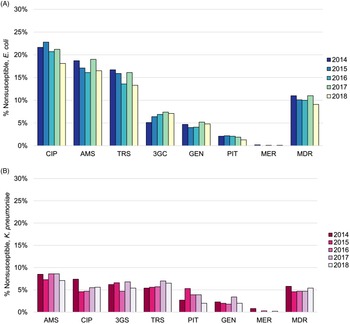
When evaluating the first urine isolate collected per patient per year, 3,913 E. coli isolates and 1,736 K. pneumoniae isolates were examined. The mean annual prevalences of nonsusceptibility among E. coli and K. pneumoniae urine isolates were 21% and 6% for ciprofloxacin, 17% and 8% for ampicillin-sulbactam, 15% and 6% for trimethoprim-sulfamethoxazole, 7% and 6% for third-generation cephalosporins, 5% and 2% for gentamicin, and 2% and 4% for piperacillin-tazobactam, respectively (Fig. 1). Also, <1% of E. coli and K. pneumoniae urine isolates were nonsusceptible to meropenem. Overall, multidrug-resistance was detected in 9%–11% of urine E. coli isolates and 5%–6% of K. pneumoniae urine isolates (Supplementary Material online).
Annual prevalence of antimicrobial nonsusceptibility when evaluating (A) the first E. coli urine isolate and (B) the first K. pneumoniae urine isolate collected per patient per year from homebound older adults with dementia who received home-based primary care through the Veterans Affairs Healthcare System in 2014–2018. The numbers of the first E. coli urine isolates and the first K. pneumoniae urine isolates collected per year are as follows: 2014 (n = 573 and n = 259), 2015 (n = 724 and n = 302), 2016 (n = 822 and n = 383), 2017 (n = 862 and n = 383), 2018 (n = 932 and n = 409). Note. CIP, ciprofloxacin; AMS, ampicillin-sulbactam, TRS, trimethoprim-sulfamethoxazole; 3GC, third-generation cephalosporins; GEN, gentamicin; PIT, piperacillin-tazobactam; MER, meropenem; MDR, multidrug.

When evaluating all E. coli (n = 5,684) and K. pneumoniae (n = 2,337) isolates collected from urine after the initial in-person home visit by a physician or advance practice provider, 364 patients had a multidrug-resistant E. coli urine isolate, and 89 patients had a multidrug-resistant K. pneumoniae urine isolate (Table 1). Detection of multidrug-resistance from urine isolates was associated with region for E. coli (P = .0003) and K. pneumoniae (P = .007). Greater proportions of patients with versus without multidrug-resistant urine isolates were identified in the Northeast and South regions for E. coli (14.6% vs 8.9% and 36.3% vs 33.0%, respectively) and K. pneumoniae (18.0% vs 10.2% and 41.6% vs 35.2%, respectively).
Patient-Level Characteristics of Homebound Older Adults With Dementia From Whom a Urine Escherichia coli or Klebsiella pneumoniae Isolate Was Collected After Enrollment in Home-Based Primary Care, 2014–2018

Note. MDR, multidrug-resistant; BPH, benign prostatic hypertrophy.
a Patient-level characteristics at the time of their first in-person home visit by a physician or advance practice provider.
b Patients with a non-MDR isolate detected from any urine sample when evaluating all urine isolates collected after the date of the first in-person home visit by a physician or advance practice provider.
c Patients with an MDR isolate detected from at least 1 urine sample when evaluating all urine isolates collected after the date of the first in-person home visit by a physician or advance practice provider.
Discussion
Using a national sample of homebound older adults with dementia who were enrolled in HBPC, we identified a high prevalence of antimicrobial nonsusceptibility among E. coli and K. pneumoniae urine isolates between 2014 and 2018. Among 3,913 E. coli urine isolates, the annual prevalence of nonsusceptibility was greatest for ciprofloxacin, ranging from 18% to 23%, and multidrug-resistance was detected in 9%–11% of isolates. In contrast, the annual prevalence of nonsusceptibility among 1,736 K. pneumoniae urine isolates was greatest for ampicillin-sulbactam, ranging from 7% to 9%, and multidrug-resistance was detected in 5%–6% of isolates. For both organisms, carbapenem-resistance, as measured by meropenem nonsusceptibility, was rare (0%–1%), and detection of multidrug-resistance varied by region.
These results suggest that the prevalence of multidrug-resistance among E. coli and K. pneumoniae urine isolates in HBPC programs is comparable to estimates from nursing homes. Among 2,539 E. coli UTIs and 776 K. pneumoniae or K. oxytoca UTIs reported from US nursing homes between 2013 and 2017, 9.4% and 5.9%, respectively, were multidrug resistant.Reference Eure, Stone, Mungai, Bell and Thompson2 Notably, patients from these nursing homes had signs and symptoms suggestive of UTI, whereas clinical features of UTI among patients in the current study were not assessed. Patterns of antimicrobial resistance from the current work are also similar to those reported from other nursing home studies.Reference Pulcini, Clerc-Urmes, Attinsounon, Fougnot and Thilly7,Reference Fagan, Lindbæk and Grude8
Notably, guidelines for the evaluation and management of UTI in home care settings are lacking. Existing recommendations do not address the unique challenges that clinicians face in diagnosing and treating infection among homebound patients who receive home care.Reference Nicolle, Gupta and Bradley9 In the current study, we identified regional differences in the detection of multidrug-resistance among urine isolates. Many factors likely contributed to this finding, such as geographic variation in healthcare utilization, host factors, and antimicrobial use in HBPC.Reference Datta, Fried and O’Leary5 Collectively, these data support the role for local urine antibiograms that include aggregate nonsusceptibility data among programs to inform empiric antibiotic use in home care settings like HBPC.Reference Fridkin, Pack and Licitra10
Study limitations include a lack of data regarding the indication for urine specimen collection, potential contamination of urine specimens, and susceptibility to other commonly prescribed antibiotics. Urine specimens collected in non-VA locations and differences between VA microbiology laboratories were not evaluated. Finally, the current work was limited to Veterans, who are predominantly male, and involved homebound patients who received interdisciplinary, longitudinal HBPC.Reference Karuza, Gillespie and Olsan4,Reference Datta, Fried and O’Leary5 These results may lack generalizability to non-Veterans or to homebound patients in other home-care settings who receive problem-focused, episodic care.Reference Karuza, Gillespie and Olsan4 Nevertheless, this research has shown a high prevalence of antimicrobial resistance among E. coli and K. pneumoniae urine isolates, which limits the effectiveness of empiric treatment options for UTI in HBPC. This study addresses a gap in the scientific literature, which lacks surveillance data for antimicrobial resistance among uropathogens in home care and supports the rationale for further investigation of multidrug-resistant organisms in home care settings.
Supplementary material
To view supplementary material for this article, please visit https://doi.org/10.1017/ice.2023.98
Acknowledgments
This research was supported with resources from and the use of facilities at the Hospital Epidemiology and Infection Prevention Program at the Veterans Affairs Connecticut Healthcare System, West Haven, Connecticut. The content is solely the responsibility of the authors and does not necessarily represent the official views of the National Institutes of Health or the Department of Veterans Affairs. The funders had no role in the study design; in the collection, analysis, or interpretation of data; in the writing of the report; or in the decision to submit the paper for publication.
Financial support
Dr. Datta was supported by a career development award from the National Institute of Aging (NIA) of the National Institutes of Health (NIH grant no. U54AG063546), which funds the NIA Imbedded Pragmatic Alzheimer’s Disease and AD-Related Dementias Clinical Trials Collaboratory (NIA IMPACT Collaboratory). This publication was made possible by the National Center for Advancing Translational Science (NCATS), a component of the NIH (CTSA grant no. UL1 TR001863), the Operations Core of the Claude D. Pepper Older Americans Independence Center at Yale School of Medicine (grant no. P30AG021342), the Yale Physician-Scientist Development Award, and the Society for Healthcare Epidemiology of America Epidemiology Competition Award. Dr. Zullo was supported in part by the NIA (grant nos. R21AG061632, R01AG065722, RF1AG061221, and R24AG064025). Dr. Cohen was supported in part by the NIA (grant no. K76AG059987).
Conflicts of interest
All authors report no conflicts of interest relevant to this article.