The judicious incorporation of microbotanical (phytoliths, starches) analyses of carbonized cooking residues (also known as food crusts) adhering to the interiors of ceramic vessels (Hart and Lovis Reference Hart and Lovis2013) can enhance inquiry into the age of introduction as well as the regional timing and rates of adoption of maize (Zea mays ssp. mays) in northeastern North America. This is possible in part because carbonized residues can be directly dated using accelerator mass spectrometry (AMS [Hart et al. Reference Hart, Lovis, Urquhart and Reber2013; Heron and Craig Reference Heron and Craig2015; Lovis Reference Lovis1990; Lovis and Hart Reference Lovis and Hart2015]). Previous research using ceramic residues has contributed to the recognition of earlier ages for the introduction of maize (Boyd and Surette Reference Boyd and Surette2010; Hart, Brumbach, and Lusteck Reference Hart, Lovis, Schulenberg and Urquhart2007; Raviele Reference Raviele2010; St-Pierre and Thompson Reference St-Pierre and Thompson2015), often predating AD 1; the taphonomy of maize microbotanical incorporation into residues (Raviele Reference Raviele2010, Reference Raviele2011); and recognition of the form in which maize microbotanicals might have been incorporated into cooking vessels, particularly as processed or ground meal (Raviele Reference Raviele2010; St-Pierre and Thompson Reference St-Pierre and Thompson2015). Along with isotopic analysis for the identification of C4 plants as a component of food mixes, among which maize is a significant component in North America, analyses of ceramic residues have significantly altered our understanding of the history of maize adoption in northeastern North America (Hart and Lovis Reference Hart and Lovis2013; Raviele and Lovis Reference Raviele and Lovis2014).
In the northernmost parts of the Michigan-Huron lake basin of the Great Lakes system, the earliest evidence for archaeological maize are macrobotanicals, specifically 19 carbonized “Eastern complex” maize kernels, in two Late Woodland (AD 600–1600) proveniences at the Juntunen site on Bois Blanc Island in the Straits of Mackinac (Figure 1; McPherron Reference McPherron1967:Table 23; Yarnell Reference Yarnell1964:Figure 1, Table XIII). These two early context samples are dated to AD 800–1000 on the basis of associated ceramics and stratigraphic position. Preceding cultural horizons across the northern parts of the Michigan-Huron lake basin, including multiple Middle Woodland sites dating ~100 BC–AD 500/600, have yet to yield evidence for maize, consistent with notions of the earlier economy being primarily a hunting-fishing-gathering complex (Brose and Hambacher Reference Brose, Hambacher and Halsey1999; Dunham Reference Dunham2014).
Map of Winter site (20DE17) and other Woodland sites in northern Michigan discussed in the text. (Graphic by Erin Beachey.)

Early sites in Michigan's Upper Peninsula have a low incidence of macrobotanicals. Three factors explain this fact. First, almost every major reported site excavation took place prior to the routine use of flotation. This is true of the Winter site assemblage, the focus of this study; no soil samples from the 1970s excavation were archived for subsequent processing. Second, more recent sites, those dating from later Late Woodland and historic periods, enjoy far better preservation than earlier Archaic or Middle Woodland/Laurel sites. Third, in the sand matrixes and spodosols common to this part of the Michigan Upper Peninsula, soils are acidic, with high levels of permeability and oxidation, all of which promote the loss of organic remains (Kibblewhite et al. Reference Kibblewhite, Toth and Hermann2015). At sites farther to the south, where soils are less acidic and where excavations have used flotation, macrobotanicals are more common (Lovis et al. Reference Lovis, Egan-Bruhy, Smith and William Monaghan2001). Finally, with respect to maize in particular, an extensive literature suggests that site occupation characteristics (i.e., site type, intensity, and duration), the form of maize use, and the processing of kernels as hominy (nixtamalization) all affect maize macrobotanical preservation (Goette et al. Reference Goette, Williams, Johannessen and Hastorf1994; Hart Reference Hart1999; Hart, ed. Reference Hart2008; King Reference King1987; Lopinot Reference Lopinot and Woods1992:55–59; Miksicek Reference Miksicek and Schiffer1987; Wright Reference Wright2003). For time periods prior to the use of nixtamalization, it is far less likely that maize kernels will be preserved and recovered as macrobotanicals.
Meanwhile, the microbotanical evidence for maize from northeastern North America predates macrobotanical remains. Phytoliths and starches extracted from carbonized food residue on pottery have provided consistent evidence for early maize in the region, the earliest being phytoliths in northern Minnesota dated to 390 cal BC (Burchill and Boyd Reference Burchill and Boyd2015) and residues containing maize phytoliths from the Vinette site in central New York dated to 399–208 cal BC (Hart, Brumbach, and Lusteck Reference Hart, Lovis, Schulenberg and Urquhart2007). St-Pierre and Thompson (Reference St-Pierre and Thompson2015) have found evidence of maize in southern Quebec by 391–209 cal BC, while both phytoliths and starches suggest the presence of maize in the Saginaw drainage of lower Michigan by AD 1 (Raviele Reference Raviele2010). Although not directly dated, residues containing phytoliths and starches were found in Laurel pottery vessels from the boreal forests of Manitoba and Ontario in contexts dating to as early as cal AD 500 (Boyd and Surette Reference Boyd and Surette2010).
This evidence leads to the need to evaluate whether the introduction of maize across the northern Michigan-Huron lake basin was equally early. Among several candidate sites available for such a test, we focused on the Winter site (20DE17), a stratified occupation situated on the Garden Peninsula in the northwest corner of the Lake Michigan basin (Figure 1). The Garden Peninsula is one of the few locations in the Upper Peninsula of Michigan with a growing season sufficient to support maize cultivation. Moreover, the Winter site was the subject of several prior analyses of lithic and ceramic assemblages (Bianchi Reference Bianchi1974; Richner Reference Richner1973), as well as more recent geoarchaeological (Lovis et al. Reference Lovis, Arbogast and William Monaghan2012) and ceramic functional analyses (Kooiman Reference Kooiman2015). Most importantly, the ceramic assemblage has abundant adhering carbonized residues on rim interiors that have survived almost half a century of laboratory processing and storage. Residues adhering to three rims were AMS-dated by previous researchers, and an optically stimulated luminescence sample provides an age of the underlying sediments (Lovis et al. Reference Lovis, Arbogast and William Monaghan2012).
We were interested in whether diagnostic maize microbotanicals were present in the adhering carbonized cooking residues of the three dated and an additional 13 vessels. If so, we aimed to determine their quantity, any associations with other plants, and whether they displayed morphological signatures for processing damage (e.g., from grinding).
The Winter Site Case Study and Woodland Period Subsistence
Western Michigan University excavated the Winter site in 1972; the ceramic assemblage currently resides at Michigan State University. The site lies on a flat, stabilized sand dune along the banks of Valentine Creek, less than a quarter mile upstream from the north shore of Lake Michigan's Big Bay de Noc, and was likely adjacent to the lakeshore during its occupation; postglacial uplift is responsible for its current inland location (Richner Reference Richner1973). The stratigraphic sequence includes a series of organic soil horizons, within which two primary cultural deposits or occupational episodes and one secondary one were evident: a lower midden overlying lacustrine sands near the former water's edge and an upper midden to the east of the creek bank that occasionally diverged into a second discontinuous deposit (Richner Reference Richner1973). No hearth or storage features were excavated. Richner (Reference Richner1973:73) interpreted the site as a generalized seasonal occupation where pottery and lithic manufacture took place alongside hunting, gathering, and fishing.
Little is known about subsistence at the Winter site, which has no macrobotanical remains; flotation was not conducted, and soil samples were not archived. Had soil samples been collected at the site, however, they would be unlikely to yield significant viable macrobotanical data due to the site's sediments. Eastport series eolian sand dominates the site (US Department of Agriculture and Michigan Agricultural Experiment Station 1977), with soil pH ranging from strongly to very strongly acidic (4.5–5.5; Lovis Reference Lovis2007), suggesting low potential for the preservation of organics.
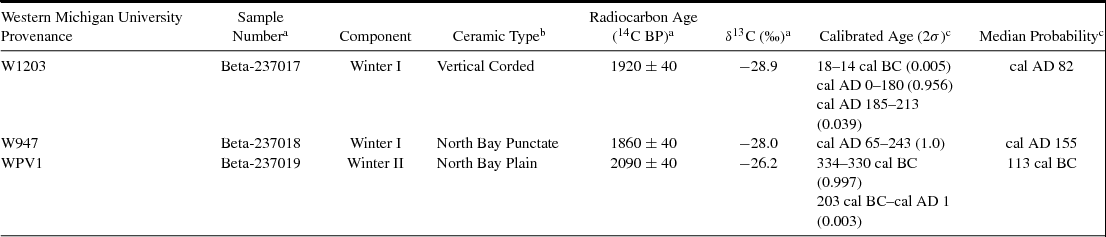
The Winter site ceramic assemblage has been the subject of three major analyses—Richner (Reference Richner1973) and Bianchi (Reference Bianchi1974) in the 1970s and geoarchaeological work 40 years later by Lovis and colleagues (Reference Lovis, Arbogast and William Monaghan2012)—as well as the present study. Richner's (Reference Richner1973) and Bianchi's (Reference Bianchi1974) initial stylistic cross dating of ceramics led them to believe that the Winter site was occupied circa AD 200. Lovis and colleagues (Reference Lovis, Arbogast and William Monaghan2012) AMS-dated carbonized food residues from three ceramic rim sherds (Table 1).Footnote 1 Two ages on sherds from the lower or 3Ab horizon are statistically identical, with a mean pooled age of 1890 ± 29 cal BP, or about cal AD 60. The age of the sample from the upper or A2/B horizon is slightly older and not statistically the same as the lower midden ages, despite overlap. Lovis and colleagues (Reference Lovis, Arbogast and William Monaghan2012:159) also explored the site with sediment cores, producing an optically stimulated luminescence date from the underlying lacustrine sands that provides a terminus post quem for the site of circa 230 BC.
Winter Site Accelerator Mass Spectrometry Sample Ages.

a Lovis et al. Reference Lovis, Arbogast and William Monaghan2012:157.
b Richner Reference Richner1973.
c Stuiver et al. Reference Stuiver, Reimer and Reimer2017.
The older radiocarbon date might be explained by vertical movement of artifacts, which in eolian contexts can be expected (see Leigh Reference Leigh, Goldberg, Holliday and Ferring2001). Additionally, the Ab horizons at the Winter site were at times discontinuous (Richner Reference Richner1973). Thus, given the available samples this age reversal cannot currently be rectified. Still, the close ages speak to both the rapid deposition and the active nature of the eolian deposits within which the cultural middens formed, approximately 200 cal BC to cal AD 240 (Lovis et al. Reference Lovis, Arbogast and William Monaghan2012:157), earlier than Richner's (Reference Richner1973) proposed age based on regional ceramic cross dating.
Isotope analysis is increasingly common in the identification of maize in preserved cooked materials (Hart and Lovis Reference Hart and Lovis2013). The δ13C ratios on the three dated samples were −28.9‰ (Beta-237017), −28.0‰ (Beta-237018), and −26.2‰ (Beta-237019), all within the range of C3 plants and their consumers and insufficiently enriched to characterize maize. That said, experimental studies reveal that the presence of such enriched δ13C values depends on both the form of the maize and its proportion when mixed with two or more other resources. In some instances, more than 70% maize is necessary in a two-part mixture before sufficiently enriched δ13C values fall within the range of maize isotopic values (Hart and Lovis Reference Hart and Lovis2013; Hart et al. Reference Hart, Jo Brumbach and Lusteck2007). Thus, the δ13C ratios obtained on the dated Winter site samples do not necessarily preclude maize in resource mixes, particularly if the maize was present in low proportions.
Bianchi (Reference Bianchi1974) analyzed ceramic material from the occupations as two discrete assemblages: Winter I, from the lower midden, and Winter II, from the upper midden and its secondary member. The Winter I assemblage contained 90 sherds representing at least 19 vessels, while Winter II yielded more than 6,000 sherds representing at least 126 vessels (Bianchi Reference Bianchi1974:3, 66). The small Winter I assemblage contained no distinctive types or varieties when compared with the Winter II assemblage, again suggesting that the two occupations were not greatly separated in time, if at all.
Winter ceramic vessels overall were well tempered, low fired, and thin walled, with vertical or everted (open) rims (Kooiman Reference Kooiman2015)—ideal traits for cooking vessels as they allow access to contents and increase both thermal shock resistance and heat conductivity (Rice Reference Rice1987; Skibo Reference Skibo2013). Adhered interior carbonized food residue indicates that vessels were involved in cooking over fire (Skibo Reference Skibo2013). Intact interior carbonization was present on ~29% (n = 66) of the discrete vessels analyzed (n = 230), evidence of the important role of ceramics in food processing at the site, regardless of whether or not perishable vessels were also used.
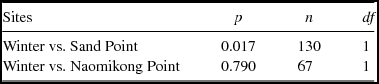
Interior carbonization patterns on ceramic vessels from the Middle Woodland Naomikong Point site (20CH2) and the Late Woodland Sand Point site (20BG14), both located in the Upper Peninsula, suggest a diachronic shift in cooking techniques (Kooiman Reference Kooiman2012, Reference Kooiman2016). Partially reconstructed vessels and sherds from Naomikong Point exhibited evidence of stewing (a long-term liquid reduction process) by the presence of interior carbonization on most of the interior surfaces. Vessels and sherds from Sand Point, on the other hand, were stained with a ring of residue encircling the top of the interior vessel rim, which indicates boiling or long-term simmering. The distribution of different carbonization patterns within the Winter site assemblage was statistically identical to that of Naomikong Point, and both were statistically different from the distribution in the Sand Point assemblage (Table 2). The discrepancy suggests temporal differences in cooking habits.
Interior Carbonization Pattern Comparisons Based on Sherd Frequencies.

Note: Results of a Kruskal-Wallis test (α = 0.05).
The close association between food choice and cooking techniques (Wandsnider Reference Wandsnider1997) provides a possible explanation for the perceived culinary shift. Dunham (Reference Dunham2014) argues for the intensified exploitation of starchy resources, namely, wild rice, acorns, and some maize in the Eastern Upper Peninsula after circa AD 1000, while O'Shea (2003) argues for intensive maize cultivation along Upper Great Lakes coastal regions post–AD 1100. Starchy foods require intensive boiling to be made palatable and digestible (Braun Reference Braun, Moore and Keene1983; Wandsnider Reference Wandsnider1997) and would serve as an explanation for the prevalence of boiling signatures.
The potential Late Woodland intensification of starchy food exploitation does not mean that starchy foods were not cooked or consumed earlier and instead raises the questions of when these food items were initially incorporated into local subsistence regimes and how long it took for them to become important components of cuisine. People collected and ate acorns across eastern North America since the Archaic period, but the local history of wild rice and maize is less clear. Paleoecological studies suggest that wild rice appeared in northeastern Minnesota by 7000 BC and northwestern Ontario by 4100 BC (Boyd et al. Reference Boyd, Surette, Surette, Therriault and Hamilton2013; Huber Reference Huber2001), although there is little evidence to suggest greater human exploitation of wild rice until the Middle Woodland period or earlier (Burchill and Boyd Reference Burchill and Boyd2015), when macroremains appear at sites from Minnesota to Ontario and settlement patterns shift to favor rice-producing locales (Arzigian Reference Arzigian2000; Boyd et al. Reference Boyd, Surette, Lints and Hamilton2014; Hart and Lovis Reference Hart and Lovis2013). The only macroremains of wild rice in the Upper Peninsula, however, are from a Late Woodland feature at the Cloudman site (Egan-Bruhy Reference Egan-Bruhy2007).
Thus, the Winter site provides a temporally consistent case study with which to address the question of whether maize and wild rice were incorporated into pre–AD 1 diets. Given a general lack of macrobotanical remains from upper Great Lakes sites, including the Winter site, microbotanical analysis is one of the optimal methods by which to evaluate the problem of food adoption and cuisine given the direct association of carbonized food residues containing starches and phytoliths with cooking technologies.
Methods
Sixteen sherds, each representing individual vessels from the Winter site, had sufficient carbonized food residue present for sampling and microbotanical analysis. Analytic procedures and references used for the identification of diagnostic starches and phytoliths are described in Supplemental Text 1. Residue samples were taken from the interior surfaces of each of the 16 ceramic sherds and gently scraped onto weigh paper using separate disposable scalpels; the amount of residue collected from each sherd varied depending on the amount present. The residue from each sample was weighed and placed in a 15-ml plastic test tube with a screw cap. The samples were then transported to the Michigan State University Department of Geography Quaternary Landscape Research Group Laboratory, where sample preparation continued.
The chemical technique for extracting microbotanicals from ceramic residue follows the protocols developed by the University of Wisconsin–Duluth Archaeometry Laboratory (1989). This procedure uses a consistently heated solution of potassium chlorate and nitric acid to dissolve nonsilica materials. Materials left after this procedure are phytoliths, starches, diatoms, silicified tissues, and other various nondiagnostic organic and inorganic materials. All samples were centrifuged and thoroughly rinsed with distilled water to remove any remaining potassium chlorate and nitric acid. These samples were stored in ethanol in half-dram glass vials. A few drops of each sample were placed on slides, one slide for each of two analysts, which were then placed on a slide warmer to evaporate the ethanol. The sample was then mixed with Permount on the slide, and a slide cover was placed over the Permount.
Samples were viewed and analyzed using a Leica DM 2500 compound microscope. Scanning was conducted at 200× magnification, and identification, at 400× magnification. The Hoya polarizers were generally set very high, and a Tiffen green filter was occasionally used to diminish the light intensity and search for starches. Diagnostic objects (Supplemental Text 1) identified on the slides were photographed, and their location on the slide was marked, along with a morphological description. Identifications were reviewed by both analysts, and then photographs of the identified microbotanicals were reviewed independently by Maria Raviele.
Results
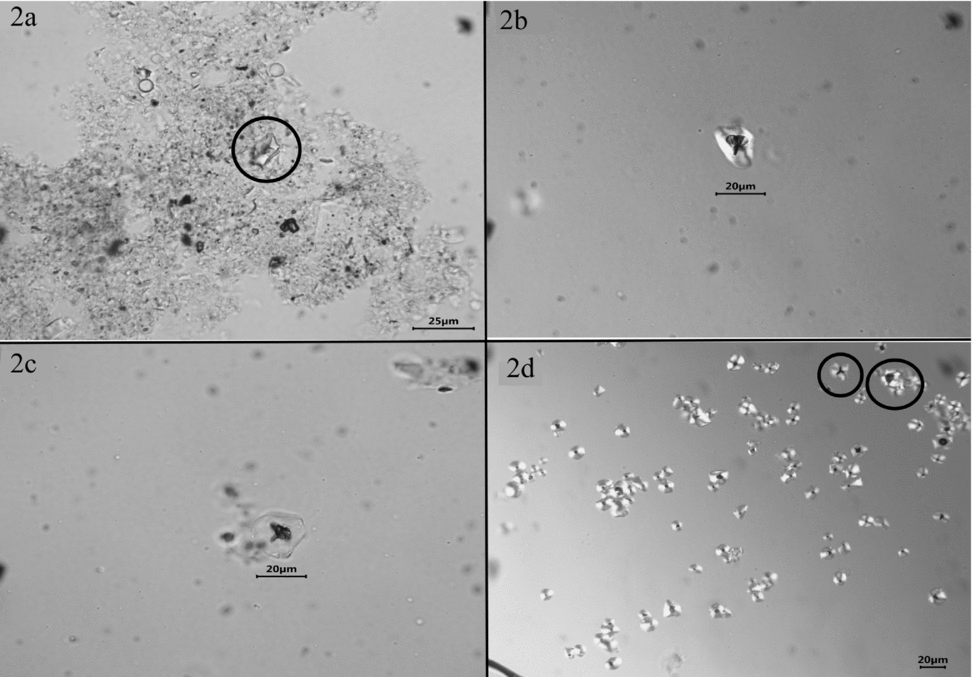
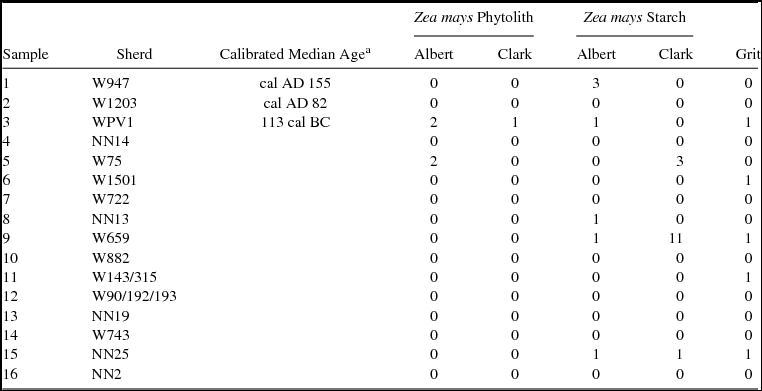
Maize phytoliths (Figure 2a) were identified independently by both analysts on the split sample slides from one vessel (Sherd WPV1; Table 3). Maize phytoliths were identified on the sample slide from one vessel by one analyst (W75). Maize starch (Figure 2c–d) was found by both analysts on the split sample slides from two additional vessels (Sherds W659 and NN25). Maize starch (Figure 2b) was also identified in three other samples (Sherds W947, W75, and NN13), in each case by only one of the analysts. In the two instances where there was a vessel sample with maize phytoliths identified by both analysts, there was correlated identification of maize starch by one of the analysts. The presence of grit in several samples, in three cases associated with maize starch and phytoliths, may indicate milling or grinding on a fine-grained stone (Raviele Reference Raviele2010; St-Pierre and Thompson Reference St-Pierre and Thompson2015). However, the grit may originate from the pottery itself, scraped off with the residue during sample collection.
(a) Zea mays rondel phytolith visible in Sample 3 (WPV1); (b) maize starch visible in Sample 5 (W75); (c) maize starch visible in Sample 9 (W659); (d) maize starches (circled) and nondiagnostic starch in Sample 9 (W659). (Photographs by Caitlin Clark.)

Results of Phytolith and Starch Analysis by Analyst.

a Lovis, Arbogast, and Monaghan Reference Lovis, Arbogast and William Monaghan2012.
In sum, maize phytoliths and starch were identified from two vessels, two vessels yielded maize starch in both of the split samples, and two had starch in one-half of the split sample. More than one-third (37.5%) of the 16 vessels analyzed, therefore, demonstrate Z. mays presence in the food mix cooked in the vessel. Residue from Sherd WPV1 was AMS-dated to 203 cal BC‒cal AD 1 (partial 2σ range; 0.997 probability; Lovis et al. Reference Lovis, Arbogast and William Monaghan2012). Vessel W75, which produced both phytoliths and starch, was not direct dated, but a second sherd producing maize starch, W947, was dated to cal AD 65‒243 (2σ range; Table 1; Lovis et al. Reference Lovis, Arbogast and William Monaghan2012).
The systematic methods used in this analysis lend credibility to our findings—two double-blind and randomly assigned split samples, between two analysts with different training, that were independently analyzed with identical microscopy and then independently validated by a third party. Findings were consistent in 14 of the 16 samples, or 87.5% consistency. The two samples where both analysts recorded phytoliths also produced starch. Both analysts identified maize starch in two samples, and one analyst identified maize starch in each of two samples. Viewed alternately, there was 100% accordance in the presence or absence of maize phytoliths between the two analysts and 75% accordance in the presence or absence of maize starch.
To evaluate these relationships, an unweighted Cohen's kappa (k; Supplemental Text 2), a standard measure of interobserver concordance often interpreted as reliability, was calculated for the presence and absence of maize starch and phytoliths for the two observers. All calculations were undertaken in the VassarStats online calculator (Lowry 2001–2016). The resulting k = 0.7143 (k = 2, N = 16) reveals “substantial” agreement between the two observers employing the scaling of Landis and Koch (Reference Landis and Koch1977), with a distance of 71.4% between random and perfect agreement. This level of accordance also suggests that maize was sufficiently well distributed in the sampled residues that it was regularly incorporated into both of the split samples.
Discussion
Contamination of results from materials or environment can be ruled out as affecting the outcome. Samples were prepared in a sterile environment specifically suited to the study of microbotanical remains, and all nitrile gloves used were powder-free and did not contain starch. As noted in Supplemental Text 1, multiple control slides placed in the laboratories for extended periods revealed no maize contamination. Finally, the land-use history of the Winter site location reveals its use as a modern fishing and hunting camp (Richner Reference Richner1973), corroborated by an absence of Ap horizon, or plow zone (Lovis et al. Reference Lovis, Arbogast and William Monaghan2012; Richner Reference Richner1973). The latter suggests an absence of identifiable farming that might contribute maize microbotanicals to the soil matrix. Additionally, the consistent absence of maize microbotanicals in 10 of the 16 samples between the two analysts would not be expected if contamination had affected the findings.
Although the identification rate of this study is comparable to that of one other study (St-Pierre and Thompson Reference St-Pierre and Thompson2015), it is somewhat below the 55%–60% Z. mays presence rates of other analyses (Boyd and Surette Reference Boyd and Surette2010; Hart, Brumbach, and Lusteck Reference Hart, Lovis, Schulenberg and Urquhart2007; Raviele Reference Raviele2010). The low within-sample incidence of maize at the Winter site would indicate that maize did not figure significantly in the diet at this point in time. The impact on cooking technologies and techniques was perhaps low until starchy foods, such as maize, became a larger component of the cuisine, as suggested by the increasing evidence for boiling in the Late Woodland.
The presence of wild rice was anticipated in the Winter samples because of the presence of wild rice microbotanicals with maize in New York, southern Michigan, and Quebec (Hart, Brumbach, and Lusteck Reference Hart, Lovis, Schulenberg and Urquhart2007; Raviele Reference Raviele2010; St-Pierre and Thompson Reference St-Pierre and Thompson2015). However, wild rice was not identified, perhaps due to low frequencies and/or differential representation of phytoliths in plant parts. However, wild rice is not regionally ubiquitous and has rather restricted growing conditions (Hart and Lovis Reference Hart and Lovis2013). Dunham (Reference Dunham2014:Figure 27) shows that the Garden Peninsula, where the Winter site is located, has no documented stands of wild rice, nor does it possess the kinds of riparian habitats conducive to wild rice growth. While the Winter site is within the known range of wild rice distribution, Valentine Creek does not currently contain stands of wild rice, and wild rice is not “generally associated with Native American subsistence in the central or eastern portion of Michigan's UP [Upper Peninsula]” (Dunham Reference Dunham2014:93). Therefore, it would be surprising to find any evidence of wild rice in food remains at the Winter site.
The presence of fine grit in multiple samples, in conjunction with the low incidence of maize, suggests that maize may have been ground into a flour or meal, either before it arrived at the Winter site or during processing at the site. Grinding or milling would make transportation of the product easier because of its concentrated and more easily packaged form, as well as reducing preparation and cooking time, since it is already partially processed. Starch damage, identified in two samples by one of the analysts, would indicate that crushed or ground maize may have been a characteristic of early maize introduction in the upper Great Lakes and that perhaps it was traded among multiple groups in the region as a flour, a foodstuff easily incorporated into the stews common in Middle Woodland cooking. That said, grit also occurs in samples that do not contain maize microbotanicals, raising the question of whether such grinding was simply a common processing technique for many resources or whether grit was introduced into the analysis during sampling. Barring functional differences in container use, which we cannot currently assess, the presence of maize in only one-third of the vessels may also suggest that this new dietary component was not universally adopted and consumed by all occupants of the site, as has been demonstrated for later time periods (Muhammad Reference Muhammad2010:85–103).
Conclusion
This analysis of microbotanicals from carbonized food residue on the ceramic assemblage from the Winter site joins an increasing number of such studies from across northeastern North America producing consistent outcomes for the earliest ages of maize use in local economies. One of the samples with a positive identification for maize phytoliths and starches, WPV1, was AMS-dated to 203 cal BC–cal AD 1 (Lovis et al. Reference Lovis, Arbogast and William Monaghan2012:Table B-1). The correlation between the microbotanicals and an early date places the Winter site as the earliest incidence of maize in the Upper Peninsula of Michigan and across the northern Great Lakes. The findings of this study correlate well with other studies in northeastern North America that identify the initial presence of maize more than 2,000 years ago—conservatively, 800 years before the macrobotanical record suggests. This observation further confirms that multiple methods in tandem are necessary to explore the role of maize and other economically important plants in early diets and that the timing and form of the introduction of maize must be rethought (Hart and Lovis Reference Hart and Lovis2013).
Acknowledgments
Support for Susan Kooiman came from the Michigan State University (MSU) Graduate School and Department of Anthropology and for Rebecca Albert from the MSU Honors College and College of Social Science. Facilities were provided by the MSU Consortium for Archaeological Research, Department of Anthropology, MSU Museum; the Department of Geography, Environment and Spatial Sciences; and the PaleoResearch Institute courtesy of Linda Cummings. Assistance with various aspects of the research was kindly provided by Maria Raviele, Catherine Yansa, Jeffrey Richner, and John Hart. The Winter site ceramic collection was accessible through a research loan by Western Michigan University. Funding for accelerator mass spectrometry dates on Winter site ceramic residues was provided by a Federal Highway Administration and Michigan Department of Transportation grant (IDS Contract No. 2006-0034 Z1/R1) to William Lovis, Alan Arbogast, and G. William Monaghan. We appreciate comments on earlier drafts by Matthew Boyd, John Hart, and Gabriel Wrobel and the statistical advice of Joseph Hefner. Erin Beachey drafted Figure 1, and Nancy Peniche May provided the Spanish abstract.
Data Availability Statement
The data used for this article are available from the corresponding author upon request. Access to the Winter site archaeological materials must be requested through the curator of anthropology at the Michigan State University Museum.
Supplemental Materials
For supplementary material accompanying this report, visit https://doi.org/10.1017/aaq.2018.10.
Supplemental Text 1. Supplementary Materials and Methods.
Supplemental Text 2. Formula for Cohen's k.
Supplemental Text 3. Supplemental References Cited.