Prince Albert and the poles
Polar lands have the special ability of exercising a powerful attraction on elite spirits, who are keen to lift part of the veil that still obscures them. These remote frozen lands and their formidable pack ice conceal no fewer obstacles and perils than do Africa's torrid and fever-laden climates. It is in the boreal regions that one may hope to find the key to many of the problems that still have to be resolved. It is in this fashion that the horizons embraced by scientists as they scrutinize the universe are constantly expanding, both in time and space (Daubrée Reference Daubrée and Nordenskiold1880: 1, 11).
So wrote Auguste Daubrée (1814–1896), Member of the Academy of Sciences of Paris, in his preface to the French edition of the book The voyage of the Vega . . . by Adolf Erik Nordenskiöld (1832–1901). These remarks reflect an opinion that became increasingly widespread during the nineteenth century. The development of railways and the great strides in steam navigation gradually increased the number of regions that could be visited. But the quest for unknown landscapes, and the search for the exotic remained keen. To travel the world vicariously and safely, and to satisfy a thirst for discovery; these aspirations became steadily more widespread as the years passed.
Geographical societies multiplied throughout Europe and America after the first was founded in Paris in 1821. Their moral, scientific and financial support and their guarantee that results would be broadcast by way of publications and conferences, contributed to making travellers and explorers the heroes of the day.
Travel accounts achieved record sales, whether they dealt with actual travels, or fictional ones such as those invented by the famous Jules Verne (1828–1905). Magazines were not far behind in this regard, especially when they were illustrated with evocative engravings, as in the case of Le tour du monde or Le monde illustré.
What was the reaction of young Albert, hereditary Prince of Monaco (1848–1922), to this atmosphere that was so favourable for exploration? From his childhood, travels had occupied a major place in his life, and not simply those that took him to the palace in the principality, to the Hôtel de Monaco in Paris and to the Château de Marchais in northeastern France. With his parents or his tutor, at an early age he explored other regions of France, Belgium, Italy, Spain, Germany and Switzerland.
As he later remarked, ‘a fascination for adventures on land or on the sea, a passion for hunting and the dreams of a lively imagination made me somewhat unruly as an adolescent’ (Albert I of Monaco 1966: 30). The letters that he wrote to his father Prince Charles III (1818–1889) while he was finishing his studies at the Collège de la Chapelle Saint-Mesmin, testify to his fascination for the sea and his keen interest in the polar regions. The orders he placed with the local bookshop are divided between works on navigation and travel accounts, not to mention maps, especially those of the Arctic. Charles Francis Hall's (1821–1871) Life with the Esquimaux features among these books (Hall Reference Hall1865). How did he, from the heart of the Orléans countryside, manage to keep abreast of new French and foreign publications? This book, and many others that he purchased at the time, attest to his gift for modern languages: he had already mastered French, English, German and Italian; subsequently he would learn Spanish, and would acquire some command of Portuguese and Arabic.
Determined to acquire the training of a naval officer, Prince Albert learned the rudiments of this over a period of six months at Lorient. Then Queen Isabelle II of Spain (1830–1904) welcomed him into her navy as Enseigne-de-vaisseau. For two years he sailed the Atlantic coasts of Spain and then the waters of the Caribbean. On his return to Europe in 1868 he tried to establish a working relationship with the explorer Gustave Lambert (1824–1871) (Albert I of Monaco 1868a). He took steps towards joining the polar expedition organised by Dr. August Petermann (1822–1878) in the spring of 1869 (Albert I of Monaco 1868b; Albert I of Monaco 1868c). Neither of these initiatives aimed at the Arctic regions was successful. To enhance his competence as a naval officer, he bought a small cutter, and sailed in it in Italian waters as far east as Livorno (Leghorn) and as far west as Provence and Languedoc.
Prince Charles III decided that his son's naval education should be pursued within a more structured framework. In 1872, he solicited the aid of King Charles XV of Sweden and Norway (1826–1872), so that Prince Albert might participate in an expedition to Svalbard but the response was negative (Charles XV of Sweden and Norway 1872). This expedition was a private undertaking, on board ‘a solidly built ship but one whose limited size would not permit foreigners to be accommodated.’ Moreover, as the Swedish ambassador in Paris specified: ‘since it was the intention of these bold sailors and scientists to spend the winter in Svalbard, it would clearly be rash for persons not accustomed to the extreme rigours of these latitudes to share the dangers to which they would be exposing themselves’ (Légation de Suède et Norvège 1872).
Hence, Prince Albert perfected his competence as navigator and captain on board a vessel that he commanded himself. In the summer of 1873 he purchased a schooner and renamed it Hirondelle. Thereafter the Prince was able to make more frequent cruises. He sailed his yacht from England to Monaco and made numerous trips around the western Mediterranean. Later he headed to Africa and stayed for several months in Tangiers. Then, after this experience in the Mediterranean he made a long voyage in the Atlantic in 1879.
But he had not abandoned his intention of exploring the Arctic regions. His schooner was outfitted appropriately for such a voyage and an excellent boatswain, Jean Auguste Le Grené (1834–1910) and a first-class crew were recruited. The Prince kept his father informed in a series of letters in the spring of 1882:
I want to put into practice a plan that I have been entertaining for a long time: to visit Iceland, or at least to attempt it (Albert I of Monaco 1882a).
I hope to make the crossing from Cherbourg to Reykjavik, non-stop, in two to three weeks. After visiting that fine country, and if the sea is ice-free I'll attempt to reach the coast of Greenland, pushing north beyond the Arctic Circle as far as Jan Mayen, which few sailors have visited thus far. Then, assuming that the winds and the ice co-operate, I will head across the Arctic Ocean to a point fairly far north on the Norwegian coast, and then will run south into the North Sea. All that remains now is to see how much of this appealing programme I will be able to execute. My schooner has never put to sea in a better condition (Albert I of Monaco 1882b).
Less than a month later Prince Albert was forced to write to his father again:
It is with a feeling of real sorrow that I begin this letter which will inform you of the failure of my expedition and of the sad events that have overwhelmed Hirondelle. We left Edinburgh on 25 April and rounded the northern tip of Britain three days later. Our progress towards Iceland was not favoured at all by the weather since we experienced constant gales, but at least those winds were not foul; as a result by 4 May we were within 130 miles of our goal. At 7 a.m. on the 4th an enormous wave swept the deck, smashing and carrying away everything in its path. The three main hatch-covers had been removed and the water flooded into the ship's interior by way of these gaping openings. It was only after some strenuous work at the pumps, and after we had managed to close the open hatches and to restore a relative level of order in the chaos in our quarters, that we could consider ourselves out of the wood. We decided to run before the wind since this was the only point of sailing that the ship could tolerate in that condition, without danger of sinking.
Following this disaster the gale has been driving us at lightning speed, and a change in wind direction and in the weather allowed us to head for Ireland, and yesterday evening I reached the small, remote port of Valentia. We thus covered the 600 miles separating that place from Iceland in five days (Albert I of Monaco 1882c).
Prince Albert's Arctic dreams had again been disappointed. However, several French naval officers, of whom he had asked advice and information, informed him that the weather conditions would not have allowed him to put his plan into operation (Miot Reference Miot1882; Maigret Reference Maigret1882). The pack ice was denying access to the north coast of Iceland and a fortiori to the Greenland coast.
Prince Albert felt a deep attachment to science, equalling his attraction to the sea; for him, as for the elite of his contemporaries, science seemed to ensure for humanity a future of material wellbeing, intellectual liberty and social justice.
During his stays in Paris he frequented scientific establishments and met university professors and professors from the Museum of Natural History, notably Alphonse Milne-Edwards (1835–1900). The latter had directed the four scientific campaigns on board Travailleur and then Talisman, the results of which were presented in an exhibition at the Museum in early 1884. Milne-Edwards suggested at this time that Prince Albert should devote himself to research of this nature.
Having assured himself that he was competent as a seaman, driven by his intellectual curiosity and keen to contribute to the advancement of knowledge, the Prince welcomed this proposal enthusiastically yet rationally. ‘For ten years I had been using Hirondelle for voyages that were instructive, certainly, yet without any generally useful purpose; now, however I began thinking that it would be more honourable to join this growing movement which, under the aegis of Science, is transforming the world and ideas’ (Albert I of Monaco 1884?: ff. 22 verso and 23 verso).
Shortly after he had decided to devote himself to marine sciences, he made a trial voyage in the North Sea and the Baltic aboard Hirondelle. Thereafter he used her for his first four oceanographic cruises between the Azores and Newfoundland and in the Bay of Biscay. He quickly realised that a vessel of this tonnage, not equipped with steam, limited the range of the work he could tackle and sometimes demanded superhuman efforts by her small crew.
On succeeding his father in 1889, one of Prince Albert I's decisions was to place an order with the Green Shipyard, near London, for a three-masted vessel with auxiliary engine, Princesse-Alice. She would be the second vessel in the world specifically built for oceanographic work, the first being the United States Fish Commission steamer Albatross (Tanner Reference Tanner1885, Reference Tanner1897). The latest technological advances were incorporated with advantage: electric light, sea-water distilling apparatus, refrigeration. Her three laboratories were equipped with tables fitted with fiddles and light tables and were each supplied with distilled water and sea water. With this vessel he made seven cruises, in the western Mediterranean, but especially in the waters around the Azores.
First Arctic cruise: 1898
Early in 1897, the Prince made three decisions of very great importance with regard to the pursuit of his scientific work. After two particularly fruitful cruises, the facilities in Paris in which he stored the specimens that he had collected, were no longer sufficiently large. It was becoming urgent that he build a museum, intended for the conservation of his collections, in Monaco. The Prince discussed the project with his chief scientific collaborator, Dr. Jules Richard (1863–1945). The architect Paul Delefortrie (1843–1910) was commissioned to draw up plans for the building and work began on its construction in the spring of 1898.
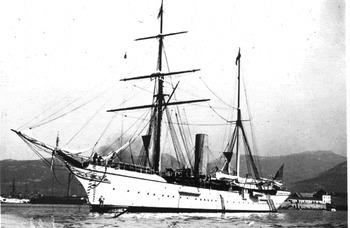
The Prince's second decision was to order a second vessel, also to be named Princesse-Alice, from the Laird Shipyard near Liverpool. The steadily increasing scale of his oceanographic operations required a larger, more powerful and faster ship. Although it had a steel hull, rather than one of wood, which latter material is better suited to navigation in arctic waters, this yacht had excellent seagoing qualities that allowed him to contemplate, without being foolhardy, a cruise in the arctic regions, more precisely in the waters around Svalbard (Figs. 1, 2).
Map of Svalbard.

The second Princesse-Alice: the research yacht of Prince Albert l, which he used on his oceanographic cruises from 1898 until 1910.

By the time of Prince Albert's voyages, although Svalbard still remained a terra nullius, in other words no nation had obtained or claimed sovereignty over the territory, it was far from being a terra incognita, and the general outlines of the islands were reasonably well established (Conway Reference Conway1906). Whalers (mainly British, Dutch and German) had frequented Svalbard waters in large numbers for about a century after 1611; thereafter walrus were hunted extensively, mainly by Norwegians, until well into the 20th century. Trappers especially Russian and Norwegian operated from lonely cabins in many of the fjords for centuries. Prior to 1898 there had been numerous exploring expeditions, sport-hunting expeditions, and scientific expeditions, especially during the two decades prior to 1898. These focussed mainly on the terrestrial environment and on meteorology and geomagnetism, for example, the Swedish expedition of the First International Polar Year (1882–1883) at Kap Thorden on Isfjorden (Académie Royale des Sciences de Suède 1886–1891).
Prince Albert's expeditions were, however the first to focus primarily on the oceanography of the Svalbard fjords and offshore waters. In this scientific area he had been preceded by only two expeditions with any significant geographic focus, namely those of Bienaimé in La Manche in 1892 (Bienaimé and others 1894) and Bruijne in Willem Barents in 1878 (Bruijne and others Reference Bruijne1879).
At the end of the nineteenth century the following comments were appropriate with regard to Spitsbergen and the neighbouring islands: ‘By virtue of its latitude and its great altitudes, its glaciers are vast, its climate entirely polar, and the archipelago is practically uninhabitable and uninhabited except during the relatively warm season when it is visited by fishermen, explorers and tourists’ (Anonymous 1904). And, indeed, tourism was already developing, and there were even some examples of ‘cultural tourism.’ A major scientific journal had no hesitation in publishing a news release which stated that ‘The archipelago of Svalbard is now connected to Europe by a steamer service that operates in July and August. Adventfjorden is the main settlement in Svalbard. There one can find a hotel with 30 or 40 small rooms’ (Anonymous 1897). Probably the earliest cruise ship to visit Svalbard with a party of tourists was the Norwegian vessel Pallas in 1881 (Cocks Reference Cocks1882).
Another factor contributed to the focus of attention on Svalbard. The archipelago's geographical location was convenient for making attempts at reaching the North Pole by air. In 1897 the Swede Salomon August Andrée (1854–1897) took off from Spitsbergen on board the balloon Örnen; what became of this balloon would be discovered only thirty years later. This uncertainty did not deter the American Walter Wellman (1858–1934) and the German Graf Ferdinand von Zeppelin (1838–1917) from organising aerial expeditions in airships, starting from Spitsbergen, in their turn (Holland Reference Holland1994: 466, 459, 480–481, 489).
Prince Albert's plans did not include expeditions by air and certainly had nothing in common with tourist enterprises. Methodical and rigorous as always, he was anxious to accumulate the most recent and reliable information in order to identify his area of study and the research to be carried out there.
The first specialist he consulted was the Frenchman, Charles Rabot (1856–1944), traveller and geographer, who had visited Spitsbergen several times, notably during the mission of La Manche in 1892. Apart from his own knowledge of the area, Rabot was in regular contact with the majority of polar explorers. He had a command of the Scandinavian languages and had translated into French numerous accounts of voyages undertaken in northern regions by Danes, Swedes and Norwegians. He proposed, as the first priority, a programme of observations of the glaciers of northern Norway and Svalbard (Rabot Reference Rabot1898).
A Norwegian naval officer, Sigurd Scott Hansen (1868–1937), who had taken part in Fridtjof Nansen's (1868–1930) voyage in Fram, was consulted next. In his response, supported by sketches, he replied with great precision and clarity to the questions the Prince had posed concerning the port he should select as his departure point, to coal supplies, to the period when it was possible to work and to equipment (clothing, provisions, means of transport), both at sea and for explorations ashore (Scott Hansen Reference Scott Hansen1897).
Finally the Prince asked Nansen what scientific projects he would recommend should be undertaken during the cruise (Albert I of Monaco 1898). Nansen replied in a long letter, accompanied by several sketches. He expressed the wish that temperature measurements might be made using the improved instruments available on board Princesse-Alice, in order to supplement, confirm or invalidate the observations made during Fram's (1893–1896) voyage and to provide a better understanding of the layering of water bodies (Nansen Reference Nansen1898).
Gradually the programme for the cruise became finalised. The usual oceanographic operations would be executed according to the methods adopted, and with the equipment perfected and improved, during his eleven previous cruises: soundings, temperature measurements, collecting of water and sediment samples. The harvest of animals obtained by dredges, trawls, traps and various nets were destined, in the first instance, to assist towards the completion of the collections of the Musée océanographique, of which construction had just started at Monaco.
Prince Albert could not neglect his duties as a sovereign Prince during his oceanographic cruises. To assist him in this task, he was accompanied by his private secretary, Adolphe Fuhrmeister (1875–1931). During all his cruises Prince Albert assumed the responsibilities of captain of his yacht and also of expedition leader. His second in command, in terms of shiphandling was a British naval officer, Captain Henry Charlwood Carr (1848–1918). Having been unable to obtain the services of Scott Hansen, who could not avoid his military service obligations, the Prince was counting on the experience of a Scottish whaling master, David Wedderburn (?1852–1931) and of the Norwegian ice-pilot, Erikson, (probably Kristoffer Meier Eriksen (1878–1920)) to advise him ‘in a type of navigation of which [he] had no experience’ (Albert I of Monaco 1966: 190).
The laboratory was entrusted to Dr. Jules Richard, the custodian of collections, who was soon to become Director of the Musée océanographique. For sorting and preliminary identification of the organisms collected, Richard was assisted by Henri Neuville (1872–1946), an assistant at the Muséum d'histoire naturelle de Paris. The ship's doctor was a young hospital intern who had just defended his thesis, Frank Baraduc (1869–1940). It was the task of an Italian artist, Count Witold Lovatelli Colombo (18??–19??), to note the colour of the animals collected as soon as they emerged from the water and before their nuances changed and faded.
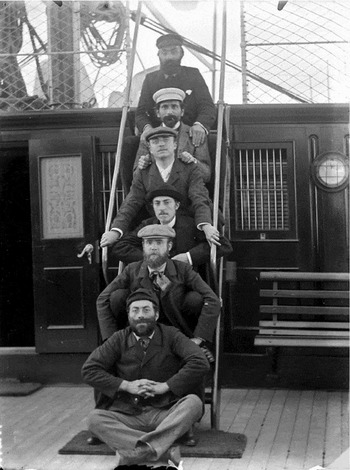
The scientific staff also included two eminent scientists. John Young Buchanan (1844–1925) was a Scottish oceanographer who had taken part in the famous circumnavigation of H.M.S. Challenger, as well as two of the cruises of the first Princesse-Alice. Prince Albert thought highly of this specialist in physical and chemical oceanography, who also had an interest in glaciology. Karl Brandt (1854–1931) was a professor at Kiel University. A few years earlier he had participated in the Plankton expedition, mounted by his master Victor Hensen (1835–1924), a cruise that resulted in the rise in quantitative analysis of plankton. Brandt brought aboard special nets, perfected by Hensen's team. Finally, during the stop at Tromsø, a member of an expedition under Andrew Coats that had just been working in the Barents Sea on board Blencathra, asked to be taken aboard Princesse-Alice; this was William Speirs Bruce (1867–1921), Scottish naturalist and explorer (Bruce Reference Bruce1899, Reference Bruce1900; Holland Reference Holland1994: 415) (Figs. 3, 4).
Some of the scientific staff, 1898. Top to bottom: Bruce, Lovatelli Colombo, Fuhrmeister, Neuville, Baraduc and Richard. Photo: Jules Richard.

Jules Richard in arctic attire, 9 September 1898. Photo: Jules Richard.

This was a larger staff than usual; five nationalities were represented, something that appealed to the Prince, who was increasingly convinced of the beneficial effects of internationalism, especially in science.
Prince Albert was keen that the inaugural voyage of his new vessel made an impact in the scientific world. The first port-of-call was Le Havre where the most famous French scientists were invited to visit the yacht. Then Princesse-Alice headed for Kiel where regatta week was in full swing. By 1914, the Prince would have attended this event eleven times, for diplomatic rather than recreational reasons. His pacifism prompted him to use his meetings with Kaiser Wilhelm II (1859–1941) and with numerous other important personalities, to press for, if not reconciliation, then at least a rapprochement between France and Germany.
During his stay at Kiel, professors at the university were able to examine the facilities on board. The Prince remarked on another visits as follows: ‘The German Emperor came aboard several times to study our scientific facilities. I said “to study” them, not just “to look at them”‘ (Albert I of Monaco 1899a: f. 3 recto).
Stops in Norway allowed the Prince to complete the victualling and to acquire the last items of equipment. Two days were devoted to observations, as well as to the placing of benchmarks and cairns on the Svartis glacier so that its behaviour, whether it was advancing or retreating, could be measured in the future.
The yacht headed for Bjørnøya where the Prince noticed ‘the contempt in which arctic birds held the human form’, thanks to which he was able ‘to approach and photograph some Rissa tridactyla [kittiwakes] that were sitting on young or eggs by the hundreds’ (Albert I of Monaco 1899b: 7).
A brief landing on Hopen resulted in collections of minerals and fossils. The Prince reported on Princesse-Alice's progress in arctic waters as follows:
Having attempted to reach Kong Karls Land, located east of Spitsbergen, I had to return westwards since the ice brought me to a halt 40 miles from Hopen. But before rounding Sørkapp, I penetrated to the head of Storfjorden, which is bounded on the west by a series of impressive glaciers. Thereafter I reached the west coast and pushed north to 80° 37′ N where the pack ice finally brought me to a halt. I returned south via the Greenland Sea (Albert I of Monaco 1899b: 6–7).
Following the procedure that he had adopted, the Prince noted the characteristics of the operations that he directed. The planned oceanographic work was carried out, while data were collected on the positions of glaciers and the geology of the islands. In addition to marine fauna terrestrial and freshwater organisms were collected (Richard Reference Richard1898).
The arctic section, sensu stricto, of the cruise lasted a month, from 30 July until 30 August. Shortly before the latter date a Norwegian sailing vessel, Bjarko, arrived with a load of coal. The planned return route, via Jan Mayen and Iceland, was thwarted by foul weather and fog. The cruise ended at Le Havre on 20 September.
It was then important to study and disseminate the results obtained as quickly as possible. As he had done ever since his first oceanographic cruise, the Prince drew up a brief summary of the results in a communication that he presented to the Académie des Sciences in Paris (Albert I of Monaco 1899c); then he gave a lecture, accompanied by numerous slides, to the Société des naturalistes du Muséum de Paris (Albert I of Monaco 1899b). In the following year he published an article entitled ‘Croisière dans les régions arctiques’ in the Grande Revue (Albert I of Monaco 1900a). The amazement that the Prince experienced at the majesty of the landscapes and the brilliance of the light, emerges in this article. He stated: ‘When one has once visited the arctic regions, one is generally possessed by a desire to see them again’ (Albert I of Monaco 1900b: f. 35 verso).
Second Arctic cruise: 1899
Hence, a few days after he had returned, Prince Albert began preparations for a cruise the following summer. He envisaged exploring the east coast of Greenland. Charles Rabot was again asked to provide information on the possibility and benefits of such a programme. He displayed marked reservations with regard to the area chosen (Rabot Reference Rabot1899). Greenland was administered by Denmark. Its exploration was tacitly reserved, more or less, for Danes. For a steel-hulled ship, such as Princesse-Alice that coast is much more dangerous than are the Svalbard waters. Hence it would be necessary to buy or charter a wooden whaling ship for this expedition. Moreover the Swedish geologist Alfred Gabriel Nathorst (1850–1921), who already had several polar voyages to his credit, had announced his intention to explore that same coast.
The problem of the ship meant that Prince had to give up the idea of Greenland. After several months of searching he summarised the situation in a letter to Dr. Jules Richard: ‘I cannot find a whaling ship in an acceptable condition. They are either too old to offer any guarantee of safety, or they are in Newfoundland, from where they would now prefer to be sailing on whaling cruises. To obtain one of them it would have to be brought here, which would greatly increase the cost; moreover, since the owners believe that I have in mind a tourist cruise, they increase their charter rates to an outrageous level’ (Albert I of Monaco 1899d).
By the late spring a second cruise to Svalbard had been decided upon; the aim was to reach the north coast of Spitsbergen and ‘there to begin hydrographic work, which was very necessary for the safety of mariners, since the only existing charts of these coasts are fraught with uncertainties and errors’ (Albert I of Monaco 1900c: f. 45 recto).
To carry out this programme under optimal conditions the Prince asked the French Minister of Marine that a naval officer be authorised to accompany him. He specified that the latter should be ‘very reliable from the point of view of the capacities necessary for the aforesaid tasks’ (Albert I of Monaco 1899e). It would be convenient if the officer selected could be assisted by a naval seaman who was also familiar with this type of work (Blanchy Reference Blanchy1899). Finally, it would be useful if the Dépôt des Cartes et Plans [Surveys and Mapping Branch] would agree to lend ‘some instruments that might be available, for this type of work, and which Princesse-Alice does not possess, or not in sufficient numbers for the intended purpose’ (Albert I of Monaco 1899f).
The French government met the Prince's requests. Lieutenant-de-vaisseau Guissez (1865–1901), who had extensive experience in hydrographic surveys, was seconded, as well as an able-bodied seaman, warranted helmsman Jean-Marie Monfort (1870–1944). The loan of the instruments that had been requested was also approved.
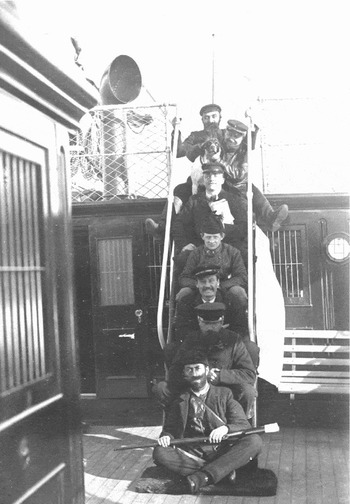
For navigation in ice a new ice-pilot, Edvard Holm Johannesen (1844–1901), also came aboard at Tromsø. There were some changes in the scientific staff as compared to the previous year. The newcomers were Dr. Paul Portier (1866–1962), an assistant at the physiology laboratory at the Sorbonne, who was to study, among other things, the blood of seals and the role played by the layer of blubber in which they were encased. A new medical doctor, Henri Chauveau (1872–1951), a hospital intern and son of a Professor at the Muséum de Paris, was entrusted with the biological research. The artist was a Scotsman, William Smith (1868–1941), recommended by William Bruce. The latter readily accepted the Prince's invitation to come aboard again. Dr. Jules Richard again assumed the duties of laboratory head. The staff, crew and support staff totalled 62 (Fig. 5).
Some of the scientific staff, 1899. Top to bottom: Bruce, Guissez, Fuhrmeister, Smith, Chauveau, Portier and Richard. Photo: William S. Bruce.

Princesse-Alice put to sea from Tromsø on 23 July and three days later rounded the northwest tip of Spitsbergen, but was soon brought to a halt by ice. The entrance to the fjords in which the Prince had hoped to study the hydrography, were inaccessible. He ‘immediately decided to focus his efforts on exploring a nearby fjord designated ‘Red Bay’ [Raudfjorden] on the map’ (Albert I of Monaco 1900b: f. 33 verso). He described his surveys there as follows:
We immediately began our hydrographic work, for which a whaleboat, the steam launch and the motor boat were manned by selected crews. Theodolites, cameras, surveyor's chains, poles for marking stations, sounding lines and signal flags, all the special equipment that had been prepared long beforehand, now came into play; and the good will of everyone, even that of the scientific group confined to the laboratory, was spontaneously offered to the officer who was now undertaking a considerable task for such a short season (Albert I of Monaco 1900b: f. 31 verso).
Simultaneously a survey was made of a lake several square kilometres in area, that the Prince had discovered and which he named after Dr. Richard. To collect its fauna, a net was set using a small Berthon boat. Recovery of the net, weighed down by the weight of water, required the use of a raft. This operation revealed that the lake contained Salmonidae (Richard Reference Richard1899).
For his part Bruce made ‘the ascent of one of the highest peaks surrounding Red Bay’ (Albert I of Monaco 1900b: f. 27 verso), and made a photogrammetric survey of the landscape.
To avoid interrupting this intense activity, a camp was pitched on shore for some of the staff and crew, while the Prince returned by sea to Adventfjorden on the west coast of the island where the Norwegians had established a post office. Indeed, whenever he was travelling, on land or at sea, the Prince took pains to be kept informed about events in the principality, and in the rest of the world. On his way back to Raudfjorden the yacht ran aground on an uncharted reef. Five days passed before the ship could be rescued from this worrying situation and before the risk of an unanticipated wintering could be eliminated. Fortunately the damage suffered by Princesse-Alice was minimal. The hydrographic surveys began again as soon as the ship had been refloated and were continued to a successful conclusion: 2400 soundings were made and 4200 angles measured, as well as the magnetic declination, the tidal range and the geographical coordinates.
Once the essential data for compiling a detailed map had been collected Princesse-Alice headed for Treurenburg (now Sorgfjorden) where a Swedish mission engaged in measuring an arc of the meridian as part of a Russo-Swedish expedition was established (Holland Reference Holland1994: 425; Fig. 6). This visit inspired some thoughts on the part of the Prince: ‘The spectacle that this bay offered, amidst the ice at 80° N, was something sure to encourage those who devote their lives to intellectual progress: 120 scientists of several nationalities focusing all their energies on the pursuit of a lofty goal! And I found myself thinking that, far to the south, the human masses were still continuing their quarrels over a handful of gold or of power’ (Albert I of Monaco 1900d: 12–13).
Svenskund and Princesse-Alice in Sorgfjorden, 18 August 1899. Photo: Prince Albert.

The ship then returned to the west coast of Spitsbergen where she encountered the Russian icebreaker Yermak, designed by Admiral Stepan Osipovich Makarov (1849–1904), which had just successfully completed trials in the pack ice near the archipelago.
A final series of observations was made in Recherchefjorden, where the fronts of several glaciers were carefully surveyed in order to permit comparison with data gathered in 1838–1839 and 1892 by two French ships, La Recherche and La Manche (Holland Reference Holland1994: 216, 374).
After a brief visit to Tromsø, the cruise ended at Le Havre on 11 September. As in the previous year Prince Albert presented a summary of these 12 weeks spent at sea in a lecture to the Société des Naturalistes du Muséum de Paris (Albert I of Monaco 1900d), and then in a report to the Académie des Sciences (Albert I of Monaco 1900e). The programme, as originally established for this cruise, was wound up with the publication of a map of the area investigated, towards the end of 1900 (Guissez Reference Guissez1900; Rabot Reference Rabot1901). It covers an area of 62 km2; plotted at a scale of 1:30,000 it displays a selection of the soundings as well as a few isobaths.
Third Arctic cruise: 1906
Just as he had done in 1889, on the occasion of the previous Exposition Universelle in Paris, Prince Albert decided not to organise an oceanographic cruise in 1900. His activities and those of Dr. Richard concentrated on the presentation of scientific collections at the Monaco Pavilion.
Starting with the following year, he resumed his well-established rhythm of a few seagoing trips in the spring in the waters off Monaco to perfect his methods and test new equipment, and of a major cruise lasting several weeks during the summer. From 1901 until 1905 the areas investigated were, in sequence, Cape Verde Islands, the Azores, the Bay of Biscay, and the Sargasso Sea. Year by year the programme expanded and became more diversified, with studies in the areas of physiology, biochemistry and bacteriology. From 1904 onwards the meteorology of the seas and oceans occupied an increasingly important place and especially studies of the upper atmosphere, on the advice of the German professor Hugo Hergesell (1859–1938).
However, the Prince still retained nostalgia for the Arctic and a convergence of circumstances decided him to return to the north. In the spring of 1905 he received a Norwegian cavalry captain, Gunnar Isachsen (1868–1939), at the palace. This cavalryman was also a specialist on the polar regions. For a period of four years he had participated, as topographer-cartographer, in the second Fram expedition, led by Otto Sverdrup (1854–1930). His contribution was remarkable, as the maps of the complex archipelago located west of Greenland and in the north of Canada, testify. Immediately appreciative of Isachsen's obvious competence, as well as of his methodical and punctual qualities, the Prince agreed to be patron of a Norwegian mission to Svalbard. The smallest details of organisation and of the responsibilities that each person was to assume, were worked out by correspondence and during a sojourn by Isachsen at the Château de Marchais towards the end of 1905.
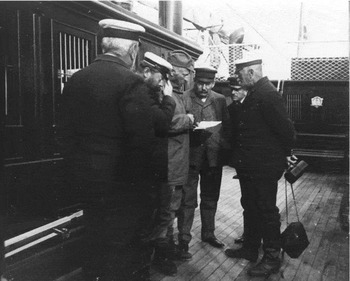
Once again the oceanographic operations would focus around Spitsbergen, complemented by two land-based investigations, that led by Isachsen (Fig. 7) and a Scottish mission. When the Prince invited William Bruce to accompany him, the latter accepted but on condition that he might pursue an autonomous research programme on Prins Karls Forland.
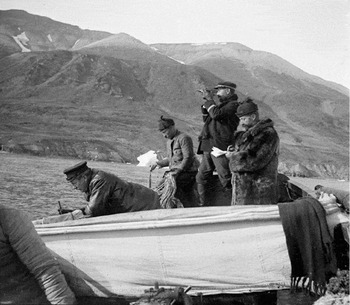
Isachsen explains his itinerary to Prince Albert, Krossfjorden, 14 August 1906. Left to right: Carr, Tinayre, Isachsen, Hergesell, Fuhrmeister and Prince Albert. Photo: Jules Richard.

Princesse-Alice sailed from Le Havre on 24 June 1906. Dr. Richard was on board again, faithfully at his post. For the sixth and last time Dr. Paul Portier was a member of the scientific staff. That staff also included, in addition, the meteorologist Hugo Hergesell. The Prince's new aide-de-camp, the French officer Lieutenant-de-vaisseau Henry Bourée (1873–1940), was to become a very valuable player, both with regard to navigation and with regard to the improvement and/or creation of oceanographic apparatus. He would also emerge as an unrivalled photographer and film-cameraman. Finally, for the third year, the artist was Louis Tinayre (1861–1942), incontestably the most gifted of the six artists who took part in the Prince's cruises. A great traveller, he would overflow with enthusiasm at the prospect of going to the Arctic.
The yacht called at Granton, Scotland to embark Bruce, his equipment and his two assistants, Gilbert Kerr (?1870–19??), taxidermist (and bagpiper!), and Ernest Miller (18??–19??), electrician. After a difficult crossing Princesse-Alice arrived at Bergen where Isachsen and the members of his team came aboard. This included, apart from its leader, Arve Staxrud (1881–1933), a Lieutenant in the Norwegian infantry; Hans Henrik Horneman (1878–1945), geologist; Alfred Koller (1878–1951), engineer; Alv Strengehagen (1880–1975), Haakon Myhre (1872–19??) and Anders Losvik (1860–1927), Norwegian non-commissioned officers with some experience in topographic surveys; and finally a French medical doctor, Ferdinand Loüet (1877–1952). During a stop in Tromsø the ice-pilot, Ludvig Bernhard Sebulonsen (1846–1921) took up his duties. From here on a small Norwegian steamer, Kvedfjord, chartered by Isachsen to transport components of the two expeditions from one place to another, sailed in company with Princesse-Alice. They reached Svalbard on 12 July. The next day Isachsen's mission was dropped off at their starting point; on the day thereafter Bruce and his companions were transported to Prins Karls Forland.
The Prince took it upon himself to see that the work was proceeding smoothly and that the three groups of scientists and explorers, 79 people in total, were transported safely. On board Princesse-Alice sounding, temperature measurements and biological sampling were proceeding as usual, the latter perfected by numerous hauls with the narrow, fine-meshed net invented by Dr. Richard (Fig. 8). For their part, Prince Albert and Henry Bourée carried out more than 500 soundings and determined the hydrography of Krossfjorden, with an area of 166 km2.
Sounding from the steam-launch, near Kapp Mitra, 20 August 1906. Left to right: Hergesell, boatswain d'Hainaut, Bourée and Richard. Photo: Jules Richard.

The meteorological observations were sometimes hampered by a lack of wind or by fog. Nonetheless Hergesell achieved 28 ascents with kites, ‘ballon-sondes’, captive balloons and pilot balloons (Albert I of Monaco 1907a; Hergesell Reference Hergesell1907). The latter, ‘whose tracking was facilitated by clear weather on the coast, were released under the best conditions and their heights, observed by theodolite, were analyzed by several methods that provided, in addition to the direction and speed of upper air currents, an interesting indication of the purity of the arctic atmosphere; these balloons remained visible at distances of up to 80 km’ (Albert I of Monaco1907b: 60).
The Isachsen mission began its work in Krossfjorden; a baseline of 1500 m was measured and the positions of peaks determined by triangulation. Then, from 20 July until 13 August, the expedition split into two groups to explore northwestern Spitsbergen between Smeerenburg, Liefdefjorden, Kongsfjorden and Krossfjorden. For glacier travel the men used skis and a sledge, that weighed initially 300 kg. The instruments they used for the topographical surveys were theodolites, plane-tables of the type used by the Norwegian Army's Topographical Service and high-quality cameras for photogrammetry.
On 14 August, the Norwegians came to spend several hours on board Princesse-Alice to report on the work they had been doing. They had travelled over 1000 km and had studied all of the following aspects of science: topography, geology, glaciology, biology and meteorology. Almost 2000 km2 had been mapped. Seven hundred photographs had been taken, the aesthetic quality of which equalled their scientific value (Fig. 9). The programme for the following two weeks was decided upon: large-scale surveys of several glaciers: Smeerenburgbreen, Magdalenabreen and Krossbreen (Isachsen Reference Isachsen1907a, Reference Isachsen1907b, Reference Isachsen1907c).
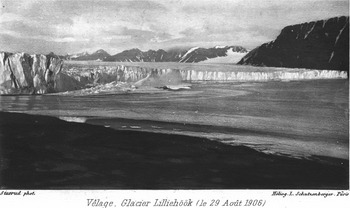
Calving from the Lilliehöökbreen, 29 August 1906. Photo: Arve Staxrud. During his research trip to Svalbard in July 2005, Prince Albert II of Monaco determined that this glacier front had retreated 6 km in a century.

On Prins Karls Forland, William Bruce and his two assistants had also been carrying out topographic work both in the interior and along parts of the coast. They had also been making meteorological observations, and assembling zoological, botanical and mineralogical collections (Bruce Reference Bruce1907, Reference Bruce1908, Reference Bruce1911).
As he had hoped, the artist Louis Tinayre was able to catch the beauty and the luminosity of the landscape in numerous drawings, canvases and pastels (Albert I of Monaco 1998: 142).
Once the men and materials of these two missions had been dropped off in Norway, Princesse-Alice returned to Le Havre, where she was moored to the quay by 19 September (Fig. 10).
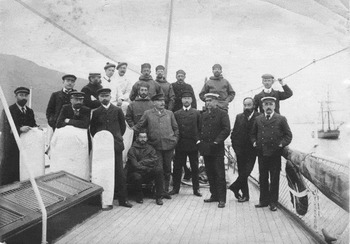
On board Princesse-Alice, September 1906. Seated: Horneman. Front row, left to right: Bourée, Richard, Portier, Hergesell, Isachsen, Prince Albert, Bruce and Carr. Back row, left to right: Fuhrmeister, Tinayre, Miller, Kerr, Loüet, Koller, Strengehagen, Myhre, Losvik and Staxrud. Photo: Henry Bourée (?).

From every point of view Prince Albert could be entirely satisfied with the intense, diverse activity that had been achieved over the course of these six weeks. He would emphasise that ‘these results pertained to all three fields: land, sea and atmosphere’ (Albert I of Monaco 1907b: 58).
Fourth Arctic cruise: 1907
Princesse-Alice sailed again from Le Havre on 16 June. Capitaine-de-frégate [Commander] Georges d'Arodes de Peyriague (1863–1927) had now taken the place of Captain Carr as the yacht's second-in-command. Dr. Richard, Professor Hergesell, Lieutenant-de-vaisseau Bourée and Louis Tinayre were once again on board. Another artist, an amateur but talented, would also come back from this voyage with a series of landscapes from Norway and Spitsbergen; this was Louis Mayer (1867–1941), one of the Prince's private advisers. Dr. Ferdinand Loüet was in charge of health services. This year's ice pilot was Johan Kjeldsen (1844–1909).
At the Prince's request, Isachsen had reduced the size of his team. He was accompanied by only one geologist, Adolf Hoel (1879–1964), who was starting a career largely devoted to the polar regions, and that would lead to his founding of the Norsk Polarinstitutt (Barr Reference Barr2003). The mission also included two non-commissioned officers, Alv Strengehagen and Karl Jakob Haavimb (1884–19??), as well as a female botanist, the latter representing a new departure for the Prince's cruises. A female artist, Jeanne Le Roux (1859–1898), had been welcomed aboard in 1896, but Madame Dieset (1873–1943) (née Hanna Marie Resvoll, and afterwards Resvoll-Holmsen) was the only female scientist included in one of the teams involved in Prince Albert's projects.
Once again Bruce benefited from the Prince's financial assistance, but he selected his projects and his landing sites quite independently. His team had increased in size, and included an experienced topographer, James Victor Burn Murdoch (1864–1924), Gilbert Kerr, who had participated in 1906, Stewart Ross (18??–19??) and a young Norwegian seaman, Johannes Svendsaas (18??–19??). Having left the south in mid-May Bruce and his team were landed on Prins Karls Forland on 11 June. They were to be joined by a veteran of polar voyages, Fredrik Hjalmar Johansen (1867–1913), who had accompanied Nansen on their amazing attempt at reaching the North Pole from Fram. Having been picked up by Princesse-Alice Johansen did not join the Scottish party until mid-August.
The pack ice extended unusually far south and this curtailed the length of the cruise and made working at sea quite difficult. Nonetheless the Prince and his team carried out oceanographic investigations, biological sampling, especially that of the plankton, and soundings that complemented the earlier data from Krossfjorden and permitted the mapping of the anchorages of Möllerhamna, Ebeltofthamna and Signehamna (Albert I of Monaco 1910a). Due to the inclement weather conditions, only a small number of pilot balloons and captive balloons could be released (Albert I of Monaco 1908). As in the previous year Dr. Richard took temperature measurements both at the surface and in a vertical series (Richard Reference Richard1908). These observations were all the more interesting in that the extent of the sea ice differed considerably between these two summers (Isachsen Reference Isachsen1908).
Visual depictions of the work were not confined to the drawings and canvases of Tinayre and Mayer. The movie camera and the still camera were used extensively. For the first time on a scientific expedition autochrome plates, recently perfected by the Lumière brothers, were used (Albert I of Monaco 1908: 1246).
The Norwegians completed their topographic studies of the glaciers and the coast. They measured 1500 angles from 120 stations and took 800 photos (Isachsen Reference Isachsen1907d, Reference Isachsen1912; Isachsen and Hoel Reference Isachsen and Hoel1913). The geologist collected numerous samples, especially of fossil fish; and particularly from a very rich site that he discovered near Woodfjorden (Schetelig Reference Schetelig1912; Hoel Reference Hoel1914). Plants collected by the botanist included phanerogams, vascular cryptogams and freshwater algae (Resvoll-Holmsen Reference Resvoll-Holmsen1913).
The Scots mapped the interior, the west coast and part of the east coast of Prins Karls Forland (Bruce Reference Bruce1908, Reference Bruce1911).
Despite the poor weather, the planned programme for this, Prince Albert's last voyage to the arctic regions, was successfully accomplished.
Achievements of Prince Albert's Arctic cruises
At a more general level, how may one assess the scientific balance sheet of these four expeditions to Spitsbergen? During all the Prince's cruises, the animals collected were initially sorted-out as soon as they were harvested, and then were classified according to the zoological groupings and entrusted to the best specialists, both French and foreign, for definitive examination. New species were described in specialist journals. In terms of monographs representing a synthesis of the expedition's results, the Prince created a series that bears the explicit title of Résultats des campagnes scientifiques, accomplies sur son yacht par Albert Ier, Prince Souverain de Monaco. Thus the marine fauna of Svalbard may be found in numerous volumes devoted, for example to Fish, Crustaceans or Echinoderms. The work of Gunnar Isachsen and his teams is also presented in five volumes of this series, the Résultats des campagnes scientifiques . . .
While William Bruce did not produce a comparable synthesis, he published numerous articles, especially in the journals of the Royal Geographical Society of London and of the Royal Scottish Geographical Society.
Cartography occupied an important place among all these publications. It was noted earlier that the map of Raudfjorden produced by Guissez, was published. The Isachsen mission's volumes contain 13 maps. The most important of these, production of which required several years of work by experts of the Norwegian Geographical Service, is the coloured map of the northwest coast of Spitsbergen (Albert I of Monaco 1910b). It is of particular interest in that it features names chosen by Guissez, Bruce, Isachsen and Bourée, often to honour Prince Albert, his scientific collaborators and his seamen. Thus, in these arctic regions one may find such toponyms, officially recognized, as Monacobreen, Grimalditoppen, Prinsesse Alicefjellet, Buchananhalvøya, Richardvatnet, Tinayrebreen, Redingerpynten and Cadiopynten. The northwestern part of Spitsbergen is now, of course, named Albert I Land in honour of the Prince.
Publication in 1913, of the map of Prins Karls Forland prepared by William Bruce benefited from Prince Albert's financial assistance (Bruce Reference Bruce1913; Bruce and Mathieson Reference Bruce and Mathieson1913). Another area of Spitsbergen, between Van Mijenfjorden and Agardhbukta, was mapped by the Swiss explorer Hermann Stoll (1882–1932), who was also subsidised by the Prince (Stoll Reference Stoll1914a, Reference Stoll1914b, Reference Stoll1914c).
Exploration and protection of the polar regions
The quality and range of the projects undertaken by Prince Albert in the arctic regions quickly earned him a reputation as an expert on polar questions. He was increasingly asked for advice, for the loan of materials, and for financial support, by those planning to explore both northern and southern regions (Carpine Reference Carpine2002: 246, 256, 260). The list of those of whom he thus became a patron is long: Jean Charcot (1867–1936) and Pourquoi-pas?, Adrien de Gerlache (1866–1934) and Belgica, William Bruce and Scotia, Charles Bénard (1867–1931) and Jacques-Cartier, the Canadian Arctic Expedition, Douglas Mawson (1882–1958) and Aurora, Raymond Rallier du Baty (1881–1978) and Curieuse, Ernest Shackleton (1874–1922) and Endurance, the Oxford University Expedition to Spitsbergen, and many others less well-known. Sometimes the Prince would extend his benevolence to welcoming those responsible for the oceanographic work during these polar expeditions to Monaco, so that they might familiarise themselves with the operation of the equipment he lent or gave. Jules Rouch (1884–1973) benefited in this fashion before Pourquoi-pas? sailed, as did Xavier Mertz (1884–1913) before Aurora put to sea.
Amidst the visits and meetings with others who shared his passion for polar exploration, and among the flow of letters and publications that he received, Prince Albert was certainly appreciative of the questionnaire sent to him by the German professor Hugo Conwentz (1855–1922), which focused on the protection of the Svalbard environment (Conwentz Reference Conwentz1912; Isachsen Reference Isachsen1915: 21). His responses are in perfect agreement with his actions over many years towards respecting natural sites, and in support of the creation of national and international reserves, and against the over-exploitation of marine resources (Albert I of Monaco 1913). Extracts from this questionnaire deserve to be quoted:
To the questions: ‘To what degree is Svalbard worthy of, and requiring of, protection? Do any particular dangers as regards conservation of natural sites result from Svalbard's neutral status’, the Prince replied: ‘On Svalbard the environment needs to be protected just as anywhere that man has gone to enrich himself or to satisfy his passions. In this case the neutral status cannot but harm the conservation of natural sites.’
He continued:
Operation of the mines will destroy many magnificent or impressive landscapes. The local animals are stupidly massacred by certain tourists whom cruise ships or yachts bring north. These unscrupulous and short-sighted people derive a stupid pleasure from shooting hundreds of inedible birds, reindeer whose carcasses are left lying, and seals whose bodies sink to the sea-bed. The sight of such behaviour is repugnant to any sensible person. It is all the more irritating, in that these animals have a natural trust that allows the intelligent tourist to wander among them, as if among animals in an ornamental park. The creation of reserves would certainly be very effective.
The Prince's prolonged sojourns in Svalbard were more than just scientific. It seems incontrovertible that Gunnar Isachsen's expeditions to the archipelago, the first two of which were undertaken with the assistance and under the auspices of the Prince, played a decisive role when an international treaty awarded sovereignty over the archipelago to Norway. And this fact was recalled with great emotion and sincere gratitude by botanist Hanna Resvoll-Holmsen in February 1920 (Resvoll-Holmsen Reference Resvoll-Holmsen1920).
Prince Albert expressed his profound impressions with regard to Svalbard as follows:
I experienced true joy in recapturing the intense melancholy of arctic scenes where body and soul become stronger in an awe-inspiring struggle, in pride in their power and in a serenity that one had lost since one's youth (Albert I of Monaco 1900b: f. 34 verso).
The Prince had not forgotten that from his youth he had dreamed of thus discovering the polar regions, both for personal satisfaction but also in the service of science ‘that force that transforms living conditions, peoples’ mentalities and international relations’ (Albert I of Monaco 1910c: 10).
Acknowledgements
On 11 and 12 May 2006, an event was held at the Musée océanographique, entitled ‘Journées commémoratives du centenaire des expéditions polaires du Prince Albert Ier.’ In the course of this conference, chaired by H.S.H. Prince Albert II, who also played an active role, one of the authors (JC-L) presented a paper entitled ‘Le Prince Albert Ier de Monaco et les régions arctiques.’ The present article represents a translation of this text (with minor amendments and additions) by the other author (WB).
We wish to thank Professor Jean Jaubert, Director of the Musée océanographique who granted permission to use the photographs that illustrate the article. We also wish to thank the anonymous referees of the paper for their critical input and for their suggestions for improvement, Marilyn Croot who produced the map, and the following individuals and institutions for supplying us with information and comments: Gunnhild and Olav Isachsen; Anita Brunschwiler (Stadtarchiv Schaffhausen, Switzerland); Daniela Josi and Thomas Germann (Club alpin suisse, Bern, Switzerland); Kjell-G. Kjær (Vannareid, Norway); Tor L. Larsen (Statsarkivet, Oslo, Norway); Nicole Momzikoff (Institut océanographique, Paris); Fred Inge Presteng (Norsk Polarinstitutt, Tromsø, Norway); Service central d’état civil du Ministère des Affaires étrangères (Nantes); Service historique de la Défense, Département Marine (Brest, Cherbourg, and Toulon, France); Cécile Thiery (Gland, Switzerland).