I. INTRODUCTION
Transition metals (TMs) form a tremendous variety of boride compounds ranging from boron-rich dodecahedron or icosahedral structures such as ScB12 and YB25 to metal-rich close-packed compounds such as W2B5 and TiB. From the larger family of boride compounds, the early TMs all form metal-rich refractory borides, Table I, 1–Reference Chung, Yang, Tolbert and Kaner21 although synthesis methods described herein are applicable to other boride compounds with different stoichiometries and structures, including ternary borides. From the larger family of metal-rich TM borides, the paper focuses on methods to produce Ti, Zr, and Hf diborides, which share the AlB2 structure with other TM diborides including CrB2, TaB2, and NbB2. The TM diborides have a complex mix of bond types resulting in a remarkable combination of metal-like and ceramic-like properties. Reference Ivanovskii22–Reference Vajeeston, Ravindran, Ravi and Asokamani25 The AlB2 structure consists of layers of close-packed metal atoms that alternate with boron in graphite-like sheets. Metallic bonding in the TM layers leads to high electrical (107 S/m for ZrB2) Reference Harrington, Hilmas and Fahrenholtz26,Reference Guo, Nishimura and Kagawa27 and thermal (∼130 W/m K for ZrB2) Reference Guo, Nishimura and Kagawa27−Reference Zhang, Pejaković, Marschall and Gasch29 conductivities, while strong covalent bonding in the B layers gives high hardness (∼33 GPa for TiB2) Reference Andrievski30 and elastic modulus (∼560 GPa for TiB2) Reference Basu, Raju and Suri31 values. Strong cohesion between TM and B layers is the result of complex bonding that includes ionic, hybridized covalent, and metallic character. Reference Zhang, Luo, Han, Li and Han32,Reference Lawson, Bauschlicher and Daw33 The same characteristics (high melting temperature, strong covalent bonds) that give TM boride compounds attractive properties also result in challenges related to producing high purity ceramics with high relative density. Reference Guo34 Based on their inherent properties, TM diboride compounds have the potential to withstand extreme environments such as those associated with hypersonic aerospace vehicles, rocket motors, scramjet engines, lightweight armor, high speed cutting tools, refractories for molten metal contact applications, plasma-facing materials for nuclear fusion reactors, and fuel forms for advanced nuclear fission reactors. Reference Wuchina, Opeka, Causey, Buesking, Spain, Cull, Routbort and Guitierrez-Mora35–Reference She, Zhan, Pang, Li and Yang46 These applications involve temperatures, heat fluxes, radiation levels, strain rates, and/or chemical reactivities that are beyond the capabilities of existing structural materials. Reference Wuchina, Opila, Opeka, Fahrenholtz and Talmy47 For example, the sharp leading edges of hypersonic aerospace vehicles are expected to experience temperatures of 2000 °C or higher and heat fluxes of more than 300 W/cm2, Reference Opeka, Talmy and Zaykoski48–Reference Gasch, Ellerby, Johnson and Bansal50 which are well beyond the capabilities of the current generations of Si-based structural ceramics and Ni-based superalloys. Realization of improved boron-based ceramics could enable revolutionary advances in these and other technologies leading to broad improvements in performance, operating lifetime, and/or efficiency.
Summary of composition, crystal structure, and properties of selected transition metal boride compounds.

*Calculated value and ?? indicates not stated in the reference.
a HfB is shown on phase diagrams including those by Rogl [Reference Rogl and Potter8] and Rudy [Reference Rudy9], but no property data or reports of synthesis were found for this compound.
Existing and future boron-based ceramics will find application in forms ranging from thin films to bulk structures. Reference Telle, Sigl, Takagi and Riedel51 Accordingly, different synthesis methods will best suit the different structures. For example, hard boride coatings for high speed cutting tools might best be synthesized and deposited by vapor phase methods, Reference Mayrhofer, Mitterer, Hultman and Clemens52 whereas liquid precursors would be preferred to produce ceramic matrices for continuous-fiber reinforced composites. Reference Xie, Zhou and Gou53 Other high temperature structural applications will require fabrication of bulk ceramics, which might be best accomplished by processes that combine reactive synthesis with densification. Reference Zhang, Liu, Wu, Zou, Ni, Guo, Liu, Wang, Fahrenholtz, Wuchina, Lee and Zhou54 Hence, a variety of methods are needed, some of which will only be capable of producing milligrams of material per day whereas others could produce kilograms of high purity ceramic powders.
The purpose of this paper is to review and evaluate methods used to synthesize TM diboride compounds. The focus is on refractory diborides of early TMs, but the same methods can be used to produce new boron-based ceramics with compositions, microstructures, and/or properties tailored for future applications.
II. HISTORIC REPORTS
Synthesis processes for TM diborides trace back to the late 1800s and early 1900s. Henri Moissan identified a number of boride compounds, Reference Moissan55,Reference Moissan56 including mentioning titanium boride in a study of the purification of titanium metal reported in 1895, Reference Moissan57 as part of his pioneering work using the electric arc furnace to produce compounds by fusion processes. In 1901, Tucker and Moody described the synthesis of zirconium boride by reaction of elements, although they assigned the formula Zr3B4 to their impure material. Reference Tucker and Moody58,Reference Tucker and Moody59 Likewise, Wedekind prepared impure borides by vacuum melting. Reference Wedekind60 One of the first reports of carbothermal reduction, Reaction 1 shown in Table II, to produce diborides was by McKenna who produced TiB2 and ZrB2 in 1936. Reference McKenna61 In contrast to the earlier papers on most other TM diborides, the first report of the synthesis of HfB2 was in 1931. Reference Agte and Moers62 Hafnium itself was not isolated until 1923, Reference Coster and Hervey63 which accounts for the delay in describing synthesis of HfB2 compared to other TM borides. While TM boride compounds were reported in this era, none of the materials were phase pure.
Example synthesis reactions for TM diborides.

Preparation of phase pure diborides was enabled by Kiessling's production of high purity boron in the late 1940s. Reference Kiessling64 This breakthrough led to the synthesis of a number of nominally pure TM diboride compounds, Reference Kiessling65–Reference Kiessling67 including zirconium diboride, Reference Kiessling68 by reaction of boron with elemental metals, Reaction 2, as well as later work on borothermal reduction of oxides, Reaction 3. Reference Peshev, Bliznakov and Leyarovska69–Reference Kuz'ma, Serebryakova and Plakhina73 Other methods such as reactions with boron carbide, Reactions 4 and 5, Reference Nelson, Willmore and Womeldorph74–Reference Meyer and Pastor76 metallothermic reduction, Reactions 6 and 7, Reference Thompson, Brotherson and Steinberg77,Reference Markovskii and Verkshina78 electrolysis of fused salts, Reaction 8, Reference Andrieux79,Reference Norton, Blumenthal and Sindeband80 and vapor phase methods, Reaction 9, Reference Agte and Moers62,Reference Roos81,Reference Gebhardt and Cree82 were also used to produce boride compounds. Through the 1950s and 1960s, research on diborides, particularly those of Ti, Zr and Hf, typically utilized commercially available powders. Reference Valentine, Jambois and Margrave83–Reference Kalish, Clougherty and Kreder85 Some of the exceptions were the phase equilibria studies by Rudy Reference Rudy, Windisch and Chang86 and the examination of borides of alkali, Reference Naslain, Etourneau, Hagenmuller and Markovich87 alkaline earth, Reference Naslain, Guette and Hagenmuller88 rare-earth, Reference Etourneau, Mercurio, Naslain and Hagenmuller89 or less–common TMs Reference Samsonov and Nesphor90 as well as studies of ternary and higher borides. Reference Rogl and Nowotny91,Reference Rogl and Nowotny92 This trend continues to hold true to the present time whereby the majority of studies of the more common diborides (e.g., TiB2, ZrB2, and HfB2) use commercial powders whereas self-synthesis is mainly used for other borides.
III. REDUCTION PROCESSES
Commercially available TM diboride powders are predominantly synthesized by carbothermal reduction of the corresponding TM oxides, Reaction 1. Reference Thomson and Freer93–Reference Schwarzkopf and Kieffer97 The resulting powders typically contain oxygen and excess carbon as impurities along with any metallic impurities present in the starting raw materials. For example, commercial ZrB2 is produced from naturally occurring zircon ores, which contain Hf as an impurity. Therefore, most commercial ZrB2 powders contain Hf. A recent analysis showed that a widely used commercial powder (H.C. Starck, Grade B) contained ∼1.7 wt% Hf, Reference Harrington, Lonergan, Fahrenholtz and Hilmas98 although the natural abundance of Hf in Zr-bearing minerals generally ranges from 1 to 5 wt% depending on the deposit. Reference Weast and Astle99 While the Hf impurities do not appear to have an effect on most properties, recent reports have shown that the presence of Hf has a strong, negative impact on thermal transport with thermal conductivity decreasing from ∼140 W/m K for ZrB2 with a Hf content of 0.01 at.% to ∼100 W/m K for ZrB2 with the natural abundance of Hf (0.33 at.%). Reference Lonergan, Fahrenholtz and Hilmas100 Likewise, the natural Hf content of ZrB2 reduces its heat capacity by about 15% compared to powders synthesized from Zr with lower Hf contents. Reference Lonergan, Fahrenholtz and Hilmas28
Carbothermal reduction of transition metal oxides by Reaction 1 only becomes thermodynamically favorable at elevated temperatures. For example, the standard state change in Gibbs' free energy (
 $\Delta G_{{\rm{rxn}}}^\circ$
) for the formation of ZrB2 by carbothermal reduction, Reaction 10, is given by Eq. (11), which shows that the reaction becomes favorable (i.e.,
 $\Delta G_{{\rm{rxn}}}^\circ$
is less than zero) above ∼1500 °C. In addition, carbothermal reduction reactions are highly endothermic (
 $\Delta H_{{\rm{rxn}}}^\circ = {\rm{1475\ kJ\ at\ 298\ K}}$
). As a result of these factors, carbothermal reduction reactions are carried out at elevated temperatures.
 $${\rm{Zr}}{{\rm{O}}_{{\rm{2(s)}}}}{\rm{ \;+\; }}{{\rm{B}}_{\rm{2}}}{{\rm{O}}_{{\rm{3(l)}}}}{\rm{ \;+\; 5}}{{\rm{C}}_{{\rm{(s)}}}}\, \to \,{\rm{Zr}}{{\rm{B}}_{{\rm{2(s)}}}}{\rm{ \;+\; 5C}}{{\rm{O}}_{{\rm{(g)}}}}$$
 $$\Delta G_{{\rm{rxn}}}^\circ = 1,430,600 - 803.25{\rm{T\ (J)}}$$
Similarly, other reactions that form transition metal borides from oxide precursors, Reactions 4 and 5, also become favorable at elevated temperature and are highly endothermic. Comparison of the values of
 $\Delta G_{{\rm{rxn}}}^\circ$
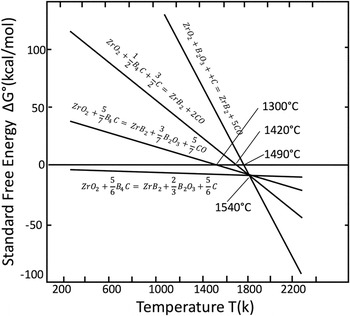
for Reactions 1, 4, and 5 normalized to the formation of one mole of ZrB2 shows that each becomes favorable between 1300 °C and 1500 °C, Fig. 1.
Reference Zhao, He and Jin101
Hence, selecting different precursors does not necessarily affect the temperature required for formation, but can impact the resulting particle morphology or reaction efficiency.
Standard state Gibbs' free energy of formation as a function of temperature for the synthesis of ZrB2 from [Reference Zhao, He and Jin101].

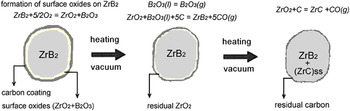
An interesting variation of carbothermal synthesis of borides has been utilized to densify TM diborides. Baik and Becher were the first to observe that densification of TiB2 was enhanced by decreasing the oxygen content of the starting powder. Reference Baik and Becher102 Subsequently, Chamberlain observed that ZrB2 containing WC impurities could be densified by pressureless sintering and attributed the enhanced densification to the removal of surface oxide impurities by reaction with WC. Reference Chamberlain, Fahrenholtz and Hilmas103 In addition, carbon, Reference Zhu, Fahrenholtz, Hilmas and Zhang104 carbides, Reference Zhang, Hilmas and Fahrenholtz105−Reference van de Goor, Sagesser and Berroth107 nitrides, Reference Li, Kim and Kang108,Reference Monteverde and Bellosi109 and combinations of these additives Reference Zhu, Fahrenholtz, Hilmas and Zhang110,Reference Sciti, Silvestroni, Medri, Monteverde, Fahrenholtz, Wuchina, Lee and Zhou111 have all been identified as sintering aids for TM diborides based on their ability to react with and remove oxide impurities from the surface of diboride powder particles. The mechanism for oxygen removal from ZrB2 was studied by Zhu et al. Reference Zhu, Fahrenholtz, Hilmas and Zhang104 and is summarized by the schematic in Fig. 2. Hence, carbothermal reduction reactions can not only be used to form boride or carbide phases, but can also be harnessed to enhance densification of pre-reacted TM diborides by removing surface oxide impurities that promote preferential coarsening rather than densification.
Schematic illustrating reactions responsible for removal of oxygen impurities from the surface of ZrB2 particles. Reference Zhu, Fahrenholtz, Hilmas and Zhang104

Both borothermal and boro/carbothermal reduction reactions can also be used to produce boride powders. The former involves a pure source of boron, which is usually more expensive than carbon and requires a higher reaction temperature. The main advantage of borothermal reduction is the purity of the final powders and the potential for achieving a fine particle size. Reference Guo, Yang and Zhang112 For example, borothermal reduction of HfO2 at 1100 °C, followed by washing with hot water and the removal of residual B2O3 at 1550 °C yielded powders with ∼0.56 wt% O2 and a particle size in the range of 0.5–1 µm. Reference Guo, Yang and Zhang112 Addition of excess B, whilst keeping the synthesis conditions the same, resulted in lowering of the O content to just 0.51 wt%. Other work on the densification of ZrB2–SiC ceramics with additional B also showed that the latter can reduce oxygen impurities and enhance the densification process. Reference Wang, Guo and Zhang113 High-purity ZrB2 powders with submicron particle size have also been synthesized by borothermal reduction of nanometric ZrO2 powders in vacuum. Reference Ran, Van der Biest and Vleugels114 The ZrO2 completely converted to ZrB2 at 1000 °C, but the removal of residual boron species required temperatures above 1500 °C. In addition, powders obtained at 1000–1200 °C were ∼150 nm and showed a faceted morphology, whereas those prepared above 1500 °C were coarser, typically ∼0.66 µm, with a nearly spherical morphology. The oxygen content of the ZrB2 powders synthesized at 1650 °C was as low as 0.43 wt%.
Carbo/borothermal reduction uses the combination of B4C and C as reducing agents. The temperature at which such reductions are initiated can be quite low, e.g., 1200 °C for ZrB2, Reference Sonber, Murthy, Subramanian, Kumar, Fotedar and Suri115 though to yield high-purity powders a higher heat treatment temperature was needed. The carbo/borothermal reduction reaction has also been exploited to promote densification of ZrB2 due to the ability of excess B4C to react with oxides and thereby reduce the amount of oxide impurities in the non-oxide ceramics. Reference Zhang, Hilmas and Fahrenholtz105
IV. REACTIVE PROCESSES
Direct synthesis and displacement reactions are also widely used to produce boride ceramics. Compared to oxides, starting from pure metals or metal compounds provides the ability to control impurity levels in the resulting ceramics. For example, a series of ZrB2 ceramics with Hf contents ranging from ∼0.01 at.% to 0.33 at.% were produced by reactive hot pressing. Reference Lonergan, Fahrenholtz and Hilmas100 Reactive processes can be used to design boride ceramics, particularly on the laboratory scale. Furthermore, reactive synthesis is routinely combined with densification into a single, in situ process to produce dense ceramics Reference Zhang, Deng, Kondo, Yang and Ohji116–Reference Fahrenholtz119 or fiber reinforced composites. Reference Chiang, Haggerty, Messner and Demetry120 Ceramics could be densified at a relative lower temperature by reactive sintering, as a result of the newly formed fine powder with a higher sinterability and a lower oxygen content, which was generated from these in situ reactions.
A. Direct reaction of elements, hydrides, or chlorides
The formation of transition metal boride compounds from elemental precursors (Reaction 2) is highly favorable. For example, the reaction of zirconium and boron to produce ZrB2 is thermodynamically favorable at room temperature
 $\left( {\Delta G_{{\rm{rxn}}}^\circ = - {\rm{319\ kJ\ at\ 298\ K}}} \right)$
and the process is highly exothermic
 $\left( {\Delta H_{{\rm{rxn}}}^\circ = - {\rm{323\ kJ\ at\ 298\ K}}} \right)$
. Because they are highly exothermic, these reactions also have extremely high adiabatic temperatures, T
ad. For the reaction of Zr and B to form ZrB2, T
ad is ∼3100 K. Previous empirical analysis has concluded that self-propagating high-temperature synthesis (SHS) can initiate for reactions when T
ad > 1800 K, indicating that an SHS reaction is likely for the reaction of TMs and B by Reaction 2. Although the latter is highly favorable at room temperature, kinetic limitations require elevated temperatures for the reaction to proceed. No ZrB2 was detected after attrition milling of Zr and B powders at a speed of 600 rpm up to 4h when the milling container remained at room temperature.
Reference Chamberlain, Fahrenholtz and Hilmas121
In this case, reaction required further heat treatment of milled powders at temperatures above 600 °C, but the reaction occurred over a broad range of temperatures. In contrast to the attrition milling studies, mechanical alloying using planetary milling at 250 rpm for 20 h in argon resulted in ZrB2 formation during milling.
Reference Wu, Zhang and Sakka122
However, the temperature inside the chamber was not monitored during milling. Together, these studies revealed that reducing the size of the elemental precursors reduced the onset temperature for reaction, as expected.
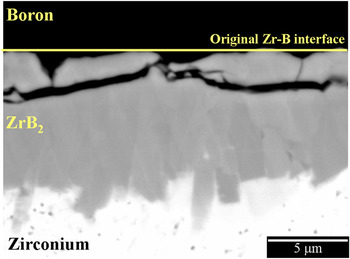
The reaction between TMs and B proceeds by diffusion of B atoms through the TMB2 reaction layer to react with the TM. Figure 3. Reference Chamberlain, Fahrenholtz and Hilmas121 The preferred diffusion path for B atoms is octahedral site (Oct)–basal bond center (Bc)–Oct, which was identified using nudged elastic band simulations. Reference Lee, Vlassak and Zhao123 The latter also revealed that the Oc–Bc–Oct mechanism had a lower energy by a factor of ∼20 compared to the next most favorable process. Building on these findings, the morphology of TMB2 produced by Reaction 2 is strongly influenced by the shape and size of starting TM powder particles. As shown in Figs. 4(a) and 4(b), ZrB2 with spherical morphology was synthesized directly from elements using precursors with sizes in the range of 200 nm–1 µm. Reference Chamberlain, Fahrenholtz and Hilmas121,Reference Wu, Zhang and Sakka122,Reference Chamberlain, Fahrenholtz and Hilmas124 Anisotropic grain growth can be promoted through additions to the starting powder mixture. For example, ZrB2 grains showing preferred growth along the a- and/or b-axes was achieved by adding Si and a TM such as Mo, Nb, Ti, or W into the initial Zr and B powder mixture, Fig. 4(c). Reference Hu, Zou, Huang, Zhang, Guo and Sakka125 Not only can reactive methods help control the shape of the particles, but they also provide control over particle size.
Cross section of the reaction front for boron (black at top of image) reacting with zirconium (white at bottom of image) to form ZrB2 (gray in the middle of the image) from [Reference Chamberlain, Fahrenholtz and Hilmas121].

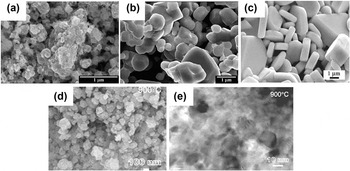
Morphology of ZrB2 powders synthesized from (a) attrition milled Zr–B mixtures followed by heat treatment at 600 °C for 6h, 124 (b) attrition milled Zr–B mixtures followed by heat treatment at 1650 °C for 1h, 124 (c) mixed of Zr, B, Si, and W powders heat treated at 1550 °C for 30 min in argon, Reference Hu, Zou, Huang, Zhang, Guo and Sakka125 and (d) and (e) mixed ZrH2 and B heated to 900 °C. Reference Guo, Hu and Kagawa128

Because they are brittle, the size of B particles can be reduced by conventional milling processes. Reference Jung, Sohn, Sung, Hyun and Shin126 In contrast, milling of ductile TM particles typically results in the formation of thin platelets or flakes due to the strong shearing forces during attrition or planetary milling. Reference Chamberlain, Fahrenholtz and Hilmas121,Reference Fahrenholtz127 Extended milling times can result in the incorporation of impurities from the milling media, which can affect the reactions, densification behavior, and properties of the resulting ceramics. To reduce milling times and, therefore, limit impurity incorporation, brittle compounds such as TM chlorides, Reaction 9, or hydrides, Reaction 13, can be used as precursors for synthesis reactions. Reference Guo, Hu and Kagawa128,Reference Ran, Van der Biest and Vleugels129
 $${\rm{TM}}{{\rm{H}}_{{\rm{2(s)}}}}{\rm{ \;+\; 2}}{{\rm{B}}_{{\rm{(s)}}}}\, \to \,{\rm{TM}}{{\rm{B}}_{{\rm{2(s)}}}}{\rm{ \;+\; }}{{\rm{H}}_{{\rm{2(g)}}}}$$
Thermodynamically, ZrH2 can be spontaneously dehydrogenated to metallic Zr during heating. In the standard state (assuming unit activity for condensed phases and a partial pressure of 101 kPa for H2), the decomposition of ZrH2 is favorable above ∼975 °C. Because the partial pressure of hydrogen is typically drastically lower than 101 kPa, the reaction can become favorable at much lower temperatures. For example, the change in Gibbs' free energy for dehydrongenation becomes negative at ∼510 °C under 10 Pa of H2 gas. In the presence of B, Reaction 13, the formation of ZrB2 is favorable across a broad range of temperatures regardless of the partial pressure of H2, indicating that ZrB2 formation should occur simultaneously with ZrH2 decomposition as compared to a sequential process in which ZrH2 decomposes at one temperature followed by ZrB2 formation at a second higher temperature. Ran Reference Ran, Van der Biest and Vleugels129 and Guo Reference Guo, Hu and Kagawa128 separately observed that ZrH2 dissociation occurred between 600 °C and 1300 °C, depending on the particle size of ZrH2 and the decomposition conditions. Kinetically, dehydrogenation of ZrH2 follows occurs in steps (e.g., ZrH2 → ZrH m (m < 2) → Zr), which results in separate endothermic peaks at 700 °C and 1300 °C in differential scanning calorimetry. Reference Guo, Hu and Kagawa128 Guo's conclusion was that ZrB2 formation occurred in steps whereas Ran hypothesized that dehydrogenation and reaction occurred in a single step at a fixed temperature. Heating rate may also have an effect on reaction. Heating ZrH2–B mixtures at 10 °C/min to 900 °C resulted in the formation of ZrB2 with a primary crystallite size of 5–20 nm, Figs. 4(d) and 4(e). Reference Guo, Hu and Kagawa128 Together, previous studies show that TMB2 with high purity can be formed by synthesis from metals or hydrides and that these processes provide control over particle size and shape.
Unlike TMH2 compounds, TMCl4 sublimes prior to decomposition. For ZrCl4, sublimation is favorable above ∼340 °C for standard state conditions. In typical synthesis processes, powder mixtures will be heated in vacuum or inert atmosphere, which will shift sublimation to even lower temperatures. Although thermodynamic calculations show that reaction between solid ZrCl4 and B is favorable below 300 °C, TMB2 powders have not been reported to be produced by direct reaction of solid chlorides with B. In addition to the vapor phase routes, TMCl4 compounds can readily hydrolyze to oxides (TMO2) or oxychlorides (TMOCl2), which can then react with B in the solid state. For example, Guo produced ZrB2 powders consisting of plate-like particles and whiskers by reaction of hydrolyzed ZrCl4 at 1200 °C. Reference Guo, Ping and Kagawa130
Chemical exchange (metathesis) reactions have also been used to produce borides from transition metal halides. Operating in a similar manner to SHS reactions discussed above, the basic form of the reaction is: AB + CD → AC + BD. Borides have been produced, for example, by reaction of a transition metal chloride with MgB2. Reference Parkin131–Reference Gillan and Kaner133 In general, such metathesis reactions can yield rapid, highly exothermic reactions with temperatures >1000 °C on very short time scales of <1 s. The products are often crystalline and single phase with crystallite sizes varying from tens of angstroms to a few microns, depending on the refractory nature of the material and the reaction conditions (i.e., scale and the use of inert additives). For the reaction between TMCl4 and MgB2, it has been reported to occur above 650 °C in an evacuated silica tube. However, apart from TMB2 and MgCl2, boron was also detected in addition to the TMB2 and MgCl2 so these routes can struggle to yield phase pure products. Reference Parkin131
To summarize this section, direct synthesis reactions have been widely used to produce TM boride ceramics. Precursors can include metals, TM hydrides, or TM compounds. These routes are highly advantageous on the laboratory scale due to the ability to control the purity of the resulting ceramic powders in addition to providing compositional flexibility and reduced particle sizes. These reactions tend to be highly exothermic, but SHS type-reactions can be inhibited by adding inert diluents or using slow heating rates. Further development of appropriate precursors and control of process parameters would be necessary to extend these methods to practical powder production routes on larger scales.
B. Displacement reactions
Displacement reactions are another common method used for in situ synthesis of ceramics and composites. Reference Fahrenholtz119 These reactions offer the same advantages as direct synthesis reactions (e.g., low temperatures, high purity, control of particle morphology), but often using less costly or more stable precursors. The section below separately considers reactions involving TM metals and TM compounds such as carbides or nitrides.
Pure TMs can react with B-containing inorganic compounds. Some examples of reactions, thermodynamic favorability, and reaction conditions for the production of ZrB2-containing materials are summarized as Reactions 14–22 in Table III. Reference Licheri, Orrù, Musa and Cao134–Reference Qu, Han, Han, Zhang and Hong142 Reaction 14 has been widely investigated to produce ZrB2–SiC ceramics. Reference Zhang, Deng, Kondo, Yang and Ohji116,Reference Zimmermann, Hilmas, Fahrenholtz, Monteverde and Bellosi143–Reference Zhao, Wang, Zhang, Jiang and Chen145 When batched according to the reaction stoichiometry, the reaction produces 74.9 vol% ZrB2 and 25.1 vol% SiC, although the ratio can be adjusted by adding either ZrB2 or SiC into the precursors. Reference Zhang, Deng, Kondo, Yang and Ohji116 Furthermore, the ratio of the precursors can be altered as described by Reaction 15 to introduce ZrC as a reaction product. Reference Wu, Zhang, Kan and Wang146 Likewise, HfB2 ceramics containing 22 vol% SiC and 5 vol% ZrC can be synthesized below 1200 °C from a mixture of Hf, Si, and B4C. Reference Monteverde147
Synthesis reactions,
 $\Delta G_{{\rm{rxn}}}^\circ$
at 300 K, and reaction conditions for the formation of ZrB2-containing ceramics by displacement reactions using Zr as a precursor.

Overall, Reaction 14 leads to the formation of ZrB2 and SiC. However, analysis of the reaction path revealed that ZrC formed prior to ZrB2 as an intermediate product at temperatures as low as 800 °C. Reference Wu, Zhang, Kan and Wang146 The preferential formation of ZrC at moderate temperatures was attributed to the lower activation energy for diffusion of C in Zr (∼75 kJ/mol) compared to diffusion of B in Zr (∼145 kJ/mol). Reference Qu, Han, Han, Zhang and Hong142 Qu et al. suggested that the intermediate carbide was carbon-deficient (e.g., ZrC x with x < 1) due to diffusion limitations during reaction. Reference Qu, Han, Han, Zhang and Hong142 Similarly, ZrC x was also formed by incorporating excess Zr into ZrC. Reference Breval and Johnson140 Above 1100 °C, x-ray diffraction (XRD) analysis suggested that the amount of ZrC decreased gradually with increasing temperature, indicating that ZrC reacted with residual B4C and Si to form ZrB2 and SiC, Reaction 22. By 1500 °C, ZrB2 formation was complete, but ZrC could be retained in the final powder mixture depending upon the Zr to B4C ratio, Reaction 15.
The kinetics of Reaction 14 and 15 can be manipulated by controlling the processing conditions. Reference Qu, Han, Han, Zhang and Hong142,Reference Wu, Zhang, Kan and Wang148,Reference Wu, Zhang, Kan and Wang149 During SHS reactions ignited by rapid heating of Zr–Si–B4C mixtures, Reaction 14 appeared to proceed in one step. Reference Wu, Zhang, Kan and Wang149 Particle size also had an effect on reaction as demonstrated by Wu et al. who observed an increase in gas pressure at ∼900 °C during heating of fine Zr and B4C, while no pressure change on vacuum was monitored for coarse powders. Reference Wu, Zhang, Kan and Wang148 Interestingly, densification behavior also benefited from the lower reaction temperature as dense ZrB2–SiC–ZrC ceramics were produced at 1600 °C for fine powders compared to temperatures at least 200 °C higher for reaction of coarse powders. Reference Wu, Zhang, Kan and Wang148
In a variation of SHS, Reaction 15 has been ignited using an infrared lamp as a heat source. Reference Wu, Zhang, Kan and Wang149 Combustion could be ignited when the Zr–B4C–Si mixture was heated in air, but not in argon. Interestingly, the powders produced by combustion in air had a lower oxygen content (0.4 wt%) than typical commercial powders, which contain 1 wt% oxygen or more. Analysis showed that the infrared lamp only heated the powder surface to ∼100 °C in air or in argon, so ignition of the SHS reaction was attributed to the exothermic oxidation of Zr when powders were heated in air. Reference Wu, Zhang, Kan and Wang149 Similarly, ZrB2–ZrC powders were synthesized by SHS that was ignited by exposing finely ground Zr–B–C powder mixture to air at room temperature. Reference Tsuchida and Yamamoto150,Reference Tsuchida and Yamamoto151 After SHS, the powders are typically agglomerated, although deagglomeration can be achieved by ball milling. In addition, powders produced by SHS can exhibit better sinterability compared to conventional powders due to finer particle size or increased defect concentrations. Reference Qu, Han, Han, Zhang and Hong142
In another variation, replacing the Si in Reaction 14 with Si3N4 results in production of ZrB2–SiC ceramics that also contained BN, Reaction 19. Reference Wu, Xiao, Estili, Zhang and Sakka152 These ceramics had an excellent combination of high strength (>600 MPa) and machinability. Additional variations in precursor chemistry and the resulting phases are summarized in Reactions 23–25. Similarly, TM carbides (TMC) and TM nitrides (TMN) can also be used as precursors for the preparation of TMB2-based ceramics. Thermodynamic analysis indicates that neither TM carbides nor TM nitrides are stable in contact with boron compounds at elevated temperatures. Reactions 22–24 are representative displacement reactions for synthesis of ZrB2-based ceramics from carbide and nitride precursors.
 $${\rm{TMC \;+\; 6B}}\, \to \,{\rm{TM}}{{\rm{B}}_{\rm{2}}}{\rm{ \;+\; }}{{\rm{B}}_{\rm{4}}}{\rm{C}}$$
 $${\rm{TMN \;+\; B}}\, \to \,{\rm{TM}}{{\rm{B}}_{\rm{2}}}{\rm{ \;+\; BN}}$$
 $${\rm{4TMN + 3}}{{\rm{B}}_{\rm{4}}}{\rm{C + 3Si}}\, \to \,{\rm{4TM}}{{\rm{B}}_{\rm{2}}}{\rm{ \;+\; 3SiC + 4BN}}$$
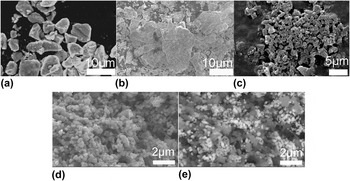
Rapid heating of the precursors for Reactions 23–25 can result in ignition of SHS reactions between 1300 °C and 1400 °C. Reference Zou, Huang, Vanmeensel, Zhang, Vleugels and Van der Biest153,Reference Zou, Liu, Zhao, Zhang, Huang, Qian, Vleugels, Van der Biest and Shen154 In general, an SHS reaction produces local extreme temperatures (e.g., approaching T melt for one or more of the product phases) for a short duration (e.g., a few seconds). As a result, fine powders produced by SHS can be partially sintered, which produces hard agglomerates and decreases sinterability. Reactions 23–25 are classified as “mild” SHS reactions because T ad is below 1800 °C. Reference Zou, Huang, Vanmeensel, Zhang, Vleugels and Van der Biest153 As a consequence, the resulting ZrB2–B4C powder mixtures can be densified below 1800 °C. Reference Wu, Zhang, Kan and Wang148 Not only can displacement reactions be used to produce sinterable powders, but the reactions can also provide increased control over the morphology of the resulting powders, Fig. 5. Reference Zou, Liu, Zhao, Zhang, Huang, Qian, Vleugels, Van der Biest and Shen154 Although the mechanisms have not been confirmed, the authors speculated that nucleation of the product phases at defects in the coarse precursor particles resulted in a substantial reduction in the size of the resulting powders compared to the size of the precursors. Reference Zou, Liu, Zhao, Zhang, Huang, Qian, Vleugels, Van der Biest and Shen154 Similar reductions in grain size were observed for synthesis of TiB2–B4C ceramics. For example, Reaction 23 was used to synthesize particles with an average size of ∼50 nm at 1200 °C and to produce ceramics in the Ti–B–C system. Reference Wang, Ran, Shen, Sun and Huang155,Reference Vallauri, Atías Adrian and Chrysanthou156
Morphologies for starting (a) Si, (b) ZrN, and (c) B4C powders and the resulting ZrB2–SiC–hBN materials shown in (d) secondary electron and (e) scattering modes showing significant reduction in particle size after synthesis. Reference Zou, Liu, Zhao, Zhang, Huang, Qian, Vleugels, Van der Biest and Shen154

Both TiB2 and ZrB2 have also been formed at room temperature via the mechanical milling of a mixture of Mg, B2O3 and the corresponding TM oxide under vacuum and argon, respectively, for up to 15 h in a laboratory scale ball mill. Reference Welham157,Reference Setoudeh and Welham158 XRD analysis showed increasing conversion with milling time, eventually leading to phase-pure borides as detected by XRD. For ZrB2, differential thermal analysis revealed multiple overlapping reactions, all of which seemed to be related to TM boride formation. After milling, separation of the boride from the MgO co-product was achieved by a mild acid leaching, leaving essentially pure boride powders with crystallite sizes of <100 nm. Similar results were obtained for TiB2 by Ricceri et al. using high-energy ball milling for ∼1 h. Reference Ricceri and Matteazzi159 They hypothesized that two nearly simultaneous thermite reactions occurred, one between TiO2 and Mg and the other between B2O3 and Mg; the first provided sufficient heat to ignite the second. These reactions were immediately followed by reaction between elemental Ti and B to provide TiB2. XRD revealed a gradual decrease in crystallite size of the reactant TiO2, with the formation of intermediate reaction products followed by a near–instantaneous reaction that produced mainly MgO and TiB2 as final products. Intermediate reaction products, such as less stable borides, were retained for shorter milling times, but TiB2 and MgO were the only products for milling times of 2 h. After the removal of MgO by leaching in dilute HCl, pure TiB2 was obtained with a typical molar yield of 81%. The powders were impact-welded aggregates composed of 50–100 nm particles. It is possible that a similar approach could also lead to the self-propagation formation of ZrB2.
Overall, displacement reactions are a highly attractive synthesis route for multiphase ceramics. Displacement reactions afford the ability to produce TM boride-based ceramics containing additional hard phases such as SiC, ZrC, or B4C that limit grain growth and improve physical and/or mechanical properties. In addition, precursors can also be designed to produce phases such as BN that improve fracture toughness or machinability. Hence, displacement reaction-based processes can be used to tailor the composition, microstructure, and properties of TM boride ceramics.
V. CHEMICAL SYNTHESIS
A broad range of chemical synthesis methods have been used to produce boride powders on the laboratory scale when highly pure and/or extremely fine particles are needed. For comparison to the methods discussed in previous sections, reduction-based processes, which are predominantly used for commercial synthesis of boride powders due to simplicity and low cost, yield coarse particles with low sinterability. Reference Segal160 Considerable grinding is required for particle size reduction, which can result in the incorporation of impurities. Likewise, the size of the end product for reaction-based processes depends on the size of the precursors; thus they are usually milled before reaction. Hence, research that aims to produce highly pure and/or extremely fine powders typically utilizes chemical synthesis routes. In addition to synthesis solely involving chemical processes, this section discusses hybrid processes that combine chemical (typically solution) routes with other processes such as direct reactions or carbothermal reduction.
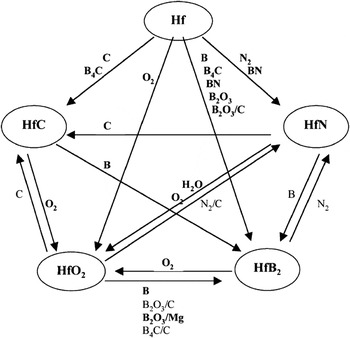
Figure 6 Reference Blum and Kleebe161 summarizes the broad range of reactions for synthesis of HfB2, several of which are possible below 1500 °C. Various reactions other than borothermal and carbothermal reduction reactions, using elemental Hf or its carbide or nitride, lead to successful synthesis. These reactions allow for use of combinations of polymeric precursors and reactive powders to synthesize group IV metal borides. All of the reactions need to be considered during design and development of practical precursor processing as intermediate reactions and their products may play a key role in obtaining the desired phases and microstructures.
Chemical reactivities of Hf and Hf-based compounds. Reactions with reagents marked in bold letters proceed (at least partially) at 1500 °C or below. The rest require higher temperatures, e.g., borothermal, carbothermal, and carbo/borothermal reduction reactions. Additional reaction products within each of the reactions (if present) are omitted. Diagram based on Figure 14 in Ref. Reference Blum and Kleebe161.

Most chemical routes involve reactions between TM-containing and B-containing precursors. For example, a principle synthesis route for TiB2 involves reduction of titanium tetrachloride and a boron halide at ∼1500 °C, Reaction 26, although the solid diboride product requires grinding. Reference Segal160
 $${\rm{TiC}}{{\rm{l}}_{{\rm{4(g)}}}}{\rm{ \;+\; 2BC}}{{\rm{l}}_{{\rm{3(g)}}}}{\rm{ \;+\; 5}}{{\rm{H}}_{{\rm{2(g)}}}}\, \to \,{\rm{Ti}}{{\rm{B}}_{{\rm{2(s)}}}}{\rm{ \;+\; 10HC}}{{\rm{l}}_{{\rm{(g)}}}}$$
Boride powders can also be formed by decomposition of borohydrides. Ti(BH4)3 was first synthesized as long ago as 1949 by passing TiCl4 vapor over lithium borohydride, Reaction 27, Reference Hoekstra and Katz162 whilst nearly a decade later Ti(BH4)3 was prepared by bubbling diborane, B2H6, through a titanium butoxide solution in tetrahydrofuran. Reference Reid, Bish and Brenner163 Interestingly, Ti(BH4)3 decomposes at ∼140 °C when dissolved in xylene, Reaction 28. Reference Gallagher, Rhine, Bowen, Mackenzie and Ulrich164 Whilst the resulting powder was agglomerated, it had a high chemical purity and a particle size in the range of 100–200 nm.
 $${\rm{2TiC}}{{\rm{l}}_{\rm{4}}}{\rm{ \;+\; 8LiB}}{{\rm{H}}_{\rm{4}}} \to {\rm{2Ti(B}}{{\rm{H}}_{\rm{4}}}{{\rm{)}}_{\rm{3}}}{\rm{ \;+\; 8LiCl \;+\; }}{{\rm{B}}_{\rm{2}}}{{\rm{H}}_{\rm{6}}}{\rm{ \;+\; }}{{\rm{H}}_{\rm{2}}}$$
 $${\rm{2Ti(B}}{{\rm{H}}_{\rm{4}}}{{\rm{)}}_{\rm{3}}}\, \to \,{\rm{2Ti}}{{\rm{B}}_{\rm{2}}}{\rm{ \;+\; }}{{\rm{B}}_{\rm{2}}}{{\rm{H}}_{\rm{6}}}{\rm{ \;+\; 9}}{{\rm{H}}_{\rm{2}}}$$
Nanocrystalline ZrB2 and HfB2 have been synthesized by Reaction 29 at temperatures of 500–700 °C and 600 °C, respectively, using a hydrothermal reaction in an autoclave. Reference Chen, Gu, Yang and Qian165,Reference Chen, Gu, Shi, Yang, Ma and Qian166 These studies make no mention of the purity of the final powder, which is a concern because sodium-bearing compounds are usually not ideal for producing engineering ceramics since the presence of alkali metals is detrimental to the subsequent properties. Nevertheless, these are amongst the lowest synthesis temperatures reported for these borides via an elevated temperature reaction. The particle sizes were reported to be as fine as 10–25 nm in both cases. Reference Chen, Gu, Yang and Qian165,Reference Chen, Gu, Shi, Yang, Ma and Qian166
 $${\rm{TMC}}{{\rm{l}}_{{\rm{4(g)}}}}{\rm{ \;+\; NaB}}{{\rm{H}}_{{\rm{4(g)}}}}\, \to \,{\rm{TM}}{{\rm{B}}_{{\rm{2(s)}}}}{\rm{ \;+\; 2NaC}}{{\rm{l}}_{{\rm{(s)}}}}{\rm{ \;+\; 3}}{{\rm{H}}_{{\rm{2(g)}}}}$$
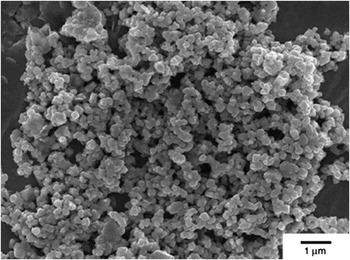
Boride powders have also been synthesized via sol–gel processing followed by carbothermal reduction. Molecular level mixing in the liquid form allows transformation to the final product at lower temperatures than by many other routes with improved homogeneity of the final product. Yan et al. prepared high-purity ZrB2 with particle sizes from 100 to 200 nm, Fig. 7, using inorganic–organic hybrid precursors of zirconium oxychloride (ZrOCl2·8H2O), boric acid and phenolic resin as sources of zirconia, boron oxide and carbon, respectively. Reference Yan, Huang, Dong and Jiang167 The reactions were substantially completed at the relatively low temperature of ∼1500 °C. The synthesized powders had a smaller average crystallite size (<200 nm), larger specific surface area (∼32 m2/g1), and lower oxygen content (<1.0 wt%) than for many commercially available ZrB2 powders. Ultrafine TiB2 powders have also been prepared by sol–gel processing with tetrabutyl titanate, boric acid and phenolic resin as the solution precursors. Reference Yan, Huang, Dong and Jiang168 The carbothermal reduction reactions were substantially completed below 1400 °C. At temperatures below 1100 °C, titanium carbide was the predominant phase and the resulting products consequently had a fine average crystallite size of <200 nm. A sol–gel mixture of HfCl4, H3BO3, and phenolic resin was used to obtain intimately mixed, yet unreacted, HfO2, B2O3, and C, which was calcined to produce HfB2. Reference Venugopal, Paul, Vaidhyanathan, Binner, Boakye, Keller, Mogilevsky, Katz and Brown169 Usually this approach results in minor impurities such as HfO2, HfC, and B4C in the final product; in this study the ratios of the different precursors were optimized to obtain HfB2 powder with negligible impurities. Calcination at temperatures as low as 1300 °C produced HfB2, but required 25 h to form pure phase HfB2. The long dwell time gave rise to a significant fraction of rod shaped particles, with screw dislocation driven growth occurring along the c-axis. Reference Venugopal, Jayaseelan, Paul, Vaidhyanathan, Binner and Brown170 The use of a higher calcination temperature avoided this problem.
SEM image of a ZrB2 powder synthesized by a sol–gel route involving carbothermal reduction at 1500 °C for 1 h. Reference Yan, Huang, Dong and Jiang167

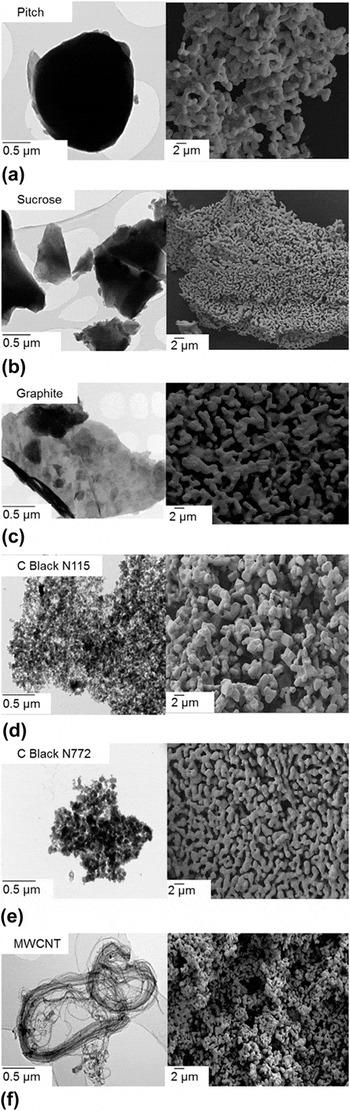
Carbon sources with different structures were studied to produce HfB2 particles with different size and morphology using HfCl4 and H3BO3 as precursors. The carbon sources included liquid phenolic resin, phenolic resin powder, pitch, sucrose, graphite, carbon black, and carbon nanotubes. Reference Venugopal, Paul, Vaidhyanathan, Binner, Heaton and Brown171 In general, the structure and level of agglomeration of the carbon source influenced the particle size of HfB2 powder, Fig. 8. For example, carbon black and carbon nanotube precursors produced HfB2 particles whose size directly depended on the level of agglomeration of carbon sources whilst, on pyrolysis, the liquid phenolic resin, sucrose, graphite and powder phenolic resin all resulted in sheet-like carbon that engulfed the ceramic particles. Finer and more dispersed sheets produced finer and less agglomerated HfB2 particles. The finest HfB2 powder was obtained when using phenolic resin powder as the carbon source, which resulted in a final particle size between 30 and 150 nm with a surface area of 21.8 m2/g1.
Transmission electron microscopy images of the carbon structures (left) resulting from the pyrolysis of different carbon sources at 1000 °C for 0.1 h and the corresponding scanning electron microscopy images of the resultant HfB2 powders after heat treatment at 1600 °C for 2 h using (a) pitch, (b) sucrose, (c) graphite, (d) C-Black N115, (e) C-Black N772, and (f) multi-walled carbon nanotubes. Reference Venugopal, Paul, Vaidhyanathan, Binner, Heaton and Brown171

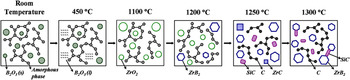
Duplex submicron ZrB2–SiC powders have been synthesized in situ via a combined sol–gel and microwave boro/carbothermal reduction route, Fig. 9. Reference Cao, Zhang, Li, Lu and Zhang172 Additives such as SiC, MoSi2, LaB6, WC, TaC, TaSi2, and TaB2 are commonly used to improve the performance of TM borides in high temperature applications, Reference Xie, Sanders and Speyer173–Reference Levine and Opila176 although they are typically added as a second phase during powder processing. Reference Monteverde177–Reference Williams, Sakidja, Perepezko and Ritt180 The most widely studied additive is SiC, which reduces the oxidation rate of TM borides by forming a borosilicate layer on the surface during oxidation at temperatures below 1600 °C. Reference Fahrenholtz and Hilmas181–Reference Opila and Halbig183 Using chemical methods, the optimum molar ratios were determined to be n(B)/n(Zr) = 2.5 and n(C)/n(Zr + Si) = 8. Chemical synthesis reduced the calcination temperature to only 1300 °C, which was ∼200 °C lower than conventional methods. Examination of microstructures and phase morphologies revealed a mixture of particles with three different chemistries, morphologies, and sizes. A sizeable fraction of 1–2 µm columnar ZrB2 grains were in a matrix consisting of ∼500 nm granular particles mixed in with numerous <100 nm particles. Both of the latter contained Zr, B, Si, and C, which was interpreted to be a ZrB2–SiC composite powder in which SiC grains were distributed evenly amongst ZrB2 grains. ZrB2–SiC duplex powders with different morphologies have also been synthesized from amorphous hydrous ZrO2–SiO2 produced by precipitation and sol–gel processing. Reference Zhao, Zhang, Li, Yang, Wang, Hu, Sun, Li, Yin, Feng and Sato184 Calcining at 1500 °C resulted in the formation of the desired phases. The powder derived from the precipitation route consisted of rod-like ZrB2 with smaller, irregular SiC particles adhering to them while the sol–gel route yielded equiaxed particles in which both ZrB2 and SiC were evenly distributed.
Schematic of the phase evolution in the powders prepared via sol–gel and microwave boro/carbothermal reduction process. Reference Cao, Zhang, Li, Lu and Zhang172

Chemical synthesis routes have also been used to produce TM borides doped with group IV and V metals. Dopants have been shown to modify the morphology of the crystalline phase in the oxide scale and reduce the oxygen permeation rate. Reference Avilés, Córdoba, Sayagués, Alcalá and Gotor185–Reference McClane, Fahrenholtz and Hilmas187 Dopants such as Ti, Nb, and Ta, form continuous solid solutions with ZrB2, Reference Post, Glaser and Moskowitz188,Reference Otani, Aizawa and Kieda189 with solid solution formation limited by diffusion of TM atoms. Hence, activation energies for metal diffusion correlate to the ease of forming a solid solution. Activation energies are 112 kJ/mol for ZrB2–TiB2, 175 kJ/mol for TiB2–NbB2 and 400 kJ/mol NbB2–CrB2, which have atomic radii differences of 1% for Ti and Nb; 9% for Zr and Ti; and 13% for Nb and Cr. Reference Fahrenholtz, Hilmas, Talmy and Zaykoski190 Note that the latter does not form a continuous solid solution. Uniform distribution of the dopants is desired and chemical synthesis routes are more successful for introducing dopants than solid state mixing techniques. For example, when milling was used to mix commercially available ZrB2 and TaB2 powders, samples required hot pressing at 1900–2000 °C. Reference Levine and Opila176 In contrast, Xie used tantalum ethoxide and zirconium n-propoxide dissolved into solution in 2,4-pentanedione to produce precursors that converted to solid solution (Zr, Ta)B2 powders at only 1600 °C due to the homogeneous distribution of the metal cations. Reference Xie, Sanders and Speyer173 Co-precipitation is another approach that promotes distribution of dopants in boride powders, though this requires precise control of the pH values to precipitate the dopant and matrix simultaneously. Jiang Reference Jiang, Li, Zhang, Zhao, Li and Feng191 used this route to synthesize ZrO2–WO3 precursors that were subsequently reacted with amorphous boron at 1550 °C to produce W-doped ZrB2 powders with a mean particle size of ∼400 nm. Besides borides and W, chemical synthesis has also been used to dope other Group IV and V refractory metal compounds, such as TaSi2, TaC, and WC, into HfB2 and ZrB2. Reference Talmy, Zaykoski and Opeka192–Reference He, Zhang, Han, Hu and Hong196 These carbide and silicide dopants can be partially reduced by boron and become mutually soluble with the host matrices, hence modifying the crystalline phase in the oxide scale as for the additions of one boride to another.
Chemical synthesis routes are attractive due to the ability to control the purity and particle size of the resulting TM boride powders. In addition, these methods can be used to uniformly distribute second phases or dopants at temperatures significantly lower than conventional powder process. Although these methods are only used at the laboratory scale presently, they have the potential for widespread use in applications that demand uniform, highly sinterable powders with controlled compositions.
VI. SUMMARY AND OUTLOOK
Synthesis methods for boride ceramics have been reviewed. While these methods can be generally used for many different boride compounds, this review emphasized methods applicable to TM diboride ceramics. Initial reports of the discovery of TM diboride compounds describe the formation of impure multiphase materials. Purification of boron enabled the isolation of phase-pure TM diborides, although present-day commercial production typically utilizes carbothermal reduction of TM oxides and boric acid based on cost considerations. Laboratory scale syntheses by reactive methods or chemical routes allow for precise control of particle size and purity for fundamental studies, although these methods have not proved commercially viable to date. The choice of methods for synthesis can be made based on a balance of cost with the properties of the resulting powders with the most important properties being starting particle size, purity, and oxygen content.
In the future, continued research into synthesis methods will be driven by the need for materials that exhibit improved performance in extreme environments, higher purity for improved properties, or smaller particle size for enhanced densification and control of final microstructure. As such, interest in the all of the synthesis methods discussed in this review should continue to increase. At the same time, continual increases in operating temperatures in applications that strive for increased energy efficiency or revolutionary changes in performance will continue to provide motivation to synthesize boride compounds with improved properties. Hence, future research will likely increasingly focus on existing and emerging methods that produce ceramic powders with submicron particle sizes, metallic impurity contents in the part-per-million range, and oxygen impurity contents below one weight percent.
ACKNOWLEDGMENTS
This manuscript was conceived and drafted as part of an extended visit by WGF to the University of Birmingham during the spring of 2015. The authors wish to thank the U.K. Engineering and Physical Science Research Council (EPSRC) for financial support through the Materials Systems for Extreme Environments (XMAT) program.