Introduction
Sleumer (1966–67) described 17 species of Diplycosia Blume (Ericaceae) from Sulawesi in his Flora Malesiana account, all of them endemic to the island. Six of the species were recorded from only a single collection and a further four from only single locations. Diplycosia as a genus is under-collected and often the specimens are in very poor condition (Argent, Reference Argent2002). The flowers are small, often green and easily overlooked. Frequently the plants are epiphytes growing in peaty masses high up in large trees in rain forest and difficult to access. Herbarium collections often lack flowers even when described with flowers on the field labels. It is worth emphasising here that when collecting these plants some flowers should be packeted separately to reduce the likely loss of corollas and stamens during specimen processing. It is equally important to collect some young stems (which are invariably without flowers) so that the indumentum can be clearly interpreted as it quickly degrades on older stems.
In this present account five new species and a new variety of Diplycosia are described. One species has been reduced to the status of a variety. Although Sulawesi still has fewer than half the number of species of Diplycosia known from Borneo (which remains the main centre of diversity with 51 species), there are now 21 known species from Sulawesi, slightly ahead of New Guinea which has a total of 20 endemic species. Further collecting is likely to result in the discovery of many new species. Even when we have a better understanding of variation patterns it is likely that most species will remain of local occurrence, commonly restricted to single mountains or mountain regions. In these newly described species I have followed Sleumer (1957, 1966–67) in laying emphasis on the distribution of the various types of indumentum. Only a great deal more field work with better population sampling will establish how reliable indumentum characters are for classification.
In addition to the descriptions of the new taxa a key to the known Sulawesi species is provided. There are also short descriptions of the previously known species so that this paper might be used as a manual for further studies in the genus on the island. For these previously described species I have relied heavily on the Flora Malesiana account (Sleumer, 1966–67). Specimens cited by Sleumer (Reference Sleumer1957) have not been re-cited, except for type specimens.
Twigs, as used here, are young, leafy shoots. The description of older stems (without leaves) has not usually been included as these have very little diagnostic value. In Diplycosia the mature functional fruit includes an accrescent calyx that surrounds the mature gynoecium unless described otherwise. A good lens or binocular microscope is needed to see characters of the indumentum which should ideally be examined on new young growth. Three main types of hair are encountered on the stems: bristles which are coarse, brown or reddish, multicellular hairs possessed by many species which occasionally have dark glandular tips; white hairs which are unicellular, softer and much smaller than the bristles, and which may occur under bristles or as a fine indumentum when bristles are lacking altogether; and small glandular hairs which mostly occur on the stems of nearly glabrous species. Very small glandular hairs often occur on the pedicels and calyx which may also have small crisped (contorted) hairs. Simple (unicellular) white hairs may also occur on the calyx, filaments, ovary and style.
A conservation status is proposed for each of the new taxa.
Taxonomic Treatment
Diplycosia Blume
Shrubs, rarely small trees, often with swollen roots and stem bases. Stems glabrous, minutely hairy and/or bristly. Leaves simple, spiral, entire or with toothed margins, young leaves often with bristles from the toothed indentations, often also bristly above when young and more persistently below. Inflorescence a fascicle, often reduced to a single flower often from both leafy and older defoliate axils; pedicels often with some small basal bracts and two distal persistent bracteoles at the base of the flower, the lower margins of which are adpressed together to form a cupule-like structure. Flowers small, rarely more than 10 mm, 5- or more rarely 4-merous. Calyx toothed or lobed, accrescent, completely enclosing the ovary at maturity, or rarely only half enclosing the ovary. Corolla campanulate, urceolate, more rarely cylindrical or globose with erect or recurved lobes. Stamens twice the number of corolla lobes, mostly as long as the corolla; anthers mostly granular or echinulate, extended apically into short, broad, or elongate and slender straight tubules, dehiscing by oblique pores or short slits which are without teeth on the margins, anthers without awns; filaments mostly flat, usually ‘S’ curved. Nectar disc with 10 (or 8) lobes appressed to the ovary. Ovary superior, rarely half inferior, with numerous ovules; style filiform; stigma a simple disc. Capsule thin walled, mostly completely enclosed within the fleshy calyx at maturity.
A mostly Malesian genus of c.120 known species distributed from Peninsular Thailand and southern Vietnam to New Guinea and to the Philippines in the north.
Field recognition and confirmation. Usually easily recognised by the fasciculate inflorescence and the cupule of bracteoles at the apex of pedicels which usually persist for a long time after flowers and fruits have gone. Only likely to be confused with Gaultheria which also commonly has similar coarse brown bristles but rarely has the cupule of bracteoles persisting at the apex of old pedicels. Sometimes confused with Vaccinium but this has an inferior ovary, only very rarely has a fasciculate inflorescence and never has a persistent cupule of bracteoles. Confirmation of Diplycosia can be made by examining the anthers. The anthers of Gaultheria differ from Diplycosia as they lack slender tubules and have teeth on the back walls of the pores.
Key to the known Diplycosia species in Sulawesi
1a. Young stems glabrous or with occasional glandular hairs only 2
1b. Young stems with bristles and/or a minute short indumentum of hairs 9
2a. Leaf apex acuminate with the terminal gland not distinctly projecting beyond the leaf margin D. capitata var. capitata
2b. Leaf apex various but with a thick apical gland distinctly protruding beyond the leaf margin 3
3a. Petiole c.10 mm long D. capitata var. crassiramea
3b. Petiole < 6 mm long 4
4a. Largest leaves > 50 mm long 5
4b. Largest leaves < 50 mm long 6
5a. Flowers mostly solitary in leafy axils; pedicels glabrous. Corolla green D. glaucicaulis
5b. Flowers 3–15 per fascicle; pedicels reddish-brown tomentose. Corolla reddish D. rubidiflora
6a. Flowers 3–6 per axil; corolla < 4 mm long; pedicels < 5 mm 7
6b. Flowers mostly solitary; corolla c.10 mm long; pedicels > 10 mm 8
7a. Pedicels with short, crisped yellowish hairs; ovary densely hairy D. minutiflora var. minutiflora
7b. Pedicels with occasional glandular hairs only; ovary glabrous or sparsely hairy D. minutiflora var. glandulifera
8a. Twigs glabrous; petiole 4–5 mm long; pedicels glabrous D. retusa
8b. Twigs minutely papillose puberulous; petiole 2–4 mm long; pedicels laxly glandular muriculate D. gracilipes
9a. Leaves c.5 × as long as broad, narrowly elliptic D. stenophylla
9b. Leaves < 3 × as long as broad, shape various 10
10a. Twigs minutely hairy only, without bristles (occasionally with a few glandular hairs) 11
10b. Twigs with coarse brown bristles, with or without minute hairs 13
11a. Pedicels < 5 mm long at flowering 12
11b. Pedicels > 10 mm long at flowering D. gracilipes
12a. Corolla > 6 mm long D. celebensis
12b. Corolla < 4 mm long D. minutiflora (see couplet 7 for the varieties)
13a. Twigs with a fine short pubescence under the bristles (lens required on young growth) 14
13b. Twigs with bristles only, without any minute hairs 19
14a. Pedicels < 2 mm long; axillary bud scales as long as the petiole 15
14b. Pedicels > 6 mm long; without conspicuous axillary bud scales which if present are much shorter than the petiole 16
15a. Bracteoles and calyx lobes with a few long bristles; corolla c.5 mm long D. sagittanthera
15b. Bracteoles and calyx lobes without any long bristles; corolla c.2.5 mm long D. supyanii
16a. Leaf base rounded; largest leaves > 15 mm wide D. hendriana
16b. Leaf base tapering; largest leaves < 15 mm wide 17
17a. Leaves elliptic, broadest in the middle, apex acute, leaves glabrous above and below, the leaves only very faintly punctate beneath 18
17b. Leaves obovate or obovate-elliptic, broadest in the distal half, apex acuminate to rounded, leaves initially bristly beneath leaving the lower (abaxial) surface distinctly punctate when they are gone D. haemantha
18a. Largest leaves > 10 mm wide; stems distinctly bristly; leaves with only an obscure margin D. balgooyi
18b. Largest leaves < 10 mm wide; stems glandular bristly; leaves with a broad, distinct cartilaginous border D. gracilipes
19a. Flowers > 3 in most axils 20
19b. Flowers mostly solitary, occasionally with up to 3 flowers per axil 23
20a. Bristles on twigs gland tipped; pedicels < 5 mm long 21
20b. Bristles on twigs not gland tipped; pedicels > 5 mm long 22
21a. Leaves > 25 mm wide; petioles < 5 mm long D. caryophylloides var. caryophylloides
21b. Leaves < 25 mm wide; petioles > 4 mm long D. caryophylloides var. longipes
22a. Terminal gland of leaves thick but not protruding beyond the leaf margin; leaf base not forming decurrent wings on the petiole; pedicels mostly < 7 mm long D. capitata var. capitata
22b. Terminal gland of leaves thick and protruding beyond the leaf margin; leaf base decurrent as wings on the petiole; pedicels mostly > 8 mm long D. capitata var. crassiramea
23a. Pedicels < 3 mm long, with crisped hairs; corolla shorter than broad D. gallowayana
23b. Pedicels > 5 mm long, with straight hairs; corolla at least as long as broad mostly longer than broad 24
24a. Leaves < 10 mm wide 25
24b. Leaves > 10 mm wide 26
25a. Twigs with appressed bristles; terminal leaf gland small, only slightly protruding; leaf base acutely tapering D. filipes
25b. Twigs with patent bristles; terminal leaf gland thick and protruding; leaf base broadly tapering to rounded D. triangulanthera
26a. Pedicels < 6 mm long D. kjellbergii
26b. Pedicels > 8 mm long 27
27a. Leaves sub-circular to broadly elliptic D. undata
27b. Leaves ovate to elliptic 28
28a. Leaf base rounded to sub-cordate D. hirsuta
28b. Leaf base broadly tapering D. aperta
Diplycosia aperta J.J.Sm., Bot. Jahrb. Syst. 68: 208 (1937). – Type: Central Sulawesi, Enrekang, B. Poka Pindjang, 2500 m, 27 xi 1929, Kjellberg 1454 (holo S; iso L).
Diplycosia pokapindjangensis J.J.Sm., Bot. Jahrb. Syst. 68: 204 (1937). – Type: Central Sulawesi, Enrekang, B. Poka Pindjang, 2500 m, vi 1929, Kjellberg 3923 (holo S).
Epiphytic or terrestrial, sometimes climbing, shrub to 2 m high, sometimes stoloniferous. Twigs rounded, densely covered with patently spreading or appressed long (2–5 mm) reddish bristle-like hairs, fine pubescence lacking. Lateral buds small (c.1 mm), conical. Leaf blade leathery, 12–40 × 7–25 mm, elliptic or ovate elliptic, base broadly tapering, apex shortly and gradually acuminate, sub-acute or obtuse, distinctly apiculate by the thick terminal gland, margin minutely and remotely denticulate, the teeth ciliate by longish, early caducous bristles, or sub-entire, on both sides glabrous, though sub-densely blackish spotted especially beneath, mid-vein slightly impressed above, prominent beneath, lateral veins in 2 pairs, one of them from the base of the lamina, the other from the lower third of the mid-vein, all curved-ascending to the apex, slightly impressed above, obscure beneath. Petiole 2–4 mm long, laxly covered with short bristles. Flowers 1–3 in each of the upper axils. Pedicels 8–11 mm long, slender, laxly covered with sub-appressed, longish, fine caducous bristles, or finally with their gland-like bases; basal bracts minute, c.0.5 mm; bracteoles c.1.5 mm, ovate, obtuse, muriculate-ciliate. Calyx c.3 mm long, contracted at the base, glabrous or with some fine glandular protuberances dorsally, lobes 2 mm long, ovate, obtuse, ciliate and glandular muriculate. Corolla 8–9 × c.2.5 mm, red, elongate urceolate, glabrous, lobes 1.5 mm long, paler. Stamens c.7 mm long; filaments 4–5 mm long, slender, slightly dilated towards the base, glabrous, undulate; anthers, including the very short tubules, c.2.8 mm long. Ovary glabrous or with some scattered hairs; style c.4 mm long, completely, or in its upper 2/3, shortly patent-pubescent. Fruit reported to be blue.
Distribution. SW Central Sulawesi, Latimodjong Range: Mt. Pokapindjang and its spurs, Mt. Mambuliling, N of Mamasa.
Ecology. In ridge forest and sub-alpine thickets, (730–)2400–3000 m, locally common. Flowering March, June–August and November.
Additional specimens. South Sulawesi: Rantemario above Rantelemo, Enrekang District, c.3°30′S, 120°00′E, Argent, Mendum & Hendrian 00262 (BO, E); Enrekang District, Latimojong Mts, 23 x 69, Sands 249 (K). North Sulawesi: Sangihe and Talaud, Kalumelahana, 30 vi 1999, Talangamin 47 (K).
Argent et al. 00262 (BO, E) has red flowers with white tips to the lobes, the bristles on the stem are appressed, not patent, and there is no fine under-indumentum. This last negative character is only implied from Sleumer’s key (1966–67) and does not feature in his description. The young leaves of this specimen have short, appressed caducous bristles on both surfaces, the bases of which no doubt account for the ‘blackish punctulate’ description in Sleumer (1966–67). Talangamin 47 (K) is reported from extremely low altitude (730 m) and has the longest patent bristles (up to 5 mm). Sands 249 has appressed bristles and no fine indumentums. Eyma 640 (L) (Sleumer, Reference Sleumer1957) has been re-determined as Diplycosia undata – see under that species.
Diplycosia balgooyi Argent, sp. nov.
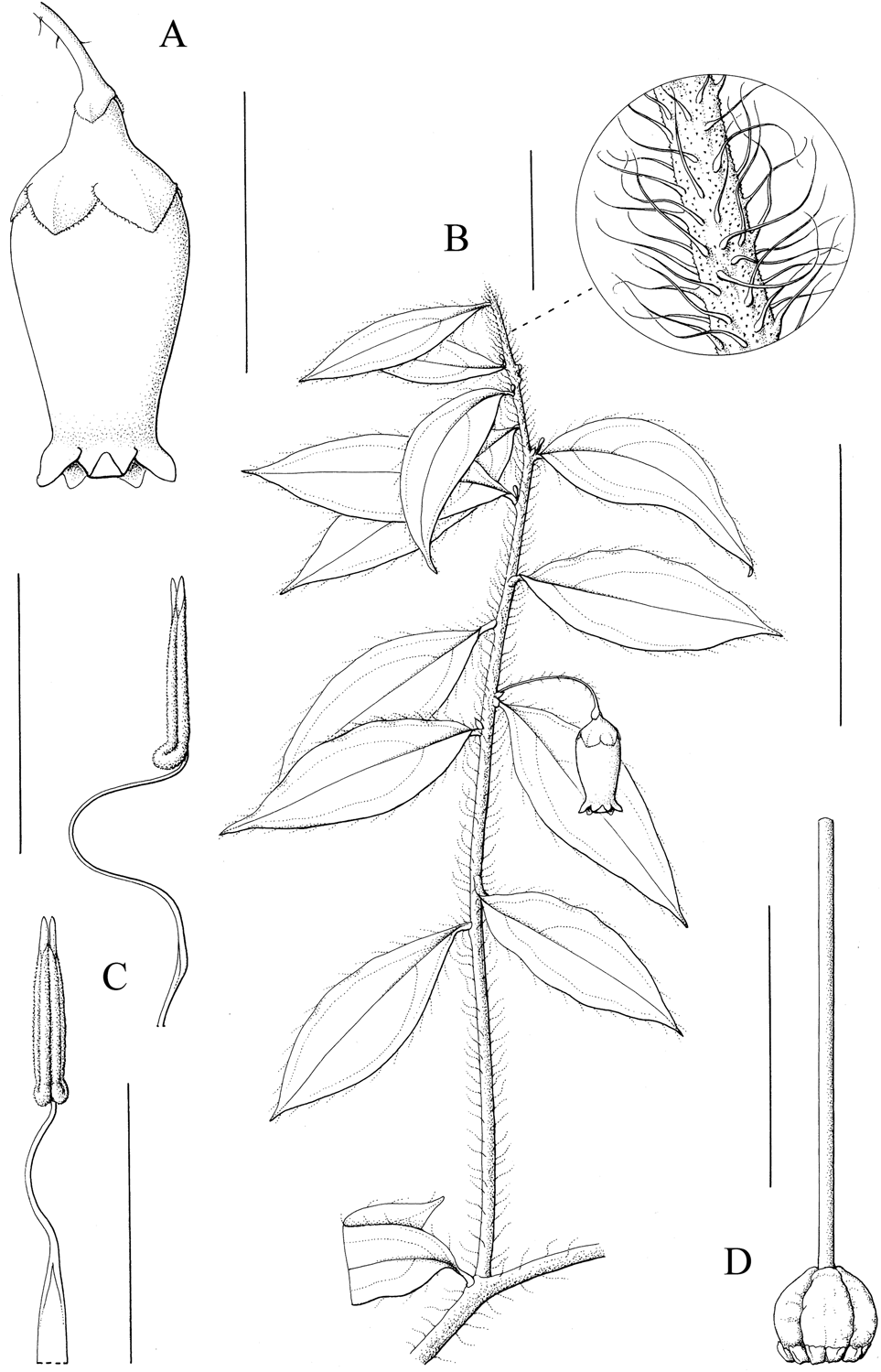
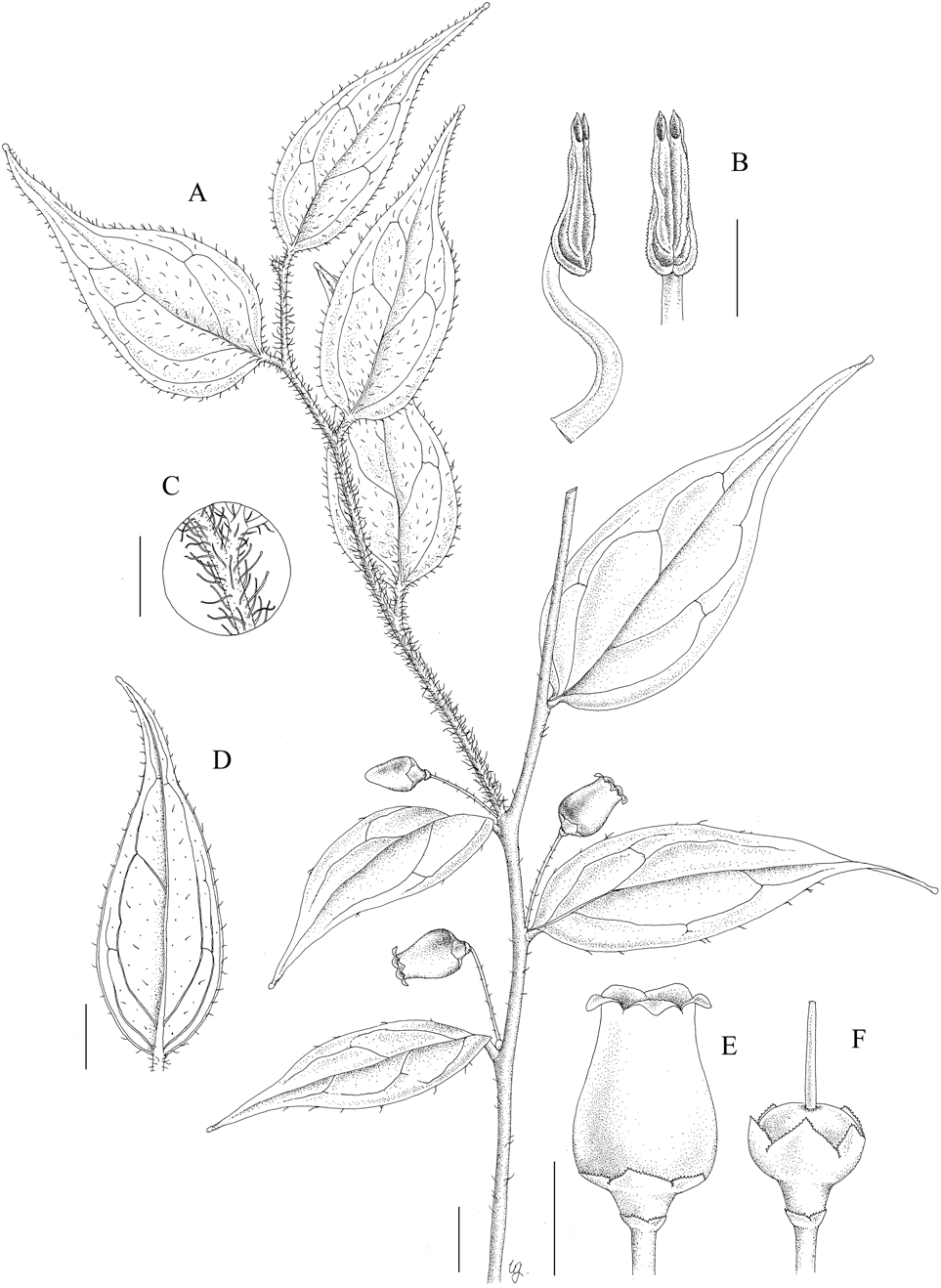
Plants both bristly and minutely hairy. Similar to Diplycosia gracilipes but differing in the much more densely bristly stems, the leaves having an acute apex (not rounded or slightly retuse); the pedicels have sparse bristles (not minutely, laxly clavate muriculate) and the flowers are red and not white. – Type: Central Sulawesi, Mt. Roroka Timbu, W slope, c.0°30′–1°30′S, 119°30′–120°30′E, 2100 m, 9 v 1979, Balgooy 3238 (holo BO; iso E, L). Fig. 1.
Diplycosia balgooyi Argent. A, flower rehydrated (scale bar 1 cm); B, habit (scale bar 3 cm) with inset to show details of the indumentum (scale bar 3 mm); C, stamens side and front view (scale bars 0.5 cm); D, pistil (scale bar 0.5 cm).

Epiphytic shrub. Twigs with a dense covering of sub-patent bristles to 3 mm long and a minute white surface indumentum. Lateral buds small and inconspicuous. Leaf blade leathery, 25–35 × 10–15 mm, elliptic, the base broadly tapering, apex acute, the terminal gland very distinctly sub-caudately protruding, margin entire, with long sub-persistent bristles, flat, without a distinct cartilaginous border, glabrous above and below, mid-vein slender, slightly impressed above, and weakly prominent beneath throughout its length, one sub-basal lateral vein ascending to 1/4 of the length of the leaf and, above this, one on each side from well above the base of the leaf high ascending almost to the apex, the larger leaves with a faint pattern of pinnate veins in the distal half of the blade, in the smaller leaves the veins reduced to just one high arching vein per side. Petiole 2–2.5 × 0.75–1 mm, at first with appressed bristles. Flowers solitary. Pedicels c.15 × 0.2 mm, slender at anthesis with sparse sub-patent bristles; basal bracts small and inconspicuous; bracteoles c.1 mm long, semi-circular, glabrous except for the ciliate margins. Calyx tube c.2 mm long, glabrous, the lobes broadly triangular, c.2 × 2.5 mm, glabrous except for the glandular fimbriate margins. Corolla 9–12 × 6 mm, red, campanulate, glabrous inside and out, lobes 5, c.2 × 2 mm, triangular. Stamens c.8 mm long; filaments sigmoid, glabrous, c.7 mm long; anthers c.3.5 mm long, echinulate, the tubules c.0.6 mm long. Disc of 10 lobes appressed to the ovary. Ovary glabrous; style c.7.5 mm long, cylindrical, glabrous. Fruit reported to be purple.
Distribution. Known only from the type locality.
Ecology. Montane ridge forest dominated by conifers (Agathis) and Fagaceae on rotting log, probably mostly epiphytic. Flowering February.
Conservation status. Data Deficient. Although the plants occur in a conservation area there is too little data to calculate an area of occupancy (AOO) and extent of occurrence (EOO) and the potential threats are unknown.
Etymology. Named after the collector, Max M. J. van Balgooy, an outstanding botanist and expert on the Malesian flora.
This new species keys out in Sleumer (1966–67) to Diplycosia gracilipes J.J.Sm. but differs in the characters given in the diagnosis.
Additional specimen. Central Sulawesi: Mt. Roroka Timbu, W slope, c.0°30′–1°30′S, 119°30′–120°30′E, 9 v 1979, E.F. de Vogel 5386 (K).
Diplycosia capitata Sleumer, Bot. Jahrb. Syst. 71: 149 (1940). – Type: Central Sulawesi, Mt. Ponáa, on the water divide N of Paloppo, 2°15′S, 120°22′E, 1620 m, 22 ix 1902, Sarasin 2081 (holo B†; iso L, fragment).
var. capitata
Shrub to 2 m high. Twigs angular, grey, with short solitary bristles becoming glabrescent. Lateral buds broadly conical, small, up to 1.5 mm. Leaf blade thinly leathery, 50–120 × 25–55 mm, broadly elliptic to sub-ovate, base broadly tapering to nearly rounded, apex acuminate, the terminal gland thick, but not distinctly protruding beyond the leaf margin, margin entire, caducously ciliate (1 mm), laxly to densely covered with short (1 mm) bristles and bristle-like reddish hairs all over the undersurface, mid-vein impressed above, distinctly raised beneath, lateral veins 4–5 pairs, the lowest pair arising close to the base, the upper 2–3 pairs curved, the uppermost pair almost straight, all anastomosing and very slightly impressed above, indistinct beneath. Petiole 5–7 × 1.5–2 mm, laxly bristly initially, glabrescent. Flowers 8–9 per fascicle. Pedicels 5–8 mm long at anthesis, up to 10 mm long in fruit, thick, densely reddish-brown tomentose by short crisped hairs; basal bracts small, subulate, tomentose; bracteoles c.2 mm long, broadly ovate, obtuse, densely rusty tomentose externally, glabrous inside. Calyx 2.5 mm long, glabrous or tomentose, lobes 2 mm long, broadly ovate, obtuse, tomentulose at the margin. Corolla 6 × 4–5 mm, green, shortly campanulate, glabrous, lobes triangular, obtuse, 1.5 mm long. Stamens c.3.5 mm long; filaments 2 mm long, linear, glabrous; anthers 1.5 mm long, oblong, tubules 0.7 mm long, slender. Ovary glabrous; style c.4.5 mm long.
Distribution. Central Sulawesi: Mt. Ponáa.
Ecology. Sub-montane forest and open ridge-top flora, thin soil amongst quartzite rubble, c.1620 m. Flowering September.
Additional specimens. South Sulawesi: Enrekang District, Latimojong Mts, ridge running W of Bunte Batu Kapur and Bunte Pese II, 1850 m, 22 xi 1969, M.J.S. Sands 562 (K).
Hitherto known only from the type collection, M.J.S. Sands 562 is a good match to the original description despite its lack of corollas.
Diplycosia capitata var. crassiramea (Sleumer) Argent, comb. et stat. nov. – Diplycosia crassiramea Sleumer, Reinwardtia 4: 141 (1957). – Type: Central Sulawesi, Enrekang, Tinábang, W side of G. Rantemario, 3000 m, 18 vi 1937, Eyma 736 (holo L; iso BO).
Shrub. Stems with large raised rounded scars. Twigs angular when young, slender (3–5 mm diameter), exclusively covered with scattered bristles (2–3 mm). Buds small, to 1.5 mm, sub-spherical or conical, minutely puberulous. Leaf blade rigidly leathery, 70–130 × 35–75 mm, broadly elliptic to obovate, base tapering into the petiole, apex shortly acuminate to broadly tapering or rounded, the terminal gland very thick and protruding, margin revolute, minutely crenulate or entire, glabrous above, densely blackish spotted beneath the bristles, very early caducous, mid-vein slightly impressed above, very thick and prominent beneath, lateral veins in 3–4 distinct pairs, curved-ascending and anastomosing, slightly impressed above, raised beneath, other distal and shorter veins distinct or obscure. Petiole c.10 × 3 mm, grooved above, winged in its upper part by the decurrent lamina. Flowers both from foliate and defoliate axils, 4–8 per fascicle. Pedicels 7–12 mm long, thick, densely reddish-brown, crisped-pubescent (not properly bristly); basal bracts small, to 1.5 mm long, with ciliate margins; bracteoles 2–3 mm long, ovate, sub-acute, very shortly glandular fimbriate and ciliolate, externally brown-pubescent. Calyx 4–4.5 mm long, contracted at the base, glabrous or very shortly reddish-hairy at the lobes, lobes 2 mm, triangular, sub-acute, reflexed at anthesis, shortly glandular fimbriate. Corolla 6 × 4–5 mm, green, sub-campanulate, slightly constricted both at the base and the limb, glabrous, lobes c.2 mm long, erect. Stamens c.6 mm long; filaments 3–3.5 mm long, linear, somewhat dilated above the base, papillose; anthers c.2.5 mm long, oblong, incurved at the base, echinulate, tubules 1.3 mm long, narrow. Ovary glabrous; style c.5 mm long, glabrous.
Distribution. SW Central Sulawesi, Latimodjong Range, Rantemario-Pokapindjang massif.
Ecology. On open slopes in sub-montane shrubbery, 2400–3000 m. Flowering June.
Additional specimen. South Sulawesi: Enrekang District, Rantemario, above Rantelemo, c.3°30′S, 120°00′E, 3000 m, 7 iii 2000, Argent, Mendum & Hendrian 00286 (BO, E).
Argent, Mendum & Hendrian 00286 exhibits some features described for Diplycosia capitata var. capitata. It has leaves with short, well-spaced bristles abaxially (although most of these have gone, leaving a punctate surface) and a fringe of bristles round the leaf margin. The leaf description does not entirely agree with either variety but the narrowly attenuate leaf base with decurrent wings most closely agrees with Diplycosia capitata var. crassiramea although the leaves are elliptic rather than broadly elliptic and certainly not obovate.
As species the differences between Diplycosia crassiramea and D. capitata were not clear cut and it was difficult to identify them satisfactorily using a key. Both have glabrescent stems, many-flowered fascicles and a densely crisped indumentum on the pedicels. These similarities, along with the fact that most other characters significantly overlap, suggest the two species should be united. They are maintained as varieties pending further collections.
Diplycosia caryophylloides J.J.Sm., Bot. Jahrb. Syst. 68: 209, 214 (1937). – Type: SE Sulawesi, Mengkoka Mts, B. Porema, 1400–1500 m, ? x 1929, Kjellberg 3914 (holo S).
var. caryophylloides
Epiphytic shrub to c.1 m high. Twigs slightly angular (1–1.5 mm), the very young shoots laxly to very densely covered with patent gland-tipped bristles. Lateral buds small and inconspicuous. Leaf blade leathery, 45–70 × 25–36 mm, inserted on a thick cushion, protruding from the stem, elliptic to broadly elliptic, base broadly tapering to rounded, apex broadly tapering, obtuse, the terminal gland thick and prominent, margin revolute, entire, the marginal bristles early caducous, glabrous above, initially bristly, but becoming glabrescent and finally sparsely spotted beneath, mid-vein sharply impressed above, very prominent beneath, lateral veins in 3–5 pairs, curved ascending and anastomosing, distinctly impressed above, mostly prominent beneath, reticulation obscure. Petiole 2.5–5 × 1–1.5 mm, thick, grooved, glandular bristly initially, glabrescent. Flowers 3–6 per fascicle both in the foliate and defoliate axils. Pedicels 3–5 mm long, thick, laxly covered with reddish, fine, spreading hairs; basal bracts numerous, small; bracteoles 1.5 mm long, short ovate-triangular, obtuse, patent puberulous dorsally, ciliolate. Calyx obconical, distinctly funnel-shaped, tapering towards the base, tube at anthesis c.2 mm long, in fruit c.3 mm long, glabrous, lobes c.1.7 mm long, triangular, sub-acute, shortly glandular fimbriate. Corolla 5–6 mm long, greenish-white, campanulate, glabrous, lobes c.2 mm long, abruptly tapering towards the tips. Stamens c.4 mm long; filaments c.2.8 mm long, linear, papillose; anthers 1.5 mm long, ovate oblong, inflexed at base, echinulate. Ovary glabrous; style 5–6 mm long, glabrous. Fruit c.8 mm long, c.4 mm in diameter in its upper part, pear-shaped, blue.
Distribution. SE Sulawesi: Mengkoka Mts.
Ecology. In rain forest, 1400–1500 m, apparently rare. Flowering March and October.
Diplycosia caryophylloides var. longipes Sleumer, Reinwardtia 4: 144 (1957). – Type: SE Sulawesi, Kolonedale, between saddle and E slope of Tomongkobae-group, 17–20 x 1938, Eyma 3960 (holo L; iso BO).
Differing from the type variety by smaller leaves, 30–50 × 15–25 mm, and generally longer petioles, 4–7 mm long.
Distribution. SE Sulawesi: mountains N of Kendari, one collection.
Ecology. Flowering October.
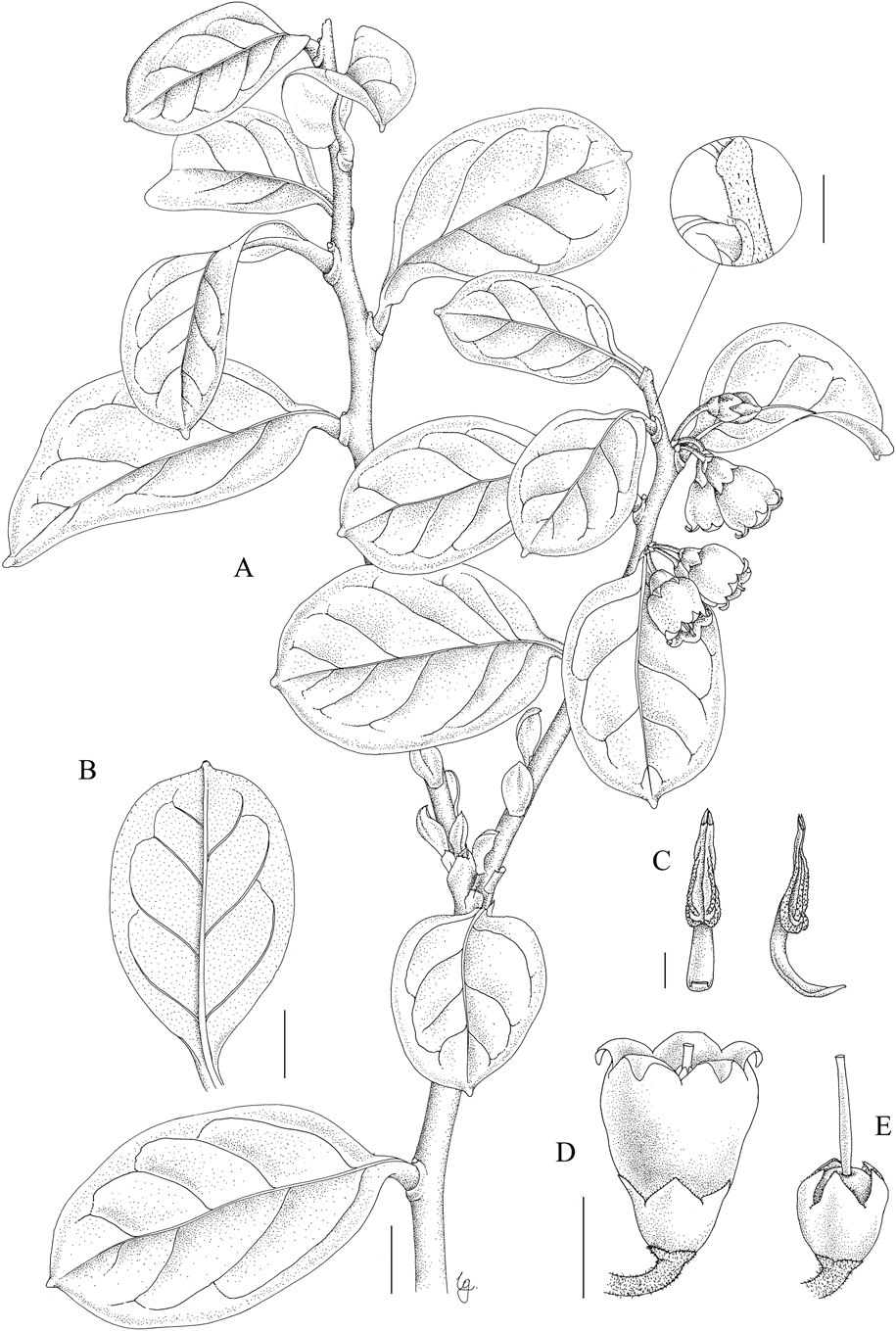
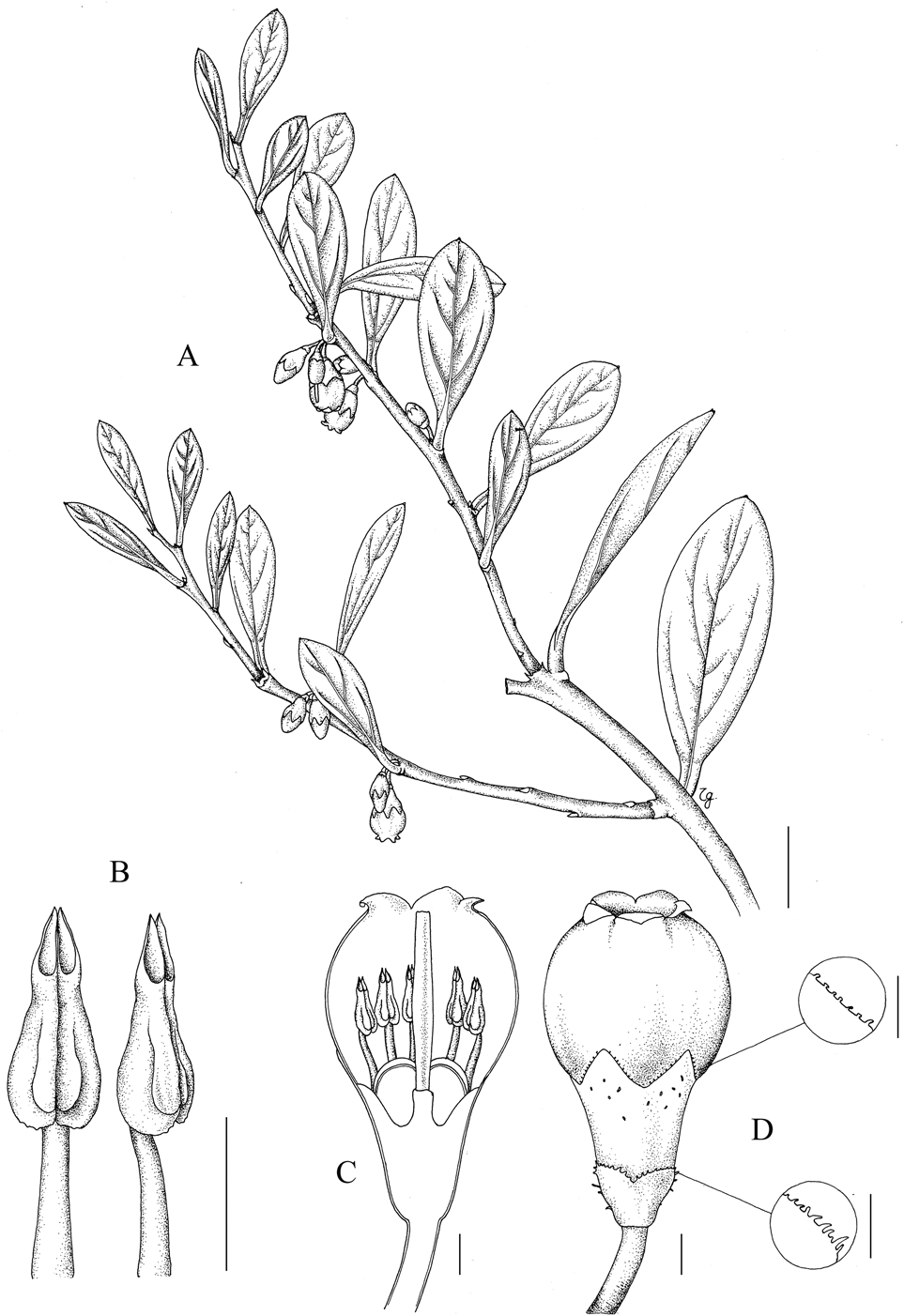
Diplycosia celebensis J.J.Sm., Bull. Jard. Bot. Buitenzorg III, 1: 406, t.53 (1920). – Type: South Sulawesi, Latimodjong Range, G. Sinadji (N of Makale and Rantepao), ? xi 1913, Rachmat 884 (holo L; iso BO). Fig. 2.
Diplycosia celebensis J.J.Sm. A, habit (scale bar 1 cm) with inset to show indumentum (scale bar 5 mm); B, leaf (scale bar 1 cm); C, stamens front and side view (scale bar 1 mm); D, flower (scale bar 5 mm); E, pistil with calyx.
Shrub or small tree up to 3 m high. Twigs: the younger parts brownish-red, the tips densely patently papillose puberulous, sometimes with some scattered bristle-like short hairs which are slightly clavate or gland tipped, no true bristles present. Lateral buds broadly conical to 2 mm high, somewhat less than half the length of the petioles. Leaf blade leathery, 15–53 × 7–35 mm, varying in shape even on the same individual specimen, narrowly elliptic or obovate-elliptic to obovate, base broadly tapering, glabrous and a little shining above, apex broadly acuminate to rounded, the terminal gland thick, distinctly prominent, very slightly revolute at the narrowly cartilaginous margin, minutely glandular crenulate, laxly blackish spotted and dull beneath, with some marginal glandular hairs when very young, mid-vein slightly impressed above, flat or strongly raised beneath, lateral veins 2–4 per side, pinnate, spreading at c.45°, very slightly impressed above, raised beneath. Petiole 2–6 × 2–3 mm, shining wine-red, grooved, glabrescent. Flowers 1–6 per axil. Pedicels 1.5–5 × 1 mm, at anthesis glabrescent and up to 6 mm long in fruit, thick, laxly puberulous and with some short crisped glandular hairs; bracteoles c.1 mm long, ovate, obtuse, muriculate, fimbriate and ciliolate. Calyx c.2.5 × 4.5 mm, contracted at the base, glabrous or nearly so, lobes 1.5 mm long, ovate, sub-acute, glandular-muriculate or fimbriate. Corolla 6–7 × 6–8 mm, white, green or green flushed with purple to completely purple, campanulate or broadly tubular, glabrous, 1.5–2 × 4 mm, ovate, obtuse, reflexed. Stamens c.5 mm long; filaments 2–3.5 mm long, linear, slightly curved, papillose; anthers 1.5–3 mm long, oblong, granular, tubules narrow, 1.5 mm long. Disc of 10 lobes. Ovary glabrous; style 4–5.5 mm long, cylindrical, glabrous. Fruit up to 10 × 9 mm, ovoid, grey.
Distribution. Central Sulawesi: Mt. Sojol; Latimodjong Range: Mt. Sinadji, Mt. Batuding, Mt. Tinabábang and Mt. Pokapindjang.
Ecology. Epiphytic in sub-montane mossy and montane forest at 2400–3000 m. Flowering: June, November; fruiting: February.
Additional specimens. South Sulawesi: S of Gunung Lompobatang, above Desa Bonto Lojang, Kab. Bantaeng, c.5°24′S, 109°56′E, 9 ii 2000, Argent, Mendum & Hendrian 0029 (BO, E); G. Bawa Karang, subsidiary to G. Lompobatang, Gowa District, c.5°18′S, 119°56′E, 2400 m, in low bush on ridge; sub-montane mossy forest, sometimes epiphytic, 2400–3000 m, 13 ii 2000, Argent, Mendum & Hendrian 0057 (BO, E); Enrekang District, Latimojong Mts, ridge spur to the SE of Bunte Pese I, 2300 m, 20 xi 1969, M.J.S. Sands 517 (BO, K); Mt. Roroka Timbu, W slope, c.80 km SSE of Palu at 2050 m, 16 v 1979, E.F. de Vogel 5404 (BO, E, L); Mt. Sojol, 26 ii 2000, living collection grown on at RBGE and vouchered as Smith & Galloway 20000476 (BO, E).
The leaves are reported to smell strongly of anise after bruising although the living material in Edinburgh (accession numbers 20000448 and 20000476) does not. This species is superficially very similar to Diplycosia heterophylla Blume which, although widespread, is not yet recorded from Sulawesi. Diplycosia celebensis differs significantly in the pronounced apical gland at the apex of the leaves, the minute white pubescence of the young stems, and the dense crisped indumentum on the pedicels. The description above has been augmented from living material growing in Edinburgh and the recently collected herbarium material. The original collection was said to have white flowers (Smith, Reference Smith1920), presumably at the recollection of the collector, but this information is not on the label. There must be some doubt about this as the cultivated plants have green or green-flushed-purple corollas and Argent et al. 0057 is recorded as having dark purple flowers. The Mt. Sojol plant has small apical glands, which are less conspicuous than in other material as they are reflexed under the leaf tip. It also has a less dense indumentum on the pedicels, but otherwise agrees well with the description of this species.
An additional specimen, Eyma 578, 16 vi 1937, from Enrekang, determined by Sleumer in 1955, is a very odd specimen with very small leaves mostly less than 20 × 10 mm. It is difficult to credit that it is the same species as the Lompobatang and Bawa Karang specimens but again it is in very poor condition. Argent, Mendum & Hendrian 0029 was recorded at much lower altitude than previously (c.850 m) and the seedlings had a few bristles. E.F. de Vogel 5404 is probably this species although the specimen seen (K) is in poor condition.
Diplycosia filipes Sleumer, Reinwardtia 4: 133 (1957). – Type: Central Sulawesi, Masamba, between Kambuno and Tomadu, 2550–2800 m, 27 vii 1937, Eyma 1409 (holo L).
Epiphytic, small shrub. Twigs rounded, slender, densely covered with fairly long (1.5–2 mm) appressed, reddish, fine bristles when young. Lateral buds small and inconspicuous. Leaf blade somewhat leathery, 12–20 × 4–6 mm, narrowly elliptic or elliptic, base tapering into the petiole, acute, apex gradually short acuminate, sub-acute, the terminal gland small, only slightly protruding, margin regularly minutely crenulate-denticulate, axils of the teeth in the young leaves with a long, early caducous bristle-like hair, glabrous above, sparsely blackish spotted beneath, mid-vein impressed above, slightly prominent beneath; lateral veins obscure. Petiole c.1.5 mm long, bristly. Flowers solitary. Pedicels 5–7 mm long, slender, laxly and shortly appressed-bristly initially, finally glabrescent; basal bracts minute; bracteoles small, ovate-obtuse, glabrous. Calyx 2.5–3 mm long, glabrous, 5-lobed halfway, lobes ovate, acute, glandular fimbriate. Corolla not observed fully developed, probably c.4 mm long, said to be red, apparently urceolate, glabrous. Stamens not known fully developed. Ovary glabrous; style 3.5 mm long. Immature fruit c.3 mm in diameter, contracted at the base.
Distribution. Central Sulawesi: between Kambuno and Tomadu, known from one collection.
Ecology. In light forest, near rockery, 2550–2800 m. Flowering July.
I suspect the interpretation of the size of the corolla and style to be an overestimate as styles often elongate considerably after the flowers open.
Diplycosia gallowayana Argent, sp. nov.
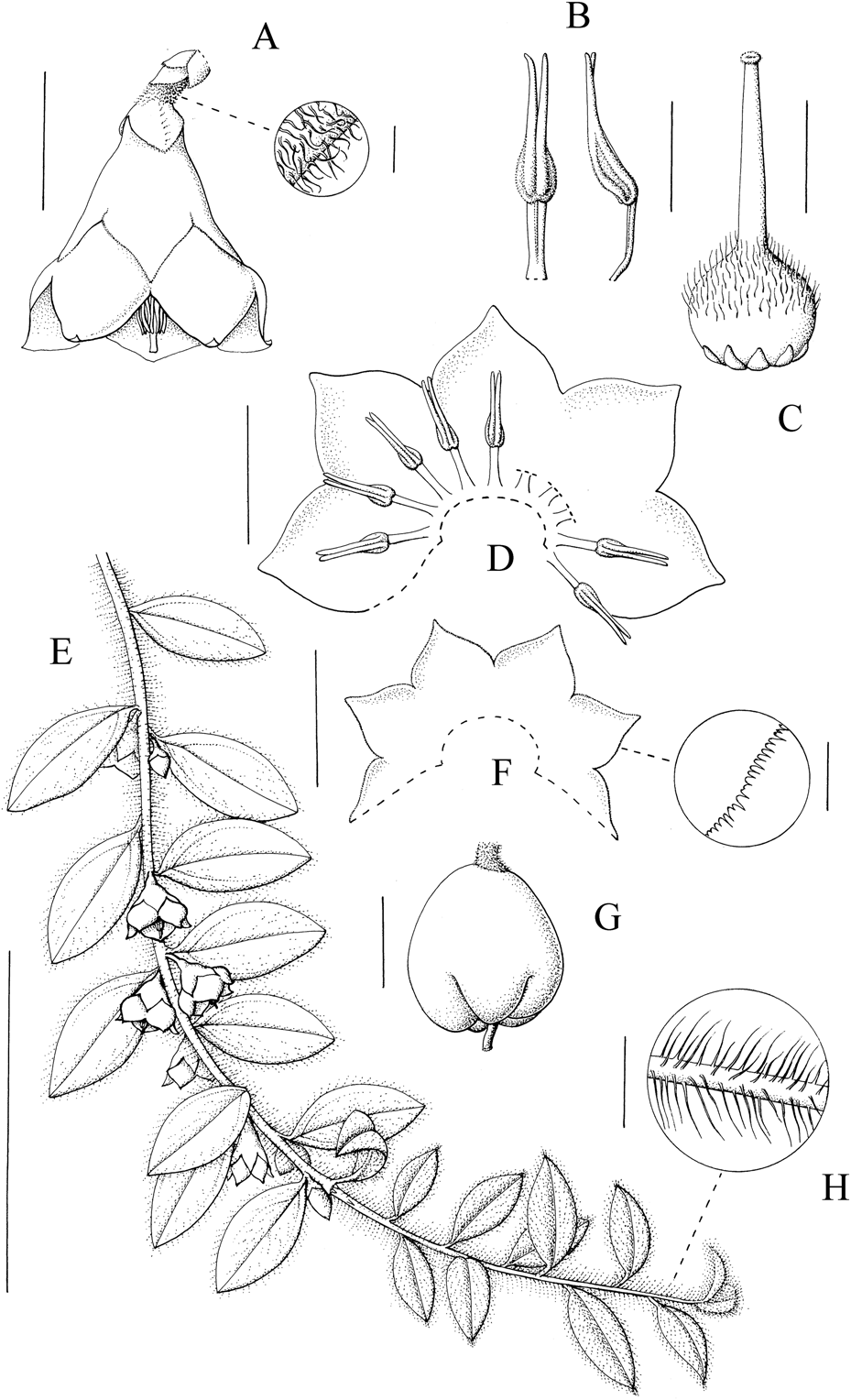
Similar to Diplycosia pseudorufescens Sleumer, from Borneo and Peninsular Malaysia. This new species differs in having the pedicels densely covered with crisped hairs (not bristly short-hairy), the ovary has rather sparse long vertical hairs and not the dense grey pubescence of D. pseudorufescens, and the branches are without a fine patent pubescence under the bristles. – Type: NW Sulawesi [Central Sulawesi province], Mt. Sojol, c.0°40′N, 120°10′E, 9 xii 2010, 1500–2000 m, living collection grown on at RBGE and vouchered as Smith, P., Galloway, L. & Argent, G. 20000480 (holo BO; iso A, E, L). Fig. 3.
Diplycosia gallowayana Argent. A, flower (scale bar 5 mm) with inset to show pedicel indumentum (scale bar 0.5 mm); B, stamens front and side view (scale bar 2 mm); C, pistil (scale bar 2 mm); D, open corolla (scale bar 5 mm); E, habit (scale bar 5 cm); F, open calyx (scale bar 5 mm) with inset to show ciliate margin (scale bar 0.5 mm); G, fruit (scale bar 5 mm); H, inset to show stem indumentum (scale bar 5 mm).
Spreading shrub, branches rounded, to 0.7 m high. Twigs with moderately dense, sub-patent bristles, variable in length, the longest to 3 mm, no fine indumentum. The lateral buds hemispherical but small and inconspicuous. Leaf blade leathery, 15–23 × 7–14 mm, elliptic, the base broadly tapering, the apex obtusely pointed, the terminal gland small, slightly protruding from the apex, margin entire, with bristles when young, very slightly revolute, when young patently bristly both above and below, quickly glabrescent above, more slowly so beneath, mid-vein impressed above, weakly raised beneath, the lateral veins one per side arising near the base and disappearing in the middle of the leaf, or in small leaves obscure, plane or minutely impressed above. Petiole 1.5–2.5 × 0.8 mm, without a groove when fresh, densely sub-patently bristly. Flowers solitary, rarely with 2 per axil. Pedicels at anthesis 2.5–3 × c.1 mm, densely covered in crisped hairs and with several minute bracts (c.0.6 mm) sheathing the base; bracteoles to 1.6 × 1.8 mm, semi-circular, with a few crisped hairs mainly along the median line and fringed with hairs. Calyx tube c.2 × 4 mm, glabrous, the lobes 3.5 × 3 mm, ovate-triangular, glabrous except for the ciliate margins. Corolla c.5 × 9 mm, translucent white, becoming pinkish-purple with age, broad-campanulate, glabrous inside and out, lobes 5, 3 × 4.5 mm, broadly triangular with acute reflexed tips. Stamens 4 mm long, hardly protruding; filaments 2 mm long, only slightly curved, white, glabrous; anthers c.3–4 mm long, only minutely echinulate, cells c.1.8 mm long, the tubules c.1.5 mm long, with very obliquely cut pores. Disc a series of small heart-shaped, glabrous lobes. Ovary c.2.2 mm in diameter, with long vertically pointing hairs; style c.3.8 mm long, cylindrical, glabrous. Fruit shiny, black, sub-spherical, c.12 × 12 mm; capsule black, c.3 × 5 mm in diameter.
Distribution. Known only from the type locality.
Ecology. Epiphyte in sub-montane ridge forest at 1500–2000 m. Flowering December.
Conservation status. Data Deficient. Although the plants occur in a conservation area there is too little data to calculate an AOO and EOO and the potential threats are unknown. It is, however, in a remote location and the lack of timber-sized trees mean it is unlikely to be disturbed.
Etymology. Named after Louise Galloway of the Royal Botanic Garden Edinburgh, collector of this species and an excellent field companion.
Additional specimen. Central Sulawesi: Mt. Sojol, Argent, Mendum & Hendrian 00164 (BO, E) [also cultivated as RBGE accession no. 20000480 (field number G.85) from which the type was grown and vouchered].
This new species will not key out satisfactorily in Sleumer (1966–67). It differs from Diplycosia aperta from Sulawesi in having a glabrous style, the flowers are a totally different shape (open campanulate and only 5 mm long in D. gallowayana, elongate-urceolate and 8–9 mm long in D. aperta), and the pedicels are thick and only c.3 mm long (8–11 mm long in D. aperta). It perhaps comes closest to Diplycosia pseudorufescens Sleumer from Borneo (Mt. Kinabalu), with D. pseudorufescens var. elliptifolia Sleumer additionally found in Peninsular Malaysia (an unusually broad distribution for a Diplycosia species). Diplycosia gallowayana does significantly differ, however, in having the pedicels densely covered with crisped hairs (bristly short-hairy in D. pseudorufescens), the ovary has rather sparse long vertical hairs (dense grey pubescence in D. pseudorufescens), and the branches are without a fine patent pubescence under the bristles.
Diplycosia glaucicaulis Argent, sp. nov.
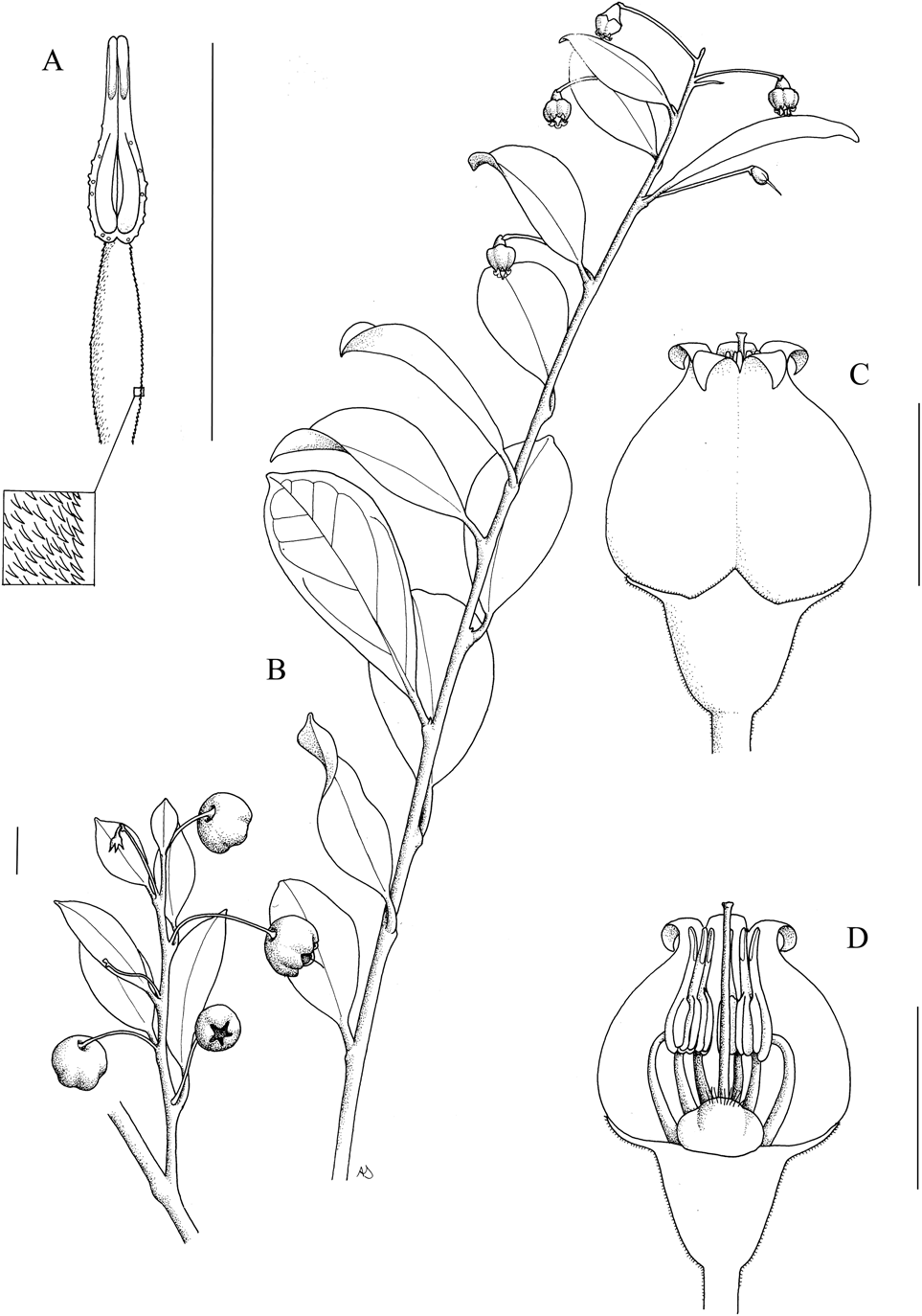
Plants completely glabrous except for a few hairs on the ovary. Young stems glaucous when young. Similar to Diplycosia brachyantha Sleumer and D. ledermannii Schltr. but differing from both of these in the urceolate (not widely campanulate or ovoid) shape of the corolla. – Type: NW Sulawesi [Central Sulawesi province], Mt. Sojol, c.2000 m, c.0°40′N, 120°10′E, 27 ii 2000, Argent, Mendum & Hendrian 00187 (holo BO; iso A, E, K, L). Fig. 4.
Diplycosia glaucicaulis Argent. A, stamen (scale bar 5 mm) with inset showing details; B, habit (scale bar 1 cm); C, flower (scale bar 5 mm); D, half flower (scale bar 5 mm).
Epiphytic shrub, c.1 m tall. Twigs purplish-pink when young and covered with a white waxy ‘bloom’ but totally glabrous. Axillary buds small and inconspicuous. Leaf blade leathery, 45–65 × 20–45 mm, elliptic to broadly elliptic, base narrowly tapering, apex broadly acute to rounded, the terminal gland small but distinctly protruding from the apex, margin entire, without bristles or hairs, very slightly revolute in the distal half, glabrous above and below, mid-vein weakly impressed above, distinctly prominent beneath at least in the proximal half, bright red for the proximal 2/3 when fresh, the lateral veins plane or minutely impressed, the larger leaves with 1–3 pairs of high arching veins spreading at c.45° at the base and 1–3 pairs of short pinnate veins in the distal half of the blade, in the smaller leaves the veins may be reduced to just one short visible pair or be entirely inconspicuous; with a faint smell of wintergreen when crushed. Petiole 4–5 × 1–1.5 mm, smooth, glabrous. Flowers solitary, rarely with 2 per axil. Pedicels 10–12 mm long and less than 1 mm thick at anthesis, completely glabrous; basal bracts minute (c.0.5 mm); bracteoles c.1 mm long, semi-circular, glabrous except for the ciliate margins. Calyx tube c.2 mm long, glabrous, the lobes c.1 × 2 mm, broadly triangular, completely glabrous. Corolla c.5 × 6 mm, pale green, urceolate, contracted distally, glabrous inside and out, lobes 5, 1.3 mm long, narrowly triangular with acute apices, becoming revolute. Stamens 5 mm long, slightly protruding; filaments 2.7 mm long, sigmoid, white, glabrous but with elongate papillae; anthers c.2.5 mm long, echinulate, the tubules c.1.2 mm long. Disc of 10 lobes appressed to the ovary. Ovary with sparse long hairs; style c.4.5 mm long, cylindrical, glabrous. Fruit (accrescent calyx) 8–12 × 7–13 mm, grey, sub-spherical; capsule c.4 mm in diameter, black.
Distribution. Known only from the type locality.
Ecology. Sub-montane mossy ridge forest at c.1500–2000 m. Flowering February.
Conservation status. Least Concern. There appeared to be a good population on Mt. Sojol which, because of its remote location and lack of timber-sized trees, is unlikely to be disturbed. It is also a designated protected area.
Etymology. Latin – glauci = glaucous, caulis = stem, from the distinctive glaucous stems.
Additional specimens. Central Sulawesi: Mt. Sojol, c.2000 m, Argent, Mendum & Hendrian 00169 (BO, E); ibid. 00188 (BO, E). Voucher from cultivated specimen RBGE accession no. 20000526 from the type locality, collected 28 ii 2000 (grown on from Smith & Galloway 127) (BO, E).
This distinctive new species keys out in Sleumer (1966–67), in the smaller part of his key, with the glabrous-stemmed species. One arrives fairly easily to couplet 97 where the choice is: corolla (widely) campanulate, calyx lobes 4 mm (Diplycosia brachyantha Sleumer from Sumatra) vs. corolla ovoid, calyx lobes c.2 mm (D. ledermannii Schltr. from Papua New Guinea). In Diplycosia glaucicaulis the corollas are neither of these shapes but urceolate, distinctly contracted distally and the calyx lobes are only 1 mm long. Diplycosia brachyantha and D. ledermannii have pubescent pedicels whereas in this new species the pedicels are completely glabrous. Most Diplycosia species have very restricted distributions and it would be most unusual to find a species from Sulawesi in either Sumatra or Papua New Guinea. The pruinose colouring of the young stems and leaves is very distinctive and has not been described in any other species of Diplycosia but it does not always appear to be present. The inflorescence is sometimes a terminal raceme with the proximal flowers arising from the axils of foliage leaves but the terminal flowers arising from much smaller leafy bracts. However, with age secondary flowers sometimes arise in the axils of these bracts so that the basic fasciculate form of the inflorescence is thereby generated. From older wood the flowers are mostly solitary but again two-flowered fascicles do occasionally occur. When the inflorescence is racemose there is a strong resemblance to species of the genus Gaultheria but the anthers of Diplycosia glaucicaulis lack projecting teeth distally and have long tubules and so are completely consistent with the characters of Diplycosia.
Diplycosia gracilipes J.J.Sm., Bull. Jard. Bot. Buitenzorg III, 1: 407, t.54 (1920). – Type: South Sulawesi, Latimodjong Range, G. Sinadji (N of Makale and Rantepao), ? xi 1913, Rachmat 886 (holo L; iso BO).
Shrub to 3 m high. Twigs red-brown, angular, papillose puberulous, occasionally with some short gland-tipped bristle-like hairs. Lateral buds to 2 mm long, the scales acute. Leaf blade leathery, 14–30 × 6–15 mm, sub-spathulate-obovate, base tapering into the petiole, apex rounded, sometimes slightly retuse, more rarely broadly acute, the terminal gland thick, protruding, margin obscurely crenulate towards the apex, or nearly entire, flat, with a distinct cartilaginous margin, sparsely minutely blackish spotted on both sides especially beneath, mid-vein impressed above, prominent beneath, obscurely tri-nerved, veins impressed but sometimes hardly visible above, mostly slightly raised beneath. Petiole 2–4 mm long, grooved, muriculate. Flowers mostly solitary, sometimes in twos or threes. Pedicels 12–26 mm long, sub-filiform, minutely laxly muriculate, with club-shaped glands; basal bracts minute, c.0.5 mm; bracteoles c.1 mm long, broadly triangular to semi-circular, obtuse, puberulous and glandular muriculate dorsally, marginally ciliolate. Calyx 3 mm long, puberulous, lobes 1.8 mm long, triangular, sub-acute, margin glandular-muriculate and ciliolate. Corolla c.10 mm long, red (white?), campanulate, glabrous, lobes c.3 mm long, obtuse. Stamens c.5 mm long; filaments 3 mm long, linear, somewhat dilated at the base, papillose; anthers 2 mm long, oblong, inflexed at the base, tubules nearly 1 mm long, broad. Ovary glabrous; style 7 mm long, glabrous. Fruit dull bluish.
Distribution. SW Central Sulawesi: Mt. Sinadji, Mt. Roroka Timbu.
Ecology. Summit areas with elfin forest of Myrtaceae and Ericaceae at c.2450 m. Flowering May and November.
Additional specimens. Central Sulawesi: Mt. Roroka, Timbu, 14 v 1979, Van Balgooy 3317 (BO, L); Mt. Roroka, Timbu, 15 v 1979, De Vogel 5372 (BO, L).
Van Balgooy 3317 is distinctive in having very pronounced protruding cushions on the stems at the leaf attachments. De Vogel 5372 has more acutely pointed leaves. As with Diplycosia celebensis the white flower colour in the protologue is doubtful as it was described only on the recollection of the collector. The Van Balgooy and De Vogel collections clearly state on the labels that the corolla is red.
Diplycosia haemantha Sleumer, Reinwardtia 4: 150 (1957). – Type: East-Central Sulawesi, N spur of G. Lumut between bivouc II & III, 3 ix 1938, Eyma 3577 (holo L; iso BO).
Small shrub, terrestrial or epiphytic. Twigs slender, red-brown, laxly covered with appressed bristles and more densely with fine, spreading short hairs. Lateral buds inconspicuous. Leaf blade thinly leathery to leathery, 14–35 × 8–15 mm, elliptic, obovate-elliptic or obovate, base tapering into the petiole, apex broadly acuminate to rounded, the terminal gland thick and prominent, margin paler and cartilaginous, crenulate in the distal part, the teeth initially ciliate, or sub-entire or entire, glabrous above, laxly blackish spotted beneath by the remaining bases of early caducous bristles, mid-vein impressed above, nearly flat beneath, lateral veins obscure. Petiole 1–3 mm long, thick, rugulose, laxly bristly. Flowers solitary, or rarely in twos or threes. Pedicels 6–10 mm long, slender, nodding, almost glabrous; basal bracts minute, bracteoles 1 mm long, ovate, obtuse, connate, ciliolate. Calyx c.3 mm long, glabrous, lobes ovate, obtuse, very shortly glandular-muriculate or fimbriate. Corolla 6.5 mm long, blood red, urceolate, glabrous, shortly 5-lobed. Stamens c.5.5 mm long; filaments 4 mm long, linear, glabrous; anthers 1.8 mm long including the short broad tubules, ovate-oblong, echinulate. Ovary glabrous; style 3 mm long. Fruit c.4 mm in diameter, black.
Distribution. Central Sulawesi: Mt. Lumut, Mt. Watuwila.
Ecology. In rain forest at c.1500 m. Flowering March–September.
Additional specimens. Central Sulawesi: N spur of Mt. Lumut, SE Mt. Watuwila, 3 ix 1938, Eyma 3577B (BO, L). SE Sulawesi: B. Watuwila, 14 iii 1929, Kjellberg 1090 (BO).
Diplycosia hendriana Argent, sp. nov.
Closest morphologically to Diplycosia pilosa Blume from W Java but the indumentum on the stems is different, lacking the yellow short hairs described for this species, the pedicels are longer (10–15 vs. 3–7 mm), and the corolla is red rather than the green of D. pilosa. Amongst the Sulawesi species it is distinct in its stem indumentum with both bristles and short white hairs, it lacks axillary bud scales, has long slender pedicels and large, red, glabrous flowers. – Type: Central Sulawesi, Mt. Sojol, c.0°40′N, 120°10′E, 2000 m, 27 ii 2000, G. Argent, M. Mendum & Hendrian 00189 (holo BO; iso E). Fig. 5.
Diplycosia hendriana Argent. A, habit (scale bar 1 cm); B, stamens side and front view (scale bar 2 mm); C, inset to show stem indumentum (scale bar 5 mm); D, leaf (scale bar 1 cm); E, flower (scale bar 5 mm); F, pistil with bracteoles and calyx (scale bar 5 mm).
Epiphytic shrub to 0.8 m high. Twigs variable in length, with semi-appressed bristles up to 2.2 mm long, later becoming sub-patent and with a short, fine, white pubescence. Lateral buds small, sub-spherical, up to 0.6 mm in diameter. Leaf blade thin, 40–70 × 15–22 mm, elliptic to narrowly cordate, the base rounded, the apex long acuminate with a narrowly acute tip although terminated with a moderately distinct terminal gland, margin minutely indented at hair attachments (fringed with bristles when very young), slightly revolute, when young with scattered bristles both above and below, especially on the veins, but quickly becoming completely glabrescent leaving the surface punctate with hair bases, mid-vein narrowly impressed above, prominent beneath almost to the apex, the lateral veins level or minutely impressed, the larger leaves with 1 or 2 high arching veins spreading at c.45° at the base and with some short indistinct pinnate veins in the distal half of the blade. Petiole 1.5–3 × 1–1.25 mm, at first with semi-appressed bristles, quickly glabrescent and somewhat rugose. Flowers all solitary. Pedicels 10–15 × c.0.5 mm at anthesis, when young with semi-appressed glandular hairs but quickly glabrescent; basal bracts small and inconspicuous; bracteoles c.0.8 mm long, semi-circular, glabrous except for the glandular margins. Calyx tube c.2 mm long, glabrous, the lobes c.1 × 1.8 mm, broadly triangular, glabrous except for the margin which has a fringe of short thick glands. Corolla c.9 × 6 mm, glossy red, urceolate, contracted distally, glabrous inside and out, lobes 5, c.1 mm long, broadly triangular with acute apices, becoming revolute. Stamens 7 mm long, not protruding; filaments 5 mm long, sigmoid, white, glabrous; anthers c.3.5 mm long, smooth, the tubules very short, c.0.6 mm long. Disc of 10 lobes. Ovary glabrous; style c.5 mm long, cylindrical, glabrous. Fruit not seen.
Distribution. Known only from the type locality.
Ecology. Sub-montane mossy forest at c.2000 m. Flowering February.
Conservation status. Least Concern. There is a substantial population (mostly sterile) in this remote location which is in a protected area with no discernible threats.
Etymology. Named after Hendrian our expedition counterpart for his excellent organisation and support.
Diplycosia hirsuta Sleumer, Bot. Jahrb. Syst. 71: 154 (1940). – Type: Central Sulawesi, Berg Poanáa, 1500–1700 m, 22 ix 1902, Sarasin 2110 (holo B†; iso L, fragment).
Terrestrial or epiphytic shrub. Twigs grey and laxly patently setose when older, reddish brown and very densely setose (2–3 mm) when younger. Lateral buds small and inconspicuous. Leaf blade thinly leathery, 35–60 × 20–35 mm, ovate, base rounded to slightly cordate, apex shortly acute, sometimes abruptly acuminate, the terminal gland small, margin entire, long soft-bristly-ciliate along its length, soft-bristly on the mid-vein and lateral veins above, densely and patently bristly (the bristles 0.5–1.5 mm long) below, mid-vein impressed above, prominent beneath, lateral veins 2 pairs from the base and from slightly above the base of the lamina, these curved ascending; other more distal veins in 1–2 less distinct pairs, all slightly impressed above, raised beneath, reticulation only visible on the upperside of old leaves. Petiole 2–4 × 1.5 mm, thick, densely setose. Flowers axillary, solitary or in twos. Pedicels 8–13 mm long, accrescent in fruit up to 20 mm long, very slender, nearly filiform, laxly covered with patent bristle-like hairs; basal bracts small and inconspicuous; bracteoles c.1 mm long, broadly ovate, glabrous, ciliate. Calyx c.3 mm long, with some bristle-like hairs dorsally and on the lobes, otherwise glabrous, lobes 1.5 mm long, ovate, obtuse, shortly glandular fimbriate. Corolla 10–11 × 4–5 mm diameter (c.6 mm at base), deep red, urceolate, glabrous, shortly 5-lobed. Stamens c.7 mm long; filaments 4–5 mm long, linear, glabrous; anthers 2.5 mm long including the short tubules, inflexed at the base, oblong, echinulate. Ovary glabrous; style 6–7 mm long, glabrous. Fruit 6–7 mm diameter, black when dry, bluish when fresh, glabrous.
Distribution. Central Sulawesi: Mt. Poanáa and Mt. Kambuno.
Ecology. Margin of a quartzite peaty plateau, 1500–1700 m. Flowering August–September.
Diplycosia kjellbergii J.J.Sm., Bot. Jahrb. Syst. 68: 206 (1937). – Type: SE Sulawesi, Porema, S of Malili, 1500 m, ? x 1929, Kjellberg 3913 (holo S; iso BO).
Epiphytic, climbing shrub. Twigs 1.5–2 mm wide, densely patently bristly. Lateral buds small and inconspicuous. Leaf blade thinly leathery to papery, 14–32 × 8–17 mm, elliptic, base tapering, apex shortly or somewhat abruptly acuminate, the apical gland small, margin minutely denticulate, each tooth bearing a long, persistent bristle, very laxly bristly on both sides when young, glabrescent with age above, mid-vein slightly impressed above, prominent beneath, lateral veins 2 pairs, one pair basal, the other more distal from the mid-vein, faintly visible beneath. Petiole 1.5–2 mm long, bristly. Flowers axillary, solitary. Pedicels 3–5 mm long, slender, sub-densely patently longish bristly; basal bracts small, c.1 mm long; bracteoles c.1.2 mm long, ovate-sub-circular, very laxly bristly dorsally, ciliate. Calyx 4 mm long, sub-densely patently covered with long (2 mm), crisped, reddish hairs, lobes 2.5 mm long, ovate-triangular, sub-acute. Corolla 6.5 × 2.5 mm, red, urceolate, glabrous or with some solitary scattered hairs on the lobes, lobes 1 mm long. Stamens c.4.5 mm long; filaments 3 mm long, linear, very slightly dilated towards the base, glabrous; anthers 1.8 mm long including the very short, broad tubules. Ovary glabrous; style up to 3 mm long, glabrous. Fruit c.5 mm diameter, dark blue, laxly covered with reddish bristles.
Distribution. Known only from the type collection from SE Sulawesi.
Ecology. Collected at 1500 m, vegetation not described. Flowering October.
Diplycosia minutiflora Sleumer, Reinwardtia 4: 151 (1957). – Type: North-Central Sulawesi, Bivouc Puna, near Poso, 24 vi 1931, Steup 21 (holo BO).
var. minutiflora
Shrub, 2 m high. Twigs erect, angular, stiff, brown-red and densely papillose puberulous in the younger parts. Lateral buds minute and inconspicuous. Leaf blade thinly leathery, 15–30 × 9–17 mm, obovate-elliptic or obovate, base broadly tapering into the petiole, apex very shortly and broadly obtuse to rounded, the terminal gland thick and prominent, margin slightly revolute and minutely impressed-crenulate but seemingly entire, glabrous and shining above, dull and densely minutely blackish spotted beneath, mid-vein slightly impressed above, prominent beneath only in its proximal half, lateral veins 2–3 pairs, the lower pair high curved-ascending to the apex, the upper ones shorter and less curved, all faintly impressed above, inconspicuous beneath. Petiole 2–3 mm long, thick. Flowers 3–6 per fascicle. Pedicels 3–5 mm long, slender, densely shortly crisped-yellowish hairy; basal bracts small, sheathing; bracteoles 0.8 mm long, ovate, sub-acute, hairy in the middle externally, ciliolate. Calyx 2 mm long, contracted at the base, glabrous, lobes 1 mm long, ovate, sub-acute, glandular fimbriate. Corolla c.3.5 × 1.8 mm, white, tubular, glabrous, lobes 0.6 mm long, erect. Stamens c.3 mm long; filaments 1.5 mm long, linear, glabrous; anthers 1 mm long, oblong, echinulate, gradually passing into the tubules; tubules 1 mm long, narrow. Ovary densely yellowish hairy; style 2–2.5 mm long, hairy at the base. Fruit red?
Distribution. Known only from the type collection from North-Central Sulawesi.
Ecology. In open forest, 1800 m, on flat peaty-swampy quartzite ground, scattered, but common there. Flowering June.
The report of red fruit is probably misleading. The young fruit of Diplycosia is often strongly flushed with reddish-purple when young but there is no reason to suppose that the ripe ‘fruit’ is other than the blue, grey or black (rarely white) found in this genus.
Diplycosia minutiflora Sleumer var. glandulifera Argent, var. nov.
Differing from Diplycosia minutiflora var. minutiflora in the sparsely glandular hairy pedicels (vs. densely crisped and yellowish hairy), and in the ovary which is glabrous or only sparsely hairy (vs. densely hairy). – Type: Indonesia, South Sulawesi, Enrekang District, Rantemario above Rantelemo, c.3°30′S, 120°00′E, 6 iii 2000, living collection grown on at RBGE and vouchered as Smith, P. & Galloway, L. 20000706 (holo BO; iso E, K). Fig. 6.
Diplycosia minutiflora Sleumer var. glandulifera Argent. A, habit (scale bar 1 cm); B, stamens front and side view (scale bar 1 mm); C, half flower (scale bar 1 mm); D, flower (scale bar 1 mm) with insets to show marginal indumentum (scale bars 1 mm).
Small shrub with weakly spreading branches to 0.4 m. Twigs minutely puberulous, without bristles but with a few scattered glandular hairs on the youngest growth. Lateral buds small, conical and inconspicuous. Leaf blade thinly leathery, 25–44 × 8–17 mm, elliptic to obovate-elliptic, base tapering, apex rounded to broadly obtusely pointed, the terminal gland forming a small mucro, margin entire, with glandular hairs when very young, flat, glandular hairy above and below but very quickly glabrescent leaving a minutely punctulate surface below, mid-vein slightly impressed above, distinctly raised beneath in the proximal half when dry, lateral veins obscure. Petiole 2.5–5 × 1.5–2 mm, red, minutely hairy and weakly grooved. Flowers 1–5 per axil in both leafy and in older defoliate axils. Pedicels 2–3 mm long, with occasional glandular hairs; basal bracts sheathing the base; bracteoles to 1.4 mm long, semi-circular, with a few crisped hairs mostly along the median line and with small glandular hairs along the margins. Calyx tube c.2 × 3 mm, expanding distally, glabrous, lobes c.2 × 2 mm, triangular, minutely papillose and glandular hairy along the margins and with a small tuft of simple hairs at the apex. Corolla c.3 × 4 mm, translucent green with purple speckling or, where exposed, strongly flushed purple, shortly cylindrical, slightly contracted distally, glabrous inside and out, lobes 5, 1.5 × 1.5 mm, broadly triangular, reflexed, green with purple margins or purple. Stamens 2.7 mm long, not protruding; filaments 1.4 mm long, almost straight, white, papillose; anthers 1.6 mm long, narrowly triangular, minutely echinulate, tubules c.0.6 mm long, with very obliquely opening pores. Disc minute, of heart-shaped lobes, glabrous. Ovary glabrous or with a few, long, vertically pointing hairs; style 2.7 mm long, glabrous. Fruit 6–7 × 5–6 mm, grey, slightly obovoid, capsule c.3 mm in diameter, greyish-black or purplish-black.
Distribution. Known only from the type locality.
Ecology. Epiphytic shrub in sub-montane mossy forest at c.2500 m. Flowering in cultivation in June and July.
Conservation status. Data Deficient. There are too few collections to assess an AOO and EOO and the threats are unknown, but the plants were collected in a protected area.
Etymology. Latin – glandulifera = gland bearing. Alluding to the distinctive glandular hairs on the pedicels.
Additional specimen. South Sulawesi: Enrekang District, Rantemario above Rantelemo, 6 iii 2000, Argent, Mendum & Hendrian 00291 (BO, E).
The measurements are all within reasonable margins of variation with those of the type variety. However, the pedicels are not shortly crisped yellowish-hairy but glandular hairy. The corolla is not ‘tubular longer than broad’, but weakly urceolate, about as broad as long and the ovary is glabrous or only sparsely hairy. This new material keys in Sleumer (1966–67) to Diplycosia commutata Sleumer from Borneo but differs from that species in having minutely puberulous stems and in lacking bristles on the margins of even the youngest leaves. The wild collected herbarium material has more acutely pointed leaves than the cultivated type.
Diplycosia retusa Sleumer, Bot. Jahrb. Syst. 71: 156 (1940). – Type: Central Sulawesi, Topapu Mts [2°0′S, 120°15′E], 1300–1700 m, 17 ix 1902, Sarasin 2097 (holo B†; iso L, fragment).
Shrub, apparently epiphytic. Twigs slender, laxly leafy, glabrous. Lateral buds small, rounded, to 2 mm. Leaf blade thinly leathery, 30–40 × 15–20 mm, obovate, base tapering, apex rounded, the terminal gland thick and prominent, entire or with some minute impressed glandular crenations on the somewhat cartilaginous margin, glabrous, mid-vein slightly impressed above, somewhat raised beneath, lateral veins in 1–2 pairs, ascending from, and from slightly above, the base of the lamina, high curved, anastomosing, obscure or very little impressed above, faintly raised beneath. Petiole 4–5 mm long. Flowers solitary. Pedicels 15 mm long, very slender, glabrous; basal bracts small and inconspicuous; bracteoles 1 mm long, ovate, glabrous. Calyx 2.5 mm long, glabrous, 5-lobed nearly to the base, lobes triangular, acute, glandular ciliate. Corolla 10 mm long, apparently white, elongate campanulate, glabrous, lobes 3 mm long. Stamens c.4 mm long; filaments 2 mm long, undulate, linear, glabrous; anthers 1.5 mm long, tubules 1 mm long. Ovary glabrous; style 5 mm long, glabrous. Fruit not known.
Distribution. Known only from the type collection from Central Sulawesi.
Ecology. Flowering September.
Very similar to Diplycosia gracilipes but distinct in having glabrous stems and leaves.
Diplycosia rubidiflora J.J.Sm., Feddes Repert. Spec. Nov. Regni Veg. 30: 172 (1932). – Type: South Sulawesi, G. Bantaeng [Bonthain], 1900–2600 m, 12–15 v 1921, Bünnemeijer 12153 (lecto L, designated by Sleumer (Reference Sleumer1957); isolecto BO).
Epiphytic or terrestrial robust shrub. Twigs brown, glabrous except for some small, brown, scattered, glands. Lateral buds small, broadly hemispherical. Leaf blade leathery, 50–80 × 30–58 mm, broadly elliptic to obovate-elliptic or sub-circular, sometimes obovate, base broadly tapering to rounded but shortly (c.1 mm) decurrent into the petiole, apex broadly tapering, obtuse to rounded, rarely sub-emarginate, the terminal gland small but thick and prominent, margin entire, revolute, glabrous, but laxly spotted beneath, shining above, dull beneath, mid-vein grooved above, distinctly prominent beneath, lateral veins 3–5 per side, slightly curved towards the edge, anastomosing, mostly impressed above, raised beneath, reticulation inconspicuous above. Petiole 3–5 × 2 mm long, grooved, rugulose. Flowers 3–15 per fascicle. Pedicels 6–8 mm long, thick, densely reddish-brown tomentulose; basal bracts c.1.5 mm long, numerous, ovate, acute, pubescent, often remaining as a persistent cone-like structure on the bare stems; bracteoles 1.5 × 2 mm, sub-circular-ovate, obtuse, with a reddish-brown pubescence dorsally. Calyx 3.5–4 mm long, glabrous, lobes c.2 mm long, ovate-acuminate, sub-acute, ciliate and glandular muriculate. Corolla light brown to dull red, glabrous, 7–8 mm long, lobes c.2 mm long. Stamens c.5 mm long; filaments c.3 mm long, linear, somewhat dilated in the middle only, papillose in the upper half; anthers 2.8 mm long, oblong, echinulate, the very short tubules included. Ovary glabrous; style 6 mm long. Fruit not known.
Distribution. South Sulawesi (G. Bonthain) and SE Sulawesi (N Kolaka District).
Ecology. In forest or scrub forest, 1900–2600 m. Flowering June–July.
Additional specimen. SE Sulawesi: N Kolaka District, Tinukari village, 2580 m, Wahyudi Santoso, Ujang Hapido & E. Widjaja EAW 9908 (BO).
Smith (Reference Smith1932) states ‘in the shape of the leaves this closely resembles Diplycosia baclayensis Elm. [reduced to D. heterophylla Blume by Sleumer (Reference Sleumer1957)] but differs in the leaf base generally being shortly acuminate into the petiole, the larger and differently coloured flowers with the sepals sparingly muriculate on the back, larger filaments and anthers and much larger style’. Argent, Mendum & Hendrian 00224, from the pass between Lake Poso and Wotu at c.500 m in Central Sulawesi, is very similar to Diplycosia rubidiflora but apparently has smaller flowers given that the style is only 3 mm and it is from much lower altitude. It has glabrous stems and densely hairy pedicels but lacks flowers and must await better material for a full evaluation.
Diplycosia sagittanthera J.J.Sm., Bot. Jahrb. Syst. 68: 205 (1937). – Type: Central Sulawesi, Nuha, B. Wawu Meusa (N of Lake Matana), 11–28 xi 1929, Kjellberg 2316 (holo S; iso BO).
Epiphytic shrub. Twigs patent-reddish-bristly, most of these bristles distinctly gland tipped, additionally covered with a fine patent pubescence. Lateral buds with subulate scales, as long as the petioles, persistent at least in the upper axils. Leaf blade leathery, stiff, somewhat convex when dry, 17–30 × 9–15 mm, ovate to broadly elliptic-ovate, base broadly tapering to rounded, apex gradually acuminate, the terminal gland small, not or only a little prominent, margin minutely denticulate, greenish-brown glabrous and somewhat shining above, the undersurface and along the margin with scattered, caducous, blackish, bristle-like hairs, finally blackish spotted, mid-vein strongly impressed above, slightly raised beneath, 1 pair of veins from near base of the lamina ascending to the top, slightly impressed above, somewhat inconspicuous beneath, some more distally inserted veins faintly visible. Petiole 1.5–2.5 mm long, thick, grooved, bristly. Flowers solitary in the upper axils. Pedicels 1–2 mm long, thick, sub-glabrous; basal bracts small and inconspicuous; bracteoles 1 mm long, ovate, obtuse, ciliolate and with a few long bristles along the margin. Calyx c.2.5 mm long, cup-shaped, glabrous dorsally, lobes spreading, 1.5 mm long, the very apex ciliolate, otherwise with numerous, coarse, long (c.1.5 mm), marginal bristles. Corolla 5 mm long, white, cylindrical or narrowly campanulate, glabrous, lobes 2 mm long. Stamens c.2 mm long; filaments 1.8 mm long, S-curved, linear, but distinctly dilated above the base; anthers spear-shaped with spreading basal lobes, as long as the filaments, the anther cells echinulate; tubules 0.8 mm long, narrow and divergent. Ovary glabrous; style c.3 mm long, glabrous. Fruit not known.
Distribution. Known only from the type locality from Central Sulawesi.
Ecology. In rain forest at 800 m, said to be rare. Flowering September.
Diplycosia stenophylla Sleumer, Reinwardtia 4: 147 (1957). – Type: Central Sulawesi, Poso, Bóro-Púna, 1700–1800 m, 10 viii 1937, Eyma 1603 (holo L; iso BO).
Erect shrub, c.0.3 m high. Twigs puberulous, with occasional solitary appressed bristles. Lateral buds small and inconspicuous. Leaf blade thinly leathery, 20–35 × 4–6 mm, narrowly elliptic, base tapering into the petiole, apex short acuminate, the terminal gland small though somewhat prominent, margin entire or remotely ciliate-denticulate, glabrous except for some scattered blackish points underneath, mid-vein impressed above, a little raised beneath, lateral veins obscure. Petiole 1–2 mm long, thick, inserted on a thick protruding cushion. Flowers axillary, solitary or rarely in twos. Pedicels c.1.5 mm long, pubescent; basal bracts 2–3, minute; bracteoles broadly ovate, glabrous, ciliate. Calyx 2 mm long, contracted at the base, glabrous, lobes 1 mm long, ovate, obtuse, fimbriate-ciliolate. Corolla 2.5–3 × c.1.5 mm, red, cylindric-urceolate, glabrous, very shortly 4(or 5)-lobed. Stamens 8 or 10; filaments c.1.5 mm long, linear inflexed, glabrous; anthers c.1.5 mm long, the short tubules included, ovate, saccate at the base. Ovary glabrous; style 2.5 mm long, glabrous, filiform. Fruit not known.
Distribution. Central Sulawesi: Lake Poso, two collections.
Ecology. On quartzite peaty plateau, 1700–2000 m. Flowering October–November.
Diplycosia supyanii Argent, sp. nov.
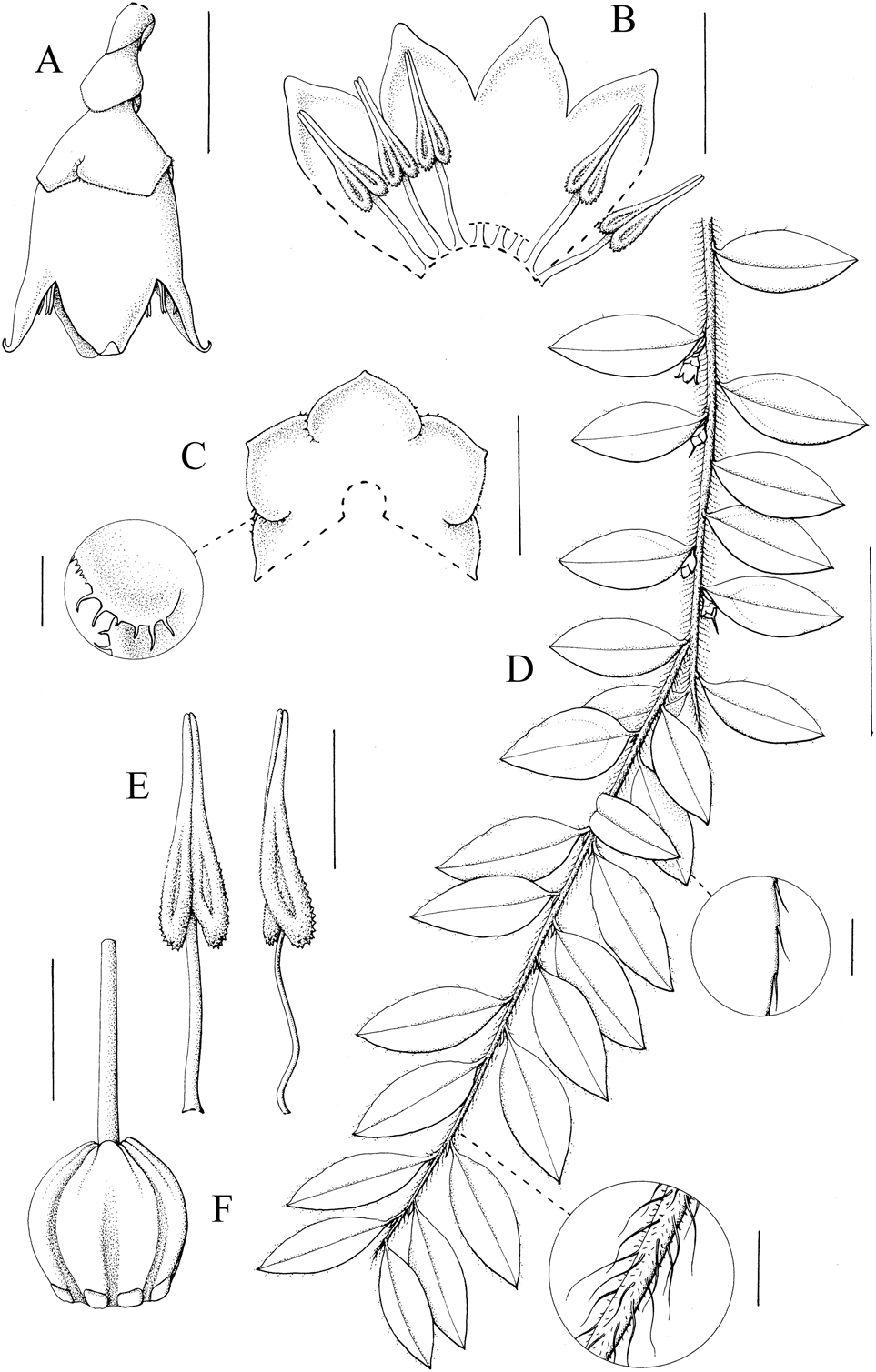
Similar to Diplycosia sagittanthera but differing in the lack of the long bristle-like hairs on the bracteoles and calyx and the flowers being much smaller. – Type: North Sulawesi, Gorontalo Province, Gunung Gambuta, 0°40′N, 123°21′E, 10 iv 2002, Mendum, Atkins, Newman, Hendrian & Supyan 61 (holo BO; iso E). Fig. 7.
Diplycosia supyanii Argent. A, flower (scale bar 2 mm); B, open corolla with some stamens (scale bar 2 mm); C, open calyx (scale bar 2 mm) with inset showing detail (scale bar 0.5 mm); D, habit (scale bar 2 cm) with insets of leaf margin (scale bar 2 mm) and stem indumentum (scale bar 2 mm); E, stamens front and side view (scale bar 1 mm); F, pistil (scale bar 1 mm).
Epiphytic spreading shrub to 1.2 m high; young growth flushed pink. Twigs with variable, semi-appressed bristles up to 2.5 mm long, with a short coarse under-pubescence. Lateral buds small, rounded and inconspicuous. Leaf blade slightly leathery, 15–20 × 5–10 mm, elliptic to sub-cordate, the base broadly tapering to rounded, apex broadly acute to acute, with an inconspicuous terminal gland, margin minutely indented, fringed with bristles when very young, flat, deep glossy green above, paler below, with a few scattered bristles below, especially on the mid-veins but apparently none on the upper side, becoming completely glabrescent leaving the surface punctate below with hair bases, mid-vein narrowly impressed above, only slightly prominent beneath, the larger leaves with 1 or 2 lateral veins spreading at c.45° in the basal half of the leaf, mostly the lateral veins are obscure. Petiole 1–1.5 × c.0.5 mm, with a few long bristles, becoming glabrescent. Slender axillary bracts in some leaf axils, as long as the petiole. Flowers all solitary. Pedicels at anthesis c.1 mm long; basal bracts sheathing, often obscuring the pedicels, glabrous; bracteoles c.0.7 × 1.2 mm, semi-circular, glabrous except for the margin which is fringed with short white hairs. Calyx tube c.0.7 mm long, glabrous, lobes 4, c.1 × 1.7 mm, broadly ovate, glabrous, except marginally white-ciliate and with a few darker glands towards the base. Corolla c.2.5 × 1.5 mm, white, narrowly campanulate, glabrous inside and out, lobes 4, c.1.3 × 1.3 mm, broadly triangular, becoming reflexed. Stamens 2.8 mm long, becoming slightly exserted; filaments 1.5 mm long, sigmoid, white, glabrous; anthers c.1.5 mm long, sagittate, the cells divergent and minutely echinulate, the tubules c.0.7 mm long. Disc of 8 lobes. Ovary glabrous; style c.1.5 mm long, cylindrical, glabrous. Fruit not known.
Distribution. Known only from the type locality from Gorontalo Province.
Ecology. On fallen tree on ridge at c.1300 m. Flowering April.
Conservation status. Data Deficient. There are too few collections to assess an AOO and EOO and the threats are unknown, but the plants were collected in a protected area.
Etymology. Named in honour of Ahmad Supyan, one of the collectors who was so helpful to the expedition on which this was collected.
Very similar to Diplycosia sagittanthera but lacking the bristles on the bracteoles and calyx lobes of that species and the flowers are only half the size. The 4-merous flowers are not considered to be very significant as they have been found to vary from 4–5-merous even on the same plant in other species (Argent, Reference Argent2002). The original description of Diplycosia sagittanthera records a 5-lobed corolla for that species.
Diplycosia triangulanthera J.J.Sm., Bot. Jahrb. Syst. 68: 207 (1937). – Type: Central Sulawesi, Palopo, Todjambu, 1000 m, 28 vi 1929, Kjellberg 1811 (holo S; iso BO).
Terrestrial or epiphytic shrub to 0.5 m high. Twigs slender, densely and patently reddish-bristly (bristles c.1.5 mm long) when young, gradually glabrescent with age. Leaf blade leathery, 10–19 × 5–10 mm, elliptic to ovate, base broadly tapering to rounded, apex broadly acuminate, the terminal gland thick and protruding, margin with persistent bristles, denticulate distally, when young laxly covered with longish patent bristles on both sides glabrescent with age, the undersurface finally spotted with blackish points, mid-vein slightly impressed above, other veins obscure. Petiole 1–2 mm long, bristly. Flowers 1–3 in upper axils. Pedicels 6–10 mm long, slender, with short patent bristles; basal bracts several, very small; bracteoles 1 mm long, broadly ovate, glandular ciliate. Calyx 2.5 mm, glabrous, lobes 1.4 mm long, broadly ovate, the margins glandular muriculate and ciliate. Corolla c.4 × 4 mm, white, broadly campanulate-urceolate, slightly constricted at the mouth, glabrous, lobes 0.5 mm long, recurved; filaments 1.5 mm, linear, inflexed, glabrous; anthers c.1 mm long including the very short tubules, triangular-ovate, granular. Ovary glabrous; style 2 mm long, glabrous. Fruit c.4 mm in diameter, blackish-blue.
Distribution. Central Sulawesi: Todjambu near Palopo and Puna near Poso.
Ecology. In open primary rain forest, on quartzite peaty soil, 1000–1800 m. Flowering June.
Diplycosia undata J.J.Sm., Feddes Repert. Spec. Nov. Regni Veg. 30: 171 (1932). – Type: SW Sulawesi, G. Bantaeng (Bonthain), 2700–2890 m, 16 vi 1921, Bünnemeijer 1222 (holo L; iso BO).
Small, highly branched shrub to 0.8 m. Twigs sub-patently, long (2–4 mm), reddish bristly in the younger parts, without any fine under-indumentum. Lateral buds conical to sub-globular, up to half the length of the petioles. Leaf blade firmly sub-leathery, 13–40 × 10–29 mm, sub-circular to broadly elliptic, base broadly tapering to rounded, apex sub-acuminate or obtuse, the terminal gland thick and very distinctly protruding, margin revolute and finely crenulate with each tooth ending in a fine, long, persistent bristle, shining and glabrous above, laxly spotted beneath by hair bases, mid-vein impressed above, raised beneath, lateral veins 2–3 pairs arising from, and from somewhat above, the base of the lamina, spreading at c.45°, curved-ascending and anastomosing, slightly impressed above, visibly raised beneath, other veins from the upper 2/3 of the mid-vein inconspicuous. Petiole 1.5–3 mm long, thick, bristly. Flowers solitary. Pedicels 8–15 × c.0.5 mm, slender, laxly appressed-bristly, or muriculate; basal bracts small, to c.1 mm long; bracteoles c.1.8 mm long, sub-circular-ovate, obtuse, glabrous dorsally, shortly glandular-fimbriate or muriculate. Calyx 3–4 mm long, glabrous, rugulose, with a few thick glands externally, lobes c.2.5 × 2 mm, ovate, acute, with a densely glandular margin and a thick protruding apical gland. Corolla c.8–11 × 3.5–5 mm, bright red, with pale pink lobes, urceolate, slightly contracted distally, somewhat fleshy, glabrous, lobes c.1.5 mm long, obtuse. Stamens c.8.5 mm long, protruding; filaments 4–5 mm long, S-curved, white, linear, slightly dilated towards the base, glabrous; anthers 2–2.7 mm long, oblong, granular, the tubules c.1.25 mm long. Disc of 10 small lobes. Ovary glabrous; style 5–6 mm long, cylindrical, glabrous. Fruit not known.
Distribution. SW Sulawesi (Mt. Bonthain) and South Sulawesi (Mt. Bawakareng).
Ecology. In brushwood of sub-alpine shrubbery, 2700–2890 m. Flowering February and June.
Additional specimens. South Sulawesi: Gowa District, G. Bawakareng, subsidiary to G. Lompobatang, c.5°19′S, 119°57′E, c.2600 m, 14 ii 2000, Argent, Mendum & Hendrian 0070 (E).
Argent, Mendum & Hendrian 0070 agrees well with the original description and the small variations have been included in the description above. Sleumer determined Eyma 640 as Diplycosia aperta but I have reidentified it as Diplycosia undata as this specimen (without flowers) conforms much more closely to D. undata than to D. aperta. It is, however, distinctive in only having a single pair of lateral veins and having slightly retuse leaf apices.
Acknowledgements
I thank the Sibbald Trust for financial support for visits to the Kew and Leiden herbaria in conjunction with this study and the curators of those herbaria for allowing access and facilities to study their specimens. I also acknowledge financial support from the James and Eve Bennett Trust for two of the illustrations used. I am grateful to Tony Conlon for assisting this study and maintaining the living collection of Diplycosia species at the Royal Botanic Garden Edinburgh. I am grateful to Claire Banks, Anna Dorward, Işık Güner and Lorna Fraser for the illustrations.