Introduction
Seed germination and successful seedling establishment are two independent events of major concern in crop production. These two events are thus heavily targeted to increase crop yield. Smoke was identified as an important germination stimulant in post-fire environments (De Lange and Boucher, Reference De Lange and Boucher1990). Subsequently, smoke or aqueous smoke extracts were used to enhance seed germination and seedling vigour in many plants, irrespective of fire sensitivity (Light and Van Staden, Reference Light and Van Staden2004). The chemical identity of the active compound present in smoke is 3-methyl-2H-furo[2,3-c]pyran-2-one (a butenolide) (Flematti et al., Reference Flematti, Ghisalberti, Dixon and Trengove2004; Van Staden et al., Reference Van Staden, Jäger, Light and Burger2004). The promotive role of the purified butenolide on seed germination and seedling vigour is well documented (Kulkarni et al., Reference Kulkarni, Sparg, Light and Van Staden2006; Merritt et al., Reference Merritt, Kristiansen, Flematti, Turner, Ghisalberti, Trengove and Dixon2006; Van Staden et al., Reference Van Staden, Sparg, Kulkarni and Light2006). In all these studies, seeds were placed in the continuous presence of the compound. This approach is not feasible for its utilization in commercial crop production. Recently, it was reported that pre-conditioning of maize kernels with butenolide promoted both germination and seedling vigour (Van Staden et al., Reference Van Staden, Sparg, Kulkarni and Light2006).
Seed priming is an economical, safe and commercially accepted method for improving and synchronizing germination, as well as improving seedling vigour. Priming involves the hydration of seeds in a solution that permits preliminary processes of germination, but not the final phase of radicle emergence (Heydecker et al., Reference Heydecker, Higgins and Gulliver1973). Priming of seeds with osmotica (mannitol, polyethylene glycol), inorganic salts (sodium chloride, nitrate and phosphate salts of potassium) and water enhances seedling establishment and yields in a variety of crops, including tomato (Sung and Chiu, Reference Sung and Chiu1995; Oluoch and Welbaum, Reference Oluoch and Welbaum1996; Ozbingol et al., Reference Ozbingol, Corbineau and Côme1998). Several cellular and molecular changes are known to occur during priming that contribute to improved germination and seedling vigour (Bray et al., Reference Bray, Davison, Ashraf and Taylor1989; Garćia et al., Reference Garćia, Jiménez and Vázquez-Ramos1995). Previously, an aqueous extract of smoke was used as an effective seed-priming agent (Baxter and Van Staden, Reference Baxter and Van Staden1994). Beneficial effects of priming are evident not only under optimum growing conditions; rather, such seeds are able to overcome various field stresses, such as water, salinity and temperature stresses (Frett and Pill, Reference Frett and Pill1989; Frett et al., Reference Frett, Pill and Morneau1991; Demir and Van de Venter, Reference Demir and Van de Venter1999). Under adverse field conditions, primed seeds perform better, resulting in earlier flowering, earlier harvesting and a higher yield compared to unprimed seeds (Amzallag et al., Reference Amzallag, Lerner and Poljakoff-Mayber1990; Passam and Kakouriotis, Reference Passam and Kakouriotis1994). The present study was undertaken to assess the potential of the smoke-derived butenolide as a priming agent for tomato seeds in order to facilitate its better usage in horticulture and agronomy.
Materials and methods
Plant material
Fresh commercial seeds of tomato (Solanum esculentum Mill.), cultivar ‘Heinz 1370’, were purchased from McDonalds Seeds, Pietermaritzburg, South Africa. They were stored at room temperature in aluminium foil packets until experimentation. The butenolide used in the experiments was isolated and purified from smoke-saturated water derived from burned Themeda triandra L., as described by Van Staden et al. (Reference Van Staden, Jäger, Light and Burger2004). In short, initial fractionation and purification procedures involved liquid–liquid partitioning, vacuum liquid chromatography and separation on Sephadex LH-20. Further purification was achieved by repeated reverse-phase high performance liquid chromatography (HPLC). The active compound was recovered using dichloromethane, yielding the target compound (99% purity), which was characterized using gas chromatography–mass spectrometry, infrared spectroscopy, and nuclear magnetic resonance spectroscopy.
Seeds (5 g) were soaked in either water or butenolide (10− 7 M) in 20-ml glass tubes. Tubes were left undisturbed in the dark at room temperature (23 ± 2°C) for 24 h. Thereafter, seeds were blotted dry to remove excess liquid, spread onto filter paper and allowed to dry at room temperature until they reached their initial weight. Primed seeds were then stored in aluminium foil at room temperature until experimentation.
Flow cytometric analysis
Water- and butenolide-primed seeds (10, replicated 3 times) were imbibed in water for 30 min to ease the isolation of embryos. Radicle tips were chopped with a sharp razor blade in 500 μl of nucleus extraction buffer containing 45 mM magnesium chloride, 36 mM trisodium citrate, 22 mM MOPS (4-morpholinepropane sulphonic acid, sodium salt) and 0.1% Triton X-100 at pH 7.14 (Galbraith et al., Reference Galbraith, Harkins, Maddox, Aryes, Sharma and Firoozabady1983). Another 500 μl of buffer was added after chopping, and the buffer containing nuclei was filtered through a 50 μm nylon filter. The samples were kept on ice until analysis. Propidium iodide (500 μl of 20 μg ml− 1) was used to detect DNA. After addition of propidium iodide, the samples were left undisturbed for 10 min prior to measurement.
All analyses were performed using a Coulter® Epics XL™ and XL-MCL™ flow cytometer (Beckman Coulter, USA) using the peak height identification method at 488 nm wavelength. Each sample was analysed for 10,000 nuclei. Data acquisition and analysis were performed using EXPO32 ADC software (Beckman Coulter, USA). The amount of DNA is proportional to the fluorescent signal and is expressed as arbitrary C values in which 1C comprises the DNA content of the unreplicated chromosome complement.
Germination experiments
Germination experiments were carried out in 65-mm Petri dishes lined with two layers of Whatman No. 1 filter paper. For unprimed seeds, the filter paper was either moistened with 3 ml distilled water (control) or butenolide (10− 7 M). In the case of primed seeds, distilled water was used. Each experiment was replicated three times with 25 seeds per Petri dish, and all experiments were repeated at least twice. Petri dishes were incubated at room temperature in the dark and were examined under green safelight conditions (0.5 μmol m− 2 s− 1) for germination. To ascertain the time of emergence of the radicle in primed seeds, the Petri dishes were examined every 4 h for the initial stages of germination. Seedlings were allowed to develop for a further 7 d, after which the number of germinated seeds, shoot length, radicle length and fresh weights of seedlings were recorded.
Experiments were carried out to compare the effect of various stress conditions (salinity, osmoticum or temperature) on control, water-primed or butenolide-primed seeds. To test for salinity stress, seeds were incubated in different concentrations of sodium chloride (0, 100, 125 or 150 mM) in the dark at room temperature. For osmotic stress, seeds were incubated in solutions of polyethylene glycol 6000 (PEG-6000) (0, − 0.05, − 0.15, − 0.30 or − 0.49 MPa) at 25°C (Michel and Kaufmann, Reference Michel and Kaufmann1973). For temperature stress, seeds were incubated at 10, 15, 20, 25, 30 or 35°C. Seeds incubated at 10°C were allowed to grow for 2 weeks. All other experiments were terminated after 7 d. Seedling parameters, as described above, were measured.
Data analysis
The seedling vigour index (VI) was calculated as: VI = seedling length (mm) × percentage germination. Statistical analysis was performed using the MINITAB® version 14 (Minitab Inc., USA). The germination data were arcsine transformed and subjected to one-way analysis of variance (ANOVA). Fisher's least significant difference (LSD) at the 5% level was used to analyse the differences between means of growth parameters of seedlings.
Results
Butenolide as a seed-priming agent
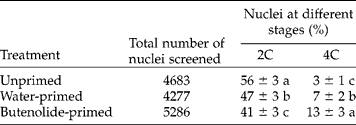
Tomato seeds were primed either with water or butenolide for 24 h at room temperature. Priming resulted in an increase in the percentage of 4C nuclei in both treatments (Table 1). In unprimed seeds, an average of 2.67 ± 0.9% nuclei were observed in the 4C stage, which increased to 13.4 ± 2.5% in the case of butenolide-primed seeds.
Percentage of 2C and 4C nuclei in radicles from unprimed and primed tomato seeds. Values represent mean±SE
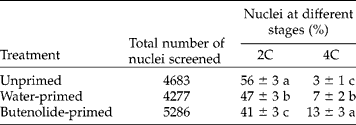
Values followed by the same letter are not statistically significant from each other (P ≤ 0.05).
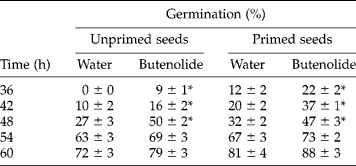
No radicle emergence was recorded in unprimed seeds in water within the first 36 h of imbibition, while for the water-primed seeds at the same time point germination was 12% (Table 2). At 36 h, the unprimed seeds germinated in the presence of butenolide had only 9% germination in comparison to the butenolide-primed seeds, which resulted in germination of 22%. For both the water- and butenolide-primed seeds, priming resulted in increased radicle emergence in the early stages of germination. Initially, radicle emergence was lower in water-primed seeds; however, germination caught up with that of the butenolide-primed seeds within 60 h of imbibition.
Germination (%) of unprimed tomato seeds imbibed either in water or butenolide (10−7 M), or seeds primed with either water or butenolide (10−7 M) for 24 h and subsequently imbibed in water. Values represent mean±SE
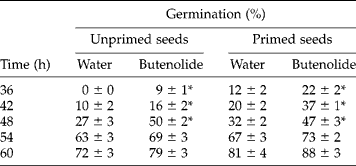
* Values are statistically significant from the corresponding control (P ≤ 0.05).
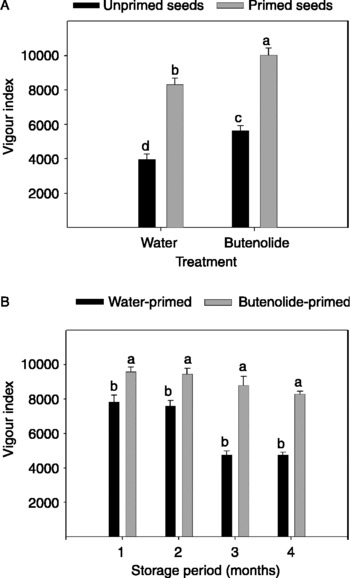
Butenolide improved overall seedling growth, and increased root and shoot length and seedling weight. Seedling vigour increased considerably with both water and butenolide priming in comparison to the control seeds (Fig. 1A). Furthermore, seedling vigour of the butenolide-primed seeds was significantly (P ≤ 0.05) higher than that of the water-primed seeds. A similar trend was recorded for the seedling weight (data not shown). Seedling vigour indices were higher for the butenolide-primed seeds than for seeds raised in the continuous presence of butenolide (Fig. 1A).
Comparative growth of tomato seedlings raised at room temperature (23 ± 2°C). (A) Vigour indices from unprimed, water-primed or butenolide-primed seeds. For the unprimed treatments, seeds were incubated for 7 d in either water or butenolide. For the priming treatments, seeds were primed either with water or butenolide for 24 h, and subsequently incubated in water for 7 d. (B) Vigour indices of seedlings raised from water-primed or butenolide-primed seeds after different periods of dry storage. Bars (mean ± SE) with the same letters (a–d) are not significantly different from each other (P ≤ 0.05).

Shelf-life of primed seeds
Primed seeds were stored at room temperature and subsequently tested for seed germination over a period of 4 months. A gradual decline in seedling vigour and seedling weight was recorded with increased storage of water-primed seeds at room temperature (Fig. 1B). After 4 months, seedling vigour declined by 13% compared to that recorded after 1 month in butenolide-primed seeds. However, in the case of water-primed seeds, the decline was 27%. Thus, after 4 months of storage, butenolide retained its promotive effect upon seedling vigour.
Effect of stress conditions on primed seeds
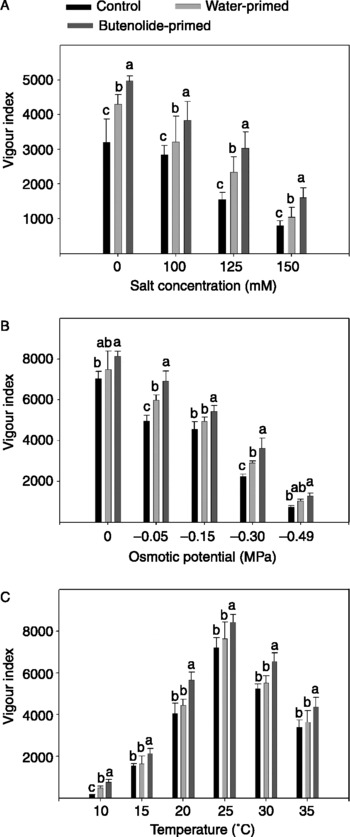
Results of experiments carried out to ascertain the effect of different stress conditions on the growth of seedlings are summarized in Fig. 2. A gradual decline in seed germination and seedling growth was recorded for seeds incubated in increasing concentrations of sodium chloride or PEG-6000 (Fig. 2A, B). Likewise, incubation of seeds under sub- or supra-optimal temperatures reduced seed germination (Fig. 2C). For the three treatments (unprimed, water-primed or butenolide-primed seeds), the butenolide-primed seeds exhibited a better response in terms of seed germination, seedling vigour and seedling weight at all concentrations for all treatments (Fig. 2A, B, C; data for seed germination and seedling weight not shown). In all cases, seedling vigour indices for the butenolide-primed seeds were significantly (P ≤ 0.05) greater than those recorded for the other two treatments.
Comparative growth of tomato seedlings raised under different stress conditions from unprimed, water-primed or butenolide-primed seeds. (A) Vigour indices of seedlings raised in the presence of different concentrations of sodium chloride (0, 100, 125 or 150 mM) in the dark at room temperature. (B) Vigour indices of seedlings raised in solutions of PEG-6000 (0, − 0.05, − 0.15, − 0.30 or − 0.49 MPa) at 25°C. (C) Vigour indices of seedlings raised in incubators maintained at 10, 15, 20, 25, 30 or 35°C. Bars (mean ± SE) with the same letters (a–d) are not significantly different from each other (P ≤ 0.05).

Discussion
The promotive role of butenolide on seed germination and seedling growth is well documented for a wide range of plant species, irrespective of fire sensitivity (Kulkarni et al., Reference Kulkarni, Sparg, Light and Van Staden2006; Merritt et al., Reference Merritt, Kristiansen, Flematti, Turner, Ghisalberti, Trengove and Dixon2006; Van Staden et al., Reference Van Staden, Sparg, Kulkarni and Light2006). In all these studies, seeds were incubated in the continuous presence of the active compound, which restricts the use of the butenolide on a large scale. In a previous study, smoke water was used as a pre-treatment agent for seeds of Themeda triandra. Treated seeds retained the promotive effect up to 21 d (Baxter and Van Staden, Reference Baxter and Van Staden1994). Therefore, the present study employed the use of the butenolide as a seed-priming agent. Besides comparing the effect of the priming treatment on seedling growth, studies were also carried out to obtain more insight into other changes induced in seeds/seedlings following priming.
Flow cytometric analysis of DNA content of unprimed and primed seeds revealed an increase in the DNA content from the 2C to the 4C level. This increase was significantly greater in the case of butenolide-primed seeds compared to water-primed seeds. These results are in agreement with several other studies where an increase in DNA content from 2C to 4C has been reported during priming (Bino et al., Reference Bino, De Vries, Kraak and Van Pijlen1992; Redfearn and Osborne, Reference Redfearn and Osborne1997; Gurusinghe et al., Reference Gurusinghe, Cheng and Bradford1999). Such an increase in DNA content is indicative of the progression from the G1 phase of the cell cycle to the S or G2 phase. This advancement in DNA synthesis during priming reflects the efficiency of the priming treatment in accelerating subsequent germination (Lanteri et al., Reference Lanteri, Saracco, Kraak and Bino1994).
Priming increases the speed and uniformity of seed germination and seedling development (Khan, Reference Khan1992; Taylor et al., Reference Taylor, Allen, Bennett, Bradford, Burris and Misra1998). Additionally, the primed seeds produced more vigorous seedling growth. Significant differences were recorded in the numerical values of seedling vigour of primed versus unprimed seeds. Furthermore, the growth parameters were greater for the butenolide-primed seeds compared to the water-primed seeds. Increased seedling growth in the primed seeds has been attributed to earlier initiation of various metabolic processes required for seed germination (Bewley and Black, Reference Bewley and Black1982). These metabolic activities are merely arrested, but not reversed, during the drying of primed seeds. Therefore, when such seeds are re-imbibed, germination may be faster and more uniform. However, one of the disadvantages of a priming treatment is that it generally reduces the longevity of seeds. A number of methods are known to increase the longevity of primed seeds. One of the most effective longevity treatments includes a moderate reduction in seed moisture content after priming, followed by incubation of primed seeds at elevated temperatures for short periods (Gurusinghe and Bradford, Reference Gurusinghe and Bradford2001; Schipper et al., Reference Schipper, van der Toorn and Bruggink2001). Primed seeds of tomato retained their promotive effects for up to 18 months when stored at low temperatures (Alvarado and Bradford, Reference Alvarado and Bradford1988; Frett and Pill, Reference Frett and Pill1989). In the present study, the butenolide-primed seeds retained the promotive effect for up to 4 months when stored under ambient conditions. A gradual decline in seedling vigour was recorded with an increase in the storage duration.
In order to expand production and availability, field crops are now also frequently cultivated under a range of stress conditions. Among the various stresses, soil salinity is of major concern. It is estimated that approximately 20% of cultivated lands and 33% of irrigated agricultural lands in the world are afflicted by excessive salinity (Rowley, Reference Rowley1993). Rapid seed germination and uniform field emergence are essential for the establishment of a successful crop stand in fields under both optimal and stress conditions. Slow or sporadic germination and seedling emergence, common phenomena observed under various biotic or abiotic stresses, result in fewer and weaker plants (Ashraf and Foolad, Reference Ashraf and Foolad2005). If the effects of such stresses are alleviated at early stages of seedling development, the chances of establishing a successful crop increase significantly under prevailing stress conditions (Ashraf et al., Reference Ashraf, Zafar and Ashraf2003). Priming is known to make seeds more resistant to various field stresses (salinity, osmoticum or temperature) at the initial stages of plant development. In the present study, butenolide-primed seeds overcame such stresses more effectively compared to the water-primed seeds or unprimed seeds. A similar promotive effect of priming in overcoming such stresses has been documented for melon, impatiens, asparagus and tomato seeds (Frett and Pill, Reference Frett and Pill1989; Frett et al., Reference Frett, Pill and Morneau1991; Demir and Van de Venter, Reference Demir and Van de Venter1999). Yield of tomatoes in the field is hampered by various stress conditions (Arin and Kiyak, Reference Arin and Kiyak2003). Priming of seeds has proved important for crops, which are either sown directly in fields or when transplanted. Generally, tomatoes are transplanted in fields from nurseries. Priming of tomato seeds has resulted in the development of healthier seedlings compared to those raised from unprimed seeds, even under optimal growing conditions. Such healthier seedlings should withstand the prevailing field stresses better than their counterparts.
In conclusion, results of the present study indicated that the smoke-derived butenolide can be used as a seed-priming agent, thereby facilitating its more efficient usage in horticulture and agronomy. Butenolide-primed tomato seeds exhibited faster radicle emergence coupled with improved seedling vigour. The seeds retained this promotive effect for a considerable time when stored at ambient conditions. Furthermore, butenolide-primed seeds withstood the various adverse stress conditions better than the corresponding controls. The present results indicate that tomato seeds primed with the butenolide can be marketed for commercial use by seed suppliers. Therefore, it seems possible to transfer smoke technology effectively from the laboratory to the field.
Acknowledgements
Financial assistance was provided by the National Research Foundation, South Africa.