Introduction
Clinically significant depressive symptoms affect nearly one in four adults over the age of 65 (Blazer, Reference Blazer2003). The public health burden is undeniable. Depressive symptoms increase health-care costs (Katon et al. Reference Katon, Lin, Russo and Unutzer2003) and amplify risk for morbidity and mortality (Beekman et al. Reference Beekman, Penninx, Deeg, Ormel, Braam and van Tilburg1997; Fröjdh et al. Reference Fröjdh, Håkansson, Karlsson and Molarius2003; Blazer & Hybels, Reference Blazer and Hybels2004).
A recent meta-analysis of 89 treatment studies of late-life depression (LLD) revealed that only 50% of subjects treated with medication or psychotherapy improve considerably by the end of treatment (Pinquart et al. Reference Pinquart, Duberstein and Lyness2006). These findings point to the need for the identification of vulnerable subgroups, which could lead to earlier implementation of stronger, more targeted treatments and prevention strategies (Smit et al. Reference Smit, Ederveen, Cuijpers, Deeg and Beekman2006).
Given theoretically important distinctions between early onset and late-onset depression (Charney et al. Reference Charney, Reynolds, Lewis, Lebowitz, Sunderland, Alexopoulos, Blazer, Katz, Meyers, Arean, Borson, Brown, Bruce, Callahan, Charlson, Conwell, Cuthbert, Devanand, Gibson, Gottlieb, Krishnan, Laden, Lyketsos, Mulsant, Niederehe, Olin, Oslin, Pearson, Persky, Pollock, Raetzman, Reynolds, Salzman, Schulz, Schwenk, Scolnick, Unutzer, Weissman and Young2003), attempts to develop clinically useful conceptual models of first lifetime episodes of depression in older adults are a high priority (Jorm, Reference Jorm2000; Pálsson et al. Reference Pálsson, Östling and Skoog2001; Brodaty et al. Reference Brodaty, Luscombe, Parker, Wilhelm, Hickie, Austin and Mitchell2002; Kessing et al. Reference Kessing, Agerbo and Mortensen2003). LLD is often viewed as a biopsychosocial problem (Engel, Reference Engel1977), and compelling arguments have been presented for the potentially causal involvement of biological and psychosocial processes (Krishnan, Reference Krishnan2002; Blazer, Reference Blazer2003). Speculation has outpaced solid data, however. Few so-called ‘risk factor’ studies have used prospective designs, incidence studies with long-term follow-up are rare, and most studies have been conducted on psychiatric patients, not community samples.
Prospective studies have shown that personality traits confer risk for clinically significant depression in younger adulthood (Boyce et al. Reference Boyce, Parker, Barnett, Cooney and Smith1991; Krueger, Reference Krueger1999; Pelkonen et al. Reference Pelkonen, Marttunen and Aro2003; Kendler et al. Reference Kendler, Gatz, Gardner and Pedersen2006), but the influence of personality on the development of first lifetime episodes of depression in advanced age has not been examined prospectively in a sample of older adults. A 9-month follow-up study of subjects 57 years of age or older (Ormel et al. Reference Ormel, Oldehinkel and Brilman2001) and a 6-year follow-up of subjects 55 years or older (Steunenberg et al. Reference Steunenberg, Beekman, Deeg and Kerkhof2006) suggested that the personality trait Neuroticism increased risk for clinically significant depression. The current study is the first to test the hypothesis that Neuroticism confers risk for first lifetime episodes of depression in a cohort of older adults.
Method
Sample
In 1971–72, all 70-year-old residents in Göteborg, Sweden, born between 1 July 1901 and 30 June 1902, were systematically sampled from the Population Register. Of the 1148 community-dwelling and institutionalized residents born on dates ending with 2, 5 or 8, 973 (85%) took part in the Gerontological and Geriatric Population Studies in Göteborg, a multidisciplinary prospective study of an entire birth cohort that was designed to develop a greater understanding of aging and age-related disorders (Svanborg, Reference Svanborg1977; Persson, Reference Persson1980; Skoog, Reference Skoog2004).
All subjects in the inception cohort were assigned index numbers ranging from 1 to 5. Subjects who had been assigned a 1 or 2 were invited to take part in a psychiatric examination; 392 (85%) accepted. The sampled cohort included community dwellers as well as institutionalized individuals and was representative of its population base with regard to sex, marital status, income, community rent allowance, rate of in-patient and out-patient care in psychiatric hospitals, clinics, and municipal out-patient departments and rates of registration with the Temperance Board for severe alcohol abuse (Svanborg, Reference Svanborg1977; Persson, Reference Persson1980; Skoog, Reference Skoog2004).
Personality was assessed using the Maudsley Personality Inventory (MPI; Jensen, Reference Jensen1958; Eysenck, Reference Eysenck1959). Of the 392 participants, 31 did not return the MPI, nine refused to complete it, 13 were judged to be incapable of completing the instrument, and data from two participants could not be used, leaving 337 with a completed MPI in the 1971–72 wave of data collection. There were no differences between those who did and did not complete the MPI with respect to gender, education, social class, social network, history of depression, presence of depression at baseline, presence of depression at follow-up, and 5-year mortality.
Given the present focus on first lifetime episodes of depression, 55 subjects with past histories (n=39) or active (n=16) depression at age 70 were excluded on the basis of an extensive psychiatric interview and review of medical records (Pálsson et al. Reference Pálsson, Östling and Skoog2001). Two were excluded due to dementia and five due to another psychiatric disorder at age 70. The baseline sample size for these analyses was therefore 275 (122 men, 153 women). None were institutionalized.
Subjects were invited for follow-up examinations at the ages of 75, 79, 81, 83 and 85 years. For subjects who completed the MPI, sample sizes (and number of recorded deaths) at each of the five follow-up waves were: 223 (39), 150 (97), 120 (116), 92 (135) and 74 (163). Numbers of subjects who refused or could not be traced at each wave were 13, 28, 39, 48 and 38, yielding participation rates of 94.4% (age 75), 84.2% (age 80), 75.5% (age 81), 65.7% (age 83) and 66.1% (age 85).
Instruments and procedures
Data collection involved an extensive physical examination, a mental health examination and a social assessment (Svanborg, Reference Svanborg1977; Persson, Reference Persson1980; Skoog, Reference Skoog2004). Personality was assessed using the Swedish translation of the MPI, an 80-item self-report instrument that includes 24 Extroversion items, 24 Neuroticism items, 20 lie-scale items and 12 items designed to conceal the nature of the questionnaire. Responses range from 0 to 2. As used in the MPI, the term Neuroticism refers to the tendency to experience distress, worry, anxiety, nervousness and unstable moods: ‘(N)euroticism refers to the general emotional lability of a person, his emotional overresponsiveness, and his liability to neurotic breakdown under stress’ (Eysenck, 1959, p. 5). Sample Neuroticism items include: ‘Do you often worry about things you should have not done or said?’, ‘Would you call yourself tense or high-strung?’, ‘Are you an irritable person?’ and ‘Do you have many nightmares?’ A reliability coefficient of r=0.72 has been provided for this scale in a Swedish sample (Åström & Ölander, Reference Åström and Ölander1960). Adjectives used to describe people who score low on the MPI Extroversion scale include reserved, unsociable, quiet, passive, careful and thoughtful. High scorers tend to be impulsive, optimistic, active, sociable, outgoing and talkative (Eysenck, Reference Eysenck1959). Sample Extroversion items include: ‘Are you usually quiet and shy when you are together with other people?’ (reverse scored), ‘Do you usually speak before you think?’ and ‘During a party can you let loose and have a really good time?’ A reliability coefficient of r=0.74 has been reported (Åström & Ölander, Reference Åström and Ölander1960).
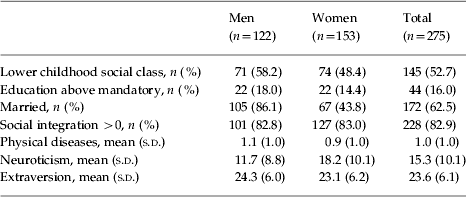
Demographic covariates were gender, current marital status and education, all coded dichotomously (Table 1). Theoretically important covariates were childhood social class, physical disease, and social integration. For the former, respondents were asked about their father's occupation; responses were coded on the basis of prestige, per convention. The cut-point for education was >6 years, as authorities required school attendance up to the sixth grade in early 20th-century Sweden. Each study wave included a complete physical examination, history, and laboratory tests (electrocardiogram, blood tests). Categories used to quantify disease included: cancer diagnosed within the past 10 years, endocrine, hematological, neurological, cardiovascular, respiratory, gastrointestinal, urogenital, rheumatoid arthritis, and specific treatments (warfarin, cytostatics, oral steroids). Each category was rated 0 (absent) or 1 (present); scores could range from 0 to 10. For the assessment of social integration, respondents were asked whether they had regular visits with their children, neighbors, or others. Responses were dichotomized and summed; scores could range from 0 to 3 and were dichotomized (0 v.>0) prior to analyses. Diagnoses were based on psychiatric examinations (including questions on symptoms present during the month preceding the interview and past psychiatric symptoms) and evaluation of medical records from the health-care system in Göteborg. The interviews were semi-structured, which meant that the questions were structured but clarifying questions were allowed to, for example, assess symptom severity or provide synonyms for different symptoms. Psychiatric symptoms and signs were rated in accordance with the Comprehensive Psychopathological Rating Scale (Åsberg et al. Reference Åsberg, Montgomery, Perris, Schalling and Sedvall1978) at all examinations except at baseline, when a similar scale was used (Persson, Reference Persson1980; Nilsson, Reference Nilsson1984; Pálsson et al. Reference Pálsson, Östling and Skoog2001). Procedures for rating every scale step for each symptom in the diagnostic algorithms have been well established (Åsberg et al. Reference Åsberg, Montgomery, Perris, Schalling and Sedvall1978).
Baseline characteristics at age 70: demographics, personality and physical disease

s.d., Standard deviation.
Inter-rater reliability for the semi-structured interview has previously been reported for symptoms and signs. Persson (Reference Persson1980) reported Spearman rank correlations for indicators of depression at age 70 ranging from 0.59 (lowered concentration) to 0.98 (thoughts of suicide). Focusing on dementia symptoms between ages 70 and 79, Nilsson (Reference Nilsson1984) reported comparable levels of inter-rater reliability. For the psychiatric investigation at age 85, Skoog et al. (Reference Skoog, Nilsson, Landahl and Steen1993a) reported Spearman rank-order correlations for depression symptoms that ranged from 0.87 (insomnia) to 1.00 (decreased appetite). For signs of depression, the rank-order correlations ranged from 0.55 (inability to think or concentrate) to 0.88 (decreased amount of speech) for signs.
Diagnoses of depression [major depressive disorder, dysthymia and depressive disorder not otherwise specified (NOS)] at each examination were established according to DSM-III-R criteria (APA, 1987) based on symptoms and signs during the month preceding the examination using an algorithm (Skoog et al. Reference Skoog, Nilsson, Landahl and Steen1993a). As the 2-year criterion for dysthymia could not be applied, this entity was treated as a form of mild depression, consistent with prior work (Kay et al. Reference Kay, Henderson, Scott, Wilson, Rickwood and Grayson1985).
Examinations at ages 70, 75, 79, 81, 83 and 85 years also included questions about past lifetime psychiatric disorders. This information was evaluated by psychiatrists, who made best-estimates or approximations of diagnoses according to the DSM-III-R criteria. Medical records were retrieved from general hospitals and homes for older adults, in-patient and out-patient departments in psychiatric hospitals and clinics, and municipal psychiatric out-patient departments in Göteborg. Every individual in the sample was checked. As almost all people in Sweden receive their medical health treatment within the public health system, all individuals had an equal and high probability of having a medical record. Retrieved records dated from the early 20th century until the end of the study and were gathered from 1971 to 1989. Of the 275 participants in this study, 194 had a medical record. Experienced psychiatrists conducted the record reviews. Diagnoses were recorded only if the criterion symptoms caused significant morbidity and functional impairment (Pálsson et al. Reference Pálsson, Östling and Skoog2001).
Dementia with onset before the depressive episode and concurrent psychotic disorder were exclusion criteria. Dementia diagnoses were initially based on the ICD-9 (WHO, 1977). Using methods described previously (Skoog et al. Reference Skoog, Nilsson, Landahl and Steen1993b), we were also able to diagnose dementia according to DSM-III-R criteria when subjects were aged 85 years (Persson & Skoog, Reference Persson and Skoog1996).
Statistical methods
The incidence (I) was based on person-years at risk and computed as:

The sum of risk years was computed as follows: first, all persons with a previous or current depression at the age of 70 were excluded. The risk time for those who did not develop depression during the 15-year follow-up was calculated as the time from the first examination to the time of death, development of dementia or the end of follow-up (at age 85). For incidence cases where depression was first diagnosed at a psychiatric examination, the individual risk time was calculated as the time from the first examination to the date of the diagnosis of depression. For incidence cases of depression first diagnosed by retrospective information from the participants themselves, the approximation was made that onset of disease occurred in the middle of the period between the last disease-free psychiatric examination and the next examination. For incidence cases of depression first diagnosed by information from case-records, the individual risk time was calculated as the time from the first examination to the date of the diagnosis of depression.
Hypotheses were tested by Cox survival analyses (Hosmer & Lemeshow, Reference Hosmer and Lemeshow1999). The dependent variable was time to first lifetime onset of mood disorder. Main predictors were the Neuroticism and Extroversion scores; covariates included marital status, childhood social class, education, gender, physical illness at baseline, and social integration at baseline. Findings are not reported for other covariates that were examined (e.g. childlessness, prior marriages) because they were not significant predictors and did not significantly influence the hazard ratios for the personality traits of interest.
Three sets of supplemental, exploratory analyses were conducted, acknowledging that definitive conclusions are precluded by the small sample sizes in some strata. In one analysis, we excluded the 51 subjects who developed dementia during the follow-up period. In a second, we conducted gender-stratified analyses. In a third, we divided the 15-year follow-up period into two age cohort phases (70–79, 80–85) to explore, in a preliminary fashion, whether the influence of personality on depression remained constant across the follow-up period.
Results
Demographic characteristics of the baseline sample of respondents who completed the MPI are presented in Table 1. Fifty-nine subjects (47 women, 12 men) were diagnosed with depression during the follow-up period, 41 of whom were diagnosed on the basis of psychiatric interviews: there were eight cases of incident depression diagnosed upon psychiatric examination at the 5-year follow-up (age 75), 12 at the 9-year follow-up, eight at the 11-year follow-up, eight at the 13-year follow-up and five at the 15-year follow-up. The total number of person-years at risk was 2576.5.
In addition to the 41 participants diagnosed at interview, 18 developed at least one clinically significant depressive episode during the intervals between psychiatric examinations. These diagnoses were established on the basis of participant self-report and a review of available records. Although sufficient to establish the presence of a mood disorder, the level of detail provided did not permit the diagnostician to distinguish between major depression, dysthymia and depressive disorder NOS. Thirty-six subjects developed first lifetime episodes of depression between the ages of 70 and 79; the remaining 23 developed first episodes after age 79, 21 of which were established by psychiatric interview.
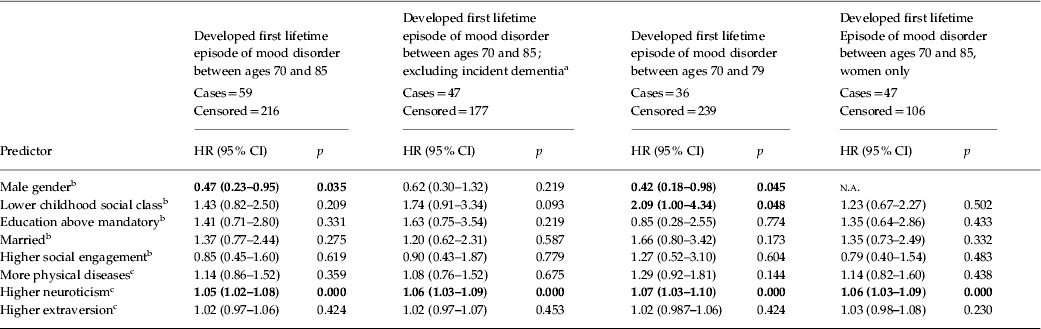
Table 2 reports the hazards ratios (HR) and 95% confidence intervals (CIs) for each of the predictors and covariates for developing first lifetime episodes of depression. This analysis, which simultaneously controls for all covariates and takes into consideration non-response and mortality, shows that women and people with higher Neuroticism were at greater risk of developing a mood disorder over the follow-up interval (first column). Supplementary analyses revealed a similar overall pattern of findings. The second column in Table 2 shows that Neuroticism at age 70 was associated prospectively with the development of clinically significant depression when we excluded the 51 subjects who developed dementia between ages 70 and 85.
Hazard ratios (95% CIs) for developing first lifetime episode of mood disorder after age 70

HR, Hazard ratio; CI, confidence interval; n.a., not applicable; analysis confined to women.
All p values are two-tailed. HRs are adjusted for other covariates Statistically significant p values are in bold.
a Fifty-one subjects developed dementia during the follow-up period (20 men and 31 women).
b Dichotomous variable.
c Continuous variable; the HRs for continuous variables refer to a 1 unit increase in the predictor. For example, a 1-point difference in Neuroticism corresponds to a 5% difference in the likelihood of developing depression prior to age 86 and 7% prior to age 80. A 1 standard deviation difference in Neuroticism (10.1 points) corresponds roughly to a 50% difference in the likelihood of developing depression prior to age 86.
Neuroticism was also associated with the development of depression when we restricted the analyses to those who developed first episodes between ages 70 and 79. Women and those from lower socio-economic strata were also at greater risk (Table 2, third column of HRs). Twenty-three participants developed first lifetime episodes of depression in their ninth decade. We identified no significant predictors (data not shown), but there was a trend for people with smaller social networks at age 70 to be at elevated risk for the development of a first lifetime episode of depression after age 79 (HR 0.42, 95% CI 0.16–1.08, p=0.07).
The rightmost column of Table 2 reports the predictors of developing a first onset mood disorder among women. Neuroticism remains a significant predictor. Given that only 12 men developed depression over the follow-up period, it is not surprising that we were unable to identify significant predictors of incident depression in that small group (data not shown).
Discussion
Neuroticism is a stable trait, even in older adulthood (Roberts & DelVecchio, Reference Roberts and DelVecchio2000). If it is assumed that its depressogenic effects ought to be manifest only earlier in the lifespan, the finding that Neuroticism confers risk for first lifetime episodes of depression in older adulthood may seem counterintuitive. Just as early adversity or exposure to toxins might first become pathogenic only in later adulthood (Finch & Crimmins, Reference Finch and Crimmins2004), there is no a priori reason to think that the adverse effects of Neuroticism are confined to younger adulthood.
Any explanation of how Neuroticism might lead to clinically significant depression in older adulthood must consider why distress-prone patients did not become depressed earlier in their lives. Although we are aware of no research on how people who are highly distress prone manage to stave off clinically significant depression, protective factors might play a role. Candidate protective factors include close personal relationships, rewarding occupations or meaningful hobbies, physical vigor and vitality, economic independence, and spiritual well-being. Processes related to aging might inexorably erode some of these protective factors. Loss increases the risk of depression in older adults (Kraaij et al. Reference Kraaij, Arensman and Spinhoven2002) and life events amplify the effects of Neuroticism on depression (Ormel et al. Reference Ormel, Oldehinkel and Brilman2001). Research is needed on how subtle and significant changes in the social, economic, physical and spiritual arenas interact with Neuroticism to amplify the risk of LLD.
Although our explanations for the role of Neuroticism in LLD emphasize life circumstances and changes, other mechanisms might also be relevant. Writing nearly 50 years ago, Eysenck maintained that Neuroticism was closely tied to the inherited degree of lability of the autonomic nervous system (Eysenck, Reference Eysenck1960). In this connection, it has been suggested recently that distress proneness could amplify risk for cognitive decline by compromising the neural regulation of the hypothalamic–pituitary–adrenal axis, including regions in the hippocampus, amygdala and prefrontal cortex (Wilson et al. Reference Wilson, Bennett, Mendes de Leon, Bienias, Morris and Evans2005). Among people high in Neuroticism, the chronic, dysregulated activation of specific neural circuits could accelerate cognitive decline. Similar processes might amplify risk for LLD and the brain diseases of older adulthood.
In general, findings from the supplementary analyses suggest that the relationship between personality and LLD are relatively independent of sample composition. The findings hold whether or not patients who develop dementia are included. The relationship between Neuroticism and depression onset between the ages of 79 and 85 was not statistically significant, partly because of the lower statistical power in this group. In addition, first lifetime episodes of mood disorders that develop in the ninth decade might be etiologically distinct from mood disorders that develop earlier in the lifespan, including in the eighth decade.
In addition to personality traits, sociodemographic factors also serve as markers of depression risk. Consistent with previous research (Smit et al. Reference Smit, Ederveen, Cuijpers, Deeg and Beekman2006), most of the analyses suggested that women are at greater risk than men. Having a working-class background may also place older adults at heightened risk, particularly prior to age 80. Replication of this finding is warranted. Relationships between childhood socio-economic status and LLD have rarely, if ever, been studied.
Our findings should be interpreted in the context of several methodological considerations. First, generalizability outside of Sweden, particularly to ethnic minorities, cannot be guaranteed. Second, we were unable to distinguish the effects of personality on specific mood disorders, although there is no reason, conceptually or empirically, to believe that Neuroticism would amplify risk for one form of depression but not another. Credible data and arguments have been presented for ‘etiological continuity’ between major depression and other forms of depression in older adults (Ormel et al. Reference Ormel, Oldehinkel and Brilman2001), although this controversy remains unresolved. Third, having experienced mental health professionals collect data, too rare in population studies, might confer a methodological advantage over studies that use bachelor's level interviewers. Acknowledging that no consensus exists on this issue (Brugha et al. Reference Brugha, Bebbington and Jenkins1999; Wittchen et al. Reference Wittchen, Üstün and Kessler1999), there are some data to suggest that participants are more likely to express at least one ‘symptom’, thoughts of suicide, to a physician than to interviewers with less training (Skoog et al. Reference Skoog, Aevarsson, Beskow, Larsson, Pálsson, Waern, Landahl and Östling1996). The interviews, initiated in 1971, were semi-structured, allowing for clarification of questions after the initial, more structured questions. Despite adequate inter-rater reliability data, it is possible that differences between interviewers or within an interviewer over time might have influenced the patterns of diagnosis over the 15-year study period. Even so, this cannot explain the reported associations with Neuroticism. Fourth, although this prospective study used data from case-records and face-to-face interview, the quality of data on past, current, and even incident episodes of depression is based in part on the subjects' memory, willingness to disclose personal information, and an array of other psychological and social processes unknown to us and rarely investigated in the epidemiological context. The diagnoses should be viewed as approximations. Similarly, the retrospective method may have led us to include people in our baseline sample who should have been excluded because they had a past episode of clinically significant depression, or we may have excluded incident cases that developed and remitted between data collection intervals (e.g. between ages 70 and 75). The effects of these potential biases are difficult to gauge. Fifth, we do not have data on years of education past the mandatory 6 years.
Finally, given that only 12 men developed a clinically significant mood disorder over the follow-up period, we were unable to identify any statistically significant predictors in that group. The same was true of people who developed a mood disorder after age 79. Future research on larger community samples using a more comprehensive personality taxonomy is warranted to elucidate the relationships between personality, age, and first lifetime episodes of depression. This is a particularly important issue for older men, given their high suicide rate in many Western countries, and the observation that they often take their lives in the midst of a first lifetime episode of depression (Conwell et al. Reference Conwell, Duberstein and Caine2002).
The conceptual relationships and distinctions between personality and depression are complex (Akiskal et al. Reference Akiskal, Hirschfeld and Yerevanian1983), particularly given the uncertain nosological status of minor, subsyndromal and subthreshold depressions (Pincus et al. Reference Pincus, Davis and Moqueen1999). Whereas many contemporary theorists and researchers consider the tendency to experience sadness or low mood to be a core component of Neuroticism, Eysenck apparently did not when he began working on the MPI in the 1950s (Eysenck, Reference Eysenck1959): no item on the MPI inquires about sadness or low mood. Nor are there any items pertaining to anhedonia, concentration problems, appetite disturbance, thoughts of death, low self-esteem, hopelessness, or thoughts of suicide. Clearly, the MPI does not assess prior or contemporary conceptualizations of major depression, dysthymia, or depressive disorder NOS. Moreover, all the interviews were conducted by an experienced psychiatrist, who concluded, on the basis of a careful review of all the available evidence, that the 275 patients included in these analyses had no significant history of depression and were not depressed at baseline.
Even if we assume that high Neuroticism scores in this sample represent subsyndromal depression, the predictive value of Neuroticism is undeniable. Data alone cannot definitively resolve the debate about personality versus pathoplastic processes. In this regard, it is worth noting that a 16-year follow-up study of a representative sample of American adults showed that scores on a depression measure at baseline were associated prospectively with psychiatric diagnoses at follow-up (Zonderman et al. Reference Zonderman, Herbst, Schmidt, Costa and McCrae1993). The authors concluded that scores on their measure of depressive symptoms served as a proxy for Neuroticism. Depending on the theoretical framework used, some might conclude that high Neuroticism scores represent unmeasured symptoms of depression, while others will maintain that the scores reflect enduring traits. Similarly, some might conclude that high depression scores reflect high Neuroticism, whereas others will maintain that they reflect subsyndromal depression.
The need for clinically useful conceptual models of late onset depressions that are of practical utility will only grow over the next few decades. These models ought to acknowledge the contributions to risk of long-standing personality traits. Future research, informed by developmental science and epidemiologic personology (Krueger et al. Reference Krueger, Caspi and Moffitt2000), could consider how personality interacts with biological, sociological and economic vulnerabilities to amplify risk.
In considering the implications of these findings for public health, the distinction between ‘risk factor’ and ‘risk marker’ (Kraemer et al. Reference Kraemer, Kazdin, Offord, Kessler, Jensen and Kupfer1997) may prove useful. Given the stability of personality, it is unwise to conceptualize Neuroticism as a risk factor to be modified, although it may well be modifiable in certain circumstances. High Neuroticism is best conceptualized as a risk marker, a signal that preventive intervention might be warranted, especially in the context of other risk markers. With respect to treatment, research on younger samples suggests that people treated for mood disorders who have higher levels of Neuroticism have poorer prognoses (Mulder, Reference Mulder2002). If this is true of older adults, modifications in treatments and service delivery will be required.
Acknowledgments
Work on this publication was supported in part by a sabbatical leave from the University of Rochester and United States Public Health Service Grant R01MH60285 and K24MH072712. Data collection was supported by grants from the Swedish Research Council (no. 11267), and the Swedish Council for Working Life and Social Research (no. 1154). The study is part of the Gerontological and Geriatric Population Studies in Göteborg, Sweden. We gratefully acknowledge the editorial assistance of Kelly McCollum and Patricia Bamonte, as well as Valter Sund's help with data analysis, the vision of Göran Persson, and the leadership of Professors Alvar Svanborg, who directed the study from 1971 to 1987, and Bertil Steen, who has been PI since 1988.
Declaration of Interest
None.