Introduction
As shown by the State of the World's Animal Genetic Resources for Food and Agriculture, SoW-AnGR (FAO, Reference FAO2007), domestic animal populations play important and multiple roles in human society, but the degree of knowledge of their characteristics is still very variable, depending on species and country. As stated in the SoW-AnGR, inventory, characterisation and monitoring should include the identification, quantitative and qualitative description, of domestic populations and the natural habitats and production systems in which they are embedded. Considering the currently available methods and criteria, this paper will address more particularly how these methods are applied to poultry.
Poultry genetic resources deal with several species and the wild ancestor is still present in many countries for all of them (chicken, duck, goose, guinea-fowl, pigeon, quail) except maybe for the turkey. This is an interesting feature in contrast to mammals, because gene flow may still take place locally, which has various consequences, both positive (maintain genetic diversity in local populations raised in free range conditions) or negative (replace the wild species with hybrids which may have lost some adaptive features).
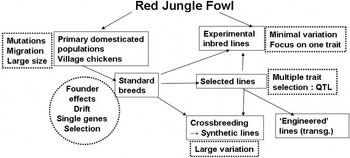
Among poultry species, chickens probably show the greatest variability of population types, from village chickens to highly specialised commercial lines and inbred experimental lines. All these populations, from village chickens to commercial and experimental lines constitute the genetic resources of this species (Figure 1). Such a wide scope of variation in the history and use of populations is not always easy to represent with the concept of breed for several reasons:
• local populations are not well characterized and are often missing from national inventories
• experimental lines may become very extreme within a given breed
• genetic make-up of commercial lines is generally kept confidential
In contrast to this large variability in poultry populations, the scientific community as well as public services dedicated to the poultry sector are not very large, and have probably decreased over the past 20 years. Furthermore, breeding programmes of commercial lines are in the hands of very few international companies. Thus, limited human resources are available to study poultry genetic resources.
A schematic representation of the diversity of chicken genetic resources obtained from domestication and selection, with their typical genetic features.

Inventories of poultry genetic resources
Making inventories is the first step in any national programme devoted to genetic resources, and the concept of breed needs to be taken in a broad sense, in order to avoid losing relevant data. Furthermore, the within-population diversity needs to be described, because both the between- and the within-population diversity should be assessed in order to have a reliable and global picture. Typically, the inventory will start by itemising genetically distinct populations or ‘breeds’, the number of animals per population, and the number of farms that keep these resources. Actually, inventories will generally be updated at the same time that characterisation studies are launched, so that both steps are generally connected.
Countries generally start this procedure with livestock species such as cattle, sheep and goats, which are widespread. Poultry are generally considered last. The usual method of establishing inventories for poultry requires the identification of breed associations, breeding companies, state institutions and research laboratories, who receive a questionnaire. The efficiency of this method will depend on the presence of a mandated institution within each country. Such a national institution will collect data from government extension services, as well as from farmers’ organisations – at any level from local communities to commercial companies. Involving local communities in the process has the advantage of raising awareness about the value of the populations in question. In the absence of any national structure, associations may organise the inventory but some coordination is needed. The poultry sector is characterized by an important fragmentation, with large commercial companies, which do not publicise the size or nature of their operations, and fancy breeders who keep private registers that do not always use a universal system for individual identification. Thus, specific surveys need to be launched to determine the state of poultry genetic resources. All information collected will be useless if it is not made available to the public at large, either through scientific papers, communications to the FAO journal, AGRI, and moreover, through Internet access to a searchable database. This is the role of the DAD-IS database maintained by FAO. The usefulness of the World Watch List of FAO for poultry biodiversity was discussed previously by Weigend and Romanov (Reference WEIGEND and ROMANOV2002).
The achievement of the SoW-AnGR by FAO in 2007 made possible to update the data on livestock resources from 182 countries, with a similar procedure to be followed in each country. This was an unprecedented effort. The results of the study are described in the following paper by Hoffmann (Reference HOFFMANN2009). Among the main features of this survey, one may notice that population data are frequently missing for chickens, and that information on risk status is missing for about one third of populations. A further third is considered to be endangered. There may be a slight bias in this regarding endangered populations, Europe and USA appear to exhibit the largest proportion of endangered populations, which may reflect the development of commercial lines in these countries but also the importance of missing information in other countries. Collection of complementary data could benefit from the involvement of WPSA which is a network of national branches, gathering people who are well aware of their national poultry sector (Pym et al., Reference PYM, EVANS, HUQUE and GIBBINS2005). For instance the Small Scale Family Poultry Farming working group of the Asian Pacific Federation has been able to gather rare information on the situation of local chickens in south-east Asia that was presented at a symposium within the 8th Asian Pacific Poultry Conference (Pym, 2007).
The most important factor that may improve this first level of inventory is the technology of geo-referencing. This technology offers a quite different approach that could be powerful in obtaining a more comprehensive record, because it does not require any prior identification of a contact list, but relies on the systematic association of a geographic co-ordinate with the counting of animals. Since chickens are not particularly associated with pastoralism, there is no real risk of counting them twice in a given population. Yet, this approach requires an investment in the technology, and to develop appropriate databases, that will facilitate the compilation of different types of data related to a given geographic region (climate, socio-economic background, epidemics). The generalisation of this technology should be considered as a priority at the international level.
Characterisation of performance and phenotypes
In addition to data on population size and geographical distribution, characterisation includes collection of data on production systems, phenotypic attributes (physical features, performance means and variances, special traits), historical development of the breed (crossbreeding, selection, connectedness with other breeds). The within-population genetic diversity needs to be measured both at the phenotypic level (phenotypic breed diversity) and at the molecular level; the two being complementary. Characterisation is needed to provide data on present and potential future uses of the genetic resources under consideration, and establishes their current state as distinct breed populations. Historical data will be particularly useful to analyse results from molecular markers.
In the absence of any national programme, research institutions generally make an important contribution to the characterisation of poultry genetic resources, which often involves PhD projects devoted to the poultry resources in a given country.
data collection methodology
The general approach to characterise poultry performance will typically have four parts: viz. production system including breed history and management; morphological attributes; performance level; and special traits.
First of all, the production system, in which the population is used, needs to be described. It is not possible to analyse performance levels without knowing the production conditions. Information to be collected will involve feed, housing and animal density, lighting, vaccination and medicines, animal identification, mating plan if any, reproduction, selection objectives or, at least, motivations for raising these chickens, marketing conditions and introduction of animals from foreign breeds. In developed countries, where breed associations can be found, structured interviews can be used to generate data on breeding objectives, breed and trait preferences and production system. In the absence of any association, a specific survey needs to be set up. FAO has started to develop simplified formats for data collection, and it is recommended to test a questionnaire on a subset of breeders before launching the large scale survey, in order to identify the relevant questions for a given population or a given region. Also, the scale of study has to be defined: regions, localities or farms. As an example, a survey has been set up in savanna and forest regions of Benin, Ghana and Ivory Coast in the frame of a DURAS project, supported by the French Ministry of Foreign Affairs, which is testing a questionnaire for village chicken owners. FAO is also launching specific surveys in Uganda, Egypt and Cambodia. One product of these surveys would be to define the required procedure to obtain, at a reasonable cost, the most useful information that will help to identify critical points for future management of the populations.
For commercial lines, as well as experimental lines, data are generally available regarding feed, housing, lighting, vaccination; yet, selection objectives, mating plan and line history are kept confidential by companies, but are published for experimental lines.
The second step is morphological description. Poultry, and particularly chickens, exhibit a large number of genetic variants affecting feather colour, feather distribution, feather structure, skin colour, comb morphology and the skeleton. These variants were described in a registry of mutations (Somes, Reference SOMES1988), but this has not been recently updated .An extensive review, however, has recently been published in French and Chinese by Coquerelle (Reference COQUERELLE2000). Pictures are the best way of recording the data for subsequent analysis. A check list of morphological variants was established for the European Avian Div project. Such variants provide information at three levels:
• farmer preference and uses, for instance for feather colour and religious events ;
• adaptation to the environment, for instance for feathering mutations in hot climates;
• population origin: for instance yellow skin may suggest crossbreeding with commercial lines where this mutation is quite frequent; a shiny white egg shell colour is typical of local breeds in Africa whereas a brownish colour will suggest introgression from brown egg commercial layers.
The third step is to measure production levels for a list of primary traits of economic importance that can be observed on live birds: e.g. body weight at a given age, shank length, shank diameter, age at first egg, egg number at a given age, egg weight at a given age, and hatchability. The quality of data collected depends to a large extent upon the production system: body measurements and egg weight can be measured on free-range chickens, but other egg production traits are mainly collected on a declarative basis. Even the age of the animal is not always accurately known with on-farm surveys. Survival rate is also recorded on a declarative basis for local populations. Thus, on-station testing is generally recommended to get more accurate measurements, but this imposes at the same time a standardised production system, so that on-station testing may give information on the productive potential of a population, provided that the birds can adapt to this system. For instance, free range chickens may adapt more or less easily to a confined environment, and behaviour should be monitored in order to avoid aberrant results due to excessive feather pecking, difficult adaptation to drinking system for instance.
The fourth step is to measure special traits that require specific equipment or require the slaughter of the bird: e.g. feed intake, egg quality, meat quality, body composition, disease resistance. These traits generally require station testing, to get individual feeders or electronic systems to monitor feed intake. Meat and egg quality require standard procedures to prepare the samples and specific equipments to assess colour, pH, physical features (tenderness for meat, breaking strength for eggs). Yet, sensorial quality of the meat may be more relevant for local breeds than technological parameters which are related to further meat processing techniques. Testing panels for sensorial quality are needed and judges have to be well trained in order to compare results between studies.
Facilities for ‘Random Sample Test’ breed comparisons were developed in the USA, Asia, Australia and in Europe for both laying hens and broilers. They were essentially used for the purposes of comparing the performance of commercial lines, but could be used in rare instances for other genotypes, provided that funding was available. This system was comparable to that used for pigs or beef cattle, but the decrease in the number of companies, the ban on cages in some countries, and reduced public funding have considerably decreased the activity of these stations. Some are still active in Europe, for instance in Germany specific studies are currently underway on floor systems for laying hens.
Research institutions also have experimental facilities for broilers or layers, mainly for chickens, but the introduction of live birds or fertile eggs from foreign countries is problematic owing to veterinary regulations. Thus, it is quite important that chicken experimental facilities are set up by each country in order to collect accurate phenotypic data; this will generally involve universities and research centres.
Finally, breeding companies have large facilities for their own selection programmes: data may be available under collaborative scientific project arrangements and may be published for specific studies.
survey data
Regarding local populations, results from surveys, morphological description and data on some primary traits are regularly published by the AGRI journal of FAO and by the INFPD Newsletter (International Network for Family Poultry Development) which is now called ‘Family Poultry’. The WPSJ is a possible publication point for such country studies, as was recently the case for Myanmar (Henning et al., Reference HENNING, PYM, HLA, KYAW and MEERS2007). Journals accepting French papers such as REMVT or Tropicultura are another source of data. Other sources are Master's or PhD thesis reports and congress communications. Altogether, data have been published for Bangladesh, Burkina Faso, Bhoutan, Cameroon, Ghana, Guinea, Kenya, India, Iraq, Maltese Islands, Morocco, Nigeria, Senegal, Sudan, South-Africa, Tanzania, Tunisia, Uganda and Zimbabwe.
Results for African countries have been summarized by Gueye (1998, 2002). In Europe, the research project AvianDiv provided a primary description of 53 populations including 22 local breeds scattered from Ukraine to Iceland and from Finland to Sicily (Tixier-Boichard et al., Reference TIXIER-BOICHARD, COQUERELLE, VILELA-LAMEGO and THE AVIANDIV CONSORTIUM1999). China has set up a programme including conservation farms and is publishing monographies on conserved breeds (Shadong, Reference SHADONG2006). South-America is probably the continent with the least data available in the literature.
Briefly, village chickens offer low output for minimal input, so efficiency can be seen as high. Natural incubation is the rule for reproduction. There is a variety of motivations of farmers for keeping chickens, including product quality, adaptation to environment and cultural uses, which shows that within population diversity is a major objective of keeping these birds. Product quality is rarely documented but is influenced by the production system: one study in India showed that meat from broilers raised in scavenging conditions, as compared to intensive system, was more coloured, less juicy and altogether better accepted (Deka and Kalita, Reference DEKA and KALITA2004).
In developed countries, the situation of fancy breeds or local breeds is rather variable, because some breeders keep them for exhibition purposes and are creating specific varieties within breeds, on the basis of morphological attributes, while others keep them to produce typical high quality and high price products, as in the case of the Bresse breed (Verrier et al., Reference VERRIER, TIXIER-BOICHARD, BERNIGAUD and NAVES2005). A number of local breeds in France, Belgium or Italy may see their numbers growing again with the development of niche markets for high quality products with cultural value. At that point, a measurement of product quality or the certification of a production method would be needed to assess the specific feature of the breed.
A puzzling question for local breeds involves disease resistance: local chickens are often said to have become adapted to harsh conditions, but most surveys show not infrequent high mortality rates, with some variability between populations. While juvenile mortality is due to various causes (predators, disease, malnutrition, climatic stress and theft) disease is generally the main cause of mortality of adults. There is no real proof of resistance to viral diseases of village chickens, they often die from Newcastle disease and are currently under threat of highly pathogenic avian influenza, but they are not at a higher risk than commercial birds (Otte et al., Reference OTTE, PFEIFFER, TIENSIN, PRICE and SILBERGELD2007). The threat to their existence comes from extensive culling programmes, which is a major issue for the monitoring of poultry genetic resources. Village chickens may be more resistant to parasitic and bacterial diseases, but this is extremely difficult to document. Only in the case of the Fayoumi breed, several studies have documented an increased resistance to Marek's disease (Tixier-Boichard et al., Reference TIXIER-BOICHARD, MONVOISIN, MORISSON, COVILLE, LE COQ and GUITTET1998) and to coccidiosis (Pinard-van der Laan et al., Reference PINARD-VAN DER LAAN, MONVOISIN, PERY, HAMET and THOMAS1998). This breed has been selectively bred in Egypt, and has a fixed plumage colour, so cannot really be considered any more as a village chicken. Furthermore, the Fayoumi breed has maintained its better disease resistance even after being kept for 20 years in an experimental facility with a vaccination programme and anti-coccidial additives. Thus, it can be seen as a unique breed from the viewpoint of disease resistance.
Data from testing stations for local populations are rare. The positive effect of a better controlled environment is expected for survival rate, as well as for egg production when hens are housed in cages, because broodiness is reduced. Estimates of genetic parameters for traits of economic interest are limited by the sample size of these trials. Actually, an important issue for characterisation of local populations is how to define objective criteria to describe their adaptation to local environments. Several environmental factors vary in these conditions: temperature, lighting, predators, diseases, feed heterogeneity and feed shortage. Limited resources may be considered as a stimulating factor for adaptation, but relevant criteria to score adaptive potential are difficult to define. Considering the questions raised by climate change in the mid-term, specific adaptive features of local breeds should be better characterised from now on. In Europe, a subset of fancy breeds was included together with commercial lines in a comparative study of welfare-related behavioural traits. There was significant variation between the breeds (Hocking et al., Reference HOCKING, CHANNING, ROBERTSON, EDMOND and JONES2004).
Regarding commercial lines, the most striking feature is the continuous trend in production in spite of many generations of selection. The fact that this trend is mainly due to genetic progress was shown by a comparison of a typical commercial broiler line in 2001 to a randomly-bred population kept unselected since 1957, using two diets, the 2001 diet and the 1957 diet (Havenstein et al., Reference HAVENSTEIN, FERKET and QURESHI2003). The change in diet had a dramatically smaller effect on growth of both genotypes than did the change in genotypes with a given diet. There was a significant line x diet interaction and mortality was lower in the unselected population. Thus, genetic variability appears to be still available for selection after 50 generations, which may be the consequence of a large base population and/or a careful management of genetic variability within the nucleus populations. Regarding laying hens, in the past random sample tests provided recurrent data for layers that were summarized by Working Group 3 of the European Federation of WPSA branches (Heil and Hartmann, Reference HEIL and HARTMANN1999). The last summary included four white egg stocks and seven brown egg stocks tested in six stations over three countries. Each stock was included in at least three testing groups, and significant differences were observed between stocks for egg production traits. Although performance of commercial lines was regularly increasing, there was no random-bred genotype introduced in the test, as was done in the broiler study.
Finally, numerous experimental lines have been developed in Europe and in the USA. A survey prepared by working group 3 ‘Breeding and Genetics’ of the European Federation of WPSA (Tixier-Boichard, Reference TIXIER-BOICHARD2003) identified 130 chicken lines kept in ten countries and 22 chicken breeds kept by public institutions in five other countries. Most of these lines were derived from a single breed and immune studies were the first motivation (68 lines) to keep these lines. For quails, 24 lines were present in five countries. In the USA, the genetic resources conservation program published a registry of 268 genetic stocks together with scientific information on these stocks and a proposal to organise conservation and distribution of these resources (Pisenti et al., Reference PISENTI, DELANY, TAYLOR, ABBOTT, ABPLANALP, ARTHUR, BAKST, BAXTER-JONES, BITGOOD, BRADLEY, CHENG, DIETERT, DODGSON, DONOGHUE, EMSLEY, ETCHES, FRAHM, GERRITS, GOETINCK, GRUNDER, HARRY, LAMONT, MARTIN, MCGUIRE, MOBERG, PIERRO, QUALSET, QURESHI, SHULTZ and WILSON1999). The most numerous category was mutant stocks (85 lines), which provide models for fundamental biology. This feature of poultry, mainly chicken, as a model species, should not be forgotten in any survey.
Molecular characterisation
The use of molecular markers can provide quantified criteria to assess genetic diversity, either within or between populations. They are used to study relatedness between populations, to provide information on past history of populations, to detect introgressions and finally they contribute to the genetic definition of a breed's entity. Yet, they do not provide any information on phenotypes and special adaptive traits, except for specific mutations of known genes, such as sex-linked dwarfism or feather colour genes.
The starting point of any molecular characterisation is the sampling stage, which may be ideally associated with the surveys described previously, so that molecular data can be related to a breed's management and phenotype. Where pedigree data are available, the sampling should be organised so as to represent as many family origins in the line as possible. In the absence of any pedigree data, sampling should follow the geographical distribution of chicken populations under study, without forgetting remote villages, in order to provide a reliable estimate of the whole diversity. The number of animals sampled varies between 30 and 50 per population for most studies and may reach a few hundred in some cases.
The polymorphism of mitochondrial DNA is generally used to infer domestication scenarios and detect ancient migration events via the female lineage. Chromosomal markers have the advantage of covering all the genome and of providing information on the current structure of the genetic diversity of a species. The chicken has the advantage of having a well documented genetic map since the year 2000 (Groenen et al., Reference Groenen, Cheng, Bumstead, Benkel, Briles, BURKE, BURT, CRITTENDEN, DODGSON, HILLEL, LAMONT, PONCE DE LEON, SOLLER, TAKAHASHI and VIGNAL2000) and the whole genome sequence has been available on-line since 2004 (Hillier et al., Reference HILLIER, MILLER, BIRNEY, WARREN, HARDISON, PONTING, BORK, BURT, GROENEN and DELANY2004). It was updated in 2006, and benefits from improvements through publications on specific chromosomes (Z chromosome, microchromosomes). Genome knowledge is less complete for other poultry species, but linkage maps are available for ducks, quail and turkeys and reference to the chicken genome is generally an efficient approach to study gene order and gene structure. Thus, availability of molecular markers is not a limiting factor in most poultry species, and their usefulness for the characterization of genetic diversity in chickens was reviewed by Weigend and Romanov (Reference WEIGEND and ROMANOV2001). Highly polymorphic microsatellite markers are preferred because they provide much information for a limited number of loci, the number of markers used varies between 20 and 30 for most studies. In 2004, FAO published guidelines for the measurement of domestic animal diversity with molecular markers, but they appear not to have been followed so well in chicken studies (Baumung et al., Reference BAUMUNG, SIMIANER and HOFFMANN2004). The marker set used within the European project AvianDiv (Rosenberg et al., Reference ROSENBERG, BURKE, ELO, FELDMAN, FREIDLIN, GROENEN, HILLEL, MAKI-TANILA, TIXIER-BOICHARD, VIGNAL, WIMMERS and WEIGEND2001; Hillel et al., Reference HILLEL, GROENEN, TIXIER-BOICHARD, KOROL, DAVID, KIRZHNER, BURKE, BARRE-DIRIE, CROOIJMANS, ELO, FELDMAN, FREIDLIN, MAKI-TANILA, OORTWIJN, THOMPSON, VIGNAL, WIMMERS and WEIGEND2003), however, has been used for a large number of population studies. Considering the recent development of single nucleotide polymorphisms (SNP) for use in genome sequencing, it is likely that molecular tools to study genetic diversity will evolve (Hillel et al., Reference HILLEL, GRANEVITZE, TWITO, BEN-AVRAHAM, BLUM, LAVI, DAVID, FELDMAN, CHENG and WEIGEND2007) and that the FAO guidelines will need to be revised accordingly.
Considering methods of analysis, a variety of software are now available to calculate parameters for within-breed diversity (observed and expected heterozygosity, deviation from Hardy-Weinberg equilibrium, number of effective alleles, Fis). It can also measure breed differentiation (Fst, number of private alleles) and breed relatedness according to genetic distances such as DA (Nei et al., Reference NEI, TAJIMA and TATENO1983) DR (Reynolds et al., Reference REYNOLDS, WEIR and COCKERHAM1983) and the PSA distance based on proportion on shared alleles (Bowcock et al., Reference BOWCOCK, RUIZ-LINARES, TOMFOHRDE, MINCH, KIDD and CAVALLI-SFORZA1994).
It should be noted that phylogenetic reconstruction is not well adapted to the dynamics of domesticated populations, which do not diverge strictly from a common ancestor and may include cross-breeding, admixture and introgression events in their histories. Clustering methods, which do not rely on phylogenetic assumptions, are quite powerful in unravelling the genetic structure of populations, as shown with the structure algorithm (Pritchard et al., Reference PRITCHARD, STEPHENS and DONELLY2000) or with Bayesian methods (Piry et al., Reference PIRY, ALAPETITE, CORNUET, PAETKAU, BAUDOUIN and ESTOUP2004). These methods allow inference on individual ancestry and make it possible to study clustering of individuals into a breed. Multivariate methods are another way, which are independent from any phylogenetic hypothesis, to identify population typology and study the efficiency of a given marker to describe population structure, as shown recently in chickens (Berthouly et al., Reference BERTHOULY, BED'HOM, TIXIER-BOICHARD, CHEN, LEE, D., LEGROS, VERRIER and ROGNON2008).
data from molecular characterisation
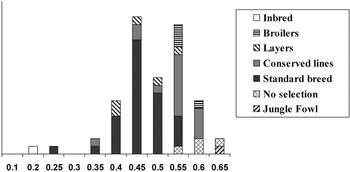
Several studies have been published which include a large array of chicken populations typed with microsatellite markers (Wimmers et al., Reference WIMMERS, PONSUKSILI, HARDGE, VALLE-ZARATE, MATHUR and HORST2000 ; Rosenberg et al., Reference ROSENBERG, BURKE, ELO, FELDMAN, FREIDLIN, GROENEN, HILLEL, MAKI-TANILA, TIXIER-BOICHARD, VIGNAL, WIMMERS and WEIGEND2001; Hillel et al., Reference HILLEL, GROENEN, TIXIER-BOICHARD, KOROL, DAVID, KIRZHNER, BURKE, BARRE-DIRIE, CROOIJMANS, ELO, FELDMAN, FREIDLIN, MAKI-TANILA, OORTWIJN, THOMPSON, VIGNAL, WIMMERS and WEIGEND2003; Su et al., Reference SU, YANG, LI, XU, CHEN, YANG, ZHANG, WU, HOU and XU2004 ; Granevitze et al., Reference GRANEVITZE, HILLEL, CHEN, CUC, FELDAM, EDING and WEIGEND2007 ; Berthouly et al., Reference BERTHOULY, BED'HOM, TIXIER-BOICHARD, CHEN, LEE, D., LEGROS, VERRIER and ROGNON2008). Nearly 200 populations have been studied, about 100 of them using a common set of 21 markers originating from the AVIANDIV European project. The main results showed a large range of variation of heterozygosity values which reflected differences in population history (Figure 2) but the average value (around 50%) was rather lower than that observed in domestic mammals. Highest levels of within-population diversity were found in the wild ancestor species, in unselected local populations, in a few standardised breeds kept with a large population size and in some commercial broiler lines. A range of values were obtained for European fancy breeds, which reflected the variability of population history within this type of population. Expected values for heterozygosity ranged between 50 and 63% for broilers, between 45 and 50% for brown-egg layers and around 40% for white-egg layers which exhibited the lowest levels of all commercial lines. Thus, white-egg layers may be considered to be in a more critical situation than other breeds/lines regarding their future development, whereas some local breeds do represent a significant reservoir of genetic diversity.
Range in unbiased heterozygosity values for 64 populations using 29 microsatellite markers, according to domestication status of the populations (from the data published by Granevitze et al., Reference GRANEVITZE, HILLEL, CHEN, CUC, FELDAM, EDING and WEIGEND2007).

Clustering methods showed a high rate of correct assignment of individuals to breeds in the case of standardised breeds and experimental lines, with a mean percentage above 95% using 22 microsatellite markers (Rosenberg et al., Reference ROSENBERG, BURKE, ELO, FELDMAN, FREIDLIN, GROENEN, HILLEL, MAKI-TANILA, TIXIER-BOICHARD, VIGNAL, WIMMERS and WEIGEND2001; Berthouly et al., Reference BERTHOULY, BED'HOM, TIXIER-BOICHARD, CHEN, LEE, D., LEGROS, VERRIER and ROGNON2008). Depending on the history of populations, and on the polymorphism at marker loci, as few as nine markers may be sufficient to correctly assign individuals to their breed of origin (Rosenberg et al., Reference ROSENBERG, BURKE, ELO, FELDMAN, FREIDLIN, GROENEN, HILLEL, MAKI-TANILA, TIXIER-BOICHARD, VIGNAL, WIMMERS and WEIGEND2001). Thus it may be concluded that molecular markers may contribute to define breed identity and can be used to assign individuals to their population of origin. Yet correct assignment appeared more difficult in the case of commercial lines having the same breed of origin and similar selection programmes; a higher number of markers are needed to distinguish these lines. Finally, village chickens populations do not seem to exhibit a typical breed structure, as shown in Zimbabwe (Muchadeyi et al., Reference MUCHADEYI, EDING, WOLLNY, GROENEVELD, MAKUSA, SHAMSELDIN, SIMIANER and WEIGEND2007) and population differentiation may be observed only for large geographical distances between African countries (Mwacharo et al., Reference MWACHARO, NOMURA, HANADA, JIANLI, HANOTTE and AMANO2007).
The simultaneous study of breeds from very distant countries permits inference or confirmation as to its history: for instance, some French traditional chicken breeds, known to have received introduction of Asiatic birds in the past, were found to be closer to Chinese breeds than other French traditional Mediterranean types (Berthouly et al., Reference BERTHOULY, BED'HOM, TIXIER-BOICHARD, CHEN, LEE, D., LEGROS, VERRIER and ROGNON2008).
In the future, it is expected that the progress of genomics may merge functional data with historical data. This could be achieved by the use of thousands of SNPs able to provide a rather complete assessment of genome polymorphism, including polymorphisms related to phenotypes. Another way will be to use transcriptomics and proteomics to describe the phenotypes more accurately. Tools are being developed for a high throughput analysis of gene expression in chickens, but they have not yet been applied to the characterisation of genetic resources. These technologies are still quite expensive, but it is likely that the whole genome approach, with thousands of SNPs, will make rapid progress.
Monitoring
The Global Plan of Action for Animal Genetic Resources recognizes the need to have a country-based strategy so that activities for inventory and monitoring can be linked and coordinated with action plans such as agricultural censuses or livestock population surveys. Monitoring requires regular checking of population status, and the evaluation of trends in the size and structure of breed/populations, their geographical distribution, risk status and genetic diversity. Again, the application of geo-referencing tools can make a major contribution to improving the scope and scale of advanced inventory and monitoring both at country and global levels. Yet, it must be stated that poultry genetic resources are not always the priority for countries.
Major driving factors can lead to rapid changes in the population size and structures of locally adapted breeds. In poultry, this is particularly true with the epizootic of highly pathogenic avian influenza (HPAI) which is causing both direct mortality and indirect mortality through extensive culling programmes. The FAO has already indicated that systematic culling of village chickens will not reduce the risk of propagation of HPAI to industrial chickens. At the moment, the impact of HPAI on genetic resources is not well known, but local populations in developing countries are the most exposed.
Indicators are needed for population trends, breed risk status and changes in the production environment. Indicators should also address between- as well as within- population variability. A compromise has to be found between the ideal list of indicators needed to provide accurate information, and the cost of collection and ease of interpretation. In general, a small number of indicators are preferable in terms of measurability and communication, but relevant information needs to be captured. Indicators should not be published without a clear explanation on how they were obtained.
The assessment of risk status should not rely on population size alone, because mating plans or population management will greatly affect the level of genetic diversity within a given population. The use of molecular markers can provide useful indicators for population management, such as:
• compensating for the lack of pedigree data in unmanaged chicken populations, and unravelling the genetic entity behind the breed which will refine the inventory.
• detecting fragmented populations and providing the basis for improved management, such as exchange of breeding males within a breed;
• detecting loss of diversity and promoting conservation measures.
The current situation of monitoring practise depends on countries and varies according to population type.
Typically, developed countries can rely on breeders associations and national mandated institutions to monitor population sizes and numbers of breeding animals for traditional breeds and experimental lines. Experimental lines may be considered at risk not because of their limited population size, but because of the cost in maintaining them and the difficulty in getting recurrent support for them. Scientific studies need to clearly refer to experimental lines in publications where they are being used.
While the development of high- producing commercial lines has been the main factor leading to extinction of traditional breeds in Europe, commercial lines are one component of poultry genetic resources. They are used for large scale food production worldwide, and it is the responsibility of breeding companies to monitor both the within-line diversity and the number of lines they maintain. Parameters calculated on the basis of pedigree analysis, such as inbreeding coefficients of current breeding animals, or the number of ancestors with a cumulated contribution of 50 percent of the total gene pool, are useful indicators to monitor genetic diversity of commercial lines as well as experimental lines. In the absence of pedigree recording, loss in diversity may be monitored using molecular markers, particularly on the basis of the adjusted mean number of alleles calculated for reference sets of microsatellite markers. Appropriate time points need to be defined, chickens have a relatively short generation interval, and population status should be checked on a regular basis, the frequency should be defined in the national policy (every year or two).
Local populations in developing countries represent a critical issue for monitoring chicken genetic resources, particularly because they contribute to a large extent to the consumption of poultry meat in rural communities. One important message is that family poultry should be included in the official statistical data for these countries, because this monitoring will contribute to national development policies. Monitoring is particularly critical for countries with economies in transition, where changes in production systems may lead to the loss of indigenous populations. Local populations from Asia and Africa in particular should be monitored because they exhibit large genetic diversity and are exposed to HPAI risk. Technicians from development agencies need to be included in seminars or conferences dealing with genetic resources, so that they include this dimension into their current activities.
Conclusions
Maintaining genetic diversity is key to sustainable poultry production and monitoring poultry genetic resources. This topic needs to receive more attention by national programmes because poultry provide a large part of animal protein consumed all over the world. Poultry species, and particularly chickens, are characterised by a wide range of phenotypic variation between populations. Data on production systems need to be integrated with genetic data to better describe diversity. Although pedigree recording is mainly available for commercial and experimental lines, the availability of molecular markers can provide useful information on relatedness between populations, breed identity and within-breed diversity.