Consanguineous marriage refers to marriage between a man and a woman who share a common ancestor or ‘blood’. Depending on religion, culture, socioeconomic conditions and geography, the prevalence of consanguineous marriage varies significantly from one population to another. Western Europe, North America, Australia and Russia have the lowest prevalence of consanguineous marriage (less than 1%), while the Iberian Peninsula, Japan and South America have an intermediate level (1–20%). North Africa and sub-Saharan Africa, and West, Central and South Asia, have the highest levels (20–50%+) of consanguineous marriage (Bittles, Reference Bittles2012). The highest rates of consanguineous marriages are found among Arab Muslims and some other Muslim communities because, despite it resulting in a higher risk of negative health effects in offspring, consanguinity is deeply rooted in the culture of these communities and has many social and economic advantages (Tadmouri et al., Reference Tadmouri, Nair, Obeid, Al Ali, Al Khaja and Hamamy2009; Bittles, Reference Bittles2012; Islam, Reference Islam2017).
In Jordan, like most other Arab communities, consanguineous marriage is widely practised. Previous studies have reported that more than half of total marriages were consanguineous in Jordan during the 1970s through to the 1990s (Hijazi, 1977; Khoury & Massad, Reference Khoury and Massad1992; Al-Salem & Rawashdeh, Reference Al-Salem and Rawashdeh1993). More recently it has shown a declining trend (Assaf & Bradley, Reference Assaf and Bradley2014). However, most of these studies were based on regional or hospital-based data. In this respect, the large national-level Demographic and Health Survey (DHS) data sets conducted in Jordan provide an opportunity to analyse the different aspects of consanguinity in the country. This short report presents an update of the level, trends and determinants of consanguineous marriage rates in Jordan using the 2012 Jordan Population and Family Health Survey (JPFHS) data, along with data extracted from the previous JPFHS (Department of Statistics & ICF International, 2013).
The dependent variable was consanguineous marriage. This was derived from the individual questionnaire of the JPFHS, which asked ever-married women if they had any blood relation to their husband. Socioeconomic and demographic characteristics of women were considered as explanatory variables. Multivariate logistic regression analysis was performed with consanguinity as a dichotomous dependent variable and socioeconomic and demographic variables as explanatory variables to identify the significant determinants of consanguinity.
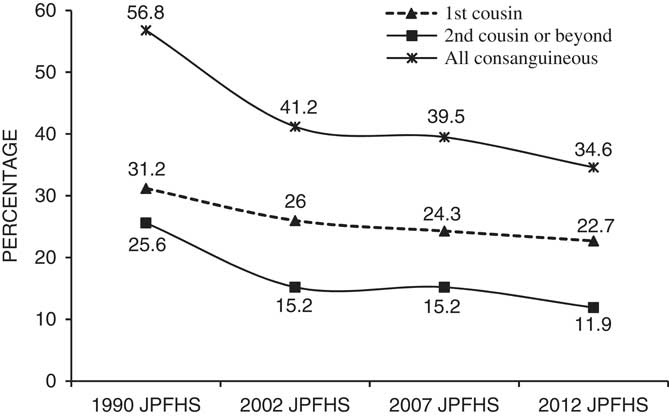
Information on consanguineous marriage was available from the 1990, 2002, 2007 and 2012 JPFHSs. Figure 1 presents the estimates of consanguineous marriage rates obtained from these surveys. The results indicate that consanguineous marriage was still very common in Jordan in 2012 as more than one-third (34.6%) of ever-married women reported having a blood relation with their husbands. Most consanguineous marriages were first cousin marriages (23%). The results indicate a secular declining trend in all form of consanguineous marriage in Jordan. Overall, the prevalence of consanguineous marriage declined by 39% – from 56.8% in 1990 to 34.6% in 2012 – a decline of 1.8% per year (statistically significant at p<0.001). The most significant decline occurred in second cousin or beyond second cousin marriages.
Levels and trends of different forms of consanguineous marriage in Jordan, 1990–2012.
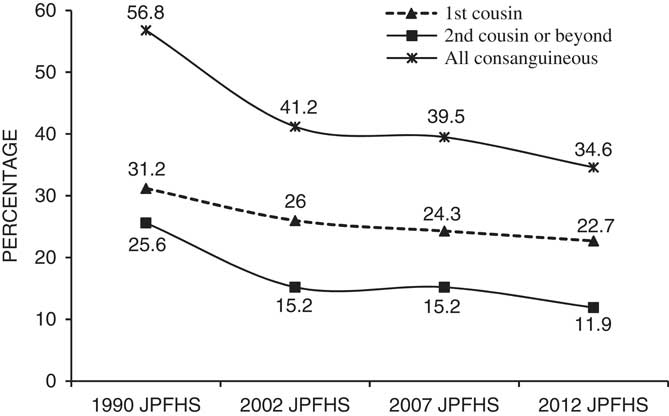
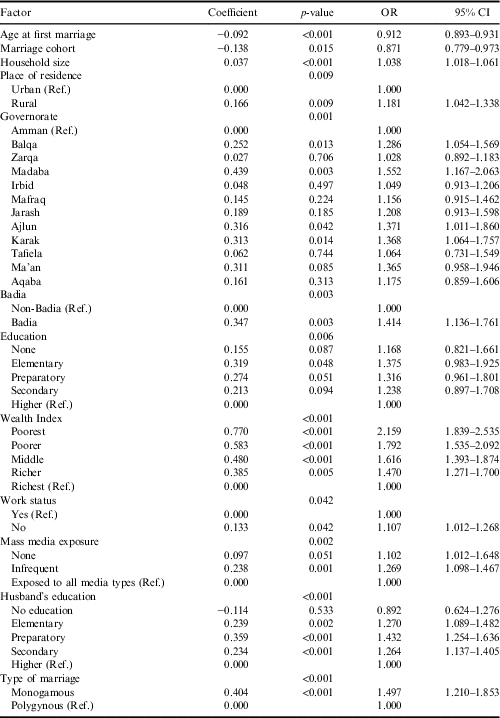
Table 1 presents the results of the logistic regression analysis showing the effects (odds ratio, OR) of the significant determinants of consanguineous marriage in Jordan. The results indicate that women’s age at first marriage, marriage cohorts, family size, urban/rural place of residence, administrative region (governorates), women’s education, work status, wealth index and mass media exposure, husband’s education, types of marriage (monogamous/polygynous) and women from Badia region have significant independent effects on consanguineous marriage in Jordan. Similar patterns of consanguinity have been found in several other Arab and Muslim countries (Radovanovic et al., Reference Radovanovic, Shah and Behbehani1999; Jurdi & Saxena, Reference Jurdi and Saxena2003; Bittles, Reference Bittles2012; Islam, Reference Islam2012).
Logistic regression analysis showing the effect (odds ratios) of socioeconomic and demographic factors of women on consanguineous marriage in Jordan, 2012

Women’s age at marriage and marriage cohort showed significant negative associations with the incidence of consanguineous marriage. The data indicated that a 1-year increase in age at marriage decreased the likelihood of a consanguineous marriage by 9% (OR=0.91; 95% CI: 0.89–0.93). Similarly, older marriage cohorts were more likely to have consanguineous marriage than their more recent counterparts. Family size showed a significant positive association with the incidence of consanguineous marriage. It is seen that a one-unit increase in family size increased the likelihood of consanguineous marriage by about 4% (OR=1.04; 95% CI: 0.78–0.97). Women living in rural areas were 1.18 times more likely to have a consanguineous marriage than those living in urban areas (OR=1.18; 95% CI: 1.04–1.34).
Consanguinity varied significantly across the administrative regions of the country. Women from Madaba, Ajlun and Balqa governorates were 29–55% more likely to have a consanguineous marriage than those from Amman governorate. Women from Badia region were 1.4 times more likely to have a consanguineous marriage than women from non-Badia regions (OR=1.41; 95% CI: 1.14–1.76). The Badia region is an arid or semi-arid area of Jordan that constitutes 80% of the total land area and 6.5% of the total population of the country (Setlur, Reference Setlur2012). It is not exactly desert as there is some rainfall, and plants and animal life. The inhabitants of the region are mostly the Bedouin tribes who lead a traditional nomadic life. The higher prevalence of consanguineous marriage among the tribal Badia women is consistent with the findings of other studies (Raz & Atar, Reference Raz and Atar2005; Bittles, Reference Bittles2012; Bakoush et al., Reference Bakoush, Bredan and Denic2016). The higher prevalence of consanguineous marriage among tribal communities is generally attributed to their cultural system of inheritance, poor economic condition, lack of education and low level of social security (Khlat, Reference Khlat1997).
Women with no education, or secondary or less education, were at least 17–38% more likely to have a consanguineous marriage than women with higher levels of education. Women who did not participate in the labour force were 1.1 times (OR=1.1; 1.01–1.27) more likely to have a consanguineous marriage than those who were employed. Women having no exposure to any type of media or infrequent exposure to any one of the three media types (radio, TV and newspaper) were more likely to have a consanguineous marriage than those who had exposure to all three media types. This result indicates that there is a significant negative impact of higher level of education of the husband in lowering the risk of consanguinity. Women having husbands with monogamous types of marriage were 1.50 times more likely to have a consanguineous marriage than those with polygynous marriages (OR=1.50; 95% CI: 1.21–1.85).
The findings of this study reveal that consanguineous marriage is highly preferred in Jordan as more than a third (35%) of all marriages were consanguineous in 2012. Consanguinity, however, is gradually losing ground in Jordan as it is gradually declining. A clinic-based study in Amman, the capital city of Jordan, also reported a declining trend in consanguineous marriage in three generations: before 1950, 1950–1979 and 1980 and later (Hamamy et al., Reference Hamamy, Masri, Al-Hadidy and Ajlouni2005). The declining trends in consanguinity in Jordan could be attributed to socioeconomic development and increased urbanization and modernization of Jordanian society. Although cousin marriage is a cultural preference in Jordan, the execution of such a preference is likely to be affected by the ongoing demographic transition in Jordan with declining fertility and improvement in health and survival. Also, increasing awareness about the negative health impact of consanguineous marriage on offspring might act as a constraint for preference for consanguinity in the future in the country.