Introduction
Myringoplasty is a well-established procedure for tympanic membrane perforation closure. A variety of methods exist, employing different techniques and materials. Although many factors are thought to affect the success rate, there is no consensus. Therefore, our study aimed to identify which factors significantly influence tympanic membrane perforation closure.
Materials and methods
A retrospective study was performed of all patients, both adults and children (i.e. less than 16 years old) who underwent myringoplasty from January 2005 to January 2010 in a teaching hospital. All patients were identified using the theatre coding system. Inclusion and exclusion criteria used were in accordance with the National Comparative Myringoplasty Audit.Reference Jurovitzki and Sade1 Inclusion criteria comprised perforations of the pars tensa, all age groups, and cortical mastoidectomy and myringoplasty for non-cholesteatoma ears. Exclusion criteria comprised cholesteatoma surgery and concomitant ossiculoplasty. The two main outcome measures were an intact tympanic membrane and air–bone gap (ABG) closure by at least 20 dB HL or by at least 10 dB HL if the ABG was within 20 dB HL at post-operative follow up.
Potential influencing factors were surgeon grade (consultant, associate specialist or registrar); pre-operative condition of the ipsilateral middle ear (inactive or active chronic otitis media, with persistent or intermittent discharge); pre-operative condition of the contralateral middle ear (normal, otitis media with effusion, inactive chronic otitis media or active chronic otitis media); perforation site (anterior, posterior, inferior or subtotal); perforation size (0–20 per cent, 21–40 per cent, 41–60 per cent or subtotal); and simultaneous cortical mastoidectomy. The indication for a cortical mastoidectomy was myringoplasty in the presence of an actively discharging ear or a revision paediatric case. Several different graft materials were used: temporalis fascia, perichondrium, perichondrium and cartilage, fat, and periosteum.
Statistical analysis
Statistical analysis was performed using the XLSTAT statistical computer program (Addinsoft, New York, USA). Logistic regression analysis was used to determine which factors significantly influenced outcome. Statistical significance was set at a p value of less than 0.05.
Results
A total of 394 procedures were included, involving 313 adults and 81 children. The mean overall age was 35.8 (range 10–72), and the mean length of follow up was 7.5 months (range 2–48).
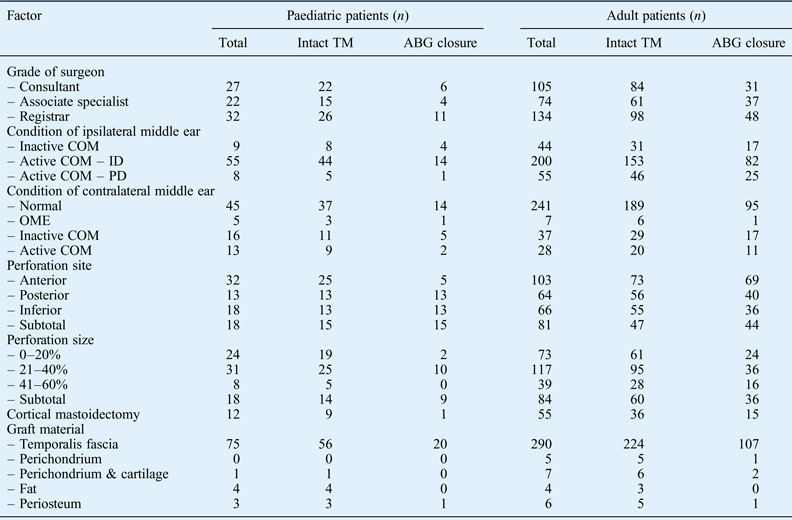
In the adult group, there were 263 (84 per cent) primary procedures and 50 (16 per cent) revisions; in the paediatric group, there were 70 (86 per cent) primary cases and 11 (14 per cent) revisions. The graft take rate was 81 per cent in the adult group and 85 per cent in the paediatric group. In the adult group, the tympanic membrane perforation site significantly influenced successful tympanic membrane closure at follow up (p = 0.016), with anterior (p = 0.008) and subtotal perforations (p = 0.017) demonstrating the greatest influence (Table I). No other factor significantly influenced tympanic membrane closure or ABG closure to within 20 dB HL. In the paediatric group, none of the factors significantly influenced either intact tympanic membrane closure or ABG closure to within 20 dB HL.
Factors that significantly affect outcome in paediatric and adult patients*

*Outcome is an intact tympanic membrane or air–bone gap closure to within 20 dB HL. TM = tympanic membrane; ABG = air–bone gap; COM = chronic otitis media; ID = intermittent discharge; PD = persistent discharge; OME = otitis media with effusion
Discussion
The graft success rate achieved in this study is comparable with other studies, which report graft take rates of between 70.8 per cent and 97.8 per cent for both adults and children.Reference Jurovitzki and Sade1–Reference Onal, Uguz, Kazikdas, Gursoy and Gokce9
This study demonstrated a significant association between perforation site and graft take rate, with anterior and subtotal perforation sites having the most influence on outcome. Anterior perforations were previously demonstrated to have an increased graft failure rate because of the technical difficulty of ensuring that the graft heals at the anterior rim of the perforation whilst avoiding anterior blunting and lateralisation of the graft.Reference Scally, Allen and Kerr10 Using fluorescein staining, Applebaum and Deutsch demonstrated the anterior to be the least vascular part of the tympanic membrane.Reference Applebaum and Deutsch11 Subtotal perforations are more likely to fail because there is no tympanic membrane remnant for the graft to heal on to. Previous studies either agree or disagree with this study. Frade Gonzalez et al. demonstrated that perforation site affects the perforation closure rate: subtotal perforations were associated with a reduced success rate.Reference Frade Gonzalez, Castro Vilas, Cabanas Rodriguez, Elhendi, Vaamonde Lago and Labella Caballero12 Jurovitzki et al. demonstrated that anterior perforation grafts were less successful than those of other perforation sites.Reference Jurovitzki and Sade1 Albera et al. demonstrated that the perforation site has a significant influence on the graft take rate, although they found that posterior perforations have a lower success rate.Reference Albera, Ferrero, Lacilla and Canale13 In contrast, several studies have found no significant relationship between perforation site and graft take rate in adultsReference Vartiainen and Nuutinen2, Reference Al-Ghamdi14, Reference Westerberg, Harder, Magnuson, Westerberg and Hyden15 and in children.Reference Caylan, Titiz, Falcioni, De Donato, Russo and Taibah16, Reference Berger and Berger17
Yung demonstrated a relationship between perforation site and hearing gain, with posterior perforations showing the greatest pre-operative hearing loss and post-operative gain.Reference Yung18
None of the other factors assessed in this study had a significant influence on perforation closure or hearing gain. In agreement with this study, Wasson et al. demonstrated that neither surgeon grade nor graft material had a significant effect on closure rate or hearing outcome.Reference Wasson, Papdimitriou and Pau19 In contrast, similar studies reported other factors to have significant effects on outcome. Several studies demonstrated a relationship between perforation size and closure rate. Jurado et al. and Lee et al. demonstrated a relationship between perforation size and both closure rate and hearing gain.Reference Jurado, Gil, Secall, Vadillo, Palau and Novoa20, Reference Lee, Kelly and Mills21 Others demonstrated a relationship between perforation size and hearing gain.Reference Wasson, Papdimitriou and Pau19, Reference Pfammatter, Novoa and Linder22, Reference Thiel, Mills and Mills23 In a study of 106 patients with a central dry perforation and an intact, mobile ossicular chain, Pfammatter et al. demonstrated complete closure of the ABG in 20 per cent of patients and closure to within 10 dB HL in 80 per cent of cases. These authors stated that perforation size had the greatest positive impact on outcome.Reference Pfammatter, Novoa and Linder22 In a study of 169 myringoplasties, Thiel et al. demonstrated ABG closure to within 10 dB HL in 53 per cent of patients and stated that hearing gain was more likely with larger perforations.Reference Thiel, Mills and Mills23 Vartiainen and Nuutinen demonstrated that perforation size had no effect on either ABG closure or hearing.Reference Vartiainen and Nuutinen2
This study found no significant relationship between a discharging ear (either persistent or intermittent) or a dry ear and either closure rate or hearing gain. In agreement with this, Onal et al. and Albera et al. demonstrated no difference in closure rates between discharging and dry ears.Reference Onal, Uguz, Kazikdas, Gursoy and Gokce9, Reference Albera, Ferrero, Lacilla and Canale13 Caylan et al. demonstrated that operating on actively discharging ears increased the closure rate from 75 per cent to 100 per cent in children.Reference Caylan, Titiz, Falcioni, De Donato, Russo and Taibah16 Mills et al. demonstrated no significant difference in closure rate between actively discharging (either intermittent or persistent) and inactive ears in a study of 268 ears over a 10-year period.Reference Mills, Thiel and Mills24 Thiel et al. demonstrated that patients with a discharging ear at the time of surgery were less likely to have an audiological gain following the operation.Reference Thiel, Mills and Mills23
This study demonstrated that the condition of the contralateral ear has no impact on closure rate or hearing gain. This is consistent with several other studies;Reference Carr, Poje, Nagy, Pizzuto and Brodsky6, Reference Albera, Ferrero, Lacilla and Canale13 however, other studies reported the contralateral ear status to have a significant effect on closure rate.Reference Onal, Uguz, Kazikdas, Gursoy and Gokce9, Reference Caylan, Titiz, Falcioni, De Donato, Russo and Taibah16, Reference Adkins and White25
This study demonstrated no relationship between simultaneous cortical mastoidectomy and graft take rate or hearing gain. In agreement, Albu et al. demonstrated that cortical mastoidectomy has no significant effect on graft take rate.Reference Albu, Trabalzini and Amadori26 McGrew et al. demonstrated that concomitant mastoidectomy was not necessary for successful perforation repair, although it did reduce the number of patients requiring future procedures and slowed disease progression.Reference McGrew, Jackson and Glasscock27 Yoon et al. demonstrated no significant difference in graft take rate between children who had undergone mastoidectomy and those who had not (97 per cent vs 98 per cent after 6 months), although they performed mastoidectomy in the presence of cholesteatoma.Reference Yoon, Park, Kim, Pae and Ahn28 Improvements in myringoplasty success when performed in conjunction with cortical mastoidectomy were previously demonstrated by Jackler and Schindler. These authors proposed that this occurred because a small mastoid volume, as well as chronic infectious middle-ear disease, has a detrimental effect on graft survival following myringoplasty.Reference Jackler and Schindler29, Reference Jackler and Schindler30
• There is no consensus about which factors influence tympanic membrane closure and hearing gain following myringoplasty in adults or children
• This study demonstrates a significant relationship between perforation site and closure rate in adults
• In adults, lowest graft take rates are associated with anterior perforations
• No factors significantly influence outcome in children
• Surgeons should consider which factors influence myringoplasty success when obtaining patient consent and performing the procedure
This study identified no significant causative factors affecting the paediatric group. This result is consistent with several other studies. In a study of 604 children, Sckolnick et al. investigated many potential influencing factors, including graft material, prior otorrhoea and perforation site.Reference Sckolnick, Mantle, Li and Chi31 Only myringoplasty performed with Gelfoam® (as opposed to fat or paper) proved to have a significant effect on outcome. Kumar et al. showed that only younger age and anterior perforations were associated with a poorer outcome in a study of 132 children.Reference Kumar, Acharya, Hajihannas, Panagamuwa and McDermott32 Knapik et al. investigated similar factors to those used in this study and demonstrated no significant effect for any.Reference Knapik and Saliba33
Although reports are variable, it is important that surgeons appreciate which factors may influence myringoplasty outcome when obtaining informed consent and deciding whether to operate.