Introduction
The banana weevil Cosmopolites sordidus Germar (Coleoptera: Curculionidae) is a primary production constraint. The species is narrowly oligophagous, and all four developmental stages are associated with cultivars of the genus Musa (Musaceae) (McCarthy, Reference McCarthy1920; Masanza et al., Reference Masanza, Gold, van Huis, Ragama and Okech2005). Adults are nocturnally active and attracted to the host plants by volatiles emanating from fresh and decomposing banana material (Budenberg et al., Reference Budenberg, Ndiege, Karago and Hansson1993; Braimah and van Emden, Reference Braimah and van Emden1999). While adult weevils feed mostly on banana residues (Gold and Bagabe, Reference Gold and Bagabe1997), the larvae cause crop damage by tunnelling into the corm, pseudostem and true stem of the living plant (Rukazambuga et al., Reference Rukazambuga, Gold and Gowen1998), impeding water and nutrient uptake and weakening the stability of the mat (Masanza et al., Reference Masanza, Gold, van Huis, Ragama and Okech2005). Banana weevil attack can result in delayed maturation, snapping, toppling, reduced bunch weight, mat die-out and shortened plantation life (Gold et al., Reference Gold, Pena and Karamura2001, Reference Gold, Kagezi, Night and Ragama2004).
Heavy infestations of banana weevil have been recorded in many regions of Tanzania, including Kagera, Arusha, Kilimanjaro and Mbeya regions (Uronu and Mbwana, Reference Uronu, Mbwana and Makundi2006). Weevil dispersal is mostly by passive movement of infested planting material containing eggs, larvae, pupae and/or adults (McCarthy, Reference McCarthy1920; Gold et al., Reference Gold, Pena and Karamura2001). In recent studies by Rannestad et al. (Reference Rannestad, Sæthre and Maerere2011), the migration potential of weevils in non-host habitats (using pheromone bait) was shown to be at least 70 m. Smallholder farmers in Tanzania often use suckers obtained from their own fields or from neighbours' fields as planting material, thus aiding weevil dispersal. Clean planting material from existing fields or tissue culture plants is, therefore, recommended (Gold et al., Reference Gold, Pena and Karamura2001). The implementation of such improved crop management practice is slow due to the lack of access to tissue culture plants in most areas in Tanzania (Tenkouano et al., Reference Tenkouano, Hauser, Coyne and Coulibaly2006). Crop sanitation and pseudostem traps are also recommended, but do not offer complete control of banana weevil (Masanza, Reference Masanza2003). Pheromone traps for monitoring and control can be used, but are costly, and are thus not yet an option in the context of smallholder farmers.
Biological control in combination with crop sanitation and trapping measures (pseudostem, pheromone) could constitute a sustainable integrated pest management (IPM) approach. Entomopathogenic nematodes (EPNs) in the genera Heterorhabditis and Steinernema (Rhabditida) are obligate parasites of insects and considered strong candidates for use in biological control programmes (Adams and Nguyen, 2002; Grewal et al., Reference Grewal, Ehlers and Shapiro-Ilan2005; Klingen and Haukeland, Reference Klingen, Haukeland, Eilenberg and Hokkanen2006). EPNs effectively control a variety of economically important weevils including black vine weevil, citrus root weevil and sweet potato weevil (Stuart et al., Reference Stuart, Shapiro-Ilan, James, Nguyen and McCoya2004; Shapiro-Ilan et al., Reference Shapiro-Ilan, Duncan, Lacey, Han, Grewal, Ehlers and Shapiro-Ilan2005; Georgis et al., Reference Georgis, Koppenhofer, Lacey, Belair, Duncan, Grewal, Samish, Tan, Torr and van Tol2006; Haukeland and Lola-Luz, Reference Haukeland and Lola-Luz2010). The use of EPNs in controlling banana weevil has been explored mainly in Australia (Treverrow and Bedding, Reference Treverrow, Bedding, Bedding, Akhurst and Kaya1993; Smith, Reference Smith1995), and in Spain (Padilla-Cubas et al., Reference Padilla-Cubas, Hernandes and Garcia del Pino2010). On the Canary Islands (Spain), a study on indigenous EPNs against neonate banana weevil larvae indicated excellent control in laboratory sand bioassays (Padilla-Cubas et al., Reference Padilla-Cubas, Hernandes and Garcia del Pino2010). Laboratory bioassays to assess virulence and efficacy of endemic or selected EPNs on a specific target host are recommended as a preliminary step prior to conducting field trials (Treverrow and Bedding, Reference Treverrow, Bedding, Bedding, Akhurst and Kaya1993). The objectives of this study were, first, to isolate EPNs that naturally occur in selected regions of Tanzania and, second, to test endemic isolates against larval and adult stages of the weevil to assess their potential for use in the IPM of banana weevil.
Materials and methods
Isolation of EPNs
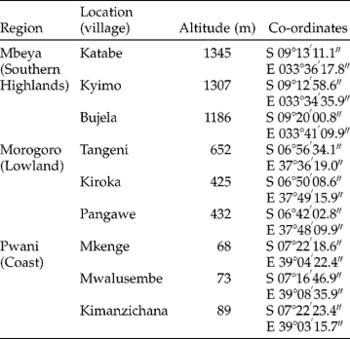
This study was conducted in three regions of Tanzania representing three different agro-ecological zones: Pwani, representing the coastal region (altitude under 300 m, mostly sandy soils), Mbeya representing the Southern Highlands (altitude 1200–1500 m, mostly clay soils) and the region of Morogoro representing Lowland Plains (altitude less than 750 m, mostly clay soils). Three locations (smallholder banana fields) from each region were selected for soil sampling (Table 1). At each location, an area of minimum 100 m2 was sampled. Soil samples were taken approximately every 2 m at a depth of about 15 cm using a shovel, and in each sampling site, subsamples were mixed to make one sample. Ten samples with a sample weight of about 2.5 kg were taken per location and kept separately in plastic bags making a total of 90 samples. Immediately after sampling, soil samples were kept in cool boxes for transportation to the laboratory where they were then stored in an incubator at 15 °C before nematode extraction.
Overview and geographical details of the sampling regions in Tanzania

Each soil sample was mixed thoroughly and a subsample of approximately 400 ml was placed in 500 ml plastic containers (10 cm high) with perforated lids and baited with late instar larvae of the greater wax moth Galleria mellonella (L.) (Lepidoptera: Pyralidae). Galleria mellonella were obtained from local bee-keepers and further cultured on cereal-based medium adapted from the method described in Woodring and Kaya (Reference Woodring and Kaya1988). Wax moth larvae were used as bait at a rate of five larvae per container. The containers were incubated in the dark at room temperature (28 ± 3 °C) and G. mellonella larvae were examined for mortality after 6 days. Thereafter, every 3–4 days for 3 weeks, dead larvae were collected during this time period but not replaced.
Dead larvae that exhibited signs of infection with EPNs, placid soft odourless larvae with either light to dark brown or reddish colour, were placed in modified White traps (Woodring and Kaya, Reference Woodring and Kaya1988). The dead larvae on the White trap were checked for emergence of nematodes after 1 week and thereafter daily. All emerging nematodes were collected from single dead larvae and considered as one isolate. The nematode isolates were maintained on G. mellonella larvae where ten larvae were infected per isolate during each round of infection. For each isolate, all nematodes that emerged from the infected larvae over a 2-week period were harvested and pooled for use in the experiments or for the next cycle of infection in G. mellonella. Preliminary identification was carried out based on morphological observations of the infected wax moth larvae and the infective juveniles and males (Adams and Nguyen, 2002).
Virulence studies
Banana weevils used in this study were trapped from the experimental plots at Sokoine University of Agriculture in Morogoro and reared outdoors in a screen cage fed with old banana corms where both adults and larvae were collected for use.
Nine EPN isolates were screened in a small-volume arena, 143 cm2 cylinders (diameter 4.5 cm and height 9 cm) filled to 6 cm with sterile sand adjusted to 15% water content. The moisture content was kept stable by high room humidity and by avoiding rapid evaporation. The experiments were conducted at room temperature (28 ± 3 °C) under natural daylight conditions (approximately 12 h daylight). Two experiments were conducted whereby in one, adult banana weevils of similar age and mixed sex were used and in the other, mature (late instar) banana weevil larvae. Each cylinder was supplied with single larva/adult banana weevil and a piece of fresh banana corm (~2 cm3) as food source. Nematode concentrations of 50 (0.35/cm2), 500 (3.5/cm2) and 1000 (7.0/cm2) infective juveniles in 1 ml distilled water were applied to the centre of each cylinder; every five cylinders were considered as one observation. Five replicates were made for each nematode concentration, plus a non-treated group where only distilled water was added as a control. The experiments were arranged in a complete randomized design. The main plot was three nematode concentrations randomized in five replicates and the sub-plots were the nine EPN isolates randomized in the main plots.
After 4 days, banana weevils were checked for mortality and the number of dead insects was recorded. Dead insects were individually dissected under a stereomicroscope using tweezers and needles by destroying the cadavers in Petri dishes with quarter-strength Ringer solution (Merck KGaA, Darmstadt, Germany). Nematodes, if present, were teased out to confirm nematode infection and to count the number of developing nematodes that had established. The number of nematode-killed insects was recorded as the mean percentage of mortality and the number of nematodes per insect cadaver was recorded as the mean number of established nematodes.
Statistics
For the virulence studies, data were subjected to ANOVA using the general linear model and means were separated using Tukey's method at 95% confidence. The data were also subjected to (factorial) two-way ANOVA to analyse the interactions between dosage and isolates. Statistical procedures were conducted using MINITAB 16 Statistical Software.
Results
Isolation of EPNs
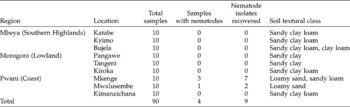
EPNs were present in four (4.4%) out of the 90 soil samples collected (Table 2). Three positive samples were from Mkenge Village and one was from Mwalusembe Village, both from the Pwani region (coastal area). Nine isolates of EPNs were isolated from the four soil samples. Based on the characteristics of the dead G. mellonella larvae and on microscopic observations of infective juveniles and adults (Adams and Nguyen, 2002), all isolates were identified as Steinernema spp. except for two isolates (one soil sample) that were Heterorhabditis spp. The new isolates were designated by site, sample number, bait larva and genus acronym (St, Steinernema; Ht, Heterorhabditis): MK1ASt, MK1BSt, MK4ASt, MK4BSt, MK7ASt, MK7BHt, MK7CHt, MW8ASt and MW8BSt.
Number of soil samples from different locations in three regions of Tanzania, frequency of samples positive for EPNs, number of isolates recovered and the dominating soil texture in the samples

Soil samples from Mbeya and Morogoro were characterized by high percentage of clay, and no EPNs were recovered from these sites (Table 2). All EPN isolates were recovered from the Pwani region (coastal area) in samples with loamy sand (LS) and sandy loam (SL) (Table 3).
Soil characteristics of the positive soil samples from Pwani (Coast) in Tanzania

EC, electrical conductivity (a measure of salinity).
Virulence of nematode isolates against adult and late instar larval stages of Cosmopolites sordidus
The EPN isolates had no significant effect against adult banana weevil; only four adults out of all treatment units were infected by isolates MK7ASt (one), MK7BHt (two) and MW8ASt (one), respectively. Natural mortality of adult banana weevil in the control treatment was not observed.
Significant differences in the percentage of mortality of banana weevil larvae were observed among the isolates (F = 15.48, df = 2; P < 0.000) (Fig. 1). No larval mortality occurred in the control treatment. Significant differences in the percentage of mortality also occurred among nematode concentrations (F = 123.15, df = 2; P < 0.000). At low nematode concentration (0.35/cm2), most isolates caused less than 50% mortality, with MK4ASt and MK4BSt causing significantly lower mortality of 24%, whereas MK7CHt caused 52% (F = 2.57, df = 8; P < 0.025). At the higher concentrations, significantly higher mortality was caused by many of the isolates, reaching 100% for isolate MK7BHt at the 7.0 infective juveniles (IJ)/cm2 dose (F = 8.69, df = 8; P < 0.000) (Fig. 1). Larval mortality increased significantly with increasing nematode concentration and the interaction was significant (F = 2.67, df = 16; P < 0.001).
Mean mortality (%) of banana weevil larvae exposed to nine endemic EPN isolates at three different dosages (nematode concentrations). Isolates: MK1–MK7A and MW8A&B, Steinernema spp.; MK7B&C, Heterorhabditis spp. Different letters on bars indicate significant differences at P < 0.05 between the isolates at each dosage.

Invasion rate of nematode isolates in C. sordidus larvae
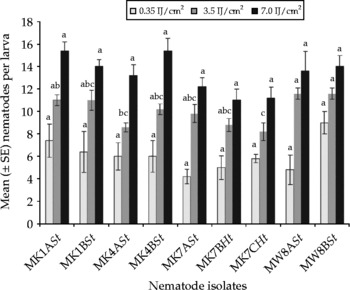
Figure 2 shows the mean number of nematodes established per banana weevil larva with all nematode isolates compared among three different nematode doses (concentrations). The number of nematodes that established in the larvae after 4 days exposure differed significantly among the isolates (F = 4.57, df = 8; P < 0.000) and concentrations (F = 120.14, df = 2; P < 0.000). At the lowest dose (0.35 IJ/cm2), the mean number of nematodes per host varied between four and nine nematodes per larva but was not statistically significant. At 3.5 IJ/cm2, significant differences were observed between some of the isolates (F = 4.45, df = 8; P < 0.001). The highest number of established nematodes per insect host was observed at the highest concentration (7/cm2) for all isolates, with the mean number of nematodes ranging from 11 to 15 per larva (not significant). In general, the number of nematodes successfully establishing in the host larvae increased with increasing concentration (Fig. 2), but the interaction was not significant.
Mean number of nematodes per larva (nematodes established) of nine endemic EPN isolates in banana weevil larvae, after 4 days exposure to three different nematode dosages. MK1–MK7A and MW8A&B, Steinernema spp.; MK7B&C, Heterorhabditis spp. Different letters on bars indicate significant differences at P < 0.05 between the isolates at each dosage.

Discussion
A total of nine isolates of EPNs were isolated from four (4.4%) of the 90 soil samples collected. This is the first report of endemic EPNs isolated in Tanzania. In Africa, so far, EPNs had been isolated only in Egypt, South Africa and Kenya (Shamseldean and Abd-Elgawad, Reference Shamseldean and Abd-Elgawad1994; Waturu et al., Reference Waturu, Hunt and Reid1997; Hussein and Abou El-Souud, Reference Hussein and Abou El-Souud2006; Malan et al., Reference Malan, Nguyen and Addison2006; Abd-Elgawad and Nguyen, Reference Abd-Elgawad and Nguyen2007; Hatting et al., Reference Hatting, Stock and Hazir2009).
In this study, EPNs were found to occur only in the coastal sampling area at low altitude (below 300 m) that contained soils with a high sand content. The overall EPN prevalence is similar to other studies, indicating higher occurrence of EPNs in the coastal region sampled. Hominick (Reference Hominick and Gaugler2002) commented on coastal zones providing excellent sources for EPNs. In this study, EPNs were frequently recovered in light soils (LS and SL), corroborating earlier studies that found EPNs primarily in SL soils (Rosa et al., Reference Rosa, Bonifassi, Amral, Lacey, Simoes and Laumond2000; Mrácek et al., Reference Mrácek, Bebvál, Kindlmann and Jersáková2005; Haukeland et al., Reference Haukeland, Klingen and Brurberg2006; Simard et al., Reference Simard, Bélair, Stock, Mauléon and Dionne2007).
The study also indicated that Steinernema spp. were more prevalent than Heterorhabditis spp. Hominick (Reference Hominick and Gaugler2002) reported that Steinernema spp. are recovered more often simply because there are many more species of Steinernema than Heterorhabditis and they, therefore, occupy more niches. Another reason is the difference in life history of the two genera, which also contributes to the unequal recovery. A single Heterorhabditis IJ is sufficient to multiply after invasion while at least two Steinernema IJ, a male and female, must invade before reproduction can occur (Downes and Griffin, Reference Downes and Griffin1996). Therefore, Steinernema species are expected to be more abundant in the environment, giving higher possibilities for recovery.
The EPN isolates tested showed their ability to infest the larval stage of the banana weevil, whereas adults appeared resistant to infection. The mortality in banana weevil larvae reached up to 52% at the low concentration of 0.35/cm2 and up to 92 and 100% at concentrations of 3.5 and 7.0/cm2, respectively. Larval mortality increased significantly with increasing nematode (IJ) concentration, indicating the importance of dosage. In other studies with C. sordidus, 85% infection by Steinernema carpocapsae isolate BW was reached in a laboratory experiment in Australia (Treverrow and Bedding, Reference Treverrow, Bedding, Bedding, Akhurst and Kaya1993). In the Canary Islands, 100% mortality of neonate banana weevil larvae was reported using indigenous EPN (Heterorhabditis bacteriophora and Steinernema spp.) (Padilla-Cubas et al., Reference Padilla-Cubas, Hernandes and Garcia del Pino2010). Many studies on the virulence of EPNs on different species of weevil have shown that Heterorhabditis species perform much better than Steinernema species (Treverrow and Bedding, Reference Treverrow, Bedding, Bedding, Akhurst and Kaya1993; Dolinski et al., Reference Dolinski, Del Valle and Stuart2006). The same trend has been observed in this study whereby the most virulent isolates MK7BHt and MK7CHt were both Heterorhabditis spp., although it was also clear that some of the Steinernema spp. were equally virulent (MK7ASt and MW8St). A high virulence of an EPN isolate is one important characteristic required for the successful biological control of a pest using nematodes; however, commercial feasibility with respect to the potential of mass propagation is also important. All tested EPN isolates penetrated and successfully established in the banana weevil larvae, increasing in numbers with increasing dose, though not significantly. Nevertheless, successful nematode establishment in the larvae implies a potential for recycling of EPNs in the host environment, thereby increasing the control potential.
Studies have shown that adults of some weevil species are susceptible to EPNs including the banana weevil (Treverrow et al., Reference Treverrow, Bedding, Dettmann and Maddox1991). However, most studies have shown that the adults are not particularly susceptible. Treverrow and Bedding (Reference Treverrow, Bedding, Bedding, Akhurst and Kaya1993) suggested that the resistance is almost certainly due to the difficulty of nematodes entering the host rather than establishment once infection is successful. Anon. (Reference Adams, Nguyen and Gaugler2003) found that both adults and larvae of banana weevil were susceptible to attack by infective juveniles of S. carpocapsae and H. bacteriophora. Heterorhabditis IJs have an interior ‘tooth-like structure’ that enables enhanced penetration of the larval cuticle (Bedding and Molyneux, Reference Bedding and Molyneux1982; Dolinski et al., Reference Dolinski, Del Valle and Stuart2006). This capability might be especially important for virulence against banana weevil larvae since there is some evidence based on histopathological studies that IJs enter the larvae mainly through the cuticle and less often through the anus (Dolinski et al., Reference Dolinski, Del Valle and Stuart2006).
There was no significant interaction between increasing nematode dose (concentration) and the number of established nematodes, but significant differences were observed within some nematode isolates. Gaugler et al. (Reference Gaugler, McGuire and Campbell1989) found a similar variation among geographically distant strains of S. carpocapsae. These results might suggest that the new isolates were of different species or natural variability within the C. sordidus population. However, Tomalak (Reference Tomalak2004) observed variation in nematodes established between new isolates of Steinernema feltiae originating from collection sites located within a distance of only a few kilometres, suggesting that variation in infection (established nematodes) can be observed between EPNs of different species but also between strains of the same EPN species.
Conclusion
The present study has shown that EPNs in the genera Heterorhabditis and Steinernema occur naturally in some parts of the coastal region of Tanzania. EPNs were recovered preferentially in loamy sandy soils, with sand contents above 80%. All isolates of the endemic EPNs have shown the ability to infect C. sordidus larvae in laboratory experiments, and the percentage of mortality differed significantly with nematode isolates and dosage. The effect of the nematode isolates on adult C. sordidus was negligible. Several of the Heterorhabditis spp. and Steinernema spp. isolates from Mkenge and Mwalusembe villages have potential for biological control of C. sordidus in Tanzania.
Acknowledgements
We are grateful to the PANTIL (Programme for Agricultural and Natural Resource Transformation for Improved Livelihoods, Tanzania) for funding this study, and Bioforsk and Sokoine University of Agriculture for allowing us to use their laboratory facilities.