1. Introduction: the demise of carbonate platforms in the Sinemurian Age of the Tethyan area
Global episodes of environmental change represent major turning points in the history of the Earth. Among these, the Triassic/Jurassic boundary (T/J) is characterized not only by a major extinction but also by disturbances in the carbon-isotope reservoir of the oceans and atmosphere. Despite its global impact, the T/J event had only a modest effect on the palaeogeographic configuration of the Southern Alps as exposed in Northern Italy. The palaeogeography of this region at the beginning of the Jurassic Period was characterized by the widespread development of shallow-water carbonate platforms (Corna, Monte Zugna Formation), representing the continuation of Late Triassic peritidal sedimentation, and stretching from Lombardy to Slovenia, only interrupted by the deep Belluno Basin (Gaetani, Reference Gaetani and Squyres1975; Winterer & Bosellini Reference Winterer and Bosellini1981; Masetti et al. Reference Masetti, Fantoni, Romano, Sartorio and Trevisani2012). Similar shallow-water environments also existed elsewhere, for example in the Umbria–Marche Apennines of Central Italy (Calcare Massiccio Formation), and in the Southern Limestone Apennines (Calcare a Paleodasycladus Formation; D’Argenio, Pescatore & Scandone, Reference D'Argenio, Pescatore and Scandone1973).
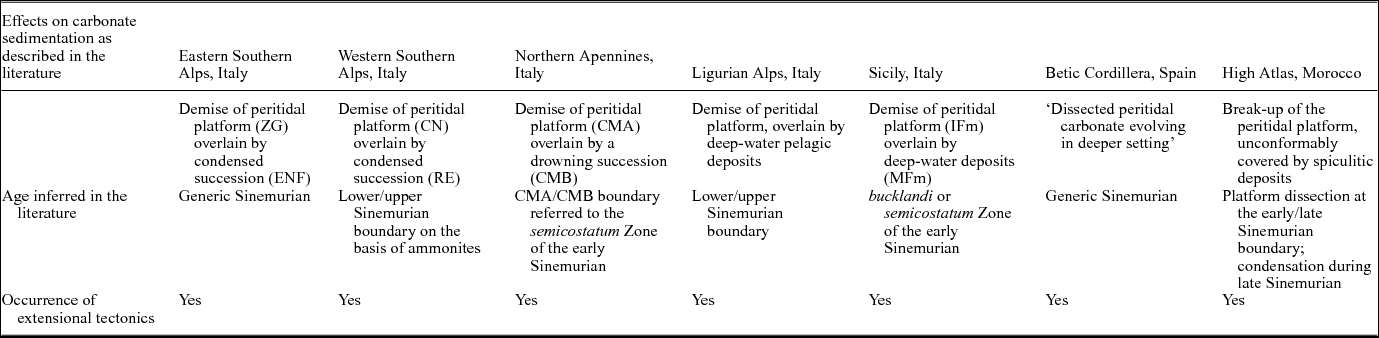
Although the T/J event had a negligible effect on the Jurassic depositional systems of the Southern Alps and Apennines, a fundamental reorganization of their carbonate systems took place during Sinemurian time (Masetti et al. Reference Masetti, Fantoni, Romano, Sartorio and Trevisani2012), here summarized in Table 1, locally acting together with the onset of extensional tectonics. In Lombardy, starting from the interval between early and late Sinemurian time, the Corna Platform was locally capped by open-marine crinoidal calcarenites (Rezzato Encrinite; Schirolli, Reference Schirolli1997; Meister, Schirolli & Dommergues, Reference Meister, Schirolli and Dommergues2009); across much of the Trento Platform, the Hettangian–Sinemurian peritidal succession of the Calcari Grigi Group (Monte Zugna Formation) is unconformably overlain by a Sinemurian–Pliensbachian condensed succession (Fanes Piccola Encrinite; Masetti & Bottoni Reference Masetti and Bottoni1975; Masetti et al. Reference Masetti, Fantoni, Romano, Sartorio and Trevisani2012); in the Northern Apennines, Marino & Santantonio (Reference Marino and Santantonio2010) described the early Sinemurian replacement of the peritidal Calcare Massiccio platform by means of deep-water deposits of the Corniola Formation. In the structural highs of the same area this event is recorded later, at the base of the semicostatum Zone, by the superposition of a ‘drowning succession’ (‘Calcare Massiccio B’) over the underlying, peritidal, ‘Calcare Massicio A’. In the Ligurian Alps, the early Sinemurian carbonate platform ceased sediment production and was covered by deep-water deposits (Decarlis & Lualdi, Reference Decarlis and Lualdi2010); in eastern Sicily, the progradational trend of the peritidal Inici Formation ceased at the early/late Sinemurian boundary, just before the drowning of the carbonate platform that occurred in late Sinemurian time, when the deep-water Modica Formation started to accumulate (Ronchi, Lottaroli & Ricchiuto, Reference Ronchi, Lottaroli and Ricchiuto2000). Ammonites found close to the top of the Inici Formation in western Sicily also suggest that the carbonate platform, locally at least, ceased deposition at some point in the bucklandi or semicostatum Zone of early Sinemurian time or soon thereafter (Wendt, Reference Wendt1969; Jenkyns & Torrens, Reference Jenkyns, Torrens and Végh-Neubrandt1971). In the Betic Cordillera (Spain) Ruiz-Ortiz et al. (Reference Ruiz-Ortiz, Bosence, Rey, Nieto Castro and Molina2004) described the Early Jurassic stratigraphic evolution of the rifted Iberian margin indicating that widespread peritidal carbonates evolved with faulting to a more open and deep-marine setting. These authors refer the first dissection of the platform by extensional faults to early Pliensbachian time, on the basis of a benthic foraminiferal association. However, previous interpretations have dated the faulting as intra-Sinemurian (Ruiz-Ortiz et al. Reference Ruiz-Ortiz, Bosence, Rey, Nieto Castro and Molina2004), so the evolution may be similar to the Italian examples. In the High Atlas (Morocco) Merino-Tomé et al. (Reference Merino-Tomé, Della Porta, Kenter, Verwerk, Harris, Adams, Playton and Corrochano2012) described in detail the break-up of the peritidal Early Jurassic carbonate platform of Djebel Bou Dahar into smaller deeper water blocks as a result of tectonic processes at the boundary between the early and late Sinemurian. The same authors highlight a sudden contemporaneous decrease in carbonate production leading to the generalized developing of hiatuses and the subsequent onset, in late Sinemurian–Pliensbachian time, of sub-photic siliceous sponge microbial facies. Despite the huge increase in area affected by the drowning of carbonate platforms in the Apennines and Southern Alps, the consensus to date is to view this event as regional and essentially due to the increasing subsidence rate of fault-bounded blocks during extension of the Jurassic continental margin (Bernoulli & Jenkyns, Reference Bernoulli, Jenkyns, Dott and Shaver1974).
Summary of the variations in the carbonate sedimentation affecting some Tethyan areas occurring around ‘Arnioceras Time’. More detail and references in the text
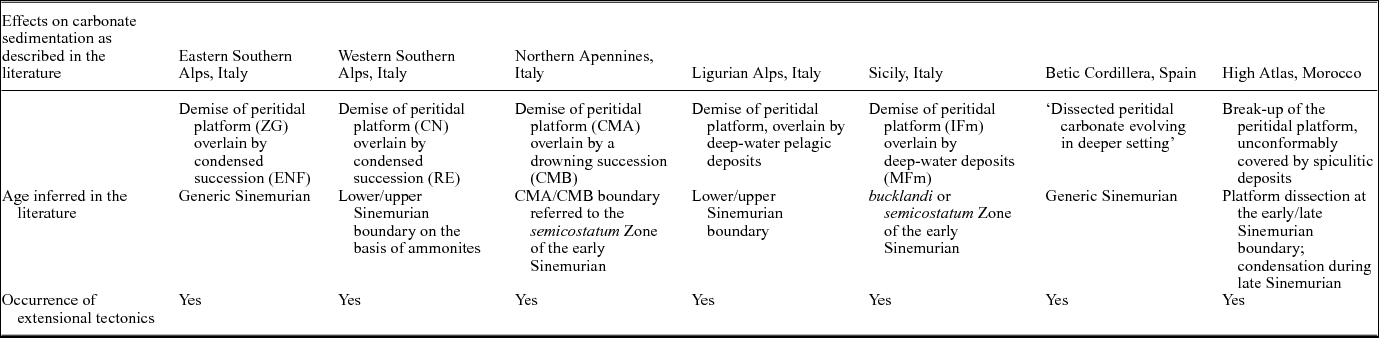
CN – Corna Formation; ZG – Zugna Formation; ENF – Fanes Piccola Encrinite; RE – Rezzato Encrinite; CMA and CMB – Calcare Massiccio Formation, A and B Type; IFm – Inici Formation; MFm – Modica Formation.
Bearing in mind the widespread demise/drowning of carbonate platforms in the Tethyan area during a poorly dated interval or intervals in Sinemurian time, and that the Southern Alps contain outcrops of a former passive Mesozoic continental margin affected by such phenomena, the main aims of this paper are:
(1) to investigate whether or not the demise of Sinemurian carbonate platforms was the result, wholly or partially, of a chemostratigraphic/palaeoenvironmental event, by examining carbon-isotope anomalies in successions across the whole area of the Eastern Southern Alps;
(2) to provide high-resolution correlation between shallow-water platform carbonates and deeper water pelagic ammonite-bearing successions across the Eastern Southern Alps by means of carbon isotopes in order to refine, as much as possible, the exact position/timing of any palaeoenvironmental event.
(3) to ascertain the nature of carbonate-platform evolution coincident with this putative palaeoenvironmental event in order to highlight the potential response of the sediment-producing carbonate factory.
2. Geological setting: the Southern Alps
Since the early 1970s, the Southern Alps have been interpreted as a passive continental margin that, during Mesozoic time, experienced polyphase extensional tectonics that caused the fragmentation of the Adriatic Plate. The tectonic activity started during Late Triassic (Norian) time. After relative quiescence during Rhaetian (latest Triassic) time, renewed extension took place during Early Jurassic time. Extension shifted westwards to the Ligurian–Piedmont area where oceanic crust had formed by Middle Jurassic time (Bill et al. Reference Bill, O'Dogherty, Guex, Baumgartner and Masson2001). From this time until the Early Cretaceous, the Southern Alps underwent post-rift thermal subsidence (Bertotti et al. Reference Bertotti, Picotti, Bernoulli and Castellarin1993; Fantoni & Scotti, Reference Fantoni and Scotti2003).
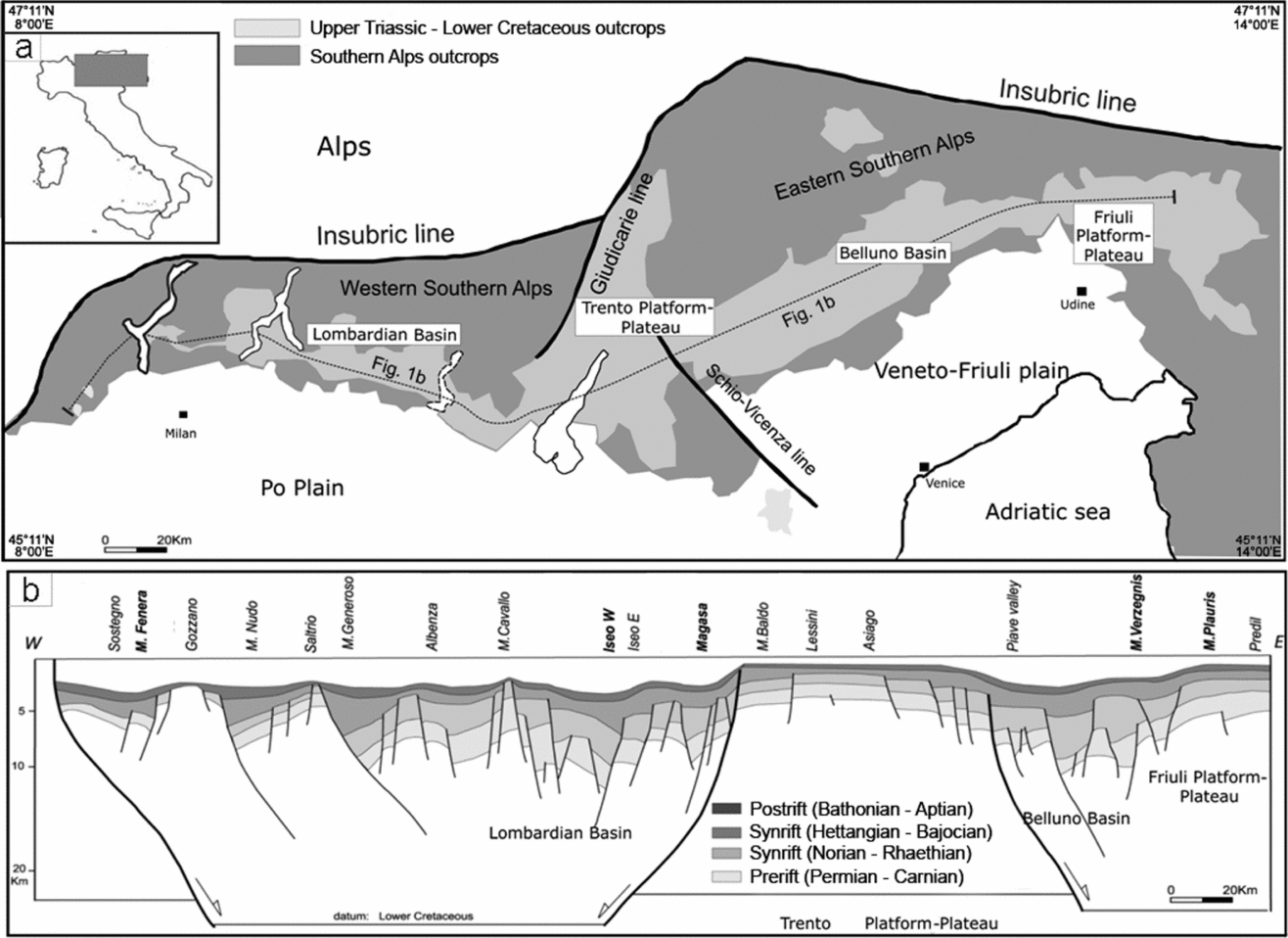
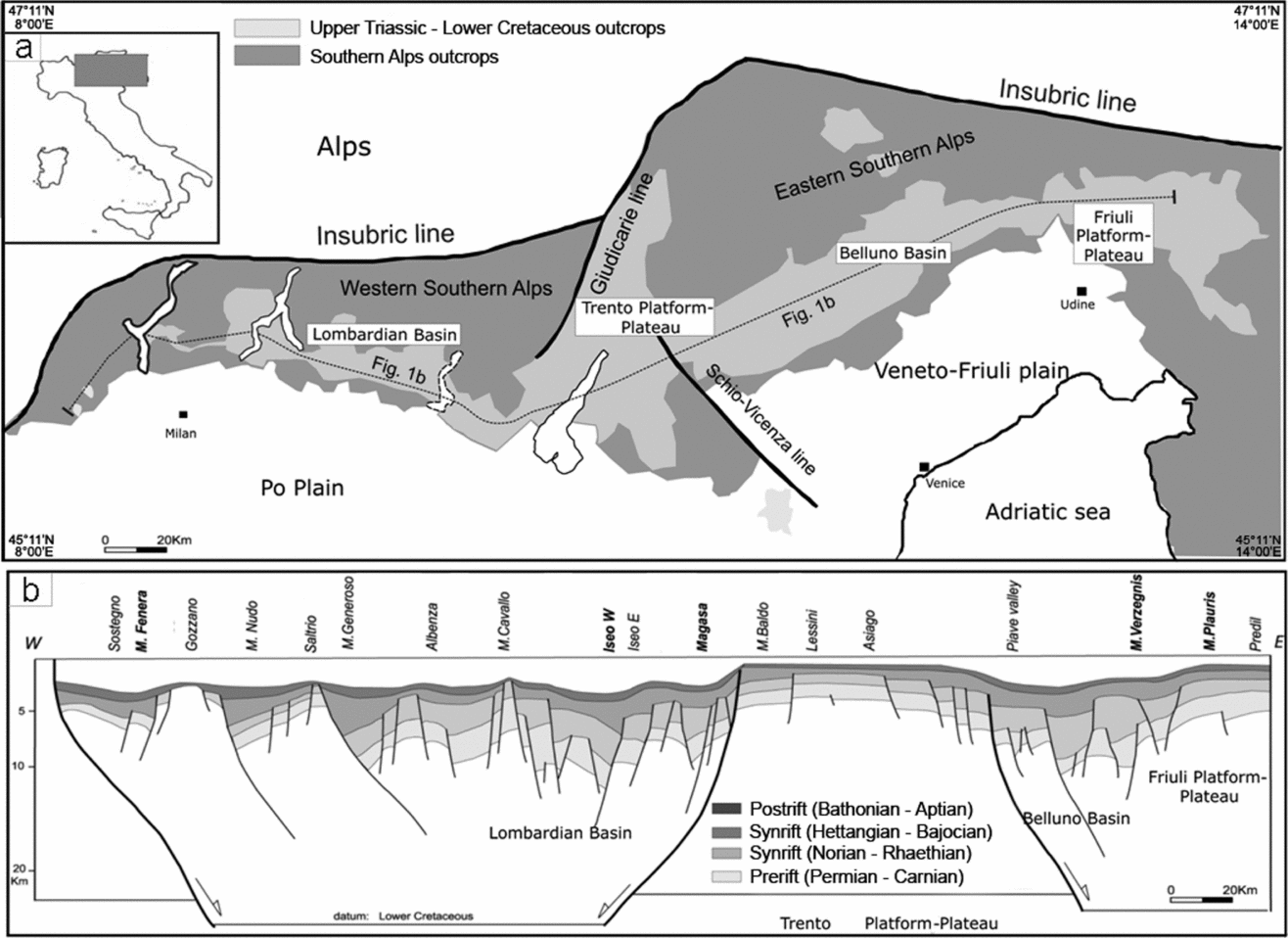
The Mesozoic extension resulted in the creation of N–S half-grabens, bounded by E- and W-dipping master normal faults (Fig. 1). In the Eastern Southern Alps three palaeogeographical-structural units are recognizable. These are, from west to east (Gaetani, Reference Gaetani and Squyres1975; Winterer & Bosellini, Reference Winterer and Bosellini1981): a carbonate platform, which drowned in Early Jurassic time, evolving into a pelagic plateau with condensed pelagic sedimentation during Late Jurassic time (Trento Platform) and bordered to the west by the Lombardian Basin that accumulated pelagic clays and carbonates; a basin, with similar pelagic facies, that developed in very Early Jurassic time (Belluno Basin); and a carbonate platform that persisted from Jurassic until Cretaceous time (Friuli Platform).
(a) Mesozoic structural domain of the Southern Alps. The dotted line indicates the section in (b). (b) Section across the Southern Alps showing the extensional Mesozoic architecture of the Southern Alps at the end of Early Cretaceous time. After Masetti et al. (Reference Masetti, Fantoni, Romano, Sartorio and Trevisani2012).
2.a. The Trento Platform
On the Trento Platform, the shallow-water sedimentation of the Early Jurassic is recorded in the thick pile of the Calcari Grigi Group, and the overlying pelagic ‘condensed’ sedimentation recorded by the Rosso Ammonitico Veronese (Bajocian to Tithonian, Fig. 2). The Calcari Grigi Group is several hundred metres thick; its lower part corresponds to the Monte Zugna Formation, a unit representing the Jurassic continuation of the underlying, Upper Triassic, peritidal succession of the Dolomia Principale. The Loppio Oolitic Limestone and the Rotzo Formation represent, respectively, the middle and upper part of the Calcari Grigi Group; the most typical and renowned facies are those present in the Rotzo Formation, characterized by abundant plant remains and extensive banks of oyster-like ‘Lithiotis’, deposited in a dominantly subtidal environment (Masetti et al. Reference Masetti, Claps, Giacometti, Lodi and Pignatti1998; Posenato & Masetti Reference Posenato and Masetti2012; Franceschi et al. Reference Franceschi, Dal Corso, Posenato, Roghi, Masetti and Jenkyns2014). This subtidal environment, interpreted by previous authors as lagoonal (the ‘Lithiotis Lagoon’ of Bosellini & Broglio Loriga, Reference Bosellini and Broglio Loriga1971), passed laterally to the western marginal oolitic complex (Massone Oolite, Figs 2, 3). The Monte Zugna Formation and the Loppio Oolitic Limestone, lacking faunas of proven biostratigraphic value, have been referred to a generic Hettangian–Sinemurian p.p. interval, whereas the age of the Rotzo Formation is still debated and ascribed to a time interval spanning the late Sinemurian to late Pliensbachian, on the basis of foraminiferal biostratigraphy (Fugagnoli, Reference Fugagnoli2004), or to early Pliensbachian to late Pliensbachian, on the basis of ammonite biostratigraphy (Sarti in Posenato & Masetti, Reference Posenato and Masetti2012).
Chemostratigraphic transect across different types of Jurassic successions inside the main palaeogeographic units of the Eastern Southern Alps and location of the sections presented here. On the map, depicting the Pliensbachian stage, 1 and 2 represent, respectively, the areal distribution of central-western and the northeastern areas of the Trento Platform; 3 represents the Belluno Basin; 4 and 5 represent, respectively, the northern and southern areas of the Friuli Platform. ZG – Monte Zugna Formation; OL – Loppio Oolitic Limestone; RZ – Rotzo Formation; CG – undifferentiated Calcari Grigi; OM – Massone Oolite; ENF – Fanes Piccola Encrinite; OSV – San Vigilio Oolite + Tenno Formation; SOV – Soverzene Formation; IGNE – Igne Formation; ARV – Rosso Ammonitico Veronese; VJ – Vajont Limestone; CEL – Cellina Limestone. Modified from Masetti et al. (Reference Masetti, Fantoni, Romano, Sartorio and Trevisani2012).
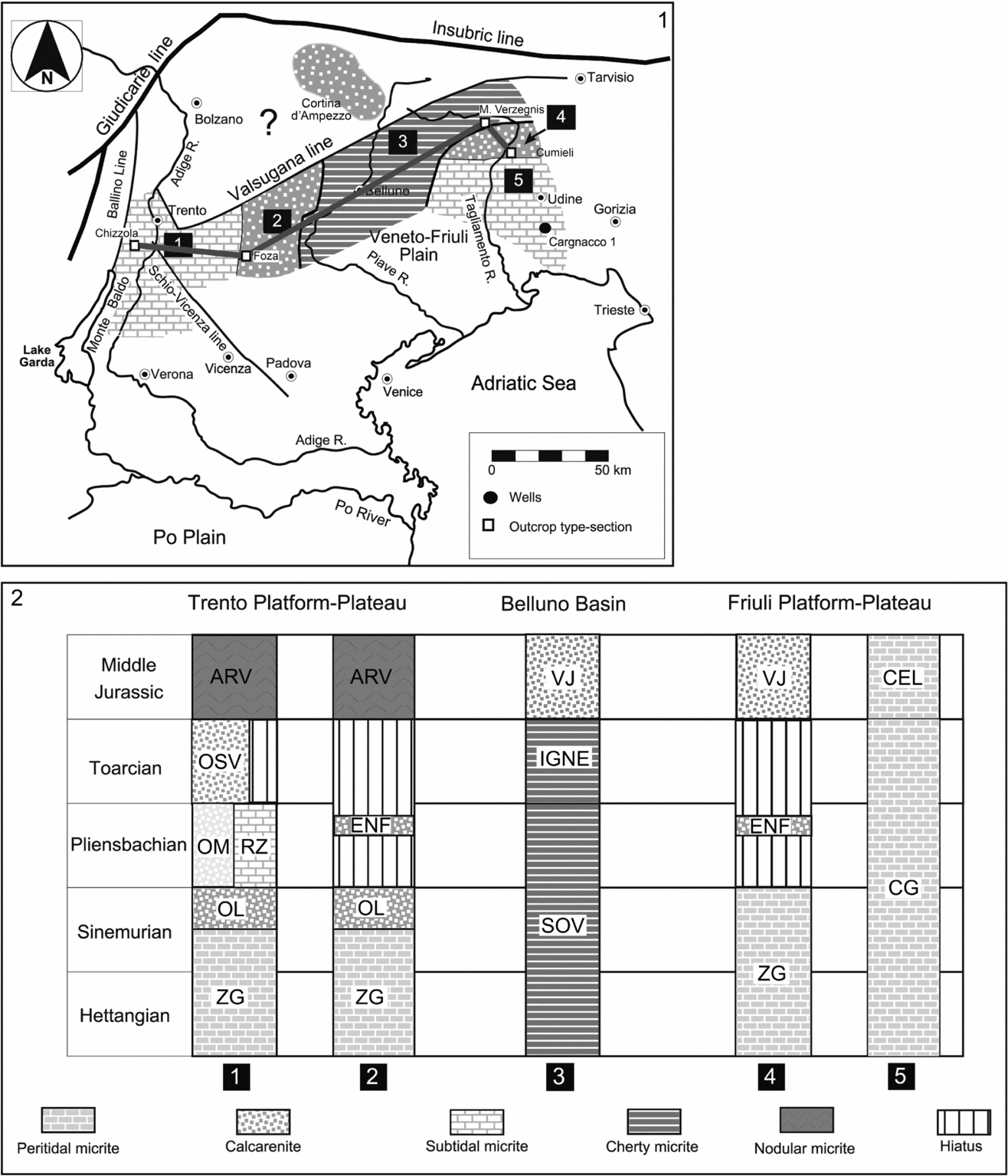
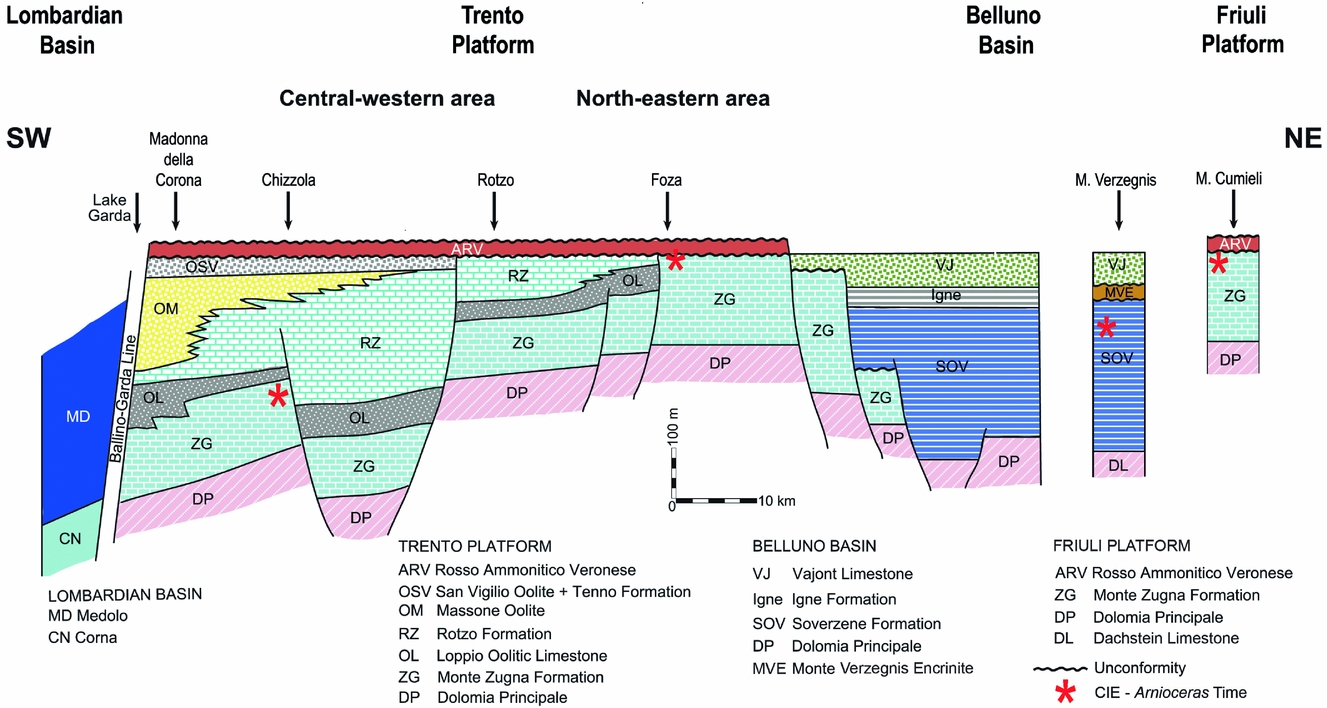
Lithostratigraphic relationships of the Jurassic units across the entire Trento Platform–Plateau from the Lombardian Basin in the west, to the Belluno Basin in the east. Red spots highlight the location of the negative CIE described in the text. Modified from Masetti et al. (Reference Masetti, Fantoni, Romano, Sartorio and Trevisani2012).
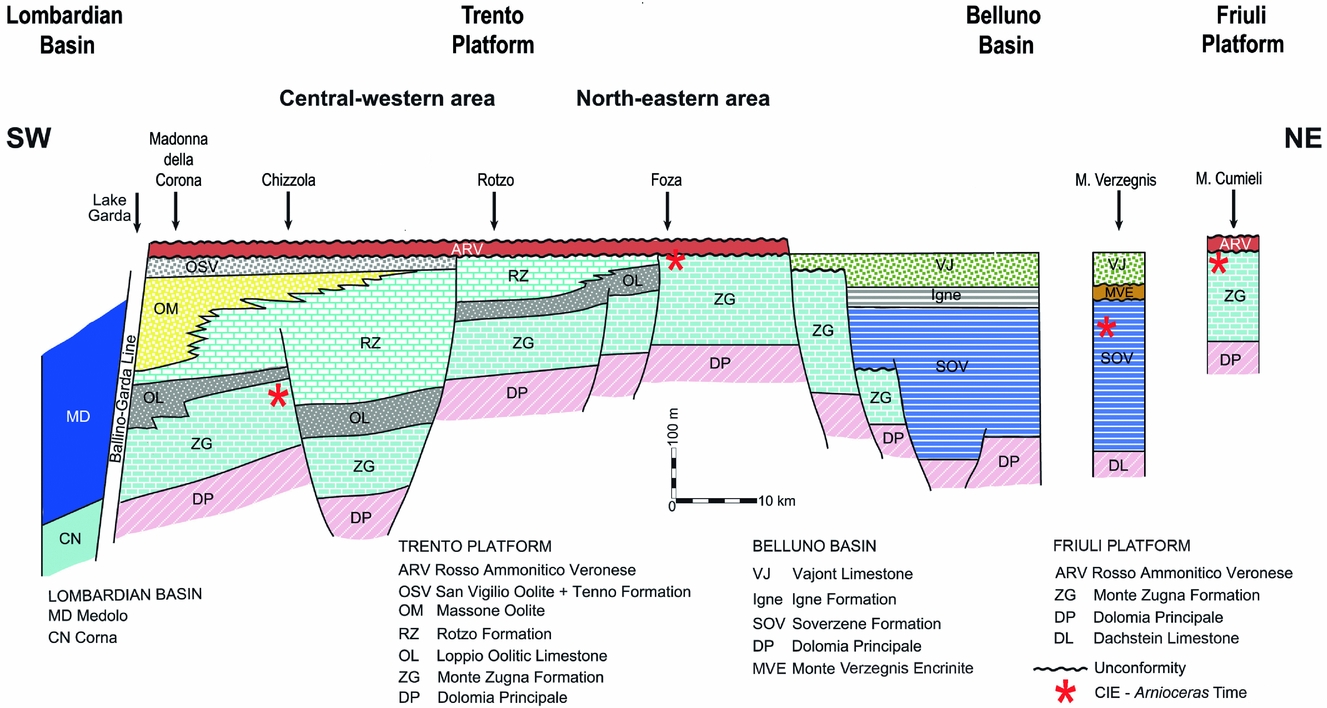
The unconformity surface capping the top of the shallow-water Calcari Grigi Group corresponds to a temporal hiatus that expands in duration eastwards (Masetti et al. Reference Masetti, Claps, Giacometti, Lodi and Pignatti1998; Figs 2, 3). Based on the hiatus at the top of the Calcari Grigi Group and the lateral variations displayed by the Pliensbachian units, Masetti et al. (Reference Masetti, Fantoni, Romano, Sartorio and Trevisani2012) proposed a further subdivision of the Trento Platform into a central-western area (with the Pliensbachian Rotzo Formation) and a northeastern area (without the Rotzo Formation). The approximate spatial distribution of these areas is shown in Figure 2; Figure 3 illustrates the Hettangian–Sinemurian Monte Zugna Formation crossing the entire Trento Platform from west to east with little variation in facies and thickness (Masetti et al. Reference Masetti, Claps, Giacometti, Lodi and Pignatti1998), whereas the classic Calcari Grigi succession with its well-known ‘Lithiotis’ beds (Rotzo Formation) is present only in the central-western sector of the Trento Platform and passes westwards to planar-bedded facies interpreted as marginal shoals (Massone Oolite; Beccarelli-Bauck, Reference Beccarelli-Bauck1988).
The northeastern sector of the Trento Platform (Figs 2, 3) is characterized by a widespread hiatus corresponding to the Pliensbachian units, replaced by a thin veneer of red cross-bedded crinoidal sand-bodies corresponding to the Fanes Piccola Encrinite: where this unit is missing, the Rosso Ammonitico rests directly on the Monte Zugna Formation (Masetti et al. Reference Masetti, Fantoni, Romano, Sartorio and Trevisani2012).
2.b. The Belluno Basin
The inception of the Belluno Basin was linked to Early Jurassic rifting that led to a roughly N–S-oriented fault system (Masetti & Bianchin, Reference Masetti and Bianchin1987); during Hettangian–Pliensbachian time, this basin was filled by dark cherty, basinal micrites (Soverzene Formation, Figs 2, 3). On the basis of data coming from the Verzegnis section, where sediments are free from heavy dolomitization, Masetti et al. (Reference Masetti, Fantoni, Romano, Sartorio and Trevisani2012) suggested that the birth of the Belluno Basin can be referred to the Triassic–Jurassic boundary interval or even to latest Triassic time. Above the Soverzene Formation, the early Toarcian oceanic anoxic event (Jenkyns, Reference Jenkyns1988) is recorded by discontinuous levels of black shales and manganoan carbonates, contained within the Igne Formation, which consists of decimetric rhythms of grey marls and marly mudstones (Jenkyns et al. Reference Jenkyns, Sarti, Masetti and Howarth1985; Claps et al. Reference Claps, Erba, Masetti and Melchiorri1995; Bellanca et al. Reference Bellanca, Masetti, Neri and Venezia1999). This last unit is covered by the Vajont Limestone, composed of oolitic sands and biogenic skeletal debris redeposited by means of gravity-flow processes that transferred oolitic sands from the western edge of the Friuli Platform into slope and basin environments (Bosellini & Masetti, Reference Bosellini and Masetti1972; Bosellini, Masetti & Sarti, Reference Bosellini, Masetti and Sarti1981). The age of the Vajont Limestone, revised by Cobianchi (Reference Cobianchi2002) on the basis of nannofossil biostratigraphy performed on several sections, can be ascribed to the late Bajocian–Bathonian interval. The Fonzaso Formation (Callovian to lower Kimmeridgian) overlies the Vajont Limestone and consists of pelagic cherty mudstones and skeletal-rich turbidites and debris-flow deposits. The Fonzaso Formation grades upwards into nodular, micritic red limestones very similar to the Rosso Ammonitico Veronese (Upper Member, upper Kimmeridgian to lower Tithonian; Martire, Reference Martire, Cita, Abbate, Balini, Conti, Falorni, Germani, Groppelli, Manetti and Petti2007).
2.c. The Friuli Platform
In a similar way to the Trento Platform, Masetti et al. (Reference Masetti, Fantoni, Romano, Sartorio and Trevisani2012) proposed a further subdivision of the Friuli Platform into a northern and a southern area (Figs 2, 3). The northern area is characterized by a stratigraphic evolution similar to that experienced by the eastern and northern sector of the Trento Platform, in which the shallow-water Rotzo Formation is missing and the Monte Zugna Formation is overlain by the Fanes Piccola Encrinite. On top of this last unit lies a deep-water, Mid and Upper Jurassic succession, typical of the Belluno Basin (Vajont Limestone and Fonzaso Formation). To the south, the classic persistent carbonate platform is exemplified by the section cropping out along the Valcellina Valley, located at the southern edge of the Friuli Prealps, in which the exposed shallow-water succession spans the interval from the Oxfordian through the whole of the Cretaceous (Cuvillier, Foury & Pignatti Morano, Reference Cuvillier, Foury and Pignatti Morano1968).
2.d. Selected stratigraphic sections across the Southern Alps
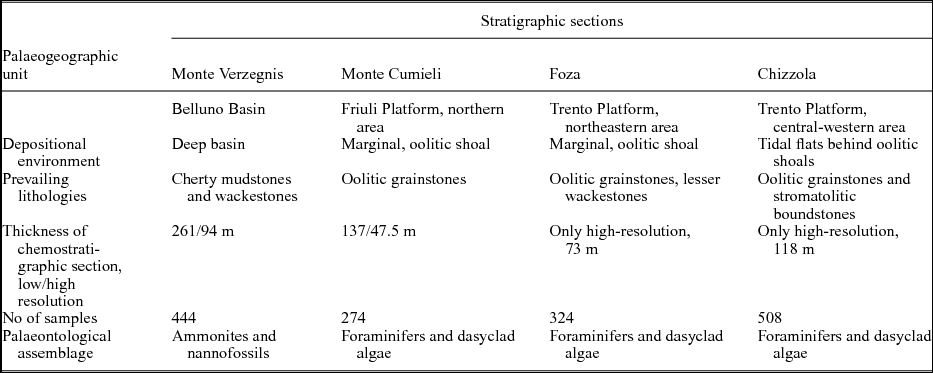
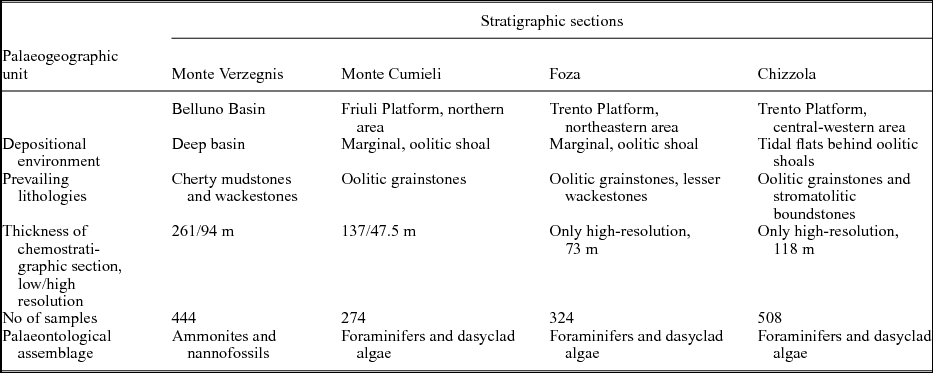
Bearing in mind the above-mentioned stratigraphic setting shown in Figure 2, four stratigraphic sections have been selected, each being representative of the different sectors into which Masetti et al. (Reference Masetti, Fantoni, Romano, Sartorio and Trevisani2012) subdivided the main palaeogeographic units of the Eastern Southern Alps. Study of these sections allowed the generation of a chemostratigraphic transect from Lake Garda to the eastern Italian border (Fig. 2). The stratigraphic sections selected are, from east to west (Figs 2, 3): Monte Verzegnis, located in the Belluno Basin; Monte Cumieli, located in the northern sector of the Friuli Platform; Foza, in which the Rotzo Formation is missing and the Mid Jurassic Rosso Ammonitico rests directly on top of the Monte Zugna Formation; and Chizzola, representative of the central-western area of the Trento Platform (with the Pliensbachian Rotzo Formation). In all these sections, chemostratigraphic sampling has been concentrated just below the unconformity surface at the top of the shallow-water succession where distinctive carbon-isotope anomalies were predicted to be present (Fig. 3). A summary of the principal characteristics of the four sections is highlighted in Table 2.
Summary of the principal characteristics of the four sections selected for the generation of a chemostratigraphic transect across the Eastern Southern Alps.
3. Chemostratigraphic transect across the Eastern Southern Alps
3.a. Chemostratigraphic sampling and analyses
3.a.1. Analytical techniques
Chemostratigraphic sampling was performed on the selected stratigraphic sections at a resolution of 20 cm, wherever allowed by the exposure conditions; powdered samples were obtained directly by means of a drill powered by a generator, with micritic matrix being preferentially sampled and skeletal fragments and veins being avoided, on the assumption that these components would have been more prone to vital effects and diagenesis. The high-resolution sampling was preceded by a lower resolution sampling (a sample every 2 m) in order to identify the main isotopic anomalies present in the section. The total thickness of the four sections presented here, on which this high-resolution sampling has been performed, exceeds 570 m. For isotopic analysis, the samples were analysed isotopically for δ13C and δ18O using a VG Isogas Prism II mass spectrometer with an online VG Isocarb common acid bath preparation system. Samples were cleaned with hydrogen peroxide (H2O2) and acetone ((CH3)2CO) and dried at 60°C for at least 30 minutes. In the instrument they were reacted with purified phosphoric acid (H3PO4) at 90°C. Calibration to PDB standard via NBS-19 was made daily using the Oxford in-house (NOCZ) Carrara marble standard. Reproducibility of replicated standards was typically better than 0.1‰ for both δ13C and δ18O.
For strontium-isotope analyses, c. 50 mg of carbonate per sample were dissolved in 6 ml of 2HNO3 for both 87Sr/86Sr and trace-metal analyses. A 1.5 ml aliquot of the dissolved solution was taken to perform strontium purification for the 87Sr/86Sr measurements, and the remaining solution was diluted and measured for Sr, Mn and Fe concentrations. Strontium was separated by a standard chromatography method using Eichrom Sr resin, and the purified solution was dried at 100°C and re-dissolved in 2% HNO3 prior to the isotopic analysis. The total blank was < 2 ng Sr. The 87Sr/86Sr measurements were performed on a Nu Plasma multi-collector inductively coupled plasma mass spectrometer (Plasma 1), and the trace-metal abundances were measured on a Thermo-Finnigan inductively coupled plasma mass spectrometer (Element II) at the University of Oxford. Both instruments were coupled with a membrane desolvating system (Aridus, Cetac) to achieve high signal sensitivity and stability. For 87Sr/86Sr measurements, all isotopes (88Sr, 87Sr, 86Sr, 85Rb, 84Sr and 83Kr) were measured in static mode. To achieve maximum precision and accuracy, the 88Sr signal was kept between 13 and 16 V, and a minimum of 40 isotope ratios were collected with 20-second integration time per ratio. 83Kr was monitored to correct for the interference of 86Kr on 86Sr, and likewise 85Rb was monitored for 87Rb correction on 87Sr. 83Kr intensity was generally consistent and below 0.2 mV, and 85Rb varied between samples but was generally lower than 2 mV. Samples were measured using a standard bracketing method with the NIST SRM 987 standard. The instrument mass fractionation was corrected internally using 86Sr/88Sr = 0.1194. The external reproducibility of 87Sr/86Sr in SRM 987 showed a value of 0.710258±0.000049 (2 s.d.) from August to September 2013.
3.a.2. Diagenesis versus palaeoceanography
The diagenetic behaviour of carbon and oxygen isotopes in shallow-water carbonates is problematic because such materials are particularly susceptible to meteoric-water diagenesis. Such facies accumulate close to sea level, small changes in which can lead to periodic emergence. The resultant diagenesis would typically introduce fluids with relatively low δ18O and δ13C values derived from rainwater after its interaction with atmospheric carbon dioxide and humus-rich soils (Hudson, Reference Hudson1977; Marshall, Reference Marshall1992). Typically, horizons affected by such processes would have scattered and relatively low carbon- and oxygen-isotope ratios compared to normal marine values. Other possible causes for deviation of isotopic values from primary signals include variable quantities of skeletal grains exhibiting non-equilibrium fractionation, different quantities of aragonite and calcite in the original sediment (Swart, Reference Swart2008), and the presence of void-filling secondary, low-Mg calcite in cavities opened in the supratidal environment (e.g. Grötsch, Billing & Vahrenkamp, Reference Grötsch, Billing and Vahrenkamp1998; Davey & Jenkyns, Reference Davey and Jenkyns1999). Despite the possible modification of shallow-water carbonates introduced by meteoric-water diagenesis, the primary isotopic signal of carbon should not change substantially because the amount of carbon in diagenetic fluids is low, unlike the case with oxygen, whose primary isotopic signal can also be deeply modified during burial with recrystallization at relatively high temperatures (Scholle & Arthur, Reference Scholle and Arthur1980).
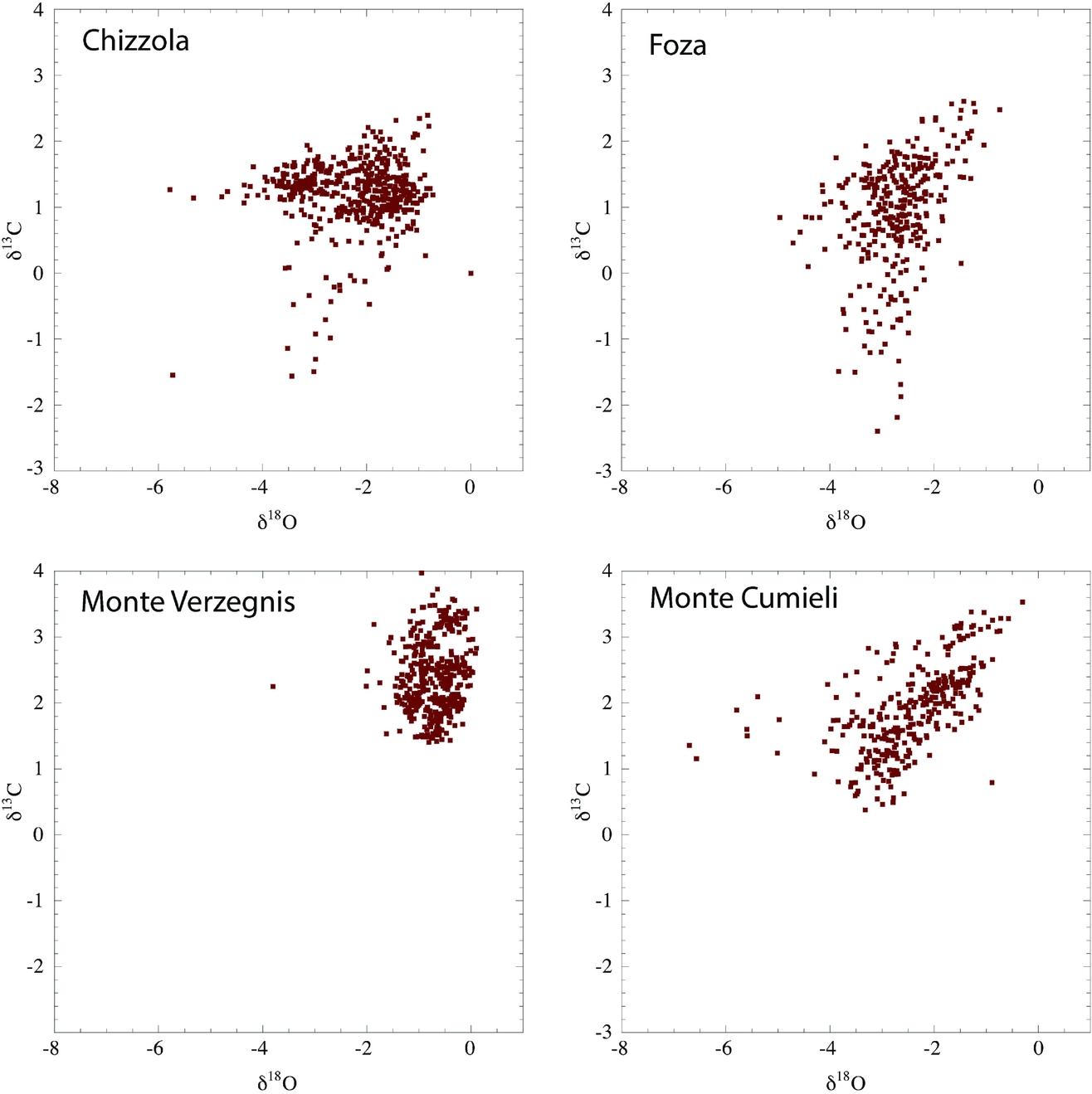
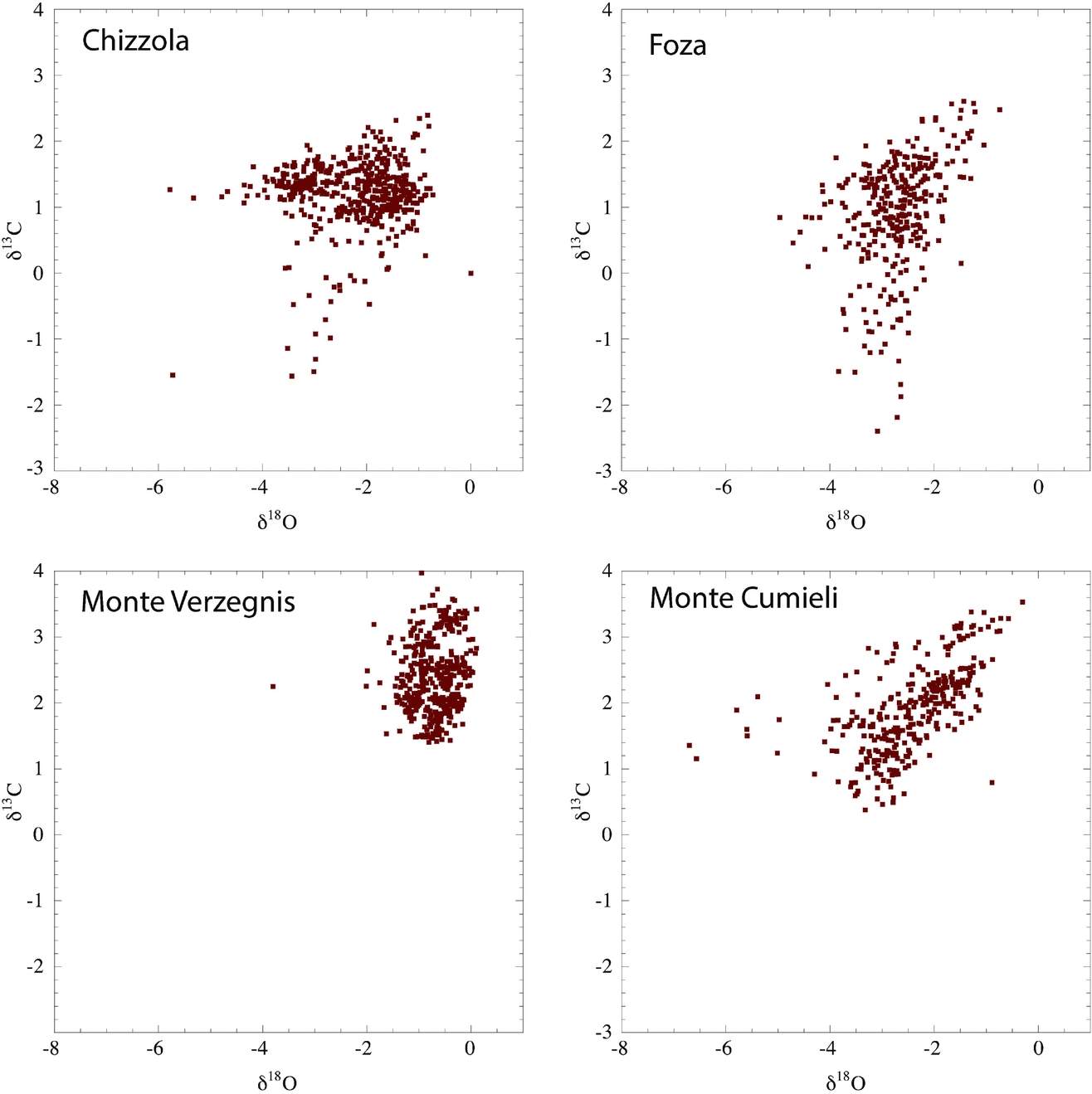
Isotopic cross-plots of the data show some differences (Fig. 4). As would be expected, the relatively deep-water section of Monte Verzegnis shows the most clustered set of values, with δ18O mostly falling between −2 and 0‰ and more variability taken up with the range in δ13C that reflects the pronounced negative excursion (linear regression coefficient, R = 0.12). The shallow-water sections, potentially prone to greater diagenetic effects, show considerably more scatter, particularly in the case of Chizzola (R = 0.10). Addition of diagenetic calcite may be implied by some degree of correlation between carbon and oxygen (negative diagenetic trend) that is particularly apparent in the data from Foza (R = 0.37) and particularly Monte Cumieli (R = 0.58), although the latter shows most overlap with Monte Verzegnis by virtue of some relatively greater carbon-isotope values that exceed 3‰. However, global warming forced by addition of isotopically light carbon dioxide and/or methane to the ocean–atmosphere system would potentially produce negative excursions in skeletal and inorganic carbonates for both carbon and oxygen isotopes: phenomena totally unrelated to diagenesis (Luciani, Cobianchi & Jenkyns, Reference Luciani, Cobianchi and Jenkyns2004). When chemostratigraphic analysis has been simultaneously performed on the same stratigraphic interval in both shallow- and deep-water Jurassic successions, in conjunction with available biostratigraphy (calcareous algae and benthic foraminifera in platform carbonates and ammonites in deep-marine carbonates), the presence of similar carbon-isotope anomalies in all sections proves the primary nature of these major oceanographic and carbon-cycle perturbations (Woodfine et al. Reference Woodfine, Jenkyns, Sarti, Baroncini and Violante2008; Trecalli et al. Reference Trecalli, Spangenberg, Adatte, Follmi and Parente2012; Sabatino et al. Reference Sabatino, Vlahović, Jenkyns, Scopelliti, Neri, Prtoljan and Velić2013). Bulk carbonate δ13C values of between 0 and 3‰ in all four sections analysed here are certainly compatible with normal marine values for the time interval and, since distinct negative excursions are developed, rather than randomly scattered data, it is assumed that the platform carbonates contain a primary isotopic record, albeit with a diagenetic overprint.
Isotopic cross-plot (δ13C v. δ18O) of key Lower Jurassic sections in the Southern Alps. The deeper water section (Monte Verzegnis) displays the most tightly clustered data; shallower water sections are more variable in their isotopic composition. Most carbon-isotope values fall between 1 and 3‰ and likely record a primary signature, albeit with a diagenetic overprint.
3.b. The Monte Verzegnis section
This section, 261 m thick (Fig. 5), has been measured and sampled in the homonymous mountain group located in the Carnian Alps, not far from the small town of Tolmezzo. The section contains a little dolomite. From the palaeogeographic point of view, it belongs to the northeastern sector of the Belluno Basin (Fig. 2).
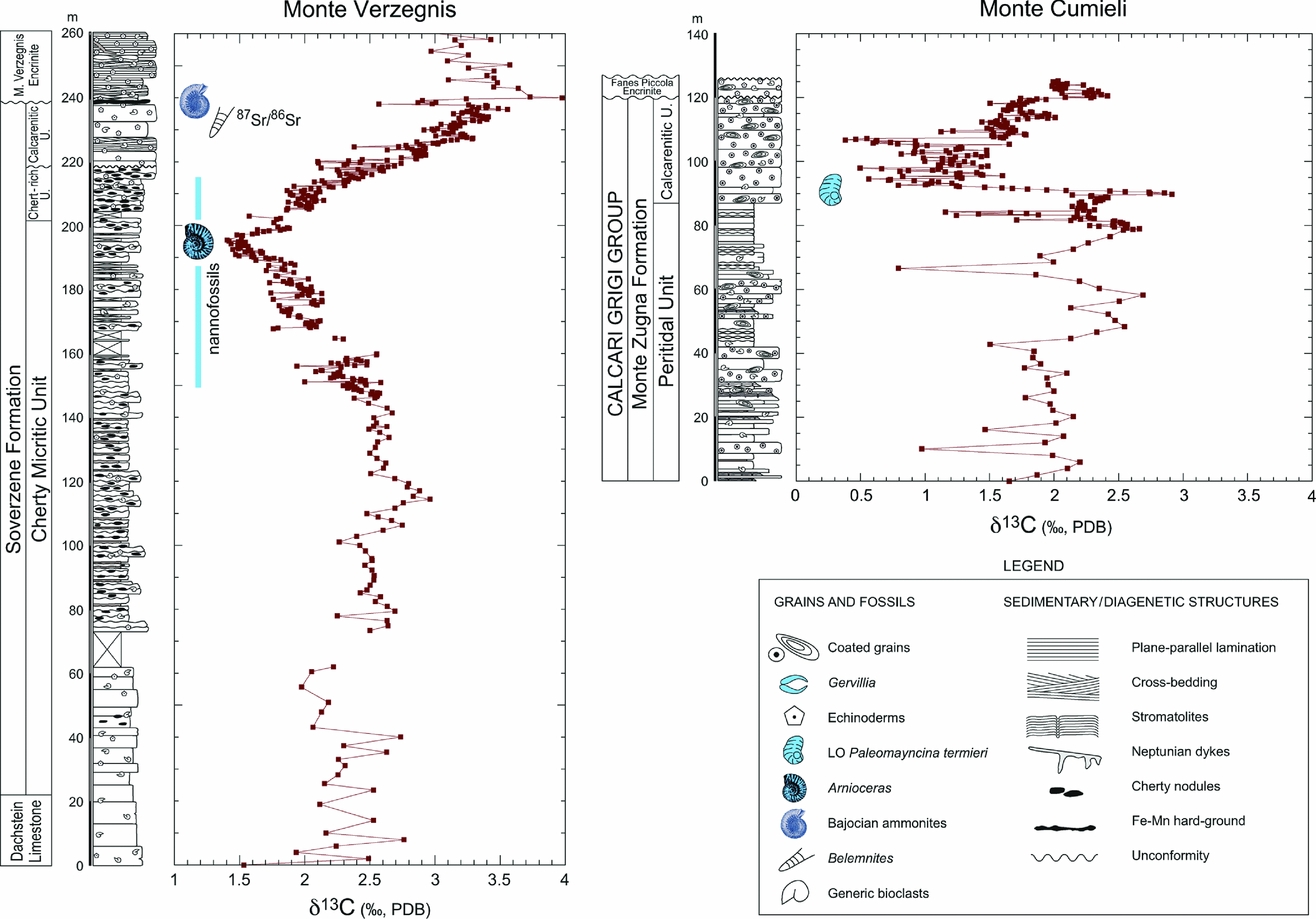
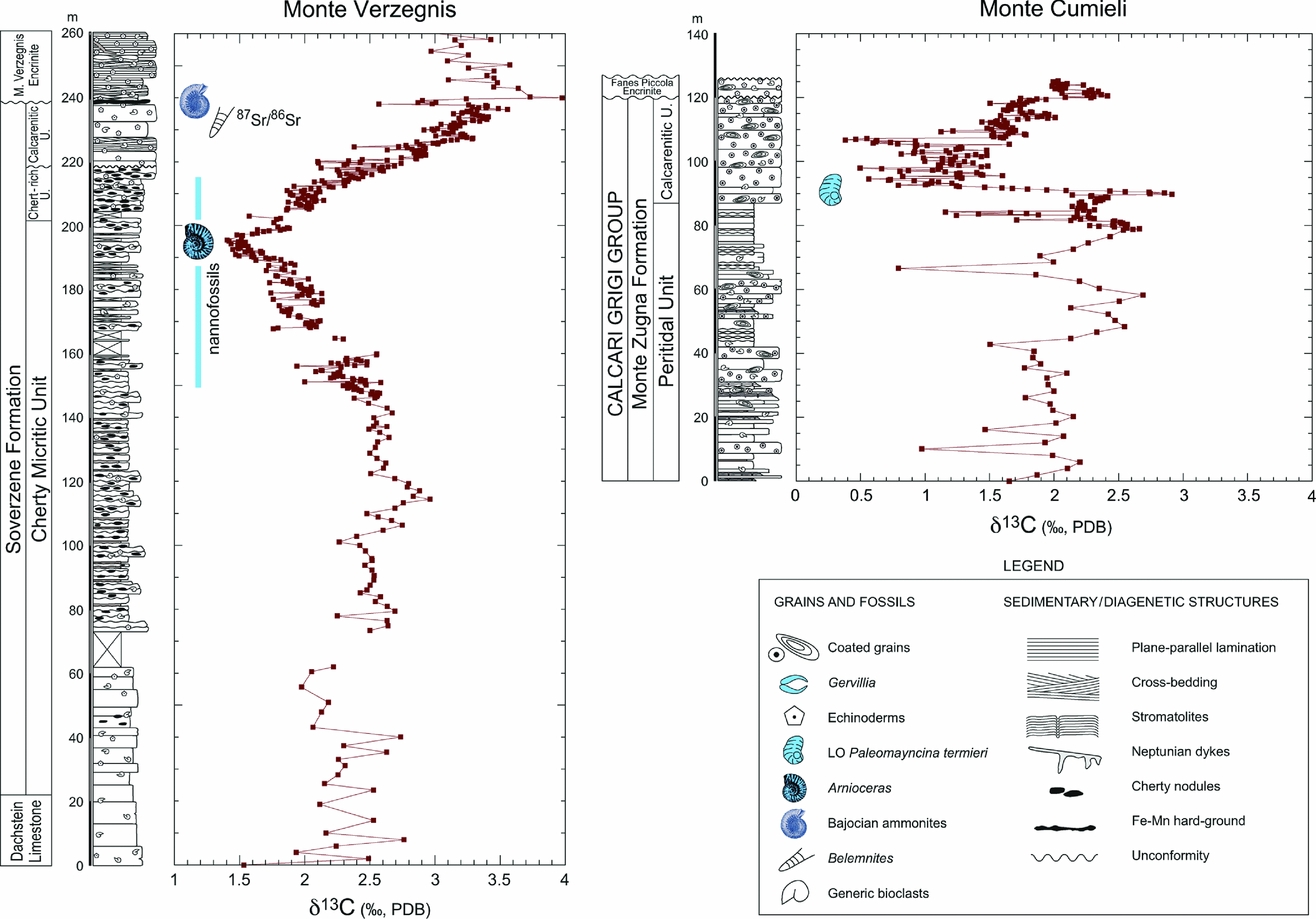
Monte Verzegnis and Monte Cumieli sections. In the upper part of the deep-water Monte Verzegnis section there is an abrupt positive carbon-isotope excursion followed by a broad negative excursion over the likely stratigraphical range of Arnioceras. In the shallow-water Monte Cumieli section, the same two negative excursions are tentatively recognizable, the first just above the top of the peritidal unit of the Monte Zugna Formation and the second in the calcarenitic unit of the same formation, separated by a thin micritic intercalation corresponding to a positive CIE. LO Paleomayncina termieri indicates its lowest occurrence identified in the section.
3.b.1. Lithostratigraphy
The Lower Jurassic fill of the Belluno Basin is made of thin-bedded, cherty mudstones and wackestones with peloids, radiolarians and sponge spicules representing the Soverzene Formation (Fig. 5). This unit has been interpreted as peri-platform ooze (cf. Schlager & James, Reference Schlager and James1978) in which pelagic material falling through the water column has mixed with the carbonate mud supplied from adjacent carbonate platforms (Zanferrari et al. Reference Zanferrari, Masetti, Monegato and Poli2013). The Soverzene Formation is ~ 200 m thick and lies atop the peritidal deposits of the Dachstein Limestone containing Upper Triassic megalodontids and the foraminifer Triasina hantkeni, thus allowing the time of the initial development of the Belluno Basin to be fixed as close to the Triassic–Jurassic boundary. In its uppermost portion, corresponding to a thickness of 16 m (Fig. 5), the Soverzene Formation is enriched in white chert that forms thick bands (up to 40 cm) interbedded with thinner limestones. The rise in the silica content corresponds to an increase in the proportion of sponge spicules in the rock, likely indicative of the onset of mesotrophic conditions in the Belluno Basin (cf. Föllmi et al. Reference Föllmi, Weissert, Bisping and Funk1994).
The Soverzene Formation passes upwards, through an unconformable boundary, to a pinkish bi-directional cross-bedded calcarenitic unit, 20 m thick, present at the top of this formation in the whole area of the Carnian and Julian Prealps. This unit is composed of light grey grainstones with small superficial ooids in which radiolarians and sponge spicules are mixed with benthic foraminifera and crinoidal fragments, recording an ephemeral shallowing-upwards evolution experienced during this time by the Carnian Prealps area of the Belluno Basin (Zanferrari et al. Reference Zanferrari, Masetti, Monegato and Poli2013). This calcarenitic unit of the Soverzene Formation is truncated by a hard-ground surface coated with Fe–Mn oxyhydroxide crusts, on top of which lies the Monte Verzegnis Encrinite, a condensed unit, ~ 20 m thick, characterized by the intercalation of cross-bedded, red crinoidal calcarenites and red nodular limestones in facies of the Lower Rosso Ammonitico, commonly showing peculiar stromatolitic/thrombolitic structures similar to those described by Jenkyns (Reference Jenkyns1971a) from western Sicily and Massari (Reference Massari, Farinacci and Elmi1981) from the Trento Plateau. Further upwards, this unit passes into the Vajont Limestone, largely constituted by redeposited oolitic grainstones, recording a return to basinal conditions on top of the underlying shallower water deposits.
3.b.2. Biostratigraphy
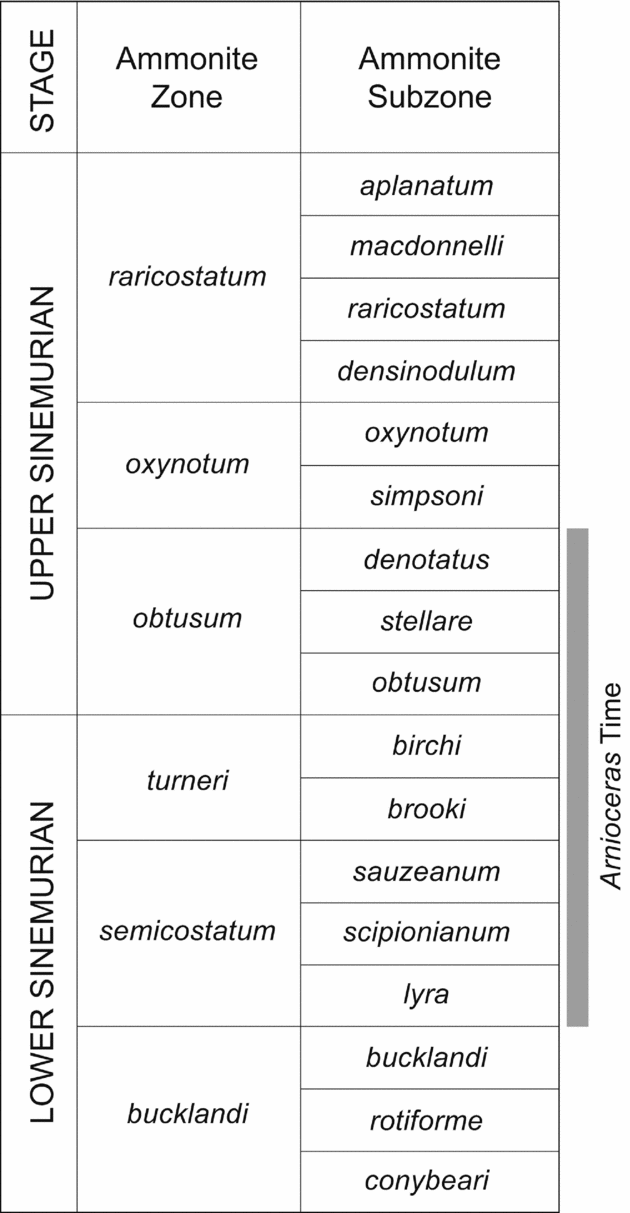
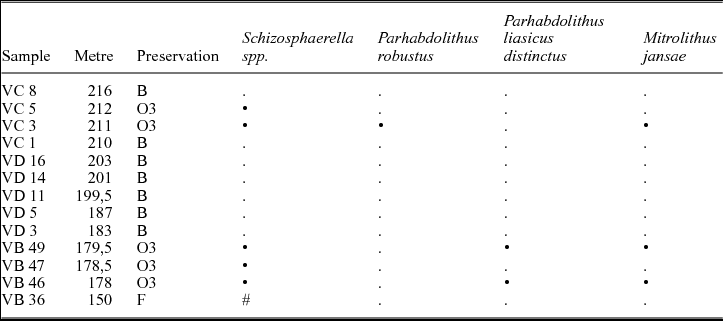
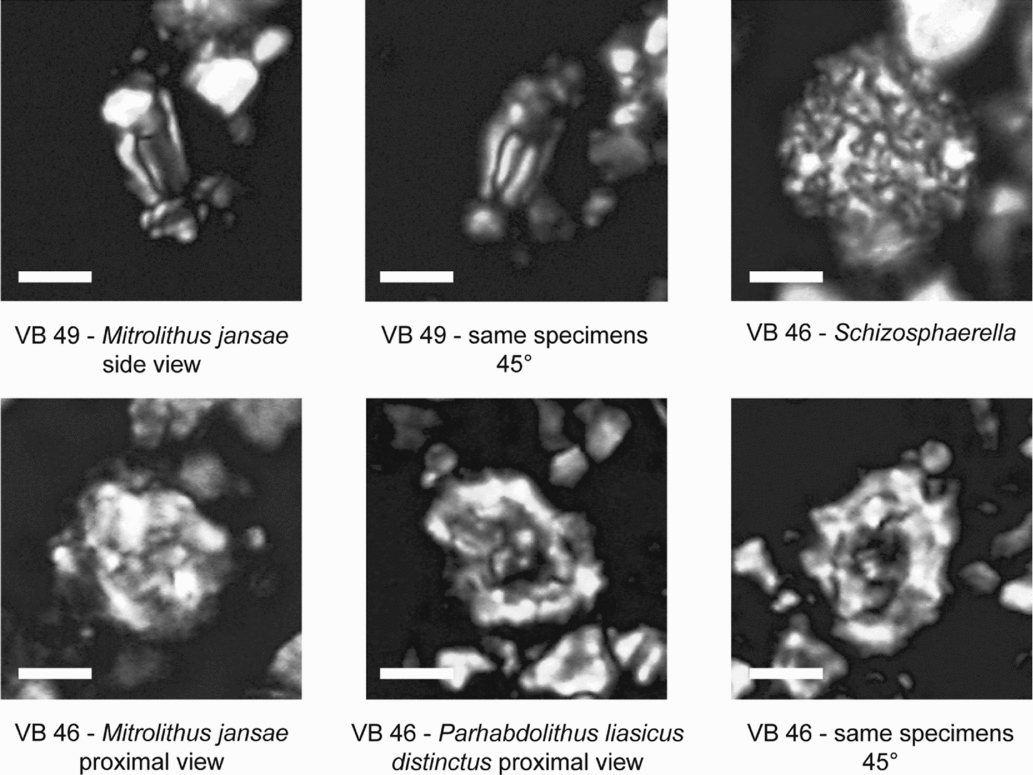
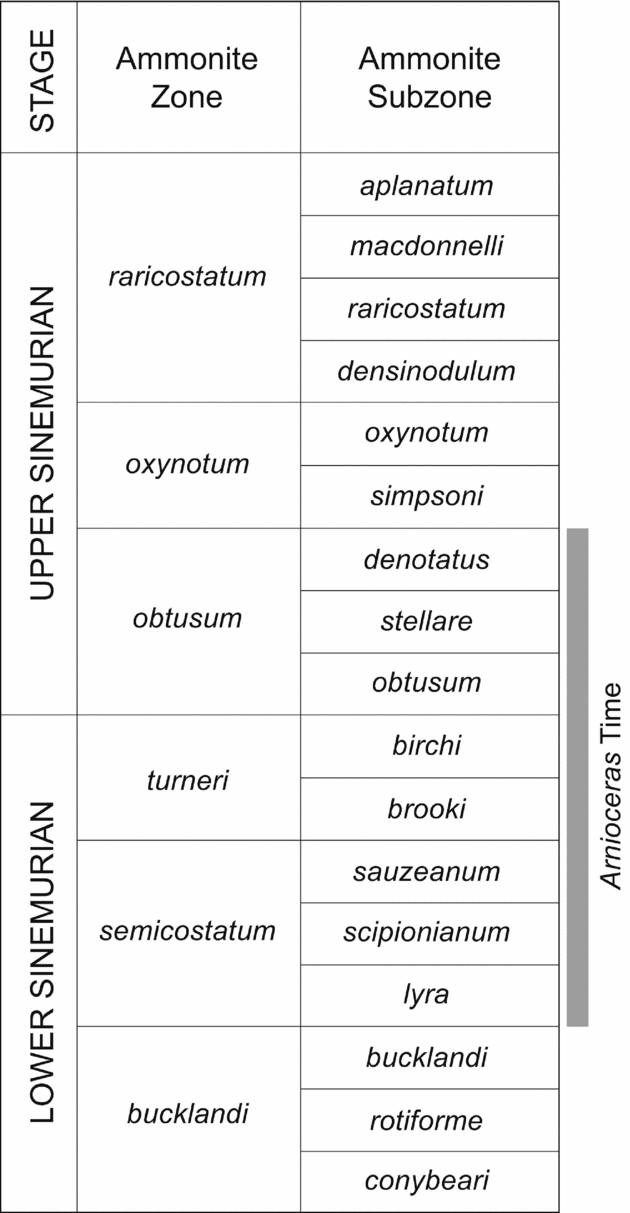
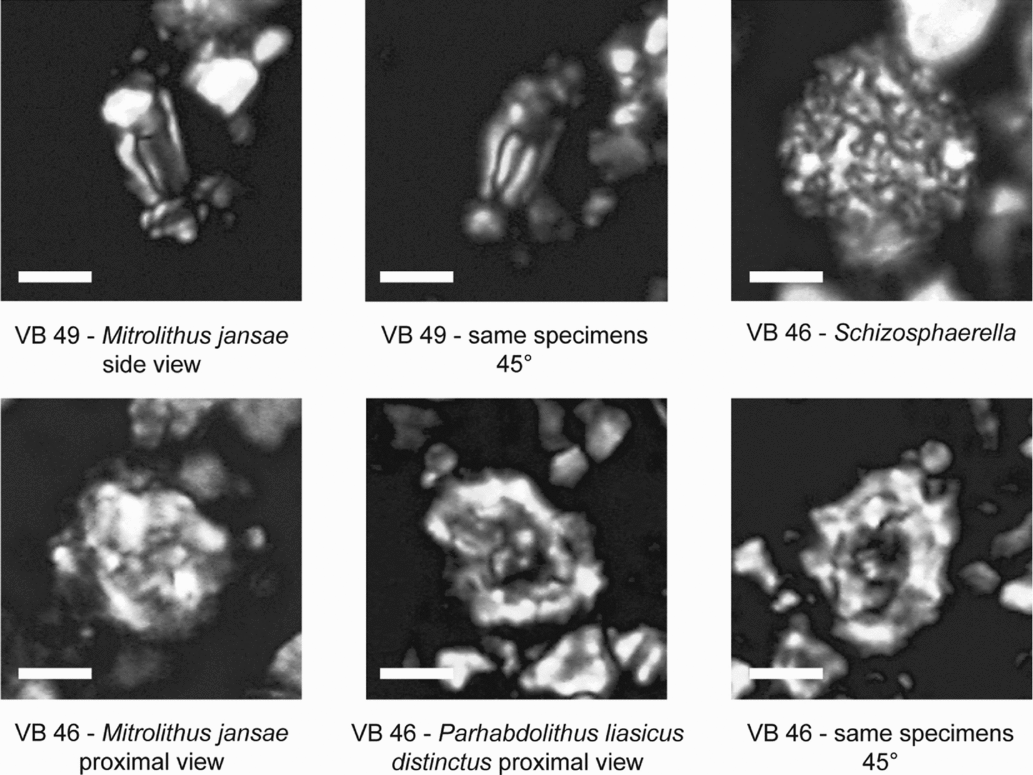
The Soverzene Formation is referred in the literature to the Hettangian–Pliensbachian (Zanferrari et al. Reference Zanferrari, Masetti, Monegato and Poli2013). During the measuring of the section, a specimen of an ammonite, identified by F. Venturi (Perugia University) as pertaining to the genus Arnioceras, was discovered in a debris cone fed from a small cliff located ~ 20 m below the top of the Soverzene Formation. Other specimens of Arnioceras have been described by Piano & Carulli (Reference Piano, Carulli, Carulli and Ponton2002), albeit from a poorly defined upper part of the formation. The Arnioceras genus has a distribution that embraces the semicostatum, turneri, obtusum and, possibly, oxynotum ammonite zones (transition from the lower to the upper Sinemurian; Dommergues, Ferretti & Meister, Reference Dommergues, Ferretti and Meister1994; Fig. 6), here informally called ‘Arnioceras Time’. The finding of the Arnioceras 20 m below the top of the unit indicates deposition of the main part of the Soverzene Formation, at least in this part of the Belluno Basin, during the Hettangian–Sinemurian interval. A section interval, ~ 70 m thick (150–220 m, Fig. 5) and corresponding to the upper portion of the unit from which the Arnioceras specimen comes, has been sampled for calcareous nannofossil analysis. Smear slides (Bown & Young, Reference Bown, Young and Bown1998) were thoroughly studied for 13 samples under an optical microscope with polarized light at ×1000. Seven of the 13 samples bear very rare and poorly preserved calcareous nannofossils; one other sample only revealed broken specimens of Schizosphaerella spp. Other species recorded are Parhabdolithus robustus, Parhabdolithus liasicus distinctus and Mitrolithus jansae (Table 3). Despite the very poor nannofossil record (Fig. 7), such an assemblage is consistent with the early Sinemurian age provided by the Arnioceras because Parhabdolithus liasicus distinctus and Mitrolithus jansae are reported to first occur in the bucklandi Zone and P. robustus in the turneri Zone (see compilation in Bown, Reference Bown1987). The recorded assemblage is compatible with the JL2 nannofossil zone, which spans the bucklandi to the base of oxynotum ammonite zones (Bown, Reference Bown1987).
Ammonite stratigraphy of the Sinemurian Stage. Modified from Dommergues, Ferretti & Meister (Reference Dommergues, Ferretti and Meister1994).
Distribution chart of calcareous nannofossils of the Monte Verzegnis section. For each slide, four transverses were studied (3, 2 cm each) under an optical microscope, polarized light at ×1000. Preservation was estimated according to Roth (Reference Roth1983).
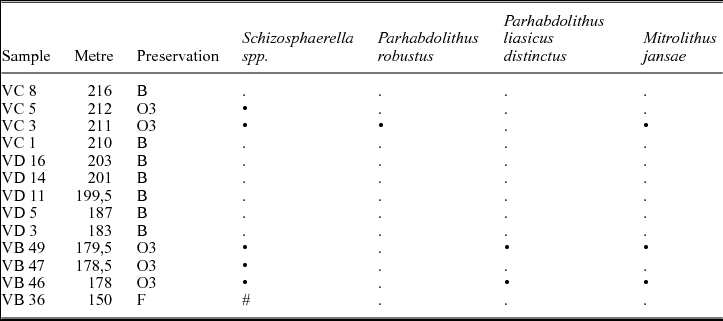
• – present; # – fragment (F); B – barren sample; O3 – overgrown nannofossils.
Images of calcareous nannofossils recorded in the Monte Verzegnis section. White scale bar = 5 µm. In spite of poor preservation and important calcite overgrowth on coccoliths (three bottom pictures), diagnostic characters are still present.
The crinoid-rich calcarenitic unit at the top of the Soverzene Formation is devoid of ammonites and nannofossils (Erba, pers. comm. 2011); a 87Sr/86Sr ratio from a belemnite rostrum collected a few centimetres below its upper boundary gave a value of 0.707196±0.000042 (normalized against a value of 0.710250 for the NBS-987 standard) suggesting an age interval either spanning the middle Pliensbachian to the early Toarcian or the early Bajocian (reference curve in Jones, Jenkyns & Hesselbo, Reference Jones, Jenkyns and Hesselbo1994; Jenkyns et al. Reference Jenkyns, Jones, Gröcke, Hesselbo and Parkinson2002). This evidence suggests that this unit could be considered the more open-marine counterpart of the mid-upper portion of the Rotzo Formation in the Venetian Prealps and could be ascribed to the Pliensbachian p.p. (Masetti et al. Reference Masetti, Claps, Giacometti, Lodi and Pignatti1998; Posenato & Masetti, Reference Posenato and Masetti2012).
In the Monte Verzegnis Encrinite, referred in the literature to the Toarcian p.p. – Bajocian p.p. (Piano & Carulli, Reference Piano, Carulli, Carulli and Ponton2002), some ammonite specimens were collected in the lower part of the formation. Among these, G. Pavia (Turin University) identified Teloceras cf. triptolemus (Buckman) and Holophylloceras sp. ammonites, both referable to the early Bajocian. A 87Sr/86Sr determination for a belemnite collected in the lowermost part of the Verzegnis Encrinite gave a value of 0.707062±0.000042 (normalized against a value of 0.710250 for the NBS-987 standard) indicating either the Pliensbachian–Toarcian boundary or a time interval spanning from the early Bajocian to the early Bathonian. Taken together, the data confirm an early Bajocian age for the lower portion of the unit. No ammonites have been found in the upper part of the Monte Verzegnis Encrinite and, by analogy with the similar Rosso Ammonitico cropping out in other areas of the Eastern Southern Alps (Martire, Reference Martire, Cita, Abbate, Balini, Conti, Falorni, Germani, Groppelli, Manetti and Petti2007), it likely corresponds to the Bathonian–lower Callovian.
3.b.3. Summary of original biostratigraphic data
(1) In the Verzegnis section, the deep-water micritic unit of the Soverzene Formation, chert-rich unit included, corresponds to peri-platform ooze delivered to the basin during Hettangian–Sinemurian p.p. time, up to and including the so-called ‘Arnioceras Time’. New calcareous nannofossil data are consistent with this age.
(2) 87Sr/86Sr data suggest that the calcarenitic unit at the top of the Soverzene Formation belongs to the mid–upper Pliensbachian, and it corresponds to the mid-upper portion of the Rotzo Formation in the Venetian Prealps, overlying the lower part of the same formation with a hiatus corresponding to the upper Sinemurian – lower Pliensbachian; and the Monte Verzegnis Encrinite was deposited during early Bajocian – early Callovian time and lies unconformably on top of the Soverzene Formation with a hiatus corresponding to the Toarcian–Aalenian interval.
3.b.4. The δ13C curve
A total of 444 samples have been analysed from a stratigraphic section 261 m thick (Fig. 5). The high-resolution interval (20 cm/sample) goes from 146 to 240 m. The remaining under- and overlying segments have been sampled with lower resolution (2 m/sample). Through the entire section, the carbon-isotope values mostly fluctuate between ~ 1.5‰ and ~ 3.5‰. In the lowest 60 m, the curve mostly ranges between ~ 2‰ and ~ 2.7‰: the relatively low resolution of the profile prevents reliable identification of the negative peaks located at the T/J boundary. Stratigraphically higher, between 60 and 80 m, including an unexposed interval of ~ 11 m, the curve shifts towards consistent values around 2.5‰. Up to about 160 m, the curve fluctuates around a value of 2.5‰, with a pronounced positive shift (to ~ 3‰ around 114 m). A small (0.5‰) negative followed by a small (0.5‰) positive excursion characterizes the 140–160 m interval. From here on up, the profile describes a symmetrical oscillation that arrives at a minimum of ~ 1.4‰ at ~ 196 m then rises up to ~ 3.6‰ at ~ 236 m. This spectacular and symmetric oscillation of the carbon-isotope curve corresponds to about 60 m of section and is completely contained within the Soverzene Formation. The lowest value is located close to the cliff where the Arnioceras specimen was found, just at the base of the chert-rich unit located at the top of the typical micritic facies of the Soverzene Formation. At ~ 237–238 m the carbon-isotope curve moves relatively abruptly to lower values (~ 2.6‰) just below the unconformable boundary between the calcarenitic unit of the Soverzene Formation and the Monte Verzegnis Encrinite before rising to > 3.5‰ at the base of this latter unit.
3.c. The Monte Cumieli section
The Monte Cumieli section (Fig. 5) crops out in the Carnian Prealps, not far from the small town of Gemona, is 137 m thick, and exemplifies the Jurassic succession of the northern sector of the Friuli Platform, characterized by the early demise of the Early Jurassic carbonate platform of the Monte Zugna Formation (Fig. 2) and by the lack of shallow-water carbonates younger than Sinemurian (Zanferrari et al. Reference Zanferrari, Masetti, Monegato and Poli2013).
3.c.1. Lithostratigraphy
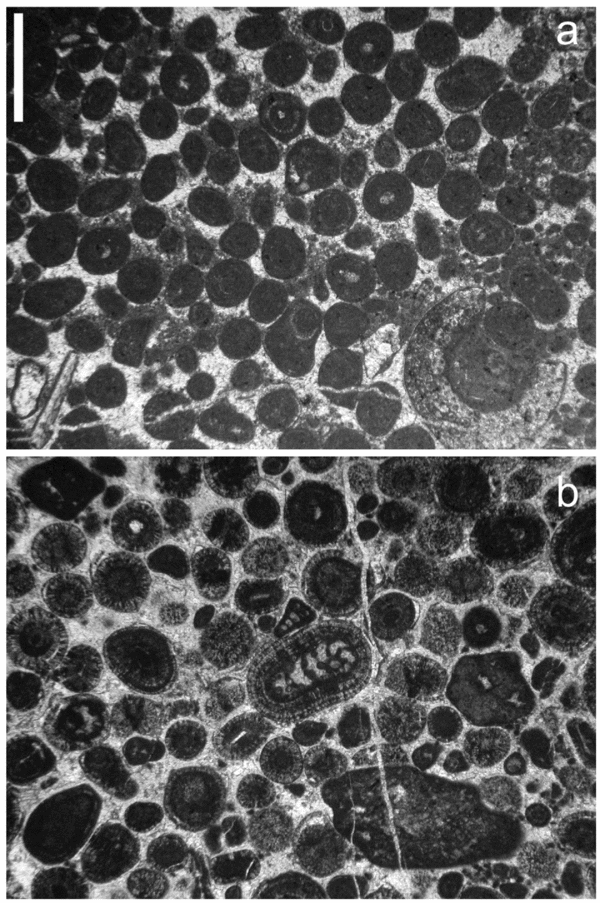
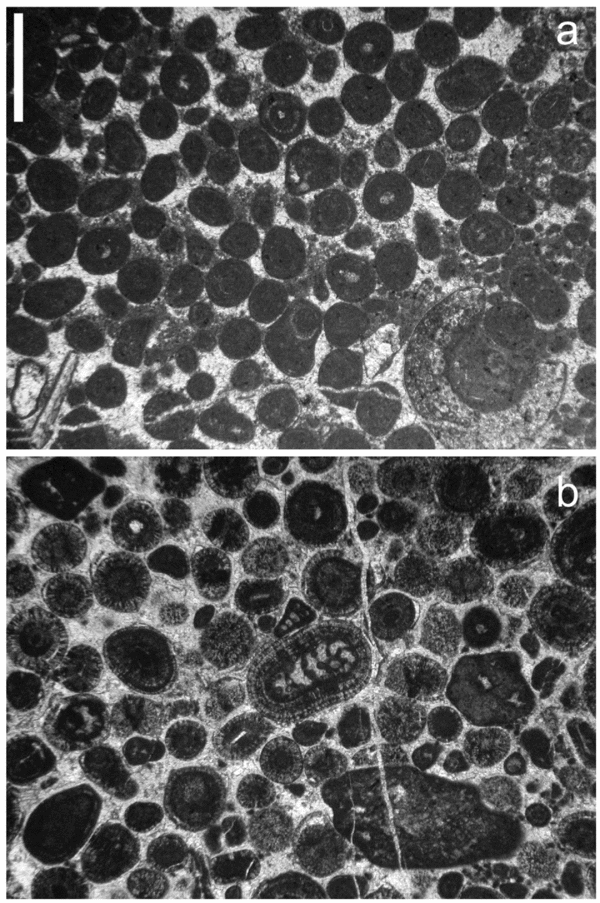
The Monte Zugna Formation is further subdivided, as illustrated in Figure 5, into a lower peritidal and an upper calcarenitic unit. The lower unit is 87 m thick and is composed of peritidal cycles representing the Jurassic continuation of the depositional theme of the underlying Upper Triassic Dolomia Principale. The calcarenitic unit is 33 m thick and comprises metre-scale beds of oolitic grainstones that become progressively richer upwards in echinoderm debris suggesting increasing open-marine influence (e.g. Jenkyns, Reference Jenkyns1971b). This calcarenitic body is interpreted as a subtidal shoal largely controlled by storm waves whose activity is recorded by plane-parallel lamination. Throughout the entire unit, the ooids exhibit some degree of concentric structure; however, in the lower part of the unit, the cortex is dominantly micritic, in some cases with outer thinly laminated tangential oriented crystals (Fig. 8a). These micritic ooids are associated with oncoids, dasyclad algae (Palaeodasycladus mediterraneus, Palaeodasycladus gracilis) and foraminifers (Aeolisaccus dunningtoni, Siphovalvulina spp., Everticyclammina praevirguliana). The micritic ooids are replaced up-section by radial-fibrous ooids whose structure is interrupted by dark microborings (Fig. 8b). The palaeontological assemblage associated with these radial-fibrous ooids is characterized by foraminifera with a complex wall structure (Paleomayncina termieri, Tersella genotii, Rectocyclammina sp.), locally acting as nuclei for the oolitic cortex (Everticyclammina praevirguliana, Fig. 8b).
Microfacies from the Foza and Cumieli sections. (a) Micritic ooids showing thinly laminated outer tangential cortices, associated with Palaeodasycladus mediterraneus, visible in a transversal section in the lower part of the thin-section. Lower part of the calcarenitic unit of the Monte Zugna Formation, Foza section, scale bar = 1 mm; (b) radial-fibrous ooids in which crystalline cortices are penetrated by dark microborings. Everticyclammina praevirguliana at the nucleus of the largest ooid. Upper part of the calcarenitic unit of the Monte Zugna Formation, Cumieli section, scale as in (a).
The Monte Zugna Formation is truncated by a disconformity surface on top of which lie the grey, locally reddish, cross-bedded crinoidal calcarenites of the Fanes Encrinite interpreted as sand-waves (Zanferrari et al. Reference Zanferrari, Masetti, Monegato and Poli2013). Resedimented deposits of the Vajont Limestone represent the youngest unit cropping out in the Monte Cumieli section and record a deepening-upwards evolution of the northern sector of the Friuli Platform, which, during Middle Jurassic time, foundered to become effectively part of the Belluno Basin where it received oolitic turbidites derived from the southern portion of the same platform that persisted as a productive shallow-water carbonate source (Masetti et al. Reference Masetti, Fantoni, Romano, Sartorio and Trevisani2012; Zanferrari et al. Reference Zanferrari, Masetti, Monegato and Poli2013).
3.c.2. Biostratigraphy
The shallow-water assemblage recorded in the Monte Cumieli section accords with the classic successions of the Alpine–Mediterranean Tethys as documented in the Central Apennines and Southern Apennines (De Castro, Reference De Castro, Barattolo, De Castro and Parente1991; Chiocchini et al. Reference Chiocchini, Farinacci, Mancinelli, Molinari, Potetti and Mancinelli1994, Reference Chiocchini, Chiocchini, Didaskalou and Potetti2008), Western Croatia (Velić, Reference Velić2007) and Morocco (Septfontaine, Reference Septfontaine1984, Reference Septfontaine1985). Barattolo & Romano (Reference Barattolo and Romano2005) recognized the following four shallow-water carbonate-platform assemblages as pertaining to the Upper Triassic – Lower Jurassic:
(1) Algal and foraminiferal Triassic assemblage (TA assemblage, uppermost Rhaetian) characterized by the occurrence of dasycladaleans, Griphoporella curvata (Gümbel) and Gyroporella vesiculifera Gümbel, involutinid foraminifera (essentially Aulotortus and Triasina) and oncoids. The macrofauna is composed of the large shells of megalodontid bivalves. Foraminifera and megalodontids become more common up-section, whereas dasycladaleans become rare or are missing altogether.
(2) Thaumatoporella and Aeolisaccus dunningtoni assemblage (LA assemblage, lowermost Hettangian – upper Hettangian) characterized by the exclusive occurrence of Thaumatoporella and Aeolisaccus dunningtoni Elliott, mainly in the lower part of its range. Small siphonous valvulinid foraminifera are rather rare, but up-section they become more common. Rare gastropods, bivalves and corals may also occur. Oncolitic coatings on grains are common.
(3) Lower Jurassic dasycladalean assemblage (LB assemblage, upper Hettangian – upper Sinemurian) characterized by the occurrence of a variety of Liassic species of dasycladaleans. The most representative genera are Palaeodasycladus, Fanesella, Sestrosphera and Tersella. Taxa of the previous LA assemblage continue into the base of the LB assemblage, which can be subdivided into lower (LB1) and upper (LB2) sub-assemblages. In LB1, Liassic dasycladaleans are not abundant and LA microfossils are still important. In LB2, dasycladaleans become dominant and large foraminifera appear (e.g. Paleomayncina).
(4) Large foraminifer assemblage (LC assemblage, upper Sinemurian – upper Pliensbachian) marked by a dominance of dasycladaleans, but with a relatively low diversity. Larger foraminifera with a complex internal skeleton are abundant, the most widespread genera being Orbitopsella, Lituosepta, Amijiella and Haurania. The background fauna is always composed of an LA assemblage.
The Monte Zugna Formation in the Monte Cumieli section is dominated by foraminifers (Aeolisaccus dunningtoni, Siphovalvulina spp., Meandrovoluta asiagoensis, Everticyclammina praevirguliana) and algae (Thaumatoporella parvovesiculifera, Palaeodasycladus mediterraneus, Palaeodasycladus gracilis, Tersella genotii and Cayeuxia-like briopsidales); the calcarenitic unit records the first occurrence of Paleomayncina termieri and an enrichment of foraminifera with a complex wall structure. According to Zanferrari et al. (Reference Zanferrari, Masetti, Monegato and Poli2013), the Monte Zugna Formation has been assigned a generic Hettangian–Sinemurian age; the micropalaeontological content of the section corresponds to the upper part of the LB1 and the lower part of the LB2 assemblages sensu Barattolo & Romano (Reference Barattolo and Romano2005).
The biotic assemblage of the Monte Zugna Formation in the Monte Cumieli section is representative of typical shallow-water faunas in Tethyan successions (Velić, Reference Velić2007; Chiocchini et al. Reference Chiocchini, Chiocchini, Didaskalou and Potetti2008), among which the algae supply the most reliable indications of palaeoenvironment and water depth. In particular, the green algae Dasycladales are considered environment sensitive, typically represented in the Lower Jurassic by taxa such as Palaeodasycladus mediterraneus, Palaeodasycladus gracilis and Tersella genotii. These green algae are thought to be characteristic of infralittoral, mostly tropical to subtropical waters (Berger & Kaever, Reference Berger and Kaever1992). Extant species of Dasycladales, like Acetabularia, commonly grow in shallow protected lagoons and on roots and shells in mangrove swamps; Dasycladales populate relatively quiet lagoonal floors, typically less than 10 m deep, and they commonly occur in tidal pools and protected microenvironments within the barrier reef (e.g. Valet, Reference Valet1979). With respect to the Lower Jurassic dasycladaleans, Tersella genotii is recorded from the Gran Sasso area (Central Italy) in bioclastic sands interpreted as shoals located near to the platform margin (Barattolo & Bigozzi, Reference Barattolo and Bigozzi1996). In the Middle Atlas of Morocco, the same species is found fossilized in situ in reef facies, whereas in the High Atlas it is found as mechanically sorted debris in oolitic grainstones (Barattolo et al. Reference Barattolo, Granier, Romano and Ferré2008). In the Monte Cumieli and Foza sections, Tersella genotii occurs as fine debris in oolitic grainstones or as more complete specimens in packstones, thus suggesting a moderately turbulent lagoonal environment. In summary, the Palaeodasycladus–Thaumatoporella algal assemblage is interpreted as characteristic of a subtidal setting with quiet to moderately agitated water, presumably representing an open lagoon environment (Barattolo & Bigozzi, Reference Barattolo and Bigozzi1996).
The palaeontological assemblage of the overlying Fanes Piccola Encrinite is characterized by the dominance of foraminifers (Involutina liassica, Agerella martana, Lenticulina, Frondicularia, Ophtalmididae and Nodosaridae) of little reliable stratigraphic significance. Zanferrari et al. (Reference Zanferrari, Masetti, Monegato and Poli2013) interpreted this unit as the result of discrete, and virtually instantaneous, deposition of sand-waves bounded by long-lasting periods of non-deposition that overall occurred between the age of the earliest ‘Arnioceras Time’ and the age (Bajocian–Bathonian) of the base of the overlying Vajont Limestone.
3.c.3. The δ13C curve
A total of 274 samples have been analysed from a 137 m thick stratigraphic section (Fig. 5). The first segment of the section, 55 m thick, has been sampled at relatively low resolution (2 m/sample), the second, 47.5 m thick, extending up to the top, at a higher resolution (one sample every 20 cm). Within the section, the carbon-isotope values fluctuate between ~ 2.9‰ (90 m) and ~ 0.4‰ (107 m). Up to 43 m from the base, within the peritidal unit of the Monte Zugna Formation, the profile evolves vertically with symmetric oscillations centred around a value of 2‰. Higher in the stratigraphy, extending up to ~ 90 m, the curve moves to generally more positive values (maximum value in the section: 3‰) with a trend interrupted by a couple of negative shifts (at 67 m and 84 m). This positive fluctuation of the curve corresponds to a thin intercalation of micritic deposits located in the upper part of the peritidal unit and to the first few metres of the calcarenitic unit of the Monte Zugna Formation (Fig. 5). The calcarenitic unit, starting from the first occurrence of Paleomayncina termieri, records a clear negative excursion in which values shift from ~ 2.9‰ (at ~ 90 m) to ~ 0.4‰ (at ~ 107 m); higher in the section, the curve returns towards more positive values (~ 1.7‰) up to ~ 120 m, at the level of the unconformity between the Monte Zugna Formation and the Fanes Piccola Encrinite.
3.d. The Foza section
The Foza section (Fig. 9) is located in the eastern sector of the Asiago Plateau (Venetian Prealps), is 73 m thick, and has been sampled along the road connecting the small towns of Valstagna, located in Valsugana, to Foza, just below this last village. The Foza section exemplifies the Jurassic succession of the northeastern area of the Trento Platform, characterized by the lack of Pliensbachian shallow-water carbonates (Rotzo Formation) and hence the early demise of the Early Jurassic carbonate platform of the Monte Zugna Formation (Figs 2, 3).
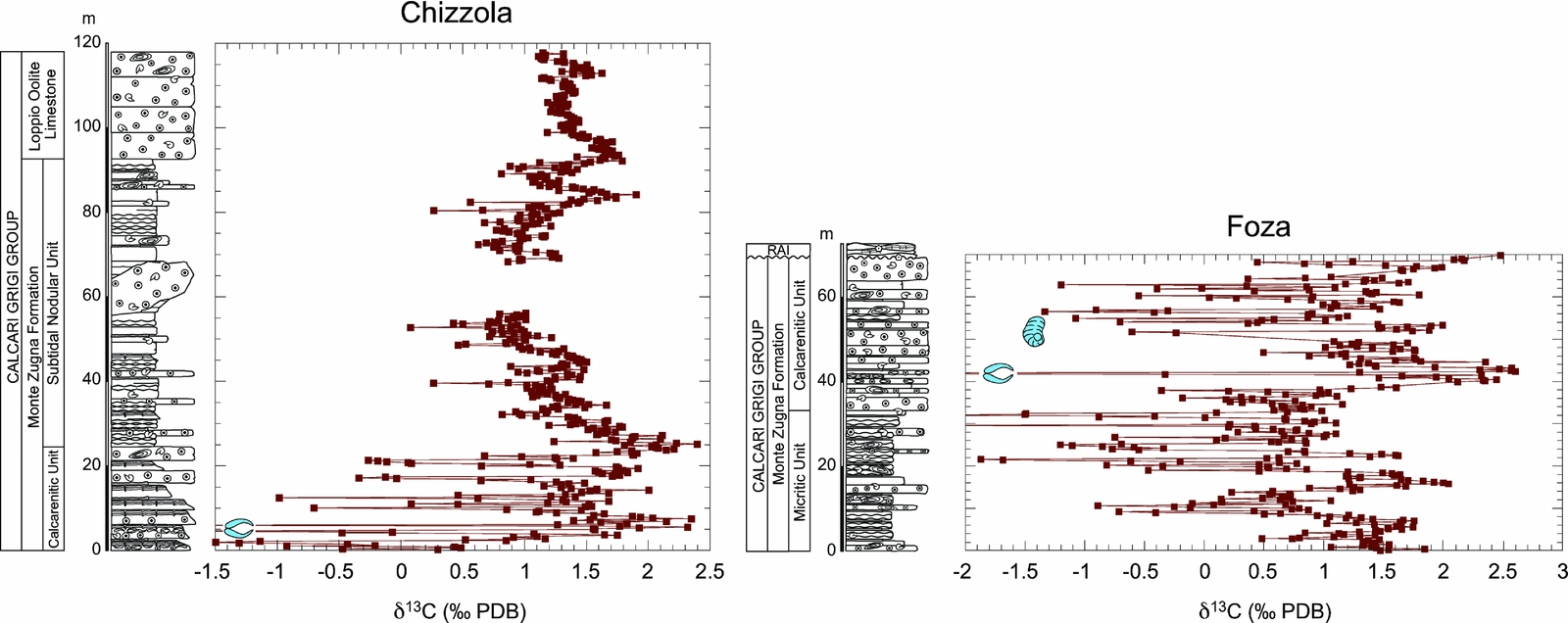
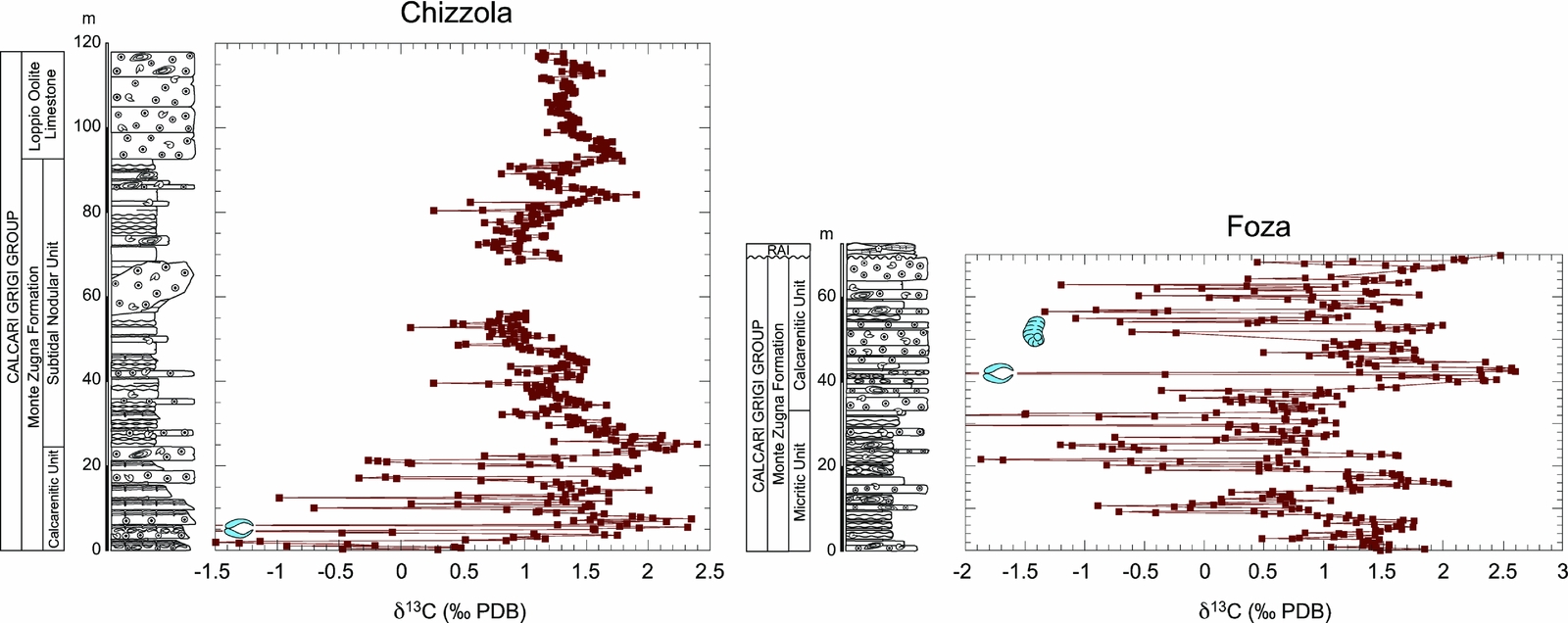
Foza and Chizzola sections. In the Foza section the same two negative excursions described in the Monte Verzegnis section are readily discernible. The stratigraphically lowest negative excursion is present just above the base of the calcarenitic unit of the Monte Zugna Formation where the Gervillia Bed crops out, and the stratigraphically higher negative excursion in the calcarenitic unit of the same formation. In the Chizzola section, the same isotopic pattern is repeated with the positive excursion coincident with the Gervillia Bed, but outcrop failure does not allow generation of data from stratigraphically lower strata. Legend as in Fig. 5.
3.d.1. Lithostratigraphy
The Foza section has been entirely sampled inside the Monte Zugna Formation, up to its upper boundary with the Lower Rosso Ammonitico; in the shallow-water carbonates of the Monte Zugna Formation the peritidal features are less marked than elsewhere, but the depositional environment may be interpreted as the internal, slack-water and muddy sector of the carbonate platform (Romano, Barattolo & Masetti, Reference Romano, Barattolo and Masetti2005). As with the Monte Cumieli section, a calcarenitic unit, 33 m thick, is superimposed on the lower, mainly micritic unit of the formation (Fig. 9); this granular unit is split into two parts by intercalated fine-grained deposits of lagoonal character containing the bivalve Gervillia buchi (Fig. 9). Here the ooids also exhibit a stratigraphic evolution in which the micrite-coated grains with thinly laminated tangential cortices (Fig. 8a), present at the base, are replaced up-section by radial-fibrous ooids (Fig. 8b).
3.d.2. Biostratigraphy
The micropalaeontological content is similar to that present in the Monte Cumieli section. The micritic unit is characterized by dasycladaleans (Palaeodasycladus mediterraneus, Sestrosphaera liasina and Eodasycladus sp.) and the foraminifer Everticyclammina praevirguliana. In addition to this, the calcarenitic unit contains Paleomayncina termieri, Terquemella sp. (dasycladalean calcified reproductive organs) and the coprolite Favreina sp. The first occurrence of Paleomayncina termieri falls in the middle of the calcarenitic unit, ~ 20 m below the unconformity. The Monte Zugna Formation has been assigned to the Hettangian–Sinemurian interval (Romano, Barattolo & Masetti, Reference Romano, Barattolo and Masetti2005). The micropalaeontological assemblage of the Foza section, like that of the Monte Cumieli section, corresponds to the upper part of the LB1 and the lower part of the LB2 assemblages sensu Barattolo & Romano (Reference Barattolo and Romano2005). From a palaeoenvironmental point of view, the section is similar to that of Cumieli. In addition, the occurrence of Sestrosphaera liasina is recorded here. According to Romano & Barattolo (Reference Romano and Barattolo2009), this alga most likely populated protected microhabitats at the boundary between the platform margin and the lagoon. The unconformity surface is covered by the Rosso Ammonitico Inferiore whose stratigraphical extent in the Trento Plateau is referred to the upper Bajocian – lower Callovian (Martire, Reference Martire, Cita, Abbate, Balini, Conti, Falorni, Germani, Groppelli, Manetti and Petti2007).
3.d.3. The δ13C curve
A total of 324 samples have been analysed from a 73 m thick stratigraphic section (Fig. 9). The δ13C values, which are highly scattered, mostly fall between −2 and 2‰. Overall, the curve can be split into three minor negative excursions separated by positive rebounds. The stratigraphically lowest negative excursion corresponds to the 0–16 m segment of the section, reaches a minimum value of ~ −0.9‰ (at 10.6 m) and returns to a value of ~ 2‰ (at 15.8 m); the second reaches ~ −2.40‰ at 32 m from the base (not shown in figure) then moves rather abruptly in a positive sense towards a value of 2.45‰ at the level of a bivalve bed (Gervillia) located at about 40 m from the base of the section, close to the lower boundary of the calcarenitic unit of the Monte Zugna Formation. The third, relatively broad negative excursion starts from a value of ~ 2.5‰ (highest value in the section: 42.5 m), then falls abruptly, following the calcarenitic unit and the stratigraphical distribution of Paleomayncina termieri, to reach a minimum of ~ −1.4‰ (56 m) and returns to ~ 2.5‰ at the boundary with the Rosso Ammonitico.
3.e. The Chizzola section
This section (Fig. 9) represents the central-western areas of the Trento Platform (Fig. 2) in which the Pliensbachian shallow-water unit (Rotzo Formation) lies on top of the Monte Zugna Formation. Located in the Adige Valley, the Chizzola section has been sampled along the road connecting the villages of Chizzola and Mori. The top of the section, corresponding to the upper half of the Loppio Oolitic Limestone, has been measured near Nomi village.
3.e.1. Lithostratigraphy
The Chizzola section exposes the upper portion of the Monte Zugna Formation (92 m) and the whole thickness of the Loppio Oolitic Limestone (32 m). The first unit is further subdivided into a peritidal calcarenitic unit (25 m) in which the peritidal cycles are made of cross-bedded, subtidal oolitic calcarenites (or, in one case, micrites with Gervillia, Fig. 9) passing upwards in the cycle to inter–supratidal stromatolites, locally with dinosaur tracks (Avanzini et al. Reference Avanzini, Frisia, Keppens and Van den Driessche1997), and an upper, subtidal, nodular unit (67 m) cut by a neptunian dyke filled with oolites derived from the overlying Loppio Oolitic Limestone. The occurrence of peritidal facies in the calcarenitic unit of the Monte Zugna Formation is a peculiar feature of the Adige Valley, and the sediments have been interpreted by Masetti et al. (Reference Masetti, Claps, Giacometti, Lodi and Pignatti1998) as deposited inside small tidal flats, developed behind marginal shoals, that were retrograding towards the inner part of the Trento Platform during a transgressive phase. The nodular subtidal units are interpreted as representing a deepening phase of the topmost portion of the Monte Zugna Formation, which is missing in the other sections; the Loppio Oolitic Limestone is an oolitic body interposed between the Monte Zugna Formation and the Rotzo Formation that spread across the main portion of the underlying unit during a sea-level rise that pushed the marginal oolitic bars composing this unit from west to east across the Trento Platform (Fig. 3; Masetti et al. Reference Masetti, Claps, Giacometti, Lodi and Pignatti1998).
3.e.2. Biostratigraphy
The micropalaeontological content and the palaeoenvironments of the Monte Zugna Formation are similar to those described in the two previous sections. As regards the Loppio Oolitic Limestone, the lack of fauna of significant value precludes reliable stratigraphic attribution and, by analogy with other areas in the Eastern Southern Alps, it is generically referred to the Sinemurian Stage, although Franceschi et al. (Reference Franceschi, Dal Corso, Posenato, Roghi, Masetti and Jenkyns2014) recognized the Sinemurian–Pliensbachian carbon-isotope boundary event in the uppermost portion of the unit. The stratigraphic setting of the Rotzo Formation is still a matter of debate: either from the upper Sinemurian to the upper Pliensbachian, if assigned on the basis of foraminiferal biostratigraphy (Fugagnoli, Reference Fugagnoli2004), or from the lower Pliensbachian to the upper Pliensbachian, on the basis of ammonite biostratigraphy (Posenato & Masetti, Reference Posenato and Masetti2012). The sharp bounding surface between the Loppio Oolitic Limestone and the Rotzo Formation, locally encrusted with red ferruginous coatings, suggests that the contact between these two units represents a regionally extensive unconformity.
3.e.3. The δ13C curve
A total of 508 samples have been analysed from a 118 m thick stratigraphic section (Fig. 9) with a sampling resolution of 20 cm. The entire carbon-isotope curve fluctuates between values of ~ −1.6‰ (~ 4.5 m) and ~ 2.4‰ (~ 25 m), with values being particularly scattered in the basal 20 m. The curve illustrates a positive excursion (~ 2.4‰) at 7.5 m, corresponding to the Gervillia Bed, declining abruptly to a relative minimum at 13 m, before moving again to more positive values that reach a maximum value of ~ 2.4‰ at 25 m. These positive–negative oscillations are entirely contained within the calcarenitic unit of the Monte Zugna Formation, here characterized by peritidal features. On the basis of the chemostratigraphic correlation, it is possible to correlate the Gervillia beds of the Chizzola and Foza sections, located at the two opposite edges of the Trento areas, across the entire platform, and even correlate the same horizons with the micritic unit, devoid of Gervillia, cropping out in the Cumieli section (Friuli Platform) corresponding to the same positive excursion (Fig. 10). Above these excursions and extending for about 60 m up to ~ 84 m, within the upper portion of the Monte Zugna Formation in which peritidal structures are missing, the profile displays another broad negative excursion, centred around the neptunian dyke and reaching the lowest value of ~ 0.1‰ at ~ 53 m; positive indentations are present around 35 m and 44 m. The top of the subtidal, mainly micritic unit of the Monte Zugna Formation, from 84 to 92 m (~ 1.6‰), corresponds to a third negative excursion (minimum value of ~ 0.8‰ at 89 m) between two positive excursions. The curve becomes more stable in the remaining part of the unit, fluctuating around an average value of ~ 1.3 ‰, with a minor positive excursion around 114 m.
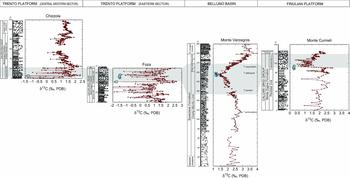
Chemostratigraphic transect through the Eastern Southern Alps with pertinent biostratigraphic data. The figure illustrates the correlation of the above-described anomalies of the δ13C curves across the entire Eastern Southern Alps, from Lake Garda to the eastern Italian border. The excellent matching between the single curves allows recognition, both in the shallow- and deep-water units, of the abrupt positive followed by broader negative carbon-isotope excursion described in the text. The correlation belt, coloured grey in the figure, defines the major negative excursion, and its lower boundary (abrupt positive excursion) can be correlated with the peak of the excursion to heavier values in the turneri Zone: this level records the first appearance of the foraminifera Paleomayncina termieri. Recognition and proposed zonal attribution of key carbon-isotope excursions in Monte Verzegnis derives from data from well-dated Sinemurian mudstones and shales from the UK (Fig. 11). Legend as in Fig. 5.

3.f. Correlations of δ13C curves across the Eastern Southern Alps and their comparison with coeval anomalies
The proposed correlation of the above-described anomalies of the δ13C curves across the entire Eastern Southern Alps, from Lake Garda to the eastern Italian border, is illustrated by the grey band in Figure 10. Lithologies in which the carbon-isotope excursion (CIE) has been recorded include the cherty micrites in the basinal succession of the Monte Verzegnis section and the oolitic grainstones locally interlayered with micrites of the shallow-water facies (Table 2). The excellent matching between the single curves allows recognition, both in the shallow- and deep-water units, of a distinct abrupt positive followed by broader negative CIE located just below an unconformity surface (Fig. 3). The primary origin of these excursions is supported by the following observations: all the coeval segments sampled in different sections exhibit the same CIEs with similar geometry and extending over similar stratigraphic thicknesses; all the curves are characterized by well-defined trends and not by single peaks that might represent diagenetic artefacts; the curves conform with the stratigraphic occurrence of key faunal datum levels; the curves conform with similar facies developments.
In the basinal Monte Verzegnis section, the CIE spans a stratigraphic thickness of ~ 60–70 m (depending on chosen baseline), referable, thanks to the finding of a specimen of Arnioceras, to a time interval ranging from the base of the semicostatum, through the turneri to the top of the obtusum zones (Dommergues, Ferretti & Meister, Reference Dommergues, Ferretti and Meister1994; Fig. 6) and thus likely corresponding to an interval of 2–3 Ma (Gradstein, Ogg & Schmitz, Reference Gradstein, Ogg and Schmitz2012). The same negative CIE is clearly recognizable, with a similar geometry, in the two palaeogeographic domains situated either side of the Belluno Basin, namely in the Monte Cumieli section (Friuli Platform) and the Foza section (northern sector of the Trento Platform). Although values are scattered, this negative CIE signal, which is entirely contained within the calcarenitic unit at the top of the Monte Zugna Formation (thickness ~ 30 m), is not only preceded by a positive excursion but also interrupted by positive indentations. Significantly, the positive to negative shift at the base of the major negative CIE correlates with the first occurrence of the foraminifer Paleomayncina termieri in both the Foza and Monte Cumieli sections. The isotopic correlation with strata containing Arnioceras allows this foraminifer, once attributed a poorly defined Sinemurian age, to be linked to the transition from the lower to the upper part of the stage. In the Chizzola section, located on the other side of the Trento Platform, this negative CIE is contained within the c. 25 m thick calcarenitic unit of the Monte Zugna Formation.
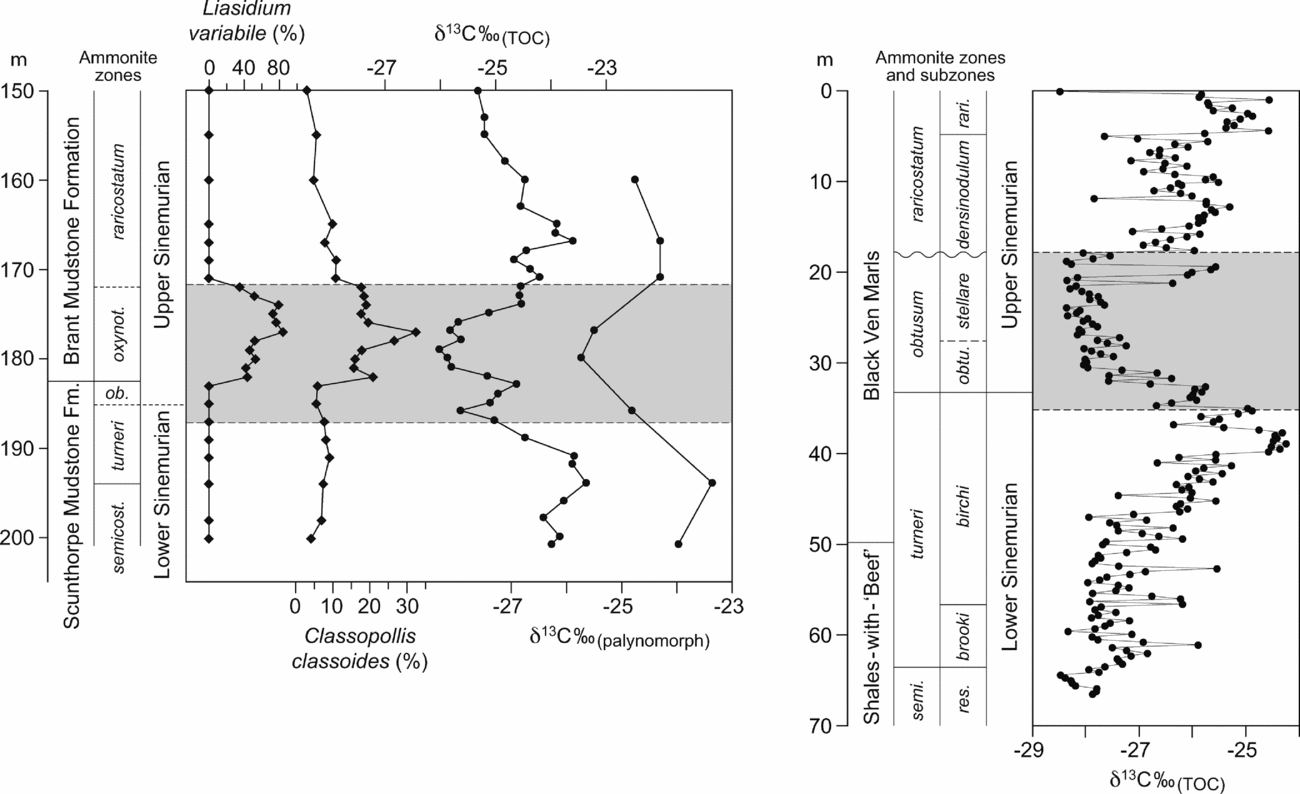
Most Jurassic chemostratigraphical studies to date have been mainly focused on the Pliensbachian–Toarcian interval; other stages are less well defined. In the Hettangian–Sinemurian interval, Jenkyns et al. (Reference Jenkyns, Jones, Gröcke, Hesselbo and Parkinson2002) recorded carbon-isotope ratios from belemnites and oyster shells from Portugal and England indicating a positive excursion in the lower Sinemurian followed by a negative excursion at the Sinemurian–Pliensbachian boundary. More detail is given by Jenkyns & Weedon (Reference Jenkyns and Weedon2013), who illustrated a high-resolution organic-carbon-isotope curve from Sinemurian black shales cropping out in the Wessex Basin (Dorset, UK). These data show a negative excursion likely centred around the boundary of the semicostatum and turneri zones, a positive excursion extending through the upper turneri Zone before a fall at the close of that zone into the lower part of the obtusum Zone, followed by a rise before the continuity of the section is interrupted by a hiatus (Fig. 11). This positive turneri Zone excursion has been recorded also by Porter et al. (Reference Porter, Smith, Caruthers, Houa, Gröckeb and Selbyb2014) in marine sediments from North America (British Columbia, Canada) and manifestly represents a global marine carbon-isotope signature. Riding et al. (Reference Riding, Leng, Kender, Hesselbo and Feist-Burkhardt2012) studied a section from a borehole in eastern England and documented a marked negative excursion in a δ13C curve from wood and palynomorphs centred in the oxynotum Zone (lower part of the upper Sinemurian, Fig. 6), an interval that is missing in the Dorset profile. This negative excursion, registered in both marine and terrestrial carbon (thereby indicating a response in both atmosphere and oceans) was coupled with an increase in abundance of the thermophilic pollen Classopollis classoides (Fig. 11), suggesting the occurrence of a warming event.
Left-hand diagram illustrates the Copper Hill Borehole (eastern England) studied by Riding et al. (Reference Riding, Leng, Kender, Hesselbo and Feist-Burkhardt2012) and illustrating an increase of the dinoflagellate cyst Liasidium variabile and the thermophilic pollen grain Classopollis classoides in ammonite-bearing mudstones, suggesting the occurrence of a warming event coincident with a negative carbon-isotope excursion in marine and terrestrial organic matter largely corresponding to the obtusum and oxynotum zones of the Sinemurian Stage. The presence of the negative excursion in terrestrial pollen indicates that the atmosphere as well as the ocean was affected by the disturbance in the carbon cycle. Scale in metres is depth below surface. semicost. – semicostatum Zone; ob. – obtusum Zone; oxynot. – oxynotum Zone. Right-hand diagram illustrates high-resolution organic carbon-isotope stratigraphy of Sinemurian ammonite-bearing black shales from Dorset, southern England (Jenkyns & Weedon, Reference Jenkyns and Weedon2013). A positive excursion is characteristic of the turneri Zone followed by a negative excursion in the lower part of the obtusum Zone; the upper part of the obtusum Zone and the whole of the oxynotum Zone are lost to a hiatus. Grey band illustrates the position of the principal negative carbon-isotope excursion, only partly developed in Dorset. Depth is given in metres below the top of the Black Ven Marls. semi. – semicostatum Zone; res. – resupinatum Subzone; obtu. – obtusum Subzone; rari. – raricostatoides Subzone.
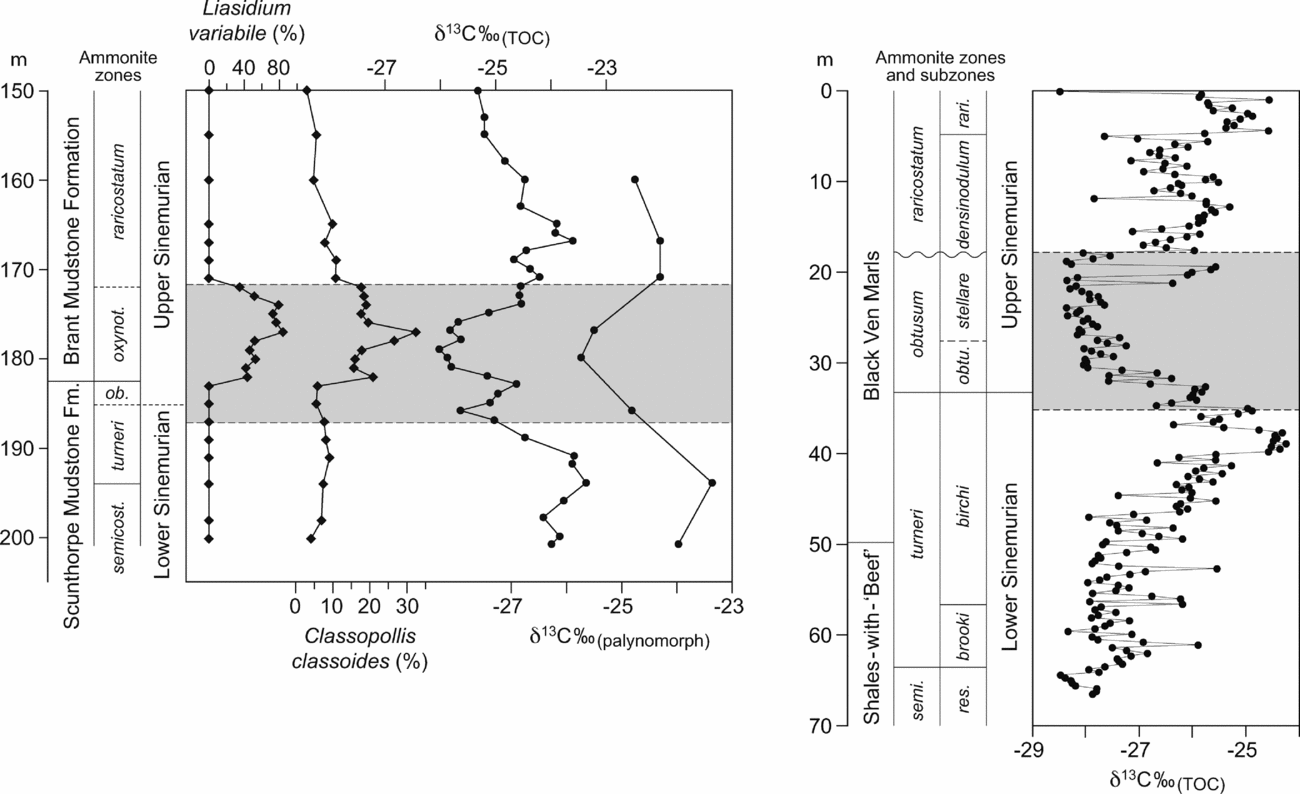
In Morocco, carbonate isotopic data from Lower Jurassic peritidal platform carbonates show a well-defined negative excursion attributed to an early Sinemurian age and a positive excursion in overlying open-marine sediments whose basal levels contain the ammonite Arnioceras and are placed in the upper Sinemurian (Wilmsen & Neuweiler, Reference Wilmsen and Neuweiler2008). In England and other parts of northern Europe, Arnioceras ranges from the bucklandi Zone of the basal Sinemurian into the obtusum Zone (Page, Reference Page, Lord and Davis2010), in good correspondence with the distribution proposed by Dommergues, Ferretti & Meister (2004; Fig. 6). If high-resolution data from all these sections are taken as a guide (Figs 5, 9, 10), it seems that there are two possible negative excursions over the likely stratigraphical range of Arnioceras. Concentrating on positive excursions, the most pronounced of which in the Dorset profile is in the upper part of the turneri Zone (Fig. 11), gives the suggested zonal equivalence in the Verzegnis profile as suggested in Figure 10. A negative trend covers the interval attributed to the semicostatum Zone and possibly some of the turneri Zone, whose defining feature, however, is a positive excursion, albeit relatively small in the Verzegnis profile. Following the turneri Zone positive excursion, there is a well-defined negative excursion attributed to the obtusum Zone, likely extending into the oxynotum Zone, followed by near-symmetrical recovery to higher values: a pattern matching that in the borehole material in eastern England (Fig. 11). In the platform-carbonate sections, the abrupt positive excursions seen in Chizzola, Foza and Monte Cumieli can thus be tentatively referred to the turneri Zone and the ensuing negative excursion to the obtusum and oxynotum zones.
4. Possible causes of the ‘Arnioceras Time’ negative δ13C excursion
The ‘Arnioceras Time’ broad negative δ13C excursion of ~ 1.0 ‰ recorded in the Soverzene Formation of the Monte Verzegnis section is well defined and extends over a thickness of ~ 60 m. Unlike the negative excursion that characterizes the lower Toarcian interval, which is abrupt with a clear stepped profile in all sections (Jenkyns et al. Reference Jenkyns, Jones, Gröcke, Hesselbo and Parkinson2002; Kemp et al. Reference Kemp, Coe, Cohen and Schwark2005; Hesselbo et al. Reference Hesselbo, Jenkyns, Duarte and Oliveira2007; Sabatino et al. Reference Sabatino, Neri, Bellanca, Jenkyns, Baudin, Parisi and Masetti2009; Hermoso et al. Reference Hermoso, Minoletti, Rickaby, Hesselbo, Baudin and Jenkyns2012), the excursion at Monte Verzegnis appears more gradual with values dropping from ~ 2.5‰ to ~ 1.5‰. If values of ~ 2.5‰, which characterize the lower parts of the section, are taken as background, the negative shift may record introduction of isotopically light carbon into the ocean–atmosphere system through oxidation of a formerly buried reservoir such as sub-seafloor clathrates or organic-rich sediments. Alternatively, a reduction in the amount of global biomass or organic carbon buried in response to environmental change could have caused movement to lower carbon-isotope values. Large Igneous Province (LIP) volcanism cannot be invoked, because there are no known provinces of this age (Courtillot & Renne, Reference Courtillot and Renne2003): the main activity phase of the Central Atlantic Magmatic Province (CAMP) occurred around 200 Ma and terminated during Hettangian time (Marzoli et al. Reference Marzoli, Renne, Piccirillo, Ernesto, Bellieni and De Min1999).
If isotopically light CO2 were to have been introduced into the atmosphere, resultant global warming would have likely led in turn to acceleration of the hydrological cycle and to the increase of global weathering rates. Increased quantities of nutrients and fine-grained continental sediments delivered to oceans would have favoured both increased organic productivity and formation of salinity-stratified water bodies leading to the onset of eutrophic conditions and deposition of organic-rich clays and clay-rich limestones. No such markers of wet and humid conditions during the CIE have been so far identified in the Southern Alps during ‘Arnioceras Time’, but a coeval warming event has been recognized in southern England by Riding et al. (Reference Riding, Leng, Kender, Hesselbo and Feist-Burkhardt2012), based on palynological data and extending over the obtusum and oxynotum zones (Fig. 11). A possible important role in the release of the isotopically light 12C into the atmosphere could have been played by syn-sedimentary tectonics that caused fracturing and leakage of gas-hydrate reservoirs (cf. Jenkyns, Reference Jenkyns2003). The negative excursion of ‘Arnioceras Time’ occurred coincidently with the reactivation of the rifting activity that affected large sectors of the Tethyan areas from the Southern Alps, Apennines and Sicily to the Betic Cordillera (Spain) and Moroccan High Atlas (Masetti et al. Reference Masetti, Claps, Giacometti, Lodi and Pignatti1998; Ruiz-Ortiz et al. Reference Ruiz-Ortiz, Bosence, Rey, Nieto Castro and Molina2004; Marino & Santantonio, Reference Marino and Santantonio2010; Merino-Tomé et al. Reference Merino-Tomé, Della Porta, Kenter, Verwerk, Harris, Adams, Playton and Corrochano2012). This coincidence in timing could explain why many authors have ascribed local to regional drowning of carbonate platforms primarily to tectonic causes affecting subsidence rate rather than climatic influence on the sediment factory itself.
5. Impact of the ‘Arnioceras time’ negative δ13C excursion on carbonate sedimentation
The inferred position of the ‘Arnioceras Time’ negative δ13C excursion within the Lower Jurassic succession along the transect crossing the Eastern Southern Alps is shown in Figures 3 and 10. In the Belluno Basin, the negative carbon-isotope anomaly corresponds with the upper part of the lower micritic unit of the Soverzene Formation, with the lowest values located just below the base of the chert-rich unit at the top of the same formation (Figs 5, 9, 10). In the shallow-water carbonates, both in the Trento and Friuli platforms, the anomaly begins at the top of the lower, peritidal unit of the Monte Zugna Formation, is interrupted by a short positive δ13C pulse, and culminates in the calcarenitic unit at the top of the same formation.
The chert-rich unit of the Belluno Basin (Fig. 5, 16 m thick) correlates with an appreciable increase in sponge-spicule content, likely reflecting a more nutrient-rich mesotrophic environment. Such mesotrophic conditions could have been related to an accelerated hydrological cycle linked to introduction of isotopically light CO2 into the atmosphere and subsequent global warming. The deleterious effects of nutrient excess on shallow-water carbonate production by reducing water transparency, and encouraging bioeroding organisms is well documented (Hallock & Schlager, Reference Hallock and Schlager1986; Schlager, Reference Schlager2005). Consequently, the hiatus in the Verzegnis section between the chert-rich and calcarenitic units in the upper part of the Soverzene Formation, supposedly representing the upper Sinemurian – lower Pliensbachian interval, could in part be related to the postulated coeval drop in the carbonate production on the neighbouring carbonate platforms. Since the lower portion of Soverzene Formation represents peri-platform oozes in which pelagic material, falling through the water column, has been mixed with carbonate mud supplied by the adjacent platforms (‘peri-platform ooze’ of Schlager & James, Reference Schlager and James1978), the drop in carbonate precipitation and secretion in the shallow-water feeder areas, acting together with the Sinemurian/Pliensbachian carbon-cycle boundary event recognized on the Trento Platform by Franceschi et al. (Reference Franceschi, Dal Corso, Posenato, Roghi, Masetti and Jenkyns2014), could have produced the basinal starvation that caused this hiatus.
The onset of the calcarenitic unit at the top of the Monte Zugna Formation in many localities represents a fundamental reorganization of the palaeogeography during the interval of the major negative CIE: tidal flat areas across much of the Tethyan area were replaced by subtidal, wave-controlled, oolitic shoals, in which peritidal facies are missing. The only exception in the Southern Alps is the Adige Valley (Chizzola section, Fig. 9) where Masetti et al. (Reference Masetti, Claps, Giacometti, Lodi and Pignatti1998) interpreted these remnants of the former peritidal system as small tidal flats developed behind the western marginal shoals of the Trento Platform. The calcarenitic unit at the top of the Monte Zugna Formation, like the overlying Loppio Oolitic Limestone, has been interpreted as due to the retrogradation of the marginal carbonate sand bars located at the western margin of the Trento Platform during a relative sea-level rise (Masetti et al. Reference Masetti, Claps, Giacometti, Lodi and Pignatti1998). At its most extreme, this deepening and transgressive phase in the Eastern Southern Alps coincided with the definitive loss/drowning of early–late Sinemurian peritidal platforms, inherited from Late Triassic time, which were located in many other areas around the Mediterranean (e.g. Western Southern Alps, Ligurian Alps, Northern Apennines, western and eastern Sicily, and High Atlas).
Previous authors have postulated an interaction between tectonic and eustatic processes as the most viable mechanism able to explain the transgressive phase that occurred at the boundary between early and late Sinemurian time. Tectonic and/or eustatic processes were probably important, given the significant rise in the semicostatum Zone of the putative eustatic sea-level curve of Haq, Hardenbol & Vail (Reference Haq, Hardenbol, Vail, Wilgus, Hastings, Posamentier, Van Wagoner, Ross and Kendall1988) and the north European relative sea-level curve of Hesselbo & Jenkyns (Reference Hesselbo, Jenkyns, de Graciansky, Hardenbol, Jaquin, Vail and Farley1998). However, taking in account the coeval CIE described herein, this relative sea-level rise in the Southern Alps and elsewhere in the Tethyan region could be interpreted not as purely eustatic but as the consequence of a simultaneous decrease in carbonate production in shallow-water platforms caused by the introduction into the atmosphere–ocean system of isotopically light carbon that led to increased introduction of terrestrially derived nutrients and ocean acidification, hence suppressing carbonate production and deposition (cf. Trecalli et al. Reference Trecalli, Spangenberg, Adatte, Follmi and Parente2012).
This climatic event, acting together with a reactivation of the syn-sedimentary extensional tectonics that reduced the productive areas of the carbonate platforms, would have ensured that the top of the carbonate platforms could no longer be readily maintained at sea level. Such a proposed decrease in carbonate production is also suggested by a fall in the sedimentation rate: the thickness of the calcarenitic units, in both the Friuli and Trento platforms is ~ 30 m (Foza and Monte Cumieli sections) and a little thinner (~ 20 m) in the Chizzola section, likely corresponding to the turneri, obtusum and oxynotum zones (~ 10 m Ma−1 sedimentation rate). Assuming a thickness of ~ 100 m for the lower peritidal unit of the Monte Zugna Formation (Masetti et al. Reference Masetti, Claps, Giacometti, Lodi and Pignatti1998) and referring it to the remaining part of the lower Sinemurian (semicostatum and bucklandi zones) and to the Hettangian, the corresponding time span could be estimated as about 4 Ma according to the time scale of Gradstein, Ogg & Schmitz (Reference Gradstein, Ogg and Schmitz2012): that is, a sedimentation rate (~ 25 m Ma−1) more than twice that of the calcarenitic unit.
Obvious evidence for the mesotrophic environments recorded by the chert-rich unit of the Verzegnis section in the Belluno Basin is apparently missing in the palaeontological assemblage in the shallow-water calcarenitic units at the top of the Monte Zugna Formation. On the contrary, the first appearance of Paleomayncina termieri and, more generally, an enrichment of foraminifera with a complex wall structure, seem to be related to an amelioration of the environment and to a shift towards an oligotrophic regime as proposed, for example, by Fugagnoli (Reference Fugagnoli2004) for the overlying Rotzo Formation. This anomaly could be explained assuming that trophic conditions are not the main parameter controlling the development of these foraminifera. Analysing in detail the behaviour of the carbonate factory with respect to the isotopic excursions in all three shallow-water sections suggests that the first negative CIE, centred around the boundary of the semicostatum and turneri zones (Fig. 10), coincides with the stratigraphic level recording the loss of peritidal sediments; and their replacement by subtidal shoals coincides with the interval of transition between negative and positive excursions of the isotopic curve. These shoals are composed of ooids with a dense micritic ultrastructure (Fig. 8a), typically associated with oncoids and dasycladaleans (Palaeodasycladus mediterraneus, Palaeodasycladus gracilis). The recovery of the platform during the positive turneri Zone CIE caused its progradation outwards and the deposition of the fine-grained lagoonal Gervillia buchi beds on top of the marginal oolitic deposits of the Chizzola and Foza sections, respectively, at the western and eastern margins of the Trento Platform. In the Friuli Platform (Cumieli section) the Gervillia beds are not recorded and are replaced by micritic deposits lacking obvious macrofossils.
The negative obtusum–oxynotum Zone excursion, which may be interpreted as due to a further introduction of isotopically light carbon into the ocean–atmosphere system, can similarly be linked to a reduction in carbonate production and a new transgression, recorded everywhere in the upper portion of the calcarenitic unit of the Monte Zugna Formation. Being similar in bed organization and sedimentary structures to the lower part of calcarenitic unit, this upper portion shows a vertical evolution in which micritic ooids and dasycladaleans are replaced upwards by radial-fibrous ooids and foraminifera with a calcitic wall structure (Fig. 8b). The degree of water turbulence and velocity, as denoted by sedimentary structures, apparently changed little during deposition of the unit, ruling out physical environmental factors as controlling ooidal ultrastructure. Notably, the micritic ooids are associated with aragonitic dasycladaleans and correlate with transitions between positive and negative excursions of the CIE, whereas the radial-fibrous ooids are associated with foraminifera with calcitic walls during the acme of the CIE. These associations point to seawater pH, in turn forced by CO2 release, as a leading factor controlling both fossil occurrence and ooidal structure by promoting short-term changes in the dominant mineralogy (aragonite v. calcite) of the carbonate factory (e.g. Sandberg, Reference Sandberg1983; Wilkinson & Given, Reference Wilkinson and Given1986; Zhuraviev & Wood, Reference Zhuravlev and Wood2009). Following Strasser's (Reference Strasser1986) study of Lower Cretaceous limestones in France and Switzerland, the micritic ooids are interpreted as originally aragonitic, which, after inversion to calcite, preserved some degree of original concentric structure, whereas the radial-fibrous ooids, formed in waters of relatively low pH, preserved the original calcitic composition and crystallographic orientation. Because a negative pulse of the carbon-isotope curve corresponds with a transgressive trend of the sedimentary succession, and the positive excursion records the contrary, the seawater pH may have directly controlled the whole production of the carbonate platform and hence sedimentary accumulation rate and relative sea level.
In mid-late Pliensbachian time, the carbonate factory moved laterally from the top of the platform into the neighbouring Belluno Basin, incorporating the portion of the basin corresponding to the Monte Verzegnis area into a shallow-water domain where the cross-bedded calcarenitic unit at the top of the Soverzene Formation (interpreted as subtidal shoals) started to accumulate (Fig. 5; Zanferrari et al. Reference Zanferrari, Masetti, Monegato and Poli2013). During the same interval, a lack of accommodation space is assumed to have prevented deposition of shallow-water deposits in the adjacent Friuli Platform (Monte Cumieli section; Zanferrari et al. Reference Zanferrari, Masetti, Monegato and Poli2013). The calcarenitic unit at the top of the Soverzene Formation is in turn truncated by a hard-ground surface intervening between its upper boundary and the Verzegnis Encrinites. Since this latter unit corresponds to the lower Bajocian to lower Callovian interval, the hard-ground surface is equivalent to a time span extending from the Toarcian to the Aalenian, a hiatus equivalent to that separating the top of the Rotzo Formation from the Lower Rosso Ammonitico in the central-western sector of the Trento Platform (see above and Masetti et al. Reference Masetti, Claps, Giacometti, Lodi and Pignatti1998).
After the postulated Sinemurian event, the Pliensbachian recolonization seems to have been largely controlled by an extensional tectonic phase that led to the first differentiation of the central-western and northern-eastern sector of the Trento Platform in which accommodation space regulated the thickness of the shallow-water succession. In the more subsident central-western sector of the Trento Platform, the available accommodation space allowed the onset of a new type of carbonate factory characterized, at the beginning, by eutrophic deposits with abundant marls and lenses of black shales, followed by the development of the ‘Lithiotis’ beds (Rotzo Formation; Masetti et al. Reference Masetti, Claps, Giacometti, Lodi and Pignatti1998; Bassi et al. Reference Bassi, Boomer, Fugagnoli, Loriga, Posenato and Whatley1999; Posenato & Masetti Reference Posenato and Masetti2012). This early Pliensbachian environmental deterioration could be also ascribed to the climatic events that occurred at the Sinemurian/Pliensbachian boundary (Korte & Hesselbo, Reference Korte and Hesselbo2011; Franceschi et al. Reference Franceschi, Dal Corso, Posenato, Roghi, Masetti and Jenkyns2014) or, more likely, to the cumulative effects of both the preceding ‘Arnioceras Time’ and the Sinemurian/Pliensbachian boundary events. According to Posenato & Masetti (Reference Posenato and Masetti2012), it is likely that the Rotzo Formation, overlying the Monte Zugna Formation, is separated by a depositional hiatus referable to part of the lower Pliensbachian. Other evidence of mesotrophic conditions during ‘Arnioceras Time’ comes from the Umbro–Marchean Apennines where peritidal deposits of the Calcare Massiccio pass upwards into a deeper water succession characterized by the prevalence of sponges and other filter-feeding organisms (‘Calcare Massiccio B’, from semicostatum (lower Sinemurian) to jamesoni zones (lower Pliensbachian) following Marino & Santantonio, Reference Marino and Santantonio2010).
In the northeastern portion of the Trento Platform and on the northern edge of the Friuli Platform, where no accommodation space was available, the top of the Monte Zugna Formation is truncated by an unconformity surface corresponding to the gap embracing the Pliensbachian, Toarcian and Aalenian stages (about 20 Ma, Gradstein, Ogg & Schmitz, Reference Gradstein, Ogg and Schmitz2012), sporadically interrupted by the emplacement of the crinoidal sand-waves of the Fanes Piccola Encrinite (Masetti et al. Reference Masetti, Claps, Giacometti, Lodi and Pignatti1998; Zanferrari et al. Reference Zanferrari, Masetti, Monegato and Poli2013). The lithostratigraphic relationships depicted in Figure 3 suggest that this huge hiatus could be related to the interplay between negligible accommodation space, with the top of the Trento Platform fixed at sea level for more than 20 Ma, and the deleterious effects on the carbonate factory of at least four climatic events: that of ‘Arnioceras Time’ described here, the Sinemurian/Pliensbachian boundary event, the mid-Pliensbachian warming event and the Toarcian oceanic anoxic event.
6. Summary and conclusions
Starting from the documented demise and/or drowning of several Tethyan carbonate platforms at some point during Sinemurian time, a chemostratigraphic transect through this interval has been generated across the whole domain of the Eastern Southern Alps to investigate the response of both shallow- and deep-water domains during this time interval. Investigation has concentrated on carbonate-platform successions, locally underlying open-marine and/or pelagic cover, and one basinal peri-platform succession. An abrupt positive followed by a broader negative CIE, typically in the range of 0.5–1.0‰, has been detected in all four stratigraphic sections suggested to correspond with the likely stratigraphical extent of the ammonite Arnioceras that is recorded from the adjacent deep-water basinal succession. The positive excursion is here attributed to the turneri Zone and the following negative excursion likely centred in the obtusum Zone (Figs 6, 10).
In the Belluno Basin, filled by peri-platform oozes (Monte Verzegnis section: deep-water Soverzene Formation), the negative CIE spans a stratigraphic thickness of ~ 60 m and its lowest value is located immediately below the base of a chert-rich unit corresponding to an increase in the sponge content of the sediment. The hiatus between the chert-rich and calcarenitic units in the upper part of the Soverzene Formation is considered to embrace the upper Sinemurian – lower Pliensbachian, an interval missing in both the shallow-water Monte Cumieli and Foza sections, and could be related to the coeval postulated drop in the sediment production of the feeder carbonate platforms.
In the shallow-water carbonate succession of the Monte Zugna Formation (Monte Cumieli, Foza, Chizzola sections), the correlative major carbon-isotope negative excursion is mainly developed within the calcarenitic unit at its top, which is divided into two parts (semicostatum–turneri zones and obtusum Zone, respectively, for the lower and upper parts) by the lagoonal Gervillia buchi beds, indicating an apparent rapid recovery of the platform (turneri Zone, Figs 5, 9, 10). The different ooidal structures and fossil assemblages characterizing the two calcarenitic units (Fig. 8) could have been a result of changes in pH that, operating on a scale of a few thousands of years, favoured first ‘aragonitic’ and then ‘calcite seas’. The virtual lack of fine-grained carbonate in the succession during the negative excursion may thus be explained if the switch to calcite seas also controlled the production of aragonitic mud, whether inorganically precipitated or derived from biological sources. These considerations, coupled with a fall in sedimentation rate to half the value of the preceding peritidal platforms, suggests that the transgression recorded by the calcarenitic unit that came to overlie the lower peritidal unit of the Monte Zugna Formation and well documented by sea-level curves reconstructed for the early/late Sinemurian interval, could be the consequence, not of a purely eustatic oscillation, but also a decrease in carbonate production. The lateral spread of this calcarenitic unit represents a potential first step towards the demise and ultimate drowning of the platforms.
The recolonization of the Trento Platform after the ‘Arnioceras Time’ climatic event was controlled by extensional tectonics governing the availability of accommodation space: where such space was negligible, the top of the Monte Zugna Formation is truncated by a huge unconformity surface corresponding to a hiatus spanning the upper Sinemurian to the lower Bajocian (about 20 Ma); in the more subsident central-western sector, the available accommodation space allowed the onset of a new type of subtidal carbonate factory characterized by the Pliensbachian ‘Lithiotis facies’.
The negative δ13C excursion may be attributed to a reduction of global biomass and/or burial of organic matter and/or introduction of 13C-depleted CO2 into the atmosphere–ocean system from a buried source of isotopically light carbon. A coeval negative excursion in δ13C, described from southern England, is accompanied by palynological evidence suggesting the onset of a major warming event. The data presented here demonstrate that the major negative CIE of ‘Arnioceras Time’ is represented across the entire Eastern Southern Alps, invariably associated with environmental reorganization of carbonate platforms and regional deepening. Taking in account also the widespread occurrence of the definitive demise and drowning of carbonate platforms during Sinemurian time in many parts of the Tethyan area, the negative CIE likely represents a global climatic event that pre-conditioned many carbonate platforms for demise and ultimate drowning.
Acknowledgements
We are grateful to: Federico Venturi (Perugia University), who identified the Arnioceras specimen in the field; Giulio Pavia (Turin University) helped us in recognizing other ammonite specimens coming from condensed units in the Verzegnis section; Elisabetta Erba examined open-marine and basinal samples for nannoplankton; Marco Avanzini (MuSe, Trento) supplied the logistic help that made possible the sampling of the Chizzola section; Guido Roghi, Jacopo del Corso (Padua University) and Marco Franceschi (MuSe, Trento) leant a hand in the field during the chemostratigraphic sampling of the same section. Isotopic analyses in Oxford were facilitated by Norman Charnley, Chris Day and Alan Hsieh. Smear slides for nannofossil study were prepared by Ghislaine Broillet. Karl Föllmi reviewed the manuscript. This research was supported by project PRIN 2008: Demise of the carbonate platforms in the Sinemurian – Pliensbachian time: a new global event? – National coordinator: Daniele Masetti.