Introduction
Volunteer oilseed rape (Brassica napus L.) is an issue of concern due to the difficulty of chemical control of volunteers in a sown crop, especially when the varieties of oilseed rape are tolerant to specific herbicides such as imidazolinone. The emergence of volunteer oilseed rape is strongly dependent on seed persistence in the soil seed bank, which can last up to 11 years (Lutman et al., Reference Lutman, Freeman and Pekrun2003). Secondary dormancy, induced by external environmental conditions such as dryness, darkness or oxygen deficiency (Pekrun et al., Reference Pekrun, Lutman and Baeumer1997, Reference Pekrun, Hewitt and Lutman1998) is a crucial contributor to seed persistence (Pekrun et al., Reference Pekrun, Hewitt and Lutman1998; Gulden et al., Reference Gulden, Shirtliffe and Thomas2003, Reference Gulden, Thomas and Shirtliffe2004a), in interaction with varieties (Gruber and Claupein, Reference Gruber and Claupein2007a; Messéan et al., Reference Messéan, Sausse, Gasquez and Darmency2007; Weber et al., Reference Weber, Gruber and Claupein2014). Gruber et al. (Reference Gruber, Bühler, Möhring and Claupein2010) found that 60% of initially buried seeds of a high-dormancy variety were still viable after 4.5 years of burial in the soil, while only 8% of a low-dormancy variety survived. Accordingly, a 30-fold increase in volunteer oilseed rape was recorded after growing and harvesting a high-dormancy variety compared to a low-dormancy variety in spring of the first following crop of winter wheat (Weber et al., Reference Weber, Gruber and Claupein2014).
In contrast to secondary dormancy, primary dormancy is expressed in underdeveloped embryos and is controlled by phytohormones (mainly abscisic acid, ABA) (Hilhorst, Reference Hilhorst1995; Baskin and Baskin, Reference Baskin and Baskin2004), preventing pre-harvest sprouting on the mother plant. Primary dormancy has previously been shown to be low (Momoh et al., Reference Momoh, Zhou and Kristiansson2002; Gruber et al., Reference Gruber, Pekrun and Claupein2004; Gulden et al., Reference Gulden, Thomas and Shirtliffe2004a) or nearly absent in fully mature seeds of oilseed rape (Schlink, Reference Schlink1993). Evidence has been found that primary dormancy may sometimes be present at harvest but that it decreases with the duration of dry storage (Gruber et al., Reference Gruber, Pekrun and Claupein2004; Haile and Shirtliffe, Reference Haile and Shirtliffe2014).
Dormancy dynamics are probably linked to a set of environmental conditions (e.g. precipitation or temperature) during the crop growth period. There appears to be a link between secondary dormancy and year (Gruber et al., Reference Gruber, Emrich and Claupein2009). For example, environmental conditions generally considered ‘optimal’ for seed yield have been shown to result in comparatively high levels of dormancy in winter oilseed rape (Schatzki et al., Reference Schatzki, Allam, Kloeppel, Nagel, Börner and Möllers2013a), and Gulden et al. (Reference Gulden, Thomas and Shirtliffe2004a) showed that the environment contributed 0.1–4.5% to secondary dormancy in spring oilseed rape.
Neither the degree of primary dormancy of oilseed rape nor how long it is able to express secondary dormancy before harvest is well understood. This information could be especially relevant for oilseed rape fields that have been damaged by hailstorms in the weeks before harvest, to assess the potential of their seeds both to fall dormant and to result in volunteers in following crops. In two studied oilseed rape varieties, primary dormancy decreased over time during seed development, while secondary dormancy tended to increase (Haile and Shirtliffe, Reference Haile and Shirtliffe2014). In fully mature oilseed rape seeds, there is a weak positive correlation between primary dormancy and secondary dormancy (Schatzki et al., Reference Schatzki, Schoo, Ecke, Herrfurth, Feussner, Becker and Möllers2013b) but this has not been observed with respect to different stages of seed development. Whether there is an interaction between primary and secondary dormancy in oilseed rape and, if there is, how this interaction occurs during seed development are important for understanding seed dormancy in oilseed rape. If a correlation between them could be demonstrated, prediction of secondary dormancy by the level of primary dormancy would be possible. The objectives of this study were to determine the development of primary dormancy and secondary dormancy in oilseed rape, and, further, to find correlations between these during seed development.
Materials and methods
Field trials
Field trials were conducted in the years 2009, 2010 and 2014 at the experimental station Ihinger Hof (IHO) of the University of Hohenheim, south-west Germany (48°45′N, 8°56′E) on a loam soil. Mean annual temperature is 7.9°C and mean precipitation is 690 mm. Mean daily temperatures from flowering to harvest of oilseed rape (May–July) in 2009, 2010 and 2014 were 16.1, 15.8 and 15.7°C, respectively. Cumulative precipitation during this period in the 3 years was 362, 275 and 255 mm. Weather details are provided in supplementary Fig. S1. Daily temperature was calculated based on the mean hourly air temperature at 2 m above soil, and cumulative precipitation was derived from the daily rainfall. Weather data were obtained from the experimental station Ihinger Hof.
The trials were arranged in a randomized block design with four parallel blocks including ten line varieties of winter oilseed rape in 2009 and 2010 and five hybrid imidazolinone-tolerant (IT) oilseed rape varieties in 2014 per block. There were four field replicates per variety with a plot size of 4 m × 8 m in all 3 years. Seeds were sown on 27 August 2008, 29 August 2009 and 21 August 2013, with a sowing density of 50 seeds m−2. Pest control and fertilization were performed according to the best management practice at that location.
Flowers in full bloom of the main inflorescence of 50 randomly chosen individual plants per variety and replicate were marked in 2009 and 2010, and 30 plants per variety and replicate in 2014, in the first week of May. The label was placed within the inflorescence, below the cohort of recently opened blossoms, to indicate the flowering time of these individual flowers. About 1 month after flowering, the first five pods of the main inflorescences directly above the label of five marked plants per harvest date were picked by hand at weekly intervals in all years (supplementary Table S1). In 2009 (eight harvest timings) and 2010 (nine harvest timings), five varieties (Smart, Express, Compakt, Splendor and Nemax) were harvested first, and the remaining five varieties (Lilian, Charly, Beauty, Ladoga and Komando) were harvested 2 d later, due to different flowering stages between two variety groups; ten varieties were harvested at the final timing in 2010. In 2014 (six harvest timings), all five varieties were harvested on the same day at each harvest.
Assessment of primary and secondary dormancy
The seeds of the five pods were removed from the siliques, pooled and then tested for primary dormancy and secondary dormancy according to the Hohenheim Standard Dormancy Test (Weber et al., Reference Weber, Frick, Gruber and Claupein2010) on the same day of seed collection. The test of secondary dormancy is comprised of three sequential processes. First, dormancy induction: 100 seeds per variety and harvest date in four laboratory replicates were imbibed in 8 ml of a polyethylene glycol 6000 solution (354.4 g l−1, −15 bar; Michel and Kaufmann, Reference Michel and Kaufmann1973) in 9-cm plastic Petri dishes with double layers of filter paper. The Petri dishes were then put in metal boxes lined with black film to exclude any light and water evaporation, and were transferred to an incubator (20°C) for 14 d. Second, germination of non-dormant seeds: seeds were transferred to new Petri dishes equipped with double layers of filter paper and 6 ml deionized water in darkness at 20°C (14 d). During this period, seeds that were not induced into dormancy germinated and were removed from Petri dishes under a green safety light (500–600 nm). Third, dormancy breaking: non-germinated seeds were subjected to alternating light and temperature (12 h, 3°C, darkness/12 h, 30°C, light) for 7 d; germinated seeds in this process were considered to be induced into secondary dormancy in the first process. Seeds that germinated in the above three processes were considered viable. Intact seeds that did not germinate after dormancy breaking were considered dead or unable to germinate due to any other reasons; usually none or very few of these seeds existed. Secondary dormancy level was the proportion of induced dormant seeds over the total number of viable seeds used in the assays.
A parallel test for primary dormancy included the same two latter processes, germination of non-dormant seeds in darkness and dormancy breaking, but excluded a preceding dormancy induction in polyethylene glycol solution. Seeds that did not germinate before dormancy breaking were declared primarily dormant. Primary dormancy level was the proportion of dormant seeds over the total number of all viable seeds found in a sample. Seed viability was the proportion of the sum of any germinated seeds in a sample (during germination test and dormancy breaking) to all seeds used in the sample (Gruber et al., Reference Gruber, Pekrun and Claupein2004; Weber et al., Reference Weber, Frick, Gruber and Claupein2010).
Secondary dormancy in the fourth to ninth harvests in 2010 and in all harvests in 2014 was tested; primary dormancy was tested for seeds harvested at each harvest in all 3 years. Before starting the tests, broken or obviously mouldy seeds were excluded from seed lots.
Seed water content
Seed water content, as a measure of the developmental stage and grade of maturity of the seeds, was determined as follows: a portion of the harvested seed lot was dried in a 60°C oven for 48 h and seed water content was calculated as the per cent water content in the fresh seed weight. Additionally, embryos were removed from the seeds from another part of the harvested seed lot and photographed to document the stage of seed development.
Statistical analysis
Dormancy values were arc-sin transformed to stabilize variance and adjust the data to a standard normal distribution, with the following formula (Chatterjee and Hadi, Reference Chatterjee and Hadi2012):
 $$y = {\rm arcsin}\left( {\sqrt {\displaystyle{{d + 3/8} \over {v + 3/4}}}} \right);$$
where y is the transformed value, d the number of dormant seeds, and v the number of viable seeds per replicate. The adjusted data were back-transformed for presentation. Analyses of variance for primary and secondary dormancy were performed according to the experimental design using the PROC MIXED procedure of the statistical software SAS 9.3 (SAS Institute, Cary, North Carolina, USA). All main effects for varieties, harvest date and their interactions were taken as fixed, while effects for laboratory replicates were taken as random. The correlations between primary dormancy and secondary dormancy at different harvests were analysed with the procedure PROC CORR of SAS 9.3.
Results
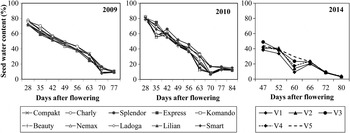
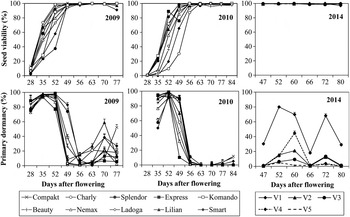
The water content of oilseed rape seeds harvested at different dates decreased continuously from approximately 80% at 28 d after flowering (DAF) to 9% when seeds were fully mature in 2009 and 2010 (Fig. 1). The decrease in seed water content ranged from 40% to 4% during the monitoring period of 2014. In 2009 and 2010, seed viability increased rapidly from nearly zero (28 DAF) to 100% (49 DAF) within 3 weeks, depending on variety, and remained at 100% until final harvest (Fig. 2). In 2014, seed viability was already 100% at the first harvest, and lasted until the final harvest. Embryo development was exemplarily documented by images taken of the variety Smart (supplementary Fig. S2); the embryo was green at the beginning of the study, and over time it lost chlorophyll and turned yellow.
Seed water content (%) during seed development of ten oilseed rape varieties (lines) in 2009 and 2010, and of five hybrid imidazolinone-tolerant oilseed rape varieties (V1−V5) in 2014; for harvest dates see supplementary Table S1.

Seed viability (%) and primary seed dormancy (%) during seed development of ten oilseed rape varieties (lines) in 2009 and 2010, and of five hybrid imidazolinone-tolerant oilseed rape varieties (V1−V5) in 2014; for harvest dates see supplementary Table S1; error bars indicate standard error of mean.

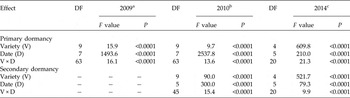
Variety, harvest date and their interaction had significant effects on both primary dormancy and secondary dormancy of oilseed rape (Table 1). Primary dormancy at the first harvest (28 DAF) in 2010 was not shown because of low seed viability (0.4%; Fig. 2). The primary dormancy values in viable seeds of ten line varieties were 73−89% at 28 DAF in 2009 and 50−95% at 35 DAF in 2010, depending on variety, peaking at 100% at 42 DAF, and decreased to zero in another 7−14 d (Fig. 2). Primary dormancy in varieties Compakt, Smart and Ladoga was still at 20−50% at the last harvest (c. 80 DAF) in 2009, but decreased to below 20% in 2010, similar to the other varieties. When seeds were fully viable (47 DAF) in 2014, primary dormancy was nearly zero for varieties V2−V5, was 30% for V1, and increased to the highest level at 52 or 60 DAF, followed by a non-linear decrease with time. At the final harvest in 2014, primary dormancy of varieties V2−V5 were nearly zero, but variety V1 still had 29% primary dormancy.
Analysis of variance for primary dormancy and secondary dormancy of oilseed rape in 2009, 2010 and 2014, as affected by variety (V), harvest date (D) and their interactions (V × D)

aTen line varieties of winter oilseed rape, eight harvest dates; not analysed: secondary dormancy in 2009.
bTen line varieties of winter oilseed rape, nine harvest dates; not analysed: primary dormancy at the first harvest because of low seed viability, secondary dormancy from the first harvest to the third harvest.
cFive hybrid imidazolinone-tolerant oilseed rape varieties, six harvest dates.
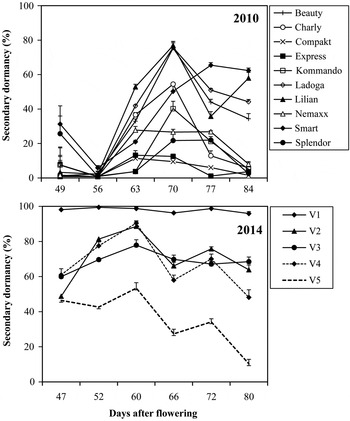
Secondary dormancy was initially low at 50−60 DAF (2010), reached a peak at about 70 DAF, depending on variety, and gradually decreased over time (Fig. 3). However, there were still four varieties that showed quite high secondary dormancy (>40%) at the last harvest in 2010. Particularly, secondary dormancy in variety Smart continued to increase from 31% at 49 DAF to 62% at 84 DAF, the highest dormancy among ten varieties at the final harvest. The levels of secondary dormancy tended to remain stable or to decrease slightly in the varieties V1, V2, V3 and V4 in the 2014 trial; V5 showed a clear decrease in secondary dormancy during that time.
Dynamics of secondary dormancy (%) during seed development of ten oilseed rape varieties (lines) in 2010, and of five hybrid imidazolinone-tolerant oilseed rape varieties (V1−V5) in 2014; for harvest dates see supplementary Table S1; error bars indicate standard error of mean.

As seed development progressed, the percentage values of both primary and secondary dormancy did not closely correlate with seed water content (data not shown), or with morphological seed development in general.
A significant correlation between primary dormancy and secondary dormancy was only found in the early stage of seed development (Table 2); correlation coefficients decreased from 0.58 at about 50 DAF to 0.09 at the final harvest in 2010, and deceased from 0.95 at 47 DAF to 0.69 at the final harvest in 2014. Both primary dormancy and secondary dormancy were not significantly correlated with cumulative precipitation and temperature during the harvest intervals (data not shown).
Correlation coefficients (r) between primary dormancy and secondary dormancy at different harvest dates during seed development of oilseed rape in the years 2010 (n = 10) and 2014 (n = 5); experimental station Ihinger Hof, south-west Germany; ten line varieties of winter oilseed rape in 2010 and five hybrid imidazolinone-tolerant oilseed rape varieties in 2014. DAF, days after flowering. For harvest dates see supplementary Table S1

*P < 0.05; ns, not significant.
Discussion
This study indicates that primary dormancy decreased and the disposition to secondary dormancy (induced dormancy) of oilseed rape increased during the two months before typical harvest (normally at the end of July at the experimental site), in agreement with the findings of Gulden et al. (Reference Gulden, Thomas and Shirtliffe2004a), Gruber and Claupein (Reference Gruber and Claupein2007b), and Haile and Shirtliffe (Reference Haile and Shirtliffe2014). However, a rapid decline in primary dormancy in as short a period as 1 week, as seen in the present study (42−49 DAF in 2009, and 49−56 DAF 2010; Fig. 2) – coinciding with a rapid increase in seed viability and with embryo colour change from green (49 DAF) to yellow (56 DAF; supplementary Fig. S2) – had not been demonstrated to date. This rapid reduction in primary dormancy was not observed in 2014, probably due to the observed high seed viability of about 100% at first harvest (47 DAF). The rapid increase of seed viability at early seed development is supposed to depend on a critical growing period of embryos, after which almost all the seeds have a capacity to germinate if primary dormancy can be broken (Holdsworth et al., Reference Holdsworth, Kurup and McKibbin1999, Reference Holdsworth, Lenton, Flintham, Gale, Kurup, McKibbin, Bailey, Larner and Russell2001). Based on the calculation of seed dormancy in the present study, all the dormant seeds were viable. Therefore, the observed high primary dormancy before the rapid decline at early seed development may be attributable to development of the embryos (Bewley, Reference Bewley1997; Haile and Shirtliffe, Reference Haile and Shirtliffe2014). This process is assumed to depend on variety: primary dormancy in six out of ten varieties decreased to below 10% at 49 DAF, and the other four varieties (Smart, Splendor, Komado and Beauty) needed another 7 d (56 DAF) to reach the same dormancy level (in 2009). Using the water content of the seeds as an indicator of seed development, there was no apparent difference in water decrease between the varieties, so this would not explain differences in dormancy. Thus, the levels and changes in dormancy do not seem to be linked directly to morphological and physiological ripening alone. However, there seems to be a critical stage of development at which primary dormancy starts to decline. This stage may depend somehow on embryo development.
Various studies have documented the regulation of onset and maintenance of primary dormancy in many crop species by ABA (Finkelstein et al., Reference Finkelstein, Tenbarge, Shumway and Crouch1985; Bewley, Reference Bewley1997; Gubler et al., Reference Gubler, Millar and Jacobsen2005; Nambara et al., Reference Nambara, Okamoto, Tatematsu, Yano, Seo and Kamiya2010). ABA content accumulated during seed development in oilseed rape, and reached its highest level at 35–40 DAF (Finkelstein et al., Reference Finkelstein, Tenbarge, Shumway and Crouch1985), coinciding with the second to third harvests in 2009 and 2010 in our study, then declined with seed development. The appearance of ABA peaks during seed development can be influenced by environmental conditions, such as rainfall, temperature and humidity, surrounding mother plants (King, Reference King1993; Romagosa et al., Reference Romagosa, Prada, Moralejo, Sopena, Muñoz, Casas, Swanston and Molina-Cano2001; Chono et al., Reference Chono, Honda, Shinoda, Kushiro, Kamiya, Nambara, Kawakami, Kaneko and Watanabe2006). This may explain observed differences in the onset of the decline of primary dormancy in seed development between years.
Dormancy variation, particularly for primary dormancy, between varieties in the late seed development might be attributed to the temporal effects of environmental conditions (e.g. precipitation). However, correlations of primary and secondary dormancy with cumulative temperature and precipitation the week before harvest were not significant (not shown). Harvest timing experiments conducted at different locations or under controlled conditions could probably offer more robust data for detecting this relationship.
Secondary dormancy of most varieties used in the current study increased after the immature seeds achieved full viability, consistent with the findings of Haile and Shirtliffe (Reference Haile and Shirtliffe2014), then decreased to different degrees (Fig. 3). In oilseed rape, there is consensus that secondary dormancy decreases with storage time post-harvest (Gulden et al., Reference Gulden, Thomas and Shirtliffe2004a), which is likely to be connected with the decline of secondary dormancy when seeds are still on the mother plants. With this in mind, this dormancy decline might be a continuous process in time, which starts before seed maturity and continues during seed storage. Also, the potential dynamics of secondary dormancy are dependent on the variety, as shown in Table 1 and Fig. 3. The importance of variety has been reported previously in European, Canadian and Chinese oilseed rape (Momoh et al., Reference Momoh, Zhou and Kristiansson2002; Gruber et al., Reference Gruber, Pekrun and Claupein2004, Reference Gruber, Emrich and Claupein2009; Gulden et al., Reference Gulden, Thomas and Shirtliffe2004a; Schatzki et al., Reference Schatzki, Allam, Kloeppel, Nagel, Börner and Möllers2013a, Reference Schatzki, Schoo, Ecke, Herrfurth, Feussner, Becker and Möllersb), but these studies focused mainly on the mature seeds. The present study indicates that genotypic differences in secondary dormancy are initially small, but become greater with seed development. This result may provide some clues to understanding the formation and maintenance of secondary dormancy, if differences in genetic background between varieties can be detected clearly enough.
Similar to primary dormancy, secondary dormancy in oilseed rape is also presumed to be associated with ABA (Gulden et al., Reference Gulden, Thomas and Shirtliffe2004b; Fei et al., Reference Fei, Tsang and Cutler2007, Reference Fei, Ferhatoglu, Tsang, Huang and Cutler2009). More ABA-inducible genes were up-regulated in mature seeds of a high-dormancy oilseed rape variety compared to a low-dormancy variety when treated with polyethylene glycol; twice as much ABA was detected in freshly harvested seeds of a high-dormancy variety (Fei et al., Reference Fei, Tsang and Cutler2007, Reference Fei, Ferhatoglu, Tsang, Huang and Cutler2009) and high-dormancy oilseed rape varieties seem to be more sensitive to ABA than low-dormancy varieties (Gulden et al., Reference Gulden, Thomas and Shirtliffe2004b). Despite the complex mechanisms involved in the dynamics of secondary dormancy, which are not yet completely understood, the results of this study indicate that harvest before full seed maturity might lead to high dormancy levels (mainly secondary dormancy) in the seeds, but accompanied by low harvest losses (Price et al., Reference Price, Hobson, Neale and Bruce1996). Also, there seems to be a certain degree of primary dormancy in mature seeds, which could lead to a soil seed bank even if there are no further dormancy-inducing conditions. In contrast, late harvest can result in low-dormancy seeds, but the harvest losses will be great (e.g. c. 5000 seeds m−2; Lutman et al., Reference Lutman, Berry, Payne, Simpson, Sweet, Champion, May, Wightman, Walker and Lainsbury2005). With the improvement of harvesting techniques and breeding (pod-shattering resistance), the latter option could become a more acceptable way to reduce volunteer problems in a crop rotation with oilseed rape. However, a problem would arise if, for example, hailstorms cracked unripe pods and fresh seeds dropped (e.g. more than 280 hailstorms were recorded in June and July 2014 across Germany; ESWD, 2014). These fresh seeds with high levels of primary dormancy could lead to seed survival in the soil without further inductive environmental conditions, and could be induced into secondary dormancy by environmental conditions such as dryness (Pekrun et al., Reference Pekrun, Lutman and Baeumer1997, Reference Pekrun, Hewitt and Lutman1998). Based on our results, seed dormancy (primary and secondary dormancy) is variety-dependent during late seed development; i.e. varieties with low dormancy represent a lower risk of a soil seed bank after hailstorms or after early harvest.
A significant correlation between primary dormancy and secondary dormancy at early stages of seed development in oilseed rape, as shown in the current study, could be used to predict roughly the level of secondary dormancy from a specific stage of development. Because of environmental effects, however, this prediction would be most useful for plants grown under controlled conditions, such as in a greenhouse. In a different plant, Arabidopsis thaliana, it was shown that the state of primary seed dormancy can affect secondary dormancy induction after harvest (Auge et al., Reference Auge, Blair, Burghardt, Coughlan, Edwards, Leverett and Donohue2015). In this case, secondary dormancy was more easily induced in seeds with higher primary dormancy than in seeds with low or no primary dormancy of the same A. thaliana variety that matured under a different maternal environment. This may also occur in oilseed rape during late seed development, based on the positive correlation between primary dormancy and secondary dormancy, but depends on the year and the variety.
Because both primary and secondary dormancy are present in immature seeds of oilseed rape, both timing and techniques of harvest should be reconsidered. Early harvest, for example windrowing before full maturity, may reduce harvest losses caused by pod shattering, but could lead to higher seed dormancy. Afterripening, which was not tested in this study, would further decrease dormancy. However, in the context of increasingly worldwide use of the combine harvester, harvest at full maturity or late harvest is preferred but could cause large harvest losses. Under this harvest scenario, selection of low-dormant oilseed rape varieties would be a simple and feasible strategy to reduce the risk of soil seed bank and volunteers in a crop rotation.
Supplementary material
To view supplementary material for this article, please visit http://dx.doi.org/10.1017/S0960258516000118
Acknowledgements
The authors would like to thank Andrea Rückle for excellent technical support, the staff of the experimental station Ihinger Hof for excellent field management, Dr Sebastian Munz, Jialu Xu and Kathleen Regan for their useful comments, and the China Scholarship Council (CSC) for their support.
Financial support
Financial support was provided by the German Federal Ministry of Education and Research (BMBF 0315211A) and China Scholarship Council (CSC 201206350064).
Conflicts of interest
None.