Introduction
Throughout the world, the pace of population aging is rapidly accelerating, especially in industrialized countries, due to low birth rate and prolongation of life expectancy (United Nations, 2009). The proportion of older people in South Korea aged 65 years and older was 11.0% in 2010, but projected to increase to 24.3% in 2030, higher than the Organization for Economic Cooperation (OECD) countries’ average of 22.8% (United Nations, 2009; Korean Statistical Information Service, 2012).
With the aging of the population, the prevalence of frailty is expected to increase markedly (Ahmed et al., Reference Ahmed, Mandel and Fain2007). Frailty is a multifactorial syndrome due to diminished metabolic reserves with increased difficulty in maintaining homeostasis and weakened resistance to stressors, leading to an increased risk of disability (Fried et al., Reference Fried2001; Hogan et al., Reference Hogan, MacKnight and Bergman2003). Frailty may occur as a consequence of a certain disease (Fried et al., Reference Fried2001; Rockwood et al., Reference Rockwood2004), but can be present even in the absence of known comorbid or life threatening conditions (Kanapuru and Ershler, Reference Kanapuru and Ershler2009). Frailty has also been shown to be a risk factor for falls, hospitalization, and mortality (Fried et al., Reference Fried2001).
The traditional frailty phenotype encompasses self-reported exhaustion, reduced physical activity, reduced grip strength, unintended weight loss, and slow walking speed (Fried et al., Reference Fried2001). However, it has been suggested that the current concept of frailty focusing on physical functioning needs to be expanded to include other aspects of health, such as cognitive function (Langlois et al., Reference Langlois, Vu, Kergoat, Chassé, Dupuis and Bherer2012).
Several studies have reported that frailty is associated with cognitive performance. Frailty has been demonstrated to be associated with low cognitive function and cognitive impairment (Fried et al., Reference Fried2001; Jacobs et al., Reference Jacobs, Cohen, Ein-Mor, Maaravi and Stessman2011; Macuco et al., Reference Macuco2012). Longitudinal studies have found significant association of frailty with cognitive decline (Buchman et al., Reference Buchman, Boyle, Wilson, Tang and Bennett2007; Samper-Ternent et al., Reference Samper-Ternent, Al Snih, Raji, Markides and Ottenbacher2008; Boyle et al., Reference Boyle, Buchman, Wilson, Leurgans and Bennett2010; Auyeung et al., Reference Auyeung, Lee, Kwok and Woo2011), mild cognitive impairment (Boyle et al., Reference Boyle, Buchman, Wilson, Leurgans and Bennett2010), and incident dementia and Alzheimer's disease (AD; Buchman et al., Reference Buchman, Boyle, Wilson, Tang and Bennett2007; Reference Buchman, Schneider, Leurgans and Bennett2008; Ávila-Funes et al., Reference Ávila-Funes2009). Among the subdomains of cognitive function, time orientation and memory, most sensitive in predicting dementia, have been reported to be significantly associated with frailty (Jacqmin-Gadda et al., Reference Jacqmin-Gadda, Fabrigoule, Commenges, Letenneur and Dartigues2000; Macuco et al., Reference Macuco2012).
Some researchers have considered cognitive impairment as a component of frailty (Rockwood et al., Reference Rockwood2004; Reference Rockwood2005). Frailty has been shown to better predict adverse outcomes, such as disability, mobility impairment, and hospitalization, once cognitive impairment has been taken into account (Ávila-Funes et al., Reference Ávila-Funes2009). But so far there is no general agreement about the best definition and standard to classify the frailty syndrome (Hogan et al., Reference Hogan, MacKnight and Bergman2003; Walston et al., Reference Walston2006; Abellan et al., Reference Abellan, Rolland, Houles, Gillette-Guyonnet, Soto and Vellas2010) and there is still controversy as to whether cognitive impairment is a symptom of frailty or a separate syndrome (Buchman et al., Reference Buchman, Schneider, Leurgans and Bennett2008).
The aim of this study was to evaluate association between frailty and cognitive function in a large national sample of older South Korean adults living in the community. It was hypothesized that the cognitively impaired group would be more frail than those who have normal cognition, and that cognitive subdomains of time orientation and memory would be significantly associated with increased frailty.
Methods
Study population
Data were from the year 2008 baseline survey of the Living Profiles of Older People Survey (LPOPS) comprising 15,146 elderly participants aged 60 years and older living in the community in South Korea. Details of the survey design are described elsewhere (Ministry of Health and Welfare, 2009). Briefly, using a multistage cluster sampling design, older residents were selected from households stratified by 25 metropolitan and provincial (urban and rural) regions with an overall response rate of 79.7%. Trained interviewers conducted the interview by visiting the participant's home after obtaining informed consents from the study participants. In the analysis, only those aged 65 years and older were included (n = 12,087). Excluding the participants due to missing values on height, weight, grip strength, and gait speed, the final analytical sample comprised 10,388 cases (4,294 men and 6,094 women).
Measurement
Frailty was defined using Fried's criteria, including unintentional weight loss, exhaustion, low grip strength, slow walking speed, and low physical activity (Fried et al., Reference Fried2001). Weight loss was defined as unintentional weight loss of more than 5 kg in the last six months. Exhaustion included self-reported fatigue or depressive symptoms. Low physical activity was defined as energy expenditure due to physical activity in the lowest quintile during last week. Slow walking speed was the slowest quintile for the 2.5-m-walk speed, adjusting for median of height by gender. Low grip strength was defined as in the lowest quintile, based on gender's body mass index (BMI).
Cognitive function was assessed using the Korean version of the Mini-Mental State Examination (MMSE-KC; Folstein et al., Reference Folstein, Folstein and McHugh1975; Lee et al., Reference Lee2002). Given the low education level of older South Korean adults, reading and writing a sentence items in the original MMSE have been replaced with asking reasons for washing clothes and ways to return a lost registration card that assess judgment in the MMSE-KC. Cognitive impairment was defined as more than 1.5 standard deviation (SD) below the age-, gender-, and education-specific mean scores. The MMSE subdomains comprised time orientation, spatial orientation, immediate recall, attention and calculation, delayed recall, naming, repetition, commands, construction, and perception. Each raw score was converted into Z scores.
Among the covariates socio-demographic variables included age (65–74 vs. ≥ 75 years), sex, marital status (presence of a spouse), years of education (<7 vs. ≥ 7 years), household income (in quartiles), and employment (currently working or not). Health behaviors included current smoking and alcohol drinking. BMI was measured by body weight divided by height squared (kg/m2) and categorized in three groups: <18 as underweight, 18 to 24.9 as normal, and ≥25 as overweight. Self-rated health was dichotomized as good (very good, good, average) and poor (poor and very poor). Depression was defined when diagnosed with depression by a physician or ≥8 on the short-form of the Geriatric Depression Scale. Disability was assessed using seven-item activities of daily living (ADL) and ten-item Instrumental ADL (IADL) scales, and defined as disabled when the participant reported limitations in performing specific activities without assistance (Lawton, Reference Lawton1969; Katz et al., Reference Katz, Downs, Cash and Grotz1970). Comorbidity was defined as the number of physician-diagnosed chronic conditions, including hypertension, stroke, hyperlipidemia, coronary heart disease, diabetes mellitus, arthritis, osteoporosis, back pain, fracture, pulmonary emphysema or chronic bronchitis, thyroid disease, liver disease, chronic renal failure, and cancer.
Statistical analysis
Analysis of variance and χ 2 tests were performed to examine differences in respondent characteristics among the non-frail, pre-frail, and frail subgroups. The association between cognitive impairment and frailty was examined using multinomial regression analysis, adjusting for socio-demographic factors, health behaviors, and health-related variables. To assess the association of frailty status with the MMSE total and subdomain scores, multinomial logistic regression analysis was conducted, controlling for all covariates. Because of differences in the prevalence of frailty and cognitive impairment between men and women, analyses were conducted stratified by gender. All analyses were performed taking into account complex sampling weights, using PASW Statistics 18.0 (SPSS Inc., Chicago, IL, USA).
Results
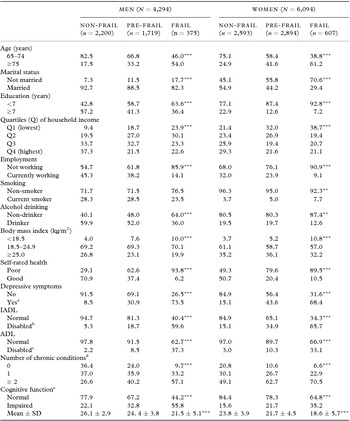
Overall, 9.3% of the respondents were frail, with 42.3% being pre-frail and 48.4% non-frail. The prevalence of frailty was higher in women (10.0%) than men (8.3%), with 37.1% of men and 46.0% of women being pre-frail and 54.7% of men and 43.9% of women being non-frail. In both men and women, those who were older, not married, less educated, having lower household income, and not currently working tended to have higher levels of frailty (Table 1). Those who were frail were also more likely to be non-drinkers of alcoholic beverages and underweight. With increased frailty, respondents tended to report poorer self-rated health, more depressive symptoms, more physical disability, and higher comorbidity. Mean scores of the MMSE-KC were the lowest among the frail in both men (21.5 ± 5.1) and women (18.6 ± 5.7), with 55.8% and 35.2% of the frail, respectively, being cognitively impaired.
Socio-demographic and health-related characteristics of respondents by frailty status (%)

Notes: a≥8 on the short form of the Geriatric Depression Scale.
bLimitations in the instrumental activities of daily living (IADL).
cLimitations in the activities of daily living (ADL).
dHypertension, stroke, hyperlipidemia, coronary heart disease, diabetes mellitus, arthritis, osteoporosis, back pain, fracture, pulmonary emphysema or chronic bronchitis, thyroid disease, liver disease, chronic renal failure, and cancer.
eKorean version of the Mini-Mental State Examination (MMSE-KC), with cognitively impaired defined as more than 1.5 standard deviation (SD) below the age-, gender-, and education-specific mean.
**p < 0.01, ***p < 0.001.
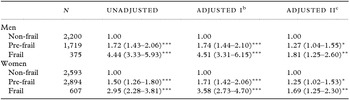
Cognitive impairment also demonstrated higher risk of frailty (Table 2). Men who were cognitively impaired, compared with those who were not, were more likely to be pre-frail (odds ratio (OR) = 1.72, 95% confidence interval (CI): 1.43–2.06) and frail (OR = 4.44, 95% CI: 3.33–5.93), respectively, than non-frail. The respective odds ratios for women were slightly lower than men but significant at 1.50 (95% CI: 1.26–1.80) for the pre-frail and 2.95 (95% CI: 2.28–3.81) for the frail group. Adjusting for all covariates, cognitive impairment was associated with a higher likelihood of being pre-frail (OR = 1.27, 95% CI: 1.04–1.55) and frail (OR = 1.81, 95% CI: 1.25–2.60), compared with being non-frail. Women also showed similar patterns, but exhibiting slightly lower odds ratios than in men.
Odds ratios (95% CI) of frailty status among older adults with cognitive impairmenta: multinomial logistic regression analysis

Notes: aMore than 1.5 standard deviation below the age-, gender-, and education-specific mean on the Mini-Mental State Examination (MMSE-KC).
bAdjusted for socio-demographic factors.
cAdditionally adjusted for health behaviors and health status.
*p < 0.05, **p < 0.01, ***p < 0.001.
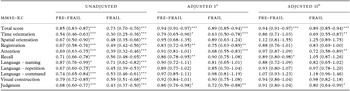
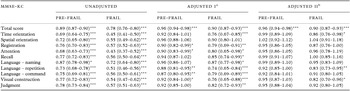
Tables 3 and 4 show frailty status regressed on the MMSE-KC components by gender. In the unadjusted model, all subdomain Z scores of the MMSE-KC were inversely associated with frailty risk. Overall, the odds ratios were slightly lower in men than in women. Among the subdomains of cognitive function, higher scores on time orientation, registration, attention, and judgment were associated with a lower likelihood of frailty in both men and women after adjusting for confounders. Whereas time orientation, registration, attention, recall, and judgment were significantly associated with a lower likelihood of frailty in men, in women all but spatial orientation maintained statistical significance. Following the adjustment for each of the other subdomains, time orientation remained significant in both genders. In addition, higher scores on attention, recall, and judgment in men, and higher scores on repetition and visual construction in women, were significantly associated with lower odds of frailty.
Association between frailty status and Mini-Mental State Examination (MMSE-KC) subdomains (Z scores) in men aged ≥65 years (n = 4,294): multinomial logistic regression analysis with odds ratio (95% CI)

Notes: Frailty status: Non-frail (n = 2,200, reference group), pre-frail (n = 1,719), frail (n = 375).
aAdjusted for socio-demographic factors, health behaviors, and health status.
bAdditionally adjusted for each of the other subdomains.
*p < 0.05, **p < 0.01, ***p < 0.001.
Association between frailty status and Mini-Mental State Examination (MMSE-KC) subdomains (Z scores) in women aged ≥65 years (n = 6,094): multinomial logistic regression analysis with odds ratio (95% CI)

Notes: Frailty status: Non-frail (n = 2,593, reference group), pre-frail (n = 2,894), frail (n = 607).
aAdjusted for socio-demographic factors, health behaviors, and health status.
bAdditionally adjusted for each of the other subdomains.
*p < 0.05, **p < 0.01, ***p < 0.001.
Discussion
The present study revealed that cognitive impairment and cognitive function assessed by the MMSE were associated with physical frailty. In this study, cognitive impairment, defined as SD > 1.5 below the adjusted mean score on the MMSE-KC, was associated with higher odds of pre-frail (OR = 1.27, 95% CI: 1.04–1.55 in men; OR = 1.25, 95% CI: 1.02–1.53 in women) and frail (OR = 1.81, 95% CI: 1.25–2.60 in men; OR = 1.69, 95% CI: 1.25–2.30 in women). The pattern of increased frailty among the cognitively impaired found in this study was comparable with previous studies. In a Jerusalem older cohort (Jacobs et al., Reference Jacobs, Cohen, Ein-Mor, Maaravi and Stessman2011), cognitive impairment (MMSE score 25–27 compared with MMSE score 28–30) was associated with higher odds of the pre-frail (OR = 1.01, 95% CI: 0.64–1.59) and frail (OR = 2.42, 95% CI: 1.03–5.72) than that of the non-frail, adjusting for covariates (sex, education, self-rated health, ADL disability, BMI, and chronic diseases). Further, MMSE ≤ 24 compared with MMSE = 25–27 was associated with a higher likelihood of pre-frail (OR = 1.23, 95% CI: 0.55–2.82) and frail (OR = 3.77, 95% CI: 1.42–9.99). Estimates obtained from the two studies, however, may differ due to differences in the study sample and definition used for cognitive impairment. Further, a more extensive adjustment of covariates, such as health behaviors, in the present analysis may have resulted in a relatively lower odds ratio estimate for those classified as frail.
In this study, cognitive function assessed by the MMSE total score was also significantly associated with frailty status in both men and women. In the Hispanic Established Populations Epidemiologic Studies of the Elderly (Ottenbacher et al., Reference Ottenbacher, Ostir, Peek, Snih, Raji and Markides2005), the baseline MMSE total score was significantly predictive of frailty at one-year follow-up in men (p = 0.05), but not in women (p = 0.09). The definition of frailty used in the study, however, used a modified Fried's index that included four of the five items of the original scale, lacking information on low levels of activity in its definition. This may have underestimated those classified as frail. In a Brazilian population-based study, older adults who were frail, compared with those not frail, according to the Fried's criteria were associated with significantly worse MMSE total scores (Macuco et al., Reference Macuco2012).
There were some gender differences in the strength of the association. Although there was a higher risk of frailty among the cognitively impaired men and women, slightly higher odds were observed in men than in women. In the unadjusted analysis for the MMSE total and subdomain scores on frailty, a stronger relationship was also found for men than for women. This is in line with two previous studies that have reported less strong association between cognitive function and frailty in women than in men (Ottenbacher et al., Reference Ottenbacher, Ostir, Peek, Snih, Raji and Markides2005; Auyeung et al., Reference Auyeung, Lee, Kwok and Woo2011). Differential effects of decline in sex hormones on cognition and frailty have been suggested as a possible reason (Auyeung et al., Reference Auyeung, Lee, Kwok and Woo2011).
Frailty appears to be associated with multiple domains of cognition. Among the subdomains of cognitive function, time orientation, registration, attention, and judgment were associated with a lower likelihood of frailty in both men and women after adjusting for confounders. A study on Brazilian elderly people also reported worse performance on time orientation, immediate memory, and repetition to be associated with a higher risk of frailty (Macuco et al., Reference Macuco2012). In the Rush Memory and Aging Project, physical frailty was associated with a faster cognitive decline in five domains of episodic memory, semantic memory, working memory, perceptual speed, and visuospatial ability (Boyle et al., Reference Boyle, Buchman, Wilson, Leurgans and Bennett2010). Physical frailty is a multidimensional construct and reflects muscle strength, gait speed, body composition, and fatigue. Consequently, the associations between physical frailty and cognitive domains may differ by components of frailty affected. Alternatively, there may be differential influence of frailty on cognition's subdimensions. According to earlier studies, time orientation and episodic memory were the most useful items of the MMSE instrument in distinguishing between normal persons and patients having dementia, and in predicting incident dementia (Small et al., Reference Small, Viitanen and Backman1997; Jacqmin-Gadda et al., Reference Jacqmin-Gadda, Fabrigoule, Commenges, Letenneur and Dartigues2000). It may be possible that specific cognitive subdomains, such as time orientation and memory, which are more sensitive to detect differences and changes in cognitive ability, have more discriminant power in the identification of frailty.
Moreover, this study found that frailty by MMSE subdomains exhibited gender differences. Whereas women showed significant associations between frailty and all subdomains except spatial orientation, in men, time orientation, registration (immediate memory), attention, recall (delayed memory), and judgment were found to be significantly associated with frailty. Controlling for each of the other subdomains, higher scores on attention, recall, and judgment in men and repetition and visual construction in women were further independently associated with a higher likelihood of frailty.
The significant relationship between frailty and cognitive function found in this study suggests that the two may share similar etiology and pathogenesis. Cognitive impairment has been reported to occur concurrently with frailty as well as to precede frailty and vice versa (Auyeung et al., Reference Auyeung, Lee, Kwok and Woo2011). Common mechanisms involving vascular risk factors, inflammation, decrease in sex hormones, energy production, and stress have been implicated in both frailty and dementia (Buchman et al., Reference Buchman, Boyle, Wilson, Tang and Bennett2007; Buchman et al., Reference Buchman, Schneider, Leurgans and Bennett2008; Auyeung et al., Reference Auyeung, Lee, Kwok and Woo2011; Jacobs et al., Reference Jacobs, Cohen, Ein-Mor, Maaravi and Stessman2011). Frailty might also be a prodromal sign of AD, with the accumulation of AD pathology found to be associated with higher levels of frailty (Buchman et al., Reference Buchman, Schneider, Leurgans and Bennett2008).
Our study has several limitations. First, the study was based on a cross-sectional design so that any causal inference is not warranted. Second, subdomain scores of the MMSE were used to assess different cognitive abilities, which may not represent all cognitive functions. Further, the MMSE is not able to differentiate mild impairment. Third, data on biomarkers, such as those for chronic inflammation that plays an important role in frailty and cognitive impairment, were not available for adjustment. In spite of these limitations, this is the first study to examine the association between cognitive impairment and frailty using a large national sample of community-dwelling older adults.
In conclusion, this study showed that a close link exists between the frailty phenotype and cognitive function in the older population. Either as a frailty syndrome or a precursor of cognitive decline, the simultaneous assessment of frailty and cognitive ability would be useful at the population level as well as in clinical settings. Assessment of cognitive function may help to better define and characterize frailty in older persons. This would be useful in predicting healthcare needs to provide appropriate services. A better understanding of the causal relationship between cognition and frailty, based on longitudinal studies, may help in developing effective interventions. Such information may contribute to an early detection of deterioration in not only cognitive ability but also in physical function that could delay the onset of adverse health outcomes. Further research is needed to investigate whether interventions aimed at improving cognitive function in the frail elderly and preserving physical function in the cognitively impaired are beneficial.
Conflict of interest
None.
Description of authors’ roles
E. S. Han designed the study, acquired the dataset, and wrote the paper. Y. Lee supervised the study design and statistical analysis and wrote the paper. J. Kim was responsible for carrying out the statistical analysis.
Acknowledgment
This study was supported by the Basic Science Research Program through the National Research Foundation of Korea (NRF), funded by the Ministry of Education, Science and Technology (2012R1A1B3002939).