Monitoring rectal temperature (RT) for 5–10 d after parturition has received remarkable attention because of its cost effectiveness (Smith et al. Reference Smith, Donovan, Risco, Littell, Young, Stanker and Elliott1998; Wenz et al. Reference Wenz, Moore and Kasimanickam2011) and has been incorporated as a routine diagnostic component into protocols for early post-partum cow management (Smith & Risco, Reference Smith and Risco2005). The normal body temperature (BT) in dairy cattle ranges from 38·6 to 39·5°C (Radostits et al. Reference Radostits, Arundel and Gay2000). Temperature thresholds of BT >39·2°C and >39·7°C (Smith et al. Reference Smith, Donovan, Risco, Littell, Young, Stanker and Elliott1998; Wenz et al. Reference Wenz, Moore and Kasimanickam2011) have been recommended to distinguish between healthy cows and cows suffering from an infectious disease.
Several studies demonstrated an effect of parity, days in milk (DIM), time of day, calving ease, season and post-partum diseases on RT (Kristula et al. Reference Kristula, Smith and Simeone2001; Smith & Risco, Reference Smith and Risco2005; Wagner et al. Reference Wagner, Schimek and Cheng2008). Furthermore, it is well known that BT is influenced by heat stress in cattle (Hahn, Reference Hahn1999; Kadzere et al. Reference Kadzere, Murphy, Silanikove and Maltz2002) and responds earlier than other parameters such as sweating or dry matter intake. Little information is available, however, on how heat stress affects BT in the early post-partum period (Wenz et al. Reference Wenz, Moore and Kasimanickam2011). In most studies investigating disease in the post-partum period RT was recorded once a day (Drillich et al. Reference Drillich, Beetz, Pfützner, Sabin, Sabin, Kutzer, Nattermann and Heuwieser2001; Wenz et al. Reference Wenz, Moore and Kasimanickam2011). Few studies, however, have measured RT (Wagner et al. Reference Wagner, Schimek and Cheng2008) or vaginal temperature (VT) (Vickers et al. Reference Vickers, Burfeind, von Keyserlingk, Veira, Weary and Heuwieser2010) more frequently. Overall, there is a dearth of information on how ambient temperature (AT) and relative humidity (RH) affect BT of cows in the early post-partum period considering parity, DIM and time of day. Elevated BT values, however, are an important component for plausible treatment decisions regarding antibiotic drugs alone or in combination with supportive therapy.
Therefore, the overall objective of the study was to evaluate the association of plausible factors with continuously measured BT of healthy cows in the first 10 DIM. Specifically we set out to study: 1) the effect of heat stress and other plausible factors such as parity, DIM, time of day, and month on BT of healthy post-partum cows during first 10 d after parturition and 2) the incidence rate for the occurrence of BT above ⩾39·5°C during the first 10 DIM during an experimental period of 3 months.
Materials and Methods
Cows and herd management
From May to July 2010 a prospective observational study on BT in early post-partum Holstein dairy cows was conducted on a commercial dairy farm in Sachsen-Anhalt, Germany (51°58′ N 11°28′ E). All experimental procedures reported herein were conducted with the approval of the Institutional Animal Care and Use Committee. The herd consisted of 1200 dairy cows with an average 305-d milk production of 10 124 kg (4·1% fat and 3·4% protein). Cows were managed according to the guidelines set by the International Cooperation on Harmonization of Technical Requirements for Registration of Veterinary Medicinal Products (Hellmann & Radeloff, Reference Hellmann and Radeloff2000).
The main barn was positioned in a NE–SW orientation with open ventilation and mechanical fans. All cows were housed indoor in a free-stall facility with slotted floors and cubicles equipped with rubber mats. Group composition was dynamic with cows entering and leaving the experiment depending on their calving dates. Early post-partum cows were fed a TMR consisting of 41·9% concentrate and mineral mix, 31·2% corn silage, 21·6% grass silage and 2·5% barley straw on a dry matter (DM) basis (NEL=7·03 MJ/kg DM) distributed with a conveyer belt system up to 10-times a day. Cows were milked 3-times a day (approximately at 6.00, 14.00 and 22.00).
Post-partum cow monitoring
Post-partum cow monitoring was performed by study personnel twice daily (7.00±1 and 17.00±1; DIM: 1–10) and consisted of measuring RT and scoring rumen fill as described previously (Burfeind et al. Reference Burfeind, von Keyserlingk, Weary, Veira and Heuwieser2010). Rectal temperatures were measured using a digital thermometer (VT 1831, Microlife AG, Widnau, Switzerland). The digital thermometer measured RT from +34°C to +42°C with an accuracy of ±0·1°C and a resolution of 0·1°C. To minimize bias, RT was measured with the same thermometer at the same insertion depth (i.e. 8 cm). Furthermore, on DIM 2, 5 and 10, vaginal discharge was observed and beta-hydroxybutyrate determined in whole blood with a hand-held meter as described previously (Iwersen et al. Reference Iwersen, Falkenberg, Voigtsberger, Forderung and Heuwieser2009). On DIM 2 and 10 body condition score (BCS) was determined on a scale from 1 to 5 (Edmonson et al. Reference Edmonson, Lean, Weaver, Farver and Webster1989).
Vaginal temperature was monitored with a microprocessor controlled temperature logger (Minilog 8, Vemco Ltd., Halifax, Canada) attached to a modified vaginal controlled internal drug release. Temperature loggers (size=92 mm×20 mm; weight=40·5 g) were inserted in the vaginal cavity for an 8-d period from days 2 to 10 after parturition and measured VT every 10 min. The temperature loggers measured VT from 0 to +42°C with an accuracy of ±0·3°C and a resolution of 0·2°C. This method was recently validated by our group (Vickers et al. Reference Vickers, Burfeind, von Keyserlingk, Veira, Weary and Heuwieser2010).
Ambient temperature and relative humidity
Ambient temperature and RH within the experimental barn were recorded every 30 min using two Tinytag Plus II loggers (Gemini loggers Ltd, Chichester, UK) that were secured at beams 3 m from the ground and 40 m apart. These loggers measured AT from −25 to +85°C with an accuracy of ±0·3°C and a resolution of 0·01°C and RH from 0 to 100% with an accuracy of ±3% and a resolution of 0·3%. Temperature humidity index (THI) was calculated according to the equation reported by Kendall et al. (Reference Kendall, Tucker, Dalley, Clark and Webster2008): THI=(1·8×AT+32)−[(0·55−0·0055×RH) ×(1·8×AT–26)].
Inclusion criteria
Dry cows within 3 weeks of calving were managed in a separate group and observed frequently for signs of imminent calving by farm employees. A total of 264 cows calved during the experimental period. Of those 82 cows met the following inclusion criteria and were included for analyses. Inclusion criteria were spontaneous calving (i.e. no assistance), delivery of a single live calf, shedding of the placenta within 12 h, serum beta-hydroxybutyrate concentration below 1·2 mmol/l on all of the three (i.e. DIM 2, 5 and 10) sample days (Rollin et al. Reference Rollin, Berghaus, Rapnicki, Godden and Overton2010) and no treatment (i.e. antibiotic or anti-inflammatory drugs, fluid therapy) during the observational period of 10 d.
Statistical analysis
Data from temperature and THI loggers were downloaded into Excel spread sheets (Office 2003, Microsoft Deutschland GmbH, Munich, Germany) and analysed using SPSS for Windows (Version 19.0, SPSS Inc., Munich, Germany). Vaginal temperature values ⩽37·9°C were considered artefacts due to confounding by AT after logger movements and excluded from analysis.
Hourly AT, RH, and THI means were produced averaging a total of 4 measurements (i.e. 2 from each THI logger) for each variable during the whole experiment. Hourly VT means for every individual cow were produced averaging 6 VT measurements.
The relationship of AT, RH, and THI on RT and VT was evaluated using Pearson's correlation. The difference and relationship between RT and VT was assessed using paired t test and Pearson's correlation. In a preliminary analysis over the period of 3 months the association between THI and BT (RT and VT) gradually increased. Therefore, month was used as an independent factor with a nominal scale (May=1, June=2, July=3). Difference of AT, RH and THI for 3 months for DIM 2–10 of each cow was analysed in repeated measure analysis ANOVA with mixed model procedure. The Bonferroni post-hoc adjustment was used for estimating the mean difference. Homogeneity of proportion of parturitions during the 3 months (May, June and July 2011) was evaluated with χ2 test. The biologically plausible factors such as parity, DIM, time of day, month of calving, THI, BCS and their potential interactions associated with VT and RT during the first 10 DIM and variables representing these factors were included and analysed with repeated measure ANOVA in a linear mixed model. The scaled identity structure was used, because it resulted in the model with the lowest Akaike information criterion value. Interaction terms α<0·05 were included in the model. Parity, DIM, month, time of day and potential interaction between these factors were included as fixed factors in the models. No effect of BCS was observed (P=0·531) and therefore it was excluded from the model. Experimental cows nested within month were included as a random effect in the models. Normality of RT and VT stratified by time of day, parity, DIM and month was evaluated using Levene's test. The Bonferroni post-hoc adjustment was used for estimating mean difference.
For the 3 different months, the percentage of hourly THI values above a threshold (i.e. ⩾72) and percentage of RT and hourly VT values above a threshold (i.e. ⩾39·5°C) were calculated and compared using χ2 test. These thresholds were selected because a BT of ⩾39·5°C is used to distinguish between healthy and diseased cows that require antibiotic treatment (Radostits et al. Reference Radostits, Arundel and Gay2000; Drillich et al. Reference Drillich, Beetz, Pfützner, Sabin, Sabin, Kutzer, Nattermann and Heuwieser2001; Zhou et al. Reference Zhou, Boucher, Dame, Moreira, Graham, Nantel, Zuidhof, Arfi, Flores, Neubauer and Olson2001) and a THI ⩾72 is indicative of heat stress (Hahn, Reference Hahn1999; Kadzere et al. Reference Kadzere, Murphy, Silanikove and Maltz2002). In standard fresh cow protocols RT is usually measured in the morning hours (6.00–10.00) and BT is reported to be greater in the evening (Vickers et al. Reference Vickers, Burfeind, von Keyserlingk, Veira, Weary and Heuwieser2010; Wenz et al. Reference Wenz, Moore and Kasimanickam2011). Therefore, the percentage of VT measures above the threshold (⩾39·5°C) was determined for a period 6.00–10.00, and for the remaining 20 h and compared for the 3 months using χ2 analysis. The percentage of RT values above the threshold level (⩾39·5°C) at 7.00±1 and 17.00±1 were calculated and compared using χ2 test.
Results
A total of 82 cows (26 primiparous, 56 multiparous; 31·1%) met the inclusion criteria and were enrolled in this prospective observational study. During May, June, and July 31 (7 primiparous, 24 multiparous; 37·8%), 29 (8 primiparous, 21 multiparous; 35·4%), and 22 cows (11 primiparous, 11 multiparous; 26·8%) were enrolled, respectively. The distribution of parturitions was homogeneous between the 3 months (P=0·1).
During the experiment, a total of 93 165 10-min VT observations were recorded. After exclusion of 190 observations (0·2%) due to erroneous (i.e. ⩽37·9°C) measurements 15 570 hourly VT means were calculated. In the course of the experiment 1636 RT measurements (7·00±1 and 17·00±1) and 8696 half-hourly observations of AT and RH were recorded. A total of 2175 hourly means of AT, RH and THI were calculated.
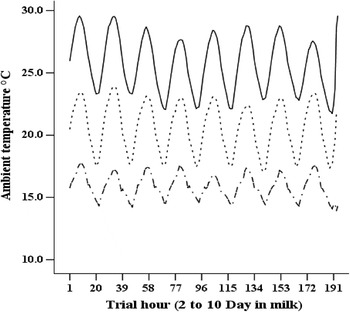
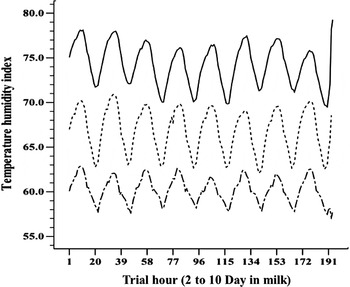
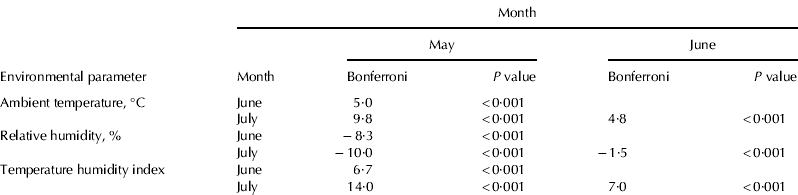
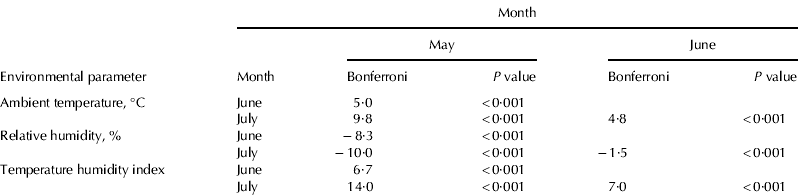
Within each of the 3 months, differences of daily AT (P<0·05; Fig. 1) and THI (P<0·05; Fig. 2) averages between days (i.e. DIM 2–10) were negligible. Considering the DIM 2–10 and cows calving in a given month, average AT and THI were greater (P<0·05; Table 1) in July (25·6±3·4°C; 74·2±4·3) compared with May (15·9±2·6°C and 60·1±5) and June (20·6±3·9°C; 66·8±5·6). During May, RH remained 8·3 and 10·0% greater than during June and July for the DIM 2–10 period, respectively (P<0·001; Table 1). The minimum and maximum AT was recorded at 6.00±2 and 18.00±2 (14·7±0·2°C and 17·2±0·1°C) during May, at 5.00±1 and 17.00±2 (17·7±0·2°C and 23·2±0·2°C) during June, and at 6.00±2 and 18.00±1 (22·7± 0·2°C and 28·5±0·2°C) during July (P<0·05). The minimum and maximum THI was recorded at 8.00±3 and 20.00±3 (58·4±0·3 and 62·3±0·3) during May, at 5.00±1 and 17.00±3 (63±0·3 and 70±0·3) during June, and at 5.00±1 and 19.00±2 (71±0·3 and 77±0·3) during July (P<0·05).
Hourly ambient temperature during the period 2–10 DIM of healthy, post-partum dairy cows in the experimental months (- – - – -) May, (- - - - - - - -) June and (——) July 2010.

Hourly temperature humidity index during the period 2–10 DIM of healthy, post-partum dairy cows in the experimental months (- – - – -) May, (- - - - - - - -) June and (——) July 2010.

Adjusted mean differences of ambient temperature, relative humidity and temperature humidity index between the 3 months of the experiment
Factors associated with vaginal temperature
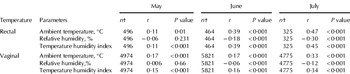
Rectal and vaginal temperature was associated with AT, RH and THI in the 3 experimental months (P<0·05; Table 2). The association of RT and VT with AT and THI respectively, was stronger during July compared with May and June (Table 2). Rectal and vaginal temperature had a negative association with RH during June and July (P<0·001) but no association was observed during May (P>0·05; Table 2). Pearson's correlation between RT and VT of healthy early post-partum cows during the 3-month study was 0·86 (n=1298 matched pairs; P<0·001). Vaginal temperature was 0·2±0·2°C greater than RT (P<0·001).
Association of rectal and vaginal temperatures of healthy, post-partum dairy cows with environmental parameters that calved in May, June or July

† Number of paired observations
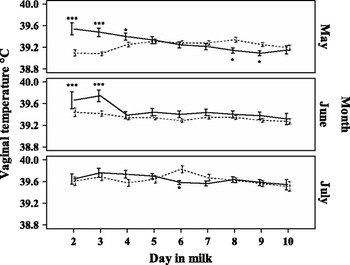
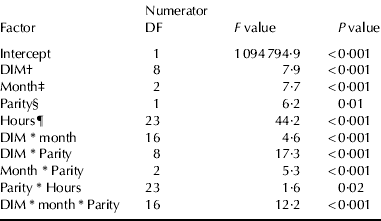
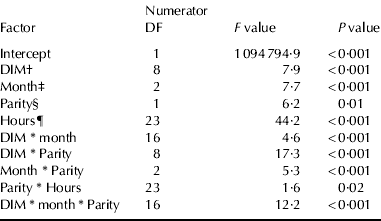
Parity, DIM, time of day and month had an effect on VT (P<0·001; Table 3). Parity, month and DIM demonstrated an interaction (P<0·001). During the period DIM 2–10, VT of primiparous cows was greater (0·2°C) than that of multiparous cows (P<0·001). Consequently, within month the effect of parity varied depending on DIM. During May and June, VT of primiparous cows was 0·2 to 0·4°C and 0·2 to 0·3°C greater for DIM 2–4 and DIM 2–3, respectively compared with multiparous cows (Fig. 3). During July, VT was similar for primiparous and multiparous cows. Stratifying by DIM, mean VT of primiparous cows was 0·2–0·3°C greater than that of multiparous cows during the first 5 DIM (P<0·05). It remained similar, however, for DIM 6–10 (P>0·05).
Vaginal temperature (mean±sd) of healthy (——) primiparous and (- - - - - - - -) multiparous dairy cows during May, June and July of the experimental period. Vaginal temperature of primiparous and multiparous cows differed * P<0·05, ***P<0·001.

Fixed and interactive effects, degree of freedom and F value of the final model to identify effects associated with vaginal temperature of 82 healthy, early post-partum dairy cows
† Days in milk
‡ Month of calving (May, June and July 2010)
§ Primiparous and multiparous
¶ Time of day
Parity and time of day demonstrated an interaction (P=0·02); however, variation in VT over time of day was negligible. Therefore, diurnal body temperature rhythm was evaluated without stratifying parity. A diurnal body temperature rhythm was evident during DIM 2–10 for all cows that calved during May, June or July. The minimum VT during May, June and July occurred around 10·00±3 (39·1±0·04°C), 9·00±2 (39·2±0·03°C) and 10·00±2 (39·4±0·03°C), respectively (P<0·001). The maximum VT during May, June and July occurred around 21·00±2 (39·4±0·04°C), 18·00±2 (39·5±0·03°C) and 19·00±2 (39·9±0·03°C) respectively, (P<0·001). Mean VT amplitude was greater in July (0·7°C) compared with June (0·4°C) and May (0·3°C).
Factors associated with rectal temperature
Similarly to VT, plausible factors such as parity (P=0·007), DIM (P=0·001), time of day (P<0·001), and month (P<0·001) affected RT. There was no interaction of parity with DIM (P=0·86), time of day (P=0·77) or month (P=0·06). Primiparous cows had 0·1°C greater temperature than multiparous cows. Within month the effect of parity differed depending on DIM (P=0·006). During May primiparous cows demonstrated 0·1–0·3°C greater RT for DIM 1–3 (P<0·05); however, during June and July no difference was observed for parity during the first 10 DIM. Rectal temperature measured at 17·00±1 was 0·2°C greater than RT measured at 7·00±1.
Percentage of measurements above the thresholds for THI (⩾72) and body temperature (⩾39·5°C)
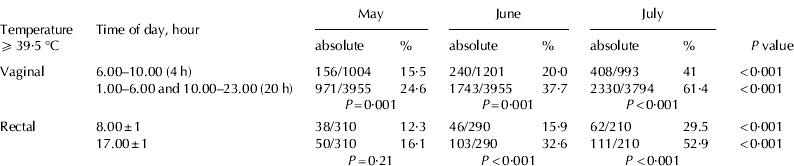
The percentage of hourly THI values above the threshold (⩾72) was greater during July (n=3368; 73·6%) compared with May (0%) and June (n=1208; 26·4%; P<0·001). The percentage of hourly VT values above the threshold (⩾39·5°C) was also greater in July (n=2738; 46·8%) compared with May (n=1127; 19·3%) and June (n=1983; 33·9%; P <0·05; Table 4). During the morning hours (6.00–10.00) the percentage of VT measurements above the threshold ⩾39·5°C was greater in July compared with May and June (P=0·001; Table 4). Furthermore, the percentage of hourly VT values above threshold ⩾39·5°C was lower during the period 6.00–10.00 compared with the remaining 20-h period during all 3 experimental months (P<0·05; Table 4). Similarly to VT, the percentage of hourly RT values above threshold ⩾39·5°C was greater at 17·00±1 than 7·00±1 for cows that completed their 8-d observational period in June and July (P<0·05; Table 4) whereas, in May the percentage of RT measures above ⩾39·5°C were similar (P=0·21; Table 4).
Distribution of vaginal and rectal temperature measures above a ⩾39·5°C threshold considering the three months of the experiment
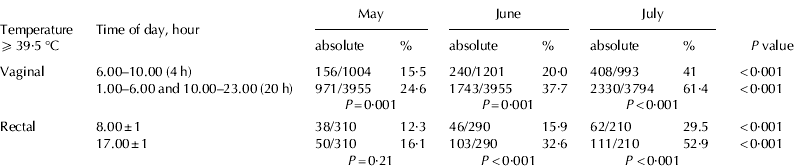
Fifty-five per cent (17/31) of the cows that calved during May had at least one RT above the threshold ⩾39·5°C considering two measurements a day (7.00±1 and 17.00±1) whereas 82% (24/29) and 95% (21/22) of the cows that calved during June and July, respectively, had at least one RT above the threshold ⩾39·5°C. Analysing only the morning measurements (7·00±1) in May, June and July 42% (13/31), 59% (17/29) and 77% (17/22) of cows that calved in the respective month had at least one RT above the threshold ⩾39·5°C.
Discussion
There is strong science-based evidence that BT is a useful and sensitive parameter to study the reactions of animals to physiological functions (e.g. nutrition, lactation and reproduction), environmental challenges and disease processes (Nakamura et al. Reference Nakamura, Araki, Clarke and Kam1983). In cattle, monitoring BT has been used for predicting physiological events such as oestrus (Suthar et al. Reference Suthar, Burfeind, Patel, Dhami and Heuwieser2011a), parturition (Aoki et al. Reference Aoki, Kimura and Suzuki2005), adaptive responses to heat stress (Hahn, Reference Hahn1999; Kadzere et al. Reference Kadzere, Murphy, Silanikove and Maltz2002) and for the diagnosis of infectious disease processes (Radostits et al. Reference Radostits, Arundel and Gay2000). In the last decade the importance of monitoring animal health as a key component for productivity and fertility has been widely accepted (Smith et al. Reference Smith, Donovan, Risco, Littell, Young, Stanker and Elliott1998; Smith & Risco, Reference Smith and Risco2005; Benzaquen et al. Reference Benzaquen, Risco, Archbald, Melendez, Thatcher and Thatcher2007). Measuring RT during DIM 5–10 after calving has received attention in the past because of ease of implementation and low cost (Kristula et al. Reference Kristula, Smith and Simeone2001) and has been incorporated into standard operating protocols for early post-partum cow management and disease intervention. Several studies demonstrating the efficacy of antibiotic treatment of post-partum metritis used RT thresholds as inclusion criteria (Drillich et al. Reference Drillich, Beetz, Pfützner, Sabin, Sabin, Kutzer, Nattermann and Heuwieser2001; Zhou et al. Reference Zhou, Boucher, Dame, Moreira, Graham, Nantel, Zuidhof, Arfi, Flores, Neubauer and Olson2001). Among researchers and veterinarians, there is agreement that monitoring RT during this critical period is a successful tool for the management of diseases (Smith & Risco, Reference Smith and Risco2005). Most authors define fever as a RT exceeding a predefined threshold and consider a single instance of a temperature above the threshold value as an indication of illness. Threshold values of >39·2°C (Smith et al. Reference Smith, Donovan, Risco, Littell, Young, Stanker and Elliott1998), >39·5°C (Chenault et al. Reference Chenault, McAllister, Chester, Dame, Kausche and Robb2004; Drillich et al. Reference Drillich, Beetz, Pfützner, Sabin, Sabin, Kutzer, Nattermann and Heuwieser2001) and >39·7°C (Overton et al. Reference Overton, Sischo and Reynolds2003) were utilized to distinguish between healthy cows and cows suffering from an infectious disease. Furthermore, it has been demonstrated that RT values can be influenced by multiple factors (e.g. intra-observer variability, penetration depth, thermometer; Burfeind et al. Reference Burfeind, von Keyserlingk, Weary, Veira and Heuwieser2010). Evidence is also available which suggest that BT is influenced by heat stress during different stages of lactation (Hahn, Reference Hahn1999; Kadzere et al. Reference Kadzere, Murphy, Silanikove and Maltz2002; Mader et al. Reference Mader, Davis and Brown-Brandl2006). There is a dearth of information, however, on how heat stress in combination with other plausible factors affects BT of early post-partum cows, which is the period in which they are most susceptible to disease.
The coefficient of correlation between RT and VT in this study was greater than in previous studies conducted with peak-lactation (0·46), healthy post-partum (0·81), pregnant (0·84) and sick post-partum (0·76) cows (Bewley et al. Reference Bewley, Einstein, Grott and Schutz2008; Vickers et al. Reference Vickers, Burfeind, von Keyserlingk, Veira, Weary and Heuwieser2010; Suthar et al. Reference Suthar, Burfeind, Patel, Dhami and Heuwieser2011b).
An association between parity and BT (RT and VT) was identified with primiparous cows having a greater BT than multiparous cows. This association was found to be influenced by DIM. Stratified by DIM the average VT (0·2–0·4°C) during the first 5 DIM and RT (0·1–0·3°C) during first 3 DIM was greater for primiparous than for multiparous cows. These results are in accordance with those of Wenz et al. (Reference Wenz, Moore and Kasimanickam2011) who reported that primiparous cows had 0·1–0·2°C greater RT v. multiparous cows during the first 5 DIM (P=0·004). Bewley et al. (Reference Bewley, Einstein, Grott and Schutz2008) identified an association between RT and parity (P=0·0052); however, they did not report the difference observed between primiparous and multiparous cows. In contrast, Kristula et al. (Reference Kristula, Smith and Simeone2001) did not identify a parity-dependent difference in RT. Interestingly, BT (VT and RT) of early post-partum cows during July was not influenced by parity in our study. Kristula et al. (Reference Kristula, Smith and Simeone2001) and Wenz et al. (Reference Wenz, Moore and Kasimanickam2011) reported an effect of parity on RT but no effect of an interaction between parity and month.
Average BT of multiparous cows during May and June was 39·2±0·01°C and 39·3±0·01°C. These findings are consistent with those of Vickers et al. (Reference Vickers, Burfeind, von Keyserlingk, Veira, Weary and Heuwieser2010) who reported a slightly lower VT (39·1±0·001°C) for moderate climatic conditions (THI=49·0) for the identical time post partum. Interestingly, in our study cows that calved during July experienced greater VT than cows that calved during May and June. This observation supports an earlier report (Wenz et al. Reference Wenz, Moore and Kasimanickam2011) that described greater RT (0·1°C) for healthy early post-partum cows that calved physiologically during July compared with June.
There is evidence that BT of heifers, peak-lactation and pregnant cows is influenced by time of day resulting in a BT rhythm (Brown-Brandl et al. Reference Brown-Brandl, Nienaber, Eigenberg, Hahn and Freetly2003; Kendall et al. Reference Kendall, Nielsen, Webster, Verkerk, Littlejohn and Matthews2006; Kendall & Webster, Reference Kendall and Webster2009). Similarly, the present study demonstrated that BT of early post-partum cows is influenced by time of day. Body temperatures of early post-partum cows were low in the morning and reached a maximum in the evening regardless of the month. Several factors have been shown to influence the time of the daily maximum and minimum temperature values such as ambient conditions, housing, milking and season (Brown-Brandl et al. Reference Brown-Brandl, Nienaber, Eigenberg, Hahn and Freetly2003; Kendall et al. Reference Kendall, Nielsen, Webster, Verkerk, Littlejohn and Matthews2006; Kendall et al. Reference Kendall, Tucker, Dalley, Clark and Webster2008; Kendall & Webster, Reference Kendall and Webster2009).
There is also evidence that the increased amplitude of the BT rhythm and the decreased time lag between BT and THI provide an understanding of regulation of the thermoregulatory mechanism during periods of heat stress (Hahn, Reference Hahn1999; Brown-Brandl et al. Reference Brown-Brandl, Nienaber, Eigenberg, Hahn and Freetly2003). During the course of this study healthy early post-partum cows demonstrated a diurnal rhythm of BT with an approximate time lag of 1–2 h compared with THI. This time lag is in agreement with previous findings (Kendall et al. Reference Kendall, Nielsen, Webster, Verkerk, Littlejohn and Matthews2006) for pregnant Holstein Friesian dairy cows. Our 1–2 h time lag is, however, lower than that described in studies conducted in tropical climates or in a controlled environment chamber (Brown-Brandl et al. Reference Brown-Brandl, Nienaber, Eigenberg, Hahn and Freetly2003; Aoki et al. Reference Aoki, Kimura and Suzuki2005). These authors reported a time lag of 3–5 h between core BT and AT. While one study showed a decrease in the time lag during periods of heat stress (Brown-Brandl et al. Reference Brown-Brandl, Nienaber, Eigenberg, Hahn and Freetly2003) our data demonstrated a consistent time lag for 2–10 DIM for all 3 months despite differences in average THI. Furthermore, Brown-Brandl et al. (Reference Brown-Brandl, Nienaber, Eigenberg, Hahn and Freetly2003) reported that time of day and AT had an effect on the amplitude of the BT rhythm. Our data also indicated a greater amplitude of BT in cows that had calved during July (0·7°C VT; 25·6±3·4°C AT; 74·2±4·3 THI) compared with cows that calved during May (0·3°C VT; 15·9±2·6°C AT and 60·1±5 THI) and June (0·4°C VT; 20·6±3·9°C AT; 66·8±5·6 THI).
Daily evaluation of RT is a common component of monitoring protocols designed to facilitate early identification and management of post-partum complications in dairy cows (Smith & Risco, Reference Smith and Risco2005). Rectal temperature, however, is not always an accurate indicator of infection (Palenik et al. Reference Palenik, Dolezel, Kratochvil, Cech, Zajic, Jan and Vyskocil2009) and a notable frequency of type I (fever when the animal is actually healthy) and type II (no fever when the animal is actually sick) errors has been reported (Kristula et al. Reference Kristula, Smith and Simeone2001; Wagner et al. Reference Wagner, Schimek and Cheng2008). While the reference range of BT for cattle is consistently reported to be 38·6±0·5°C (Radostits et al. Reference Radostits, Arundel and Gay2000) or 38·7±0·8°C (Wenz et al. Reference Wenz, Moore and Kasimanickam2011) the threshold of RT utilized to distinguish diseased from healthy post-partum cows varies considerably from >39·2°C (Smith et al. Reference Smith, Donovan, Risco, Littell, Young, Stanker and Elliott1998) to >39·5°C (Drillich et al. Reference Drillich, Beetz, Pfützner, Sabin, Sabin, Kutzer, Nattermann and Heuwieser2001; Chenault et al. Reference Chenault, McAllister, Chester, Dame, Kausche and Robb2004) and >39·7°C (Overton et al. Reference Overton, Sischo and Reynolds2003). All cows enrolled in our study did not have any risk factors for post-partum diseases (spontaneous calving, delivery of a single live calf, shedding of the placenta within 12 h) as described by Dubuc et al. (Reference Dubuc, Duffield, Leslie, Walton and LeBlanc2011), were clinically healthy and did not show any signs of infectious disease processes. The goal of a practical post-partum monitoring protocol is to timely identify diseased cows with the lowest frequency of errors possible. Our data clearly show that such an approach cannot be based on a single measurement of BT exceeding a generic threshold. Future research is warranted to develop threshold scenarios including AT and time of measurement to more accurately identify cows really requiring antibiotic treatment and to reduce the frequency of type I errors.
It remains to be determined whether more frequent measurements might help to reduce the considerable prevalence of type I (66%) and type II (21%) errors that were reported in studies measuring RT only once a day (Kristula et al. Reference Kristula, Smith and Simeone2001; Wagner et al. Reference Wagner, Schimek and Cheng2008).
On the other hand it has been recorded that over half of cows with metritis did not show fever during the first week post partum (Benzaquen et al. Reference Benzaquen, Risco, Archbald, Melendez, Thatcher and Thatcher2007). As stated previously (Sheldon & Dobson, Reference Sheldon and Dobson2004; Sheldon et al. Reference Sheldon, Rycroft and Zhou2004; Sheldon et al. Reference Sheldon, Lewis, LeBlanc and Gilbert2006) pyrexia is not consistently associated with puerperal metritis even though it correlates with the presence of uterine pathogens and the fact that febrile animals have higher concentrations of acute phase proteins. Moreover, it has been postulated that the occurrence of fever is irregular and the measurements of BT conducted once a day for 10 d post partum does not represent a sufficiently accurate diagnostic approach for puerperal metritis, but might be a useful indicator for the assessment of the severity of the disease (Palenik et al. Reference Palenik, Dolezel, Kratochvil, Cech, Zajic, Jan and Vyskocil2009).
Conclusions
In conclusion, BT of healthy dairy cattle during the first 10-d post-partum period is greater compared with the reference range reported and affected by parity, time of day, THI and their interaction. Primiparous cows have greater BT during the first 5 DIM than multiparous cows and the difference is affected by THI. When the association between BT and THI increased the reliability of a threshold level of BT decreased. Further research is warranted to establish more specific thresholds considering acute phase protein levels, diseased cows and THI.
The authors gratefully acknowledge the cooperation with the owners, the herdswoman and the staff of the farm. We should also like to acknowledge Prof. Dr J. S. Patel, Department of Agricultural Statistics, B. A. College of Agriculture, Anand Agricultural University, Anand-388110 (GUJARAT) India, who helped us in analysing data. This project was funded by Pfizer Animal Health, Veterinary Medicine Research and Development, UK and by Tiergyn Berlin e.V. We also acknowledge the financial support given to Vishal Suthar by the European Commission under Erasmus Mundus External Cooperation Window Lot 15 for conducting this work as part of his PhD dissertation.