Background
The increase in life expectancy worldwide can be viewed as the biggest accomplishment of the 20th century, yet now presents the greatest challenges of modern-day society (Prince et al. Reference Prince, Wu, Guo, Robledo, O'Donnell, Sullivan and Yusuf2015; Thompson Reference Thompson2015). In high-income countries, the proportion of the population aged 65 years and older has doubled, and as fertility continues to fall, with life expectancy set to increase, this is a trend set to continue (Prince et al. Reference Prince, Wu, Guo, Robledo, O'Donnell, Sullivan and Yusuf2015). Globally, half the burden of disease in high-income countries arises in older people, the impact of which is vast. For example, in the United Kingdom (UK), 15 million people have a long-term health condition 58 per cent of whom are aged 60 years and over (Department of Health 2012), accounting for £9.3 billion, 70 per cent of the whole health and social care budget (Wittenberg et al. Reference Wittenberg, Hu, Comas-Herrera and Fernandez2012).
The increased demand alongside the reduction of social care funding has subsequently meant that the ageing populations are more than ever dependent on informal care (Beesley Reference Beesley2006). The term ‘informal care’ refers to someone who ‘spends a significant proportion of their life providing unpaid support to family or potentially friends. This could be caring for a relative, partner or friend who is ill, frail, disabled or has mental health or substance misuse problems’ (Department of Health, 2008,19). Historically the distinction between ‘informal care’ and ‘formal care’ was financial remuneration (Van Houtven and Norton Reference Van Houtven and Norton2004). However, in the UK it is not uncommon for informal carers to receive some financial recompense through direct payments (Beesley Reference Beesley2006). In this paper, we focus on ‘informal care’ in the context of the transaction of care to a family member regardless of whether payment is or is not being received. Similarly, we will refer here to ‘informal carers’ as ‘family care-givers’ to encapsulate those who provide care to another family member within a non-professional capacity
In the UK, informal care remains the most important source of care for elderly people (Pickard et al. Reference Pickard, Wittenberg, Comas-Herrera, Davies and Darton2000), with around one in five households cited to contain a carer (Maher and Green Reference Maher and Green2002). Currently, there are in excess of 5.8 million people providing unpaid care in England and Wales, which represents over 10 per cent of the national population (Office for National Statistics 2013). Moreover, there is an increase in older people who are providing informal care. Older care-givers not only are shown to spend more time on care-giving compared to their younger counterparts (Dahlberg, Demack and Bambra Reference Dahlberg, Demack and Bambra2007), but the amount of care has increased, with more than half shown to provide at least 50 hours of care a week (Doran, Drever and Whitehead Reference Doran, Drever and Whitehead2003). Older care-givers are also exposed to having poorer health, e.g. over one-quarter of all older people who provided informal care asked about their health rated their health as ‘not good’ (Doran, Drever and Whitehead Reference Doran, Drever and Whitehead2003). This highlights not only the increased demand of informal care but the increased burden that is being put on to existing vulnerable population groups such as the frail elderly, who very often have poor health of their own (Dahlberg, Demack and Bambra Reference Dahlberg, Demack and Bambra2007).
The delivery of informal care has been negatively linked to access to formal care (Pickard et al. Reference Pickard, Wittenberg, Comas-Herrera, Davies and Darton2000), where often patients do not receive appropriate access to the right services they need. The burden on ‘informal carers’ should also be acknowledged, with family carers more likely to experience isolation, psychological distress, depression and loss of self-esteem often linked to poor lifestyle behaviours (Hoffman and Rodrigues Reference Hoffman and Rodrigues2010; Jones and Peters Reference Jones and Peters1992; Livingston, Manela and Katona Reference Livingston, Manela and Katona1996; Pinquart and Sörensen Reference Pinquart and Sörensen2007). Thus, the continued pressure placed on family care-givers coupled with the economic demands have created the need for a more innovative and sustainable approach to support both carers and the patients to not only improve quality of life but to reduce whole-life health and care costs (Doran, Drever and Whitehead Reference Doran, Drever and Whitehead2003; Pickard et al. Reference Pickard, Wittenberg, Comas-Herrera, Davies and Darton2000).
Assistive technology is well placed to meet this need, through the provision of remote technologies to enable older people to live more safely and independently in their own home for longer (Botsis et al. Reference Botsis, Demiris, Pedersen and Hartvigsen2008). Assistive telecare (AT) devices have a well-documented impact on family care-givers and offer family care-givers high-quality reassurance for their relative (Department of Health 2009) which consequently provides great relief and peace of mind (Carretero, Centeno and Stewart Reference Carretero, Centeno and Stewart2013). These technologies also serve to enable family care-givers to care more effectively and can place less demand for caring responsibilities (Magnusson, Hanson and Nolan Reference Magnusson, Hanson and Nolan2005). In turn, this can enable family care-givers to have increased independence, with the opportunity to hold secure full-time employment where needed, and to have more active social lives with more time for themselves and their family (Cahill et al. Reference Cahill, Begley, Faulkner and Hagen2007; Carretero, Centeno and Stewart Reference Carretero, Centeno and Stewart2013).
Assistive technology can be used to serve two purposes; firstly, to improve independence and wellbeing of the care recipient, but also to support the family care-giver through improved wellbeing and reduced care-giver burden (Topo Reference Topo2009). This sometimes competing interest has presented conflicting needs of use particularly when the care recipient is not aware of their needs (Topo et al. Reference Topo, Saarikalle, Begley, Cahill, Holthe and Macijauskiene2007). This becomes more complex when the family care-giver is the active technology user with often no active involvement expected from the care recipient, particularly common when the patient has cognitive decline (Topo Reference Topo2009). Therefore, it is not unusual for the family carer to make the decision on behalf of the care recipient to seek referral and ultimately use AT devices (May et al. Reference May, Finch, Cornford, Exley, Gately, Kirk, Jenkings, Osbourne, Robinson and Rogers2011; NHS 2010; Sugarhood et al. Reference Sugarhood, Wherton, Procter, Hinder and Greenhalgh2014).
The barriers and facilitators that impact on adoption of AT technology from the perspectives of health-care professionals and patients are well documented (Cook et al. Reference Cook, Randhawa, Sharp, Ali, Guppy, Barton, Bateman and Crawford-White2016; Nicholson et al. Reference Nicholson, Coates, Mountain and Hawley2013; Sanders et al. Reference Sanders, Rogers, Bowen, Bower, Hirani, Cartwright, Fitzpatrick, Knapp, Barlow, Hendy, Chrysanthaki, Bardsley and Newman2012). However, less is known about adoption from the perspectives of family care-givers. Research that has drawn on care-giver perspectives of assistive technologies is focused on carers of children with physical and cognitive disabilities (Mortenson et al. Reference Mortenson, Demers, Fuhrer, Jutai, Lenker and DeRuyter2012; Nicolson, Moir and Millsteed Reference Nicolson, Moir and Millsteed2012) alongside people with dementia (Rosenberg, Kottorp and Nygård Reference Rosenberg, Kottorp and Nygård2012; Topo Reference Topo2009), with less known across the wider older population. Nevertheless, research that has been conducted has revealed that informal carers have an overall positive attitude and readiness towards technology which is ultimately driven by perceived need (Demiris et al. Reference Demiris, Rantz, Aud, Marek, Tyrer, Skubic and Hussam2004; Rosenberg, Kottorp and Nygård Reference Rosenberg, Kottorp and Nygård2012). It is also suggested that there are large misconceptions about assistive technology, with variable levels of support for using such devices (Cardon, Wilcox and Campbell Reference Cardon, Wilcox and Campbell2011).
AT technologies aim to improve health and social outcomes not only for older patients but for their supporting family care-givers, yet uptake remains relatively low. There is a dearth of research that has explored the factors that impact on the decision to engage with such devices and services from the perspectives of family care-givers, particularly in relation to the general older population who receive informal care. This paper addresses this gap, and uncovers views of family care-givers of patients who used AT devices provided by the Assistive Telehealth and Telecare (ATT) service, delivered by Cambridge Community Services (CCS) NHS Trust. This research will add to the wider debate on what factors impact the decision to use AT devices, drawing on the perspectives of family care-givers.
Setting
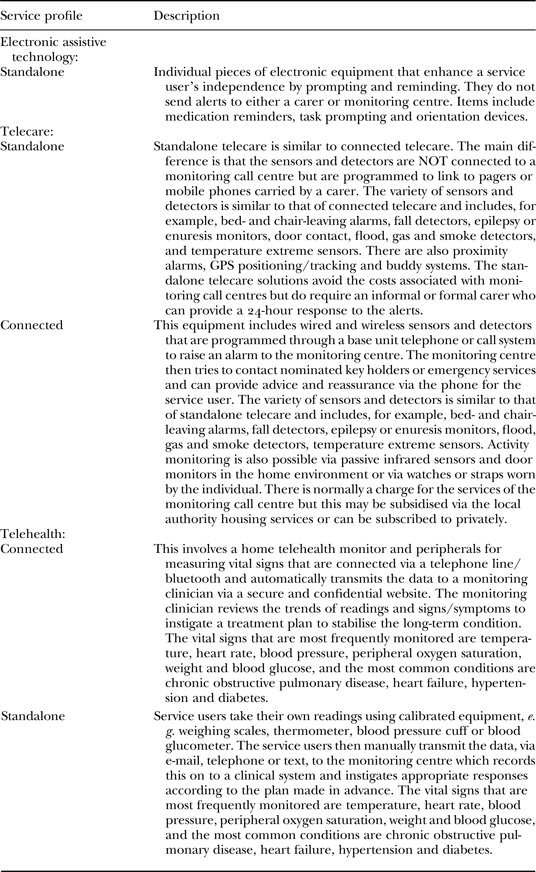
This research focuses on the ATT service which provides a range of AT devices to support patients and their carers to address challenges to everyday living and enhance their independence. The equipment provided by the ATT service ranges from the simplest automated pill reminder to the more sophisticated Activity Data Monitoring systems. The technological devices are not meant as a solution on their own but are a tool to supplement and support other services provided by professionals alongside formal and informal care-givers. This service operates five service profiles: (a) ‘standalone’, (b) ‘telecare connected’, (c) ‘telecare standalone’, (d) ‘telehealth connected’ and (e) ‘telehealth standalone’. Table 1 provides a breakdown of all the service profiles that the ATT service provides with a description of the devices which are provided.
Cambridge Community Services NHS Trust Assistive Telehealth and Telecare service profiles

Source: Cook et al. (Reference Cook, Randhawa, Sharp, Ali, Guppy, Barton, Bateman and Crawford-White2016).
Methodology
Family care-givers were defined as providing unpaid care if they ‘look after or give help or support to family members, friends, neighbours or others because of long-term physical or mental ill health or disability, or problems related to old age’ (Office for National Statistics, 2011, 43). All family care-givers supported patients who were (a) included in the ATT service evaluation period between 1 August 2013 and 31 January 2014 and (b) identified on the internal ATT service database (SystmOne) as either a ‘registered’ or ‘non-registered’ informal family carer were invited to attend an interview.
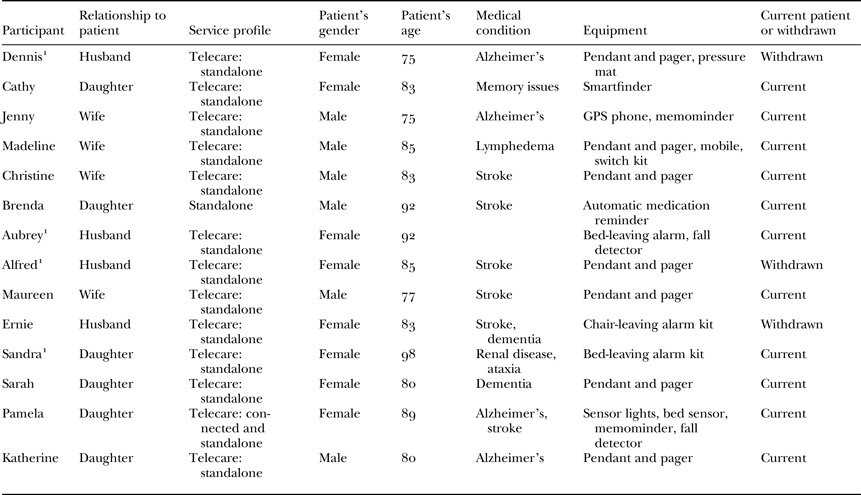
A total of 14 family care-givers were interviewed. The age of the patient whom the carer supported ranged from 75 to 98 (mean = 84.07; standard deviation = 6.78). Patients were mainly from the telecare standalone and standalone service profile (N = 13; 92.9%) with only one participant from the telecare connected profile (Cook et al. Reference Cook, Randhawa, Sharp, Ali, Guppy, Barton, Bateman and Crawford-White2016). The ages are reflective of the overall ATT service profiles, with older age groups (70 years+) accounting for 75 per cent of all referrals made. The relationship with the patient varied across the sample with the majority being either a spouse (four husbands and four wives) or the daughter of the patient (N = 6). It emerged throughout the interviews that three of the family care-givers had since withdrawn from the service (see Table 2). Common reasons for patients withdrawing after referral related to the usability of equipment, i.e. difficult to use, or not perceiving the equipment as useful or meeting their specific requirements. Functionality of equipment and threat to identify and independence also impacted on withdrawal (Cook et al. Reference Cook, Randhawa, Sharp, Ali, Guppy, Barton, Bateman and Crawford-White2016).
Participant details of ‘family care-givers'

Note: 1. Interview held at patient's home with patient present.
The ATT service team posted invitation letters to all family care-givers of patients who met the inclusion criteria. Anyone who lacked mental capacity to consent was excluded. The invitation letter asked the potential participant to state whether they (a) were interested in taking part in the study and being interviewed, (b) did not want to take part or (c) wanted more information. There was a total of 46 ‘informal family care-givers’ registered on SystmOne who were invited to attend. Six family care-givers agreed to be interviewed, with a further ten who requested more information and were subsequently posted a detailed information sheet followed up by a phone call three days later. A further four agreed to take part. All family care-givers who opted not to take part in the study were not contacted again and were immediately excluded. In the situation where no response was received, the interviewer phoned all potential family care-givers to ask if they would be interested in taking part, and a further four family care-givers agreed to take part, giving a total sample of 14. Interviews were conducted by CH who is a trained researcher purposefully employed to fulfil this role. Most interviews were conducted at the care-giver's home, with four interviews conducted at the patient's home (Table 2). All interviews were audiotape-recorded with permission from the participant.
The interview guide was developed collaboratively as part of the multi-disciplinary research group and validated with members of the Trusts Patients Forum and a patient experience group, set up in the initial stages of the project, which included eight non-expert public members who had knowledge of AT and/or had experience of informal care.
The interview guide used open-ended questions to explore the decision-making process of the patient being referred to the ATT service, the advantages and disadvantages around using the equipment/service, and attitudes and perceptions relating to the equipment and/or using the service.
NHS ethical approval was obtained by the National Research Ethics Service Committee East of England (reference 13/EE/0362) in January 2014. All family care-givers were posted a detailed participant information sheet, which provided important information about the study and their right to withdraw. When the interview took place, the interviewer went through the patient information sheet and if the participant still agreed to take part, they were then asked to sign a consent form. No one at this stage declined to take part. On completion of the interview, family care-givers were given a £20 high street voucher as a goodwill gesture. To ensure full anonymity names were removed, with pseudonyms used which aimed to reflect the gender and age of the patient.
A framework analysis method was used to analyse the data (Ritchie and Lewis Reference Ritchie and Lewis2003). The transcription of all interviews was outsourced to an independent professional transcriber. Content was more important as opposed to the structure of family care-givers' responses for analysis, as such only long pauses, interruptions and non-verbal communication were noted within the transcriptions. EJC checked the completed transcripts for consistency and completeness with a sub-sample (N = 3) checked by CS. No issues were found. Two senior researchers (EJC and CS) were involved in the familiarisation process, which involved reading and re-reading the transcripts alongside listening to the audio recordings across a range of interviews, noting any initial impression. Both researchers independently open-coded a sub-sample of three transcripts. This involved coding part or full sentences alongside full paragraphs. After this both EJC and CS met to discuss the open codes. A coding tree was developed which grouped together in categories, and formed the analytic framework. Both researchers applied this framework to two manuscripts, which were then checked to ensure consistency and to identify the need for additional codes. No additional codes at this stage were needed.
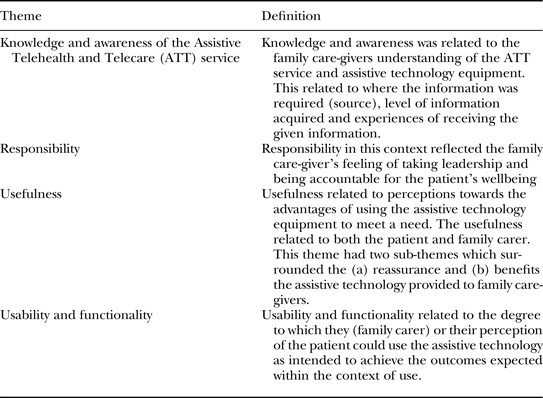
EJC then applied the analytic framework to the remaining manuscripts in NVivo version 10. Once all data were coded, a framework matrix was developed that comprised of one row per participant, with columns representing themes/sub-themes. Data were summarised in verbatim and linked to the original narrative for easy retrieval. There were four core themes identified (Table 3). The core themes and sub-themes were then checked with the interviewer to determine they were an accurate reflection of the interviews. No inaccuracies were found.
Description of core themes

Findings
This research study was interested in uncovering the factors which impacted on family care-givers' decisions to refer a patient to use the ATT service and ultimately use the AT devices that this service provided. The findings revealed four main themes: ‘knowledge and awareness of service’, ‘responsibility’, ‘usefulness’ and ‘usability and functionality of equipment’.
Knowledge and awareness of service
There was a distinct lack of awareness of the ATT service and the AT devices they provide. Family care-givers were asked if they were aware of the ATT service and ten indicated that they had not been aware of the service before being referred by a health-care professional. The remaining four family care-givers who were aware of the ATT service disclosed they heard about the service through discussions with others who had used the service or most commonly (three of the four cases) through demonstrations at organised events, e.g. carer conferences, carer events, and Parkinson's and Alzheimer's meetings and social events.
Demonstration events were very favourably received. It was viewed as beneficial for the family care-giver to understand the different ranges of AT devices available as well as to see the equipment in use so they could see how it works. This was useful on two levels. Firstly, family care-givers could gauge the usefulness of the equipment to support the patient and him- or herself. Secondly, it enabled carers to determine how easy it was to use these devices in practice and provided an opportunity to discuss any questions or concerns.
Jenny is a carer to her husband who has been diagnosed with Alzheimer's. Whilst attending an Alzheimer's carers' event, Jenny came across an ATT service stand which displayed a range of AT devices available. In this extract, Jenny discusses her positive experiences and perceptions towards this event, which consequently led to the decision to refer her husband to use the ATT service:
Well I thought they were brilliant, as soon as I kind of saw all the lovely wonderful gadgets I thought they would be really good for my husband to try … just to be able to touch you know, and see and they [ATT technologists] would show you how they worked and stuff and explain. Yes, it was good to see all of it, yeah, laid out so well. (Jenny, wife, telecare standalone)
Responsibility
Whilst patients are commonly viewed as the core decision maker in adoption of AT, discussions with the carers challenged this assertion. Instead, family care-givers viewed themselves as the main decision maker whereby all interviewed stated that they referred the care recipient to the ATT service. In the majority of situations, family care-givers stated that the care recipient was not aware of the referral. Whilst patients should consent to using the service, this in some situations is not possible. For example, many patients who were not aware of their referral had memory-related issues, often dementia or Alzheimer's.
As such, it was ultimately viewed by the family care-givers that it was their responsibility to make the decision to use the ATT service based on the patient's best interests. Interviews revealed that patients often did not understand what the ATT service was or how the AT devices would help them, as they were often unaware of their vulnerability. Moreover, the findings revealed that many patients struggled to make decisions and were often keen to comply with what the care-giver wanted.
You know I just said look [mum] we're doing it! I just say you know this is what's going to happen. The truth is she has no idea of her vulnerability. I mean if I waited for her it wouldn't have happened because she would have changed her mind so many times. I just have to make that decision for her. (Sandra, daughter, telecare standalone)
We spoke about it, but when we spoke about it she had the early onset dementia, so it was all over the top of her head. She just went along with what I wanted. (Aubrey, husband, telecare standalone)
Usefulness
Perceived usefulness of the AT devices provided by the ATT service centred around three sub-themes; ‘reassurance’, ‘prevention and support’ alongside ‘benefit to carer’. The AT devices were commonly viewed as a preventative measure, e.g. a memominder to remind patients to turn off the oven; others would enable a patient to get help straight away, e.g. a pendant and pager to notify someone that the patient has fallen. As stated previously, many patients who were referred were not often aware of their referral and, in many cases, were vulnerable and susceptible to high-risk situations. Therefore, family care-givers viewed the AT devices as a useful measure of the patient's safety. Some devices also provided the family care-givers and patient with the opportunity to be accessible to each other. As such, if there was an emergency it meant that both parties knew how to get in touch with each other quickly.
We were in separate rooms and for obvious reasons I needed to be in touch with him very quickly, so the idea of a pendant and pager meant that it would assist us to be accessible to each other. (Christine, wife, telecare standalone)
He likes to wander off you know, go to the shops and catch the bus and whilst nine times out of ten he is fine, sometimes he forgets to catch the right bus, or he gets lost. So, the fact he now has a GPS phone meant we knew that we can see he is where he says he is and we can contact each other straight away. (Jenny, wife, telecare standalone)
Reassurance
Reassurance for the family carer often related to the safety of the patient for the majority of family care-givers. This was a common view held in cases where the patients were prone to falls, or at risk of wandering off and forgetting where they were. For example, the GPS phone tracker would allow family members to know where the patient is when they leave the house so they can make sure that the patient is safe; bed and floor sensors would notify the carer when the patient gets out of bed so they could support them to ensure they do not fall, or be notified straight away if they have fallen; and a memominder would remind patients to turn off the oven and lock the front door to ensure they are kept safe from fire or burglary.
I was getting really worried about mum and basically we got to the point where I was panicking I wouldn't hear her wake up. (Sandra, daughter, telecare standalone)
She kept having falls and I never knew how long she would be lying there ’cause I mean memory wise she wouldn't know how long it would be. She fell in the bath one night and didn't manage to get out until the morning! So here I am worried about her falling, then I'm worried about her getting out of bed, I'm not there at night times you see, so that's when I agreed to the idea of a bed detector. (Pamela, daughter, telecare connected and standalone)
The idea that I can keep an eye on my dad at all times while he can continue to be independent which means that I am reassured without risking his safety. (Katherine, daughter, telecare standalone)
In addition, there was reassurance for the family care-giver of the patient's health and wellbeing. For example, medication reminders could reassure the care-giver that the patient is taking their medication. Many family care-givers agreed that the AT devices could also prevent adverse situations and in turn provided carers with reassurance that the patient would be less stressed and anxious.
Mum was getting a bit stressed, her memory was deteriorating badly and she was getting to the stage where she was constantly forgetting to lock the door and things like that. The breaking straw was when I went round to her after work to find her crying. She had lost her keys so she couldn't leave the house. It made sense to try something to help even to stop her getting so distressed. (Cathy, daughter, telecare standalone)
Benefit to family carer
A few family care-givers revealed that the main reason they referred the patient to the ATT service was for their own benefit rather than the patients. This finding was most common among older care-givers who were often the spouse of the dependent care recipient. Aubrey is the sole carer for his wife who is 92 years old. In his extract below, Aubrey describes the negative impact that having to clean up after his wife has on his daily tasks. He therefore felt that having an alarm would reduce this work and effectively make his life easier.
It was more for my benefit, I mean have you ever got up two or three o'clock in the morning cleaning up pee and poo off the floor? I knew if I could have an alarm as soon as I hear it go off I could jump out of bed and help her to the toilet. It meant I could potentially save myself a lot of work so it was to assist me not her really, to make my life easier if you like. (Aubrey, husband, telecare standalone)
It was also more common among family care-givers who were ‘struggling’, particularly in situations where the care recipient was completely dependent and lived with the care-giver. For example, Sarah's mother has dementia and now stays at Sarah's house where she currently looks after her. Sarah's main concern relates to worrying her mother would get up and fall, which resulted in Sarah now sleeping downstairs on the sofa. This subsequently meant that Sarah was getting less and less sleep and was concerned she was getting exhausted. She therefore felt that the AT device would enable her to sleep upstairs in a bed with the knowledge she would be informed when her mother wakes up.
I was sleeping upstairs erm and so I said for a trial I would sleep downstairs … I was sleeping on the sofa and then every night she would wake up she would call me so it meant I was getting less and less sleep and I was getting horrible and nasty you know. So, the idea of using something like an alarm seemed like a good idea. It meant that I could then sleep in the bedroom again otherwise I knew I was going to be physically and emotionally exhausted. (Sarah, daughter, telecare standalone)
Another positive aspect of the AT devices revealed by most family care-givers, particularly by those who used the pendant and pager or sensor devices, was that it would relieve them from having to be with the patient at all times. This meant they had more time to themselves and increased independence for them both.
I mean if you're in the garden, for example, and you have to keep coming in every ten minutes, are you ok, are you ok, and that [the equipment] has changed it because that way I can maybe stay out 20 minutes and in that time or maybe a bit more and in that time if he needs me he just pushes the button. (Madeline, wife, telecare standalone)
They all seem to be useful, I mean the things we have got are really helpful because they take a bit of pressure off me which is what I want you know. (Pamela, daughter, telecare standalone)
Usability and functionality
Most family care-givers had a positive attitude towards using the AT devices before referral to the ATT service. In situations where there was some anxiety they found it really useful to discuss this with the ATT service team who quickly put them at ease. Commonly, family care-givers who received AT devices felt that the equipment was simple and easy to use. Family care-givers who were provided with the pendant and pager and alarm kits all felt that the equipment was easy to use, all they had to do was ‘plug it in’ and remember to turn it on. In fact, some family care-givers were surprised as they thought that it would be more difficult than it actually was.
However, there were some technical difficulties raised by two family care-givers which related to the medication reminders and the memominder. Family care-givers were responsible for setting up and loading the medication reminders for the patient. This would mean the family carer would have to preset the times when the medication should be released and for when the alarm should sound and ensure that the right medication was in the correct container. One family carer stated that they had to do this with limited support and had to rely on manufacturer instructions which were unclear.
We do it for mum, we had to reset it and even we had teething problems at the start. It's a learning curve but it was a case of getting used to it. You have to make sure that the numbers come up at the right time then every Wednesday we have to replenish it and move the disc around, like I said a learning curve. It was pretty difficult also having to rely on manufacturer's instructions. To say they were unclear would be an understatement. (Brenda, daughter, standalone)
Some issues also related to the design of the equipment. For example, Pamela sets up the memominder for her mother although she had issues in pressing the item on without resetting it.
The prompt boxes are easy enough apart from the trouble I had with the prompt boxes, if you aren't careful, when you're turning them off you push it all the way down and it goes to record then. So, then you have to start again which is a bit of a pain especially if you are creeping in in the morning and you accidently push it too much. (Pamela, daughter, telecare standalone)
Maintenance of the AT devices was perceived as generally fine but an issue that was raised in many of the interviews related to batteries. Many family care-givers felt that they were not provided with sufficient information about when and how these should be changed and which size battery to use. Some respondents stated they were provided equipment with used batteries which quickly ran out, whilst others spoke of difficulties in not knowing when they had to change batteries, i.e. what the warning sign was, or not being given enough notice.
Except they came without batteries and I just thought they were broken but we've sorted it now. I didn't know all the different lights and things, I didn't know it was running out of batteries I just assumed that when they came in the little boxes they hadn't been used and they were with batteries. I couldn't understand why we were pressing away and it wasn't working. (Christine, wife, telecare standalone)
ATT's after-support service was viewed very positively by all family care-givers and those who did have problems with batteries who contacted the ATT service appreciated a quick response and being provided with a new device if needed. There were, however, some situations where the person who provided the family care-giver with the AT device was not from the ATT service where care-givers found it much more difficult to get support.
I've just recently had to contact them [ATT] because erm again he said it wasn't there, the tablet wasn't there, now I don't know what I have done but I know that I loaded it correctly so I rang them up because I thought maybe more batteries are needed, and straight away she said we'll send you another one, I'll post it out today, just return the one back to us and we received it the next day and this one has been no problem. (Brenda, daughter, telecare standalone)
A pendant yes, we've got a couple of them, actually because one of them didn't seem to be working very well and so they sent me one straight away as soon as I phoned up and I said I've changed the battery, he said don't worry about it we'll send you another one, and they did the next day. (Madeline, wife, telecare standalone)
The family care-givers generally felt happy that the equipment would work during an emergency or when it needed to. Here an extract from an interview with Jenny outlines how a GPS tracker enabled her to find her husband when she needed to check on him. Situations where the equipment was used and worked reinforced the carer's confidence in relying on the equipment.
Yes, yes, where I know where he is yes, because it's like yesterday, say he was in Cambridge and erm I wanted to make sure that he was ok so anyway I put it in once and then I knew where he was. He was walking back down the main road in Cambridge and I know what he's doing cause I told him we were having hair appointments and I said you must get the half past three bus back at the latest and then anyway just before ten past three I tracked him again and he was waiting at the bus stop so I knew everything was fine. (Jenny, wife, telecare standalone)
There were, however, some issues that related to convenience. For example, one family carer discusses having to change the messages every week on a memominder to ensure the patient takes notice of it. Another carer felt that the medication reminder was very time consuming, particularly as the patient was on a lot of different medications.
Discussion
The core theme captured the barriers and facilitators to using the ATT service and the AT devices they provide at the point of referral. Within this core theme, there were four sub-themes that emerged: ‘knowledge and awareness, ‘responsibility’, ‘usefulness’ and ‘usability and functionality’.
There was a distinct lack of prior knowledge and awareness of both the AT devices and the ATT service among family care-givers, which has been previously cited as a core reason for low adoption (Carers UK 2013b). The complexity of the ATT service is that whilst it provides AT devices to support patients, it often is there to support the family care-giver. This is further marred by patients who are unable to consent as they lack capacity. Given this, it is proposed that more consideration is given to the referral processes in place and then a more targeted approach is taken to advertising the service. Organised demonstration events for carers were viewed favourably and enabled the family care-givers to assess the benefits and usability of the devices, both found to be core factors that impact on adoption which is supported by the wider literature (Carers UK 2013a; Sanders et al. Reference Sanders, Rogers, Bowen, Bower, Hirani, Cartwright, Fitzpatrick, Knapp, Barlow, Hendy, Chrysanthaki, Bardsley and Newman2012).
Findings revealed that family care-givers were pivotal in the referral process. Family care-givers ultimately viewed referral and providing consent to use the ATT service as their responsibility. It was discovered that in some situations the patients were unaware of the referral; this was particularly common in situations where the patient had cognitive impairment, including diagnosis of dementia where patients lacked capacity to consent. This therefore raises the question as to who this service is aimed at, e.g. many family care-givers made the decision based on the idea that the equipment that the ATT service provided would reassure and benefit them as the care-giver and guardian rather than the patient. As assistive devices are being more increasingly targeted to support family care-givers, this finding does encourage a broader ethical debate, particularly around how patients who lack capacity are involved in the decision-making process. This will become a more prominent argument as new technologies develop and bring associated dilemmas with, for example, tracking and location devices, intelligent camera systems and continuous assessment of activities (Turnstall Alzheimer's 2008). Whilst the best approach to gaining consent is on an individual basis, there is a need for a well-defined ethical and mutual framework to ensure there is the right balance between quality of life outcomes, including independence and safety (Social Care Institute for Excellence 2010).
Family care-givers were overall positive towards the AT devices. They also valued the technical support from the ATT service team, with most finding the devices they were given easy to use. There were some discussions on design issues and some felt that some of the manufacturer instructions were unclear. Despite these challenges, all family care-givers felt confident in the equipment working and viewed the service positively, particularly the quick response. There is a current perception that usability of the devices is a widely cited reason linked to low adoption of telecare (McCreadie and Tinker Reference McCreadie and Tinker2005; Topacan, Basoglu and Daim Reference Topacan, Basoglu and Daim2009). For example, it is a common perception that older people have more negative attitudes towards usability of equipment (Sanders et al. Reference Sanders, Rogers, Bowen, Bower, Hirani, Cartwright, Fitzpatrick, Knapp, Barlow, Hendy, Chrysanthaki, Bardsley and Newman2012). However, it is argued that engagement of older people in technology is strongly influenced by perceived behavioural control even when controlling for socio-demographic factors (Morris and Venkatesh Reference Morris and Venkatesh2000). This finding also supports previous literature which suggests that the importance of the unmet need that the assistive devices serve to fulfil outweighs any negative stereotypes towards technology (Demiris et al. Reference Demiris, Rantz, Aud, Marek, Tyrer, Skubic and Hussam2004; Rosenberg, Kottorp and Nygård Reference Rosenberg, Kottorp and Nygård2012).
Strengths and limitations
The presented research drew on the experiences of family care-givers to identify the underlying factors which impacted on their decision to refer/support the patient to uptake and engage in the use of AT devices. The findings subsequently demonstrated the influential role of family care-givers on this process and thus drawing on their views has enabled a richer understanding of the influential factors that impact on the broader decision-making process surrounding telecare.
There are, however, some limitations that are noteworthy. As we relied upon an informal family carer being recorded in SystmOne this may have impacted on us identifying other suitable informal carers that were not recorded on the system. There is normally only a recording for one informal family carer who is cited as the primary carer. This subsequently restricted us from inviting other informal carers who perhaps were just as involved in supporting the patient, such as friends and/or neighbours. This may prove an interesting avenue for future research. A further limitation was that the interviews were not conducted by the research team but instead were completed by a trained research assistant (CH) who had experience in qualitative fieldwork. To overcome this limitation, the research team provided the interviewer (CH) with training on ATT induction of equipment and service delivery plus refresher interview training. Alongside the training, the research team briefed the researcher on the research study in full, with special attention paid to the conceptual framework on which the study was based and research tools that had been developed. In addition, the audio recordings of the interviews and the typed transcripts were routinely checked by EJC and GR for conceptual and methodological consistency. Discussions around fieldwork reflections further ensured that in-depth and high-quality data were collected.
Conclusions
This research revealed that family care-givers who perceived AT devices to be useful and functional were more likely to either refer the patient or support the patient's decision to use the ATT service. Usefulness, particularly the reassurance it provided the family care-giver of the safety of the patient, was a key selling point to wanting to use the AT devices. However, the value of the devices was not only based on how they would benefit the patient but also how they would benefit the family care-giver, with this in some situations being the core reason for referral.
Whilst the decision-making process is often cited as a patient's decision, this research highlighted that this was not the case. In fact, the majority of family care-givers interviewed disclosed that their relative was not aware of the referral and they consented on their behalf as their guardian. This therefore raises an ethical and moral debate as to how such devices are used to support family care-givers without the ‘consent’ of the patient. As new technologies emerge and are increasingly integrated in community care settings, this will become a more prominent argument.
Family care-givers and patients were overall positive towards the AT devices which were viewed as easy to use, useful and functional. The findings presented highlight the influential role of family care-givers in using telecare and assistive technology. Efforts to increase adoption and engagement should therefore adapt recruitment strategies and service pathways to support not only the patient but also the family care-givers who support them.
Acknowledgements
We would firstly like to thank the ATT team who supported the research team in data recruitment. Also, we would like to acknowledge Claire Herring for conducting the interviews alongside Ian Merrick and the funding body Health Innovation and Education Cluster (HIEC) for taking an active interest in its progress and outcomes. Andrew Bateman and Garry Barton are supported by the National Institute for Health Research (NIHR) Collaboration Leadership in Applied Health Research & Care (CLAHRC) East of England, at Cambridgeshire and Peterborough NHS Foundation Trust. This research was funded by Cambridge Community Services NHS Trust. The views expressed are those of the authors and not necessarily those of the NHS, the NIHR or the Department of Health. JC-W, EJC, GR, GB, AB and AG were involved in the conception and design of the study. EJC completed all qualitative data analysis with the support of CS. EJC, CS, JC-W, GR, GB and AB all contributed to the interpretation and prioritisation of findings. EJC drafted the paper. GR is the guarantor. JC-W, EJC, GR, GB, CS, AB and AG read and approved the final manuscript.