Patients undergoing surgical palliation with functionally univentricular heart are known to be at increased risk for venous thromboembolic disease. Prophylactic anticoagulation is usually given in the immediate postoperative period, but thromboembolism remains a major problem in the long-term for children after conversion to the Fontan circulation, with the reported incidence varying between 5 and 33%.Reference Monagle and Karl1–Reference Hanséus, Björkhem, Jögi and Sonesson3 There is no consensus concerning the optimal postoperative therapeutic mode and duration of anticoagulative prophylaxis.Reference Kaulitz, Ziemer and Rauch4, Reference Walker and Gatzoulis5
Theories regarding the aetiology of thromboembolism in these patients have been difficult to substantiate. The mechanism may be a state of low flow, atrial arrhythmias, adhesion to prosthetic materials, or a hypercoagulable state presumably due to a decreased synthesis of anticoagulant factors in the liver. Abnormalities in the system providing coagulation have been reported following conversion to the Fontan circulation,Reference Cromme-Dijkhuis, Hess and Hahlen6–Reference Odegard, McGowan and Zurakowski8 while other findings suggest that abnormalities in coagulation factors could precede the surgical procedures, albeit normalizing following the surgery, perhaps due to improved systemic oxygenation.Reference Cheung, Chay, Ma and Cheung9
A better understanding of the risk factors for thromboembolic complications would assist in the formulation of recommendations for antithrombotic prophylaxis. Because of the complexity of the coagulation system, and the large number of candidate risk factors, assessing the risk of thrombosis in an individual patient is difficult. It is important, therefore, to find clinically useful markers to identify children at increased risk. Thus, we endeavoured to evaluate long-term changes in the haemostatic system following surgical treatment of children with functionally univentricular hearts, to compare markers of activated coagulation in a healthy population of children, and to evaluate their relationship to adverse clinical outcomes, such as depressed ventricular function, atrial arrhythmias or thromboembolic events.
Materials and methods
Patients and their controls
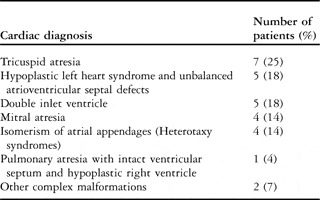
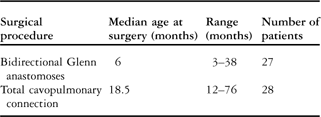
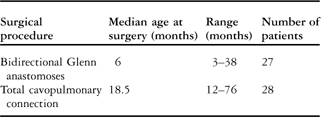
We enrolled 30 consecutive patients with functionally univentricular hearts admitted to our hospital for the bidirectional Glenn procedure, or partial cavopulmonary anastomosis, or for construction of a total cavopulmonary connection. We subsequently excluded 2 patients, the first because of failure of the total cavopulmonary connection necessitating take down, and the other who died during surgery. The final cohort, therefore, was made up of 28 patients, 19 boys and 9 girls, of whom 12 were enrolled before the Glenn procedure, and 16 prior to construction of a total cavopulmonary connection. All children subsequently underwent construction of both the Glenn shunt and the total cavopulmonary connection, except for 1 child who had initial construction of the total cavopulmonary connection. In 26 patients, other palliative surgery had also been previously performed. After the total cavopulmonary connection surgery, patients were routinely anticoagulated with aspirin or unfractionated heparin, followed by warfarin sodium for 6 months. Prolonged primary prophylaxis thereafter was given with low-dose aspirin. The anatomical diagnoses are shown in Table 1. Down’s syndrome co-existed in 1 patient, but the remaining patients had no other extracardiac malformations. The ages at surgery are shown in Table 2. Pre-and postoperative clinical data were obtained from the hospital files.
The cardiac diagnoses prior to surgery.

The ages at surgery for creation of the functionally univentricular circulation.
In 12 of the patients, blood samples were obtained before the Glenn procedure, and in 25 blood was drawn before construction of the total cavopulmonary connection. Sampling proved impossible in 3 children. We were able to follow-up 27 of the 28 patients, with 1 child subsequently refusing testing. The median time from final surgery to follow-up was 9.6 years, with a range from 3.7 to 10.5 years. None of the patients were receiving heparin or warfarin sodium at the time of blood sampling. At the time of the postoperative evaluation, all were medicated with low-dose aspirin. In our diagnostic approach, screening for thromboembolic events with transthoracic echocardiography was followed by transoesophageal evaluation in patients with a clinical suspicion of formation of thrombus, or a questionable finding on transthoracic echocardiography.
To obtain reference values for generation of thrombin in childhood, and for the activated protein C-protein C inhibitor complex, we obtained venous samples from 45 healthy children about to undergo minor surgery. Comprising 24 girls and 21 boys, their mean age was 10 years, with standard deviation of 5.3 years. None of the children were suffering from cardiac, thrombotic, or inflammatory disease or infection.
Assays
Venous blood for analysis of the process of coagulation was collected preoperatively in 5 millilitres silicone coated vacuum tubes containing 0.5 millilitres of sodium citrate at 0.129 moles per litre, and at follow-up also in 5 millilitres vacuum tubes containing citrate with a lower pH, which precludes inadvertent formation of the activated protein C-protein C inhibitor complex.Reference Strandberg, Svensson and Stenflo10 The blood was centrifuged at 3600 g for 10 minutes within 30 minutes of collection, and the plasma frozen in aliquots at −70 degrees Celsius until use. Blood samples were analysed by standard methods at the Department of Clinical Chemistry, which is accreditated by the Swedish Board for Accreditation and Conformity Assessment.
At all occasions samples from the study participants were examined for coagulation factors VII, IX, and X; antithrombin, protein C and free protein S; prothrombin fragment F1 + 2; D-dimer, fibrinogen; plasminogen activator inhibitor type 1; and functional activated protein C resistance. At follow-up, they were additionally tested for coagulation factor VIII levels, the factor V 1691 G/A, and factor II 20210 G/A mutations, the capacity to generate thrombin, and levels of the activated protein C-protein C inhibitor complex.
In brief, coagulation factors VII, IX and X were analysed with one-stage assays and coagulation factor VIII by employing chromogenic substrate Coatest SP FVIII on the Behring Coagulation System. Protein C was measured using the chromogenic substrate S-2366, and free protein S in samples before surgery were analyzed with an in-house competitive radioimmunoassayReference Malm, Laurell and Dahlback11 and at follow-up with a latex agglutination assay. Antithrombin was assayed by a commercial amidolytic assay. The D-dimer assay was based on antibody coated latex particles, and fibrinogen was measured as a clotting time after addition of thrombin. D-dimer in samples before surgery was analyzed with Nycocard D-dimer kit. The plasminogen activator inhibitor type 1 activity was measured with an enzymatic assay. The activated protein C-protein C inhibitor complex was analysed according to Strandberg et al,Reference Strandberg, Kjellberg, Knebel, Lilja and Stenflo12 and generation of thrombin assayed according to the method described by Varadi et al.Reference Varadi, Negrier and Berntorp13 An enzymatic immunoassay was used for determination of prothrombin fragment. Activated protein C resistance was measured with Coatest activated protein C resistance test. Mutations in the factor V Leiden (1691 G/A) and prothrombin genes (20210 G/A) were determined using standard DNA techniques based on polymerized chain reaction gene amplification and fluorescein labeled specific probes.
Ethics
The study was approved by the Regional Committee for Research Ethics at Lund University, and informed consent was obtained from all study participants, control patients or/and their parents.
Statistical analysis
Differences between the groups were assessed using Mann-Whitney’s test or Student’s t-test as appropriate. A p-value less than 0.05 was considered statistically significant. Age-specific reference intervals were derived from control subjects based on the empirical 95% confidence intervals of mean plus or minus 2 standard deviations.Reference Wright and Royston14
Results
Clinical outcome
At the time of the last follow-up, 25 (89%) of the patients were in the first or second class of the functional grading system of the New York Heart Association, and 3 (11%) were in the third class. The mean saturation of oxygen saturation was 95%, with a range from 90 to 97%. In terms of cardiac activity, 23 patients were in sinus rhythm, with 1 of these having episodes of tachycardia and another frequent ventricular extrasystolies, 1 was in nodal rhythm, and 4 patients had pacemakers. Inhibitors of angiotensin converting enzyme inhibitors were required by 5 patients, 2 along with furosemide, and 1 with a beta-blocker. None of the patients were receiving heparin or warfarin sodium, or had a history of prolonged such treatment, whereas all were on treatment with low-dose aspirin. Ventricular function as assessed by transthoracic echocardiographically was good in 27 patients, and fair in the other patient. The atrioventricular valves were competent, or showed only slight regurgitation, in all but 1 patient, who had moderate regurgitation. None had a history of thromboembolism, and no intracardiac thrombus was detected. Protein losing enteropathy was present in 1 patient.
Coagulation studies
Activated protein C-protein C inhibitor complex
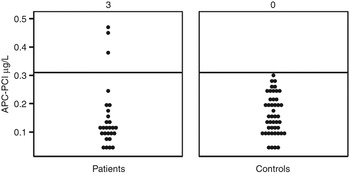
The results were skewed amongst the patients, with 3 showing distinctly elevated values of 0.47, 0.45, and 0.38 micrograms per litre (Fig. 1). All of these patients were in functional class II. Their diagnoses prior to surgery had been mitral atresia in 2, and pulmonary atresia with a hypoplastic right ventricle in the other. The patient with the highest level of activated protein C-protein C inhibitor also had the highest endogenous potential for generation of thrombin. The concentrations of activated protein C-protein C inhibitor in healthy children were normally distributed, and a reference interval was calculated as between 0.02 and 0.31 micrograms per litre, with a mean of 0.16 micrograms per litre. There was a tendency towards lower values in the patients as compared to their healthy peers, with non-parametric testing giving a p value equal to 0.09. When excluding the three outliers discussed above, the difference between the groups became significant, with a p value less than 0.01.
Levels of the activated protein C-protein C inhibitor complex in 27 patients (mean 0.15 microgram per litre, standard deviation 0.11) and 45 controls (mean 0.16 microgram per litre, standard deviation 0.07) at follow-up. Three (11%) of the patients, and none of the controls, had levels above the reference (indicated by line).

Generation of thrombin
When compared to the controls, no significant differences could be found in the profile for generation of thrombin, including the lag-phase, the maximum rate, the time to peak, the peak concentration, and the endogenous thrombin potential (Table 3). A tendency toward an increased rate of the time to peak was noted in those with the Fontan circulation, at 30.6 versus 35.9 minutes, giving a value for p equal to 0.07.
Generation of thrombin in the patients with the Fontan circulation and their controls.

SD: Standard deviation; n: number of subjects; min: minutes; RFU, real fluorescence units; nM: nanomoles per litre.
Coagulation factors
Prior to the surgical procedures, the mean concentrations of the vitamin K dependent factors VII, IX and X were in the low range of age-adjusted reference values,Reference Andrew, Paes and Johnston15, Reference Andrew, Vegh, Johnston, Bowker, Ofosu and Mitchell16 but were normal at all times. Low levels of factor VII were found in 2 patients prior to construction of the total cavopulmonary connection, but not at follow-up. When factor VIII was analyzed during follow-up, 6 of 27 patients had levels above the reference level.
Coagulation inhibitors
When compared to the age-adjusted reference values,Reference Andrew, Paes and Johnston15, Reference Andrew, Vegh, Johnston, Bowker, Ofosu and Mitchell16 low levels of antithrombin and protein C were found in 7 patients prior to construction of the Glenn procedure, and in 3 patients before the total cavopulmonary connection. At follow-up, all values were normal. Mean levels of free protein S were at all times within the reference interval for healthy adults.
Prothrombin fragment F1 + 2
Samples collected prior to surgery were analysed with a previous lot of the commercial kit. Before the total cavopulmonary connection, 4 patients had results above the reference interval for healthy adults given by the manufacturer, namely 0.44 to 1.10 nanomoles per litre. At follow-up, levels were generally low.
Fibrinolytic parameters
Levels of fibrinogen were generally low, with slightly elevated levels found in 2 patients at follow-up. The D-dimer levels were slightly elevated in 3 patients at all time points. The results for PAI-1 were within the reference interval for healthy adults.
Markers of thrombophilia
At all time points tested, the functional activated protein C resistance was normal in all patients. None of the patients had mutations in the factor V or the prothrombin genes.
Frequency of prothrombotic changes in coagulation variables
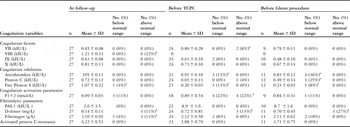
The frequency of specific coagulation and fibrinolytic variables outside the normal range towards a prothrombotic state decreased from 72% before the Glenn procedure and 69% before the total cavopulmonary connection to 26% at follow-up, increasing to 48% when including coagulation factor VIII, which was not determined before the procedures (Table 4).
Levels of coagulation variables before and after conversion to the Fontan circulation.

aProthrombotic changes (in total 26% at follow-up, 69% before total cavopulmonary connection and 72% before Glenn procedure). kIU/L: kilo international units per litre; nmol/L: nanomoles per litre; mg/L: milligrams per litre; g/L: grams per litre; PAI-1: plasminogen activator inhibitor type 1; TCPC: total cavopulmonary connection. n: number of subjects.
Discussion
We found a lower incidence of procoagulant changes in the haemostatic system at long-term follow-up, when compared to finding prior to surgery, in children with functionally univentricular hearts who had been converted to the Fontan circulation. Assessing the risk of thrombosis, or its recurrence, in an individual patient with a functionally univentricular heart is difficult due to the inherent complexity of the coagulation system, and the presence of multiple other possible risk factors. A method that reliably measures overall coagulative potential would, therefore, enhance the understanding of multicausal thrombophilia. In this study of patients from one of the two centers of performing paediatric cardiac surgery in Sweden, we evaluated the use of such global coagulation tests in a cohort of patients who had been converted to the Fontan circulation.
All our patients had a favourable outcome, with no clinical events of thrombosis reported at follow-up. The incidence of asymptomatic cardiac thrombus could possibly have been underestimated, as transoesophageal echocardiography, requiring general anaesthesia in clinically asymptomatic children, was not performed on a routine basis. The favourable outcome corresponds with our finding of low concentrations of F1 + 2, and to the normal profile for generation of thrombin compared to control subjects. Evaluation of activated protein C-protein C inhibitor complex, a new and sensitive biological marker for generation of thrombin, however, revealed a subset of 3 patients with distinctly elevated values despite treatment with low-dose aspirin. In adults, increased levels of this marker are found in hypercoagulant states such as inherited thrombophilia.Reference Strandberg, Stenflo, Nilsson and Svensson17, Reference Watanabe, Wada and Sakakura18 The fact that the highest activated concentration of this complex, as well as the highest potential for generation of thrombin, were noted in the same patient suggests that the evaluation of the complex may be of importance in identifying patients with an overall procoagulant haemostatic profile. Further evaluation of increased levels of the complex in patients with the Fontan circulation will be needed to determine if this could, indeed, identify a subset of patients for whom different anticoagulation is indicated. The reference values we generated from the children recruited for our study correspond well to those already recognized in adults,Reference Strandberg, Svensson and Stenflo10 and will be useful in future evaluations.
We found no case of inherited thrombophilia or activated protein C resistance in our cohort. Given that a combination of inherited and acquired risk factors is often found in children with thrombosis, this may have contributed to the good clinical outcome we observed. Improvements in surgical and anticoagulative regimens could also be partially responsible for our findings, which are favourable in comparison to earlier studies.Reference Monagle and Karl1–Reference Hanséus, Björkhem, Jögi and Sonesson3
We found the vitamin K dependent factor IX, as well as the natural anticoagulants antithrombin, protein C and free protein S, to be reduced at the time of surgery in some of our patients compared to previously published age-specific reference data. The observation of low levels in the perioperative period is in concordance with other studies. It has been a matter for speculation whether a decreased hepatic synthesis of procoagulant and anticoagulant factors, or a subclinical form of protein losing enteropathy, may cause an apparently delayed maturation of the haemostatic system, and thence contribute to the thrombotic risk.Reference Jahangiri, Kreutzer, Zurakowski, Bacha and Jonas19, Reference Rauch, Ries, Hofbeck, Buheitel, Singer and Klinge20 It is not clear, however, if these results are clinically significant, nor the magnitude of their overall impact on the haemostatic system. In some patients, we could also confirm the finding of elevated levels of factor VIII previously reported in those with the Fontan circulation.Reference Odegard, McGowan and Zurakowski8
The frequency of prothrombotic changes indicates that the children are less prone to thromboembolic complications at follow-up after the surgical procedures. In some patients, nonetheless, thrombophilic patterns remain. A clinical awareness of thrombosis, therefore, is warranted as the risk for an event may increase with age.
Some limitations to the study deserve comment. We chose to collect our own control material for assessing the results of the concentration of the activated protein C-protein C inhibitor complex, and the profile for generation of thrombin, but when interpreting coagulation data from the time of surgery we compared these to the previously published references.Reference Andrew, Paes and Johnston15, Reference Andrew, Vegh, Johnston, Bowker, Ofosu and Mitchell16 The analyzer and methods used differ slightly, but our references values for adults do not differ significantly from the published findings.Reference Andrew, Paes and Johnston15, Reference Andrew, Vegh, Johnston, Bowker, Ofosu and Mitchell16 We found our results to fit within the low normal range. Other investigators using age-matched controls have observed significantly lower levels in both pro- and anticoagulant factors in patients compared to controls, but not necessarily compared to age-appropriate reference intervals.Reference Rauch, Ries, Hofbeck, Buheitel, Singer and Klinge20, Reference Barnes and Monagle21 It is not clear, however, if these results are clinically significant, nor if they have an overall impact on the haemostatic system.
In summary, we report long-term prospective follow-up data on a cohort of patients with the Fontan circulation. We have demonstrated a lower incidence of procoagulant abnormalities when following up the patients compared to the findings before surgery. A small subset of patients showed indications of increased generation of thrombin measured as marked elevations of the activated protein C-protein C inhibitor complex compared to controls, whereas the pro-and anti-coagulant profile in the group in general was normal for age, corresponding to the lack of any clinical thrombotic events. The practical implications of these findings are that the current therapeutic approach seems to be sufficient in the majority of these patients and that, with further research, new tests of global coagulation may become helpful in identifying those children that require different approaches to anticoagulation.
Acknowledgements
The study was supported by grants from the Swedish Research Council (no. 13493), the University of Lund (ALF), and the Region of Skane.