Clashes over tax policy have been front and center in U.S. politics in recent years. In the 2008 presidential contest, the Democratic candidate, Barack Obama, promised to let Bush-era tax cuts lapse and raise rates on the wealthiest Americans, and the issue again figured in the 2012 election, with arguments over the taxes paid by wealthy GOP candidate Mitt Romney and the tax cuts proposed in a GOP Congressional budget proposal championed by Republican vice presidential candidate Paul Ryan. But even though partisan debates about taxes—especially taxes on the wealthy—have become more prominent in recent years, arguably the outcomes of legislative battles have not changed much. Even when they enjoyed unified control of Congress and the White House in 2009 and 2010, Democrats were not able to present a united front on tax issues. Although some upward adjustments for the very wealthy were eventually allowed to go into effect in 2013 after President Obama was reelected, most of the sweeping tax cuts Republicans pushed through in 2001 and 2003 remain in force. As Republicans reassert adamant opposition to any revenue increases, taxes remain a flashpoint of partisan warfare in ongoing Congressional standoffs over budgets, spending sequesters, and proposals for deficit reduction. In this warfare, however, the Republican side has been much more united than the Democratic side.
How did we get here? In particular, why have Democrats had such a hard time raising revenues, or even structuring the politics of tax decisions in a way that fits their preferences for adequately funded government? The origins of contemporary antitax efforts have popular roots back in the 1970s, but as we show in the research reported here, organized antitax groups and swelling antitax elite constituencies have played an increasingly important role in recent times, not only by working closely with the Republican Party, but also by dividing Democrats. We focus here especially on the ways in which small business organizations and constituencies have created cross-pressures on the Democratic Party, sufficient to undermine its unity and resolve on tax issues. Not only have Democrats in Congress regularly defected on tax votes advanced by the GOP, but divisions and ambivalence among Democrats catering to “small business” have also made it impossible for party leaders to control the agenda of tax debates and votes even when they nominally control Congress.
Our analysis presents new empirical data about trends in small business mobilization and the views of small business owners, including owners of actual small enterprises, as well as higher-income persons and larger firms who are using “self-employed” entities to find the most favorable tax treatment for their incomes. Against the backdrop of tax politics since the 1970s, we focus particular attention on the divisions among Democrats during the enactment of the original Bush tax cuts in 2001 and 2003, as well as their renewal in 2010. The early 2000s legislation represented a high point for the contemporary antitax movement and spurred a dramatic redistribution of public fiscal burdens, favoring the wealthy.Footnote 1 In turn, the 2010 episode was the first juncture since the passage of the cuts when Democrats, given their control of both chambers of Congress as well as the White House, ostensibly had the ability to undo the upward-tilted Bush tax cuts and expand revenue collection. The failure of the Democrats to repeal the top-end cuts in 2010 thus provides an opportunity to probe the forces constraining the party's positioning and undercutting its unity on tax issues.
We proceed as follows. After introducing our theoretical framework for understanding the interplay between organized interests and political parties on tax policymaking, we then turn to detailed analysis of the role of small business organizations and constituencies in relation to the positioning of the two major parties, and especially Democrats, on tax issues. Although this analysis is but one part of an overall explanation of party capacities and divergences on tax policy questions in recent U.S. politics, we believe the research presented here demonstrates the importance of looking at sustained relationships between organized interests and political parties. In addition, for the first time in research on tax politics, we show that changes in the federal tax code can “feed back” to change the stances of key constituencies on tax questions. This has happened among high-end earners and larger firms using self-employment designations to lower their tax rates, strengthening pressures from small businesses in American politics, not just small employers but also legal entities that stretch the meaning of small business. And the results, we show, have ratcheted up cross-pressures on Democrats in ongoing partisan battles over top-end taxes.
PARTIES, ORGANIZED ECONOMIC INTERESTS, AND TAX POLICY
Our theoretical analysis starts from the presumption that major redistributive policy changes, especially in the fragmented U.S. polity, require a broad coalition of supporters, operating not just inside the legislature but also beyond it.Footnote 2 Effective coalitions active on redistributive issues must devise strategies and make sustained investments in order to apply pressure on candidates and elected officials, encourage passage of particular pieces of legislation, and foster support among the public, especially its most attentive members.Footnote 3
Policy coalitions may require years of investment in a variety of strategies, some of which may fail, as Steven Teles has shown in his analysis of the rise of the conservative legal movement.Footnote 4 Nevertheless, when organized interest assemblages do manage to succeed, subsequent policy victories can strengthen their coalitions through feedback effects, as the actors change the political system in ways that lock-in their past victories and make subsequent successes easier.Footnote 5 For example, groups can raise the costs of changing the (favorable) status quo by broadening the coalition of actors who benefit from the status quo; by making access to the policymaking process more difficult for potential challengers; by making access to the policymaking process easier for themselves or their allies; or by drawing resources away from potential opponents. What is more, although public opinion need not be mobilized for many policy issues, the effectiveness of organized policy-driven actors can be strengthened when they are able to point to favorable public opinion, and public views can be influenced by changes wrought in policies and institutions at the hands of governmental incumbents.Footnote 6
Our perspective is congruent with a recent reconceptualization of political parties not as “teams” of politicians who seek to win and hold office (which has long been the dominant scholarly perspective), but rather as coalitions of interest groups and activists “seeking to capture and use government for their particular goals ranging from material self-interest to high-minded idealism.”Footnote 7 These organized interests develop specific policy demands, work to nominate and elect politicians who support those demands, and then ensure that politicians stick to the group's favored agenda once in office. Voters are often unable to understand or evaluate the complete range of policies pursued by political parties, creating an “electoral blind spot” in which interest groups can pursue their own goals without creating backlash from the mass public. This electoral blind spot is likely to be especially large for federal tax policy, which is highly complex and poorly understood by most Americans.Footnote 8
Here we closely probe the role of small business, a pivotal interest in U.S. tax politics and one that has had a disparate impact on the two major political parties. We examine organizations claiming to speak for small business that have had a clear impact on the parties over time, and we also examine the evolution of constituencies and public opinion relevant to small business interests in tax politics. In conducting this analysis, we build on four recent pieces of scholarship on American tax politics, all of which have made valuable contributions, but none of which, in our view, provides a complete picture of how interest groups have sustained antitax agendas not just for Republicans but also for many in the Democratic Party. Most previous scholarship has focused almost entirely on the Republican Party, but as we show, small business pressures have had a crucial—and distinct—impact on Democrats as well.
To situate ourselves in relation to the previous literature, we begin with Monica Prasad, who has carefully reconstructed the history surrounding the original Ronald Reagan tax cuts enacted in 1981.Footnote 9 Although organized business interests were supportive of Reagan's proposed tax cuts for their sector, Prasad argues that many firms were strongly opposed to the individual income tax cuts that constituted the largest portion of the Reagan package. In her account, politicians' perceptions of public preferences, rather than the preferences of organized interests, launched the original Reagan breaks that propelled tax cutting into the center of the modern Republican policy agenda. This is consistent with the narrative that the antitax agenda emerged from popular discontent with state taxes (especially property taxes) in the 1970s.Footnote 10 Additional work by David Karol characterizes the contemporary Republican embrace of tax cuts as an instance of “coalition expansion”—at least initially—where a party changes its position on an issue not because of pressure from policy demanding groups, but because party leaders want to attract new constituents to the party.Footnote 11
Compelling as Prasad and Karol are about the launch of the Reagan tax cuts, our research confirms studies by other political scientists showing that subsequent GOP tax cuts have been strongly influenced by organized interests, especially in the business community.Footnote 12 Analysis not just of public opinion but especially of evolving organizational and corporate interests and efforts is thus crucial to understanding how tax-cut politics has become entrenched GOP orthodoxy over time. And we will show that groups representing small business interests have become especially important policy demanders. We also show that even though, as Prasad argues, businesses did not stand to gain much from the original Reagan tax cuts in the individual income tax rates, those cuts had feedback effects for later tax politics, by making future individual income tax cuts much more appealing for a particular kind of “small” business.Footnote 13 The cuts in 1981 and further cuts in 1986 ended up making it more attractive for wealthy individuals and firms to route their earnings through the individual, rather than the corporate, provisions of the income tax code. As we will spell out, the enlarged small business constituency opposing higher taxes has influenced Democrats even more than Republicans.
Another relevant line of scholarship comes from Jacob Hacker and Paul Pierson, who provide comprehensive accounts of the mobilization of business since the 1970s and its role in changing the economic policies pursued by Democrats and Republicans, including taxes.Footnote 14 Their perspective emphasizes the role of organized interests in shaping policy outcomes and closely informs the theoretical framework we employ. We build on their analysis by disaggregating the business community and examining one sector—small businesses—in greater detail than their original treatment. We also track tax policy feedbacks, as already suggested, and shed unique light on the ways in which the mobilization of small business has fostered disunity and ambiguity on tax politics for Democrats.
The final piece of scholarship we draw from is by Isaac Martin, who has documented the ways that wealthy individuals have mobilized for tax cuts since the start of the federal income tax.Footnote 15 Antitax mobilization is not a new development in American politics, Martin shows. We complement his research by highlighting how antitax organizations and constituencies, above all those claiming to speak for small business, have shaped Democratic agendas and positions as well as those of Republicans.
THE RISING IMPORTANCE OF SMALL BUSINESS IN TAX POLITICS
A cursory glance at the debates on tax policy over the past few years reveals the centrality of small business, or at least those claiming to speak for small businesses. When President George W. Bush appeared alongside small business owners at a press event during his 2003 push for tax cut legislation, the New York Times described the crowd as “a presidential audience already receptive to the idea of lower taxes.Footnote 16 ” And when Congress recently considered the repeal of part or all of the Bush tax cuts, Republicans and moderate Democrats cited support from small business as the justification for their opposition to allowing the cuts to expire for top earners.Footnote 17
Is small business involvement in tax politics a twenty-first century development, or have small businesses and groups speaking on their behalf always played a central role in debates over taxes? To answer this question, we draw on data from a variety of sources, including the news media, the rhetoric of political candidates, interest group activities, Congressional actions, and the political opinions of small business owners. Although none of these sources on its own provides definitive evidence of changing patterns of small business mobilization, taken collectively, the data strongly suggest that small business has a growing presence in debates over tax politics—which is, in a way, ironic, given that employment in the small business sector has not grown in recent times.
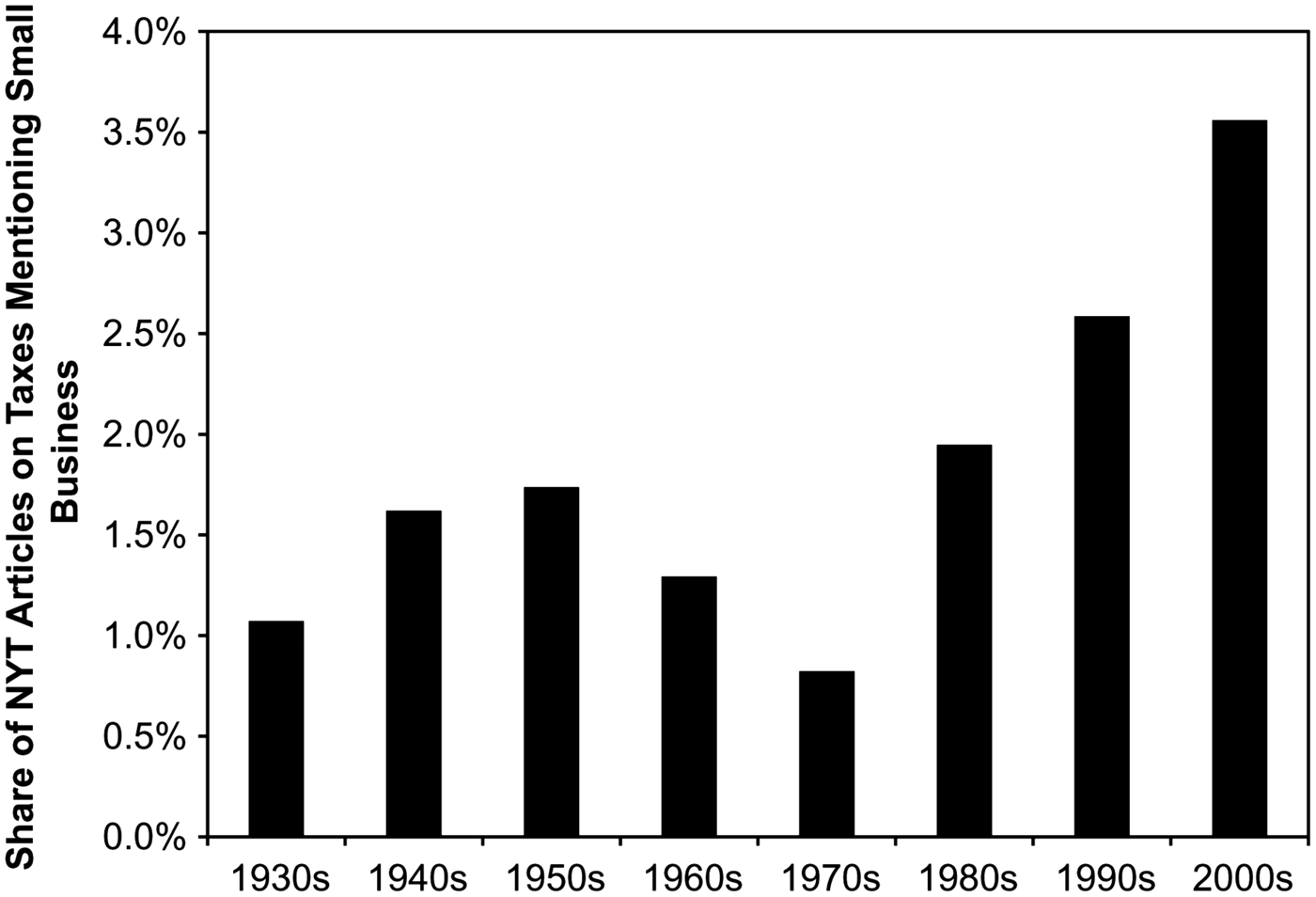
We begin with data from the New York Times on the share, over time, of articles about taxes that also mention “small business” in the body of the article. Two main trends are evident in Figure 1. First, references to small business in the article's coverage of tax policy tend to spike during periods of major tax reform—such as in 1945, 1948, 1958, and especially during the reform debates of the 1980s. Clearly, small businesses have always been an important publicly referenced constituency in discussion of major tax reform. For example, an article as early as 1936 cited the concerns of small business representatives that “the proposed tax on … corporate profits would prevent … little companies from ever becoming large ones.”Footnote 18 But our second finding is that the intensity with which the New York Times references small business and tax policy has changed since the late 1980s. From the 1990s onward, small businesses have been referenced more frequently in stories about taxes. In recent times, evidently, small businesses, their political representatives, and legislators are making the link between small firms and taxes even more frequently than they previously did.
Share of New York Times Articles on Taxes Referencing Small Business.

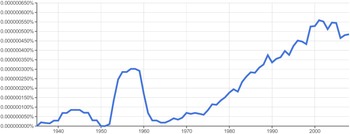
From 2000 to 2009, the New York Times coverage of small businesses and taxes frequently included discussions of the repeal of the estate tax, which commentators argued would benefit “family owned small businesses.” In addition, small business was cited in discussions of tax credits for small business that were part of various stimulus measures under Presidents Bush and Obama, as well as in discussions of the Bush tax cuts, which the Bush administration and its allies argued would benefit small business owners. In all of these debates, small businesses were represented as sympathetic likely beneficiaries of efforts to cut federal taxes. We find a similar pattern when we use Google's Ngram data to expand the scope to all texts published in American English from 1935 to 2008. As Figure 2 shows, references to “small business tax” have increased steadily since the 1970s.
Google Ngram Trend for “Small Business Tax”.

Political discussions parallel these shifts in the media. In the realm of electoral politics, references to small businesses have increasingly focused on the tax burden that small firms face. Examining the Annenberg-Pew Archive of Presidential Campaign Discourse, which includes the transcripts of speeches, ads, and debates for campaigns from 1952 to 1996, we found two suggestive trends.Footnote 19 First, mentions of small businesses were more frequent in the early 1990s than ever before. Between 1952 and 1988, candidates from the two parties mentioned small businesses in only about 1 percent of their public discourse, but the share of mentions jumped to 14 percent in 1992 and 6 percent in 1996. The share of presidential campaign speech mentioning small business in the context of taxes has also increased over time. Between 1952 and 1976, there were virtually no joint mentions of small business and taxes in the same messages, but this changed in 1980. Between 1980 and 1996, two-thirds of the references candidates made to small businesses also mentioned taxes.
For example, Republican Dwight Eisenhower appealed in general terms to small business owners during the 1952 campaign, declaring “I pledge to you my complete interest … to produce the advancement of small business with respect to its labor, the high wages for them, the full share of our productivity for those small businesses, particularly of a governmental character—all of that sort of thing to make certain it remains healthy.”Footnote 20 But later, in 1996, Republican Robert Dole's outreach to small business owners in the 1996 presidential election explicitly and repeatedly made the link to tax policy, especially for chapter-S taxpayers (a point to which we will return below). Decrying President Bill Clinton's recent tax increase on top incomes, Dole argued that “if you're a sub-chapter-S corporation … [you] had about a 30 to 40 percent tax increase…. That's a big, big tax increase.… And 70 percent of the increase would be paid by small-businessmen and women.”Footnote 21
But it has not just been Republicans who increasingly make links between small business concerns and tax policies, and not just Republicans who proudly proclaim their determination to reduce small business tax burdens. When President Clinton boasted of his small business bona fides in the 1996 election, he celebrated small business tax credits: “It is not an accident that we made every small business in America eligible to get a tax cut if they invest more in their business to hire more people, to grow the business, to make America stronger, if they take out health insurance.”Footnote 22
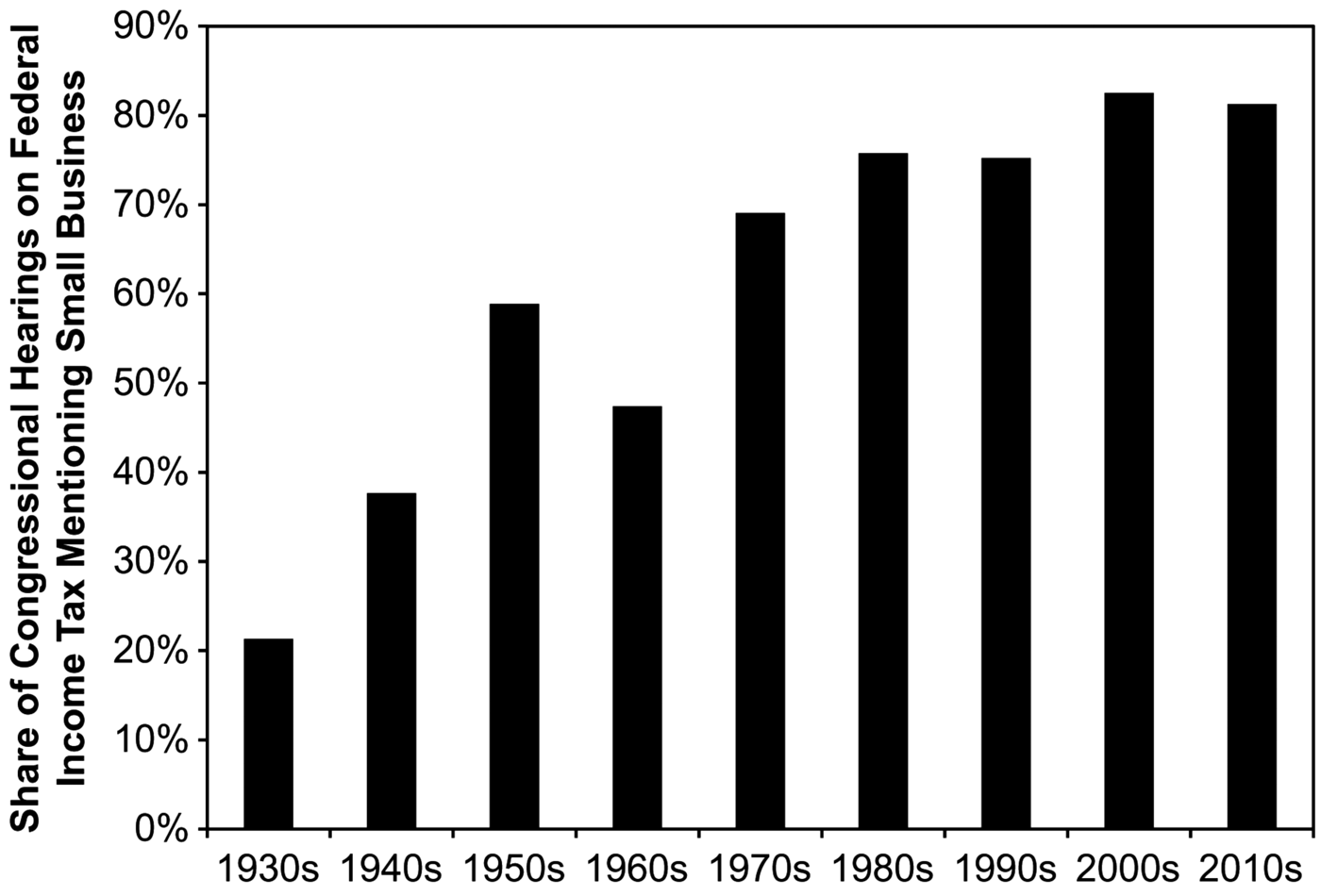
Aside from presidents and presidential aspirants, the tightening linkage between small businesses and taxes can be seen in Congress, by tracking the share of Congressional hearings on the federal income tax that include references to small business. In Figure 3, we see a distinct upward trend over time, with Congressional hearings on the income tax now much more likely than ever to refer to small businesses. Remarkably, during the late 2000s small business was referenced in some 80 to 90 percent of each year's Congressional hearings on the income tax, compared to similar references in only about half of the hearings held in the 1950s and 1960s, and in only 30 to 40 percent of the hearings in the 1940s.
Share of Congressional Hearings on Federal Income Tax Referencing Small Business.

In short, today's more prominent media coverage of small business in tax policymaking reflects what is being said in political campaigns and legislative processes. Recent Congressional hearings in the 113th Congress on taxes have, for example, included references to the Obama administration's efforts to spur small business investment through tax cuts, as well as discussions about how small businesses are taxed through the individual income tax code and testimony on how Internal Revenue Service agents are trained to be cognizant of the special needs of small businesses.Footnote 23 What is more, when Senator Max Baucus and Representative Dave Camp sought to build public support for their tax reform initiative in 2013, they publicized meetings with small business owners airing their tax concerns.Footnote 24
Beyond what politicians and legislators say, moreover, we find that organizational representatives claiming to speak on behalf of small business are increasingly present at tax-policy-related hearings—and, at the same time, participation in tax-policy-related hearings currently represents a substantially greater share of the overall Congressional activity of small business associations than it did in the past. Looking at the National Federation of Independent Business (NFIB), for instance, we find that the group participated in only about 1 percent of tax hearings in the 1970s and 1980s, but its participation rose thereafter to 8 percent of all Congressional income tax hearings. Similarly, the NFIB's testimony on income tax policies increased from about 5 percent of all NFIB hearing participations in the 1970s and 1980s to 75 percent of such involvements in the 1990s and 2000s. The NFIB is clearly much more focused on taxation than it once was.
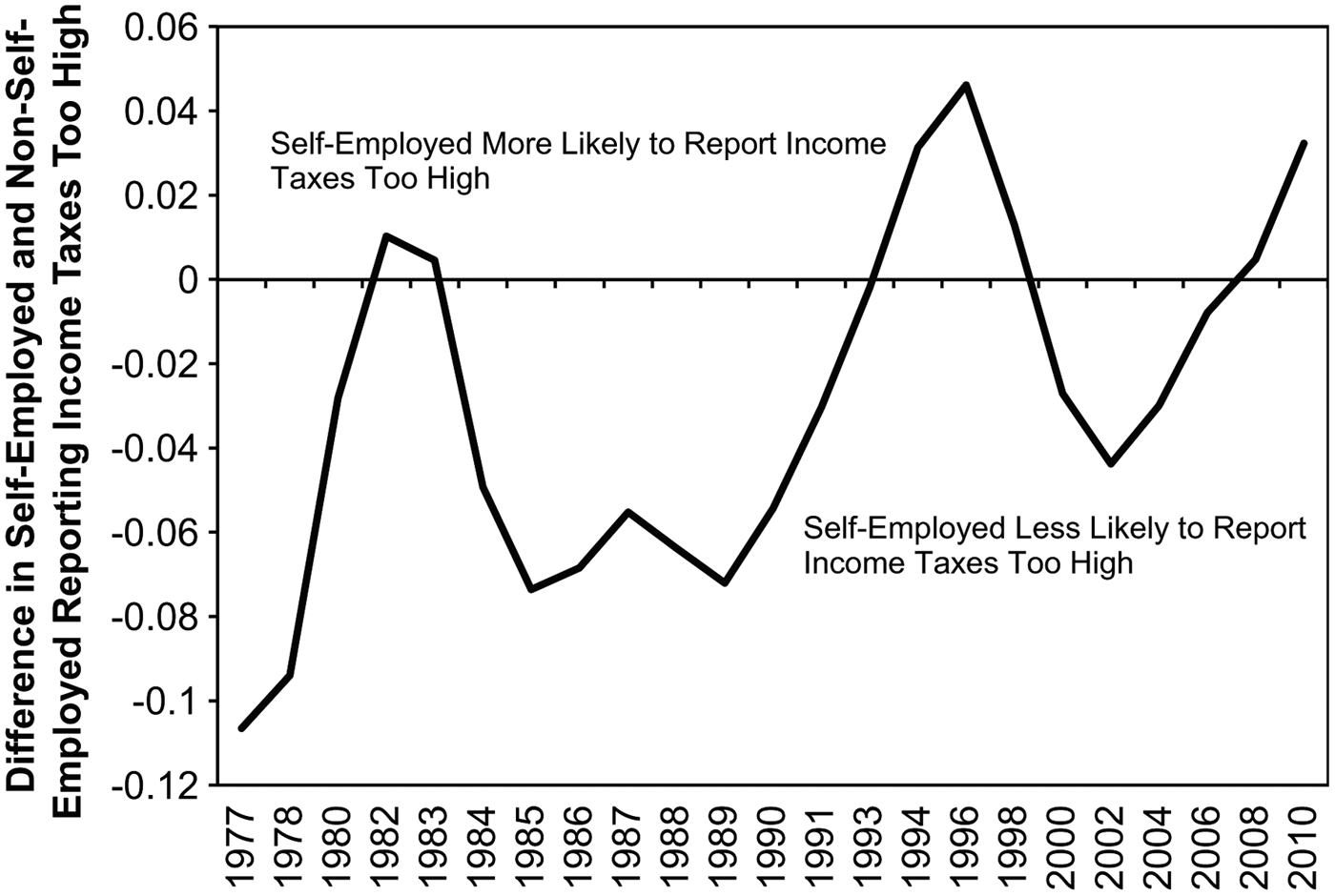
Finally, we explore the opinions of small business owners themselves toward federal taxes. The General Social Survey (GSS) offers an excellent opportunity to trace the changing opinions of small business owners, because the survey has asked consistent questions about perceptions of income tax burdens from 1977 to 2012. The GSS does not identify small business owners directly, but it does ask whether respondents are self-employed, so we use this classification as a rough proxy for small business owners. Figure 4 displays gaps in perceptions of income tax burdens over time, with the numbers graphed representing the share of self-employed workers who reported that their “federal income taxes were too high” minus the share of non-self-employed workers who said the same thing. Values below zero indicate that a greater proportion of the non-self-employed believe that their federal income taxes are too high, while values above zero indicate that the self-employed are more likely to view their federal income taxes as being too high compared to the non-self-employed. Strikingly, the data plotted in Figure 4 show that since the late 1970s, the self-employed have become more likely to report that their income taxes are too high—and the self-employed were especially likely to believe their income taxes were too high during the early 1980s, the mid-1990s, and the mid-2000s.Footnote 25 All of those have been important junctures of tax policy change—a finding consistent with our argument that small business owners have become increasingly mobilized into political debates about the federal income tax.
Perceptions of Federal Income Tax Burdens by Self-Employment Status.

WHY HAS SMALL BUSINESS BECOME MORE MOBILIZED INTO TAX POLITICS?
Have U.S. small businesses—or at least organizations claiming to represent them—become increasingly engaged in tax debates and policymaking simply because small businesses are increasingly prevalent in the American economy? Interestingly, small business has been on the wane in this era of tax politics mobilization, at least small business as defined by employment. According to the U.S. Census Bureau's Statistics of Businesses, the share of employment in enterprises with fewer than twenty paid employees has fallen gradually from 21 percent in 1988 to 18 percent in 2008, and during that same period, the employment share declined from 40 to 35 percent for enterprises with fewer than 100 paid employees. Employment in large enterprises of 500 paid employees or more grew from 46 to 51 percent over the same period. Fewer Americans are thus working in small (and very small) firms now than they once were. So whatever has happened politically is not a mere function of the sheer proportion of the citizenry at work in businesses with few employees.
Our explanation focuses, instead, on strategic and organizational shifts among business organizations maneuvering in the U.S. political and governing system, and on feedback effects of the U.S. tax code on the legal choices and perceived interests of high-income earners. Three key processes have unfolded to boost the actual and symbolic presence of small business in U.S. tax politics.
First, as prior scholarly accounts of the history of corporate involvement in U.S. politics have made clear, the 1970s and 1980s added up to a crucial turning point for business mobilization. Before that time, business interest groups were certainly present in large numbers, but they did not have a highly centralized or concerted presence in Washington. Starting in this era, however, U.S. business interest associations developed larger and more centralized operations capable of mounting steady interventions in Congressional policymaking.Footnote 26 As David Vogel sums up, by the late 1970s “corporations became highly visible and sophisticated participants in the political process. Attempting to influence the political agenda and policy outcomes, they hired large numbers of lobbyists and lawyers, opened Washington offices, established and funded political action committees (PACs), expanded the size of their governmental relations staffs, developed sophisticated strategies for influencing public opinion, and learned how to mobilize the ‘grass roots.’”Footnote 27
Associations representing smaller firms were very much part of this buildup. The NFIB, for example, doubled its membership between 1970 and 1979.Footnote 28 At the same time, even groups more focused on representing large firms—like the U.S. Chamber of Commerce and the National Association of Manufacturers—discovered the political potency of deploying small businesses in their rhetoric and lobbying campaigns. Small businesses are not just a powerful symbolic device in American politics. Equally pertinent, national business organizations could mobilize small business owners in nearly every Congressional district and state to generate the sorts of combined local and national pressures that have historically been crucial for propelling policy shifts in U.S. politics.Footnote 29
David Vogel points to the battle over labor relations reforms in 1977–1978 as a pivotal moment for the conservative mobilization of small business.Footnote 30 During this episode, small business owners coordinated with larger business associations to defeat a labor reform bill, carefully deploying both grassroots and national resources. As an observer of that Congressional battle explained to Vogel, business interests “succeeded in capturing the political center by portraying the issue as a union power grab.… In particular, the elevation of the small businessman to the exalted position of potential victim of big labor—even though the bill's impact on small business would have been minimal—was a skillful exploitation of a key American value. Supporting small business plays well in every state and congressional district (emphasis added).”Footnote 31
Another key development was the unification of business tax lobbying. Before the 1970s, businesses and their groups (and especially small businesses) usually lobbied for separate sectoral or individual tax breaks or subsidies. But in the 1970s, they began to lobby together for across-the-board tax breaks. This transformation was aided by political leaders who, for ideological reasons, wanted to promote tax cuts and garner business for support for such changes.Footnote 32 According to business lobbyists as well as journalists covering tax policymaking in this era, efforts to concert previously disparate interests were originally championed by the Reagan White House and ultimately solidified years later under President George W. Bush.Footnote 33 Contemporary cross-sectoral lobbying for tax cuts on the part of small businesses presents a striking contrast to limitations on small business influence during and after the New Deal because of cleavages among small firm owners operating in different economic sectors.Footnote 34
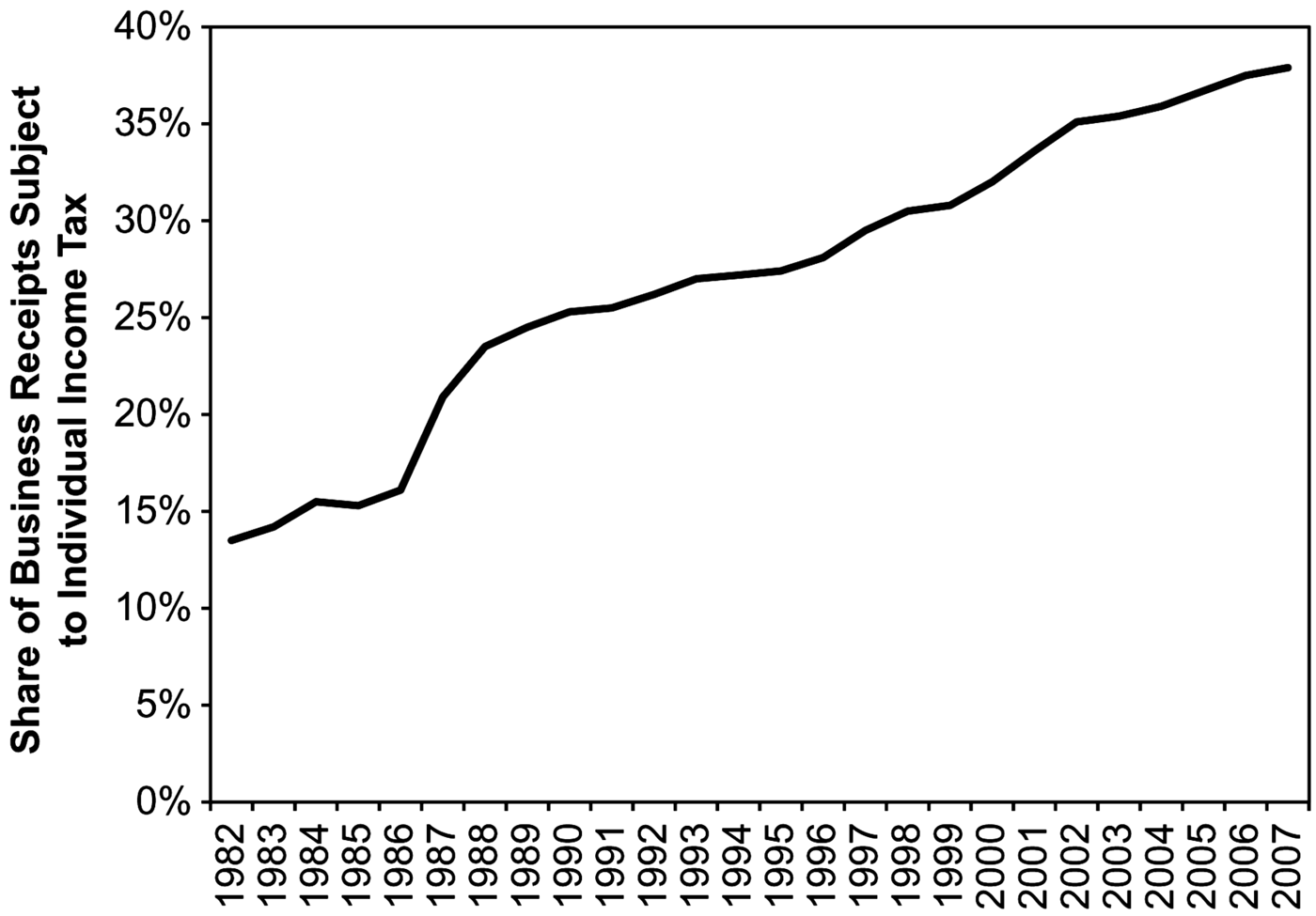
A final important propellant of small business mobilization into tax politics takes us beyond interest group organization and strategy to the impact of earlier tax code changes on later understandings of their interests by high-income earners. Over the past few decades, and especially since the 1980s, a greater proportion of U.S. businesses have organized themselves so that their revenue is taxed through the individual income taxes levied on top earners, rather than through the corporate income tax system. As Figure 5 shows, using data from the Congressional Budget Office, an increasing share of business revenue from the sale of goods and services (that is, business receipts) is taxed through the individual income tax code, not the corporate code.Footnote 35 Why has this happened? The Congressional Budget Office has suggested that changes in federal tax laws that lowered the individual income tax rates relative to the corporate tax rates prompted more and more businesses to pass their receipts through the individual income tax code. The 1986 tax reform, for example, dropped the top individual income tax rate 1.5 percentage points below the top rate of the corporate income tax in 1987 and 6 percentage points below the top rate of the corporate income tax in 1988. These shifts made it appealing for new and existing corporations to opt for pass-through incorporations.
Share of Business Receipts Taxed through the Individual Income Tax.

Here is where expansions in the ranks of “small business” enter the picture. Because of legal restrictions on the number of shareholders they can have, the new pass-through legal entities created for tax advantages tend to be smaller than the typical C-type corporation that is taxed through the corporate income tax code. But the fact that these pass-through corporations tend to be smaller on paper, however, does not necessarily make them “small businesses” in the traditional sense of the concept. Many pass-through entities are not engaging in traditional business activities. They may simply be vehicles to invest in other businesses; or they may be a mechanism for individuals to sell their own services at preferable tax rates; or they may be passive investors. Or they may very well be large companies that are simply incorporated as pass-through entities—like the Tribune Corporation or PricewaterhouseCoopers.Footnote 36 Indeed, pass-through entities with more than $10 million in receipts (or the largest 1.6 percent of all pass-through entities) account for two-thirds of total pass-through receipts.Footnote 37 Putting it another way, only 28 percent of total income received from pass-through entities and sole proprietorships is actually generated by small businesses that employ other workers.Footnote 38
Technical tax changes have given rise to ironic political consequences. Despite the fact that pass-through entities include not just traditional small business but also many other unrelated business activities and organizations, these entities now have a powerful stake in individual income tax rates in a way that they did not before. And the nontraditional pass-throughs can also claim common political cause with “small business” more generally. As already noted, this recent rapid growth of pass-through businesses has occurred against the backdrop of stagnant—and even gradually declining—small business employment in the American economy. The U.S. “small business” sector—energetically mobilized by business interest groups and incessantly celebrated by politicians—is increasingly a sector quite apart from the small establishments envisioned by most citizens. More and more so-called small businesses pushing for lower and lower taxes are, in short, tax vehicles for the well-off and large firms, much more than they are actual small companies employing actual American workers and selling goods and services to American consumers.
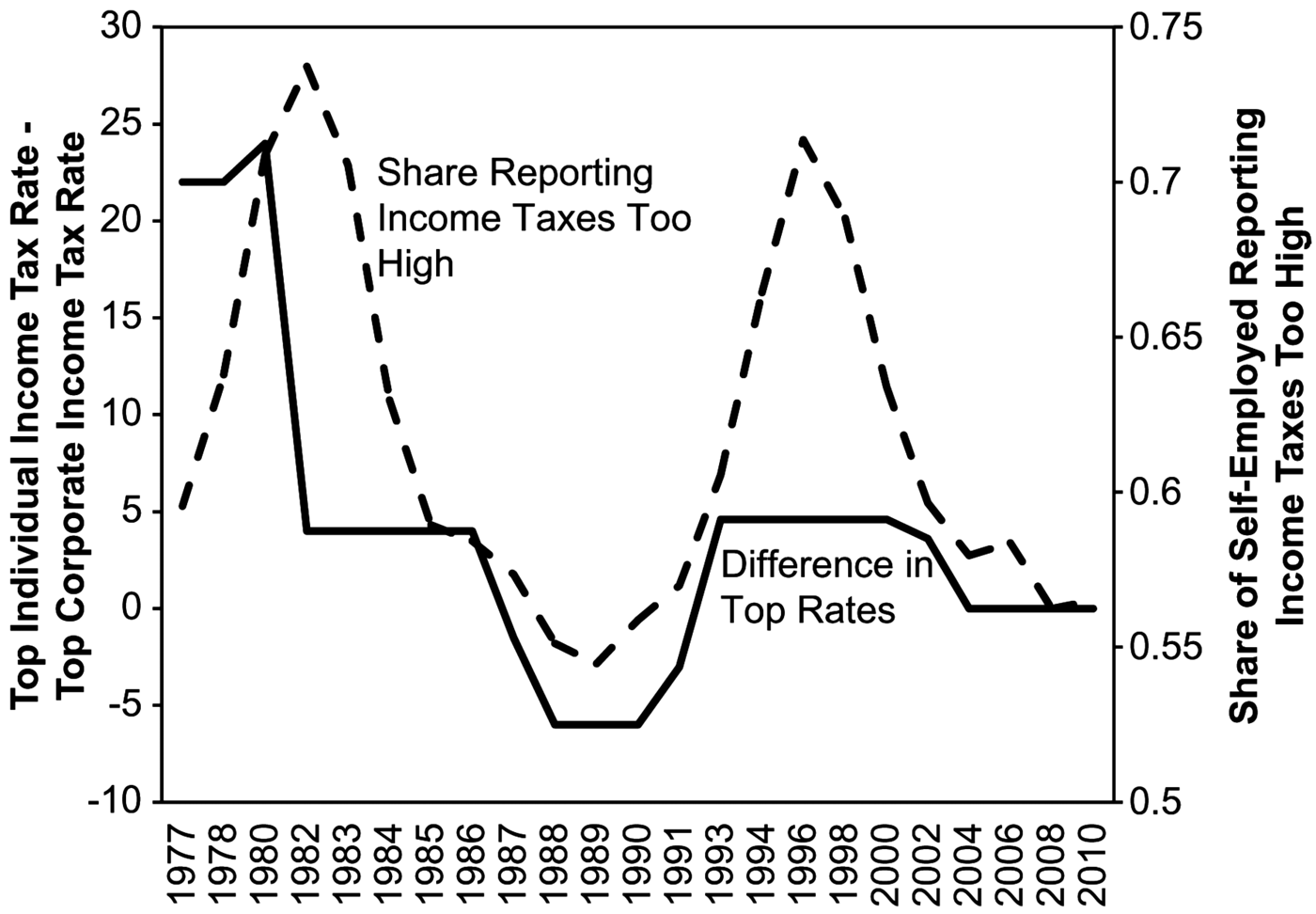
Can we see a direct connection between the rise of pass-through taxation and perceptions of federal income tax burdens among the self-employed? To answer this question, we return to the GSS data to probe how sensitive self-employed respondents are to changes in tax code provisions. On the right axis, Figure 6 plots the share of the self-employed reporting that their federal income taxes are too high (smoothed with a three-year moving average), in relation to trends on the left-axis of the difference between the top rates in the individual and corporate income tax codes. If in fact the growth of pass-through taxation has made the self-employed more attuned to the differences between individual and corporate income tax rates, we should see that the self-employed were more likely to report their income taxes as being too high when the difference between the individual and corporate income tax rates grew larger.
Trends in Self-Employed Tax Opinions and the Tax Code.

This is precisely what we observe in Figure 6. According to the GSS data, the self-employed were more likely to report that their federal income taxes were too high when the top individual income tax rate was higher than the top corporate income tax rate, as it was in the early 1980s and mid to late 1990s. Their discontent may have provided an important political resource to advocates of individual income tax rate cuts during subsequent reform efforts. On the other hand, we see that a smaller proportion of the self-employed felt their taxes were too high as the individual rates were subsequently cut relative to the corporate income rates, first by President Reagan and then by President Bush.
A second conclusion we can draw from these data is that differences between the top individual and corporate tax rates are a better predictor of tax opinions among the self-employed in recent decades compared to previous decades—a change that is consistent with the spread of pass-through taxation practices.Footnote 39 Available evidence therefore supports our hypothesis that the structure of the tax code may have changed the preferences of small businesses and the self-employed toward tax policy. Tax changes encouraged small business owners to become more attuned to top rates in the individual income tax code (and to the relationship of those rates to the corporate income tax code).
In addition to creating a new constituency of firms—both “small business” and not—that were invested in individual income tax cuts, we can speculate that the rising number of pass-through entities enhanced the symbolic political resources available to other advocates of income tax cuts. For instance, we quoted above from Senator Dole's 1996 campaign speech criticizing President Clinton's federal income tax increase precisely because “S-type” small businesses—that is, pass-through businesses—would bear the majority of the increase in the top marginal individual income tax rate. Similarly, years later, President George W. Bush would also repeatedly call during his tax cut campaigns for reductions in the top rate for small businesses filing through the income tax code. As Bush explained, “overlooked in the political hyperbole that tends to take place in our process is the fact that dropping the top rate from 39.6 to 33 percent serves as a stimulus to small business growth in America. The Treasury Department released a report earlier today on small business owners who pay personal income taxes, and small businesses which pay at the highest rate of 39.6. According to the Treasury Department, nationwide there are more than 17.4 million small business owners and entrepreneurs who stand to benefit from dropping the top rate from 39.6 to 33 percent.Footnote 40 ” A lot of the small businesses Bush was referring to were pass-throughs.
The drumbeat on this issue never stops. When Republicans or moderate Democrats claimed that a repeal of the top-end Bush tax cuts would harm small businesses in 2010, they cited the effect on pass-through businesses. Media commentators and pundits also made similar moves when calling for an extension of the top-end Bush tax cuts. Charles Krauthammer, of the Washington Post, claimed that the higher rates called for by President Obama would hurt small business, arguing that “roughly half the income of small businesses (i.e., those filing individual returns) would be hit by this tax increase.”Footnote 41 The NFIB, too, claimed during debates about the Bush tax cut extensions that over 77 percent of their members were structured as pass-through entities and that this was a key reason to keep the top federal income tax rates from returning to their pre-Bush-era rates.Footnote 42
THE CONSEQUENCES FOR DEMOCRATS
So far, we have established that small business, so-called, has become more active in tax politics, especially since the 1980s and 1990s, fighting with and through groups seeking reductions in taxes. But what difference has such small business engagement made—above all, what impact has it had on the ability of the two parties to develop and pass tax legislation? To explore this crucial question, we turn to two important junctures in recent tax politics: the passage of the original Bush tax cuts in 2001 and the subsequent debate over what to do with those cuts when they were legally set to expire in 2010.
The Bush tax cuts introduced major changes to U.S. tax policy, channeling disproportionate benefits to high-income people and thus exacerbating income inequality.Footnote 43 Moreover, the cuts were costly, contributing to large deficits throughout the 2000s.Footnote 44 For these reasons, many—but not all—Congressional Democrats opposed the original enactment of the cuts.Footnote 45 At the time of the original enactment, Congress was very closely divided between Democrats and Republicans, with the latter holding a very slim (and shifting) majority. A key puzzle, then, is the willingness of some Democrats to break ranks with their party and support President Bush and his Republican colleagues in voting for the tax cut legislation. For instance, thirteen House Democrats voted to pass the House's version of the 2001 cuts, and twenty-eight House Democrats subsequently voted for final passage of the cuts in their chamber.
We suspect that pressure from legislators' small business constituents played an important role in explaining the behavior of these Democratic lawmakers. If our suspicion is correct, we ought to observe that representatives from districts with more self-employed individuals subject to pass-through taxation were more likely to support the Bush tax cuts, even after controlling for legislators' ideologies and the overall political orientations of their home districts. Another hypothesis we have sought to test looks at pressures from political organizations representing small business interests. Did such pressures play a role in leading some Democrats to support the tax cuts in 2001, independently of the actual prevalence of self-employed constituents in their districts?
To test these hypotheses, we analyzed the votes of House Democrats and Republicans on final passage of the 2001 tax cuts.Footnote 46 We coded votes for the final package as 1 and votes against the bill, as well as abstentions from voting as 0. We included four explanatory variables. First, we included the share of workers in each lawmaker's district who were self-employed and incorporated as small businesses (outside of the agricultural sector).Footnote 47 Consistent with the theory we have outlined above, we expected that lawmakers with more constituents incorporated as small businesses—especially Democrats in such districts—would have been more likely to support the tax cuts. In addition, to assess the importance of ties between legislators and political organizations representing small businesses, we also included a measure of total donations to each legislator from the NFIB in the previous electoral cycle.Footnote 48
It is important to be clear how we interpreted the NFIB donations variable. We do not claim that donations directly caused legislators to support the Bush tax cuts. Political scientists debate the relationship, if any, between interest group donations and legislative votes. According to the currently dominant wisdom, such donations do not shape legislators' voting patterns; rather, they influence the topics legislators take up at earlier stages in the legislative process, especially in the committees where bills are written and reshaped.Footnote 49 Given these qualifications, we interpret the correlation between NFIB donations and stances on the Bush tax cuts as an overall indication of the nature and strength of the relationship between the NFIB and various legislators. A positive correlation between NFIB donations and votes for the Bush tax cuts would signal to us that the legislators involved had ties to NFIB that bolstered their antitax preferences.
For control variables, we measured legislators' own ideologies using the first dimension of standard DW-NOMINATE scores.Footnote 50 And we also accounted for district political ideologies by measuring Al Gore's presidential vote share in the 2000 election. An extensive past literature has used presidential vote shares as a measure of district-level ideology, and research by Jonathan Rodden and Christopher Warshaw has recently confirmed that it correlates quite well with actual district-level public opinion on a range of issues.Footnote 51
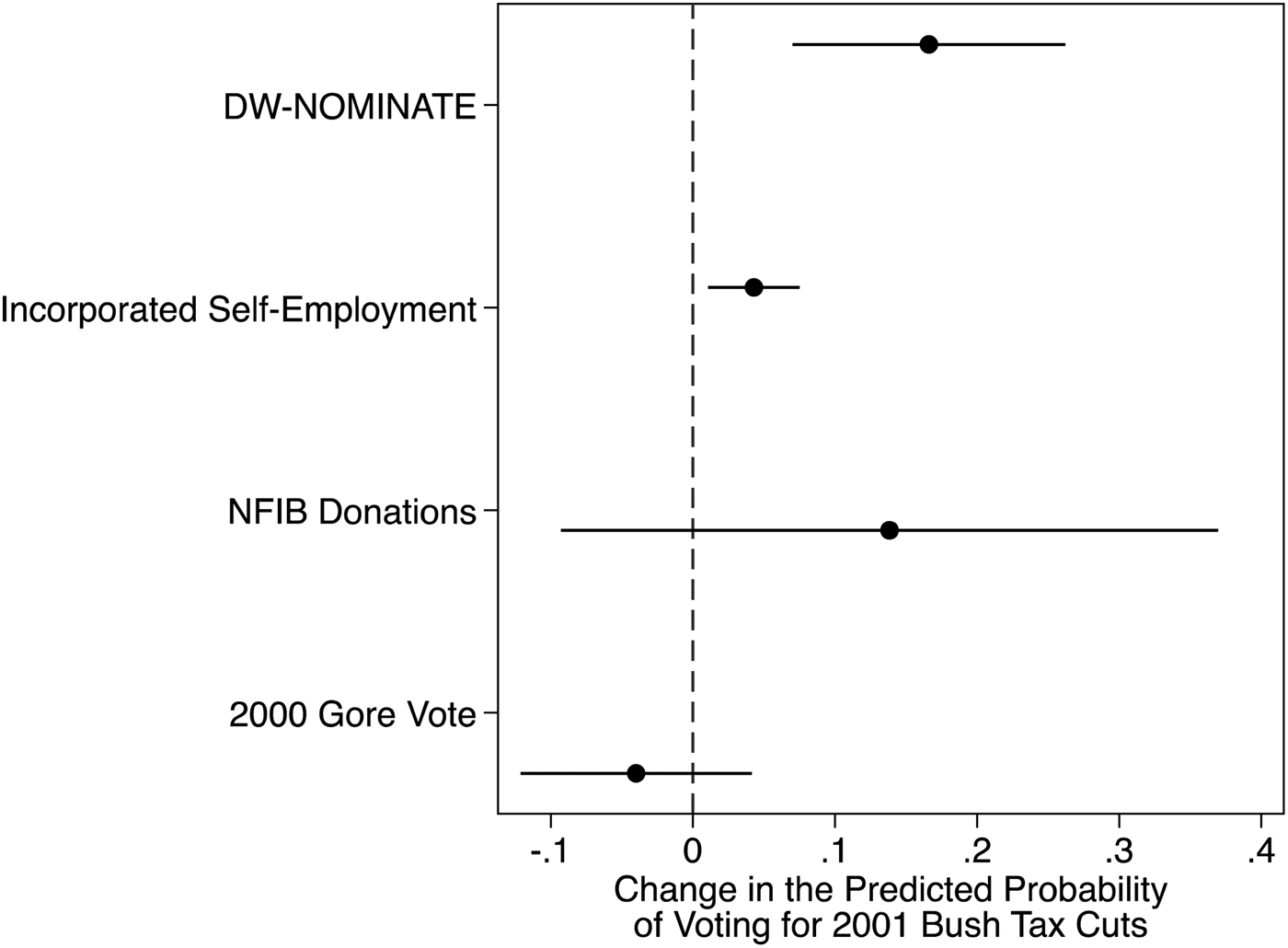
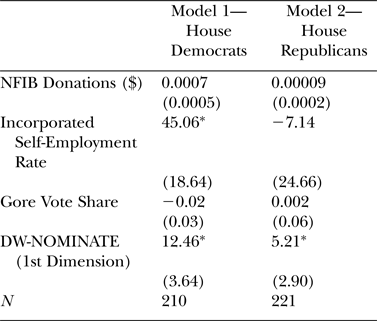
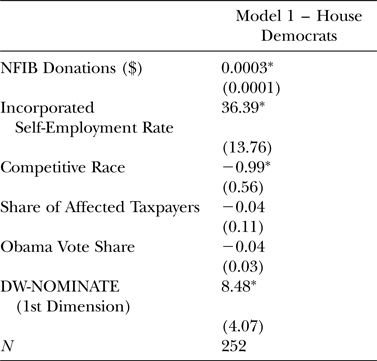
Table 1 shows the results of our logistic regression, with robust standard errors clustered by state. We examine House Democrats and Republicans separately in Models 1 and 2, respectively.Footnote 52 Figure 7 shows the predicted probabilities that are associated with changes in the logistic regression coefficients for the House Democrats (other variables held constant). Two factors emerge as statistically and substantially important predictors of votes from House Democrats on the Bush tax cuts. As anticipated, legislator ideology is a powerful predictor of support for the Bush tax cuts; more conservative legislators were much more likely to support the cuts than more liberal legislators. A move from the 20th to the 80th most conservative member of the Democratic caucus increases the probability that a Democrat would vote for the cuts by 17 percentage points (p < 0.01). (That shift is equivalent to the ideological range between Dick Gephardt and Victor Snyder.)
Determinants of Support for 2001 Bush Tax Cuts Among House Democrats.

Determinants of Support for the 2001 Bush Tax Cuts, Final Passage (Logit Regression Results)

*p < 0.10
Heteroskedasticity robust standard errors clustered on states.
Ideology aside, we found that pressure from small businesses exercises an independent effect on the probability that House Democrats would support the passage of the 2001 cuts. Moving from a district at the 20th to the 80th percentile of workers incorporated as small businesses increases the probability of a Democrat supporting the cuts by 4 percentage points (p < 0.01; we did not find a statistically significant effect for a similar move in NFIB donations for Democrats). In contrast to the Democrats, small business mobilization appears to have little effect on the voting behavior of House Republicans (see Model 2 in Table 1). Neither variation in the prevalence of incorporated small businesses nor ties to the NFIB can explain which Republicans did—and did not—vote in favor of the 2001 Bush tax cuts (ten House Republicans abstained from voting on final passage). Pressure from self-employed constituents who are highly attuned to top-end income tax rates thus appears to produce cross-pressures for the Democrats—but not the Republicans. Such pressures may well have pushed an important contingent of Democratic legislators toward more antitax stances than suggested by their ideological orientations and the overall partisan orientations of their districts. Though we do not present the results here, we found similar results examining the second round of Bush tax cuts in 2003.Footnote 53 We also examined whether our small business variables explained House Democrats' votes on other, non-tax-related legislation as a placebo test and reassuringly found no clear correlations.Footnote 54
Moving on to the 2010 tax debates gives us an even more compelling look into cross-pressures on Democrats in Congress. During the passage of the original Bush tax cuts in 2001, Democrats were on the defensive, responding to agendas that were being developed by the Bush White House and the Republican caucus that controlled Congressional votes and agendas. But what happened once Democrats regained control of the presidency and Congress in 2009, and thus had putative capacity to enact their own reforms to the tax system? After all, President Barack Obama had campaigned throughout the 2008 election in part on a promise to repeal the Bush tax cuts for very high earners (families with incomes over $250,000), and when the original Bush cuts expired by law in 2010, Democrats appeared to have many factors working in their favor to realize Obama's promise. Their party controlled Congress with even larger margins than President Bush enjoyed in 2001, and the slated legal expiration of the Bush cuts gave Democrats a clear reason to revise them and generated leverage to use in negotiations with Republicans (since taking no action would lead all of the Bush tax cuts to disappear). Public opinion in 2010 was generally was in favor of President Obama's proposal to repeal the Bush-era income tax cuts for incomes over $250,000.Footnote 55 And finally, most mainstream economists considered this to be a prudent step, given that the upward-tilted Bush cuts added to the federal deficit and created a weaker stimulus for economic recovery than would other measures, such as extended unemployment benefits and a more generous food stamp program.Footnote 56 Even with all of these advantages, however, Democrats ultimately did not act on the Bush tax cuts in 2010, instead opting for a full—and costly—extension of all of the cuts for another two years. Thus the puzzle that emerges from this episode is why Democrats failed to take action on the cuts.
As debates unfolded in 2010, early and vocal opposition from two groups of moderate House Democrats became especially critical to the Democratic impasse. By coming out very publicly against the position of Democratic House Speaker Nancy Pelosi and the Obama White House in the fall of 2010, the moderate Democrats in question ensured that there would not be a vote on repeal before the blowout 2010 midterm elections (which led to Democrats losing sixty-three House seats and six Senate seats); debates after the elections put lame duck Democrats in a much weaker position. Who were the dissident Democrats that publicly opposed changes in the Bush tax rates at this critical juncture—and what can we figure out about why the relevant House Democrats defied Congressional Democratic leadership, the White House, and the national public opinion that seemed to support (or at least allow) changes in Bush's original top-end cuts? To answer this question, we examine the characteristics of the members who signed one or both of two publicly issued letters calling for a full extension of the Bush-era tax cuts for top incomes, and we developed a regression analysis to predict whether or not each of the 255 members of the Democratic House caucus in the 111th Congress signed the letters.Footnote 57 Twenty-two representatives who signed one letter were coded 1; twenty-eight representatives who signed both were coded 2; and Democratic legislators who signed neither letter were coded 0 on our dependent variable.
Our principal causal variables are the same as those used in the previous analysis of votes on the 2001 Bush tax cuts. We recorded donations House members received from the NFIB in the most recent electoral cycle, plus the share of workers in each member's district who were self-employed and incorporated as small businesses (outside of the agricultural sector).Footnote 58 We also measured whether a representative was in a competitive race in the upcoming election (as measured by the Cook political report), since this was a common reason given by pundits for why some House Democrats opposed the repeal of the top-end tax cuts.Footnote 59 We considered the share of taxpayers in a member's district that would have been affected by a repeal of the top-end Bush tax cuts (that is, households with adjusted gross incomes of $250,000 or more), to see whether legislators might simply have been responding to constituents' economic interests, not just to the needs of small business in particular.Footnote 60 To check out another reason often cited by pundits, we controlled for President Obama's 2008 vote share in a member's district as a measure of presidential popularity and general political ideology among a representative's constituents.Footnote 61 Last, to be sure that votes were not just a simple function of ideology, we controlled for legislator ideology using the first dimension of DW-NOMINATE.
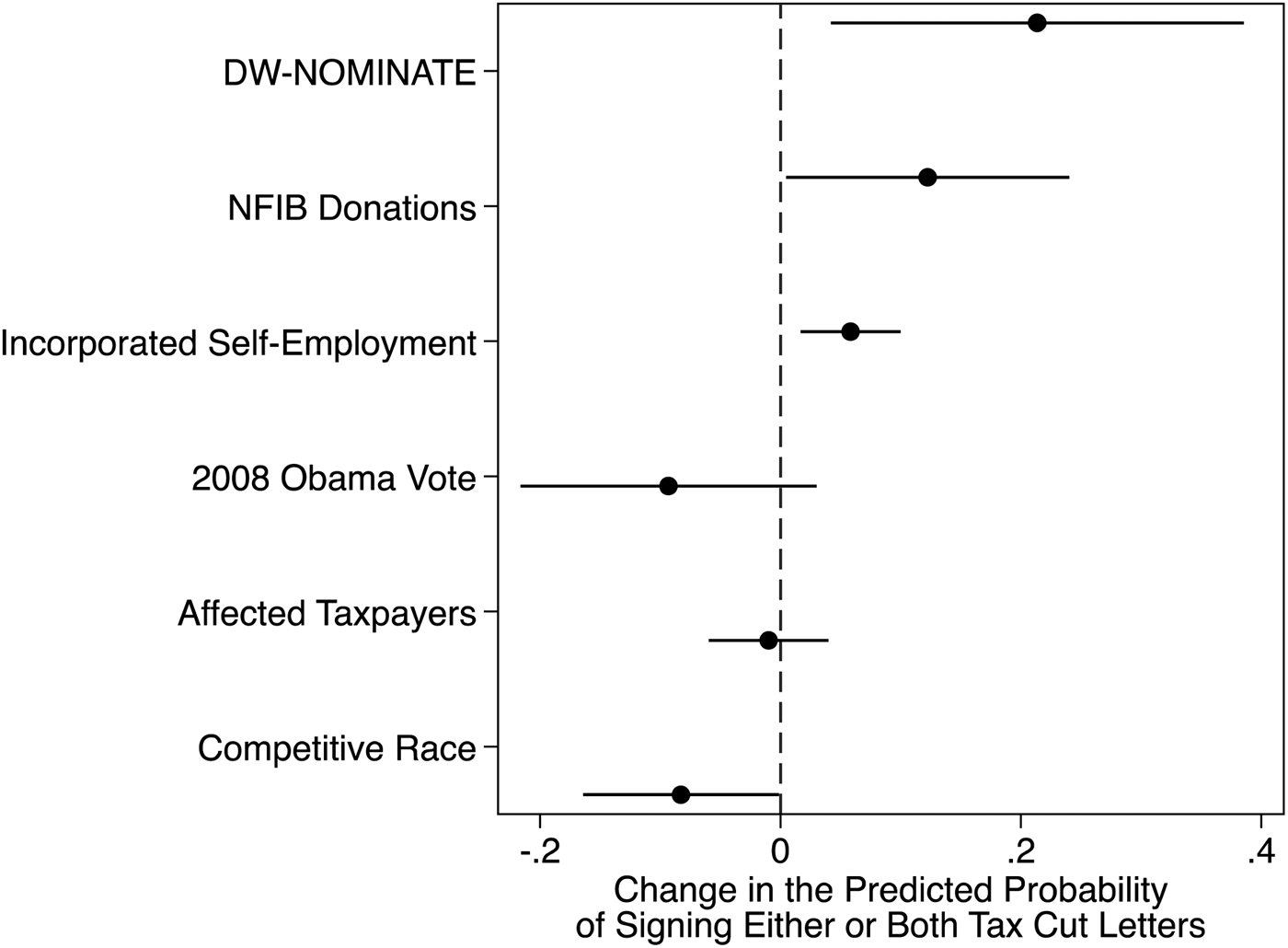
We present the results of our ordered logit regression in graphical form in Figure 8, plotting the change in the predicted probability of a House Democrat signing either or both pro-Bush tax cut letters that is associated with a change in each of the independent variables (and full results, including coefficients and standard errors for the regression, appear in Table 2).Footnote 62 The results of this analysis line up well with the arguments we have developed in this article. Legislators' ideologies, unsurprisingly, emerge as the best predictor of public stances toward the Bush tax cuts in 2010: moving from the 20th to the 80th most conservative Democrat increased the probability of his or her having signed one or both of the Bush tax cut letters by 21 percentage points (p < 0.05). (That shift is equivalent to the ideological range between Mel Watt and Earl Pomeroy.) But also relevant are NFIB donations, even independently of ideology and district preferences. Moving from zero NFIB donations to a $3,000 donation (the median donation given to Democrats) increased the probability of a legislator signing one or both letters by 12 percentage points (p < 0.05). Finally, apart from NFIB donations, we also find an effect from the prevalence of incorporated small businesses in members' districts. Democrats whose districts had a greater share of incorporated small businesses were much more likely to have signed one or both letters, with a move from the 20th to the 80th percentile increasing the probability of letter signing by 6 percentage points (p < 0.01).
Determinants of Support for Full Bush Tax Cut Extension in Fall 2010 Among House Democrats.

Determinants of Support for Full Bush Tax Cut Extension in Fall 2010 Among House Democrats (Ordered Logit Regression Results)

* p < 0.10
Heteroskedasticity robust standard errors clustered on states.
Taken together with the findings about determinants of votes on the enactment of the original Bush tax cuts, these results from 2010 provide strong evidence that small business organizational and constituent factors have introduced an important cleavage on tax politics issues within the Democratic—but generally not the Republican—Congressional caucus. In order to maintain their credibility with small business groups, many House Democrats seem to have found it important to support the Bush tax cuts, both at the time of their original enactment and again when the cuts were up for renewal in 2010. Our data analyses confirm patterns that are consistent with what we heard in interviews we conducted with staffers to House Democrats, who reported that the NFIB was particularly active in lobbying for the tax cut extension in 2010 and underlined how important many representatives felt it was to be perceived as fully supportive of small businesses.Footnote 63 The key sentiment was expressed by a senior Democratic House aide, who observed that “like it or not, most independent voters—and even conservative Democrats—think the President is anti-business, and fighting with Republicans about their small business canard is counterproductive at this stage for most members in red states.”Footnote 64
CONCLUSION
In U.S. politics since the New Deal of the mid-twentieth century, Democrats have tended to stand for using government to raise the economic security of lower- and middle-income Americans. In the post–World War II period through the 1960s, they could depend on steadily rising federal tax revenues to fund a plethora of social and economic programs that, however imperfectly, brought about such improvements for many groups in U.S. society. Republicans of the Eisenhower and Nixon era, moreover, tended to argue about the level of taxes, not seek to radically slash or eliminate tax collections, including from business and the most privileged income earners.Footnote 65 But starting in the 1970s, the contemporary Republican Party took shape, and one of its key tenets became opposition to taxes, indeed efforts to steadily reduce tax collections at the high end of the income ladder.Footnote 66 For years, Democrats offered little resistance, concentrating instead on maintaining many core government programs from the past, even if paying for them meant increasing federal budget deficits.Footnote 67 Only in the past decade have Democrats as a national party come to realize that revenues have to be sustained, with Democratic presidential aspirants and many Congressional Democrats beginning to resist new or continued reductions in taxes. But it has not been easy for the Democratic Party to gain a unified voice on tax issues, especially not in the face of increasing mantras that “taxes hurt small business.”
In this article, we have gone further toward unpacking what is going on with small business mobilization into tax politics than any previous analysts have been able to do. We have probed the changing role of business organizations as they have become more concerted champions of tax cuts as a benefit to businesses, especially small businesses, and we have shown how changes in the tax code have created new allies for a small business sector that is actually slightly declining as a source of employment in the larger productive economy. The changes we have posited and empirically demonstrated have reinforced Republican unity in pushing for lower taxes—and, crucially, they have at the same time made it harder for Democratic politicians and legislators to unite in support of adequate revenue collection by the federal government. Small business mobilization—organizational and symbolic—has been at the fulcrum of the cross-pressures on Democrats that render their party often hesitant, divided, and ineffective in the ongoing great tax debates of our time.
Aside from providing an empirical account of patterns in U.S. tax politics, our analysis has important implications for the study of American political economy. In particular, it underscores the relevance of examining how the mobilization of organized interests affects the policies pursued—and not pursued—by political parties, as well as the need to take seriously the notion of parties as coalitions of such groups, rather than simply teams of legislators. In addition, we point to the need to examine how changes in the structure of seemingly obscure tax rules and corporate governance practices—such as the treatment of corporate income flows—can have deep consequences for the behavior of legislators and for the course of public policy by mobilizing powerful economic interests through political feedbacks. Last, our work contributes to a growing literature examining the how the reorganization and mobilization of business interests have reshaped the nature of economic policymaking in contemporary U.S. politics.Footnote 68 Further scholarly attention ought to be directed to the ways in which different firms of all sizes and from all sectors participate in business associations, how membership has changed over time, and how such participation both reflects and shapes firm political preferences and strategies.