1. Introduction
Ontological questions have long been of concern to biological systematists and philosophers of biology. What should we accept as real features of the organic world, and why? Often this concern focuses on species: what are they, and how do we identify and individuate them? While there is no consensus on how we should answer these questions, there has been progress in understanding what sorts of answers we can or cannot give and why. The search for a single species criterion has made clear, for instance, the great diversity of species and processes that operate relative to these species, the difficulty in applying the various taxonomic criteria to this diversity, and the need to distinguish operational and theoretical concepts (Mayden Reference Mayden, Claridge, Dawah and Wilson1997). There is an analogous, but far more neglected ontological concern: what are characters, and how do we identify and individuate them? My intentions here are to establish first, the significance of this concern, second the inadequacy of the principles operating in the individuation of characters, and third, the implications of this inadequacy for phylogenetic inference.
In Section 2, I argue that character individuation is significant in that on the now standard approach to systematics, known as cladistics, characters are the “data” of phylogenetic inference. The basis for this approach is a parsimony principle that is used to determine evolutionary relationships among taxa. According to the parsimony principle, the best phylogenetic hypothesis is the one that requires the fewest evolutionary changes—changes in character states. Usually this is understood to be an unequivocal method of hypothesis evaluation. But since it is possible to individuate characters in different ways, with different parsimony implications (section 3), and there does not seem to be an unequivocal character individuation criterion (section 4), it seems that parsimony evaluations can have multiple outcomes. If so, then phylogenetic inference, as it is typically practiced, may well be subjective or arbitrary (section 5). This, of course, would be an unfortunate outcome if we believe that the accepted method of phylogenetic inference is a satisfactory way to discover real evolutionary relationships. I conclude (section 6), by arguing that the appropriate response to this ambiguity in character individuation is to rethink how characters are conceived.
2. Characters and Phylogenetic Inference
Biological systematists are confronted with two basic tasks, the “diagnosis” of species (the grouping of organisms into species, and the “diagnosis” of higher level taxa), and the placement of species into a hierarchical taxonomic system. On the standard approach to phylogenetic inference, cladistics, both tasks are accomplished on the basis of the characters possessed by the organisms under consideration. (This is true of other approaches—phenetics and evolutionary systematics—as well, although they will not be my focus here.) Randall Schuh explains in his 2000 textbook on taxonomy:
Taxa bear characters, and it is by these attributes that they are recognized (diagnosed; defined). It is the characters that are usually viewed as the data of systematics, what Ross (1974) referred to as the “material basis of systematics.” (Schuh Reference Schuh2000, 20)
Taxa are diagnosed at the species level by the possession of a unique combination of characters, or by the possession of a single unique character—an evolutionary novelty or autapomorphy. The basic idea is that in order for a new species to be formed, there must be at least one character (or a set of characters) possessed by members of that species that is not possessed by closely related species. The identification of this character (or set of characters) allows the identification of species.
This same general approach is used to “diagnose” supraspecific taxa—place species into genera, families, etc. The cladistic taxonomic system is based on phylogeny, or “sister grouping”—which means that species are grouped on the basis of relative recency of common ancestry. (In cladistic terms, taxa are monophyletic: each taxon contains all and only those species descended from a single common ancestral species.) The various mammalian species, for instance, are placed in Mammalia because they are all believed to have relatively recent common ancestry. This classification is done on the basis of similarities, or shared characters. The species that comprise Mammalia do so, for instance, because they share unique characters—“hair,” “milk glands,” and “the secondary jaw articulation with the three auditory ear ossicles” (Ax Reference Ax1987, 149). It is presumed that these characters are present in the species comprising Mammalia, and can therefore diagnose Mammalia, because they had a single origin in a species ancestral to all. In other words, it is assumed that these similarities are homologies.
Of course it is possible that instead of originating in an ancestral species, and being homologies, these similar characters might have originated independently in two or more of the various species. If so, then they would not be homologies, but homoplasies. They would not therefore indicate a close evolutionary relationship. “Wings” for instance, seemed to have originated independently in birds, insects, and bats, and therefore does not indicate common ancestry, but indicates a similar adaptive response instead. One basic task of phylogenetic inference then, is to distinguish the similarities that indicate common ancestry from those that do not. Cladists find their solution to this problem in a principle of parsimony.
The cladistic parsimony principle is usually understood to demand that we minimize assumptions of evolutionary change: the best phylogenetic hypothesis is the hypothesis that requires the fewest assumptions of change. One prominent cladist, E.O. Wiley, identifies the parsimony principle as a principle of simplicity, then argues that it requires we “prefer” the hypothesis that requires the fewest “ad hoc statements” of change (see also Janvier Reference Janvier and Pollard1984, 55; Farris Reference Farris1984, 330; Eldredge and Cracraft Reference Eldredge and Cracraft1980, 67):
Two or more hypotheses frequently compete against each other in explaining the same data. In such a case, the principle of simplicity (parsimony) is used to pick the hypothesis that explains the data in the most economical manner.… For our purposes in phylogenetics the most parsimonious or simplest hypothesis is that with the fewest ad hoc statements that explains the full array of available data. And we shall prefer such a hypothesis over others that compete for the same data. (Wiley Reference Wiley1981, 20)
This is, in effect, a rule to assume maximum homology, since homologies originated in a single common ancestor and require only a single assumption (ad hoc hypothesis) of change. Homoplasies, on the other hand, have independent origins in separate ancestors, and therefore require a minimum of two assumptions of change.
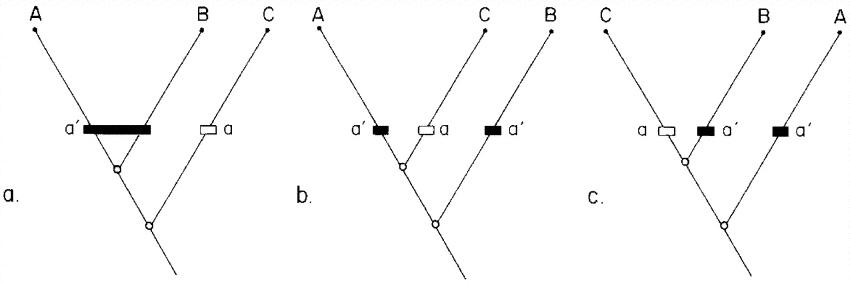
This parsimony assumption of homology can be understood in its simplest form, as applied to a group of three taxa. Eldredge and Cracraft (Reference Eldredge and Cracraft1980, 68) illustrate this parsimony approach relative to a three taxa A, B, and C, and single similarity—a (see Figure 1).
From Eldredge and Cracraft (Reference Eldredge and Cracraft1980)

In these three figures (a.-c.), there is a single character a, with two character states, a—the ancestral state, and a′—the derived state. Since a is the ancestral state, its presence does not require a change, whereas, a′ represents a change because it is not the ancestral condition. The branching order in these cladograms indicates relative recency of common ancestry. (This grouping by common ancestry, known as “sister grouping,” is indicated by partheses.) In cladogram a., the hypothesis (AB)C implies a minimum of one change (represented by the solid bar), because a′, the derived stated, originated once in the ancestor of A and B. In cladograms b. and c., there are a minimum of 2 changes each, one in A and one in B (as homoplasies). Since the parsimony principle demands that we minimize assumptions of change, it requires that we accept the hypothesis (AB)C in cladogram a.
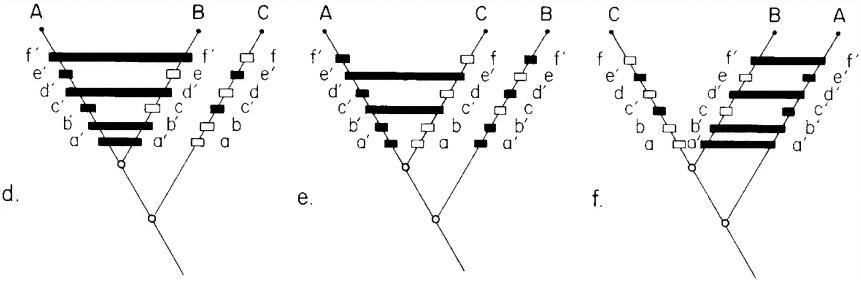
But suppose there are multiple characters, and not all of the characters favor the same phylogenetic relationship via the parsimony principle. In three additional cladograms, d.—f., we see how parsimony can be used to resolve conflicting distributions of derived homologies (see Figure 2).
From Eldredge and Cracraft (Reference Eldredge and Cracraft1980)

In d., phylogenetic hypothesis (AB)C is favored by four derived homologies (long bars) a′b′d′ and f′, implying four changes, but is opposed by two, c′ and e′, which must be reinterpreted as homoplasies, implying four more changes, for a total of eight changes. In e., (AC)B, there are two derived homologies (two changes) but four homoplasies (eight changes) for a total minimum change of ten. In f., (CB)A, all six characters must be homoplasies, indicating a minimum of twelve total changes. Of these three possible phylogenetic hypotheses then, (AB)C is the most parsimonious (eight minimum changes), followed by (AC)B (ten minimum changes) and (BC)A, twelve minimum changes. Parsimony mandates that we prefer the hypothesis that requires the fewest changes, and therefore again picks out (AB)C as the preferred phylogenetic hypothesis.
The cladistic method, then, employs the parsimony principle to provide the initial grouping of taxa and resolve conflicting similarity distributions. One advantage of this approach is that it seems to be unequivocal. Like simple addition, cladistic parsimony unambiguously specifies the outcome at each step. No preference or desire can change the fact that 2 + 3 = 5, and 5 is less than 6. And no preference or desire can change the fact that the phylogenetic hypothesis (AB)C above requires 8 changes, while the hypothesis (BC)A requires twelve changes, and since eight is less than twelve, (AB)C is therefore more parsimonious than (BC)A. Since (AB)C is the most parsimonious hypothesis of the three, the other hypotheses must be rejected.
3. Indeterminacy in Character Individuation
The application of parsimony is typically far more complicated than this simplified account suggests however. There can be, for instance, more than three taxa, and three competing hypotheses. And typically, there are many more characters in the analysis, perhaps fifty to one hundred or more. While these complications do not by themselves cast doubt on the legitimacy of the cladistic approach, there are other complications that are more troubling. What seems to be most philosophically troubling is the indeterminacy in character individuation that can cast doubt on the satisfactory application of the principle.
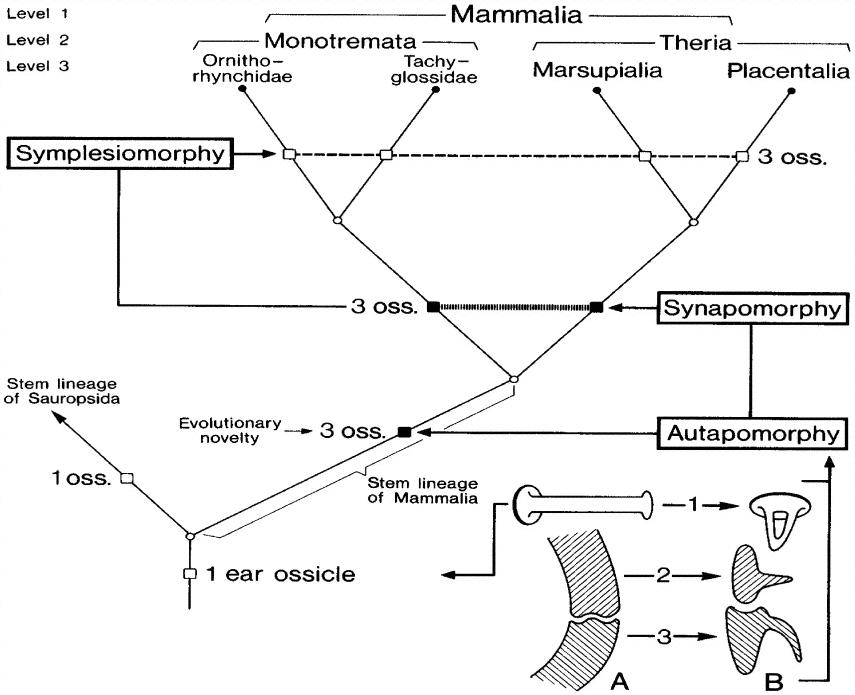
Given a set of characters, the cladistic method might be unequivocal, hence “objective,” in the manner suggested, but the outcome of the method depends on the formulation of the data set. Suppose we have a set of three taxa, A, B and C, and following cladistic procedures and applying parsimony, we propose the phylogenetic hypothesis (AB)C, which is favored by five (putative) homologies, while only four favor (AC)B, and only one favors (BC)A. Short of discovering new similarities, it seems we are forced to accept the most parsimonious hypothesis, (AB)C. In the example above, Mammalia was diagnosed partly on the basis of the presence of the character “three ear ossicles.” But how many changes this character represents, depends on how we characterize it. We could individuate three ear ossicles as one character, as Ax (Reference Ax1987, 145) does in Figure 3. Here there is one character with two character states “one auditory ossicle” and “three auditory ossicles.” (The change in character state is represented by the solid square identified as an autopomorphy.) But we could also individuate each ossicle as a single character, with alternative character states for “columella auris,” “incus,” and “malleus” (numbers 1, 2, and 3 in the diagram respectively). We might even pick out various features (bony protrusions, etc.) of each ossicle as characters to be coded and included into parsimony considerations.
From Ax (Reference Ax1987). The characterization of a particular feature state (three auditory ossicles in the middle ear) at three consecutive levels of the phylogenetic system of the mammals. Autapomorphy at level 1 = taxon Mammalia. Synapomorphy at level 2 = the adelphotaxa Monotremata and Theria. Symplesiomorphy at level 3 = adelphotaxa Ornithorhynchidae and Tachyglossidae; adelphotaxa Masrsupialia and Placentalia. Diagrams: A. Plesiomorphous condition of the Tetrapoda with one auditory ossicle (1 = columella auris) and the primary jaw articulation (2 = quadrate, 3 = articular). B. Apomorphous condition of the Mammalia with three auditory ossicles (1 = columella auris, 2 = incus, 3 = malleus). After Wake (1979, Fig. 8.9).

If we were to regard ‘three ear ossicles’ as a single character—a single similarity between A and C—then (AB)C is still the hypothesis picked out as most parsimonious, and favored by cladistic methods. But if we instead regard ‘three ear ossicles’ as three characters, individuating each ossicle, then another hypothesis, (AC)B, would be the most parsimonious hypothesis, being favored by six derived homologies.
Other traits can be decomposed similarly, as some phylogeneticists recognize. Peter Ax, for instance, admits that the spiny coat of the Australian spiny anteater can be considered as either one character, or alternatively many characters—each spine being one character. If we regard the spiny coat as a single characteristic, then we might not place the spiny anteater and porcupine in a particular sister grouping. But if we regard each spine as a character, then given the number of spines possessed by each, we may be forced to infer that the anteater and porcupine are closely related. Ax rejects this possibility:
It is very evident that each single spine is a concrete structural part of the species which is very effective in defense. Nevertheless, a single spine cannot be recognized as a separable element in the pattern of features of the spiny anteater. That can only be done for the coat of spines in its totality. (Ax Reference Ax1987, 107)
Unfortunately, Ax does not say here what principle he is using to reject the possibility that each spine can be considered a separable element—a character—and count as a single similarity in parsimony computations.
This ambiguity in character individuation is not just a problem for morphological traits like spiny coats, ear ossicles and mammary glands. Behavioral characters are subject to the same ambiguity in individuation. Open-mouth threat displays in snakes (Green Reference Green and Hall1994, 337), orb weaving in spiders, displaying behavior in wood storks (Eldredge and Cracraft Reference Eldredge and Cracraft1980, 46), and social behavior in wasps (Minelli Reference Minelli1993, 161) have all been employed in phylogenetic inference. It should not be difficult to see how we can identify multiple individuation schemes relative to threat displays, orb weaving, displaying, and social behavior in various, inconsistent ways. Eldredge and Cracraft, for instance, analyze the “displaying” behavior employed by wood storks as being comprised of “gaping,” “balancing,” and “preening” (Eldredge and Cracraft Reference Eldredge and Cracraft1980, 46). Why shouldn't we individuate each of these component behaviors as a character? Then we would have three characters rather than one. How many characters should we count here?
Likewise, we can generate different individuation schemes relative to molecules—nucleotides, nucleotide sequences, proteins or genes. A strand of mitochondrial DNA or amino acid, for instance, can be divided up in an indefinite number of ways, each with different parsimony implications. We might, for instance, individuate each change in a nucleotide as an evolutionary change. Or we might individuate on the basis of protein coding, where a character would be a sequence that codes for a particular protein. But schemes based on nucleotide changes and protein coding are inconsistent and would have different parsimony indications. The important fact is this: different character individuation schemes can be expected to produce conflicting outcomes—favoring different phylogenetic hypotheses and the taxonomies that result from them.
4. Principles of Individuation
That there are multiple ways to identify and individuate characters is certainly a problem for parsimony-based approaches to phylogenetic inference, since hypothesis evaluation depends on which individuation scheme is chosen. If choice of individuation schemes were itself arbitrary or subjective, then it would seem that hypothesis evaluation would be arbitrary or subjective. Perhaps we could avoid this possibility, if there were to be an unequivocal principle of character individuation.
In the passage quoted above, Ax suggests that characters or features must be “separable.” A few pages earlier, he had made a similar suggestion:
The word “feature” … refers to those objects in an organism which an observer notices, understands, recognizes, or establishes as separable elements. In the organism itself these are referred to in speech as attributes, special traits, characters or characteristics. (Ax Reference Ax1987, 105)
Unfortunately, Ax does not explain precisely what he means by “separable element.” Perhaps he means only that anything that can be distinguished from other “things” is separable.
Only “a separable, comprehensible, delimitable peculiarity or characteristic” … can validly be a feature of an organism which can be distinguished from other corresponding units, or perhaps better, elements, of one and the same organism. (Ax Reference Ax1987, 105)
But distinguishability cannot prevent this ambiguity. Individual spines, for instance, can be distinguished, as can groups of spines (“tail spines” from “back spines,” for instance). We can also distinguish structures on each ear ossicle as characters, on the basis of shape, size, density, etc. Separability, in this sense, shows little promise of providing an unambiguous character individuation criterion.
Perhaps we could interpret “separability” in terms of functions. Features would then be separable because they have distinct functions. But a functional criterion is still ambiguous. We could individuate a functional complex or we could individuate functioning elements in that complex. Grande and Rieppel recognize this problem:
A functional morphological complex is composed of several structural components integrated into a common functional context. As the utility of such a structural complex for cladogram building is investigated, the question arises as to whether the whole functional complex should each be coded as a single character, or whether its component elements should be coded as separate characters. (Grand and Rieppel Reference Grand and Rieppel1994, 246)
We could therefore individuate three ear ossicles as a single character by virtue of its functioning as a whole, or we could individuate each ossicle for its function within this whole. Likewise, the various characteristics of each ossicle could be individuated according to their functions.
Other criteria seem no better. Douglas Futuyma seems to suggest developmental independence might serve as a criterion, but then rejects it because of difficulties in individuating developmental pathways:
Two seeming characters may be just two aspects of a single feature if they are consistently correlated; differences in shape are often simple consequences of differences in size, because of allometric growth and are not independently varying characteristics. But knowing what characters are independent is difficult in practice. Is each bristle on a fly a separate character, or all the bristles together a single character? … And unit characters may be hard to define even conceptually. Developmental biology tells us that organisms consist not of independently formed unit characters, but of interacting developmental pathways, and the interactions among the pathways can themselves change in evolution. (Futuyma Reference Futuyma1979, 151)
Developmental independence fails as an individuation criterion because it is equivocal in just the way the other criteria are. Surely it is possible to identify developmental pathways at different levels. We might in some sense, for instance, identify a developmental pathway for each ear ossicle as well as for the complex of ossicles itself. This might seem to be a promising approach because we could then presumably individuate on the basis of the genes controlling the development. But the genes themselves interact in complex ways. It is unlikely that we will find this to be a satisfactory solution.
Other proposed criteria seem equally problematic. Wiley argues for a “communication” criterion. Any characteristic that can be communicated—described, measured, counted, etc.—is a “real” characteristic:
A character is a feature (attribute, observable part) of an organism. In practical applications, a character is a part or attribute of an organism that may be described, figured, measured, weighed, counted, scored, or otherwise communicated by one biologist to other biologists. (Wiley Reference Wiley1981, 8)
And:
If one worker can communicate to another worker about an attribute or feature of an organism or a group of organisms, then the colleague is likely to be informed and consider the character as “real.” (Wiley Reference Wiley1981, 116)
Eldredge and Cracraft similarly suggest that a character is anything that can be named:
Similarities must be named, and it is these names that we call “attributes” or characters.” (Eldredge and Cracraft Reference Eldredge and Cracraft1980, 43)
Earlier they had suggested a role for perception. Perhaps we name characters, because we can correctly perceive them as features of organisms:
Upon initiating a comparison of organisms, a systematist utilizes perceived similarities to choose those attributes (characters) of the organisms that will then be used for the more detailed comparisons leading to construction of a cladogram. Thus, the choice of characters involves a perception of similarity, i.e., a perception of comparable form and spatial relationships relative to other features of other organisms. In fact, more fundamental, subconscious perceptions probably precede even this elementary level of comparison, and perhaps the basic perceptions are those of “top,” “bottom,” “anterior,” “posterior,” and so on. Eventually, at some stage in the thought process, the characters are sufficiently similar to be accepted as the “same” character.… There is, seemingly, an infinite regress involved in our perception of similarity, and thus perhaps it can be claimed that biologists will compare that which is comparable and will not compare that which is so different … as to be termed “not the same, and not worthy of comparison.” (Eldredge and Cracraft Reference Eldredge and Cracraft1980, 29–30)
It should be obvious that this turn toward the perceptual basis of naming is no help at all. The ear ossicles in two species may be correctly perceived as similar in proportion, shape, or in any other way, but that fact still does not tell us whether there are three similarities or one, any more than it tells us whether there are three characters or one.
Eldredge seems to recognize that ambiguity in character individuation is problematic, and suggests that we should therefore not take the data too seriously.
Another potential objection to the simple, straightforward use of parsimony is that it may cause us to take the data too seriously. For instance, it has been argued that highly integrated functional complexes might be taken as a single megacharacter rather than, say, 20 to 50 separately enumerable characters. In such a situation, one's view of parsimony is likely to oscillate wildly as one grapples with various anatomical regions and views them as functional complexes. (Eldredge Reference Eldredge, Cracraft and Eldredge1979, 173. emphasis mine)
Eldredge suggests that this problem can be solved by gathering more data:
Probably the best way to test a series of conflicting cladograms is to gather additional data (i.e., other characters), which amounts to an ongoing application of the principle of parsimony. However risky raw parsimony may be, we are still better off if that is our primary criterion. (Eldredge Reference Eldredge, Cracraft and Eldredge1979, 173)
It is not obvious, however, why new characters will be any better than the original character set was. More data is no solution. Perhaps we should agree with the skepticism of Grande and Rieppel, who lament that “we can never know, in an objective way, what a ‘shared character’ is” (Grande and Rieppel Reference Grand and Rieppel1994, 238).
5. Subjectivity in Character Individuation
In the preceding passage, Eldredge does not seem to acknowledge how serious his admission is that parsimony may “cause us to take the data too seriously”. One advantage claimed by cladists over competing methods was that their method was “objective” because it forced the acceptance of the most parsimonious phylogenetic hypothesis, and the rejection of all other hypotheses, regardless of our preferences or desire. Cladists have contrasted the rigor of their method with the method used by the main rival method, evolutionary systematics. Often this criticism focuses on the use functional analysis to weigh characters—decide which characters are better indicators of phylogeny (Ridley Reference Ridley1986, Cracraft, Reference Cracraft1981). This approach, it is argued, can be subjective. Philippe Janvier (see also Farris Reference Farris1984; Eldredge and Cracraft Reference Eldredge and Cracraft1980, 66–67, 189; Eldredge Reference Eldredge, Cracraft and Eldredge1979; Cracraft Reference Cracraft1981, 28–31) claims, for instance, that:
The bitterest pill for evolutionary systematists is that cladistics prevents one building up phylogenies according to personal feelings. Cladistics provides rules, based on logic, and a comparative biologist who rejects these rules can be compared with a chemist who rejects Mendeleev's periodic table. (Janvier Reference Janvier and Pollard1984, 56)
The idea of this objectivity argument is that the application of the parsimony principle to the data provides a rule that forces the acceptance or rejection of hypotheses, just as simple addition forces us to a certain conclusion. No preference or desire can therefore play a part in hypothesis evaluation. No one can, it is presumed, save a preferred phylogenetic hypothesis by weighing more heavily the characters that favor that hypothesis. In short, the cladists see a primary advantage of their method to be the fact that it forces phylogeneticists to take the data seriously. So Eldredge's admission, that parsimony might cause us to take the data too seriously is a significant concession.
This ambiguity in character individuation is a serious problem for the application of parsimony. If there is no satisfactory way to tell how many changes a phylogenetic hypothesis presupposes, there is no satisfactory way to determine how parsimonious that hypothesis is. At best, we should doubt that our judgments about the relative parsimony of hypotheses are well grounded. At worst, we might doubt that there are any facts about the relative parsimoniousness of particular phylogenetic hypotheses. If so, parsimony judgments would then be arbitrary or subjective. In either case, we cannot establish relative degrees of parsimony. The heart of the problem is this: There is no accepted principle of character individuation that can unambiguously determine the data set—the set of characters that factor in parsimony considerations. Phylogeneticists might well identify and individuate similarities in such a way as to license the phylogenetic inference they desire or prefer. If so, it is unclear how the application of parsimony can provide a satisfactory basis for phylogenetic inference.
There are, incidentally, other possible sources of subjectivity in the formulation of the data set. Even if there were an unequivocal principle of character individuation, decisions must still be made about which characters to include in the data set. Randall Schuh explains:
Traditionally, morphology at the macroscopic level has formed the basis for most recognized taxonomic characters. More recently, DNA and amino-acid sequences have become “standard” character sources for many groups, augmenting classical morphology. Behavior and products of behavior also enjoy a place as legitimate sources of character data. (Schuh Reference Schuh2000, 89)
The first question is whether to include molecular, morphological, or behavioral characters. That question is apt to be answered differently by those phylogeneticists who have different training and inclinations. Molecular phylogeneticists, are, unsurprisingly, more likely to include molecular characters. Traditional morphologists are more likely to use morphological characters. And within this group, there is variation. Vertebrate morphologists typically rely on muscles and skeletal structure for their characters, while invertebrate morphologists are more likely to focus on genitalia. More recent trends have been toward characters based on neuroanatomical patterns and sperm morphologies (Wake Reference Wake, Grand and Rieppel1994, 174). The specific behavioral characters to include in a data set will similarly vary among phylogeneticists.
What do we do with all of these diverse sets of characters? One possibility is to include all possible characters in a single data set. This solution is problematic however, as Novacek explains.
One of the most controversial issues in phylogenetics is whether or not data from diverse sources should be combined in a single data set. This approach is emphatically favored by Kluge … who advocates the incorporation of “total information” or “total evidence” as the valid source of phylogenies and classifications. Swofford … expressed concern that the independent contributions of different data sets will be obscured if they are combined.… There are concerns that the huge numbers of characters resident in nucleotide sequences will simply swamp out the signal from a smaller set of albeit compelling morphological traits. (Novacek Reference Novacek, Grande and Rieppel1994, 119)
The first problem with this “total evidence” approach, as indicated in this passage, is that not all characters seem equivalent. Each nucleotide might conceivably count the same in parsimony considerations as a single, complex morphological character like “3 ear ossicles.” The second problem is that if we include both molecular characters and morphological characters, we might be introducing a redundancy. Certain genes, for instance, are responsible for the development of particular morphological traits. If we count both, we seem to be counting the same character twice.
Further, there are multiple algorithms for determining overall parsimony—the “Camin-Sokal method,” the “Wagner method,” “Dollo parsimony method,” and “Nonadditive Fitch optimization” (Schuh Reference Schuh2000, 117; Felsenstein Reference Felsenstein, Duncan and Stuessy1985, 171), each of which typically picks out different phylogenetic hypotheses as the most parsimonious. So which hypothesis is most parsimonious depends not only on character individuation schemes, and choice of characters for the data set, but also on which parsimony algorithm is used.
Those who wish to defend the widespread use of cladistic parsimony in phylogenetic inference should surely be concerned. The lack of first, a single unambiguous character individuation criterion; second, a principle guiding the formulation of the data set; and third, a single parsimony algorithm, suggests either that we cannot determine the relative parsimoniousness of phylogenetic hypotheses, or that there are no facts about the relative parsimoniousness of phylogenetic hypotheses. It is hard to see how in either case, cladistic parsimony is a satisfactory principle of hypothesis evaluation. Does this mean that phylogenetic inference, as it is typically practiced today, is fatally flawed? If so, a lot of resources are being misspent on a misguided approach to phylogenetic research.
This problem in character individuation is particularly troubling for the cladistic approach to phylogenetic inference because of its reliance on a parsimony principle. But competing approaches, insofar as they rely on identifying and individuating characters, are vulnerable as well. Evolutionary systematists like Ernst Mayr, for instance, seem to be employing an ambiguous character criterion as well: “We understand by taxonomic character any attribute of an organism (or better, of any group of organisms) by which it may differ from other organisms” (Mayr Reference Mayr1942, 20). Groups of organisms, after all, can be compared in multiple nonequivalent ways, depending on the choice of character schemes. (We can for instance, compare on the basis of each individual ear ossicle—or the complex of ossicles.) And if, as Mayr indicates, “the more characters two animals have in common, the closer we generally group them in a system” (Mayr Reference Mayr1942, 21), the ambiguity in character individuation will lead to taxonomic ambiguity. Nor do pheneticists seem to avoid ambiguity. Sneath and Sokal, for instance, claim that “the ruling idea is that each character state should contribute one new item of information” (Sokal and Sneath Reference Sokal and Sneath1963, 66). But until an unequivocal account of what could count as an “item” of information is given, this criterion is unsatisfactory. Ambiguity in character individuation threatens to be a problem for these approaches as well.
6. Conclusion
This problem in character individuation is a philosophical problem in that it demands that we think about an ontological category—what counts as a character. But it is no mere philosophical problem. Which hypothesis we accept as the best phylogenetic hypothesis depends on how we individuate characters. But if we have no satisfactory grounds for preferring one character individuation scheme over another, it is unclear why we should regard our evaluation of phylogenetic hypotheses as anything more than a reflection of our predispositions or biases. The outcome of phylogenetic inference therefore seems as much a consequence of illegitimate nonscientific factors as it is a consequence of legitimate scientific factors. It may seem, for instance, that sociological factors such as the political influence of particular scientists, institutions or subdisciplines within science, comes to determine decisions about first, character individuation and then, classification. To ignore this problem in character individuation would give ammunition to the social critics of science, who have been arguing that science is really only politics. If we wish to avoid this conclusion, we need a satisfactory account of character individuation. And that we do not yet have.
While it is not yet clear what prospects there are for the formulation of a satisfactory character individuation criterion, and I can only give the vaguest indication of where we should look for one, we can draw some tentative conclusions from the considerations here. We can, for instance, as in the debate over species concepts, rule out some approaches. The debate over species concepts made it clear that a purely phenetic species concept is inadequate, given the phenetic variability of individual organisms in development and across environments, sexual dimorphism, and polymorphisms within population. Observation alone, therefore, is an unpromising basis for the identification and individuation of species. Likewise, some of the proposed character individuation criteria that seem most obviously to fail are those that are based on “mere” observation. Ax's suggestion quoted above, “that the word ‘feature’ … refers to those objects in an organism which an observer notices” is therefore unpromising. Observation alone is unlikely to give any guide to the resolution of a dispute about character individuation since we can “notice” characters in conflicting character schemes. If so, the attempt to ground phylogenetic inference in pure observation is misguided.
But we need not be limited to just this sort of negative conclusion. The goal of phylogenetic inference is the reconstruction of the branching order of the evolutionary past. A satisfactory character individuation scheme—and character concept—must surely function to support that goal. What that involves is a project worthy of pursuit.