INTRODUCTION
Seamounts are relevant seafloor structures, which may have different origins and are present in all oceans. Seamounts interact with currents and create flow complexities, which depend upon current speed, water mass stratification and seamount morphology (see White & Mohn (Reference White and Mohn2004) for a complete review). Seamount effects on circulation include internal wave generation, eddy formation, local upwelling and closed circulation patterns called Taylor columns, which affect the productivity of the offshore ecosystems on a relatively small scale (Boehlert & Genin, Reference Boehlert, Genin, Keating, Fryer, Batiza and Boehlert1987). As a consequence, seamounts’ surroundings are expected to attract pelagic top predators due to the higher abundance of potential prey (McClain, Reference McClain2007; Morato et al., Reference Morato, Varkey, Damaso, Machete, Santos, Prieto, Santos and Pitcher2008, Reference Morato, Hoyle, Allain and Nicol2010). The importance of seamounts for benthic fauna and bottom fish is vastly documented (Boehlert & Sasaki, Reference Boehlert and Sasaki1988; Koslow, Reference Koslow1997; Morato et al., Reference Morato, Cheung and Pitcher2006); however, they have only recently been recognized as possible hotspots of pelagic biodiversity (Morato et al., Reference Morato, Hoyle, Allain and Nicol2010).
In an open ocean context, the effects of seamounts on pelagic top predators, such as tuna, swordfish and pelagic elasmobranchs in general, have been described by Morato et al. (Reference Morato, Varkey, Damaso, Machete, Santos, Prieto, Santos and Pitcher2008), while Kaschner (Reference Kaschner, Pitcher, Morato, Hart, Clark, Haggan and Santos2008) found evidence of the attracting effect on cetaceans. It was demonstrated that seamounts may attract pelagic visitors, which aggregate within a variable distance (5–15 nautical miles (NM)) from the summit depending on the seamount's characteristics (e.g. peak depth, elevation, circulation, etc.), and also to the considered species. While one recent study found a high concentration of seamounts (227 structures) in the basin (Würtz, Reference Würtz2014), the potential attracting effect of seamounts for pelagic fauna in Mediterranean Sea is poorly investigated. As already acknowledged for the open ocean, studies on Mediterranean seamounts have mainly investigated the benthic habitat (e.g. Danovaro et al., Reference Danovaro, Corinaldesi, Luna, Magagnini, Manini and Pusceddu2009; Pusceddu et al., Reference Pusceddu, Gambi, Zeppilli, Bianchelli and Danovaro2009; Bo et al., Reference Bo, Bertolino, Borghini, Castellano, Covazzi Harriague, Di Camillo, Gasparini, Misic, Povero, Pusceddu, Schroeder and Bavestrello2011; Covazzi Harriague et al., Reference Covazzi Harriague, Bavestrello, Bo, Borghini, Castellano, Majorana, Massa, Montella, Povero and Misic2014), while only Gannier (Reference Gannier2011) and grey literature documents are available on the pelagic life around and over Mediterranean seamounts.
Shedding light on the importance of these structures at the Mediterranean level is particularly important since seamounts are potentially subjected to many different disturbances affecting both biotic and abiotic resources. Biotic resources are usually exploited by fisheries, which consider seamounts as a target for offshore activity, while abiotic resources are focused on the exploitation of seabed minerals, rare earth elements and hydrocarbon extraction (Hein et al., Reference Hein, Conrad and Staudigel2010). Moreover, affected seamount communities are very slow to recover from disturbances (Clark et al., Reference Clark, Rowden, Schlacher, Williams, Consalvey, Stocks, Rogers, O'Hara, White, Shank and Hall-Spencer2010). This makes the evaluation of the role played by seamounts at the basin level extremely important since, in the context of a particularly fragile system with unique physiographic and biological characteristics and a high anthropogenic pressure on its habitats, such as the Mediterranean Sea (Myers et al., Reference Myers, Mittermeier, Mittermeier, da Fonseca and Kent2000; EEA, 2006; Viettia et al., Reference Viettia, Albertellia, Alianib, Bava, Bavestrello, Benedetti Cecchi, Bianchi, Bozzo, Capello, Castellano, Cerrano, Chiantore, Corradi, Cocito, Cutroneo, Diviacco, Fabiano, Faimali, Ferrari, Gasparini, Locritani, Mangialajo, Marin, Moreno, Morri, Orsi Relini, Pane, Paoli, Petrillo, Povero, Pronzato, Relini, Santangelo, Tucci, Tunesi, Vacchi, Vassallo, Vezzulli and Wurtz2010), seamounts may play a fundamental role as hotspots of endemism and biodiversity. For these reasons, seamounts have been recently listed as possible ecologically and biologically significant areas (EBSAs) in the global marine realm (CBD, 2009).
Aiming to fill the gap of information about Mediterranean seamounts, the present study focuses on the determination of the attraction effect of seamounts on some pelagic species in a Mediterranean Sea sub-basin: the Tyrrhenian Sea. This area is characterized by a high number and diversity of structures categorized by different dimensions, morphologies and depths (Würtz, Reference Würtz2014). In order to collect information about their attractiveness, two dedicated extensive surveys were carried out in 2013 and 2014 aiming at visually observing pelagic species in the Tyrrhenian sub-basin. Sightings were analysed in order to quantitatively assess the seamounts’ effect.
MATERIALS AND METHODS
Study area
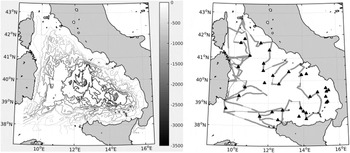
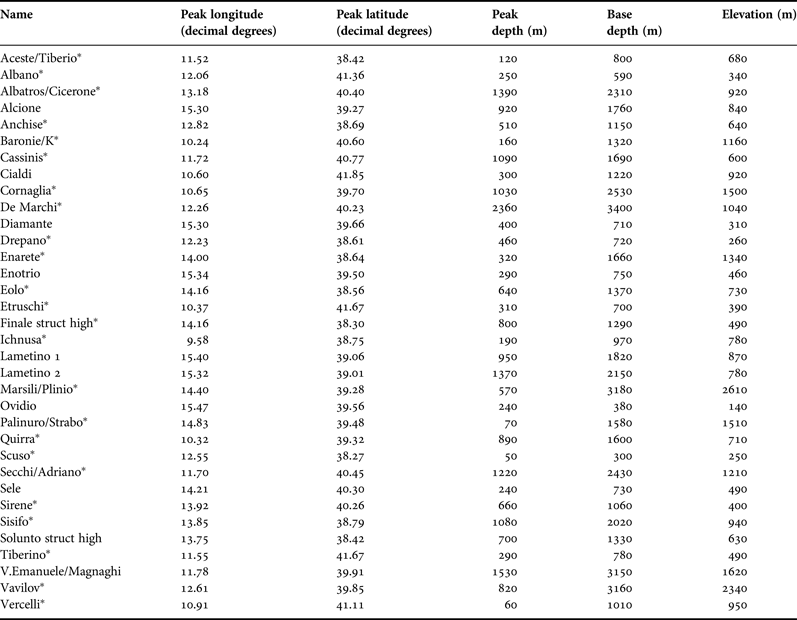
The study area ranged from 9.1° to 16° E and from 37.6° to 42.9° N comprising the southern part of the Tyrrhenian Sea (Figure 1). A previous study (Würtz, Reference Würtz2014) listed as Mediterranean seamounts any geographically isolated topographic feature on the seafloor taller than 100 m, including the ones whose summit regions may temporarily emerge above sea level, but not including features that are located on continental shelves or that are part of other major landmasses (Staudigel et al., Reference Staudigel, Moyer, Garcia, Malahoff, Clague and Koppers2010). Since our aim was the identification of the effects of seamounts on the pelagic domain, only seamounts higher than 1000 m (Menard, Reference Menard1964) or reaching at least one-third of the water column depth were considered in this analysis. 34 seamounts (Figure 1 and Table 1) met this criteria.
General bathymetry of the study area (left) and Tyrrhenian Sea seamounts (black triangles) and tracks (grey line) covered during sampling campaigns (right). The thick grey lines identify tracks covered during daytime and with observers involved in the sighting routine.

List of 34 considered Tyrrhenian seamounts and main characteristics. Seamounts with an asterisk were sampled during 2013 and 2014 campaigns.

Data collection
Two sampling campaigns were carried out during August 2013 and 2014. 3250 miles were covered overall, while 1620 NM were covered with an on-board crew actively engaged to detect animals’ presence on sea surface (hereinafter, on sighting effort) (Figure 1). 24 seamounts were sampled (Table 1).
Sampling campaigns were performed on a 15 m long sailing boat equipped with an 80.2 Hp engine. During sampling, cruising speed was maintained at an average of six knots. Sighting effort was conducted only under adequate weather conditions (Douglas sea state 3 or lower) and during daytime (from 6.00 to 22.00).
Visual surveys were conducted by four trained observers. Each observer scanned continuously a specific sector (0° to 90°, 90° to 180°, 180° to 270° and 270° to 360°). A fifth researcher on-board was dedicated to recording the boat track using a GPS device and noting details (e.g. species identification, group size, associations with other species and behaviour) when a sighting occurred. During sighting, the planned track was temporarily dropped and animals were cautiously approached aiming at the clear identification of species, abundances and main behaviour and to collect photographic documentation. As soon as all the identification procedures were completed the boat was brought back on the planned track and sighting effort protocol was resumed. To avoid double counting, data from the astern crew (from 90° to 270°) have been removed from the analyses.
Vessel tracks and sighting locations were recorded using a GPS (Garmin ETREX), which was set up to record a track point every 30 s.
Sightings were grouped into four main taxa: cetaceans, sea turtles, seabirds and pelagic fish.
Data analyses
The track covered on-effort was divided into 50 m segments (approximately 60,000 segments overall), and each track segment was considered a presence segment if a sighting was performed on the way; otherwise, it was considered an absence segment. Both presence and absence segments were associated with their distance from the closest seamount peak. Distances have been calculated with Euclidean distance formulae adapted to the geoid (spherical law of cosines).
Both absence and presence track segments were grouped in function of the distance from seamounts. 12 classes of 5 NM intervals from 0 to 60 NM were considered to obtain two distributions (one of presence track segments and one of absence track segments).
Randomization tests
In order to determine the influence of seamounts on the animals’ spatial distribution, we verified the hypothesis that animals occurred closer to the structures’ peaks than expected by chance.
To this purpose, one-tailed randomization tests were carried out on the observed distribution of distances of presence segments for each observed taxon (Manly, Reference Manly1997). The randomization test was applied to compare the distances from the seamounts observed at each taxon's sighting location with the distribution obtained from random locations (equivalent to the number of sightings of each taxa) within the whole set of absence track segments. This procedure was repeated 10,000 times per taxon to avoid misinterpretation due to the random selection of absence segments. The two presence and absence distance distributions were compared using a Kolmogorov–Smirnov (KS) similarity test. The two-sample KS test is used to determine whether two samples might be from the same distribution. The KS test is a commonly used goodness-of-fit test (Conover, Reference Conover1980), and is based on the following test statistic:
 $$Ks = \max \vert O(x) - R(x) \vert $$
where O(x) is the observed data cumulative distribution function and R(x) is the random distribution function. The KS statistic is the maximum difference between these functions.
The null hypothesis for this test is that the two data sets have the same continuous distribution, that is H 0: O(x) = R(x) for all the x from −∞ to ∞. The alternative hypothesis is that the observed data set has a continuous distribution greater than the random one, that is H 1: O(x) > R(x). The P value for the KS test is the probability of wrongly rejecting the null hypothesis if it is, in fact, true. It is equal to the significance level of the test for which the null hypothesis is rejected. The P value is compared with the significance level. Here, the significance level has been fixed at 5%. Since the test is applied 10,000 times for each taxon, results are reported as the percentage of times the test has revealed a significant difference among distributions.
RESULTS
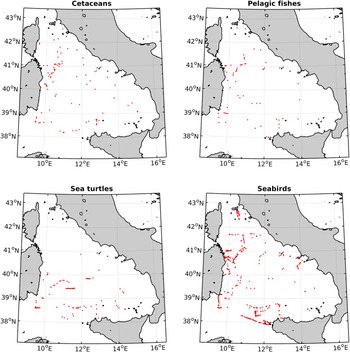
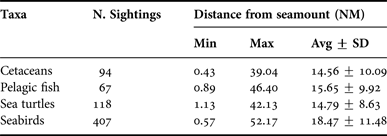
During the sampling campaigns, 686 sightings were recorded and grouped into four main taxa (Table 2, Figure 2).
Spatial distribution of sightings.

Main results of 2013 and 2014 sampling campaigns.

Observed cetaceans accounted for 14% of the total observations and included Stenella coeruleoalba (75 sightings), Delphinus delphis (six sightings), Grampus griseus (two sightings), Ziphius cavirostris (four sightings), Physeter catodon (two sightings) and Balaenoptera physalus (five sightings).
Among pelagic fish, two species were recorded: Thunnus thynnus (48 sightings) and Xiphias gladius (19 sightings), while sea turtles only included Caretta caretta (118 sightings). Finally, the most frequently observed taxon was represented by seabirds (59% of total sightings). The most commonly sighted seabird species was the Puffinus yelkouan (298 sightings).
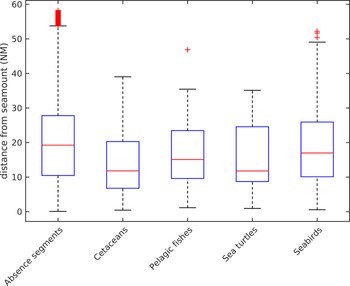
In Figure 3, the distribution of the distances from seamounts of the presence segments of each taxon was compared with the distribution of distances for absence segments by means of a boxplot representation. Cetaceans displayed narrower distance ranges with respect to the distances for absence segments (Figure 3). On the other hand, sea turtles, pelagic fish and seabirds were found to be distributed on wider ranges (Figure 3). 50% of the total observations of cetaceans and sea turtles were grouped in a distance range under 12 NM, while higher values are displayed by other taxa with pelagic fish close to 15 NM, and seabirds reaching 17 NM (Figure 3).
Ranges of distances from seamounts for absence track segments and presence track segments (cetaceans, pelagic fish, sea turtles and seabirds).

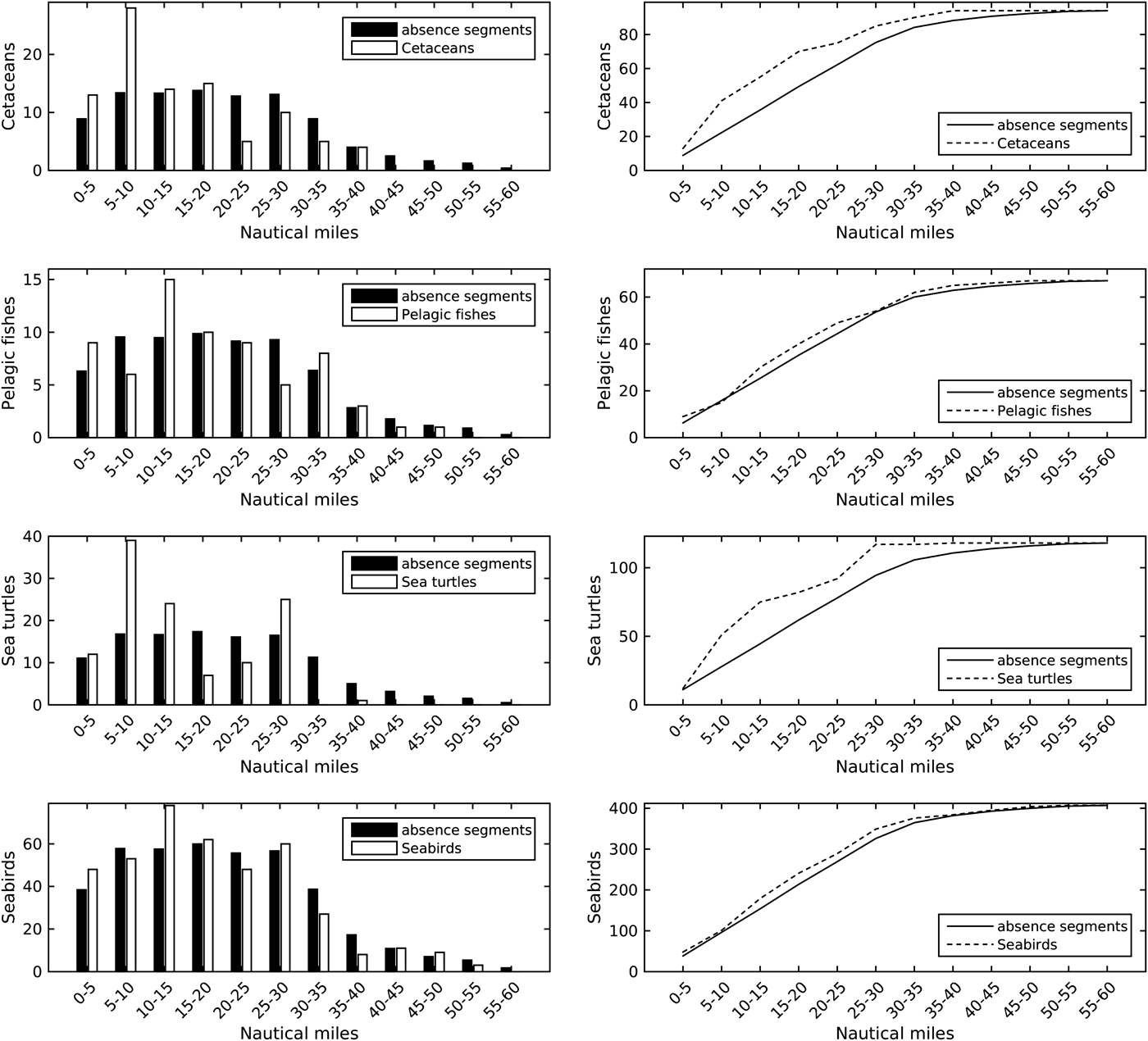
To confirm this observation, the distributions of presence segments were compared with a distribution of randomly sampled elements of absence track segments (Figure 4). For a balanced comparison, a specific set of absence track segments was selected for each taxon so that the number of elements of these randomly selected sets matched the number of presence segments.
Frequency distribution (left) and cumulative distribution (right) of presence and absence track segments for cetaceans, pelagic fish, sea turtles and seabirds in relation to the distance to the nearest Tyrrhenian seamount summit. Bin size is fixed at 5 NM.

KS tests revealed that cetacean and sea turtle distributions were significantly different (P < 0.05) from sampled data distributions. Differences revealed that cetaceans and sea turtles were also found to occur closer to the seamount than expected by chance (94 and 79% of times, respectively) (Figure 4). Pelagic fish and seabird distributions displayed fewer differences when compared with the distribution of randomly sampled absence segments of the cruise track (49% and 54% of times, respectively) (Figure 4).
DISCUSSION
The attractiveness of Tyrrhenian seamounts for pelagic predators was investigated in order to identify aggregation patterns over and around these structures. Confirming what was already observed by Morato et al. (Reference Morato, Varkey, Damaso, Machete, Santos, Prieto, Santos and Pitcher2008) seamounts displayed an attraction effect for pelagic top predators in the Mediterranean context. Therefore, seamounts should be considered hotspots of biological activity, not only for oceans but also for the Tyrrhenian Sea. This is particularly interesting since the morphology of seamounts considered here is different from the oceanic seamounts due to the heterogeneity of the seafloor in the Tyrrhenian basin. Seamounts are generally close to a continental slope and also close to each other. As a consequence, in many cases, a seamount is not the only attractive morphological structure in the surroundings, but a number of different possible interactions are likely to happen at a single observation point. In this preliminary research, seamounts have been analysed, taking into consideration the specificities of each structure such as, among others, peak depth, elevation, slope and position in the context of the basin. This is because our main objective was to evaluate if, at basin level, Tyrrhenian seamounts displayed an attraction effect on some pelagic species.
Among considered taxa, cetaceans and sea turtles showed significant association with seamounts. Cetaceans and sea turtles were found to be mostly present in the close proximity of seamount peaks, with average distances around 14 NM, and 50% of observations at a distance lower than 12 NM. The distribution of cetacean and sea turtle sightings was statistically different (and closer to seamounts) than expected by chance. Cetaceans’ frequency distribution displayed a single peak trend at 5–10 NM from seamounts, and a cumulative distribution greater than the distribution of randomly selected absence points. Sea turtles’ distribution of sightings was characterized by two peaks of frequencies at 5–10 and 25–30 NM from seamounts. Neither cetaceans nor sea turtles were sighted at distances greater than 40 NM from a seamount.
Despite other studies listing tuna and swordfish among the species positively influenced by the presence of a seamount (Morato et al., Reference Morato, Varkey, Damaso, Machete, Santos, Prieto, Santos and Pitcher2008, Reference Morato, Hoyle, Allain and Nicol2010), we did not find a similar pattern. This may be due to differences in the sampling strategy: here, surface observations were used. This might affect the estimate of abundances and distribution of fish, and thus, underestimate the effect of seamounts on these taxa.
Regarding seabirds, the results did not allow any kind of appraisal, since the distribution of seabird sightings did not show significant differences with the distribution of randomly selected absence points. This is in accord with Haney et al. (Reference Haney, Haury, Mullineaux and Fey1995), who did not detect clear evidence of seabird dependency from seamount distribution.
Many reviews (Morato & Pauly, Reference Morato and Pauly2004; Clark & Koslow, Reference Clark, Koslow, Pitcher, Morato, Hart, Clark, Haggan and Santos2007; Pitcher et al., Reference Pitcher, Morato, Hart, Clark, Haggan, Santos, Pitcher, Morato, Hart, Clark, Haggan and Santos2007; Freiwald et al., Reference Freiwald, Beuck, Rüggeberg, Taviani and Hebbeln2009; Clark et al., Reference Clark, Rowden, Schlacher, Williams, Consalvey, Stocks, Rogers, O'Hara, White, Shank and Hall-Spencer2010) have demonstrated that seamounts are unique marine ecosystems, which support fragile habitats and vulnerable species of flora and fauna often under both anthropogenic and natural threats. Even if the interest in their importance is growing, the need to protect these ecosystems is only now being recognized, and mainly focuses on the benthic fauna (Dunstan et al., Reference Dunstan, Clark, Guinotte, O'Hara, Niklitschek, Rowden, Schlacher, Tsuchida, Watling and Williams2011 and references therein). In this context, seamounts have been recently listed as possible ecologically and biologically significant areas (EBSAs) in the global marine realm (CBD, 2009), and may play a role in international ventures, such as the Global Ocean Biodiversity Initiative (GOBI; http://www.gobi.org), which is aimed at the identification of marine areas outside national jurisdiction that are in need of protection.
The peculiarities of these structures make their management an urgent task (Alder & Wood, Reference Alder, Wood, Morato and Pauly2004), and results from the presented analysis confirmed the importance of seamounts in a Mediterranean context for large pelagics and potentially for the supporting trophic web.
Our results may lead to further analyses, which will consider the presence of seamounts among variables for the prediction of the distribution of cetaceans and large pelagics in the Mediterranean basin and for the characterization of the pelagic species habitats (e.g., Fiori et al., Reference Fiori, Giancardo, Aïssi, Alessi and Vassallo2014; Marini et al., Reference Marini, Fossa, Paoli, Bellingeri, Gnone and Vassallo2015). Seamount distributions should be taken into consideration along with other related factors, such as the general morphology of the seafloor, oceanography features and differences among mountains due to several parameters such as, among others, peak depth, elevation, slope and position in the context of the basin.
Once the importance of seamounts, in general, has been acknowledged, the recognition of the different role played by each seamount is a further but fundamental step to address management and conservation objectives.
ACKNOWLEDGEMENTS
Our warmest thanks go to the scientific coordinator of the PROMETEOS project, Maurizio Würtz. We also thank the Marelibero Association, which made the sailing boat available for the sampling campaigns. We are grateful to all the researchers and students who were involved in the data collection.
FUNDING
The authors are grateful to the MAVA Foundation for the financial support through the PROMETEOS project led by the IUCN Centre for Mediterranean Cooperation.