The process of exchange between exhibitors and audiences in the practice of metropolitan displays has been explored in numerous recent histories of science. Spaces such as the lecture theatre of the Royal Institution, the galleries of popular science, and the international exhibitions have been brought together to reveal shared characteristics within the practice of scientific demonstration.Footnote 1 Significantly, historians of science have highlighted the role of these sites in producing scientific knowledge. For scientific demonstrators such as Michael Faraday and John Tyndall, experiment and exhibition were simultaneous and overlapping activities.Footnote 2 Rather than simply articulating pre-existing beliefs, sites of public communication such as the Royal Institution participated in the creation of ideas. Whereas past work in this vein has focused largely on the physical researches of natural philosophers, this paper considers how the exhibition culture of Victorian London also exercised a formative influence over technology.
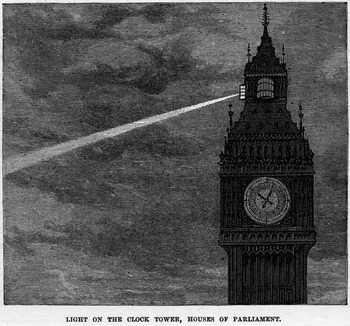
In the late summer of 1873, the Illustrated London News profiled an illumination that had become a nightly phenomenon in the life of the capital. From the Clock Tower of the Houses of Parliament, an electrical apparatus projected a ‘marvellous light’ across central London (Figure 1). The apparatus employed a powerful voltaic arc, a light produced when electrical charge passed across the space between two carbon rods. This arc light was placed behind a holophote, a ‘combination of lenses and annular prisms' developed for use in marine lighthouses, which focused the rays from the ‘brilliant star of electric light’ into a concentrated beam.Footnote 3 The profile drew attention to public experiences of the light, noting that ‘newspapers have been read by its rays in Trafalgar Square, and letters at a greater distance’.Footnote 4
The light on the Clock Tower of the Houses of Parliament. ‘The electric light at the Houses of Parliament’, Illustrated London News, 16 August 1873, pp. 149–150. © Illustrated London News Ltd/Mary Evans Picture Library.

Interpretations of the Clock Tower light proliferated in the popular and technical press in the years following its introduction in the first Parliamentary session of 1872. The initial installation, a relatively simple gaslight, had given way to the electrical apparatus and to a more complex gaslit system, involving three vertically arranged lamps, which were for a time trialled competitively against each other. The public display provided a focus for wider discussions about rival lighting technologies, and gave engineers and scientific experts a chance to represent their visions to an urban populace. These representations were contested both by their audiences and by the rival engineers, who dissected such displays in letters to national newspapers.
As the nature of lighthouses changed through the nineteenth century, exhibitions of the technology – sometimes presented in metropolitan rather than coastal locations – embodied various concerns, interacting with contemporary questions over the role of lighthouses in navigation, their public value and the best technological systems to use. Presenting their products in carefully curated spaces allowed exhibitors to communicate a particular vision for the lights, refashioning the beacons as territorial markers, facilitators of international trade or scientific instruments.
The opening section of this paper explores the prominent presentation of a lighthouse optic at the 1851 Great Exhibition, often seen as the definitive site for the articulation of British industrial and technological prowess. The apparatus was the first piece of its kind by Chance Brothers, the glassmaking firm which would go on to develop the 1873 Clock Tower holophote: installed in the middle of the Crystal Palace's West Nave, where the products of Britain and its empire were collected, the lighthouse optic acted as a prominent visual signpost while communicating a particular vision for the organization of coastal lights. In doing so, it helped to launch the company's entry into the manufacture of lighthouse apparatus.
The second and third sections of the paper consider a different type of scientific and technological exhibition. Influential representations of lighthouse technology were articulated in lectures at the Royal Institution by successive scientific advisers to Trinity House, the body responsible for the management of lighthouses in England and Wales. In 1860, Michael Faraday, the first scientific adviser, delivered a lecture to the Royal Institution on the subject of lighthouses. Delivering this talk at a time when the efficiency of the existing lights had been called into question by an official enquiry, Faraday sought to restore trust in the system by emphasizing the technology's reliability. This representational approach was subtly altered by Faraday's successor, John Tyndall, who understood the lighthouse quite differently. For Tyndall, lighthouse technology was a demonstration of the value of scientific knowledge. His work as scientific adviser and his representations of lighthouses in public lectures focused on the power and penetration of the beams of light issued. These characteristics would become the principal criteria by which the lights were judged.
The final section of the paper returns in detail to the meanings and significance of the Parliamentary Clock Tower installation of 1872. Interpretations of its significance featured a mixture of familiar visual tropes and new associations. Although the installation was not initially conceived as a showcase for any particular technology, it became entangled with a pressing debate about the best principle for illuminating lighthouses around the United Kingdom. This debate continued through the following decade, leading eventually to the resignation of John Tyndall as scientific adviser to Trinity House.Footnote 5 By exploring these metropolitan displays, this article highlights a public appetite for images, installations and representations of lighthouses. It will further show that these exhibitions were integral to the work of technicians and philosophers, contributing to the shaping of lighthouse technology throughout the nineteenth century.
The lens under glass
Amidst the industrial artefacts on display during the 1851 Great Exhibition was a peculiar and beautiful object exhibited by a small glass-manufacturing company, Chance Brothers of Birmingham.Footnote 6 Having acquired the services of the French artisan Georges Bontemps, an émigré victim of the Continental revolutions, in 1848, Chance Brothers had completed the construction of their first lighthouse lens. This remarkable assemblage, rising twenty feet from the floor of the Crystal Palace's West Nave, was intended to launch the company's venture into lighthouse engineering. Bathed in sunlight from the glass roof, the lens was a glittering symbol of Chance's engineering ambitions.Footnote 7 In pursuit of their first contract from Trinity House, Chance Brothers sought to present their lens as a national triumph, indispensable for the future of British lighthouses.
The exhibition of the new lens was saturated with patriotic connotations. The British glass industry had struggled to compete with its rivals in France and Germany in the decades after the Napoleonic Wars, a problem that manufacturers blamed on restrictive taxation.Footnote 8 As a result of prohibitive excise regulations, in operation until 1845, the lighthouse lenses in use around the British coast had mostly been made with glass from French and Belgian workshops; the Illustrated London News, in its account of the 1851 display, emphasized that ‘the materials are entirely of English produce’.Footnote 9 Securing appropriate optical technology was a national issue, as the photographer and scientific writer Robert Hunt pointed out in the Art Journal: ‘From our insular position, and the importance of our navy and our merchant marine, the question of perfecting our lighthouse arrangements around the coasts is of the utmost importance.’Footnote 10
The display of the lens represented a victory for British lighthouse engineering. In 1844, the high-profile lighthouse on the Skerryvore rock, constructed by Alan Stevenson, had been fitted with the most efficient lens apparatus then available, manufactured by the Parisian instrument-maker François Soleil.Footnote 11 British glassmakers, such as Cookson of Newcastle, could not consistently produce refracting lenses to the correct specifications. French workshops, by contrast, had been producing lighthouse lenses since their design was first detailed by the mathematician Augustin Fresnel. This production process combined industrial resources, artisanal knowledge and the mathematical skill of engineers such as Leonor Fresnel, brother of Augustin.Footnote 12 The situation changed when Chance Brothers secured the services of Georges Bontemps at their Spon Lane factory. Bontemps had been director of the optical glass factory at Choisy-le-Roi, and became responsible for managing the Chance Brothers' first lens project. His experience in producing optical glass, combined with the manufacturing and engineering expertise already in place at Spon Lane, enabled the Chance Brothers to produce a high-quality lighthouse lens which could be highlighted as a demonstration of British capability.Footnote 13
The glass assembly remained unlit for the majority of the summer, its ornate glass sections giving it a striking appearance that contributed to its role as an object of national pride. However, on the occasion of a royal visit to the Crystal Palace on 16 June, the object's symbolic significance was mobilized more explicitly. A powerful oil burner was placed in the focus of the lens, demonstrating its remarkable effects. The Queen's visit was carefully choreographed, dramatizing the royal gaze as part of an imperial pageant. The entourage, including Prince Albert and the queen's daughters, arrived at half past nine, processing through the displays and stopping theatrically at exhibits such as the Koh-i-noor diamond, before surveying the contents of the West Nave, including the illuminated light.Footnote 14 In the same way that the Koh-i-noor was associated with the reach of the British Empire, having been acquired two years earlier by the East India Company, the Chance Brothers' apparatus was a symbol of the technological infrastructure needed to master the seas. The installation served as a material synecdoche, invoking the coastal lighthouse through the demonstration of a component part. In doing so, it played a part in directing the development of lighthouse technology, as Chance Brothers' high-profile public demonstration helped to secure a long-term commercial relationship with the lighthouse corporation of Trinity House.
Adjusting the lights at the Royal Institution
A short walk away from Hyde Park, in the midst of one of London's most affluent areas, the Royal Institution offered a very different kind of space. The institution's Friday night lectures were colourfully described in an 1860 account in the Leader and Saturday Analyst:
Friday evenings during the season are famous for a mixture of fashion and science in Albemarle Street, and scores of carriages and hundreds of pedestrians draw up in front of the imitation Greek façade, and pour a well-dressed throng through the window-like aperture.Footnote 15
The Leader piece described a lecture by Michael Faraday, Fullerian Professor of Chemistry at the institution, exploring the theoretical and philosophical underpinnings of lighthouse technology. On this occasion, the audience was augmented by a number of Trinity House Elder Brethren, the lighthouse corporation's senior members. Faraday's expertly delivered performance combined the practice of philosophical exposition with his role as Trinity House's scientific adviser. His entrance at nine o'clock drew enthusiastic applause:
A slight nod accepts and puts aside the praise of the folk, nimble hands quickly place a pair of spectacles upon the decided-looking nose, and a clear, singularly impressive, and rather musical voice, plumps, so to speak, at once into the heart of the subject.Footnote 16
The content of Faraday's lecture reflected the role he played within the lighthouse corporation and the political context in which that corporation operated. In the early decades of the nineteenth century, the lighthouse system had been subject to public scrutiny as commentators questioned its efficiency and value. High lighthouse dues were charged to sailors, whilst the incidence of shipwrecks continued to increase. The Trinity House corporation had been accused of ignoring new lighting technologies at the expense of the safety of British shipping.Footnote 17 A Parliamentary enquiry in 1834, spearheaded by the radical reformer Joseph Hume, had led to Parliamentary Acts which empowered the Trinity House corporation to purchase all lights remaining in private hands. This centralizing legislation had effectively transformed the lighthouse system into a national service, its financial structure and performance becoming publicly accountable.Footnote 18 Trinity House officials were acutely aware of the need to re-establish public trust in the lights.
The enquiry had also prompted Trinity House to employ a scientific adviser to provide advice on technical matters. Michael Faraday had been appointed to the role in 1836: his pre-eminent public status as a man of science, and his well-attested communication skills, were no doubt a factor in the appointment.Footnote 19 Faraday had contributed directly to the technical refinement of the coastal lights, and yet there had been continuing allegations that the lighthouse lenses installed in various Trinity House stations were inefficient and ineffective, resulting in a further royal commission, established in 1858, which was still ongoing at the time of his lecture to the Royal Institution.Footnote 20 It was thus a priority for Faraday to represent the lighthouse system as technically reliable and socially trustworthy.
One technique used by Faraday was to characterize the lights' administrators as benevolent. Faraday's lecture embedded his role as scientific adviser to the lighthouse corporation within a Christian moral framework.Footnote 21 The technological system responsible for the safety of ships on the British coasts was an example of Christian charity, safeguarding life and furthering the progress of civilization. Faraday's approach reflected aspects of his deeply private religion: his membership of the Sandemanian congregation of St Paul's Alley, Barbican, touched every aspect of his life.Footnote 22 His lecture began with a scriptural light-based metaphor for Christian morality: ‘it certainly has astonished me since I have been connected with the Trinity House to see how beautifully and how wonderfully shines forth amongst nations at large the desire to do good’.Footnote 23 Faraday presented lighthouses as a means of salvation, a concept with irresistible religious associations. Describing this purpose, Faraday employed two familiar scriptural images: darkness and deluge. The safeguarding of sailors' lives was reframed as ‘the great object of guiding in safety all people across the dark and dreary waste of waters'.Footnote 24 Addressing his audience in the familiar language of religious crisis, Faraday presented the lights as providential beacons. Like religious salvation, the signal of the light was most needed where it was most obscured:
The light of a lighthouse, more than any other, is liable to be dimmed by vapours and fogs, and where we most want this great power, is not in the finest condition of the atmosphere, but when the mariner is in danger, when the sleet and rain are falling, and the fogs arise, and the winds are blowing, and he is nearing coasts where the water is shallow and abounds with rocks – then is his time of danger, when he most wants this light.Footnote 25
Having presented the lighthouse as a benevolent technology, Faraday used his lecture to outline the qualities required of a good coastal light. Most important was regularity of service. This quality was a fundamental necessity for any new technological component. When evaluating the battery-powered light of the Electric Power and Colour Company on behalf of Trinity House in 1854, Faraday had dismissed the system owing to its unreliability, observing,
There is no human arrangement that requires more regularity and certainty of service than a lighthouse. It is trusted by the Mariner as if it were a law of nature; and as the Sun sets so he expects that, with the same certainty, the lights will appear.Footnote 26
In the 1860 lecture, Faraday offered analogies to the splendour and the regularity of the natural world, referring to an arc light displayed before his audience as ‘this glorious sun’, and invoking the rising sun in his account of the effect of coastal lighthouses: ‘the light of the electric spark shines so far at times, that even before it has arisen above the horizon twenty five miles off, it can be seen’.Footnote 27 Reporting on the reliability of the recently installed electric light at the South Foreland lighthouse, Faraday noted, ‘Never for once during six months has it failed in doing its duty.’Footnote 28
Around the time of this lecture, Faraday, in his role as Trinity House scientific adviser, was engaged in dealing with the concerns addressed by the royal commission, which had highlighted a number of faults with the lanterns recently installed along the British coast. In the years after the Chance Brothers' Crystal Palace display, many of these lights had been converted to accommodate lens apparatus. However, although they were manufactured with the best possible glass and arranged according to established mathematical calculations, investigations at the Whitby and South Foreland lights, attended by Faraday, discovered ‘certain deficiencies in the illumination of the sea; and a waste upon the sky of a portion of light’.Footnote 29 The commission turned its attention to the fine geometrical adjustments required in lantern lenses, which had customarily been managed using a received set of mathematical calculations. However, these calculations did not accommodate the variable height of the lamp's flame, or the height of the lighthouse above the sea. One participant, the Astronomer Royal, George Airy, commented, ‘I conjecture that a rule of adjustment was laid down in the first instance – in France I suppose – which has been closely followed everywhere; and that rule is wrong.’Footnote 30 In misdirecting the light issued from the lantern, the poorly adjusted lighthouse lenses fell well short of the qualities described by Faraday before the Royal Institution.
In October 1860, Faraday visited the lighthouse at Whitby accompanied by James Timmins Chance, the youngest partner of Chance Brothers. Having graduated from Trinity College, Cambridge, in 1838, James had spent his career in the family business, introducing a new way of grinding and polishing plate glass. The investigation at Whitby relied on the exchange of expert knowledge between Faraday and Chance: ‘All the time we were at Whitby (8 or 9 days) Mr. Chance & myself were occupied in learning, practising new methods of adjustment & correction, and using new instruments.’Footnote 31 The pair worked painstakingly to direct individual panels within the optic so that their focus was in line with the sea horizon, adopting a novel technique that Chance later termed ‘internal adjustment’.Footnote 32 Rather than calculating the angle of each lens mathematically, the ‘internal’ method involved observing the horizon through successive lenses from the position of the lamp burner. As a guarantee of proper adjustment, this procedure supplemented pure mathematics with the individual authority of the practitioner. Over the following decade, lens apparatus installed in the various Trinity House lighthouses was subjected to a rigorous process of adjustment according to the techniques elaborated at Whitby.
Faraday, then, worked to fashion the coastal lights as reliable signals on two fronts, exhibiting his vision before metropolitan audiences at the Royal Institution while contributing practically to the regularization of technology in the field. The neat dovetailing of Faraday's roles was evident in the Leader and Saturday Analyst’s reflection following his Friday night lecture: ‘It is pleasant to think that during the lifetime of the Professor the beacon towers on the coasts of many lands will be converted into luminous monuments to his genius and his fame.’Footnote 33
John Tyndall and the science of projection
In the years following the close of the 1858 commission, Faraday's health began to deteriorate. In May 1865 he wrote to Captain William Pigott, then deputy master of Trinity House:
I joined the Trinity House in February 1836, now near upon thirty years since. I find that time has had its usual effect on me, and that I have lost the power of remembering, and also of other sorts, and I desire to relieve my mind. Can this be done without my retiring altogether, and can you help me in this matter?Footnote 34
The Elder Brethren solicited Faraday's close friend and protégé, John Tyndall – who was also to succeed Faraday in some of his roles at the Royal Institution – to help perform some of the functions of the scientific adviser. Tyndall was mindful of the sense of moral duty with which the role had previously been performed, but also brought a subtly different conception of illumination and projection to his work on the coastal lights, arising partly from his social and professional values. Tyndall was deeply interested in the formation of a new type of scientific expert. This man of science would be funded in such a way as to avoid interference from benefactors and to remove the necessity of working for financial profit. The expert would also exercise a governing influence over society. Where Faraday brought a modest sense of duty to his work on behalf of Trinity House, Tyndall incorporated his lighthouse work within his broader aim of elevating the social status of science.Footnote 35
The connection between Tyndall's social vision and his approach to his technological subjects is apparent in a lecture on electric illumination delivered to the Royal Institution in 1879, which dealt extensively with the application of electricity to lighthouses. Tyndall emphasized that electrical machines and the currents they produced, to the philosopher, were primarily a means of exploring invisible processes and making their effects visible, thereby allowing the discovery of physical properties.Footnote 36 This was the technology's most valuable contribution to society: ‘For more than twenty years’, he wrote, referring to the discoveries of Faraday's time, ‘magneto-electricity had subserved its first and noblest purpose of augmenting our knowledge of the powers of nature’.Footnote 37 In so doing, it demonstrated the power of rational enquiry, as consistent and determinate laws were seen to lie behind the effects. Mention of the principle of conservation of energy served to introduce a dramatic account of the power of the electric current:
One of the fundamental truths to be borne in mind is that the sum of … heats is fixed and invariable. Hence, to have heat outside, you must draw upon the heat with-in. These remarks apply to the electric light. By the intermediation of the electric current the moderate warmth of the battery is not only carried away, but concentrated, so as to produce, at any distance from its origin, a heat next in order to that of the sun. The current might therefore be defined as the swift carrier of heat. Loading itself here with invisible power, by a means of transmutation which outstrips the dreams of the alchemist, it can discharge its load, in the fraction of a second, as light and heat, at the opposite side of the world.Footnote 38
Alchemical dreams had long featured in Tyndall's rhetoric, as a superseded mystical counterpoint to the rational enquiry he promoted.Footnote 39 The power of the electric current, and of the electric light, was offered as visible proof of the success of his agenda.
Most significantly, electric light offered a case study in the benefits of liberally patronized science. Tyndall produced a history of electric lighting, invoking the names of heroes such as Galvani and Volta alongside more recent electrical engineers. The most significant figure in Tyndall's history, however, was Michael Faraday. As a gifted philosopher from a poor background, Faraday clearly illustrated the value of investment in science. His research on the principles of electromagnetic induction, made possible by the resources of the Royal Institution's laboratory and undirected by the need for commercial remuneration, had been essential in the creation of an economically viable electric light: ‘the source’, said Tyndall, ‘from which the true natural philosopher derives inspiration and unifying power is essentially ideal. Faraday lived in this ideal world’. Without his discovery of induced current, electric light would only have been possible through the use of prohibitively expensive fuels such as zinc. Lighthouse technology was an effective ambassador for the social value of philosophical research: ‘it is Faraday's spark which now shines on our coasts, and promises to illuminate our streets, halls, quays, squares, warehouses, and, perhaps at no distant day, our homes’.Footnote 40
As with Faraday's 1860 lecture, Tyndall's Royal Institution talk used naturalistic imagery to illustrate the qualities of his technological subjects. However, in Tyndall's case, this imagery was used to highlight the power of the light, rather than its reliability. Tyndall recounted a series of experiments conducted at the Trinity Wharf at Blackwall in 1869 on the generator developed by the chemist Frederick Holmes, on Faraday's principles, as a source of power for arc lighting: ‘Falling upon the suspended haze, the light illuminated the atmosphere for miles all round. Anything so sunlike in splendour had not, I imagine, been previously witnessed.’ A similar comparison appears in an anecdote recorded in a footnote to the published lecture: ‘A close inspection of [the] powerful lights at the South Foreland caused my face to peel, as if it had been irritated by an Alpine sun.’Footnote 41
Tyndall's Royal Institution lecture articulated the ideological commitments that would become visible in his work with Trinity House. Tyndall reimagined the coastal lights as projectors of learning and discipline, imposing order and rationality on their surrounding space. In a memoir published following his eventual resignation from the lighthouse service, Tyndall recalled his hopes for a new species of coastal light to be introduced in Ireland: ‘As centres of order and discipline they would be sources of education to the people; while as centres of light and warning they were sure to be instrumental.’Footnote 42 Whereas Faraday prioritized the integrity and reliability of the signal as a means of avoiding uncertainty, Tyndall prioritized the power of the lighthouse lantern to penetrate obscurity.
Tyndall's representations of lighthouse technology reflected his preoccupation with achieving the brightest possible source of illumination. In 1878 he was sent by Trinity House to make observations on the ‘group-flashing light’ installed at Galley Head, which had been engineered by a Dublin technician, John Wigham. The light was produced by an adjustable gas jet lamp of Wigham's design. The apparatus combined rotating lenses, which separated the horizon into pencils of light and dark spaces, with an automatic mechanism to raise and lower the gas. The effect produced was of intermittent periods of light delivered in a distinctive ‘group flash’ pattern. Tyndall's report to the Elder Brethren captured the power and quality of the light with a series of dramatic images:
Ascending to the top of the deck-house, the light itself came into view, its white blaze striking the eye as if the lighthouse were close at hand. On ascending from the bridge, the sudden emergence of these powerful flashes out of the darkness of a starless and moonless night was in the highest degree impressive.Footnote 43
Both in his public lectures on the value of professionalized scientific knowledge and in his technological consultancy, then, Tyndall helped to establish a lighthouse system that would be judged, and would produce impressive effects, according to the criteria of power and penetration. This priority of Tyndall's, originally articulated in the case of coastal lights, proved to be a key influence in the development of a lantern signal installed at the House of Commons from the early 1870s onwards – a metropolitan display, uniquely close to the centre of national power, which in turn informed the debate over how best to illuminate the coastal beacons.
The House of Commons Clock Tower light
On 23 June 1868, Dr John Percy, superintendent of the ventilation department of the Houses of Parliament, contacted the first commissioner of works, Acton Smee Ayrton, to relay an idea for communicating with distant Members of Parliament: ‘It has been suggested that a signal light might be placed at or near the top of the clock tower, and kept in action only during the sitting of the House of Commons.’ The installation was intended for the convenience of Members living in London's wealthy residential districts, some distance from Westminster, whose journeys were often wasted as they arrived to find the House was no longer in session. Percy, who was also a fellow of the Royal Society and a lecturer at the Royal School of Mines, consulted scientific colleagues, including Tyndall, and reported confidently that a suitable light could be provided for around £1,000, ‘a moderate outlay’, on the magneto-electric principle already ‘in operation with success at some Light Houses’.Footnote 44
The apparatus initially installed, illuminated for the first time in early June 1872, bore little resemblance to the lanterns used in British lighthouses. It consisted of a water-filled glass globe, twenty-one inches in diameter, through which shone the light of ‘40 fish-tail burners with reflectors’, arranged so as to direct the light primarily to the west, ‘where the majority of Members of Parliament reside’. Despite its comparative weakness, the Clock Tower light was witnessed from considerable distances, The Times noting that it ‘could be seen in favourable states of the atmosphere over a large area west of the Clock Tower, and northwards as far as Primrose-hill’, a distance of three miles.Footnote 45 However, in foggy weather the dim light of the glass ball became entirely invisible. The symbolic significance of this limitation was perhaps evident to the innovation's promoters: if Parliament's light could not penetrate the city's haze, a useful public indicator of the effectiveness of government was undermined.
In response to suggestions that the power of the Clock Tower light be increased, Ayrton approached Chance Brothers for an estimate of the cost of a new lens apparatus. They proposed an arrangement similar to that developed by James Chance for the South Foreland Lighthouse, lit by electricity.Footnote 46 Public attention to the scheme, however, stimulated a debate about the lighting technology to be used. Upon reading of the proposed arrangement in The Times, the above-mentioned engineer John Wigham wrote to Ayrton seeking to present his alternative gaslit system. Wigham's protestations reached Percy, who advised the Office of Works that Tyndall had spoken favourably of the approach, and proposed a trial.Footnote 47
It was agreed that the gas and electric lights should be installed together to allow comparison, but, owing to delays in the preparation of the electric apparatus, Wigham's light was initially displayed on its own, on the west side of the tower, in April 1873. The Times noted the highly distinctive appearance of the light – ‘a pillar of white fire, and intensified every few seconds by brilliant flashes’ – and its wide range of possible settings, allowing it to be greatly intensified in foggy weather and dimmed, saving fuel, when visibility was good. This facility was particular to gas, and was, the paper noted, one reason for its prior adoption in several major lighthouse stations.Footnote 48
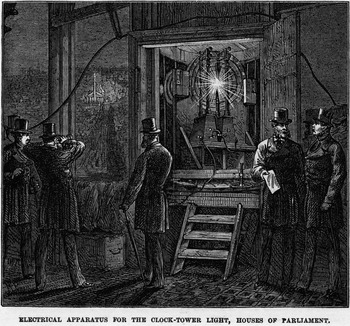
In the first week of May, the electric lamp, powered by a Gramme magneto-electric machine, was installed on the north side of the Clock Tower, its spark placed in the focus of Chance's lens system (Figure 2).Footnote 49 By mid-May the trials of the electric light and the gaslight were a regular night-time spectacle. Following a demonstration on 10 May, an effusive article published in The Standard described the place of the electric light in the poetics of the urban night-time:
The effect was very charming as seen from the roadway of the Thames Embankment. The moon had risen high in the heavens, and the winding currents of the river gleamed like burnished silver beside the tall grey form of the Clock Tower. There, above the dimly lighted clock face, shone like a wonderful star the electric point – a very diadem of light.Footnote 50
Just as in Faraday's and Tyndall's public discussions of lighthouse technology, press responses often invoked natural spectacles: Punch acknowledged the first commissioner by dubbing the new installation ‘the Ayrton Comet’, while the aforementioned Standard piece found that when viewed from Blackfriars, at a distance of more than a mile, ‘the electric star had almost become to the eyes a brilliant planet attendant on the Queen of Night’.Footnote 51
The electrical apparatus installed in the Clock Tower. ‘The electric light at the Houses of Parliament’, Illustrated London News, 16 August 1873, pp. 149–150. Reproduced with permission from © Illustrated London News Ltd/Mary Evans Picture Library.

Ayrton now instructed the Trinity House chief engineer, James Douglass, to assess the relative merits of the gas and electric lights. Observations taken on a wet and misty evening from Primrose Hill, three miles north of the Clock Tower, suggested that the electric light was more powerful than Wigham's gas lamp, although the latter was substantially augmented in periodical flashes.Footnote 52 These results were compared to a series of photometric tests conducted on the equipment in the vaults under the Houses of Parliament, which confirmed the finding.Footnote 53 Douglass's report asserted that the electric light was the brightest and steadiest available, giving an illumination equivalent to that of 3,066 candles, as against 1,199 candles for the gas system. Arguing partly from his experience with lighthouse lanterns, Douglass recommended an electric light be installed on a permanent basis.Footnote 54
Wigham's gas system, however, was not easily dismissed. Douglass's report was not published until late in the final Parliamentary session of 1873, and the reassembling of Parliament in the new year was interrupted by a general election. The situation had therefore not been settled by the summer of 1874 when Wigham wrote a letter to the new first commissioner of public works, Lord Henry Lennox, later published as a Parliamentary paper, raising a wide range of objections to Douglass's approach, from the basis on which he estimated relative costs to his unwillingness to invite Wigham to witness the photometer experiments. Perhaps most importantly, practical experience with coastal lights had repeatedly shown that the brightest electric lights were less effective than gas – and even oil lamps – in foggy weather: in these conditions, which also affected London, the distinctive appearance of Wigham's automated flash gave a major advantage.Footnote 55
The debate over Clock Tower lighting was therefore part of a wider controversy concerned largely with coastal lighthouse policy. Douglass, who was closely involved with the design of oil burners, had been using his appointment to Trinity House to advocate the use of oil-based systems, supplemented, where necessary, by high-powered electric lights.Footnote 56 Wigham's gas jet system, however, had the support of John Tyndall, who had first observed it at the Howth Bailey lighthouse in 1871. Tyndall showed particular interest in the principle of group-flashing patterns, which, besides offering a potential means to distinguish one lighthouse from another, presented a highly conspicuous pattern of pulses in a cloudy sky, even when the direct beam was obscured: ‘these atmospheric thrills’, he stated in 1879, ‘will prove of great importance to the mariner’.Footnote 57 Tyndall therefore proposed extending Wigham's gas system across the Irish lighthouse service. He was steadily opposed, however, by the Board of Trade, which continued to recommend oil burner designs. Feeling that the board was unfairly stifling an important innovation, Tyndall resigned as consultant to the board and as scientific adviser to Trinity House in 1883.Footnote 58 Over the following years, both oil and gas installations persisted, but electric lighting made little headway as an alternative to gas: installation remained costly and inconvenient, and it was widely accepted that the tremendous brightness of the electric arc light in clear weather did not translate well to the practicalities of foggy conditions. By 1901, of 1,100 lights around the British coast, only five were electrically lighted.Footnote 59
At Westminster, meanwhile, following Wigham's protests, the two lights were again in place on the Clock Tower by the autumn of 1874. An article in the Religious Tract Society's general-interest weekly Leisure Hour described the visual effect in the now customary terms:
Parliament is sitting, and the two great rival lights are on their trial up in the lantern. One of them is just now blazing out on the other side, and the summit of the tower, as seen behind, is streaming out brilliant coruscations into the silent darkness.Footnote 60
Debates over the best lighting system continued, with one public account of the late 1870s suggesting that ‘[e]xperiments on many kinds of powerful artificial light’ were at work to settle the matter.Footnote 61 In reality, despite the strong early support of Douglass, the electric light had been discontinued, and it was Wigham's gas jet apparatus that provided continuous service in the years following the original installation. In 1892, when questions were raised about increasing the power of the light, Wigham pointed to this long service, and to the widespread adoption of his approach for coastal lights, and was contracted to supply a new light on the established principle in 1893.Footnote 62 As electric lighting became increasingly widespread in street and interior lighting, the idea was periodically revived, but the central argument from lighthouse experience – that the gas system had unique advantages for signal lights, distinctive and better suited to shining through fog – retained support beyond the turn of the century.Footnote 63
The Clock Tower light, initially intended as a convenient response to a particular problem in the practicalities of parliamentary business, gained a wider role through its regular appearance as an object of general interest in the public press, which no doubt reflected its obvious status as a signal conspicuous to large numbers of Londoners. In drawing on stock images of the meteorological sublime, the allure of jewels and the light of reason piercing darkness, the poetic language of the papers relied on the same stock of rhetorical devices established around the coastal lights, just as the debate over the gas and electrical systems played out in tandem around the nation's coastline and at the literal centre of government.
Conclusion
Through formal exhibition, lecture demonstration and signalling applications, lighting technologies associated with the coastal periphery were assembled and displayed within the metropolitan centre in various ways during the second half of the nineteenth century. Manufacturers and scientific advisers sought to manage interpretations of the lights through the framing of their display, and the results contributed directly to the shaping of trends in the development of lighthouse technology. Urban and metropolitan display, however, had an important function beyond the obvious one of introducing influential authorities and wider publics to the technical principles. The spaces of metropolitan display, from the Crystal Palace to the Royal Institution to the Clock Tower as viewed through the London fog, had pre-existing associations that helped the technology to stand for broader cultural themes – reliability, scientific progress, the national interest – that actively fostered audience support. By placing exhibition at the centre of our understanding of the process of technological construction, we can highlight the importance of perceptual context in the wider history of engineering.