Interstage mortality after stage I surgery for hypoplastic left heart syndrome and other single-ventricle defects is still a problem.Reference Cua, Thiagarajan and Taeed 1 – Reference Li, Yow and Berezny 5 Some of the deaths occur soon after surgery while the patient is in hospital and some occur after discharge. The cause of early post-operative death (before discharge) is often an imbalance between systemic and pulmonary perfusion and poor myocardial function.Reference Naito, Aoki and Watanabe 6 Interstage mortality – after discharge – is reported to be between 4% and 16%, highest after Norwood surgery.Reference Cua, Thiagarajan and Taeed 1 – Reference Simsic, Bradley, Stroud and Atz 4 The late interstage deaths are often related to respiratory or gastrointestinal infections challenging the vulnerable haemodynamic balance or to shunt obstruction secondary to thrombosis. In 2006–2007, we experienced a cluster of deaths after stage I surgery for single-ventricle lesions, both hypoplastic left heart syndrome and other defects and after the Sano modification, as well as after modified Blalock–Taussig shunt. At about the same time, home monitoring of oxygen saturation was suggested as a possible way of identifying patients at increased risk for interstage death.Reference Ghanayem, Cava, Jaquiss and Tweddell 7 , Reference Ghanayem, Hoffman and Mussatto 8 We therefore decided to evaluate whether daily measurement of oxygen saturation at home between stage I and II would benefit this group of patients through earlier detection of threatening shunt occlusion (primary aim). We also examined parents’ experiences of home monitoring (secondary aim).
Materials and methods
All infants with single-ventricle physiology operated at our centre from September 2007 to December 2010 with a modified Blalock–Taussig, central or Sano shunt as the only source of pulmonary blood flow were eligible for inclusion in the study. During the study period, there were 34 patients that fulfilled the inclusion criteria. However, one patient died before discharge, one was living abroad, one was missed for inclusion at the ward, and in one case the referring hospital denied participation. Thus, 30 patients were included. All parents gave their informed consent. Up until March 2011, 28 had reached one of the two endpoints of the study, which were completion of stage II (n = 24) or death (n = 4), and they are therefore the subjects of this report. Before discharge, parents were instructed on the use of the oxygen saturation monitor and then further taught at the referring hospital. We recommended the use of a pulse-oximeter with signal extraction technology (Masimo, Irvine, California, United States of America). Parents were asked to measure oxygen saturation once daily when the baby was asleep or calm and to note the value in a logbook. They were instructed to repeat the measurement after 15 minutes if the saturation was 70% or less. If still low, they were supposed to contact the local hospital or Queen Silvia Children's Hospital in Gothenburg, one of two tertiary centres for paediatric cardiology and cardiac surgery in Sweden. The interstage follow-up programme, apart from home monitoring, included regular outpatient visits every 2 weeks at the local hospital. Home monitoring was defined as positive when a patient was admitted to Queen Silvia Children's Hospital, because of saturation less than or equal to 70% on repeated measurement at home. A shunt complication was defined as arterial desaturation and a narrowing of the shunt demonstrated by echocardiography, angiography, or computed tomography, which resulted in an intervention or death from shunt obstruction. An intervention could be intensified anticoagulation therapy – heparin or low-molecular-weight heparin – surgical replacement of the shunt, balloon dilatation or stenting of the shunt, or an earlier bi-directional Glenn than had originally been planned. In cases where death was the first sign of a shunt complication, autopsy-proven obstruction of the shunt was required in order to fulfil criteria for shunt complication. To allow a comparison of the interstage mortality in the study group with interstage mortality in previous years, we performed a review of all patients with single ventricle and a surgical shunt as the only source of pulmonary blood flow from the start of the use of the Sano modification in 2002 up until the start of the home monitoring programme (August 2002–June 2007). Interstage mortality was defined as deaths between discharge after stage I and admission for stage II.
In January 2010, a questionnaire was sent to the parents of the 17 patients who had been included up until then and who had reached one of the two endpoints, that is, completion of stage II (n = 16) or death (n = 1).
Ethics
The study protocol and the patient information were approved by the local Ethics Committee (Study Code 237-09) and followed the Declaration of Helsinki.
Statistical methods
Medians and ranges were used to describe results, and proportions were compared using the Chi-square test.
Results
Patients and surgical procedures
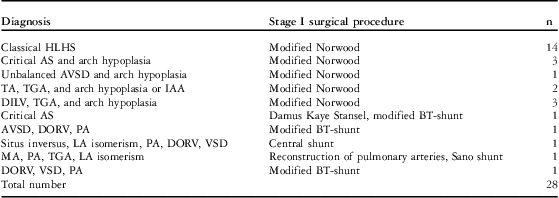
Diagnoses and surgical procedures at stage one are shown in Table 1 for the 28 patients in the study. Only one patient had extracardiac malformations. All patients were full term (37–42 weeks) with a median birth weight of 3515 grams (range 2620–5050 grams). The median age at stage I surgery was 11 days (range 3–35) and the age at discharge was 24.5 days (range 12–59 days). All patients, except one who was on warfarin alone, were on aspirin 5 milligrams per kilogram per day as thrombosis prophylaxis; two patients were on both aspirin and warfarin. In addition, four patients were also included in the Clarinet LT study (Long-Term Safety of Clopidogrel in Neonates/Infants With Systemic to Pulmonary Artery Shunt Palliation, http://clinicaltrials.gov/ct2/show/) and had either clopidogrel or placebo in addition to the standard treatment. No patient had supplementary oxygen at discharge.
Diagnoses and surgical procedures at stage I.

AS = aortic stenosis; AVSD = atrioventricular septal defect; BT = Blalock–Taussig shunt; DILV = double inlet left ventricle; DORV = double outlet right ventricle; HLHS = hypoplastic left heart syndrome; IAA = interrupted aortic arch; LA = left atrial; PA = pulmonary atresia; MA = mitral atresia; TA = tricuspid atresia; TGA = transposition of the great arteries; VSD = ventricular septal defect
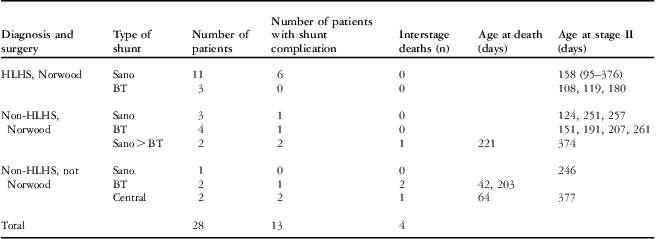
The median age at stage II was 189 days (n = 24, range 95–377). In patients with classical hypoplastic left heart syndrome stage II was performed at 169 days (n = 14, range 95–376; Table 2).
Diagnosis, surgery, type of shunt, shunt complications, interstage mortality and age at stage II or death.
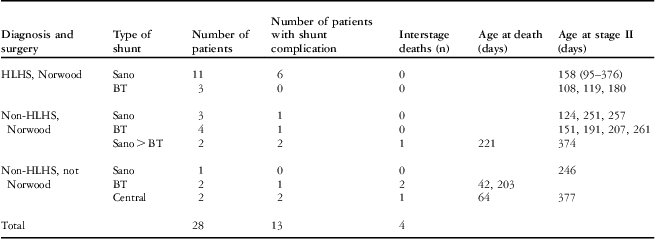
BT = Blalock–Taussig shunt; HLHS = hypoplastic left heart syndrome
>, change of shunt type during the interstage period
Shunt complications between discharge after stage I and admission for stage II and the performance of home monitoring to detect them
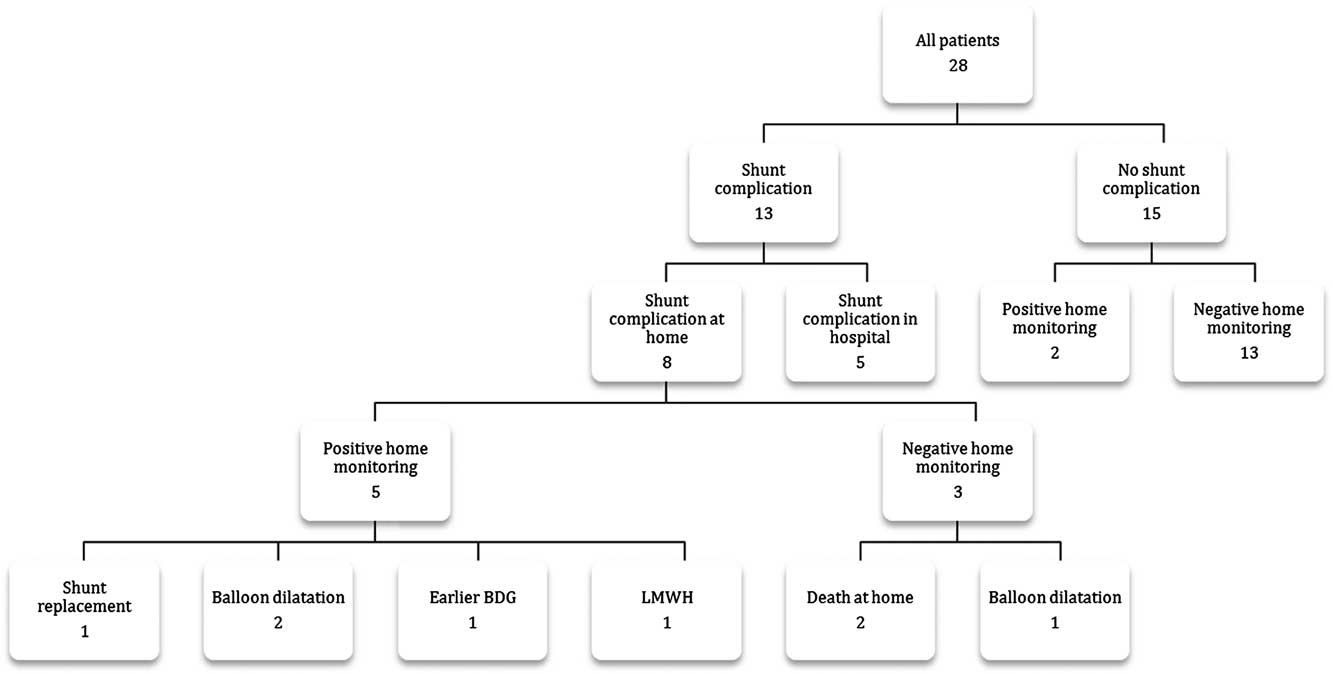
A shunt complication – according to definition – occurred in 13 out of 28 patients on 14 occasions at a median age of 95 days (n = 14, range 42–373). Of the 13 patients, eight had one shunt complication each while being at home and therefore possibly detectable by home monitoring (Fig 1). Home monitoring was positive in five out of eight patients, and in two of them probably life saving. Of the two patients, one was diagnosed with shunt endocarditis and underwent surgery with replacement of the Sano shunt to a Blalock–Taussig shunt and the other had a severe narrowing of the Sano shunt that was balloon dilated. Both interventions were performed within 24 hours from admission. The remaining three patients were treated with balloon dilatation of the shunt 2 days after admission, an earlier bi-directional Glenn than planned and low-molecular-weight heparin, respectively (Fig 1). The latter patient would probably have been admitted even if home monitoring had been negative because of symptoms of a respiratory infection.
Flow diagram showing the results of home monitoring. Numbers are number of patients. The only patient, who had two shunt complications, one at home and one in hospital, has been allocated only to the box “Shunt complication at home”. Another patient in the same box had positive home monitoring on two other occasions at a time when he had no shunt complication. This patient is also only counted once. BDG = Bi-directional Glenn procedure, LWMH = low molecular weight heparin.

Home monitoring was negative in three of the eight patients (Fig 1); two of them died suddenly at home. Autopsy showed complete occlusion of the shunt secondary to thrombosis in both cases. In one of them, oxygen saturation had been measured a couple of hours before death with levels above 90%. The third patient was admitted for an elective catheterisation at the age of 95 days and the investigation showed a distal narrowing of the Sano shunt.
Of the 13 patients, six had one shunt complication each while admitted for other reasons than positive home monitoring (Fig 1). One of them had a previous shunt complication at home and is only counted once in Figure 1. All six were successfully treated by balloon dilatation of the shunt (n = 1), stenting of the shunt (n = 2), an earlier bi-directional Glenn procedure (n = 2), or low-molecular-weight heparin (n = 1).
Positive home monitoring but no shunt complication
Home monitoring was positive on six occasions in three patients who did not have a shunt complication at that time; two of them belonged to the 15 patients who never had a shunt complication (Fig 1) and the remaining patient had a shunt complication at home at another point in time. One of them had diaphragmatic paresis and was plicated; two had several occasions each of desaturation in association with respiratory infection or for unclear reasons. There was one patient who had an earlier stage II procedure because of persistent desaturation and another who had a slight narrowing of the shunt but this required no intervention at that time.
In another of the 15 patients with no shunt complication, the parents discovered an arrhythmia while measuring oxygen saturation. On emergency admission, a pericardial effusion was discovered and drained. The arrhythmia was bradycardia secondary to blocked atrial bigeminy that was treated successfully with sotalol. This patient has not been counted as positive on home monitoring because oxygen saturation was satisfactory.
Sensitivity and specificity of home monitoring to detect shunt complications
The calculation of sensitivity and specificity was complicated by the fact that one patient had three occasions of positive home monitoring but only one shunt complication. We counted this patient as true positive. Then home monitoring detected five out of eight cases of shunt complications that occurred while the patient was at home. Therefore, the sensitivity was 63%. The corresponding specificity was calculated on the basis of the number of patients who never had a shunt complication at home, that is, 20 patients. Two of these had positive home monitoring on one or more occasions, and therefore the specificity can be calculated as 18 out of 20 (90%). This results in a positive predictive value of 71% (5/(5 + 2)), a negative predictive value of 86% (18/(3 + 18)), a false positive rate of 10% (2/(2 + 18)), and a false negative rate of 37% (3/(3 + 5)).
Interstage mortality
During the interstage period, four patients died, after discharge. Two patients who died at home from shunt occlusion are described above and two patients died while they were admitted at our centre. The cause of death in the first patient was probably circulatory and respiratory failure after anaesthesia, but parents denied autopsy. The second patient had a complicated course with several interventions. Significant aortic insufficiency and myocardial failure were the likely causes of death.
The interstage mortality was not significantly different in the study group compared with the historical group; that is, 4 out of 28 (14%) versus 5 out of 49 (10%). The mortality from shunt complications was 2 out of 28 compared with 4 out of 49. If we limit the comparison to infants with hypoplastic left heart syndrome, 3 out of 21 died in the historical group – all three from shunt complications – compared with none of 14 in the study group. Post-operative mortality after stage I – before discharge – decreased between the periods; one of 34 (3%) eligible patients died before discharge during the study period compared with 10 out of 59 (17%) in the historical group (p < 0.0002).
Results of the questionnaire
We received answers from 14 out of 17 families. All reported that they appreciated the possibility of home monitoring and no one thought that we had given them too much medical responsibility. Most parents agreed that the information about why (11 out of 14) and how (10 out of 14) to make measurements at home had been sufficient. All but one of the parents answered that they knew how to react to a low reading. Parents had been well met from health-care providers when reporting low values, with one exception. Of the 14 who responded, nine said that they were worried when performing the measurement. Eleven worried that the saturation would be low; four that it would be difficult to get a good quality reading; two that the value measured would be wrong; four that they would have to contact health care; and one that the child would be affected by the procedure in a negative way.
Discussion
Performance of home monitoring
Infants with single-ventricle physiology and a surgical shunt as the only source of pulmonary blood flow are at risk of death from shunt occlusion during the interstage period. The primary aim of this study was to examine whether home monitoring of oxygen saturation would detect shunt dysfunction earlier in such patients so that death from shunt occlusion could be prevented. We chose to define positive home monitoring as oxygen saturation of 70% or less resulting in an admission to Queen Silvia Children's Hospital. The reason was that we wanted to test the whole strategy. Thus, if a patient was admitted to the local hospital because of low oxygen saturation, and discharged home again after observation, this was not taken as positive home monitoring. In the hypothetical situation with low saturation at home and death during transport to Queen Silvia Children's Hospital, this would, however, have been taken as positive home monitoring.
Home monitoring detected five out of eight shunt complications, and in two of them positive home monitoring (unsupported by other symptoms) led to an immediate intervention. In those two cases, the contribution of home monitoring was probably life saving. Three more patients had probable benefit from the method, but as there was expectancy with the intervention one could argue that a low saturation might have been detected later at an outpatient visit without increasing the risk of death. Rapid development of shunt thrombosis resulted in death in two patients in spite of home monitoring. The potential of predicting a thrombotic shunt occlusion from one daily measurement of oxygen saturation at home depends on the assumption that the stenosis and/or thrombosis develop gradually. It is obvious from our study that development of shunt thrombosis sometimes can be an unpredictable, rapidly occurring event where there may be limited benefit of measuring oxygen saturation once daily. The protocol for our study included an outpatient visit every 2 weeks to the local hospital. The two infants in our study where the results of home surveillance led to an immediate shunt intervention would most likely have been missed in a programme with a visit every 2 weeks.
We calculated sensitivity and specificity of home monitoring to detect shunt complications based on patient numbers, that is, each patient was counted only once even if he or she had more than one shunt complication and even if home monitoring was positive more than once in the same patient without shunt complications. Furthermore, one patient who had a shunt complication but who also had positive home monitoring in the absence of a shunt complication at another point in time was counted only as shunt complication.
In all, three patients had false positive home monitoring on six occasions. However, at least two of these three patients benefited from it as the admissions resulted in the diagnosis of a problem and some sort of intervention. A further patient benefited from home monitoring as it led to the rapid diagnosis of an arrhythmia and pericardial effusion requiring emergency drainage. This is parallel to the false positives in pulse oximetry screening for duct-dependent cardiac defects in newborns. In one such study from our centre, 45% of false positives had other significant heart malformations, pulmonary problems, or infections.Reference de-Wahl Granelli, Wennergren and Sandberg 9
Parents’ experiences
Measuring saturation once daily at home was well tolerated by the parents. It was described as something positive that made the parents feel safe. Ghanayem et alReference Ghanayem, Hoffman and Mussatto 8 included daily weight in their home surveillance programme. The intention was to further increase the sensitivity to haemodynamic changes. However, in their study weight was not a strong predictor for risk, and we therefore decided to concentrate on monitoring of saturation alone. This was after first having introduced the study with monitoring of both saturation and weight in the first three patients. However, the reaction from these parents was strongly negative towards having to weigh their baby every day. They explained that it was a source of constant worry. Interestingly, this was the opposite reaction to the experience of monitoring oxygen saturation.
One possible risk using the method could be the parents’ strong belief in its importance, denying other signs of disease. This could be a potential problem also for doctors in the local hospital, underestimating the importance of signs and symptoms communicated by the parents when the saturation is acceptable. However, the information given to the parents and to the local hospital on inclusion of a patient in the study included this aspect and there was no case of shunt complication or other serious complication in the study group where admission was delayed because of this, not on the parents side nor on the local doctors.
Interstage mortality
We could not show a decrease in interstage mortality compared with the historical period. However, in order to show a 50% decrease in mortality (from 10% to 5%) on a significance level of 0.05 and with a power of 50%, a sample size of 150 patients in each group would be required. Such a study would require a multi-centre design. There was a significant decrease in immediate post-operative mortality (before discharge) between the periods from 17% to 3% (statistical power 66%), probably reflecting a gradual improvement of care on several levels.
Others experiences
Ghanayem et alReference Ghanayem, Hoffman and Mussatto 8 had the intention of reducing interstage mortality by better timing of the stage II procedure through measuring saturation and weight at home. They reported no interstage deaths in the study group of 24 children compared with a mortality of 16% before initiation of home monitoring. Patients with decreased arterial saturation (12 out of 24) or poor weight gain (1 out of 24) underwent stage II at an earlier age than patients with an uncomplicated interstage course. Srinivasan et alReference Srinivasan, Sachdeva and Morrow 10 reported improved outcome after implementing a standardized management after the Norwood procedure where home surveillance was one of the components in the programme. Wernovsky et alReference Wernovsky, Ghanayem and Ohye 11 showed that 27% of centres worldwide reported having a protocol for home monitoring for all patients with hypoplastic left heart syndrome and another 24% had home monitoring in selected cases.
Home-based monitoring has been used in a number of other conditions in children and in adults. In paediatric cardiology, it is in clinical use for the diagnosis of arrhythmias (event recorder) and to monitor warfarin treatment. Remote evaluation of pacemakers is a growing field of interest. Data are collected at home and health-care professionals at distance can make decisions. A number of models using modern technology have been described for communication of data between home and hospital.Reference Dittmar, Axisa, Delhomme and Gehin 12 – Reference van Halteren, Konstantas and Bults 14 Home-based monitoring can offer a way to follow rapid changes, to avoid time-consuming outpatient visits and to enable recording of physiological parameters over time.
Limitations of the study
This is a prospective interventional study using historical controls with its weaknesses compared with a randomized controlled study.
Conclusions
Infants with single-ventricle physiology and a surgical shunt as the only source of pulmonary blood flow are at risk for death from shunt occlusion during the interstage period. A high degree of awareness of the risk of complications during this vulnerable period is important. The primary aim of this study was to examine whether home monitoring of oxygen saturation would help detect shunt dysfunction earlier in such patients so that death from shunt occlusion could be prevented. The results indicate that home monitoring has the potential to prevent some of the interstage deaths in this group of high-risk patients, but also that thrombotic shunt occlusion can occur so rapidly that it cannot always be detected by one daily measurement of oxygen saturation. Home monitoring of oxygen saturation is well tolerated by parents.
Acknowledgements
This study was funded by grants from the Swedish Heart-Lung Foundation. We also want to thank all colleagues at the paediatric cardiology department in Gothenburg who helped us include patients in the study and our paediatric colleagues at referring hospitals taking care of the patients during the interstage period.