Trauma and loss after unprecedented events are the subject of Time’s Journey through a Room by Toshiki Okada. Set one year after the earthquake of 11 March 2011 and the ensuing tsunami and nuclear disaster in Fukushima, Japan, the play is part love story, part ghost story, part ecological exposé. Using the ghost trope of traditional Japanese nō theatre, Okada makes an important dramaturgical revision. Instead of a distraught ghost relinquishing earthly desires, his ghost haunts interpersonal human relations in the context of what Time’s Journey director Dan Rothenberg, who also works with the Philadelphia-based theatre company Pig Iron, calls our penchant to “quickly go back to sleep” after life-changing catastrophes (Rothenberg Reference Rothenberg2019). The elephant in the room is the ways in which the ongoing environmental disaster driven by the greed and hubris of human beings shapes our lives. Like the famed “wind phones”—phone booths in Otsuchi, Japan, where the living called their dead loved ones after the tsunami in 2011 (Howard Reference Howard2017)—Time’s Journey posits that we, too, may be speaking to ghosts in ways we never imagined. Time’s Journey premiered at Kyoto Fest in March 2016 and was first seen in New York in the spring of 2018, where I saw it at the A.R.T./New York Theatres.
Okada is one of the most internationally produced contemporary Japanese playwrights. His work is stylistically informed by Bertolt Brecht, traditional Japanese theatre, and—from Rothenberg’s perspective—Anton Chekhov: Brecht in the sense of political commentary; traditional Japanese theatre in its dramaturgical approach to narrative; and Chekhov in its mood, uneventfulness, and its characters’ internalization of action. In addition to the urbanism of Okada’s work resonating with New Yorkers, several other factors contribute to Okada’s popularity in New York and his strong presence on world stages. The foundational leadership of Kenji Matsumoto at the Japan Foundation, Frank Hentschker and the Martin E. Segal Theatre Center’s vision of bridging professional theatre and academia, Yoko Shioya’s curation of Japanese performance at the Japan Society, and scholar Tadashi Uchino’s abiding engagement with international theatre and his support of artists and scholars have all played important roles in promoting theatre internationally. Mark Russell, in his capacity as the Director of Under the Radar, the influential experimental theatre festival founded in 2005 at the Public Theater, coproduced with Japan Society several of Okada’s subsequent works. Kate Loewald’s Play Company (PlayCo) with its mission to present adventurous international work, and Aya Ogawa’s gifted translation all play a part.
Matsumoto writes:
One of the points on my agenda as a young Program Director of Arts & Culture at the Japan Foundation, New York was to create a forum where Japanese and American theatre professionals could meet and exchange ideas so that Japanese plays could be introduced to American audiences. Since 1972, the Japan Foundation has supported cultural exchange programs throughout the world to enhance mutual understanding between Japan and other countries. The Spotlight Japan program came out of a series of back channel conversations that I had with Dr. Hentschker, who is a close friend of mine and who I respect for his passionate commitment in international theatre exchange, as well as Professor Tadashi Uchino, who used to serve as a consultant to the Japan Foundation’s “Performing Arts Japan” grant program. (Matsumoto Reference Matsumoto2019 )
Hentschker of the Segal Center invited Uchino to curate the inaugural Japanese Playwright Project in 2007.
Using a list provided by Uchino, a New York advisory board made up of theatre professionals and academics (including myself) selected four “aesthetically and socially provocative Japanese playwrights”: Masataka Matsuda, Akio Miyazawa, Okada, and Mikuni Yanaihara. The advisory board paired the playwrights with four theatre artists/companies to present staged readings as part of the Segal Theatre Center’s Prelude Festival, held in the Martin E. Segal Theatre at the CUNY Graduate Center. On 29 September 2007 the Play Company presented the staged reading of Okada’s Enjoy, directed by Rothenberg, a work about part-time employees at a manga café in Shinjuku. Josh Fox—who was later nominated for an Academy Award for his documentary film, GasLand (2010)—directed Auto Da Fe by Matsuda. At my suggestion, Dan Safer directed Yanaihara’s The Blue Bird. Jay Scheib was scheduled to direct Miyazawa’s At the Entrance of New Town (The Segal Center 2007). With additional help from Japan Foundation, three of the four works in the Japanese Playwright Project were fully produced as part of the Japanese Playwright Project Festival held in downtown New York City. (The Scheib/Miyazawa collaboration had scheduling conflicts.)
Two years later, Shioya, the director of the performing arts program at Japan Society (a department of that organization established in 1953), presented the debut of Okada’s company, chelfitsch (founded in 1997), performing Five Days in March in February 2009, as part of Japan Society’s annual Contemporary Dance Showcase. Another work, Air Conditioner had been a finalist for the Toyota Choreography Awards in 2005. Since I was in Tokyo on a fellowship at Tokyo University at the time, I attended the competition and remember waiting an unusually long time for the jurors to deliberate. Shioya, who served as one of the four jurors, says the deliberation was about whether the jurors who did not understand Japanese were capable of evaluating Air Conditioner (Shioya Reference Shioya2019) with its fragmented language and elaborate pedestrian gestures. The concern led Japan Society to include English surtitles when it presented the work in 2009. With the Japanese Playwright Project, Safer, Rothenberg, and the Play Company got hooked on Okada’s work. At Hentschker’s invitation, Safer directed some translated scenes from Five Days in March for “An Evening with Toshiki Okada and Dan Safer,” sponsored by the Martin E. Segal Theatre Center at CUNY’s Graduate Center on 3 February 2009. The free event was in conjunction with the performance of Five Days in March in Japanese (with English surtitles), directed by Okada, 3–5 February at Japan Society. Safer was intrigued with the play’s depiction of “a lot of crazy things happening that should rock the world but don’t” and Okada’s portrayal of the ways we are good at intellectual discussion without really doing much (Safer Reference Safer2019). While the free event at CUNY’s Graduate Center helped give Okada additional exposure to American theatre artists and audiences, Japan Society had trouble with ticket sales for Five Days in March, leaving a lot of empty seats on all three nights. “The reason for the unsuccessful ticket sales,” according to Shioya, “was that in 2009 chelfitsch was known only by a handful of professionals, and the recession after 2008 caused one of the worst seasons for performing arts presenting organi-zations” (Shioya Reference Shioya2019).
Safer went on to direct the English-language premiere of Five Days in March with his New York dance theatre company, Witness Relocation, in 2011 at LaMaMa. In the play, the characters search for a genuine experience in a “love hotel,” a Japanese hotel that offers rooms for less than 24 hours for sexual trysts, while outside in the streets demonstrators protest the US invasion of Iraq. Safer shares with Okada what he calls a “mapping of talking,” which amounts to a language-driven choreographic approach to characters’ relationships. The stage action is in the present but the characters are immersed in memories of past events, making Okada’s work challenging to direct (Safer Reference Safer2019). Safer’s approach is to choreograph mental processes in parallel, synonymous, or contrasting gestural and spatial configurations. Emphasizing the way both public and private life can be treated as a performance, the beautifully acted production tilted toward all sex, no feeling, all surfaces, no depth (see Zinoman Reference Zinoman2010).
In conjunction with Under the Radar, Japan Society later presented Hot Pepper, Air Conditioner, and Farewell Speech in January 2012, and God Bless Baseball in January 2016. “I present Okada and his company chelfitsch,” Russell explains,
because I see a similar line running through his work and that of Richard Maxwell and Tim Etchells, two of the most important theatre makers of our generation. Okada joins these artists in taking theatre to its essential roots, language, presence, and movement. His company’s precise and detailed performances and abstract movement, in combination with Okada’s deceptively flat texts, asks us to think and feel on multiple planes at the same time: social, political, auditory, and visual. This intense engagement creates the electric and unique theatre experiences my audiences find so powerful, and points to a new vision of theatre. Rooted in the same assumptions and theories as John Cage and Richard Foreman, his is a new contemporary theatre “made in Japan,” informed by pop culture, yet taken to extremes to resonate as universal. (Russell Reference Russell2019)
Featuring three New York–based actors originally from Japan, the Play Company, founded by Loewald with cofounders Mike Ockrent and Jack Temchin (both cofounders have since passed away), went on to produce several plays by Okada, most recently the 2018 production of Time’s Journey through a Room. Incorporated as PlayCo in 1998, opening its office in 1999, and presenting its first work in 2001, PlayCo’s mission is to make theatre that creates alliances between artists and cultures. Before founding PlayCo, Loewald headed the literary department at Manhattan Theatre Club (MTC), where she created the MTC Playwriting Fellowship for emerging writers. When she announced that she was leaving to start PlayCo, an MTC donor (who prefers to remain anonymous) gave her the seed money for the project. When I spoke with her, Loewald said she felt the world had caught up to her vision: “Our singular international programming reflects and responds to our diverse New York City home, and to the globally connected way we all live now” (Loewald Reference Loewald2018). Loewald’s emphasis on US theatre as part of the larger international theatre community led her to produce a body of work that includes plays from Chile, Palestine, Mexico, Japan, Sweden, Poland, Romania, India, Germany, Russia, France, and the United Kingdom, as well as the United States. At the rate of two productions a year, both text-based and devised works, PlayCo cultivates single-ticket buyers because “sub-scriber relationships can be deadly” (Loewald Reference Loewald2018). Time’s Journey is the third Okada play PlayCo has produced.
Ogawa has translated all of Okada’s plays performed in the US, and Rothenberg has directed those produced by PlayCo, including a full production of Enjoy (2010) and The Sonic Life of a Giant Tortoise—Youth Is Not the Only Thing That’s Sonic (2014). Ogawa, who is not formally trained as a translator, grew up bilingual in Japanese and English. About translating Okada’s work, she observes:
The first of Okada’s plays I encountered presented me with some truly unique challenges. There were pages and pages of monologue without punctuation where one thought would start and flow into another and another but never really land, constantly stopping and starting and negating itself. I immediately understood that the plays were as much about the mode or feeling that the text conveys as a whole, and perhaps less about what specific action was transpiring or being described. I got a visceral sense of this helplessness or impotence that Okada’s (and my) generation in Japan was experiencing in society. So being keyed in emotionally gave me access and the resilience to untangle the syntax of his work in translation. (Ogawa Reference Ogawa2019 )
In addition to Five Days in March, Japan Society has produced Air Conditioner (2009) and God Bless Baseball (2016).
Loewald selects a text first, and then the director. PlayCo’s creative team identifies the goals of the production. Loewald often attends early rehearsals, steps back, and then returns for run-throughs before the project leaves the rehearsal room for the theatre. Before Time’s Journey, Loewald and Ogawa conducted a director search for Enjoy—that’s when they found Rothenberg, whom they see as having affinities with Okada’s interests and aesthetics. Rothenberg’s work with Pig Iron, his Lecoq physical theatre background, as well as his focus on the body, his sensitivity to stage language, and his interest in formal theatrical vocabularies all fit well with Okada’s unique formal yet colloquial playwriting.
Nothing happens in Time’s Journey. After lighting designer Amith Chandrashaker’s Twilight Zone–like futuristic, swirling portal of light transports us to immediately after the 2011 earthquake, Arisa (Maho Honda) walks to the center-stage microphone:
ARISA: Time’s Journey through a Room will begin now... When I ask you to “please close your eyes” please do so until I tell you, “please open your eyes.” When I say that, I will be saying, “please open your eyes,” in English. Now, please close your eyes. (Okada Reference Okada2018)
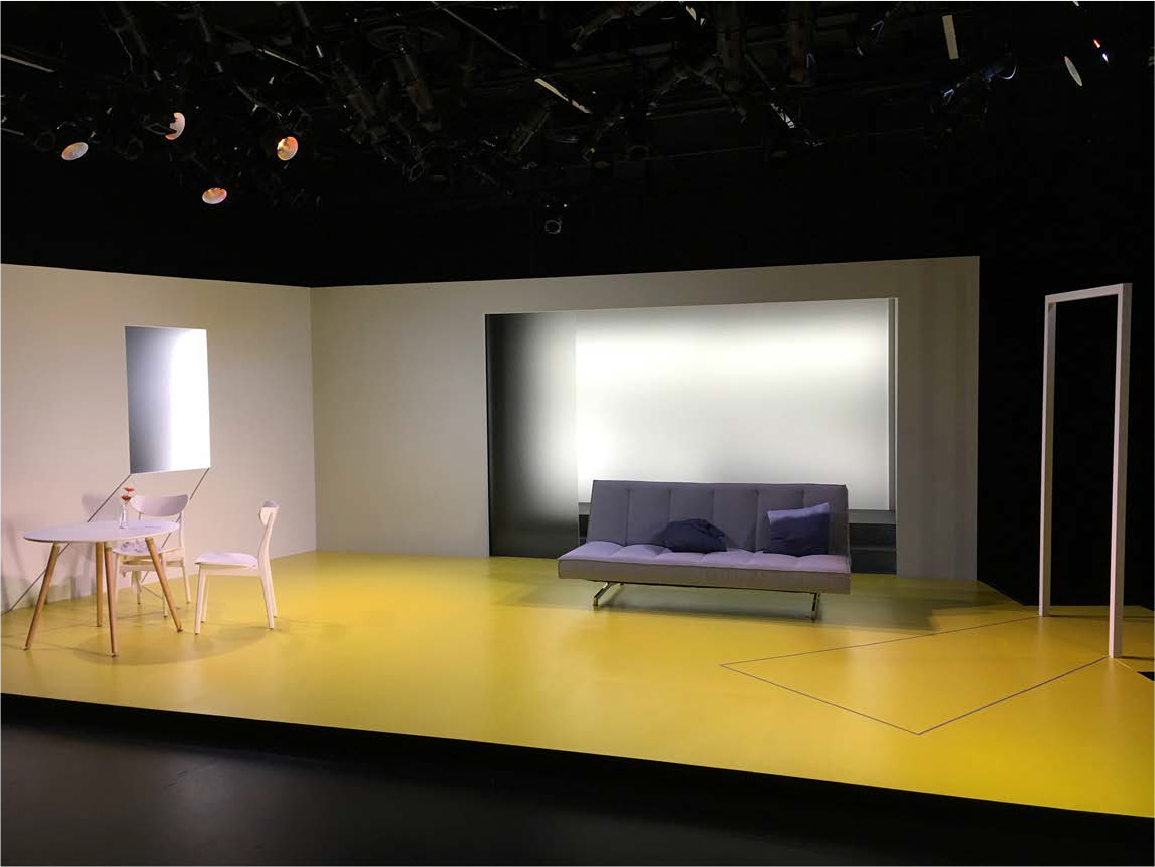
When we open our eyes, two actors are onstage. Kazuki (Kensaku Shinohara) sits in a chair with his back to the audience as Honoka (Yuki Kawahisa) approaches him (fig. 1). Arisa’s reference to English signals the dual identity of the actors as speakers of both Japanese and English, participants in two cultures. It also suggests that the performers are both in the theatre and elsewhere, in another place and time. This ambiguity about the most basic theatrical convention—when and where the play is situated—disrupts the notions of a stable time and place, a homogeneous Japanese identity, and, by extension, discrete national identities. The monochromatic set by Anna Kiraly suggests both here and there, the present and some other time; it is both earthly and otherworldly and conjures globalized mass production, contemporary Japan, and every other postindustrial metropolis. The super-sleek polymer primary colors and easy-to-assemble furniture indicate today’s lack of permanence. Rothenberg’s directing primes the audience to contemplate a world of surfaces. This world of surfaces accommodates an easy scan of the eye over the gliding ghost who comes back to tell her story. Apparitions are everywhere in this post-tsunami world.
The ghost of his dead wife, Honoka (Yuki Kawahisa), roams the apartment while Kazuki (Kensaku Shinohara) waits for his love interest Arisa (Maho Honda) to arrive. Time’s Journey through a Room by Toshiki Okada. Mezzanine Theatre at the A.R.T./New York Theatres, 10 May–10 June 2018. (Photo by Julieta Cervantes)

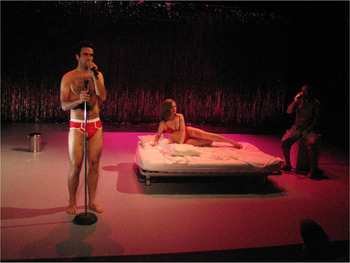
Five Days in March directed by Dan Safer, act 2. Performers Wil Petre, Kourtney Rutherford, and Mike Mikos at the love hotel. La MaMa, NYC, 6–23 May. (Photo by Jonathan Slaff, courtesy of Dan Safer)

The monochromatic set by Anna Kiraly suggests both here and there, present and sometime else, earthly and otherworldly—globalized mass production, contemporary Japan, and every other postindustrial metropolis. Time’s Journey through a Room by Toshiki Okada. Mezzanine Theatre at the A.R.T./New York Theatres, 10 May–10 June 2018. (Photo by Carol Martin)

Kazuki lost his wife, Honoka, after 11 March 2011. As he waits for his new love interest, Arisa, to come to his apartment, Honoka’s ghost appears and recounts the happiness she experienced after the earthquake, until she died of an asthma attack four days later. As in ō drama, Honoka’s ghost narrates the past events that have led to this moment. She wants Kazuki to remember the days after the earthquake, and how she transformed from indifference to happiness (Okada Reference Okada2018). Unlike the archetypal ghosts of ō, Honoka died happy; her unrequited desire is for Kazuki to acknowledge the brief contentment the couple felt in the days immediately after the earthquake. But the production destabilizes her memory with the sounds of ambulances, a baby crying, a traffic accident, shattering glass, crunching metal, and automobiles honking. As Honoka tells the story of the past, Kazuki lives in the present, and Arisa inhabits both the present and the near future as she tells us when she will meet Kazuki and become his girlfriend, and then does so.
At one point in time, Okada was closely aligned with Hirata Oriza’s kōgō engeki (Colloquial Theatre), a style of theatre that emerged in the postbubble economy of 1990s Japan and then dominated Japanese stages for 20 years. Uchino and other critics have dubbed Hirata’s theatre “Quiet Theatre,” and criticized the style for being politically conservative, but members of the younger generation find that Colloquial Theatre has a political charge that feels very much of the moment. Its supracolloquial style intervenes in the nondialogic quality of the Japanese language with idiomatic constructions that sidestep Japanese formality (Uchino Reference Uchino2000:88). The use of silence, stillness, and formal gestures, and an emphasis on the unstated are all a part of both Quiet Theatre and Okada’s aesthetic. In his introduction to Citizens of Tokyo: Six Plays, M. Cody Poulton discusses Hirata’s radically new style of realist theatre with its “avoidance of the conventional dramatic arcs of conflict, crisis, climax and denouement” and includes Okada and chelfitsch among Hirata’s progeny (2019:x). Okada is part of Japan’s “lost generation”—those who bore the brunt of the 1990s recession and the “gradual social disillusionment after the bubble of the Japanese economy burst” (Sidiropoulou Reference Sidiropoulou2017:475). His work probes the circumstances that produce human relations, and, like Brecht, he lays bare his own theatrical effects. Using the traditional Japanese theatrical convention of a ghost as a messenger is a case in point.
Here is Okada’s take:
Theatrically speaking, the conclusion of the tragic event is often recreated onstage and there is an effective and orthodox theatrical technique for it. In Western theatre, for example, the “messenger” is often a means to announce the death of an important character. For this purpose, ghosts are also a very practical tool. Ghosts are the present representation of the past. In fukushiki mugen ō [a dream or illusion seen by the waki, typically a traveler who encounters a ghost in a haunted place], the ghost takes the concluding events of his story—the tragic reason that he has been unable to let go and proceed to the next world—and he can talk about it, dance to express what happened at that time, trace the story back. This theatrical narrative technique is only possible because of the existence of the ghost. The messenger is someone who has arrived from another place. On the other hand, the ghost is coming from a different time than the present, and is able to convey an event theatrically as an entity who is not from the “here” and “now.” (Okada Reference Okada2016 )
Honoka’s ghost is simply there, speaking in the liminal present about the past. There is no fourth wall or scenic attempt at otherworldliness. Performers, spectators, and the ghost are in the room together.
The critical response to Okada’s work in the US has been overwhelmingly positive. Writing about Time’s Journey in the New York Times, Laura Collins-Hughes notes that Honoka’s ghost feels that the earthquake put an emphatic end to business as usual (Collins-Hughes Reference Collins-Hughes2018). Her ghost wants Kazuki to tell her stories about how wonderful everything became after her death, but he has already moved on. Noting Rothenberg’s pacing, she writes
The thing about that timing—the thing that makes this stark and quiet play such an arresting portrait of trauma and its aftermath—is that Honoka (Yuki Kawahisa, in a beautiful central performance) died happy, still caught up in the exhilaration of having survived that calamity. (2018)
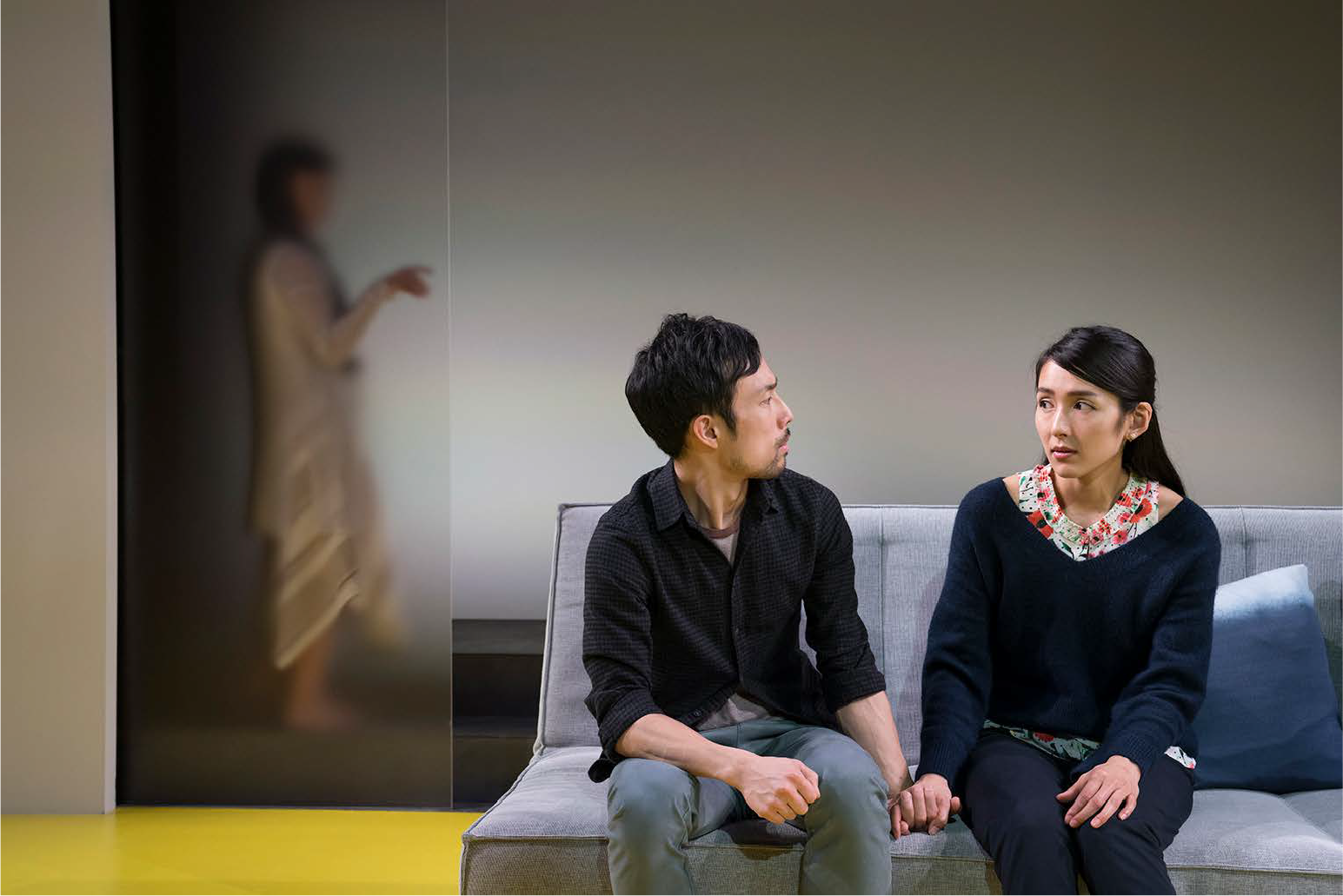
Kazuki (Kensaku Shinohara) and Arisa’s (Maho Honda) attempt to connect is shadowed by Honoka’s ghost (Yuki Kawahisa). Mezzanine Theatre at the A.R.T./New York Theatres, 10 May–10 June 2018. (Photo by Julieta Cervantes)

Contributing to the play’s status as both a culturally fluid response to post-Fukushima Japan and a universal portrayal of the aftermath of tragedy are Chandrashaker’s lighting design, Mikaal Sulaiman’s sound design, Kiraly’s set, and Ogawa’s translation. Collins-Hughes notes the loss of hope for renewal by quoting Honoka’s assertion that she knows the living can hear her. But for how long? asks Collins (2018).
An exception to the positive critical response to Okada’s work is Helen Shaw’s Time Out review of Time’s Journey. Shaw compares the play to a “meditation practice where you try to count to ten without letting your mind wander, returning to ‘one’ every time you get distracted. The point is to feel time passing, and that sensation is sometimes hard to handle” (Shaw Reference Shaw2018). What Shaw experiences as the glacial pace of the production rejects the aesthetics at work. Her quip that Kazuki spends much of his time with his back to the audience as he “simply waits for another woman to arrive” reveals her incomprehension of Okada’s dramaturgical strategies, as does her jibe that “time staggers, creeps, crawls through the room” (Shaw Reference Shaw2018). The tragic form is not only Aristotelian, not only literary. It is also theatrical, and Japanese theatre, both traditional and contemporary, has a long and living history of diverse performance forms that provide a base for Japanese theatricality. Theatrically, the collapse of linear time, the expansion of a moment, conjoining this world with the next, the pregnant reality between the spoken and unspoken, and the appreciation of slowness and the cadence of memory are all part of a Japanese aesthetic. In fact, Rothenberg’s directing draws on Samuel Beckett’s laconic temporal sensibility, inviting a perceptual engagement that goes beyond the dialogue, set, lighting, and acting—but is dependent on all of them.
The post-Fukushima reaction to yet another apocalyptic nuclear event is at the core of Time’s Journey. It is not the first time Japanese theatre has taken on this subject. In the 1980s, the outlook of the shōgekijō (Little Theatre) movement was deeply dystopic. “Within this world of ‘euphoric nothingness,’ in which traditional value systems were declared dead, there was only one transcendental ‘truth’: ‘people will die—everyone will die and there is no exception’” (Uchino Reference Uchino2000:87). In the 1970s and 1980s big-name directors like Tadashi Suzuki and Yukio Ninagawa used conventions of ō and kabuki to stage Greek tragedy. The 1995 Aum Shinrikyo terrorist gas attack in the Tokyo subway system provoked its own unique aesthetic. Led by Shoko Asahara, the cultlike group followed apocalyptic dogmas and teachings bound up with images of the end of the world. After the gas attack, which was neither a natural disaster nor an attack by a foreign power, but something perpetrated by the Japanese upon themselves, Quiet Theatre emerged as a rejection of chaos and dystopia, and flourished in the context of neona-tionalism (Uchino Reference Uchino2000:86). Honoka exemplifies this when she says to Kazuki:
HONOKA: When the earthquake happened, at first, fear and sadness and anxiety and also this feeling of not knowing what to do were all mixed up.
But afterwards, we felt happiness. A joyful feeling we had never experienced before.
You remember that, don’t you?
I’m so glad that earthquake happened, for us. Didn’t we think it was wonderful, that the world was going to change drastically for the better? It was because of that earthquake that we were able to start over. Don’t you agree? I was really glad that I was able to change at the very end of my life. And that feeling will never go away inside us; that happiness will continue forever.
Hey, isn’t it unusual for us to hear an airplane flying so low? (Okada Reference Okada2018 )
Is this the cultural memory of the planes that dropped the atomic bombs on Hiroshima and Nagasaki or the low-flying planes that struck New York’s World Trade Center towers? Honoka’s question obliquely refers to other times and tragedies, other disruptions of sun and light. An apocalyptic vision of the sky is a well-known image in Japanese theatre literature, used most famously in Mishima Yukio’s modern ō play, Yoroboshi (1960), not to mention Japanese film.
Staging the quietness of Time’s Journey in ways that give nuance to the aftermath of the environmental tragedy, Rothenberg keeps Brecht’s influence on Okada in focus. He takes care with spare textual exchanges between characters by choreographing them in temporal and spatial configurations that track what happens to the sense of hope and possibility of renewal when a major disaster alters the way people understand the world. He helped the actors find triggers for the anxiety the characters experience. He appreciates the ways different kinds of minimalism run through Okada’s work, touching both Japanese conventions such as not wearing shoes in the apartment and the ways youth culture sets the terms of their relationships.
Functioning as an interlocutor at the beginning of the play, love interest Arisa later appears stage left, where she comments on being isolated (if not isolationism) from sounds she knows are happening:
ARISA: There are many noises that we can’t hear from here. This space is blocked off so that one can spend time here quietly, and there are sounds that don’t reach here.
Listen. Do you hear them? All the sounds we can’t hear right now.
I am on my way to this room, I’m running late, and I’m on a bus, and in the bus, I’m feeling anxious. The bus has been stuck in traffic for a while, and it still is. It’s hardly moving at all, though I don’t know why, but it’s because there’s a traffic accident at the intersection on the road so far over that you couldn’t see it even if you went out to look from the veranda of this room. There was an accident because a car that was trying to turn at the intersection had tried to make a right turn without using its blinker, and a car coming from the opposite direction came at it really fast and hit it, but you couldn’t hear the honking of the car, the noise of the brakes, the sound of the cars hitting each other and crumpling, the sound of glass shattering—could you hear any of that from here? (Okada Reference Okada2018 )
Unlike both the 1995 human-caused terrorist gas attack in the Tokyo subway and the natural disaster of the Hanshin-Awaii earthquake of the same year, 11 March 2011 was both man-made and natural, with the earthquake and tsunami resulting in the meltdown of the core of the nuclear reactor in Fukushima, exposing its faulty construction and bad location. After the 1989 death of Emperor Hirohito, marking the end of the Shōwa era, these were the most recent in a series of events that each changed Japan overnight (Poulton Reference Poulton2019:viii). The resulting force majeure–like reality further destabilized a society already rapidly moving away from its traditional ritualized social interaction and obligation.
The three characters in Time’s Journey are in liminal states: Honoka’s ghost is between this world and the next, Kazuki is waiting for Arisa with uncertainty because she is very late, and Arisa’s cell phone battery is dead while her bus is stalled in traffic leaving her unable to call Kazuki. But it is Honoka’s ghost who holds on to the moment she left and to what Collins-Hughes calls the “thrilling optimism that can emerge in the wake of a shared catastrophe” (2018).
Did you notice that since that day I often went out onto the veranda? I would go onto the veranda and watch people refill the vending machines with beverages. Even after such a big earthquake, people were back out on their jobs refilling vending machines. I was listening to the clanking noise of those people throwing drinks into the machines. In that moment, I don’t know why, but in that moment I felt deeply in my heart that I love this world. Up until the day before, I didn’t feel such love. Now, I think what a wonderful world this is. From the bottom of my heart. (Okada Reference Okada2018 )
Honoka’s vision recalls when, in 2001 immediately after the terrorist attacks of 9/11, several Japanese people in New York came to a more or less spontaneous memorial for those who had perished, wearing headbands with a rising red sun at the center. It struck me then, and still does now, as a statement of identity, memory, and nationalism (“we Japanese know this”) and their presence as an act of compassion, affiliation, and identification.
I may not have spoken to you about it, but I remember it very clearly. The national flag looked completely different than it ever had, it took my breath away.
I was shocked, because I’d never seen the flag look like that. Like such a wonderful thing. Up until then, it always felt like something forced onto us. But in that moment, though it was really perplexing to me that I would think this way, I was able to imagine how that flag was going to become a symbol of our transformation, and a symbol of how the world was going to be transformed by us. (Okada 2018)
Honoka’s neonationalist vision of Japan rising again is part of what Uchino terms “theatre of the private,” in which an “unarticulated subjectivity, neither singular nor collective, dominates the theatrical space, including the audience” (Reference Tadashi2000:87). The struggle to return to a meaning-fulness existence differentiates Time’s Journey from Japanese plays about the nuclear holocaust. The reimagined symbolism of the national flag, Kazuki’s choice to take a chance on love with Arisa, and Arisa’s acceptance of Kazuki’s proposal that she become his girlfriend with the condition “I want you to be kind to me” are all a part of this theme (Okada Reference Okada2018).
Throughout Time’s Journey, Honoka’s ghost repeatedly asks Kazuki if he remembers, as if she knows that forgetting is inevitable. When Arisa comes into Kazuki’s apartment, he tells her he is planning a makeover with new curtains, wallpaper, furniture, and tableware—but it will take time (Okada Reference Okada2018). Countering this change, the ghost asserts that the room belongs to both she and Kazuki, a sense that will surely fade with the new decor. “The light that shines into this room belongs to both of us. Everything the light reminds us of belongs to both of us, and it is for us to remember that happiness after our transformation. Don’t you think that’s wonderful?” says Honoka (2018). But for Kazuki, life with Honoka is already fading.
Okada, who believes in ghosts, sees a relationship between the act of directing and ghosts as a manifestation of the past:
What I mean by “directorial skills” are the skills necessary to see what intentions, situations, and events onstage can affect the audience, and based on those workings, manipulate the elements to clarify and strengthen them. I am not looking at the performance executed by the performer, but rather the effect and phenomenon the performance can elicit in the audience. This way of viewing actors I think is similar to viewing actors as ghosts. Obviously, paranormal powers are completely different from directorial skills. It’s not as if gaining directorial skills strengthens one’s paranormal powers, and I’m fairly certain that someone with paranormal powers can’t necessarily become a great director. But there is something that these two share at their foundation. And over the years as I have continued my work as a director, somehow, unintentionally and without my realizing it, I have drawn closer to the concept of ghosts. (Okada 2016)
In addition to the dramaturgical strategy of ghosts that give the back story that informs the present, Okada suggests that performance itself is a manifestation of a world that is apart from quotidian time and space. A director makes something appear.
Katharina Pewny postulates a “globalized theatre audience in Europe being able to identify with the precarious (theatre) figures in Japan” as instrumental to the play’s popularity in Europe (Reference Pewny2011). In the US, the collaboration of forward-thinking presenters, the attention and participation of knowledgeable and creative scholars and artists, receptive criticism, and, as in Europe, content that touches global realities have all helped make Okada’s work popular. Time’s Journey has a narrative dramaturgy that travels across national borders, even as it comes from a unique theatrical and national context. From Japan but not solely about Japan, Okada’s work touches universal psychic realities. The ghost in the room is the ghost of history, the ghost of ancestors, and the ghost in all of us standing by, waiting for obliteration. When containers of reality as we know it rupture, new worlds emerge and then quickly vanish. It is not that Rothenberg, Safer, and other directors ignore that this is a Japanese work. Rather, they understand that Okada’s plays propose that Japan is a synecdoche for the world.
Even with all of this artistic and academic attention, without nonprofit funding institutions and foundations, some of which, like the Japan Society, Japan Foundation, the Martin E. Segal Theatre Center, and their significant histories of presenting and funding generative cultural exchange, we would not be able to see work like Okada’s. The leadership of organizations and individuals such as these directly affects global artistic culture and artists and audience access to that culture.
Postscript
Eraser Mountain was Okada’s most recent work to appear in New York, opening at NYU’s Skirball Center in February 2020. It was the last live theatre I saw before the pandemic decimated the theatre industry. With Eraser Mountain Okada questions our human-centric approach to the relationship between people, objects, and the natural world. The work is, in part, Okada’s response to the damage to local mountains as a consequence of using rocks from them to elevate ravaged land after the 2011 tsunami.
Supplementary Materials
To view supplementary material for this article, please visit http://dx.doi.org/10.1017/S1054204321000101.