Verbs are generally more difficult for children to learn than nouns (e.g. Fenson et al., Reference Fenson, Dale, Reznick, Bates, Thal and Pethick1994; Gentner, Reference Gentner and Kuczaj1982). These findings have been reported in Dutch, French, Hebrew, Italian, Korean and Spanish (e.g. Bornstein et al., Reference Bornstein, Cote, Maital, Painter, Park, Pascual, Pêcheux, Ruel, Venuti and Vyt2004). In many languages, nouns are also easier to learn than verbs under laboratory conditions (e.g. Childers & Tomasello, Reference Childers and Tomasello2001; Choi & Bowerman, Reference Choi and Bowerman1991; Imai et al., Reference Imai, Li, Haryu, Okada, Hirsh-Pasek, Golinkoff and Shigematsuin press; Kersten & Smith, Reference Kersten and Smith2002).
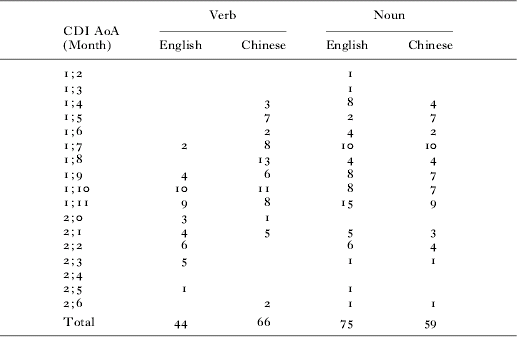
While these data seem compelling, there are inconsistencies in the literature, which researchers refer to as the verb learning paradox (Maguire, Hirsh-Pasek & Golinkoff, Reference Maguire, Hirsh-Pasek, Golinkoff, Hirsh-Pasek and Golinkoff2006). First, nouns are generally learned before verbs, but children do have verbs in their earliest vocabularies. Further, some nouns like idea or uncle are learned after verbs like eat or drink (Fenson et al., Reference Fenson, Dale, Reznick, Bates, Thal and Pethick1994). Finally, although Chinese children's vocabularies contain more nouns than verbs, there is a much higher proportion of verbs in Chinese than early English vocabularies (Tardif, Fletcher, Zhang, Liang & Zuo, Reference Tardif, Fletcher, Zhang, Liang and Zuoin press; Tardif, Reference Tardif1996; Tardif, Gelman & Xu, Reference Tardif, Gelman and Xu1999; Tardif, Shatz & Naigles, Reference Tardif, Shatz and Naigles1997). For example, parental report on the MacArthur Communicative Developmental Inventories (CDI) reveals a considerable difference between the number of verbs learned among Chinese and English children. At 1 ; 4, only three of the 100 most frequent words are verbs in English, according to age of acquisition (AoA) estimates determined by the age at which at least 50% of children understand (for infants) or produce a word (for toddlers). A full 27 of the first 100 words for Chinese children at 1 ; 4 are verbs in Chinese (Tardif, Reference Tardif, Hirsh-Pasek and Golinkoff2006). Further, according to the CDI, Chinese children learned their first 49 verbs by 1 ; 7, whereas English-speaking children learned their first 45 verbs by 2 ; 0 (see Table 1). Theories of word learning have to reconcile the cross-linguistic noun advantage with the learning of some verbs and with the relative verb advantage in Chinese.
The first 45 verbs in English- and 49 verbs in Chinese-speaking children's verb production displayed by the month in which more than 50% of children are reported to produce them

One question that has been raised is whether Chinese children are actually learning verbs (e.g. Bates, Chen, Tzeng, Li & Opie, Reference Bates, Chen, Tzeng, Li and Opie1991). Since Chinese does not have morphological affixes, it is more likely that verbs may be used as nouns and vice versa in Chinese than in English. Actually, this seems to be a misconception. Compared with the verbs English-speaking children learn, the verbs Chinese children learn are not ambiguous as to form class (Tardif, Reference Tardif, Hirsh-Pasek and Golinkoff2006). For example, in the 20 most frequently comprehended verbs in children's vocabularies at 1 ; 4, 12 of the English verbs (e.g. bite, drink) can also be nouns whereas only 3 of the Chinese verbs can be nouns. In addition, by 2 ; 0, Chinese children demonstrate their knowledge of the verb category by using verb-specific syntax (Tardif, Reference Tardif, Hirsh-Pasek and Golinkoff2006).
One explanation for Chinese children's relative verb advantage is the nature of the input. Research suggests that high-frequency words tend to be learned early (e.g. Carroll & White, Reference Carroll and White1973). Chinese caregivers produce both more verb types and tokens than English-speaking caregivers (Tardif et al., Reference Tardif, Shatz and Naigles1997; Tardif et al., Reference Tardif, Gelman and Xu1999). While input frequency surely contributes to the noun and verb disparity, it cannot provide a complete explanation. For example, function words have high token frequency (e.g. the and a) and they are not learned early (e.g. Gentner, Reference Gentner and Kuczaj1982; Bird, Franklin & Howard, Reference Bird, Franklin and Howard2001). Second, if input frequency were a key factor governing word learning, controlling the frequency of verbs and nouns in the input in laboratory studies should make verbs and nouns equally easy to acquire. However, this is not the case (e.g. Childers & Tomasello, Reference Childers and Tomasello2001; Imai et al., Reference Imai, Li, Haryu, Okada, Hirsh-Pasek, Golinkoff and Shigematsuin press). To better understand Chinese children's relative verb advantage, we must also examine the semantic properties of Chinese children's verbs.
Building on observations by Gentner & Boroditsky (Reference Gentner, Boroditsky, Bowerman and Levinson2001) and Gillette, Gleitman, Gleitman & Lederer (Reference Gillette, Gleitman, Gleitman and Lederer1999), this paper addresses the verb learning paradox by suggesting that there is a virtually unexplored factor – ‘imageability’ – that also contributes to early word learning. Chinese children's vocabularies serve as the test case for the hypothesis that words that label concepts that are relatively more imageable and easier to individuate tend to be more readily learned than those that are not. Because Chinese children hear more verbs than English-speaking children, we can also evaluate the effect of input frequency. Thus, this paper addresses two questions. First, can imageability help us better understand the cross-linguistic noun advantage for both English and Chinese, and the relative verb advantage in Chinese children's vocabularies? Second, does imageability independently account for some of the variance in when verbs are acquired above and beyond that contributed by frequency?
Imageability is defined as ‘the ease with which a word gives rise to a mental image’ (Bird et al., Reference Bird, Franklin and Howard2001; Paivio, Yuille & Madigan, Reference Paivio, Yuille and Madigan1968). For example, the word apple arouses an image relatively easily and would thus be rated highly imageable. The word tomorrow, on the other hand, would be rated low in imageability. Imageability is related to semantic notions like boundedness, which refers to whether a word's referent has boundaries that distinguish it from the world around it (Langacker, Reference Langacker1987). For example, the bounded object noun, cup, refers to an entity with distinguishable boundaries (the top, the bottom and the handle of the cup), but the unbounded verb, believe, refers to an action without a clear beginning or end. As a group, object nouns have clearer identifiable boundaries than verbs, although some verbs have clear beginning and end points (e.g. ‘jumping’, ‘running’). However, nouns such as fact and idea would not be characterized as having discernible boundaries. Highly imageable words, then, tend to be bounded words whereas less imageable tend to be unbounded. A word's boundedness may in turn be related to its learnability, since the first step in learning a word is to distinguish its referent from the world around it. The imageability hypothesis predicts that words learned early tend to be more imageable than words learned later, independent of form class and language.
Research with adults suggests this hypothesis. Gillette et al. (Reference Gillette, Gleitman, Gleitman and Lederer1999) showed adults muted video clips of conversations between mothers and children, inserting a tone exactly where a target word had been used. Asked to guess the target word, adults guessed verbs (M=15%) less correctly than nouns (M=45%). More interestingly, they performed better at guessing verbs describing concrete actions (e.g. push) (concreteness is highly correlated to imageability) than abstract mental verbs (e.g. think). Imageability ratings were highly correlated with the number of subjects who identified the correct word (Gillette et al., Reference Gillette, Gleitman, Gleitman and Lederer1999; Snedeker & Gleitman, Reference Snedeker, Gleitman, Hall and Waxman2004). Imageability also predicts word reading, word association and picture naming performance in normal adult subjects (e.g. Strain, Patterson & Seidenberg, Reference Strain, Patterson and Seidenberg1995) as well as written and auditory comprehension and word production in aphasic patients (e.g. Franklin, Howard & Patterson, Reference Franklin, Howard and Patterson1995).
Gilhooly & Logie (Reference Gilhooly and Logie1980) were the first to claim that imageability was a reliable predictor of AoA in English (Bird et al., Reference Bird, Franklin and Howard2001; Masterson & Druks, Reference Masterson and Druks1998). They collected imageability ratings from native English-speaking adults on a 7-point scale (1=not imageable at all; 7=extremely imageable). AoA was based on adults' memory for when they first learned a word on another 7-point scale (1=0–2 years; 7=13 and over). The result showed that words with higher imageability ratings were reported as being learned earlier than words with lower imageability ratings.
A serious limitation of these studies is the questionable accuracy of adults' retrospective memory of AoA. By correlating imageability ratings with American English MacArthur CDI production data, arguably a more reliable source of acquisition data than adults' retrospective memories, McDonough, Song, Hirsh-Pasek, Golinkoff & Lannon (Reference McDonough, Song, Hirsh-Pasek, Golinkoff and Lannon2008) found that CDI AoA was significantly correlated with imageability, and nouns received higher imageability ratings than verbs.
Could the imageability hypothesis help us understand differences in early production between English and Chinese? Early Chinese verbs might be more imageable than early English verbs for two reasons. First, Chinese children's verbs tend to refer to a limited range of actions. The best examples are the ‘carry’ verbs in Chinese. According to an English–Chinese dictionary (www.sino.net/Chinese/), Chinese has 26 verbs for ‘carry’, each encoding a different way of carrying. For example, bei1 means ‘to carry on the back’, bao4 means ‘to carry in one's arms in front of the body’, duan1 means ‘to carry flat on two hands in front of the body’. There are additional instances in which multiple Chinese children's verbs correspond to one verb in English. For example, tang3 means ‘to lie on the back or side’, and pa1 means ‘to lie on the stomach’; ti1 means ‘to kick’, and deng1 means ‘to kick with the bottom of the foot’.
Second, Chinese verbs tend to refer to the specific manner in which one interacts with an object. Take musical instruments, for example. In English, you can play the piano, the violin and the flute. In Chinese, however, verbs denoting specific manners are used with different musical instruments: tan2 (‘to pluck with fingers’) gang1qin2 (‘piano’), la1 (‘to pull’) xiao3ti2qin2 (‘violin’) and chui1 (‘blow’) di2zi (‘flute’). The fact that some Chinese verbs tend to specify particular manners used with particular objects might make Chinese verbs highly imageable.
This study asks whether imageability ratings predict a word's CDI AoA in Chinese. We have three weak tests for the imageability hypothesis. If the imageability hypothesis is viable, then children's words should be more imageable than words usually found only in adult vocabularies. Further, imageability should correlate with CDI AoA in Chinese. Finally, nouns should be more imageable than verbs in children's vocabularies, since Chinese children's vocabularies are also biased toward nouns (Tardif, Reference Tardif, Hirsh-Pasek and Golinkoff2006).
We also have two strong tests of the imageability hypothesis. First, Chinese children's verbs should be more imageable than English-speaking children's verbs. Second, when we compare imageability ratings and input frequency of Chinese words and of the English words used in the McDonough et al. (Reference McDonough, Song, Hirsh-Pasek, Golinkoff and Lannon2008) sample, imageability should independently contribute to AoA above and beyond that of input frequency.
METHOD
Participants
Thirty Chinese undergraduates (half male) (Mean age=22.5 years; range: 20–25 years) were recruited at a university in China. None of them were language or linguistics majors.
Stimuli and procedure
The same procedure and instructions used for imageability ratings in Paivio et al. (Reference Paivio, Yuille and Madigan1968) and Masterson & Druks (Reference Masterson and Druks1998) were employed. Imageability ratings were made on a 7-point scale (1=not imageable at all; 7=extremely imageable), translated into Chinese.
The Chinese word sample contained 125 words (59 nouns, 66 verbs) from children's vocabularies and 94 words (47 nouns, 47 verbs) from adults' vocabularies. Words from children's vocabularies were taken from the Chinese CDI (Tardif et al., in press). Adults' words were among the 500 most frequently used Chinese words collected from an on-line corpus (Chinese Text Computing; http://lingua.mtsu.edu/chinese-computing) based on modern Chinese literary texts that originally appeared in print (Da, Reference Da, Pu, Xie and Xu2004). The adults' words did not appear in the Chinese CDI and served as a comparison with words that did appear in the CDI. Four Chinese graduate students of English linguistics were asked to judge the form class of the words tested according to the instructions, ‘Could you tell me whether the following words are nouns, verbs or can be both?’ Only two words had ambiguous form class, which is consistent with the finding that Chinese CDI verbs are not class ambiguous (Tardif, Reference Tardif, Hirsh-Pasek and Golinkoff2006). For imageability ratings, these two words were disambiguated by labeling them as either a noun or a verb.
To carry out the first strong test for the imageability hypothesis (that Chinese children's verbs should be more imageable than English-speaking children's verbs), we compared the imageability ratings of Chinese words and the imageability ratings of English words used in McDonough et al.'s (Reference McDonough, Song, Hirsh-Pasek, Golinkoff and Lannon2008) sample from Masterson & Druks (Reference Masterson and Druks1998). Using the same procedure for collecting imageability ratings, Masterson & Druks (Reference Masterson and Druks1998) asked 36 adult native English speakers (Mean age=25.3 years; range=23–40 years) (mostly students), to rate 164 nouns and 102 verbs. A word's imageability score is its average imageability rating across all subjects. McDonough et al. (Reference McDonough, Song, Hirsh-Pasek, Golinkoff and Lannon2008) found that of the 266 words that comprised Masterson & Druks' word sample, 76 nouns and 44 verbs appeared on the CDI. Results showed that words' CDI AoA data (by months) were significantly correlated with their imageability scores for both nouns (r(74)=–0·39, p<0·01) and verbs (r(42)=–0·35, p<0·01).
To compare imageability ratings in Chinese and English, variables that could affect imageability ratings were matched across languages. For example, the rating schemes contained only nouns and verbs; had a similar adult word sample size (English: 146 words; Chinese: 181 words); had a similar sample size of children's words (English: 120 words; Chinese: 125 words); had a similar CDI AoA range (English: 1 ; 2–2 ; 6; Chinese: 1 ; 4–2 ; 6); and had a similar number of words around the same age (in months), according to CDI AoA (see Table 2).
Number of words in the English and Chinese word samples displayed by the age at which more than 50% of children produced the word

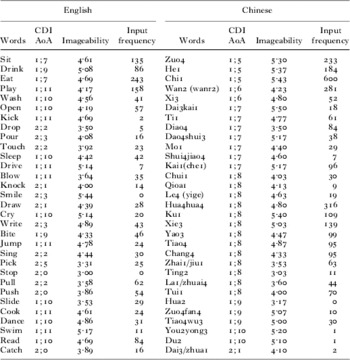
Further, to compare imageability ratings in Chinese and English, we must rule out the possibility that Chinese speakers give uniformly higher or lower imageability ratings than English speakers. We thus examined imageability ratings in a subset of the English and Chinese children's word samples that included 36 nouns and 31 verbs with close meanings across languages. The concept of ‘water’ (noun) and the concept of ‘eat’ (verb), for example, should receive roughly the same imageability ratings in Chinese and English (see Table 3).
Input frequency and imageability ratings of the English and Chinese verbs with close meanings across languages

note: Input frequency means token frequency of the verb, based on the corpus taken from CHILDES used in the present study.
One graduate student of English linguistics in China translated all the words used in McDonough et al.'s study (Reference McDonough, Song, Hirsh-Pasek, Golinkoff and Lannon2008) into Chinese. Then, from the translated words, the researcher extracted 70 words for which AoA data was available from the Chinese CDI (Tardif et al., in press). To test the reliability and quality of the translation, another Chinese graduate student translated these Chinese words back into English. Out of the 70 words, only three did not remain stable in the back translation and these were omitted. Finally, another two Chinese graduate students judged how close the meaning of the remaining 67 words were between English and Chinese on a 1 to 7 scale (1=not at all; 7=exactly). Another 16 verbs and 11 nouns that do not have close meanings across languages were included as fillers. Of the 67 words rated, 92·54% (62 words) were rated at 7; 7·46% (5 words) were rated at 6; and none were rated below 6. None of the filler words received ratings above 2. Thus, the final word sample included words with and without close meanings in English and Chinese (see Table 4).
Input frequency and imageability ratings of the 35 Chinese children's verbs that do not have close meanings to English verbs

note: The translations are based on the New China Dictionary.
To carry out the second strong test of the imageability hypothesis (that imageability contributes to AoA independently of input frequency), imageability ratings and input frequency were examined for their independent contributions to CDI AoA. Based on CHILDES, we counted the input frequency of the Chinese verbs that were rated for imageability in the current study. We also counted input frequency for the English verbs rated for imageability from the McDonough et al. study. Input frequency was defined as verb tokens, or the number of times a verb appeared in the input. The same criteria were used for input frequency computation in English and Chinese: (a) only speech directed to children (n=10 for each language) was analyzed; (b) sample size was matched based on the number of lines of text on a page; and (c) samples were matched on age range (1 ; 9 to 2 ; 3). Owing to the nature of child-directed speech, approximately 95% of the maternal utterances were a single line in length in both languages. The English sample contained 73,305 lines; the Chinese sample, 73,390 lines. The Chinese sample was transcribed in PinYin (Romanization) with indication of the lexical tones. Based on Yin & Felley (Reference Yin and Felley1990), the disyllabic verb–verb compounds were treated as one verb (e.g. zuo4 ‘sit’ xia4 ‘down’; da3 ‘hit’ kai1 ‘open’), whereas the polysyllabic verb compounds, consisting of two verb compounds or one main verb and one verb compound, were treated as two verbs in the analysis (e.g. pao3 ‘run’ chu2qu4 ‘go out’; bao4 ‘carry’ guo4lai2 ‘come here’).
RESULTS
Did Chinese and English speakers rate words with close meanings similarly?
Throughout this study, a word's imageability score is its average imageability rating across subjects. To ascertain the possibility that Chinese and English raters approached this task with systematic biases, a two-way ANOVA compared the imageability ratings of the words (36 nouns and 31 verbs in each language) with close meanings across languages, using language (Chinese vs. English) as the between-subjects factor and word class (noun vs. verb) as the within-subjects factor. The only significant result was a main effect of word class across language (F(1, 130)=350·36, p<0·01) with nouns (M=6·12, SD=0·35) receiving higher imageability ratings than verbs (M=4·46, SD=0·66). Interaction between language and word class did not approach significance, suggesting that neither nouns (English: M=6·13, SD=0·37; Chinese: M=6·11, SD=0·32) nor verbs (English: M=4·34, SD=0·61; Chinese: M=4·57, SD=0·69) with close meanings in Chinese and English differed in imageability ratings. Moreover, the variability of imageability ratings is higher for verbs than nouns in both English and Chinese. These findings suggest that Chinese and English speakers have similar imageability concepts, allowing us to now ask questions relevant to our hypotheses.
Did the Chinese children's words (from the CDI) receive higher imageability ratings than the adults' words?
A two-way ANOVA using age (child vs. adult) as the between-subjects factor and word class (noun vs. verb) as the within-subjects factor revealed a significant main effect of age (F(1, 215)=213·09, p<0·01), with children's words (M=5·37, SD=0·95) receiving higher imageability ratings than adults' (M=3·52, SD=1·25). There was a main effect of word class (F(1, 215)=64·65, p<0·01) with nouns (M=5·10, SD=1·43) receiving higher imageability ratings than verbs (M=4·08, SD=1·23) across age groups. Interaction between age and word class did not approach significance (p=0·18), suggesting that children's words (both nouns and verbs) are more imageable than adults'.
Do imageability ratings in Chinese correlate with AoA, as predicted by the imageability hypothesis?
With nouns and verbs combined, CDI AoA (by month) and imageability ratings were significantly correlated (r(123)=–0·34, p<0·01). When word classes were analyzed separately, CDI AoA and imageability ratings were also significantly correlated with a large effect size for nouns (r(57)=−0·44, p<0·01) and verbs (r(64)=−0·49, p<0·01). That is, earlier learned words, be they nouns or verbs, were more imageable than later learned words. To determine whether the correlation was carried by the words that spanned AoA in the sample, words were divided into two groups by AoA. Significant correlations between AoA and imageability ratings were found both in words with earlier AoA (n=73; AoA=1 ; 4–1 ; 9; r(71)=–0·38, p<0·01) and words with later AoA (n=52; AoA=1 ; 10–2 ; 6; r(50)=–0·33, p<0·05). The results suggest that imageability is a reliable predictor of a word's AoA in Chinese.
Did Chinese children's verbs have higher imageability ratings than English children's verbs?
To determine whether all the early verbs from the CDI, including words with and without close meanings across languages, received higher imageability ratings in Chinese than in English, a two-way ANOVA using language (Chinese vs. English) as the between-subjects factor and word class (noun vs. verb) as the within-subjects factor was performed. It showed a significant interaction between language and word class (F(1, 240)=9·72, p<0·01). Post hoc analyses revealed two significant results. First, early nouns were more imageable than early verbs in both Chinese (p<0·01, d=1·69) and English (p<0·01, d=3·42). Second, early verbs had higher imageability ratings in Chinese (M=4·80, SD=0·89) than in English (M=4·37, SD=0·60) (p<0·05, d=0·62). Interestingly, nouns did not differ in imageability ratings: Chinese (M=6·01, SD=0·49) and English (M=6·09, SD=0·37). Since nouns in Chinese and English did not differ in imageability, the rest of the analyses focused on verbs.
Do input frequency and imageability independently account for CDI AoA of verbs?
When all the verbs from the CDI, including verbs with and without close meanings across languages, were analyzed, there was a significant correlation between CDI AoA and input frequency in Chinese (r(64)=–0·57, p<0·01) and English (r(42)=–0·42, p<0·01). Thus, input frequency predicted a verb's AoA in Chinese and English. Further, imageability ratings were correlated with input frequency in Chinese (r(64)=0·29, p<0·05) but not in English (r(42)=0·02, p=0·91). Thus, highly imageable verbs are also used with high frequency in child-directed speech in Chinese, but not in English.
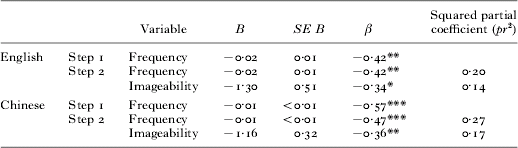
These findings led us to question whether imageability independently contributes to AoA. Separate hierarchical regression analyses were performed in Chinese and English, with CDI AoA as the dependent variable and input frequency entered in step 1 and imageability ratings entered in step 2. In step 1, input frequency accounted for 33% of the CDI AoA variance in Chinese and 18% in English (ps<0·01). In step 2, imageability and input frequency together accounted for 44% of the CDI AoA variance in Chinese and 29% in English (ps<0·01). Imageability explained a significant increase in the CDI AoA variance in Chinese (ΔR 2=0·12, p<0·01) and English (ΔR 2=0·11, p<0·05). This finding suggested that imageability had predictive value beyond input frequency alone. Independent contributions were evaluated through the interpretations of squared partial coefficients (pr2) (Tabachnick & Fidell, Reference Tabachnick and Fidell2007). Input frequency uniquely accounted for 27% of the CDI variance in Chinese and 20% in English (ps<0·01), while imageability uniquely accounted for 17% of the CDI variance in Chinese and 14% in English (ps<0·05) (see Table 5).
Multiple regression of imageability and frequency predicting CDI AoA of verbs in English and Chinese

note: In step 1, R 2=0·18 in English and 0·33 in Chinese. In step 2, R 2=0·29 in English and 0·44 in Chinese with ΔR 2=0·11 (p<0·05) in English and ΔR 2=0·12 in Chinese (p<0·01). The squared partial coefficient (pr 2) indexes the variance accounted for uniquely by each predictor after the effect of the other predictor is controlled.
* p<0·05, ** p<0·01, *** p<0·001.
With the Chinese and English verbs combined, a hierarchical regression using CDI AoA as the dependent variable, and imageability, input frequency and language as predictors did not show significant interactions between language and either input frequency or imageability. This finding suggested that the effect of input frequency and imageability was similar in English and Chinese.
DISCUSSION
This study explored the relevance of a potentially important factor in children's word acquisition: imageability. When results by McDonough et al. (Reference McDonough, Song, Hirsh-Pasek, Golinkoff and Lannon2008) suggested that imageability predicted CDI AoA in english, we selected a language with very different properties (Chinese) to see if imageability would still predict CDI AoA. Because no prior imageability ratings existed in Chinese, we collected imageability ratings for words that (a) appeared on the Chinese CDI and (b) were used more exclusively by adults.
There are two alternative explanations for the present findings that should be considered. First, Chinese speakers have an inflated view of imageability. Comparing words with close meanings in Chinese and English, however, leaves no reason to believe that Chinese-speaking adults give systematically higher (or lower) imageability ratings than English-speaking adults. Second, perhaps Chinese caregivers are more likely to overestimate their children's lexical acquisition than their English-speaking counterparts. While this cannot be ruled out, the fact that observational research suggests that parents' ratings are reliable makes that interpretation unlikely (Lee & Naigles, Reference Lee and Naigles2005; Leung, Reference Leung2001; Sandhofer, Smith & Luo, Reference Sandhofer, Smith and Luo2000; Tardif et al., Reference Tardif, Gelman and Xu1999; Tse, Chan & Li, Reference Tse, Chan and Li2005).
The imageability hypothesis: Three weak tests
First, the imageability hypothesis predicted that words appearing in children's vocabularies should be more imageable than those appearing primarily in adults' vocabularies. This was confirmed in Chinese since children's words were generally more imageable than adults' words. The second prediction of the imageability hypothesis was also confirmed such that imageability was correlated with CDI AoA; the grammatical class (noun vs. verb) was not (r pbis=0·005, p=0·96). Finally, the third prediction that nouns should be more imageable than verbs in children's vocabularies was confirmed in both Chinese and English (McDonough et al., Reference McDonough, Song, Hirsh-Pasek, Golinkoff and Lannon2008). Interestingly, Chinese and English children's nouns do not differ in imageability ratings or CDI AoA.
The imageability hypothesis: Two strong tests
The first strong test predicted that Chinese children's verbs should be more imageable than English-speaking children's verbs, since Chinese children learn more verbs and learn them earlier than English-speaking children. Comparing the McDonough data to the Chinese data, this prediction was also confirmed. Further, the second strong test predicted that compared with input frequency, imageability should independently contribute to CDI AoA. This prediction was confirmed in both Chinese and English, suggesting that imageability was not an artifact of input frequency.
The imageability hypothesis may help us explain the verb learning paradox. While verbs are hard to learn in general, children around the world do learn some highly imageable verbs (e.g. eat, drink) and learn them before some nouns (e.g. idea, uncle). Consequently, the relative verb advantage in Chinese children's vocabularies may be related to the higher imageability of Chinese children's verbs compared with English-reared children's verbs.
Why does imageability predict age of acquisition of verbs?
Imageability may be related to how a word's meaning is encoded (e.g. Strain et al., Reference Strain, Patterson and Seidenberg1995). High imageability could help children with the first step in verb learning: detecting the action. Imageability may also be related to whether a verb encodes physical motion (Strain et al., Reference Strain, Patterson and Seidenberg1995; Plaut & McClelland, Reference Plaut and McClelland1993). As children's early verb learning is partially governed by perceptual salience (e.g. Brandone, Pence, Golinkoff & Hirsh-Pasek, Reference Brandone, Pence, Golinkoff and Hirsh-Pasek2007), verbs that name physical actions are more salient and observable than verbs that name events with little physical motion (e.g. running vs. thinking). This is consistent with the finding that the first verbs children understand or produce usually describe actions or events that encode physical motion rather than the invisible mental status of an agent (Bloom, Lightbown & Hood, Reference Bloom, Lightbown and Hood1975; Snedeker & Gleitman, Reference Snedeker, Gleitman, Hall and Waxman2004).
Highly imageable verbs may also be easier to store in semantic memory than less imageable verbs (e.g. Strain et al., Reference Strain, Patterson and Seidenberg1995) as the actions verbs name are usually transient. That is, verbs may be uttered before, during or after an action is performed, making it important to remember the action being named (Tomasello & Kruger, Reference Tomasello and Kruger1992).
High imageability might also assist children in extending verbs to new exemplars. To learn the verb drink, for example, one has to abstract the common relation of drinking from a range of drinking actions that are performed by different agents, with different drinks, and with different manners in order to find what Golinkoff et al. (Reference Golinkoff, Chung, Hirsh-Pasek, Liu, Bertenthal, Brand, Maguire and Hennon2002) called the ‘verbal essence’ (e.g. ‘drinking by mouth or by straw’). Highly imageable verbs may be performed in a more consistent manner than less imageable verbs. Among the Chinese verbs in the sample, for instance, there are four verbs for specific manners of carrying that received higher imageability ratings and were reported to have been learned earlier than the general carry verb in English (Table 4). Tardif (Reference Tardif2005) also found that more Chinese verbs had specific manners and paths than English verbs.
Additionally, high imageability may be related to a limited range of verbal arguments. In Chinese, for example, some early acquired verbs entail certain types of instruments (e.g. jian3 ‘to cut with scissors’; gai4 ‘to cover with a lid’). For children who are abstracting a common action relation, verbs with narrow meanings may be easier to learn than verbs with broad meanings (Golinkoff et al., Reference Golinkoff, Chung, Hirsh-Pasek, Liu, Bertenthal, Brand, Maguire and Hennon2002). Nonetheless, these are conjectures for future research as the present study's correlational nature precludes drawing conclusions.
In summary, input frequency and imageability together account for a substantial percentage of CDI AoA variance for verb learning in Chinese (44·22%) and in English (29·16%). It is noteworthy that much more of the verb learning variance is accounted for in Chinese than in English with imageability and input frequency combined. The present study, therefore, suggests some potential explanations for Chinese children's relative verb advantage. Chinese children's verbs are more imageable than English children's verbs, and highly imageable verbs are also used with high frequency in Chinese, but not in English.Footnote 1
Chinese parents may produce verbs more frequently than their English-speaking counterparts for two reasons. First, Chinese is a pro-drop language, which allows verbal argument dropping. The fact that verbs can appear alone may make them salient. Second, Chinese allows duplicated verb structures, which increases token frequency. For example, Kan4 ‘look’ yi2 ‘one’ Kan4 means ‘Have a look’, and Kan4 bu2 ‘not’ Kan4 means ‘Do you want to have a look?’
Imageability and input frequency, however, are not the only factors governing verb learning, since they do not account for all the variance in AoA. Another factor favoring early Chinese verb acquisition may be that Chinese is pragmatically biased towards verbs while English may be biased towards nouns. For example, Tardif et al. (Reference Tardif, Shatz and Naigles1997) observed that in answering questions, whereas English allows nouns as answers, Chinese requires verbs. Thus, to the question, ‘Do you want to drink some more juice?’ an English-reared child can answer more or juice, but not want or drink, like their Chinese counterparts.
By providing support for the imageability hypothesis, this study helps to explain the cross-linguistic noun advantage in children's vocabularies and the relative verb advantage in Chinese children's vocabularies. Future research must probe which factors associated with imageability facilitate verb learning.