Introduction
Seed dormancy and pre-harvest sprouting tolerance
This study characterizes changes in hormone sensitivity associated with wheat grain dormancy loss. The mechanisms controlling seed dormancy and germination are important both from the standpoint of understanding plant adaptation to the environment and for the advancement of agriculture. Living seeds are considered dormant when they fail to germinate under favourable conditions. Seed dormancy allows time for seed dispersal and prevents germination out of season. Dormant seeds can acquire the ability to germinate through a period of dry storage called afterripening, or by imbibing water in the cold, a process called cold stratification (reviewed in Bewley and Black, Reference Bewley and Black1994; Baskin and Baskin, Reference Baskin and Baskin2004; Bewley et al., Reference Bewley, Bradford, Hilhorst and Nonogaki2013). Germination is initiated during imbibition and concludes when the embryonic root emerges from the seed. Insufficient grain dormancy in cereals, such as Triticum aestivum (wheat), Oryza sativa (rice) and Hordeum vulgare (barley), is associated with susceptibility to pre-harvest sprouting (PHS), the germination of mature seeds on the mother plant when rain occurs prior to harvest (reviewed by McCaig and DePauw, Reference McCaig and DePauw1992; Rodriguez et al., Reference Rodríguez, Margineda, González-Martín, Insausti and Benech-Arnold2001; Wilkinson et al., Reference Wilkinson, McKibbin, Bailey, Flintham, Gale, Lenton and Holdsworth2002; Li et al. Reference Li, Ni, Francki, Hunter, Zhang, Schibeci, Li, Tarr, Wang, Cakir, Yu, Bellgard, Lance and Appels2004; Fang et al., Reference Fang, Chai, Qian, Li, Tang, Sun, Huang, Guo, Sun, Liu, Zhang, Lu, Wang, Lu, Han, Chen, Cheng and Chu2008; Hori et al., Reference Hori, Sugimoto, Nonoue, Ono, Matsubara, Yamanouchi, Abe, Takeuchi and Yano2010). Even when PHS does not result in visible growth of the seedling, the initiation of germination can lead to induction of α-amylase, an enzyme that causes starch breakdown, resulting in poor-quality baked goods and economic losses (Wahl and O'Rourke, Reference Wahl, O'Rourke, Walker-Simmons and Reid1993). Too much grain dormancy at sowing, on the other hand, can cause poor seedling emergence, resulting in reduced grain yield (Ringlund, Reference Ringlund, Walker-Simmons and Ried1992). Selection for good seedling emergence can inadvertently lead to varieties with low dormancy and genetic PHS susceptibility unless breeders are careful to allow time for afterripening before sowing.
The degree of PHS tolerance is determined by several traits including spike morphology, and dormancy-related traits such as grain coat colour and plant hormone biosynthesis and sensitivity. Spike morphology appears to influence PHS susceptibility by determining how much moisture enters and is retained within spikelets during and after rain (King and Richards, Reference King and Richards1984; King and von Wettstein-Knowles, Reference King and von Wettstein-Knowles2000). Cultivars with awned spikes, with a more compact club spike morphology or with looser glumes tend to be more PHS susceptible due to a tendency to retain more moisture. Cultivars with more epicuticular wax on the surface of the spike tend to be better at resisting rain and PHS. Wheat with red grains, due to deposits of catechin and proanthocyanidins in the grain coat, tend to have higher dormancy associated with PHS tolerance (Miyamoto and Everson, Reference Miyamoto and Everson1958; Flintham, Reference Flintham2000; Himi et al., Reference Himi, Mares, Yanagisawa and Noda2002; Debeaujon et al., Reference Debeaujon, Lepiniec, Pourcel, Routaboul, Bradford and Nonogaki2007). The presence of the red seed coat colour is controlled by the TaMyb10 transcription factors encoded by the Red-1 loci of allohexaploid wheat, Red-A1, Red-B1 and Red-D1 (Himi et al., Reference Himi, Maekawa, Miura and Noda2011). Lack of function in all three copies of the R locus in allohexaploid wheat results in decreased grain dormancy and a tendency to higher sprouting susceptibility in wheat. However, the R locus is not the only factor controlling PHS tolerance in wheat. It is possible to have both PHS-sensitive (low dormancy) red-grained wheat varieties, and to have PHS-tolerant (high-dormancy) white wheat varieties (Flintham, Reference Flintham2000; Warner et al., Reference Warner, Kudma, Spaeth and Jones2000; Himi et al., Reference Himi, Mares, Yanagisawa and Noda2002). White wheat varieties are desirable due to their excellent milling quality and flour extraction rates. Grain dormancy and PHS tolerance in wheat have been associated with higher accumulation and sensitivity to the plant dormancy-promoting hormone abscisic acid (ABA), and lower accumulation or sensitivity to the hormone gibberellin (GA) in cereals (reviewed in Rodriguez et al., Reference Rodriguez, Barrero, Corbineau, Gubler and Benech-Arnold2015, this issue). It is important to understand how changes in plant hormone accumulation and sensitivity regulate grain dormancy and dormancy loss, because such information can facilitate breeding for PHS-tolerant red and white cultivars that lose dormancy rapidly enough to allow good germination and emergence.
The hormones ABA and GA regulate seed dormancy and dormancy loss
Seed dormancy and germination are regulated by two opposing hormone signals; ABA stimulates seed dormancy and GA stimulates seed germination in diverse plant species (reviewed in Kucera et al., Reference Kucera, Cohn and Luebner-Metzger2005; Finkelstein et al., Reference Finkelstein, Reeves, Ariizumi and Steber2008). ABA levels rise during embryo maturation, establishing seed dormancy and desiccation tolerance (Karssen et al., Reference Karssen, der Brinkhorst-van Swan, Breekland and Koornneef1983). Higher ABA levels in mature dry and imbibing seeds are associated with higher seed dormancy. ABA levels decrease as a result of dormancy loss through dry afterripening and cold stratification in Arabidopsis and cereals (Walker-Simmons, Reference Walker-Simmons1987; Noda et al., Reference Noda, Kawabata and Kawakami1994; Kawakami et al., Reference Kawakami, Miyake and Noda1997; Benech-Arnold et al., Reference Benech-Arnold, Giallorenzi, Frank and Rodriguez1999; Jacobsen et al., Reference Jacobsen, Pearce, Poole, Pharis and Mander2002; Kushiro et al., Reference Kushiro, Okamoto, Nakabayashi, Yamagishi, Kitamura, Asami, Hirai, Koshiba, Kamiya and Nambara2004; Yamauchi et al., Reference Yamauchi, Ogawa, Kuwahara, Hanada, Kamiya and Yamaguchi2004; Millar et al., Reference Millar, Jacobsen, Ross, Helliwell, Poole, Scofield, Reid and Gubler2006; Barrero et al., Reference Barrero, Talbot, White, Jacobsen and Gubler2009, Reference Barrero, Millar, Griffiths, Czechowski, Scheible, Udvardi, Reid, Ross, Jacobsen and Gubler2010). It is clear that ABA regulates wheat grain dormancy because mutants with increased ABA sensitivity have increased grain dormancy, whereas wheat mutants with decreased ABA sensitivity have decreased grain dormancy (Kawakami et al., Reference Kawakami, Miyake and Noda1997; Kobayashi et al., Reference Kobayashi, Takumi and Nakamura2008; Rikiishi and Maekawa, Reference Rikiishi and Maekawa2010; Schramm et al., Reference Schramm, Abellera, Strader, Campbell and Steber2010, Reference Schramm, Nelson and Steber2012, Reference Schramm, Nelson, Kidwell and Steber2013). GA stimulates germination in cereals, and is required for germination in dicots (reviewed in Finkelstein et al., Reference Finkelstein, Reeves, Ariizumi and Steber2008; Nakamura et al., Reference Nakamura, Abe, Kawahigashi, Nakazono, Tagiri, Matsumoto, Utsugi, Ogawa, Handa, Ishida, Mori, Kawaura, Ogihara and Miura2011). The GA biosynthesis gene, GA20ox, was identified as a quantitative trait locus associated with seed dormancy and PHS tolerance in rice, barley and wheat, suggesting that reduced GA signalling can increase grain dormancy in these cereals (Li et al., Reference Li, Ni, Francki, Hunter, Zhang, Schibeci, Li, Tarr, Wang, Cakir, Yu, Bellgard, Lance and Appels2004; Spielmeyer et al., Reference Spielmeyer, Ellis, Robertson, Ali, Lenton and Chandler2004; Appleford et al., Reference Appleford, Evans, Lenton, Gaskin, Croker, Devos, Phillips and Hedden2006). This notion was supported by the observation that overexpression of the gene encoding the GA turnover enzyme, GA2ox, leads to increased wheat grain dormancy and PHS tolerance (Appleford et al., Reference Appleford, Wilkinson, Ma, Evans, Stone, Pearce, Powers, Thomas, Jones, Phillips, Hedden and Lenton2007).
Understanding the role of ABA and GA signalling in controlling PHS tolerance is especially important if we are to breed successfully PHS-tolerant white wheat. Higher ABA sensitivity at maturity was associated with higher PHS tolerance and grain dormancy in white wheat (Walker-Simmons, Reference Walker-Simmons1987). Loss of grain dormancy through dry afterripening is associated with loss of ABA sensitivity in both red and white wheat (Morris et al., Reference Morris, Moffatt, Sears and Paulsen1989; Schramm et al., Reference Schramm, Abellera, Strader, Campbell and Steber2010, Reference Schramm, Nelson and Steber2013; Liu et al., Reference Liu, Gao, Kanno, Jordan, Kamiya, Seo and Ayele2013). Afterripening was also found by Morris et al. (Reference Morris, Anderberg, Goldmark and Walker-Simmons1991) to be associated with decreased endogenous ABA hormone levels in imbibing white wheat. The present study examined whether dormancy loss is generally associated with decreasing ABA sensitivity and levels. Previous work showed that wheat ABA hormone sensitivity decreases with dormancy loss through cold stratification (Noda et al., Reference Noda, Kawabata and Kawakami1994). The present study examined whether dormancy loss is also associated with changes in GA sensitivity, and characterized the changes in GA and ABA sensitivity with afterripening and cold stratification of two highly dormant and PHS-tolerant white-grained cultivars, Brevor and Clark's Cream.
The role of GA signalling in cereal grain dormancy loss is less clear than the role of ABA signalling. Afterripening of barley was not associated with a significant increase in bioactive GA1, but was associated with increasing levels of GA precursors, suggesting that the potential to synthesize GA increases as a result of afterripening (Jacobsen et al., Reference Jacobsen, Pearce, Poole, Pharis and Mander2002). Barley bioactive GA levels did not increase until afterripened barley grains were imbibed. Similarly, some increase in bioactive GA4 levels was detected with afterripening of Arabidopsis, but only after seeds had imbibed for 12 h (Ariizumi et al., Reference Ariizumi, Hauvermale, Nelson, Hanada, Yamaguchi and Steber2013). Thus, it has been suggested that reduction of ABA signalling may be more important than increased GA signalling in cereal dormancy loss (Karssen and Lacka, Reference Karssen, Lacka and Bopp1986; Barrero et al., Reference Barrero, Talbot, White, Jacobsen and Gubler2009). Transcriptomic and biochemical studies in imbibed barley illustrated that afterripening was associated with decreased ABA-responsive gene expression and ABA content, but no change in GA-responsive gene expression (Barrero et al., Reference Barrero, Talbot, White, Jacobsen and Gubler2009). Afterripening was associated with increased accumulation of jasmonic acid (JA) hormone-responsive transcripts, suggesting that JA may also function in cereal grain dormancy loss (Barrero et al., Reference Barrero, Talbot, White, Jacobsen and Gubler2009). The latter authors also suggested that hormone content and signalling within specialized tissues of cereal grains have different roles in dormancy release, and observed that the coleorhiza that covers the embryonic root plays a major role as a barrier tissue controlling barley dormancy release and germination (Barrero et al., Reference Barrero, Talbot, White, Jacobsen and Gubler2009; Jacobsen et al., Reference Jacobsen, Barrero, Hughes, Julkowska, Taylor, Xu and Gubler2013). The scutellum forms an interface between the embryo and the starchy endosperm, whereas the wheat aleurone is a living cell layer that surrounds the dead starchy endosperm. The embryo, including the scutellum, is the source of the GA that stimulates α-amylase expression in the aleurone (Radley, Reference Radley1967; Jacobsen and Chandler, Reference Jacobsen, Chandler and Davies1987; Hedden and Kamiya, Reference Hedden and Kamiya1997). Hormone profiling was performed in the embryo/scutellum and the aleurone/seed coat, allowing us to examine whether changes in these tissues parallel each other.
The present study examined changes in ABA and GA hormone sensitivity both as a result of dry afterripening and cold stratification of dormant wheat grains. While the effects of dry afterripening on wheat grain hormone sensitivity have been well characterized, little is currently known about the effects of cold stratification on wheat ABA and GA sensitivity. Moreover, the present study examined the effects of cold stratification on grain endogenous hormone levels. Most studies in barley and wheat make comparisons between ‘dormant’ and ‘afterripened’ grain. But it is very difficult to define the degree of dormancy or dormancy loss, because dormancy is generally defined by the lack of germination capacity. Examination of changes in GA and ABA hormone sensitivity allowed the definition of intermediate stages in dormancy loss both during dry afterripening and cold stratification. Based on this result, a classification chart to define stages in dormancy loss of wheat was proposed. These stages were shown to be applicable in describing the dormancy loss during afterripening of two very dormant wheat cultivars, and during dormancy loss through cold stratification of 13 diverse cultivars.
Materials and methods
Plant materials
Spikes of Triticum aestivum L. cultivars used for the spike-wetting tests shown in Fig. 2 were obtained from the Washington State University Cereal Variety Trials (Cereal Variety Testing, 2013) grown at Spillman Agronomy Farm (Pullman, Washington, USA) in 2013. Cultivars examined included: hard red winters ‘WB-Arrowhead’ and ‘Jagger’; soft white winters ‘Brevor’, ‘SY Ovation’ (03PN108-21), ‘Xerpha’, ‘Puma’, ‘Bruneau’ (PI 664304, PVP201200014), ‘ARS-Selbu’ (PI 667744), ‘Brundage 96’, ‘AP Legacy’ (PI 658008, PVP200900300) and ‘Greer’; and club soft white winters ‘Cara’ and ‘Bruehl’ (Sears et al., Reference Sears, Moffatt, Martin, Cox, Bequette, Curran, Chung, Heer, Long and Witt1997; Jones et al., Reference Jones, Murray, Lyon, Morris and Line2001, Reference Jones, Lyon, Balow, Gollnick, Murphy, Kuehner, Murray, Chen, Engle and Campbell2010; Zemetra et al., Reference Zemetra, Lauver, O'Brien, Koehler, Souza, Guy, Robertson and Brown2003; Syngenta, 2011; Campbell et al., Reference Campbell, Allan, Anderson, Burke, Blake, Hoagland, Walker, Chatelain, Little, Pritchett, Chen, Morris, See, Guy, Murray, Engle, Wetzel and Wood2013; Carter et al., Reference Carter, Jones, Cai, Lyon, Balow, Shelton, Higginbotham, Chen, Engle, Baik, Guy, Murray and Morris2014; WestBred, 2014). The cultivars used for cold stratification experiments in Fig. 7 were harvested from the Washington State University Cereal Variety Trials (Pullman, Washington, USA) in 2014. Winter cultivars, soft white Brevor, hard white ‘Clark's Cream’, hard red Jagger and soft white Greer, were either grown at the Spillman Agronomy Farm in Pullman, Washington, or in the greenhouse, as indicated (Heyne, Reference Heyne1959; Pope, Reference Pope1978; Morris and Paulsen, Reference Morris and Paulsen1989; Sears et al., Reference Sears, Moffatt, Martin, Cox, Bequette, Curran, Chung, Heer, Long and Witt1997). Greenhouse-grown material was vernalized at 4°C for 5 weeks, before transfer to a glasshouse at 22°C day/17°C night temperatures, with a 16 h photoperiod supplemented during the winter months as described in Schramm et al. (Reference Schramm, Nelson and Steber2012). All spikes were harvested at physiological maturity, as soon as glumes had lost all green colour (as in Paterson et al., Reference Paterson, Sorrells and Obendorf1989). Spikes were hand threshed to avoid scarification of the seed coat (as in Schramm et al., Reference Schramm, Abellera, Strader, Campbell and Steber2010). After the indicated period of dry afterripening, grain was stored at − 20°C to maintain grain dormancy until plating experiments were performed.
Germination assays
Wheat caryopses, which are referred to as grains in this paper, were first surface sterilized with 5% bleach/0.01% SDS (sodium dodecyl sulphate)/dH2O (distilled water) with agitation for 10 min. The bleach solution was vacuum aspirated, and grains were washed four times with sterile deionized water. Grains were plated in Petri dishes containing blue germination discs (Anchor Paper, www.anchorpaper.com) moistened with 6 ml of 5 mM MES (2-(N-morpholino) ethanesulphonic acid, pH 5.5) buffer solution without hormone or with the indicated concentration of ABA or GA3 (as in Schramm et al., Reference Schramm, Abellera, Strader, Campbell and Steber2010). ABA and GA3 0.1 M stocks were prepared in methanol and 70% ethanol, respectively, and stored at − 20°C in the dark. Plates wrapped in aluminium foil were incubated in the dark at 30°C. Germination assays were conducted at 30°C because previous work indicated that this is the optimal temperature to detect differences in ABA sensitivity in wheat (as in Walker-Simmons, Reference Walker-Simmons1988). Germination was scored as radicle emergence every 24 h, and used to calculate percent germination and germination index (GI) over the indicated number of days (d). GI was calculated using the following formula: (5 × g 1 +4 × g 2…+1 × g 5)/(5 × n) where g is the number of newly germinated grains for that respective day, and n denotes the total number of grains plated (Walker-Simmons, Reference Walker-Simmons1987; Schramm et al., Reference Schramm, Abellera, Strader, Campbell and Steber2010). GI provides an index weighted for speed of germination, ranging from 0 to 1.0. A GI of 1 indicates that all grains germinated on day 1.
Afterripening and cold stratification time-courses
Grains (9–12% moisture) were allowed to dry afterripen under non-humid conditions at room temperature in either brown paper bags or in unsealed plastic containers. Grain batches were tossed around and mixed up on a weekly basis to promote even exposure to air. Afterripening time points were taken for plating experiments at indicated intervals. Cold stratification time-course experiments were performed using grains allowed to dry afterripen for 1 week before plating. Plated grains were incubated at 4°C for 0, 6, 12, 24, 48 or 72 h. Upon removal from 4°C, they were transferred to a 30°C incubator, and the germination index determined as indicated.
Spike-wetting tests
Field-grown spikes were harvested at physiological maturity in 2013 and spike-wetting tests were performed (as in Paterson et al., Reference Paterson, Sorrells and Obendorf1989). Spikes were dry afterripened for 7 d before storage at − 15°C. For Fig. 2, five spikes from each cultivar were placed in random order, and misted for 6 s/min for 7 d. For Fig. 3A, 21 spikes per genotype were misted. Spikes were scored on days 3 through 7, using a scale from 1 (no sprouting) to 10 (3 cm long, green coleoptiles) as described by McMaster and Derera (Reference McMaster and Derera1976).
Hormone measurements
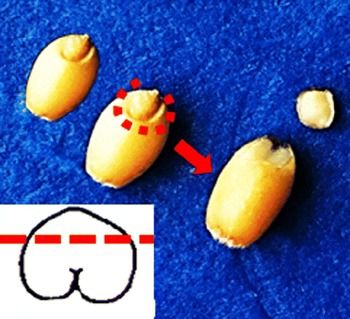
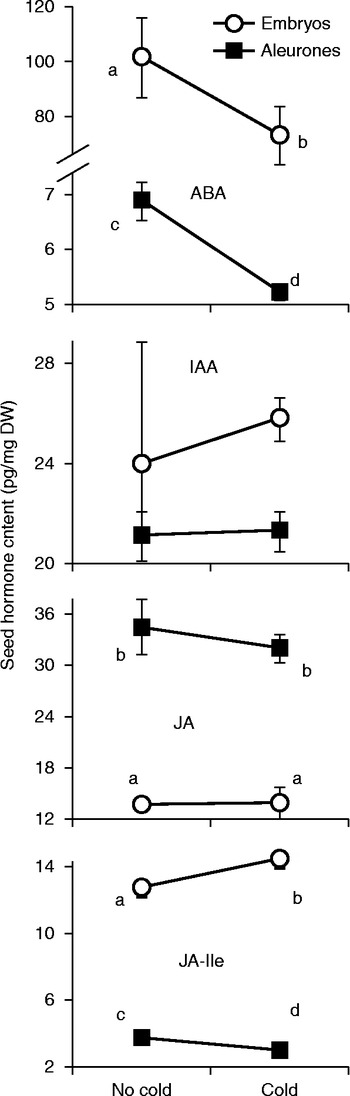
Hormone measurements were performed on Brevor grains harvested from Spillman Farm (Pullman, Washington, USA) in 2011 that were allowed to afterripen for 1 week before storage at − 20°C. Grains were imbibed for 18 h at 30°C, either with or without a cold stratification pre-treatment of 24 h imbibition at 4°C. Grains were surface sterilized and plated on 5 mM MES (pH 5.5). Whole imbibed caryopses were dissected as shown in Fig. 1 to isolate the ‘embryo’ sample, consisting of the embryo including the scutellum, and an ‘aleurone’ sample, consisting of a dorsal section containing pericarp, aleurone and a small amount of endosperm. Once dissected, tissues were immediately flash frozen in liquid nitrogen and stored at − 80°C until processing. Samples were ground to a fine powder under liquid nitrogen with a mortar and pestle, and then lyophilized for 48 h in plastic scintillation vials. For extraction of endogenous hormones, approximately 50 mg of dry ground weight was measured out for each biological replicate (n= 80 seeds; six biological replicates). The acidic organic fraction was extracted and used to measure ABA, GA1, indole-acetic acid (IAA), JA and JA-Ile (jasmonic acid–isoleucine) by ESI–LC–MS/MS (electro-spray ionization liquid chromatography tandem mass spectrometry) at the RIKEN Sustainable Resource Science Centre (also known as the Plant Science Centre, as in Yoshimoto et al., Reference Yoshimoto, Jikumaru, Kamiya, Kusano, Consonni, Panstruga, Ohsumi and Shirasu2009).
Isolation of embryo and aleurone tissue. Image shows grains after 18 h of imbibition at 30°C. The ‘embryo’ samples consisted of the embryo and scutellum dissected as shown along the embryo demarcation (marked by the red dotted line). The ‘aleurone’ samples consisted of a dorsal slice, see insert, containing some pericarp, some aleurone and a little endosperm tissue.

Statistical analyses
All raw data were checked for normal and Gaussian distribution using MiniTab® Statistical Software 17.0 (www.minitab.com) to assess residuals and variances. Datasets that did not fit a normal distribution were transformed by a log10 computation and then analysed. Analysis of variance (ANOVA) was conducted in SAS 9.3 (SAS Institute, Cary, North Carolina, USA) using Tukey's method of comparison to obtain P values. Statistical significance was based on P values ≤ 0.05.
Results
PHS tolerance is associated with higher seed dormancy in Brevor and Clark's Cream wheat
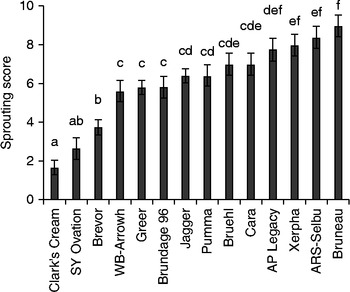
A spike-wetting test performed as in Paterson et al. (Reference Paterson, Sorrells and Obendorf1989) was used to characterize the degree of PHS susceptibility in a wide range of wheat cultivars harvested from the field at physiological maturity. The spike-wetting test is a valued method for screening PHS tolerance, because both the spike morphology and grain dormancy of cultivars impact whether or not the spikes show sprouting. Spikes harvested at physiological maturity were allowed to dry afterripen for 7 d and were then stored at − 15°C until the experiment was performed. Spikes were scored for degree of sprouting using the numerical 1–10 scale developed by McMaster and Derera (Reference McMaster and Derera1976) after 5 d of misting (Fig. 2; for P values see supplementary Table S1). Previous work demonstrated that Brevor and Clark's Cream are PHS-tolerant cultivars, whereas Greer is a PHS-susceptible wheat cultivar (Walker-Simmons, Reference Walker-Simmons1987; Anderson et al., Reference Anderson, Sorrells and Tanksley1993). The cultivars WB-Arrowhead and SY Ovation showed PHS tolerance similar to Brevor, whereas cultivars ARS-Selbu and Bruneau were more susceptible than Greer. Most varieties showed an intermediate degree of sprouting.
PHS tolerance was examined on field-grown wheat, hand harvested from Pullman, Washington, in 2013. Spike-wetting tests were performed over the course of 7 d total. This figure shows sprouting scores after 5 d of misting. Bars represent the SE of five technical replicates. Statistical significance was determined by ANOVA, P values ≤ 0.05.

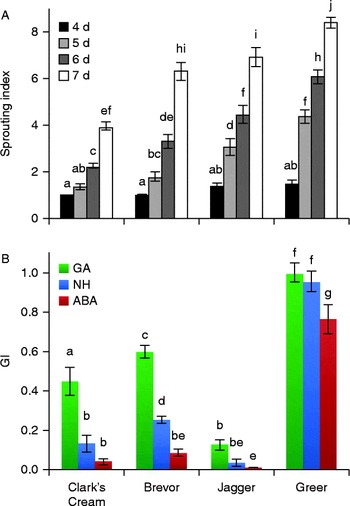
Spike-wetting tests and plating assays were used to compare the degree of PHS tolerance and grain dormancy in Clark's Cream, Brevor, Jagger and Greer after harvest at physiological maturity from the field in 2013. Spike-wetting tests were scored daily over 4–7 d of misting (Fig. 3A; for P values see supplementary Table S2). Cultivars Clark's Cream and Brevor had similar sprouting scores at days 4 and 5. However, Clark's Cream had significantly lower sprouting scores than Brevor at days 6 and 7, suggesting that it is the more PHS-tolerant cultivar. Brevor had significantly lower sprouting scores than Jagger at day 5 and 6. The PHS-susceptible cultivar Greer had significantly higher sprouting scores than Clark's Cream, Brevor and Jagger on days 5, 6 and 7. Seedlings can be seen growing from Greer spikes after 7 d of misting, while such dramatic sprouting was never apparent in Brevor and Clark's Cream.
PHS tolerance was associated with higher seed dormancy, higher ABA sensitivity and lower GA sensitivity. Spike-wetting tests and germination assays performed on grain from the same wheat plots harvested from a field in Pullman, Washington in 2013. (A) Spike-wetting tests were performed over 7 d, sprouting scores for days 4 to 7 are shown. n= 4, bars represent SE of 21 replicates. Statistical significance was based on ANOVA, P values ≤ 0.05. (B) Germination index for 2013 field-grown wheat grain that was scored over 5 d of imbibition in the dark at 30°C, either with no hormone (NH), or in the presence of 5 μM ABA or 10 μM GA3. n= 30, bars represent SE of six biological replicates. Statistical significance was determined by ANOVA, P values ≤ 0.05.

It was expected that higher PHS tolerance should be associated with higher grain dormancy, and might be associated with differences in sensitivity to GA and ABA. Plating assays were performed following 1 week of dry afterripening on medium containing no hormone (NH), 5 μM ABA or 10 μM GA3 (Fig. 3B; for P values see supplementary Table S3). Cultivars Brevor and Clark's Cream showed less efficient germination without hormone than Greer, suggesting that their higher PHS tolerance is associated with higher grain dormancy. However, Jagger showed less efficient germination than Brevor and Clark's Cream, possibly due to the fact that it has red grains whereas the other three cultivars have white grains. The germination of Brevor and Clark's Cream was only partially rescued by GA treatment, suggesting that grain dormancy was associated with lower sensitivity to GA. Finally, ABA inhibited the germination of Brevor and Clark's Cream. However, Greer was highly insensitive to the inhibition of grain germination by ABA. This suggests that higher PHS tolerance is associated with higher ABA sensitivity in these cultivars.
Two pre-harvest sprouting-tolerant cultivars showed increasing GA sensitivity and decreasing ABA sensitivity with afterripening
Previous research showed that PHS-tolerant cultivars tend to require more time to afterripen than PHS-susceptible cultivars (Gerjets et al., Reference Gerjets, Scholefield, Foulkes, Lenton and Holdsworth2010). Moreover, other published studies showed that long afterripened wheat becomes ABA insensitive (Morris et al., Reference Morris, Moffatt, Sears and Paulsen1989; Schramm et al., Reference Schramm, Abellera, Strader, Campbell and Steber2010). Based on this, and on the fact that different wheat cultivars showed different germination profiles on ABA, GA and no hormone at maturity (Fig. 3B), an afterripening time-course experiment was performed on Brevor and Clark's Cream wheat, to examine how germination capacity without hormone and on 5 μM ABA and 10 μM GA3 varies as dormancy is lost due to dry afterripening (Fig. 4).
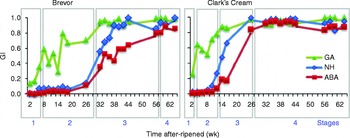
Afterripening time course for dormant and PHS-tolerant cultivars Brevor and Clark's Cream. Grain harvested at physiological maturity was plated at the indicated time points during dry afterripening on plates containing no hormone (NH), 10 μM GA3, or 5 μM ABA. GI was determined over 5 d of imbibition. The four stages of dormancy loss are marked with grey boxes and blue labels. Data points represent the mean of three replicates, n= 30.

Dormancy loss through afterripening resulted in increasing GA sensitivity and decreasing ABA sensitivity over time. Brevor and Clark's Cream showed the same general trend. However, dormancy loss appeared to be more rapid in Clark's Cream. At two weeks after physiological maturity, both Brevor and Clark's Cream failed to germinate without hormone, and showed little rescue of germination on GA. With further afterripening, both showed increasing GA sensitivity. GA began to rescue Brevor grain germination by 8 weeks and Clark's Cream germination by 4 weeks of afterripening. On GA, Brevor reached a GI of 0.95 by 32 weeks and Clark's Cream a GI of 0.98 by 26 weeks of afterripening. Without hormone, Brevor gained the ability to germinate efficiently by 32 weeks, and Clark's Cream by 14 weeks of afterripening. By the point at which grains were fully afterripened, Brevor (week 56) and Clark's Cream (week 26) were able to germinate efficiently on 5 μM ABA.
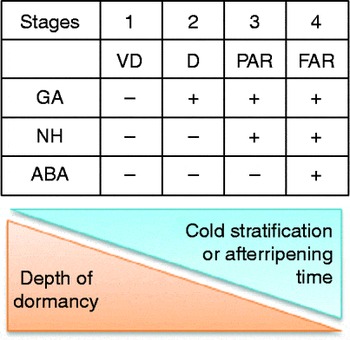
Although the kinetics of dormancy loss with afterripening were quite different in Brevor and Clark's Cream, they showed similar changes in germination on GA, no hormone and ABA over afterripening time. Thus, it appeared that germination profiles under these three conditions could serve as landmarks distinguishing four stages in dormancy loss (Fig. 4). When very dormant, stage 1, both Brevor and Clark's Cream were quite insensitive to GA rescue of grain germination. During early dormancy loss, stage 2, GA sensitivity gradually increased, but grains remained unable to germinate in the absence of hormone. When grains were partially afterripened, stage 3, they showed increased germination without hormone, but retained some sensitivity to ABA and its inhibition of germination. Finally, once grains were fully afterripened, stage 4, they became highly ABA insensitive. All in all, GA sensitivity tended to increase with afterripening time, whereas ABA sensitivity tended to decrease with afterripening time. These results suggested that stages in wheat grain dormancy loss could be defined based on their germination profile without hormone and in the presence of ABA and GA (Figs 4 and 5).
Changes in gibberellic acid (GA) and abscisic acid (ABA) sensitivity define four different stages during dormancy loss through either afterripening or cold stratification. These four distinct stages are referred to as dormancy loss stages: stage 1 or very dormant (VD), consisting of GA-insensitive grain (GI < 0.4); stage 2 or dormant (D), consisting of grain that could be GA-rescued (GI>0.4), but unable to germinate efficiently (GI < 0.4) on no hormone (NH); stage 3 or partially afterripened (PAR), consisting of grains that germinate efficiently (GI>0.4) but remain ABA sensitive (GI on ABA < GI on NH); and stage 4 or fully afterripened (FAR). consisting of ABA-insensitive grain (GI ≥ 0.9).

In some studies, wheat grains have been cut in half, and isolated embryos plated, in order to accentuate the difference between germination on ABA and in the absence of hormone (Walker-Simmons, Reference Walker-Simmons1987; Schramm et al., Reference Schramm, Abellera, Strader, Campbell and Steber2010; and others). To examine the effect of plating cut versus whole grains, grains of Clark's Cream from stages 1, 2 and 3 were plated as intact grains and half-grains on filter paper with and without 5 μM ABA (supplementary Fig. S1). Cutting the grains allowed germination on media with no hormone added at stage 2, but did not increase the difference between grains plated with and without ABA at stage 3. Using isolated embryo ends did not appear to accentuate the difference between stages 2 and 3. One drawback of using isolated embryos is that different cultivars respond differently to germination as half-grains on ABA (Schramm et al., Reference Schramm, Abellera, Strader, Campbell and Steber2010). Thus, the stages of dormancy loss were defined based on the germination of intact grains.
Changes in GA and ABA sensitivity define four different stages of dormancy loss
Many studies make comparisons between dormant and afterripened cereal grains (Walker-Simmons, Reference Walker-Simmons1987; Morris et al., Reference Morris, Moffatt, Sears and Paulsen1989, Reference Morris, Anderberg, Goldmark and Walker-Simmons1991; Barrero et al., Reference Barrero, Talbot, White, Jacobsen and Gubler2009; Gerjets et al., Reference Gerjets, Scholefield, Foulkes, Lenton and Holdsworth2010; Schramm et al., Reference Schramm, Abellera, Strader, Campbell and Steber2010; Gao et al., Reference Gao, Jordan and Ayele2012; Liu et al., Reference Liu, Gao, Kanno, Jordan, Kamiya, Seo and Ayele2013). However, it can be quite difficult to make comparisons between studies, between different cultivars, or even between two independent afterripening experiments using the same cultivar, because it is difficult to judge the degree of grain dormancy. For this reason, we propose the use of a hormone scale for measuring the degree of grain dormancy in intact wheat (or cereal) grains. Figure 5 shows the four stages of dormancy loss defined using the germination index, without hormone, and with GA and ABA, in dormant wheat cultivars during dormancy loss (Fig. 4). At stage 1, very dormant (VD) grain is GA insensitive, showing a GI less than 0.4 on 10 μM GA3, and shows no germination without hormone and on 5 μM ABA. Some wheat cultivars, such as Greer, may never manifest stage 1 (VD). Stage 2, dormant (D) grain responds to GA (GI>0.4), but still cannot germinate in the absence of hormone. By this definition, Brevor oscillated between stage 1 and 2 over weeks 8–14 of afterripening (Fig. 4). This oscillation illustrated that the transition between these dormancy stages was a gradual process. At stage 3, partially afterripened (PAR) grain loses enough dormancy to germinate in the absence of hormone (GI>0.4), but remains sensitive to 5 μM ABA. At stage 4, fully afterripened (FAR) grain becomes ABA insensitive, and shows efficient germination (GI ≥ 0.9) regardless of treatment (Fig. 5). Since afterripening and cold stratification both break grain dormancy, these stages should be able to describe dormancy levels better than referring to the time afterripened or cold stratified.
Changes in GA and ABA sensitivity as a result of cold stratification
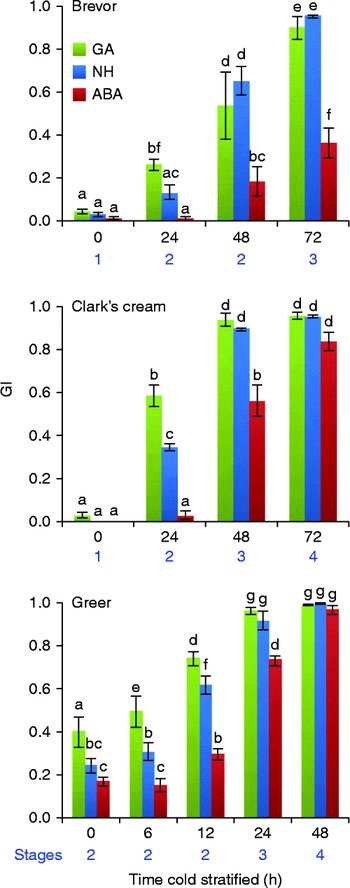
Next, we examined whether the four stages of grain dormancy loss could be used to describe degrees of dormancy loss during cold stratification time-course experiments. The afterripening time course of Brevor and Clark's Cream suggested that higher grain dormancy may be associated with more ABA sensitivity, but less GA sensitivity. Therefore, a cold stratification time-course was performed to examine if there are similar changes in ABA and GA sensitivity with cold stratification of Greer, Brevor and Clark's Cream. Grains harvested in the greenhouse at physiological maturity were plated on 1 μM GA3, 5 μM ABA and in the absence of hormone. These plates were subjected to 0, 24, 48 or 72 h of cold imbibition at 4°C. Because there was less initial dormancy, Greer germination was also examined following 6 and 12 h of cold stratification. The germination index was determined over 5 d of imbibition at 30°C (Fig. 6; for P values see supplementary Table S4).
PHS-tolerant cultivars are less responsive to cold stratification. Greenhouse-harvested grain was subjected to 0, 6, 12, 24, 48 or 72 h of cold stratification following 1 week of dry afterripening at room temperature. This figure shows the GI calculated over 5 d for treatments with 1 μM GA3, 5 μM ABA and no hormone (NH). For Brevor and Clark's Cream, data columns represent the means of three biological replicates, n= 30, and for Greer, data represent the means of nine biological replicates, where n= 10. Bars represent SE. Statistical significance was based on ANOVA, P values ≤ 0.05.

PHS-susceptible Greer was initially at stage 2 (GI 0.26 on NH) and reached stage 3 (GI 0.92 on NH) with 24 h of cold stratification. PHS-tolerant Brevor and Clark's Cream were initially at stage 1, and lost dormancy more slowly through cold stratification, showing stage 2 dormancy with 24 h of cold stratification. Brevor reached stage 3 and Clark's Cream stage 4 of grain dormancy loss with 72 h of cold stratification. The dormancy stages were as easily recognized with grain dormancy loss through cold stratification as through afterripening. Also, PHS tolerance appeared to be associated with slower dormancy loss both due to cold stratification and dry afterripening. Similar results were observed using less dormant field-grown material harvested in 2013, suggesting that the effect of cold stratification on ABA and GA sensitivity over time does not depend on the grain lot (supplementary Fig. S2; for P values see supplementary Table S5).
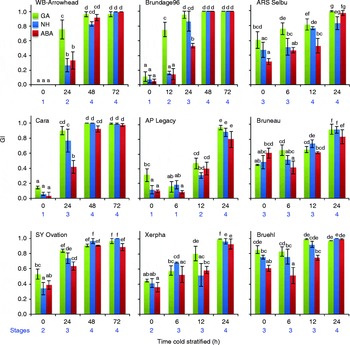
To examine whether the dormancy stages could describe dormancy loss in a wider range of germplasm, a cold stratification time-course was performed on nine of the cultivars characterized for pre-harvest sprouting tolerance in Fig. 2 (Fig. 7, for P values see supplementary Table S6). Note that more-dormant cultivars were cold stratified for 24 h or more at 4°C, whereas less-dormant cultivars were cold stratified for 6, 12 and 24 h before determining germination index over 5 d at 30°C. It was possible to observe stages ranging from 1 through 4 in cultivars WB-Arrowhead, Cara, SY Ovation, Brundage 96 and AP Legacy. Only stages 3 and 4 were observed in non-dormant cultivars Xerpha, ARS-Selbu, Bruneau and Bruehl. The dormancy stages were useful in describing a wide range of wheat germplasm. However, there clearly is a great deal of cultivar variation for initial degree of dormancy and rate of dormancy loss through cold stratification. In general, those PHS-susceptible cultivars that showed a sprouting score of 6 or higher in Fig. 2, tended to reach stage 4 within 24 h of cold stratification. The one exception is the club wheat Cara, which was at stage 3 with 24 h of cold stratification. The Cara sprouting score may be higher than would be expected for its degree of dormancy because it is a club wheat, and the compact club spike morphology was previously shown to be associated with higher sprout susceptibility (King and Richards, Reference King and Richards1984).
Dormancy stages during cold stratification. Field-harvested grain (Pullman, Washington, 2014) was subjected to 0, 6, 12, 24, 48 or 72 h of cold stratification following 1 week of dry afterripening at room temperature. This figure shows the GI calculated over 5 d for treatments of 1 μM GA3, 5 μM ABA and no hormone (NH). For all genotypes, n= 10 with three replicates, bars represent SE. Statistical significance was based on ANOVA, P values ≤ 0.05. Dormancy loss stages are indicated in blue.

The effect of cold stratification on endogenous Brevor hormone levels
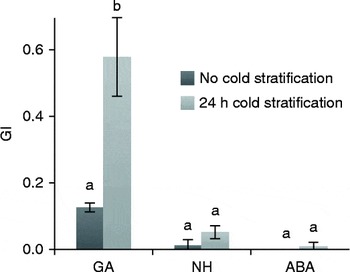
Cold stratification was used to examine the effect of early dormancy loss on endogenous hormone levels. Although previous research has shown that cold stratification results in decreasing ABA and increasing GA hormone levels in Arabidopsis (Yamauchi et al., Reference Yamauchi, Ogawa, Kuwahara, Hanada, Kamiya and Yamaguchi2004), nothing is known about the effect of cold stratification on endogenous hormone levels in wheat grain. Brevor grain harvested at physiological maturity from the field in 2011 was at stage 1 (very dormant) following 1 week of dry afterripening, but shifted to stage 2 with 24 h of cold stratification at 4°C (Fig. 8; supplementary Fig. S3). Without cold stratification, stage 1 Brevor was GA insensitive (GI = 0.13, 30% germination on day 7), and showed no germination in the absence of hormone (GI = 0.01) or on ABA (GI = 0). With a 24-h cold stratification treatment, Brevor grain gained GA sensitivity (GI = 0.58, 81% germination on day 7), a significant increase compared to stage 1 Brevor without cold (P< 0.0001; supplementary Fig. S3B). The 24-h cold stratification treatment did not result in germination in the absence of hormone (GI = 0.05) or on ABA (GI = 0.01). With the acquisition of GA sensitivity this cold-stratified Brevor grain was classified as stage 2 (dormant).
Effect of 24 h cold stratification on the germination of very dormant Brevor grain. Germination index was calculated over incubation for 7 d in the dark at 30°C following either a 24-h cold stratification treatment or no cold treatment. Grains were plated on no hormone (NH), or with 10 μM GA3 and 5 μM ABA. Cold stratification caused a shift from dormancy stage 1 to 2. n= 30, bars represent SD of three biological replicates. Statistical significance was based on ANOVA, P values ≤ 0.05.

Hormone profiling was performed on the grain samples shown in Fig. 8. Brevor grain that was either cold stratified for 24 h or not cold stratified was imbibed for 18 h at 30°C, and then dissected as in Fig. 1 to isolate the embryo sample (embryo including the scutellum) and the aleurone sample (containing pericarp, aleurone and a small amount of endosperm). Hormone profiling examined the endogenous levels of ABA, GA1, IAA, JA and JA-Ile (jasmonic acid–isoleucine, the bioactive conjugate) (Fig. 9). GA1 levels were below the detection threshold. There was no significant change in IAA or JA levels observed following cold stratification. ABA levels decreased significantly with cold stratification in both embryo (P= 0.006) and aleurone samples (P= 0.02; Fig. 9; supplementary Table S7 for means; supplementary Table S8 for P values). This is consistent with the fact that ABA levels declined with dormancy loss due to afterripening in Brevor wheat (Morris et al., Reference Morris, Anderberg, Goldmark and Walker-Simmons1991). Cold stratification was associated with a significant increase in JA-Ile levels in embryos (P= 0.017), and a significant decrease in aleurone tissue (P= 0.0004). In general, ABA (P< 0.0001) and JA-Ile (P< 0.0001) levels were higher in embryos than in aleurone tissue. Only JA levels were higher in aleurone tissues than in embryos (P< 0.0001). These data showed that dormancy loss through cold stratification, like afterripening, is associated with a decrease in ABA levels.
The effect of 24 h cold stratification on grain hormone content. Hormone profiling was performed on samples shown in Fig. 8. Seeds plated either with or without 24 h cold stratification treatment were harvested and dissected following 18 h imbibition at 30°C in the dark. n= 80, bars represent SE of four biological replicates. Letters indicate statistical significance based on ANOVA, P values ≤ 0.05.

Discussion
Defining intermediate stages in grain dormancy loss
A longstanding caveat in studying seed dormancy loss has been the fact that dormancy is generally defined by the inability to germinate. Naturally, this leads to a tendency to think in terms of two classes, ‘dormant’ and ‘afterripened’. However, seed biologists are well aware that dormancy is not a binary process; there are many intermediate stages in seed dormancy loss. Thus, researchers are careful to examine a single genotype, grain batch or harvest lot, or afterripening time-course for a given study. In order to determine whether published results are reproducible, however, scientists must be able to compare their results in independent studies. Thus, it seems necessary to be able to define intermediate stages in seed dormancy loss. The observation that there are changes in sensitivity to GA and ABA during wheat dormancy loss through afterripening and cold stratification provides an inexpensive and simple method to define stages in dormancy loss independently of seed lot, genotype or study. Germination index was used to define the stages because it provides a single value indicative of: (1) the rate at which germination is occurring; and (2) the total number of grains that germinated. This study used an imbibition temperature of 30°C because this temperature enhances apparent differences in ABA sensitivity (Walker-Simmons, Reference Walker-Simmons1988; Nyachiro et al., Reference Nyachiro, Clarke, DePauw, Knox and Armstrong2002). Studies using other incubation temperatures may find that less time is required to lose ABA sensitivity with dormancy loss. Two highly dormant cultivars that lost grain dormancy very slowly through afterripening were initially used to define four stages of dormancy loss based on plating assays with ABA, GA and no hormone (Figs 4 and 5). While it is possible to define more intermediate degrees of dormancy loss, these four stages serve as clear milestones that are broadly applicable. The definitions set in Fig. 5 require the use of ABA and GA because some intermediate stages of dormancy loss could not otherwise be differentiated. Case in point, the ability to differentiate stage 1 from stage 2 relies on plating with GA because both stage 1 and 2 grain can fail to germinate without hormone, but stage 2 grain is more sensitive to GA (GI>0.4). Examples of this include WB-Arrowhead with 24 h of cold stratification and Brundage 96 with 12 h of cold stratification (Fig. 7). Similarly, the ability to differentiate from stage 3 to 4 relies on plating with ABA, because only stage 4 grain is highly ABA insensitive (GI ≥ 0.9). Therefore, the designation of ‘dormant’ and ‘afterripened’ in different studies can refer to comparisons between stages 1 or 2 versus 3 or 4, creating apparent contradictions between studies. The classification system proposed provides a framework for comparing data in this study to other studies examining wheat hormone levels and sensitivity in dormant and afterripened grain.
Changes in hormone sensitivity and accumulation with dormancy loss
ABA hormone levels and sensitivity both decrease with dormancy loss in imbibing wheat grain. Many studies have observed a decrease in ABA sensitivity with dormancy loss through afterripening in wheat and barley (Fig. 4; Walker-Simmons, Reference Walker-Simmons1987; Barrero et al., Reference Barrero, Talbot, White, Jacobsen and Gubler2009; Gerjets et al., Reference Gerjets, Scholefield, Foulkes, Lenton and Holdsworth2010; Schramm et al., Reference Schramm, Abellera, Strader, Campbell and Steber2010). Previous work also observed that endogenous ABA levels decreased with afterripening of barley and wheat embryos (Morris et al., Reference Morris, Anderberg, Goldmark and Walker-Simmons1991; Millar et al., Reference Millar, Jacobsen, Ross, Helliwell, Poole, Scofield, Reid and Gubler2006; Barrero et al., Reference Barrero, Talbot, White, Jacobsen and Gubler2009). Consistent with this, we found that endogenous ABA levels decreased in both embryo and aleurone samples as a result of dormancy loss (stage 1 to 2) through cold stratification (Fig. 9). A recent study found that ABA sensitivity decreased with wheat afterripening, but not whole grain endogenous ABA levels (Liu et al., Reference Liu, Gao, Kanno, Jordan, Kamiya, Seo and Ayele2013). This discrepancy between studies may be due either to the fact that Liu et al. (Reference Liu, Gao, Kanno, Jordan, Kamiya, Seo and Ayele2013) used ‘afterripened’ grain that had not yet reached stage 4 of dormancy loss, or to the fact that ABA levels were measured in whole grains rather than in isolated embryos.
This paper also examined the effects of dormancy loss on GA sensitivity. Afterripening and cold stratification resulted in increased GA sensitivity and hormone levels in Arabidopsis seeds (Karssen and Lacka, Reference Karssen, Lacka and Bopp1986; Derkx and Karssen, Reference Derkx and Karssen1993; Yamauchi et al., Reference Yamauchi, Ogawa, Kuwahara, Hanada, Kamiya and Yamaguchi2004; Ariizumi et al., Reference Ariizumi, Hauvermale, Nelson, Hanada, Yamaguchi and Steber2013). While the present study was able to detect an increase in GA sensitivity early in dormancy loss due to afterripening and cold stratification, it was not possible to determine if GA1 levels increased with wheat cold stratification because the endogenous GA1 hormone levels were below the detection threshold. The transcriptome study by Barrero et al. (Reference Barrero, Talbot, White, Jacobsen and Gubler2009) found no changes in GA-responsive gene expression as a result of afterripening in barley coleorhiza. That study also compared stage 2 and stage 4 barley grains based on the fact that the ‘afterripened’ grains were ABA insensitive (stage 4), and the ‘dormant’ grains showed some germination without hormone and no germination on ABA. It would be interesting to know if there is an increase in GA levels or GA signalling gene expression during the stage 1 to 2 transition, given that this is when GA sensitivity increases (Fig. 4). This will require the development of a hormone measurement technique that is sufficiently sensitive to detect the low levels of bioactive GA found early in seed imbibition and germination (Yamauchi et al., Reference Yamauchi, Ogawa, Kuwahara, Hanada, Kamiya and Yamaguchi2004).
Previous work suggested that the hormones JA and JA-Ile are involved in barley and wheat dormancy loss (Barrero et al., Reference Barrero, Talbot, White, Jacobsen and Gubler2009; Jacobsen et al., Reference Jacobsen, Barrero, Hughes, Julkowska, Taylor, Xu and Gubler2013). Afterripening was associated with increased expression of JA signalling genes in barley, and methyl-JA (volatile conjugate of jasmonic acid) hormone application stimulated the germination of wheat grains exhibiting blue-light-induced dormancy. If JA signalling stimulates seed germination, then dormancy loss via cold stratification and afterripening might be associated with increased levels of bioactive JA-Ile and its precursor JA. Consistent with this, we observed a significant increase in wheat embryo JA-Ile levels during the stage 1 to 2 transition with cold stratification (Fig. 9, P value = 0.0174). Liu et al. (Reference Liu, Gao, Kanno, Jordan, Kamiya, Seo and Ayele2013) also observed an increase in JA-Ile levels with wheat afterripening at 24 h of imbibition, but not at 0 or 12 h of imbibition. Further investigation is needed to better understand the relative roles of GA and JA signalling in cereal grain dormancy loss.
Dormancy loss through cold stratification
Cold stratification stimulated seed dormancy loss in a wide range of wheat cultivars and was well described using the classification table proposed in this study (Figs 5, 6, 7 and supplemental Fig. S2). Although PHS-tolerant wheat varieties Brevor and Clark's Cream required more than 8 months to lose dormancy fully through afterripening, both cultivars lost dormancy rapidly over 3 d of cold stratification (Figs 4 and 6). Although dormancy loss through cold stratification was rapid, it was possible to delineate the same stages of dormancy loss as were defined with afterripening of Brevor and Clark's Cream (Figs 4, 6, 7 and Fig. S2). Note, however, that the time required to lose dormancy through cold stratification varied between different cultivars and different seed lots. For example, PHS-tolerant Clark's Cream transitioned from stage 1 to 2 within 24 h and Brevor within 48 h of cold stratification. By 72 h of cold stratification, greenhouse-grown Brevor reached stage 3, whereas 2013-field-grown Brevor reached stage 4 (Fig. 6 and Fig. S2). Some PHS-susceptible cultivars, such as Bruneau and Xerpha, showed little or no initial ABA sensitivity. Although Bruneau and Xerpha did show somewhat slower germination without cold stratification, future work will be needed to further investigate whether PHS susceptibility in these cultivars is related to lack of ABA signalling or sensitivity. Interestingly, wheat grain became ABA insensitive very rapidly with cold stratification (Figs 6 and 7; Noda et al., Reference Noda, Kawabata and Kawakami1994). This is not the case in Arabidopsis, where cold stratification improves the synchronicity of germination, but does not lead to ABA-insensitive seed germination (Steber et al., Reference Steber, Cooney and McCourt1998). Thus, it would be interesting to know whether dormancy loss through cold stratification and afterripening occurs by different hormone signalling mechanisms in wheat than in Arabidopsis.
PHS tolerance is associated with higher ABA sensitivity and lower GA sensitivity
Many previous studies have shown that PHS tolerance is associated with higher seed dormancy in wheat (reviewed in McCaig and DePauw, Reference McCaig and DePauw1992). Previous studies have also made the observation that PHS-tolerant varieties tend to require more time to lose dormancy through afterripening (Morris et al., Reference Morris, Moffatt, Sears and Paulsen1989; Gerjets et al., Reference Gerjets, Scholefield, Foulkes, Lenton and Holdsworth2010). The PHS-tolerant cultivars Brevor and Clark's Cream not only needed more time to lose dormancy through afterripening, but also needed more time for cold stratification compared to more PHS-susceptible cultivars (Figs 2, 4, 6 and 7). Although Clark's Cream was more PHS tolerant than Brevor, it required less time to lose dormancy through cold stratification and afterripening than Brevor (Figs 3 and 4). There are likely many genetic mechanisms that can result in higher or lower levels of PHS tolerance. This result suggests that there are effective mechanisms of PHS tolerance that do not always lead to a longer afterripening requirement. This is good news from a breeding perspective, because it suggests that it may be possible to find alleles that provide effective PHS tolerance but still do not compromise emergence due to the need for long afterripening.
It was also observed that differences in PHS tolerance based on the spike-wetting test were loosely associated with differences in GA and ABA sensitivity, both before and after dormancy-breaking treatments (Figs 2, 3, 4, 6 and 7). For example, Brevor and Clark's Cream were more GA insensitive than Greer with 0 and 6 h of cold stratification (Fig. 6 and Fig. S2). Thus, future work should examine whether selection for GA insensitivity (stage 1) at maturity can be used as an indirect selection for strong PHS tolerance. Moreover, it was observed that the most PHS-susceptible lines were able to germinate with high efficiency on ABA (stage 4) with 24 h of cold stratification. Thus, screening for germination on ABA with 24 h of cold stratification may provide a rapid screening method against PHS susceptibility. Additional studies are needed to determine if these associations are widely applicable within wheat breeding programmes. Plating assays may provide a good labour-saving tool. However, they cannot replace the spike-wetting test because this test for PHS tolerance includes both the contribution of grain dormancy and spike morphology. Breeding programmes have successfully employed dormancy-plating assays and spike-wetting tests as complementary approaches for breeding PHS-tolerant wheat in the past (reviewed in DePauw et al., Reference DePauw, Knox, Singh, Fox, Humphreys and Hucl2012). Thus, plating assays on GA and ABA may be useful in future breeding efforts.
Supplementary material
To view supplementary material for this article, please visit http://dx.doi.org/10.1017/S0960258515000057
Acknowledgements
The authors would like to acknowledge the members of the Steber and Campbell labs for their continued support and suggestions. We thank: Dr Yusuke Jikumaru for his critical analysis of raw chromatograms using AgilentTM software; Drs Yuji Kamiya and Hiroyuki Kasahara from RIKEN for their mentorship and helpful discussions; Dr Marc Cohn for helpful discussions; Dr Alison Thompson for guidance with statistical analysis; and Drs Amber Hauvermale and Stephen Guy for assistance in harvesting grain from the WSU Cereal Variety Trials.
Financial support
This research was supported by the National Science Foundation's East Asia and Pacific Summer Institute Award (1209878 to K.M.T.), the Japanese Society for the Promotion of Science Summer Internship Award (to K.M.T. and M.S.), the Washington Grain Commission and the US Department of Agriculture–Agricultural Research Service (to C.M.S.).
Conflicts of interest
None.