Introduction
Evidence is accruing for the impact of hypersomnia on health and quality of life across the lifespan. Adolescents with hypersomnia report more emotional disturbance, unhappiness and interpersonal problems (Roberts et al. Reference Roberts, Roberts and Chen2001), adults with hypersomnia are 13.4 times more likely to abuse substances (Breslau et al. Reference Breslau, Roth, Rosenthal and Andreski1996), and older adults with excessive daytime sleepiness report significant impairment in daily activities and productivity (Gooneratne et al. Reference Gooneratne, Weaver, Cater, Pack, Aner, Greenberg and Pack2003). Individuals with hypersomnia are more likely to be taking medications, spending more on healthcare and receiving government subsidies (Jennum & Kjellberg, Reference Jennum and Kjellberg2010). A recent meta-analysis of 16 prospective studies documented that long habitual sleep was associated with increased rates of all-cause mortality, with long sleep conferring a 1.3 × increased risk in the rate of subsequent death (Cappuccio et al. Reference Cappuccio, D'Elia, Strazzullo and Miller2010).
Hypersomnia is common in the mood disorders and portends poorer illness course. Hypersomnia is present in approximately 30% of individuals with major depressive disorder (Kaplan & Harvey, Reference Kaplan and Harvey2009) and is associated with longer, more severe and more treatment-resistant depressions (Matza et al. Reference Matza, Revicki, Davidson and Stewart2003). Hypersomnia itself is a treatment-resistant symptom (Worthington et al. Reference Worthington, Fava, Davidson, Alpert, Nierenger and Rosenbaum1995; Iovieno et al. Reference Iovieno, van Nieuwenhuizen, Clain, Baer and Nierenberg2011) and a chief complaint of those not achieving remission from depression (Zimmerman et al. Reference Zimmerman, McGlinchey, Posternak, Friedman, Boerescu and Attiullah2005). Prospective epidemiological studies suggest that individuals with hypersomnia are 2.4 to 2.9 times more likely to develop a subsequent depressive episode (Breslau et al. Reference Breslau, Roth, Rosenthal and Andreski1996; Ford & Cooper-Patrick, Reference Ford and Cooper-Patrick2001). In bipolar depression, hypersomnia is even more prevalent (estimated at 38–78% across studies; Kaplan et al. Reference Kaplan, Gruber, Eidelman, Talbot and Harvey2011) and highly recurrent (Leibenluft et al. Reference Leibenluft, Clark and Myers1995). Even outside of depressive episodes, roughly 25% of euthymic bipolar individuals experience hypersomnia, and this hypersomnia is associated with future depressive symptoms (Kaplan et al. Reference Kaplan, Gruber, Eidelman, Talbot and Harvey2011).
The present research focuses on hypersomnia in individuals with bipolar disorder for two reasons. First, among psychiatric disorders, hypersomnia appears to be most common in bipolar disorder (Akiskal & Benazzi, Reference Akiskal and Benazzi2005; Bowden, Reference Bowden2005; Benazzi, Reference Benazzi2006; Kaplan & Harvey, Reference Kaplan and Harvey2009). Second, hypersomnia persists into the inter-episode period of bipolar disorder at a relatively high rate (Kaplan et al. Reference Kaplan, Gruber, Eidelman, Talbot and Harvey2011). Because reports of hypersomnia may be confounded with other symptoms of depression such as anergia, avolition or psychomotor retardation (Billiard et al. Reference Billiard, Dolenc, Aldaz, Ondze and Besset1994; Dolenc et al. Reference Dolenc, Besset and Billiard1996), as well as mood-congruent biases in reporting, we chose to explore hypersomnia in an inter-episode sample. To our knowledge, this is the largest investigation of hypersomnia in a clinical sample using clinician-guided and self-reports of hypersomnia along with subjective and objective measures of sleep.
Despite the evidence for the importance of hypersomnia, problems related to definition and diagnosis abound (Kaplan & Harvey, Reference Kaplan and Harvey2009). Diagnostic manuals, along with the empirical research they inform, appear divided in characterizing psychiatric hypersomnia by either long sleep duration or by excessive daytime sleepiness. The Diagnostic and Statistical Manual of Mental Disorders, 5th edition (DSM-5), which renames hypersomnia ‘hypersomnolence disorder’, states that the disorder is characterized by excessive sleepiness evidenced by excessive need for sleep, long sleep or excessive sleep inertia (American Psychiatric Association, 2013). A handful of published studies define psychiatric hypersomnia via long sleep (Avery et al. Reference Avery, Khan, Dager, Cohen, Cox and Dunner1991; Tam et al. Reference Tam, Lam, Robertson, Stewart, Yatham and Zis1997; Williamson et al. Reference Williamson, Birmaher, Brent, Balach, Dahl and Ryan2000; Roberts et al. Reference Roberts, Roberts and Chen2001; Parker et al. Reference Parker, Malhi, Hadzi-Pavlovic and Parker2006; Soehner et al. Reference Soehner, Kaplan and Harvey2014). By contrast, the International Classification of Diseases, tenth edition (ICD-10; World Health Organization, 1993) and the International Classification of Sleep Disorders, second edition (ICSD-2; American Academy of Sleep Medicine, 2005) describe hypersomnia as excessive sleepiness, or the propensity of falling asleep during the daytime that is not solely accounted for by an inadequate amount of sleep. Consistent with this definition, Ohayon et al. (Reference Ohayon, Dauvilliers and Reynolds2012) investigated excessive sleepiness in the general population, identifying self-reported excessive sleepiness symptoms most strongly associated with functional impairment. These researchers proposed a definition of ‘hypersomnia disorder’ characterized by either excessive sleepiness or long sleep.
Indeed, accruing evidence suggests that these two constructs – excessive sleepiness and long sleep – may not overlap. Ohayon et al. (Reference Ohayon, Dauvilliers and Reynolds2012) found no relationship between the frequency of excessive sleepiness complaints and self-reported long sleep (though for an alternate interpretation, see Ohayon et al. Reference Ohayon, Reynolds and Dauvilliers2013). Nofzinger et al. (Reference Nofzinger, Thase, Reynolds, Himmelhoch, Mallinger, Houck and Kupfer1991) evaluated individuals diagnosed with bipolar disorder reporting hypersomnia (as defined by long sleep) on a daytime multiple sleep latency test (MSLT) and observed no excessive sleepiness in this long sleeping group. Additional studies have confirmed that excessive sleepiness, as measured objectively by daytime MSLTs, is not present in individuals with psychiatric disorders who complain of long sleep-defined hypersomnia (Billiard et al. Reference Billiard, Dolenc, Aldaz, Ondze and Besset1994; Dolenc et al. Reference Dolenc, Besset and Billiard1996; Vgontzas et al. Reference Vgontzas, Bixler, Kales, Criley and Vela-Bueno2000). In sum, those who complain of long sleep at night do not demonstrate excessive sleepiness during the daytime, and there is a suggestion in the literature that long sleep and excessive sleepiness are uncorrelated. One goal of the present paper is to examine if two separate groups are emerging under the umbrella term ‘hypersomnia’ – a group complaining of long sleep and a group complaining of excessive daytime sleepiness. At present, lack of an operational definition limits comparisons between studies and amalgamation of research findings. Correct classification of hypersomnia is essential to understanding its etiology, sequelae and treatment.
At least two important such sequelae of hypersomnia are understudied. First, the relationship between self-reported hypersomnia and actual sleep obtained is unclear. Studies that have measured night-time sleep objectively suggest that individuals with hypersomnia actually sleep no longer than their non-hypersomnolent counterparts. One study utilizing polysomnography found that a psychiatric hypersomnia group slept only 7.68 h on average, and only 14% slept beyond 9 h (Billiard et al. Reference Billiard, Dolenc, Aldaz, Ondze and Besset1994). This finding has subsequently been replicated by multiple groups using polysomnography, actigraphy and sleep diary methods (Nofzinger et al. Reference Nofzinger, Thase, Reynolds, Himmelhoch, Mallinger, Houck and Kupfer1991; Dolenc et al. Reference Dolenc, Besset and Billiard1996; Vgontzas et al. Reference Vgontzas, Bixler, Kales, Criley and Vela-Bueno2000; Kaplan et al. Reference Kaplan, Gruber, Eidelman, Talbot and Harvey2011). Individuals with insomnia have long been known to overestimate wakefulness and underestimate total sleep time (Mercer et al. Reference Mercer, Bootzin and Lack2002; Harvey & Tang, Reference Harvey and Tang2012); it is unclear if individuals with hypersomnia similarly misperceive their sleep (Attarian et al. Reference Attarian, Duntley and Brown2004; Trajanovic et al. Reference Trajanovic, Radivojevic, Kaushansky and Shapiro2007). Second, as noted above, studies have established that hypersomnia confers an increased likelihood of developing psychiatric illness (Breslau et al. Reference Breslau, Roth, Rosenthal and Andreski1996; Ford & Cooper-Patrick, Reference Ford and Cooper-Patrick2001). The extent to which excessive sleepiness, as compared with long sleep, differentially affects rates of relapse into illness episodes is not known.
This paper addresses the diagnostic confusion and understudied consequences by contributing data on hypersomnia classification and sequelae in a relatively large clinical sample. The goal is to identify subtypes of hypersomnia – namely, self-reported long sleep and excessive sleepiness – and to examine the relationship of these subtypes to prospective sleep data and relapse into depression and/or mania. We use a data-driven approach to delineating subtypes of hypersomnia based on a multi-method combination of subjective, objective and clinician-guided instruments. The first aim was to evaluate the independence of self-reported long sleep and self-reported excessive sleepiness (Billiard et al. Reference Billiard, Dolenc, Aldaz, Ondze and Besset1994; Kaplan & Harvey, Reference Kaplan and Harvey2009) via confirmatory factor analysis (CFA) and latent profile analysis (LPA), controlling for the effects of psychotropic medications. The second aim was to investigate the relationship between hypersomnia subtype, prospective sleep data and episode relapse to better characterize the sleep and psychiatric morbidity of individuals who complain of hypersomnia.
Method
Sample
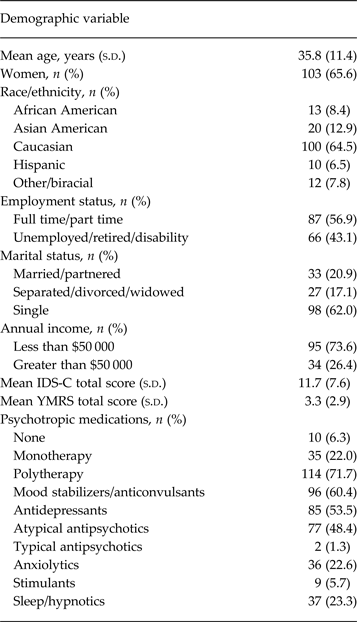
The present data are a secondary analysis of data accrued from three separate studies on sleep in bipolar disorder conducted between December 2005 and November 2011 (Talbot et al. Reference Talbot, Hairston, Eidelman, Gruber and Harvey2009; Gershon et al. Reference Gershon, Thompson, Eidelman, McGlinchey, Kaplan and Harvey2012; Kaplan & Harvey, Reference Kaplan and Harvey2013). Adult participants over the age of 18 years were recruited from advertisements, online bulletins and physician referrals. The final sample included 159 adults aged 18–70 years with bipolar spectrum disorder diagnoses [bipolar I = 143, bipolar II = 13 and bipolar not otherwise specified (NOS) = 3] who were inter-episode at study entry. Care was taken to ensure that participants were recruited to reflect Alameda County demographics. A summary of participant characteristics is presented in Table 1.
Participant characteristics (n = 159)

s.d., Standard deviation; IDS-C, Inventory of Depressive Symptomatology, Clinician Version; YMRS, Young Mania Rating Scale.
Individuals from all studies were eligible to participate if they (a) met DSM-IV criteria for a diagnosis of bipolar disorder type I, II or NOS, as determined by the Structured Clinical Interview for the DSM-IV (SCID; First et al. Reference First, Spitzer, Gibbons and Williams1997); (b) did not meet criteria for a diagnosis of current substance or alcohol abuse or dependence in the past 3 months; (c) did not meet criteria for narcolepsy, sleep apnea, restless leg syndrome or periodic limb movement disorder based on the Duke Structured Interview for Sleep Disorders (DSISD; Edinger et al. Reference Edinger, Bonnet, Bootzin, Doghramji, Dorsey, Espie, Jamieson, McCall, Morin and Stepanski2004) and (d) did not report history of severe head trauma, stroke, neurological disease or severe medical illness (e.g. advanced autoimmune disorder). Inter-episode status was confirmed with the SCID and established cut-off scores on the Inventory of Depressive Symptomatology, Clinician Version (IDS-C; Rush et al. Reference Rush, Gullion, Basco, Jarrett and Trivedi1996) and the Young Mania Rating Scale (YMRS; Young et al. Reference Young, Biggs, Ziegler and Meyer1978). All participants were required to be under the care of a psychiatrist, and information on medication dose and administration was collected upon study entry. Participants were not excluded on the basis of co-morbidities or pharmacological treatments, given that co-morbidity and polytherapy are common features of bipolar disorder. As medication class and dosing may influence the course and associated features of hypersomnia, however, medication effects were examined using an approach developed by Phillips et al. (Reference Phillips, Travis, Fagiolini and Kupfer2008) and Almeida et al. (Reference Almeida, Akkal, Hassel, Travis, Banihashemi, Kerr, Kupfer and Phillips2009) that considers both the number and dose of psychotropic medications in evaluating their impact.
Diagnostic measures
The SCID (First et al. Reference First, Spitzer, Gibbons and Williams1997) is a semi-structured interview designed to assess DSM-IV diagnostic criteria for Axis I disorders. The SCID has good inter-rater reliability for a majority of psychiatric disorders (Skre et al. Reference Skre, Onstad, Torgersen and Kringlen1991; Williams et al. Reference Williams, Gibbon, First, Spitzer, Davies, Borus, Howes, Kane, Pope, Rounsaville and Wittchen1992). Trained doctoral students and postdoctoral fellows in clinical psychology administered the SCID to all participants to assess current and lifetime Axis I disorders. Diagnostic inter-rater reliability was established by re-scoring a randomly selected sample of SCID interviews (n = 35); diagnoses matched those made by the original interviewer in all cases (k = 1.00). The DSISD (Edinger et al. Reference Edinger, Bonnet, Bootzin, Doghramji, Dorsey, Espie, Jamieson, McCall, Morin and Stepanski2004) is a semi-structured interview that assesses research diagnostic criteria for sleep disorders. The DSISD has been shown to have acceptable reliability and validity (Edinger et al. Reference Edinger, Wyatt, Olsen, Stechuchak, Carney, Chiang, Krystal, Lineberger, Means, Radtke and Knauss2009).
Inter-episode status was confirmed using established cut-offs of IDS-C < 24 and YMRS < 12. The IDS-C (Rush et al. Reference Rush, Gullion, Basco, Jarrett and Trivedi1996) is a 30-item clinician-guided instrument used to assess the severity of depressive symptoms. This measure has demonstrated good reliability and validity (Trivedi et al. Reference Trivedi, Rush, Ibrahim, Carmody, Biggs, Suppes, Crismon, Shores-Wilson, Toprac, Dennehy, Witte and Kashner2004). The YMRS (Young et al. Reference Young, Biggs, Ziegler and Meyer1978) is an 11-item measure used to assess the severity of manic symptoms, also shown to have good reliability and validity.
Hypersomnia indicators
Six items were selected as hypersomnia indicators. These indicators have been used in previous research on hypersomnia and in bipolar disorder (Frye et al. Reference Frye, Grunze, Suppes, McElroy, Keck, Walden, Leverich, Altshuler, Nakelsky, Hwang, Mintz and Post2007; Koffel & Watson, Reference Koffel and Watson2009; Kaplan et al. Reference Kaplan, Gruber, Eidelman, Talbot and Harvey2011; Plante et al. Reference Plante, Landsness, Peterson, Goldstein, Wanger, Guokas, Tononi and Benca2012).
The IDS-C (Rush et al. Reference Rush, Gullion, Basco, Jarrett and Trivedi1996) contains an item designed to assess the presence of hypersomnia based on self-reported sleep length in the past month. This item requires clinicians to probe for typical and maximal sleep length in a 24 h period, including prompts for napping. The IDS-C classifies its symptom levels according to the number of hours slept over a 24 h period. It has previously been shown to have utility in assessing bipolar hypersomnia (Kaplan et al. Reference Kaplan, Gruber, Eidelman, Talbot and Harvey2011; Plante et al. Reference Plante, Landsness, Peterson, Goldstein, Wanger, Guokas, Tononi and Benca2012). Inter-rater reliability for this item, established using intra-class correlations (Shrout & Fleiss, Reference Shrout and Fleiss1979) between the original item score and a randomly selected sample of IDS-C interviews (n = 30), was found to be excellent (r = 0.97).
The Inventory of Depressive Symptomatology, Self Report (IDS-SR; Rush et al. Reference Rush, Gullion, Basco, Jarrett and Trivedi1996) mirrors the content of the IDS-C in a self-report format. The hypersomnia item of the IDS-SR asks participants to rate the longest period slept in a 24 h period over the past month, including naps.
The Pittsburgh Sleep Quality Index (PSQI; Buysse et al. Reference Buysse, Reynolds, Monk, Berman and Kupfer1989) is a 19-item self-report measure of subjective sleep quality in the last month yielding a global score and seven component scores. The PSQI has been shown to have good internal consistency and test–retest reliability (Carpenter & Andrykowski, Reference Carpenter and Andrykowski1998). Two items from the PSQI were chosen as indicators of hypersomnia. The first was an item assessing self-reported sleep duration in the past month (question 4), which has been validated against actigraphy and sleep diary methods in various samples (Backhaus et al. Reference Backhaus, Junghanns, Broocks, Riemann and Hohagen2002; Grandner et al. Reference Grandner, Kripke, Yoon and Youngstedt2006) and has been used to estimate habitual sleep duration in previous research (King et al. Reference King, Oman, Brassington, Bliwise and Haskell1997; Knutson et al. Reference Knutson, Ryden, Mander and Van Cauter2006). The second indicator was the daytime dysfunction subscale, derived from two questions about excessive sleepiness (question 8) and daytime impairment (question 9). This subscale has been validated against other measures of daytime impairment (e.g. Buysse et al. Reference Buysse, Hall, Strollo, Kamarck, Owens, Lee, Reis and Matthews2008).
The Epworth Sleepiness Scale (ESS; Johns, Reference Johns1991) is a self-report measure of excessive daytime sleepiness. This questionnaire assesses the likelihood of falling asleep in eight different situations, yielding a composite score of sleepiness severity with scores > 10 representing excessive sleepiness. The ESS has shown good internal consistency and high test–retest reliability (Johns, Reference Johns1992).
Finally, to more directly tap the construct of excessive sleepiness, individuals were queried about the severity of their daytime sleepiness. Mirroring the definition seen in the ICSD-2 and ICD-10, participants were queried, ‘To what extent do you think that you feel sleepy during the daytime?’ and asked to rate their response on a five-point Likert-type scale, ranging from ‘not at all’ to ‘very much’. This item is subsequently referred to as the ‘excessive sleepiness item’.
Prospective sleep data
All participants kept standard sleep diaries for 1 week to assess parameters including total sleep time, time in bed and sleep efficiency. The sleep diary has been shown to be a reliable estimate (Gehrman et al. Reference Gehrman, Matt, Turingan, Dinh and Ancoli-Israel2002; Morin & Espie, Reference Morin and Espie2003) and is considered the ‘gold standard’ subjective measure of sleep (Buysse et al. Reference Buysse, Ancoli-Israel, Edinger, Lichstein and Morin2006; Carney et al. Reference Carney, Buysse, Ancoli-Israel, Edinger, Krystal, Lichstein and Morin2012). Participants completed the log prior to sleep and upon waking, and a subset of participants (n = 91) was required to call a voicemail twice daily with their answers to ensure compliance. Total sleep time was calculated by subtracting all time spent awake from all time spent in bed over a 24 h period including naps. Time in bed was scored by summing all intended sleep periods, excluding periods of reading or television watching in bed. Naps were included in total sleep time and time in bed calculations on the basis that individuals with hypersomnia are reported to experience both extended night-time and daytime bedrest durations (Billiard et al. Reference Billiard, Dolenc, Aldaz, Ondze and Besset1994).
A subset of participants (n = 75) was also equipped with an actigraph (Actiwatch AW-64; Mini Mitter, Philips Respironics Inc., USA) to obtain an objective estimate of sleep for 1 week. Actigraphs are small wristwatch-like devices that provide an empirical estimate of the sleep/wake cycle via movement. Movement data are recorded and downloaded onto a computer and analysed to generate various sleep parameters. Actigraphy has been used in previous research focusing on sleep parameters in bipolar disorder (Lam et al. Reference Lam, Watkins, Hayward, Bright, Wright, Kerr, Parr-Davis and Sham2003; Millar et al. Reference Millar, Espie and Scott2004; Harvey et al. Reference Harvey, Schmidt, Scarna, Semler and Goodwin2005; Jones et al. Reference Jones, Hare and Evershed2005) and has recently been validated as a reliable measure for sleep length and fragmentation in a bipolar sample (Kaplan et al. Reference Kaplan, Talbot, Gruber and Harvey2012). This device features a sensitivity of 0.05 g and a bandwidth between 3 Hz and 11 Hz, with a sampling frequency of 32 Hz. Analyses were completed using the medium sensitivity setting and immobile minutes algorithm in Actiware 5.57. Mirroring the variables extracted from sleep diaries, total daily sleep time and time in bed were extracted from actigraph output.
Procedures
All procedures were approved by the University of California, Berkeley, Committee for the Protection of Human Subjects. After completing the initial telephone screen, participants who appeared likely to be eligible were invited to the laboratory for a baseline visit. During this visit participants signed informed consent and were interviewed by trained postdoctoral or doctoral researchers to assess the diagnostic status and symptom severity using the SCID, the DSISD, the YMRS and the IDS-C. Once eligibility was determined by these measures, participants completed the remaining self-report and clinician-guided indicators of hypersomnia. All eligible participants completed the daily sleep diary and wore the actiwatch for 1 week. Approximately 7 months after this initial visit (222 days, s.d. = 73 days), participants were invited to the laboratory or contacted via telephone and a trained interviewer re-assessed psychiatric diagnoses over the 7-month period via the SCID. The present analyses examined relapse into mania, hypomania or depression within this 7-month follow-up time period.
Data analyses
CFA was conducted using Amos 20.0 (IBM SPSS, Inc., USA) to test the a priori hypothesis that hypersomnia is composed of two distinct subtypes: long sleep and excessive daytime sleepiness. Following generally accepted guidelines, sample size to number of indicators was kept above 20 to ensure the stability of the model (Marsh et al. Reference Marsh, Balla and McDonald1988; MacCallum et al. Reference MacCallum, Widaman, Zhang and Hong1999). Model fit was evaluated using established standards, including χ2 to degrees of freedom ratio (χ2/df) ⩽ 3, comparative fit indices (CFI) and Tucker–Lewis indices (TLI) > 0.85, and root mean square error of approximation (RMSEA) < 0.05 (Hu & Bentler, Reference Hu, Bentler and Hoyle1995; Hair et al. Reference Hair, Anderson, Tatham and Black1998). Missing data were imputed using the imbedded full information maximum likelihood algorithm (Enders & Bandalos, Reference Enders and Bandalos2001), though structural integrity of all models was confirmed by comparing the imputed model with a complete model where missing data were deleted list-wise. Likewise, to evaluate the impact of bipolar spectrum diagnosis (i.e. I, II or NOS) on model stability, model fit for the full sample was compared with a model with bipolar II and bipolar NOS (n = 16) omitted from analyses. Model fit for a two-factor solution was evaluated against a more parsimonious one-factor model by examining the statistical significance (i.e. p value) associated with the Δχ2/df value (Cheung & Rensvold, Reference Cheung and Rensvold2002).
We evaluated the impact of demographic variables on our CFA using multiple indicators multiple causes (MIMIC) modeling, a special type of structural equation modeling (SEM) which allows for the simultaneous detection of associations between covariates and latent variables. Given that females were over-represented in our sample and rates of bipolar spectrum disorders are not known to differ across genders, we evaluated the impact of gender on our CFA. We also evaluated age as a covariate in our models given previously established associations between age and long sleep (Kaplan & Harvey, Reference Kaplan and Harvey2009). MIMIC modeling was estimated using Mplus 6.11 (Muthén & Muthén, Reference Muthén and Muthén2007).
LPA was used to determine the number and composition of groups into which participants are placed based on maximum likelihood estimation (Muthén, Reference Muthén2004). LPA is a type of cluster analysis that seeks to establish group membership in categorical latent variables (hypersomnia subtypes) using continuous manifest indicators (sleep reports). Unlike traditional cluster analysis, LPA establishes group membership by probability score, not distance, and is not subject to the same constraints as traditional cluster analyses (Hagenaars & McCutcheon, Reference Hagenaars and McCutcheon2002). LPA was conducted using Mplus 6.11 (Muthén & Muthén, Reference Muthén and Muthén2007) with the number of latent classes determined by the Bayesian information criterion (BIC) parsimony index (Nylund et al. Reference Nylund, Asparoutiov and Muthen2007), the interpretability of clusters, the Lo–Mendell–Rubin adjusted likelihood-ratio test (Lo et al. Reference Lo, Mendell and Rubin2001) and the bootstrap likelihood-ratio test (McLachlan & Peel, Reference McLachlan and Peel2000) between the estimated model and a model with one fewer class.
In order to evaluate the association between hypersomnia subtypes and prospective sleep data, we applied a SEM framework to our latent factors, looking for relationships between subtype membership and sleep variables (total sleep time and time in bed) using the standard indices of model fit described above. In a similar fashion, SEM was used to evaluate the relationship between hypersomnia subgroup and relapse into depression or mania at follow up. As relapse was a binary variable, Markov chain Monte Carlo methods were used in these path analyses. Correlations among exogenous variables were examined before restricting covariances to zero.
Medication analyses
To evaluate the potential effect of psychotropic medication on hypersomnia class membership, medication load score (Phillips et al. Reference Phillips, Travis, Fagiolini and Kupfer2008; Almeida et al. Reference Almeida, Akkal, Hassel, Travis, Banihashemi, Kerr, Kupfer and Phillips2009; Kaplan et al. Reference Kaplan, Gruber, Eidelman, Talbot and Harvey2011) was then included as a covariate in our CFA models and our LPA. Medication load scores, designed to account for both the number and dose of psychotropic medications taken, involve classifying each medication dose as ‘low’ or ‘high’ and assigning a corresponding score of 1 or 2 based on published parameters for antidepressants and mood stabilizers (Sackeim, Reference Sackeim2001), for chlorpromazine-equivalent mean effective daily doses (ED50) of antipsychotics (Davis & Chen, Reference Davis and Chen2004), and for midpoint dosing as recommended in the Physicians’ Desk Reference (Physicians’ Desk Reference Staff, 2008) for anxiolytics and hypnotics. A composite measure of medication load is created for each participant by summing across medications (i.e. summing all 1's and 2's), reflecting both dose and diversity of medications taken by each participant (Almeida et al. Reference Almeida, Akkal, Hassel, Travis, Banihashemi, Kerr, Kupfer and Phillips2009).
Ethical standards
All procedures contributing to this work comply with the ethical standards of the relevant national and institutional committees on human experimentation and with the Helsinki Declaration of 1975, as revised in 2008.
Results
Factor analyses
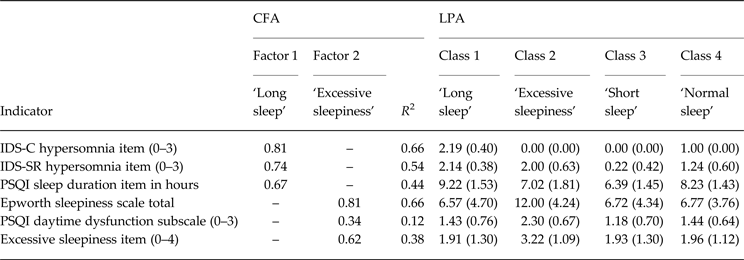
The factor loadings from the two-factor model evaluated are presented in Table 2. The overall fit of the model was good (χ2/df = 1.48, df = 8, p = 0.16, CFI = 0.97, TLI = 0.92, RMSEA = 0.05). As expected, all factor loadings onto the ‘long sleep’ and ‘excessive sleepiness’ factors were significant (mean loading = 0.66). Furthermore, the two factors themselves were uncorrelated (r = −0.09), suggesting independence. Finally, the two-factor model provided a superior fit to the data than a more parsimonious one-factor model (Δχ2 = 37.04, df = 2, p < 0.0001).
CFA factor loadings and R2 values, and LPA means (standard deviations) for the six selected indicators of hypersomnia

CFA, Confirmatory factor analysis; LPA, latent profile analysis, IDS-C, Inventory of Depressive Symptomatology, Clinician Rated Version; IDS-SR, Inventory of Depressive Symptomatology, Self-Report Version; PSQI, Pittsburgh Sleep Quality Index.
To evaluate the influence of bipolar spectrum diagnosis on the model, individuals without bipolar I disorder (i.e. bipolar II and NOS; n = 16) were excluded. The fit of the model remained acceptable even after deleting these participants (χ2/df = 0.94, df = 8, p = 0.48, CFI = 1.0, TLI = 1.01, RMSEA = 0.00). Likewise, the overall fit of the model was largely satisfactory (Hu & Bentler, Reference Hu, Bentler and Hoyle1999) after deleting missing data list-wise (χ2/df = 2.07, df = 8, p = 0.04, CFI = 0.90, TLI = 0.80, RMSEA = 0.14). Thus, CFA suggested that ‘long sleep’ and ‘excessive sleepiness’ were separate and uncorrelated latent factors, and that this superior two-factor solution held even after excluding bipolar spectrum disorders and missing data from analyses.
We evaluated the impact of key demographic variables (gender and age) as covariates in a MIMIC model, a special form of SEM that allows modeling of direct connections between covariates and factors. The overall fit of this MIMIC model was largely satisfactory (χ2/df = 1.66, df = 16, p = 0.05, CFI = 0.92, TLI = 0.87, RMSEA = 0.07). None of the factor loadings between the covariates and the factors was significant except for age, where a significant effect of age on the ‘long sleep’ factor was observed (p < 0.01).
LPA
Comparison of BIC values from two- (BIC = 3531.87), three- (BIC = 3318.98), four- (BIC = 3296.88) and five- (BIC = 3303.34) class LPA models provided evidence for the four-class model's superior relative fit. Class 1 (n = 17, ‘long sleep’) consisted of individuals with long sleep duration and a relative absence of excessive sleepiness complaints. These individuals reported sleeping over 9 h on average per night and feeling ‘a little’ to ‘somewhat’ sleepy during the daytime, with ESS scores in a non-clinical (<10) range. Class 2 (n = 14, ‘excessive sleepiness’) consisted of individuals reporting clinically significant ESS scores and rating daytime sleepiness between ‘a lot’ and ‘very much’, but with average sleep duration of 7.1 h. Class 3 (n = 88, ‘short sleep’) and class 4 (n = 39, ‘normal sleep’) was comprised of individuals who did not report excessive sleepiness (ESS scores < 10) but self-reported an average sleep duration of 6.4 and 8.2 h, respectively. Table 2 presents means and standard deviations of each hypersomnia indicator according to latent class membership. In sum, LPA again suggested that ‘long sleep’ and ‘excessive sleepiness’ were best defined as separate classes.
To examine whether bipolar spectrum diagnosis or missing data imputation affected model fit, separate LPAs were run excluding non-bipolar I participants and excluding missing data list-wise. A four-class solution continued to illustrate superior fit when excluding bipolar II and NOS subjects from analyses (BIC for two-, three-, four- and five-class solutions were 3234.70, 3016.47, 3006.82 and 3008.66, respectively) and when excluding missing data list-wise (BIC for two-, three-, four- and five-class solutions were 1599.30, 1578.24, 1543.88 and 1556.39, respectively).
Medication analyses
A summary of psychotropic medications taken by the participants in the sample is presented in Table 1. Participants took an average of 2.5 (s.d. = 1.5) medications. Mean medication load score for all participants taking medications was 3.4 (s.d. = 2.1). When entered as a covariate in our CFA models, medication load score did not significantly improve model fit (Δχ2 = 6.88, df = 5, p = 0.23). Likewise, there was no difference in medication load scores between the ‘long sleep’ class (4.2, s.d. = 2.5) and the ‘excessive sleepiness’ class (3.9, s.d. = 2.0) as determined by LPA (t 27 = 0.4, p = 0.69). We also evaluated the impact of each of the seven individual medication classes (e.g. stimulants, anxiolytics) listed in Table 1. The ‘long sleep’ and the ‘excessive sleepiness’ classes did not differ by rates of any medication class taken (χ2 ⩽ 1.00, p > 0.4 for all). We also did not observe differences in any one class of medication taken between those who did and did not relapse to hypomania/mania by follow-up (χ2 ⩽ 3.06, p ⩾ 0.07 for all). Thus, medications did not appear to influence CFA and medication load or type did not differ between the ‘long sleep’ and ‘excessive sleepiness’ classes.
Relationship with prospective sleep data
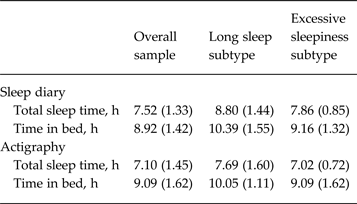
We evaluated the relationship between hypersomnia subtype and prospective sleep data (average total sleep time and average time in bed) for both sleep diary and actigraphy within an SEM framework, as well as based on our LPA classes (Table 3). Considering sleep diary data first, we found an acceptable model fit (χ2/df = 1.12, CFI = 0.99, TLI = 0.98, RMSEA = 0.03) for average diary total sleep time with significant factor loading onto ‘long sleep’ (p < 0.001) but with non-significant loading onto ‘excessive sleepiness’ (p = 0.75). Likewise, an acceptable model fit (χ2/df = 2.0, CFI = 0.98, TLI = 0.97, RMSEA = 0.04) was observed for average diary time in bed with significant factor loading onto ‘long sleep’ (p < 0.001) but with non-significant loading onto ‘excessive sleepiness’ (p = 0.73). In contrast, average actigraphy total sleep time revealed acceptable model fit (χ2/df = 1.12, CFI = 0.99, TLI = 0.98, RMSEA = 0.03) but no significant factor loadings onto either ‘long sleep’ (p = 0.22) or ‘excessive sleepiness’ (p = 0.08). Actigraphy time in bed analyses showed acceptable model fit (χ2/df = 1.45, CFI = 0.96, TLI = 0.90, RMSEA = 0.05) with a significant factor loading onto ‘long sleep’ (p = 0.05) but with non-significant loading onto ‘excessive sleepiness’ (p = 0.15). Thus sleep diary data suggested that ‘long sleep’, but not ‘excessive sleepiness’, was related to total sleep time and time in bed. Actigraphy further suggested that ‘long sleep’ was characterized by time in bed, not total sleep time.
Descriptive statistics for sleep diary and actigraphy by latent profile analysis-determined hypersomnia subtype

Data are given as mean (standard deviation).
Relationship to illness relapse
The relationship between hypersomnia subtype and SCID-determined bipolar relapse was also investigated. Of the 121 individuals who were re-assessed at follow-up, 21 individuals (17.5%) had developed a hypomanic/manic episode and 37 individuals (30.1%) had developed a major depressive episode between baseline and follow-up. Considering relapse to depression within the 7-month evaluation period, neither ‘long sleep’ nor ‘excessive sleepiness’ predicted relapse into depression (p > 0.05 for both). In examining relapse into hypomania/mania, ‘excessive sleepiness’ predicted relapse into hypomania/mania (p < 0.01) while ‘long sleep’ was not a significant predictor of manic relapse (p = 0.78). The relationship between excessive sleepiness and manic relapse did not appear to be driven by insufficient sleep, as no relationship between excessive sleepiness and prospective sleep length was observed in CFA models (all p's > 0.05). Likewise, LPA suggested that the ‘excessive sleepiness’ class slept significantly more than the ‘short sleep’ class (471 v. 411 min; t 90 = −2.6, p = 0.01) but not differently from the ‘normal sleep’ class (471 v. 487 min; t 49 = −0.72, n.s.), again suggesting that the relationship between excessive sleepiness and manic relapse was not driven by short or insufficient sleep.
Discussion
To our knowledge, this is the largest study of hypersomnia in a clinical sample using clinician-administered and self-reports of hypersomnia, as well as the largest to evaluate hypersomnia using subjective and objective measures of sleep. This paper makes four important contributions to our understanding of hypersomnia. First, we found that hypersomnia is comprised of two separate subgroups: ‘long sleep’ and ‘excessive sleepiness’. Second, neither of these subgroups appears differentially affected by medications. Third, the objective sleep of ‘long sleepers’ is characterized by a long time in bed, not long sleep duration. Fourth, excessive sleepiness predicts relapse to mania.
Our data clearly suggest evidence for subtypes of hypersomnia. Factor analyses point to long sleep and excessive sleepiness as separate constructs. Likewise, LPA, which is considered an appropriate method for identifying symptom structure when no ‘gold standard’ diagnosis is available (Garrett et al. Reference Garrett, Eaton and Zeger2002), also identified long sleep and excessive sleepiness as belonging to separate classes. Though this has been suggested in the literature (Nofzinger et al. Reference Nofzinger, Thase, Reynolds, Himmelhoch, Mallinger, Houck and Kupfer1991; Billiard et al. Reference Billiard, Dolenc, Aldaz, Ondze and Besset1994; Ohayon et al. Reference Ohayon, Dauvilliers and Reynolds2012), our investigation was the first to provide empirical data indicating that long sleep and excessive sleepiness are indeed separate and uncorrelated. It should be noted that this finding stands in contrast to a recent population-based telephone survey (Ohayon et al. Reference Ohayon, Reynolds and Dauvilliers2013), in which a positive correlation was noted between sleep length and excessive sleepiness. Differences in studies are likely to be accounted for by differences in sampling, methodology and participants. The telephone-based survey did not focus on a clinical sample, relied exclusively on self-report, and did not exclude participants based on the presence of sleep disorders such as obstructive sleep apnea or periodic limb movement disorder. As these sleep disorders involve disrupted sleep continuity, individuals are likely to experience both excessive sleepiness (from insufficient nocturnal sleep) and long sleep (reflecting a homeostatic compensatory process). The present investigation offered a clearer picture of hypersomnia by excluding such confounding sleep disorders. It further utilized clinician interviews along with self-report to make hypersomnia determinations, thereby addressing a finding in the literature that individuals with hypersomnia tend to overestimate their sleep when asked to estimate via self-report alone (Attarian et al. Reference Attarian, Duntley and Brown2004; Trajanovic et al. Reference Trajanovic, Radivojevic, Kaushansky and Shapiro2007).
Neither long sleep nor excessive sleepiness appeared to be differentially influenced by medications. Those with ‘long sleep’ and ‘excessive daytime sleepiness’ did not differ in number, dose or class of medication taken, and medication load was not a significant covariate in our models. Even so, medications present a challenge in research with clinical samples. Sleep-related side effects are present in 4% to 37% of patients with bipolar disorder (GlaxoSmithKline, 2005; Physicians’ Desk Reference Staff, 2008), and atypical antipsychotics in particular are known for their sedative properties (Kane & Sharif, Reference Kane and Sharif2008). As research in medication-free bipolar samples is neither representative nor generalizable, we did not exclude on the basis of medications and instead assessed effects of medications in careful post-hoc analyses. We did not control for medication changes over the 7-month interval between baseline evaluation and follow-up. Hence, a limitation is that medication changes during this period may have influenced rates of relapse. Even so, medications remain the first-line treatment of bipolar disorder (Sachs et al. Reference Sachs, Printz, Kahn, Carpenter and Docherty2000) and dose changes and medication augmentations are quite common in the course of treatment.
Viewing hypersomnia as comprised of subtypes has important implications for researching etiology and understanding mechanisms. Long sleep has multiple proposed etiologies, including both biological [decreased slow-wave activity at night (Plante et al. Reference Plante, Landsness, Peterson, Goldstein, Wanger, Guokas, Tononi and Benca2012), a slower circadian pacemaker (Aeschbach et al. Reference Aeschbach, Sher, Postolache, Matthews, Jackson and Wehr2003)], and psychological [anergia or avolition (Nofzinger et al. Reference Nofzinger, Thase, Reynolds, Himmelhoch, Mallinger, Houck and Kupfer1991; Billiard et al. Reference Billiard, Dolenc, Aldaz, Ondze and Besset1994), avoidance coping (Jacobson et al. Reference Jacobson, Martell and Dimidjian2001)] mechanisms. Likewise, recent research suggests that excessive sleepiness may be related to decreased cerebrospinal fluid histamine levels (Kanbayashi et al. Reference Kanbayashi, Kodama, Kondo, Satoh, Inoue, Chiba, Shimizu and Nishino2009) and differences in the human leukocyte antigen (HLA) DQB1*0602 (Goel et al. Reference Goel, Banks, Mignot and Dinges2010). The degree to which these proposed mechanisms might overlap – or differentiate – long sleep from excessive sleepiness is still unknown. Treatment of long sleep and excessive sleepiness is also likely to be quite different based on the understanding of these mechanisms.
One key finding emerged from prospective sleep measurement: actigraphy data collected over a 24-h period suggested that long sleepers display a longer time in bed but not longer total sleep time. In other words, the sleep of self-reported long sleepers is characterized by excessive bedrest duration. This finding has been observed in studies utilizing polysomnography (Nofzinger et al. Reference Nofzinger, Thase, Reynolds, Himmelhoch, Mallinger, Houck and Kupfer1991; Dolenc et al. Reference Dolenc, Besset and Billiard1996; Vgontzas et al. Reference Vgontzas, Bixler, Kales, Criley and Vela-Bueno2000; Kaplan et al. Reference Kaplan, Gruber, Eidelman, Talbot and Harvey2011) but has not been examined in the home environment using actigraphy. A relatively recent publication by the American Academy of Sleep Medicine on practice parameters for actigraphy commented on the lack of studies employing actigraphy in hypersomnia, noting that ‘there were no studies identified that compared actigraphy versus the clinical history plus sleep logs (or another reference standard) to estimate mean sleep time or sleep pattern when evaluating patients with hypersomnia as a complaint’ (Morgenthaler et al. Reference Morgenthaler, Alessi, Friedman, Owens, Kapur, Boehlecke, Brown, Chesson, Coleman, Lee-Chiong, Pancer and Swick2007). The present study is the first to use actigraphy expressly to evaluate sleep in hypersomnia and provides evidence for its utility in characterizing the sleep disturbance. It should also be noted that excessive sleepiness was not associated with increased total sleep time or time in bed measured using either diaries or actigraphy, adding further support for long sleep and excessive sleepiness as separate subtypes of hypersomnia.
Multiple studies suggest that sleep disturbances such as hypersomnia predict first-episode and recurrence of depression (Breslau et al. Reference Breslau, Roth, Rosenthal and Andreski1996; Ford & Cooper-Patrick, Reference Ford and Cooper-Patrick2001; Cho et al. Reference Cho, Lavretsky, Olmstead, Levin, Oxman and Irwin2008). Surprisingly, our findings did not support this relationship, as we observed that neither long sleep nor excessive sleepiness predicted relapse to a depression at 7-month follow-up. We offer two possible explanations as to why this may be the case. First, our follow-up period was 7 months, whereas other prospective research on hypersomnia and depression had follow-up durations of anywhere from 1 to 3 years; as such, had the interval between baseline and follow-up assessment been longer, a positive relationship might have emerged. Second, we defined relapse as a SCID-assessed depressive episode, though it may be the case that a dimensional measure of depressive symptomatology (e.g. the IDS-C) would have shown elevation at follow-up.
A novel finding to emerge from the present study was that excessive sleepiness predicted relapse into hypomania/mania, an association that has not received much attention. As mentioned above, this relationship did not appear to be attributable to medication administration. We also examined the prospective sleep of the excessive sleepiness group to see if they were sleeping less, as associations between decreased sleep and increased mania are established in the literature (Colombo et al. Reference Colombo, Benedetti, Barbini, Campori and Smeraldi1999), but we did not find supportive evidence. There may be an as-yet unexplained biological marker contributing to both excessive sleepiness dysfunction and the circadian instability at the core of bipolar illness episodes (Harvey, Reference Harvey2008). Alternatively, a homeostatic regulatory process may underlie the relationship between excessive sleepiness in the euthymic period and reduced sleep need in hypomania/mania, though little is known about the mechanisms of sleep regulation in either state (Wehr et al. Reference Wehr, Sack and Rosenthal1987; Plante & Winkelman, Reference Plante and Winkelman2008).
The present findings should be considered in the light of several important limitations. First, the study included only individuals with bipolar spectrum diagnoses given their strong relationship to hypersomnia, and results may lack generalizability to other psychiatric populations. Even so, the objective sleep data here are consistent with other published reports of dysthymia (Billiard et al. Reference Billiard, Dolenc, Aldaz, Ondze and Besset1994; Dolenc et al. Reference Dolenc, Besset and Billiard1996), and one recent study exploring sleep disturbance in seasonal affective disorder also suggested that hypersomnia may be characterized by long bedrest duration (Roecklein et al. Reference Roecklein, Carney, Wong, Steiner, Hasler and Franzen2013). An important agenda for future research will be to explore hypersomnia subtypes and their relationship to illness course in other mood disorders. It should also be noted that our findings were derived from a relatively small, predominantly female and Caucasian sample, though it was a sizeable sample given the inclusion of the clinician-administered interview and prospective sleep monitoring. Our prospective sleep monitoring included 1 week of sleep diary, though more than 1 week of diary may be needed to adequately characterize sleep disturbance (Wohlgemuth et al. Reference Wohlgemuth, Edinger, Fins and Sullivan1999). Finally, we did not assess for medication changes or hypersomnia at the follow-up assessment, so we are unable to comment on the chronicity of hypersomnia complaints or the impact of medication changes on mood episodes. We also did not assess for caffeine or other non-prescription stimulant use in the period between baseline and follow-up, and use of these substances may have made an impact on the relationship between excessive sleepiness and mania observed in our sample.
The present findings have implications for the newly published DSM-5 and set an agenda for future research. As currently stated, DSM-5 criteria for hypersomnolence disorder (what was previously referred to as hypersomnia in the DSM-IV) hinge on ‘a complaint of excessive sleepiness’ defined via excessive sleep drive, long sleep or excessive sleep inertia. The present research clearly demonstrates that excessive sleepiness and long sleep are separate subgroups. As long as they remain together under the umbrella term hypersomnolence, excessive sleepiness and long sleep will continue to confuse the literature and impede generalizability. Future research that investigates characteristics and consequences of each group separately is needed to better understand hypersomnia, and both population-based and clinical investigations that utilize semi-structured interviews along with self-report are useful in preventing sleep estimation bias. Additionally, treatment research is needed to identify interventions tailored for each subtype. For example, considering behavioral treatment options, interventions focusing on behavioral activation (Jacobson et al. Reference Jacobson, Martell and Dimidjian2001) or social rhythms stabilization (Frank et al. Reference Frank, Swartz and Kupfer2000) may be successful for long sleep, whereas interventions focused on light (Kaida et al. Reference Kaida, Takahashi, Haratani, Otsuka, Fukasawa and Nakata2006) or minimizing sleep inertia (Hayashi et al. Reference Hayashi, Masuda and Hori2003) may differentially make an impact on excessive sleepiness.
Acknowledgements
This project was supported by a National Institute of Mental Health grant (no. R34 MH080958) awarded to A.G.H. and a National Science Foundation Graduate Research Fellowship grant awarded to K.A.K.
Declaration of Interest
None.