Introduction
Chronic fatigue syndrome (CFS) is a condition characterized by chronic disabling fatigue and other symptoms that are associated with profound disability and are not better explained by an alternative diagnosis (Sharpe & Chalder, Reference Sharpe, Chalder and Ellis1994). There is now a growing body of evidence suggesting that specific treatments can improve these poor outcomes. A systematic review found that both cognitive behavioural psychotherapy (CBT) and graded exercise therapy (GET) are the most promising treatments for CFS/myalgic encephalomyelitis (ME) in secondary care (Chambers et al. Reference Chambers, Bagnall, Hempel and Forbes2006). A Cochrane review confirmed that around 40% of patients with CFS report improvements in fatigue and social adjustment if they receive CBT (Price et al. Reference Price, Mitchell, Tidy and Hunot2008) and this finding was confirmed more recently in a large multi-centred randomized controlled trial (RCT) (White et al. Reference White, Goldsmith, Johnson, Potts, Walwyn, DeCesare, Baber, Burgess, Clark, Cox, Bavinton, Angus, Murphy, Murphy, O'Dowd, Wilks, McCrone, Chalder and Sharpe2011). In a non-randomized study CBT was effective in routine clinical practice although slightly less so than in the RCT (Quarmby et al. Reference Quarmby, Rimes, Deale, Wessely and Chalder2007).
Although CBT seems to be an effective treatment for CFS, a substantial proportion of patients do not improve. Identifying mechanisms of change may elucidate ways in which treatment can be developed, tailored or optimized to suit the needs of different individuals (Laurenceau et al. Reference Laurenceau, Hayes and Feldman2007). It may also provide us with information about the clinical utility of the model on which treatment is based.
The cognitive behavioural approach involves enabling individuals to develop a consistent approach to activity, gradually increase activity, develop healthy sleep patterns and identify and challenge unhelpful cognitions (Wessely et al. Reference Wessely, David, Butler and Chalder1989; Sharpe & Chalder, Reference Sharpe, Chalder and Ellis1994), with the primary aim of improving fatigue and social adjustment. In CFS, treatment is usually initially directed at behaviour change, with cognitive strategies being introduced once a consistent approach to activity has been established.
CBT for CFS is based on a fear avoidance beliefs model about physical activity. This model supposes that unhelpful catastrophic interpretations of symptoms and excessive focus on symptoms are central in driving disability and symptom severity (Wessely et al. Reference Wessely, David, Butler and Chalder1989; Burgess et al. Reference Burgess, Manoharan and Chalder2011). These cognitive responses are also associated with behavioural patterns that contribute to outcome, including avoidance of activity together with excessive rest, and all-or-nothing behaviour; a pattern of pushing too hard or being overactive when feeling well and then needing to rest up or do very little for prolonged periods.
Evidence for this model is growing. Catastrophic beliefs about the consequences of increasing activity have been shown to be associated with worse disability and fatigue in a cross-sectional study of CFS (Petrie et al. Reference Petrie, Moss-Morris and Weinman1995). Similarly, avoiding exercise or activity and accommodating to the illness are all associated with greater disability in patients with CFS (Antoni et al. Reference Antoni, Brickman, Lutgendorf, Klimas, Imia-Fins, Ironson, Quillian, Miguez, van Riel, Morgan, Patarca and Fletcher1994; Ray et al. Reference Ray, Jefferies and Weir1995; Chalder et al. Reference Chalder, Power and Wessely1996). In a laboratory-based experiment, patients' beliefs about the negative effects of activity predicted lack of persistence on an exercise bike over and above physiological correlates of exertion, symptom severity and distress (Silver et al. 2002). This finding was confirmed in a questionnaire study that showed that kinesiophobia was associated with activity limitations/participation restrictions in patients with CFS (Nijs et al. Reference Nijs, De Meirleir and Duquet2004).
In two of the earlier CBT trials (Sharpe et al. Reference Sharpe, Hawton, Simkin, Surawy, Hackmann, Klimes, Peto, Warrell and Seagroatt1996; Deale et al. Reference Deale, Chalder and Wessely1998), patients were significantly less likely to believe that avoidance of exercise was helpful after CBT. More recently, Wiborg et al. (Reference Wiborg, Knoop, Stulemeijer, Prins and Bleijenberg2010) looked at whether actual physical activity changed with CBT in the context of three different trials: one compared CBT with ‘guided support’ and ‘no intervention’ control conditions (Prins et al. Reference Prins, Bleijenberg, Bazelmans, Elving, de Boo, Severens, van der Wilt, Spinhoven and van der Meer2001), one trial in adolescents compared CBT with a waiting list control (Stulemeijer et al. Reference Stulemeijer, de Jong, Fiselier, Hoogveld and Bleijenberg2005), and the other compared minimal CBT (self-help materials and email contact) with a waiting list control (Knoop et al. Reference Knoop, van der Meer and Bleijenberg2008). Physical activity, as measured by an actometer, was not associated with CBT or fatigue in any of the trials (Wiborg et al. Reference Wiborg, Knoop, Stulemeijer, Prins and Bleijenberg2010). The same authors set out to examine whether avoidance of activity, avoidance of aversive stimuli and focusing on fatigue mediated the effect of CBT on fatigue and impairment (Wiborg et al. Reference Wiborg, Knoop, Stulemeijer, Prins and Bleijenberg2010). The results suggested that symptom focusing but not behavioural avoidance may have mediated the effect of CBT on the outcomes.
In summary, studies to date suggest that change in cognitive responses but not behavioural avoidance may mediate the effect of CBT. However, none of the studies used mediators measured before the outcomes.
We hypothesized that, as CBT in this context focuses initially on changing avoidance behaviour, fearful cognitions will at least partially mediate the relationship between change in avoidance behaviour and illness outcomes (fatigue and disability). The current study allowed preliminary investigation of this possibility. We aimed to assess the hypotheses using data collected from routine cognitive behavioural psychotherapy patients. We first wanted to investigate whether reported improvements in disability and fatigue after CBT, within the context of a large RCT (White et al. Reference White, Goldsmith, Johnson, Potts, Walwyn, DeCesare, Baber, Burgess, Clark, Cox, Bavinton, Angus, Murphy, Murphy, O'Dowd, Wilks, McCrone, Chalder and Sharpe2011), can be replicated in routine treatment and will remain stable for up to 1 year after treatment has finished. A similar pattern of changes to that seen for CBT in the trial are expected for putative cognitive and behavioural responses. We then assessed the proposed model using mediational analysis based on path and structural equation models (MacKinnon, Reference MacKinnon2008) and compared our proposed model with the alternative that the relationship between fearful cognition and fatigue symptoms and disability respectively is mediated by avoidance behaviour. We introduced an information theoretic approach that allowed us to compare the strength of evidence for each of the competing models (Akaike, Reference Akaike, Petrov and Csaki1973; Burnham & Anderson, Reference Burnham and Anderson2002). Subjects were measured at several time points after finishing CBT, which enabled us to assess variables in the order that reflected the putative temporal order of the model. Although the majority of changes in CBT usually occur by the end of the treatment, longitudinal modelling can potentially also take account of small changes between post-treatment and follow-up. Longitudinal mediation models with at least three waves of measurements are preferred over cross-sectional models because they allow us to examine whether a change in one variable is more likely to produce changes in another variable than vice versa, even if the changes are small (MacKinnon, Reference MacKinnon2008). This approach allows the comparison of different partial mediation models using information criteria, which would not be possible if we used measurements taken at the same time point only. This is because such models would be structurally equivalent models and would produce the same model-data fit. Finally, in an exploratory study we aimed to generalize the results of the mediation analysis using putative latent traits of behavioural and cognitive responses.
Method
Participants
Participants were recruited from consecutive general practitioner (GP) and consultant referrals to the CFS Research and Treatment Unit at King's College London and the South London and Maudsley National Health Service (NHS) Trust between 2002 and 2006. All participants who were treated at this Unit between 2002 and 2006 were included in the analysis. The intervention was evidence based and stable this time period.
The diagnosis of CFS was made by either an experienced consultant psychiatrist or an experienced cognitive behavioural psychotherapist according to Oxford (Sharpe et al. Reference Sharpe, Archard, Banatvala, Borysiewicz, Clare, David, Edwards, Hawton, Lambert and Lane1991) or US Centre for Disease Control case definitions. (Fukuda et al. Reference Fukuda, Straus, Hickie, Sharpe, Dobbins and Komaroff1994). The diagnosis was then confirmed by patients completing self-report questions that assessed all aspects of the case definitions. Treatment was offered to patients who fulfilled either definition according to the assessing health professional. Routine physical investigations were performed by either the patient's GP or the CFS Unit to exclude medical causes for fatigue. Eleven therapists trained specifically in cognitive behavioural psychotherapy and experienced in the treatment of CFS treated the patients. All received regular clinical supervision.
The study was approved by the Audit Committee of the Psychological Medicine Clinical Academic Group of King's Health Partners.
Outcome measures and potential mediators
All measures were completed by patients before their treatment started, at discharge from treatment (about 8 months after the start of treatment) and at 3, 6 and 12 months after discharge.
Chalder Fatigue Questionnaire (CFQ; Chalder et al. Reference Chalder, Berelowitz, Pawlikowska, Watts, Wessely, Wright and Wallace1993)
This 11-item scale measures physical and mental fatigue. Item responses range from ‘less than usual’ to ‘much more than usual’. Either a Likert (0, 1, 2, 3) or a bimodal (0, 1) scoring system can be used. The Likert method was used in this study. It has been shown to be both reliable and valid (Chalder et al. Reference Chalder, Berelowitz, Pawlikowska, Watts, Wessely, Wright and Wallace1993; Cella & Chalder, Reference Cella and Chalder2010; Knudsen et al. Reference Knudsen, Henderson, Harvey and Chalder2011) and has been used in previous treatment trials of CFS (Deale et al. Reference Deale, Chalder, Marks and Wessely1997; Quarmby et al. Reference Quarmby, Rimes, Deale, Wessely and Chalder2007).
Work and Social Adjustment Scale (WASA; Mundt et al. Reference Mundt, Marks, Shear and Greist2002)
This disability scale measures the extent to which the person's main problem of fatigue interferes with work, home management, social and private leisure activities and relationships. A Likert scoring system, ranging from 0 to 8, is used. Responses range from ‘not at all impaired’ (0) to ‘very severely impaired’ (8). Scores on the five items are added and divided by the number of items to get a total score. The scale is reliable and valid and has also been used in a previous trial of CFS (Quarmby et al. Reference Quarmby, Rimes, Deale, Wessely and Chalder2007; Cella et al. Reference Cella, Sharpe and Chalder2011a ).
Cognitive Behavioural Responses to Symptoms Questionnaire (CBRSQ; Skerrett & Moss-Morris, Reference Skerrett and Moss-Morris2006; Knudsen et al. Reference Knudsen, Henderson, Harvey and Chalder2011)
This scale has seven subscales. Five of the subscales measure cognitive responses to symptoms: catastrophizing (e.g. ‘I think that if my symptoms get too severe they may never decrease’), damage beliefs (e.g. ‘Symptoms are a signal that I am damaging myself’), symptom focusing (e.g. ‘When I experience symptoms, I think about them constantly’), fear avoidance beliefs (e.g. ‘I am afraid that I will make my symptoms worse if I exercise’) and embarrassment avoidance (e.g. ‘I am embarrassed about my symptoms’). The other two subscales measure behavioural responses: avoidance behaviour (e.g. ‘I tend to avoid activities that make my symptoms worse’) and all-or-nothing behaviour (e.g. ‘I tend to do a lot on a good day and rest on a bad day’). The subscales are reliable and valid and were associated with fatigue and social adjustment in previous studies of CFS and multiple sclerosis (Skerrett & Moss-Morris, Reference Skerrett and Moss-Morris2006; Knudsen et al. Reference Knudsen, Henderson, Harvey and Chalder2011.
Statistical analysis
Descriptive statistics for the 389 people who participated in the study are presented. Completers and drop-outs at discharge and at the 6-month follow-up were compared on baseline data using the t test and χ 2 test for homogeneity.
The analysis was conducted in two stages. In the first stage we investigated whether patients' scores changed during the study. We used general linear mixed models (see Brown & Prescott, Reference Brown and Prescott2006) to compare the outcome scores between the five measures at pre-treatment (baseline), discharge, and 3-, 6- and 12-month follow-ups. For each variable we used a mixed model with time as a fixed factor and an unstructured covariance matrix that allows unequal variances and covariances (correlations) between repeated measures. To account for the possible dependency due to therapy effects (in other words that patients treated by a particular therapist may respond in a similar manner and may no longer be assumed to act independently), we included therapist as a random factor in the model. If the time effect was significant, pairwise comparisons were performed. As an estimate of effect size we calculated the estimated mean difference between baseline and the 6-month follow-up divided by the baseline standard deviation.
To assess the sensitivity of our results to missing data we used multiple imputation (Little & Rubin, Reference Little and Rubin2002). By using a large number of variables to impute missing measurements, the missing at random (MAR) assumption becomes more tenable than the mixed effect model approach (Little & Rubin, Reference Little and Rubin2002). Variables used to impute missing values included gender, age, therapist and behavioural and cognitive variables at all five time points. Twenty data sets were imputed using the ICE procedure in Stata (Royston, Reference Royston2005) and we reran the mixed effects model analyses.
Therapist effect
To quantify the effect of therapist on treatment outcome, we estimated the intraclass correlation coefficient (ICC) at the 6-month follow-up (Cella et al. Reference Cella, Stahl, Reme and Chalder2011b ). The ICC is the estimated proportion of therapists' explained variance, defined as the ratio of the variance attributable to the therapists to the total variance. To estimate the variances we used a conditional multi-level model with measurement at 6 months as the dependent variable, therapist as a random effect and baseline levels as a covariate to control for baseline differences. Bias-corrected and accelerated bootstrap confidence intervals (CIs) are presented around estimates.
Mediation analysis
In the second stage, we performed a path analysis to assess possible mediating effects (Judd & Kenny, Reference Judd and Kenny1981; Baron & Kenny, Reference Baron and Kenny1986; MacKinnon & Luecken, Reference MacKinnon and Luecken2008). Mediation is a hypothesized causal chain in which one independent variable X affects a mediating variable Y, which in turn affects the outcome variable Z. If the intervening mediator Y explains the correlation between X and Z, we have a full mediational model. If X still has an effect on Z after including the mediator Y in the model, the model is consistent with partial mediation.
For each of the two outcome variables (fatigue and social adjustment), we compared full and partial mediation processes for two proposed pathways: behaviour→cognition→outcome and cognition→behaviour→outcome. We used ‘avoidance behaviour’ as the behavioural response and ‘fear avoidance beliefs’ as the cognitive variable. We used the scores of the independent variable at discharge, of the mediator at the 3-month follow-up and scores of the dependent outcome variable at the 6-month follow-up. The temporal order was chosen because the mediation model assumes that the independent variable precedes and causes the mediator, which precedes and causes the dependent variable outcome (Kraemer et al. Reference Kraemer, Wilson, Fairburn and Agras2002). We expect that changes in the outcome variables are established during CBT and only small changes are expected after discharge from CBT. However, longitudinal mediation models with at least three waves of measurements are still preferred over cross-sectional models because they allow us to explore different temporal ordering of variables in the process, even if the changes are small (MacKinnon, Reference MacKinnon2008). Such multi-wave models are important for model comparisons because it is not possible to compare quantitatively the strength of support for different models using a cross-sectional approach if the models are structurally equivalent. For example, the two models ‘cognition is dependent on behaviour’ and ‘behaviour is dependent on cognition’ are very different substantively; however, the fit of the models will be identical in a cross-sectional study. In this situation, path analysis cannot resolve the issue of which model should be preferred. However, the temporal order with which the data are collected can often exclude the problem of assessing equivalent models because causal effects cannot travel backwards (Shipley, Reference Shipley, Pugesek, Tomer and von Eye2003). Even small changes after discharge should result in the same mediation process, which allows us to compare models with differences in the proposed temporal order using information criteria. If no changes occur after discharge, our mediation model would be identical to a cross-sectional model using measurements at discharge only and we would expect to see no differences in model fit of equivalent models. It should be noted that the longitudinal approach assumes that the mediational processes are the same during and after treatment.
Finally, for all variables we included a path from their baseline measure to control for baseline differences in the measures (ANCOVA approach; MacKinnon, Reference MacKinnon2008).
Model selection
To assess the different models we used Akaike's Information Criterion (AIC), which attempts to select a parsimonious model that best explains the data with a minimum number of estimated parameters (Burnham & Anderson, Reference Burnham and Anderson2002; Claeskens & Lid, Reference Claeskens and Lid2008). AIC is a measure of the goodness of fit that includes a penalty for the number of variables estimated. AIC selects the best of several competing models as the one that predicts best in a new data set. The best model is the one with the lowest AIC. Unlike model selection based on null hypothesis testing, AIC model selection enables an evaluation of the quality of other models by assessing AIC-related measures (ΔAIC i , Akaike weights and evidence ratio). ΔAIC i is the difference in AIC between model i and the best model. As a rule of thumb, a ΔAIC i value of < 2 times the AIC i value of the best model has substantial support and should be considered with the best model. A ΔAIC i value > 4 times the AIC i of the best model has substantially less support and models with a ΔAIC i > 10 times the AIC i of the best model can be omitted from further consideration (Burnham & Anderson, Reference Burnham and Anderson2002). An Akaike weight is an estimate of the probability that model i is the best model among the candidate set of models. The evidence ratio for a given model i is the ratio of Akaike weights of the best model and of model i. Unlike Akaike weights, the evidence ratio of two models is independent of other candidate models.
Structural equation and path model assessments compare the fit of the predicted covariances matrix relative to the observed covariance matrix. This means that AIC model selection can only be used to compare non-nested models with the same set of observed variables. We therefore used the full set of observed variables in the analyses and fixed the paths that were not of interest to zero. For example, if we want to determine the AIC for the path model behaviour at discharge→cognition at 3 months→outcome at 6 months, we need to include the variables cognition at discharge, behaviour at 3 months and outcome at 6 months (and their baseline measures) in the model but constrain their paths to zero.
Model fit assessment
The goodness of fit of the models was further assessed by performing a test for lack of fit using the χ 2 goodness-of-fit statistic and assessing the Comparative Fit Index (CFI) and the root mean square error of approximation (RMSEA), which are recommended for smaller sample sizes (Fan et al. Reference Fan, Thompson and Wang1999; Kline, Reference Kline2004). Support for good fit of a target model is obtained if the χ 2 goodness-of-fit test is not significant, the RMSEA value is < 0.05 (adequate fit: < 0.08) and the CFI is > 0.95 (adequate fit: > 0.90).
The final best models for fatigue and social adjustment are presented as path diagrams with standardized regression coefficients. We used Huber–White sandwich standard errors, which are robust against some failure to meet assumptions about normality and heteroscedasticity to establish CIs and statistical significance tests of direct, indirect and total ( = direct + indirect) effect for each variable in the model.
Latent variable path model
The behavioural and cognitive variables can be assumed to measure more general underlying latent variables ‘behavioural responses’ and ‘cognitive responses’. In the final exploratory analysis, we assessed whether the best model held for behavioural and cognitive variables in general by creating a composite score of the two behavioural variables (avoidance and all-or-nothing behaviour) and a latent variable for cognition using the five cognition variables (fear avoidance beliefs, catastrophizing, damage control, embarrassment avoidance and symptom focusing) as indicator variables. A latent variable for behaviour was not possible because of the small number of items. We obtained a composite score by standardizing the two variables by calculating the difference of a score and the mean of the baseline divided by the standard deviation of the baseline, and then adding up the two z scores for each individual (Cutter et al. Reference Cutter, Baier, Rudick, Cookfair, Fischer, Petkau, Syndulko, Weinshenker, Antel, Confavreux, Ellison, Lublin, Miller, Rao, Reingold, Thompson and Willoughby1999). The composite score is used as a proxy for the latent trait ‘behaviour’ and assumes equal contributions from each item to the latent trait. We reran the analyses of the best models using the composite score and the latent variable as the independent and mediating variables and fatigue and social adjustment respectively as the dependent outcome variable. Again, to control for baseline differences we included a path from their baseline measure for all manifest and latent variables. These paths are not shown in the figures to maintain clarity.
Multi-level modelling analyses were performed with Stata version 11.1 (StataCorp, 2007) and Amos 20 (Arbuckle, Reference Arbuckle2006) was used for path analysis. The user-written R package lavaan (Rosseel, Reference Rosseel2012) was used for calculating robust standard errors for the best path and the latent variable models.
Results
Recruitment, demographics and follow-up attendance
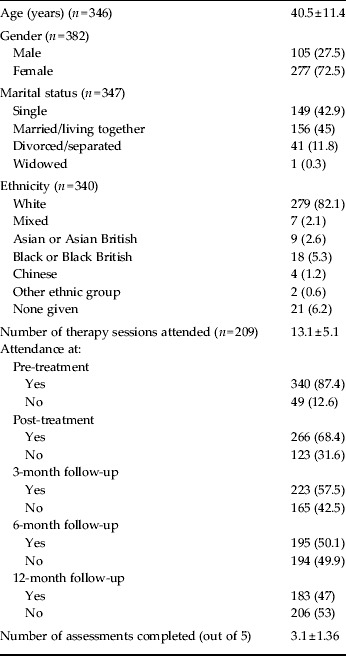
Demographic data and information on the recruitment of subjects and participation in the study are summarized in Table 1. A total of 389 people (mean age 40.5 years, 82.1% white British, 72.5% women) participated in the study. Adherence to treatment, measured by the number of therapy sessions attended, ranged from 0 to 31 with a mean of 13.1. Of the 209 subjects attending therapy sessions, 95% attended more than five of these sessions. The pre-treatment session was attended by 340 (87.4%) people. Baseline data for the seven behavioural and cognitive variables were available for between 314 (avoidance behaviour) and 340 (embarrassment avoidance) people. The attendance rate decreased to 266 (68.4%) at post-treatment, 223 (57.3%) at 3 months, 195 (50.1%) at 6 months and 183 (47%) at 12 months after treatment. Thirty-six individuals (9.3%) did not attend any post-treatment or follow-up sessions.
Demographic characteristics and attendance

Values given as mean ± standard deviation or n (%).
Comparison of completers and drop-outs at 6 months
A comparison of available baseline data (behavioural and cognitive measures, age, sex, ethnicity and education status) between ‘refusers’ and those who attended at least one follow-up session after treatment revealed a significant lower mean score in embarrassment avoidance behaviour (refusers: 14.3 versus others: 11.6 points, t 338 = 2.71, p = 0.007, Cohen's d = 0.48) A similar comparison between attendees and drop-outs at 6 months revealed small differences in mean avoidance behaviour (non-attendees: 13.7 versus attendees: 12.5 points, t 312 = 1.89, p = 0.06, Cohen's d = 0.21).
Scale reliability
Cronbach's α ranged between 0.76 and 0.94 for all scales and subscales at baseline, confirming their internal consistency (for details see online Supplementary Table S1).
Longitudinal mixed model analysis
Descriptive mean scores and standard deviations for fatigue and social adjustment and for each subscale on the CBRSQ are presented in Supplementary Table S1.
Fatigue and social adjustment (WASA)
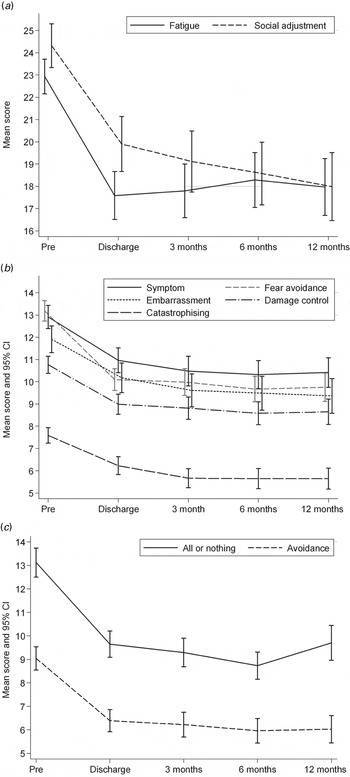
The results of the mixed model analyses revealed significant decreases in mean fatigue and WASA scores from baseline to discharge (Fig. 1 and online Supplementary Table S2). The significant difference remained at all follow-up measures at 3, 6 and 12 months for fatigue. However, for social adjustment (WASA), a small increase from discharge to the 3-month follow-up was observed (p < 0.05) and the mean score remained at a similar level afterwards. There were no significant changes in fatigue score after discharge. At 6 months the effect sizes were similar (fatigue: d = − 0.57, WASA: d = − 0.58).
Changes over time in (a) fatigue and social adjustment, (b) cognitive variables (symptom focusing, fear avoidance beliefs, embarrassment avoidance, damage control and catastrophizing) and (c) behavioural variables (all-or-nothing and avoidance behaviour).

CBRSQ subscales
The results of the mixed model analyses revealed significant decreases in the mean scores from baseline to discharge on all five subscales of cognition (fear avoidance beliefs, catastrophizing, damage control, embarrassment avoidance and symptom focusing and on both subscales of behaviour (all-or-nothing and avoidance behaviour). There was a small significant further decrease from discharge to the 12-month follow-up in catastrophizing, embarrassment, symptom focusing and all-or-nothing behaviour (all p's < 0.05). For most scales effect sizes were similar at the 6-month follow-up to those reported for fatigue and social adjustment (catastrophizing: d = − 0.55, symptom focusing: d = − 0.49, all-or-nothing behaviour: d = − 0.61, avoidance behaviour: d = − 0.69, fear avoidance beliefs d = − 0.68, damage control: −0.6, but the embarrassment avoidance effect was somewhat smaller at d = − 0.37).
Multiple imputation sensitivity analysis
The longitudinal multi-level modelling analyses were similar after multiple imputations for missing values, which suggests that the mixed model approach with missing data is robust.
Therapist effect
To quantify the effect of therapist on treatment outcome we estimated the ICC at the 6-month follow-up. The therapist effect was estimated as zero for most measures. Only for fear avoidance beliefs and damage control was a small (∼1%) but not significant effect observed (see Supplementary Table S2).
Mediation analysis
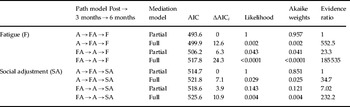
Because there were no, or only negligible, therapist effects, these effects were not incorporated in the following analyses. The mediation analysis revealed that the path ‘behaviour→cognition→outcome’, with cognition as a mediator between behaviour and outcome, explained the data better than behaviour as a mediator between cognition and both outcome variables, fatigue and social adjustment (Table 2). For both fatigue and social adjustment, a partial mediation model was selected as the best model.
Mediation analysis of fatigue and social adjustment with avoidance behaviour and fear avoidance beliefs (and baseline variables). AIC and AIC-related measures (ΔAICi, Akaike weights and evidence ratio) are presented for the four different path models for fatigue and social adjustment

AIC, Akaike's Information Criterion; ΔAIC i , the difference in AIC between model i and the best model; A, avoidance behaviour; FA, fear avoidance beliefs.
For fatigue, the partial model with fear avoidance beliefs as mediator between avoidance behaviour and fatigue as outcome had large AIC differences (6.3) compared to the path model where avoidance behaviour mediated fear avoidance beliefs. In addition, the evidence ratio suggests that the model with fear avoidance beliefs as a mediator is 23 times more likely to be the best model than the partial model with avoidance behaviour as a mediator (Table 2).
Similar results were obtained for the social adjustment models: the partial model with fear avoidance beliefs as mediator between avoidance behaviour and fatigue as outcome had an AIC 3.9 points lower and is seven times more likely to be the best model than the partial model with behaviour as a mediator.
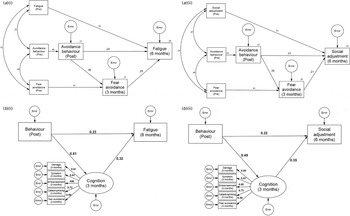
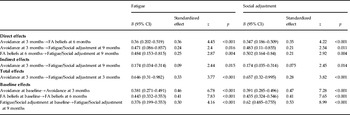
Fig. 2 a shows the best model for fatigue and social adjustment with standardized regression coefficients. The arrows reflect the hypothesized relationships between variables. Standardized regression coefficients are shown next to each path. This figure shows that avoidance behaviour at discharge was positively associated with fear avoidance beliefs at 3 months and fatigue and social adjustment at 12 months. Changes in the mediator ‘fear avoidance beliefs’ were also positively associated with the outcome variables fatigue and social adjustment respectively. All direct, indirect and total effects were significant. Table 3 shows details of the results of the statistical analyses. Fit indices for the two path models were good for fatigue [χ 2 6 = 10.1, p = 0.12, RMSEA = 0.042 (95% CI 0–0.085), CFI = 0.985] and adequate for social adjustment [χ 2 6 = 18.4, p = 0.002, RMSEA = 0.079 (95% CI 0.04–0.12), CFI = 0.964].
Best models of mediation analysis. (a) Best model for (i) fatigue and (ii) social adjustment. Full mediation model with behaviour (avoidance behaviour) at discharge (post-treatment) as the independent variable and cognition (fear avoidance beliefs) at 3 months as the mediator. Single-headed arrows reflect hypothesized relationships between variables. Standardized regression coefficients are shown next to each path. Double-headed arrows represent covariation between two variables. The correlation coefficient is shown next to the path. The explained variance of endogenous variables is on the top right on the rectangle. Circles represent error terms. Pre-treatment measurements of all three variables were included to control for baseline differences. (b) Best latent variable model for (i) fatigue and (ii) social adjustment. Full mediation model with behaviour (composite score of avoidance and all-or-nothing behaviour) at discharge (post-treatment) as the independent variable and the latent variable ‘cognition’ (circle with the five indicator variables: symptom focusing, fear avoidance beliefs, embarrassment avoidance, damage control and cathastrophizing) at 3 months as the mediator. Single-headed arrows reflect hypothesized relationships between variables. Standardized regression coefficients are shown next to each path. Circles represent error terms. Pre-treatment measurements of all three observed and latent variables were included to control for baseline differences but are not shown for reasons of clarity.

Best mediation models: standardized regression coefficients (95% robust CIs) and z value and robust p values for significance tests for direct, indirect and total effects for the mediation models for fatigue and social adjustment (WASA)

WASA, Work and Social Adjustment Scale; FA, fear avoidance; CI, confidence interval.
Composite score and latent variable mediation model
The partial mediation models for fatigue and social adjustment were replicated using a composite score for behaviour and modelling cognition as a latent variable with the five cognitive response variables as indicator variables (Fig. 2 b). The standardized direct and indirect effects were similar or slightly larger than those in the previous models and again significant (standardized indirect effect for fatigue: b = 0.16, p = 0.012, for social adjustment: b = 0.17, p = 0.003, p values for all direct effects < 0.01). Fit indices for two models were adequate [fatigue (χ 2 55 = 72.1, p = 0.06, RMSEA = 0.076 (95% CI 0.05–0.10), CFI = 0.90] and nearly adequate for social adjustment [χ 2 55 = 88.7, p = 0.003, RMSEA = 0.085 (95% CI 0.06–0.12), CFI = 0.89].
Discussion
In this study we assessed the theoretical foundations of a CBT model for CFS, namely that fearful cognitions would at least partially mediate the relationship between change in avoidance behaviour and illness outcomes (fatigue and disability). As expected from previous RCTs (White et al. Reference White, Goldsmith, Johnson, Potts, Walwyn, DeCesare, Baber, Burgess, Clark, Cox, Bavinton, Angus, Murphy, Murphy, O'Dowd, Wilks, McCrone, Chalder and Sharpe2011), which established that CBT is an effective treatment for CFS, our study demonstrates persistent improvements in fatigue and social adjustment after routine CBT training. Changes in improvement were accompanied by similar changes in illness-related cognitive and behavioural responses. All changes remained on lower levels for 12 months. The results of the mediational analyses were consistent with our hypothesized model in which fear avoidance beliefs partially mediate the relationship between avoidance behaviour and fatigue and social adjustment respectively. There was little support for the alternative models with avoidance behaviour as a mediator between fear avoidance belief and fatigue and social adjustment respectively. However, the partial mediation effect suggests that other potential mediators should be considered in further studies. An exploratory latent trait model suggests that the observed partial mediation model generalizes to illness-related behavioural and cognitive traits.
Our results are consistent with previous findings that also suggest that cognitive processes are a mediator between behaviour and outcome. Wiborg et al. (Reference Wiborg, Knoop, Prins and Bleijenberg2011) found that a decrease in symptom focusing on fatigue mediated the effect of CBT for CFS on fatigue and impairment. The measure of symptom focusing they used included items that could be construed as catastrophizing (e.g. ‘When I feel fatigued I think that the fatigue will get worse’). In contrast to our findings, unexpectedly they did not find an effect of CBT on avoidance of activity and so did not examine whether change in avoidance mediated the effect of CBT on fatigue or impairment. The authors suggested that the needs of the pervasively passive patients were being more adequately addressed in recent trials so this modification in the treatment protocol may explain their findings. One of the key components of CBT in our study is behavioural activation, which consists of encouraging patients to adopt a more consistent approach to activity with a view to gradually increasing activity thereafter.
Given these findings, even greater emphasis should be placed on behavioural change in the early stages of treatment, which may result in greater subsequent cognitive change and superior treatment outcomes. There is some supporting evidence from other studies (e.g. the PACE trial; White et al. Reference White, Goldsmith, Johnson, Potts, Walwyn, DeCesare, Baber, Burgess, Clark, Cox, Bavinton, Angus, Murphy, Murphy, O'Dowd, Wilks, McCrone, Chalder and Sharpe2011), which suggests that GET is as effective as CBT. In GET, cognitions are not a specific focus of treatment but are likely to be changed indirectly. We will be reporting our investigations of mediational processes in the PACE trial in future papers. Other studies that measure mediational factors at mid-treatment, prior to the main outcomes, will help to clarify these issues.
There are considerable strengths to this study. We considered a large routine clinic sample and the measures are used routinely as they inform the therapist and ultimately the patient about progress. The specific cognitive and behavioural responses are targeted in therapy. The statistical methods used are robust and also have major advantages over simpler methods such as the Baron & Kenny (Reference Baron and Kenny1986) approach or standard bootstrap extensions (Preacher & Hayes, Reference Preacher and Hayes2004). In the case of missing data, path analysis models using full maximum likelihood estimation allow analysis of all available data with less restrictions on the missingness assumptions and more power than standard complete case analyses. Robust standard errors correct CIs and p values for some violations of the distribution assumptions, such as normality and heteroskedasticity. Finally, the empirical support for the different models was assessed using an information-theoretic approach. Unlike model selection based on null hypothesis testing, AIC model selection enables an evaluation of the relative support in the observed data for each model by assessing AIC-related measures (Burnham & Anderson, Reference Burnham and Anderson2002). It is therefore not restricted to evaluating a single model, where significance is measured against some arbitrary probability threshold and quantitative comparisons between models are not possible.
The strengths have to be set against the weaknesses. First, our study was not an RCT and as such did not allow us to formally assess whether the observed changes are due specifically to CBT. However, a previous RCT has shown that CBT induces changes in our described mediators (Wiborg et al. Reference Wiborg, Knoop, Prins and Bleijenberg2011). Second, mediation requires temporal precedence of the outcome by the mediator and of the mediator by the mediated variable. Our cohort allowed us to model the temporal order of the proposed and alternative mediation models, which strengthens the conclusions about the causal pathway. However, the time points of measurements were not frequent enough to detect changes in behavioural responses at different time points. The main changes in all measures occurred between baseline and discharge, with few changes occurring afterwards, so that true causality could not be proven. However, the small changes allowed us to select the path ‘behaviour→cognition→outcome’ as the better mediation model. Our model selection approach of longitudinal mediation models provides more evidence for causality than using traditional modelling approaches. Third, the standard mediation model makes the verifiable assumption that there is no unmeasured confounder between mediator and outcome (Emsley et al. Reference Emsley, Dunn and White2010). The good fit indicates that the model is consistent with the data, although other models might account for the data equally. As with any other mediation analysis, the results should be interpreted with caution.
Future research should include measurement of the potential mediators at more regular intervals during and after therapy; this would allow assessment of causal pathways during the establishment of changes in addition to comparison of the pathways that mediate the sustainment of the treatment outcome. Multivariate latent growth curve models (MLGMs) could then be applied for testing mediation longitudinally, that is they model longitudinal change simultaneously across multiple variables while allowing one change process to predict another (Cheong et al. Reference Cheong, MacKinnon and Khoo2003; Duncan et al. Reference Duncan, Duncan and Strycker2006; Carey et al. Reference Carey, Henson, Carey and Maisto2010). As CBT was not compared to any other treatment, we cannot conclude that these mediators are specific to CBT. Ideally, a gold standard RCT would be used and controls for therapist time and attention would be included in the model. An RCT would also allow an estimation of the indirect effect in the presence of unmeasured confounders using instrumental variables (Emsley et al. Reference Emsley, Dunn and White2010). Clearly there are mechanisms of change in the context of CBT that are not yet fully understood. Focusing on changing fear avoidance cognitions along with change in behaviour in the early phases of treatment may bring about more rapid change in the desired outcomes of fatigue and social adjustment. In this setting a detailed formulation of the patient's problems is usually offered to the patient and precedes a rationale for treatment. Invariably, the rationale for treatment includes the role of cognitive and behavioural responses in perpetuating symptoms and disability. As a consequence it can be difficult to disentangle the respective contribution of cognitive and behavioural mechanisms during treatment. However, the results of this study go some way in suggesting that it is change in fearful cognitions that mediates the relationship between change in avoidance behaviour and illness outcomes.
Supplementary material
For supplementary material accompanying this paper visit http://dx.doi.org/10.1017/S0033291713002006.
Acknowledgements
The National Institute for Health Research (NIHR) Mental Health Biomedical Research Centre at the South London and Maudsley NHS Foundation Trust and King's College London provided T. Chalder salary support and D. Stahl other support.
Declaration of Interest
T.C. has published self-help books related to chronic fatigue.