Milk should be produced from healthy cows with the ability to produce high-quality milk throughout the lactation. The risk of clinical mastitis (CM) and culling for cows testing positive for Staphylococcus aureus or Streptococcus dysgalactiae post calving are significantly higher compared with culture-negative cows, and these cows show higher composite milk somatic cell count (CMSCC) throughout the remaining lactation compared with culture-negative cows (Whist et al. Reference Whist, Østerås and Sølverød2007c; AC Whist unpublished observations). The risk of having high CMSCC post calving and of getting a CM in the succeeding lactation increases if the CMSCC at drying-off is increasing and if the cows have had a CM event in the previous lactation (Whist & Østerås, Reference Whist and Østerås2006; Whist & Østerås, Reference Whist and Østerås2007a).
The mammary gland is susceptible to new intramammary infections (IMI) during the dry period; particular risk periods are at drying-off and near parturition (Bradley & Green, Reference Bradley and Green2000; Dingwell et al. Reference Dingwell, Kelton and Leslie2003). Many countries have therefore implemented the 5-point plan initiated by Kingwill et al. (Reference Kingwill, Neave, Dodd, Griffin and Westgarth1970) where a hygiene routine, including teat dipping, and antibiotic treatment prior to drying-off are recommended as part of a total management system. Antibiotic treatment prior to drying-off with a formula made particularly for the dry period is known as dry cow therapy (DCT) and it has two objectives: to eliminate existing infection present at drying-off; and to prevent IMI during the dry period (Bradley & Green, Reference Bradley and Green2001). In some countries there is a concern over regular use of antibiotics and therefore selective DCT is applied using CMSCC and milk culture results before drying-off to select cows for therapy (Østerås & Sølverød, Reference Østerås and Sølverød2005). The use of long-acting DCT may increase the risk of residues in milk post-calving and subtherapetutic antibiotic levels over several days may lead to an increase in antibiotic resistance. Østerås et al. (Reference Østerås, Aursjø, Gjul and Jørstad1994, Reference Østerås, Edge and Martin1999) concluded that short-acting therapy prior to drying-off showed a better effect than long-acting therapy when both regimens were conducted at quarter level. However, the new infection rate indicated that if long-acting therapy is to be used, it should be conducted at cow level.
Another approach to protect the cow against pathogens at drying-off and at calving is to use a teat sealant or regular teat dipping. The idea behind the development of teat sealant products was to close the teat canal at drying-off and thus prevent penetration of bacteria and hence reduce the incidence of new IMI during the dry-period (Cousins et al. Reference Cousins, Higgs, Jackson, Neave and Dodd1980; Oliver & Sordillo, Reference Oliver and Sordillo1988; Woolford et al. Reference Woolford, Williamson, Day and Copeman1998). Teat sealants can be used alone to prevent new IMI and decrease the use of DCT. Alternatively, they can be used in conjunction with DCT to provide protection beyond that achieved with DCT alone. Teat dipping with a germicidal solution immediately after every milking is regarded as the single most effective practice for the prevention and control of IMI in lactating dairy cows (Pankey, Reference Pankey1984; Philot & Pankey, Reference Philot and Pankey1978). No natural exposed iodine teat dipping trial has been conducted to look at the effect of teat dipping at drying-off and around calving, measured as a decreased risk of isolating mastitis pathogens post calving.
It is of great economic value for farmers to assess risk factors for isolation of mastitis pathogens post calving and the objective of this paper was to identify risk factors such as CMSCC, CM, long-acting DCT at cow level v. short-acting lactation therapy at quarter level and the influence of iodine teat dipping or an external teat sealant on isolation of Staph. aureus or Str. dysgalactiae post-calving.
Materials and Methods
Selection and randomization of the herds
The same basic data were employed in this study as in the study described by Whist et al. (Reference Whist, Østerås and Sølverød2007b) and a summary is given here. A 2-year retrospective single-cohort field study was designed which originally included 215 dairy herds. Randomization of antibiotic treatment prior to drying-off and teat dipping were conducted as a computerized systematic random assignment. The inclusion criteria were: (1) herds had to be members of the Norwegian Dairy Herd Recording System (NDHRS); (2) the farmer was willing to use the selective antibiotic treatment and teat dipping regime allocated according to a random selection process; (3) the farmer had to deliver milk to TINE BA (The Norwegian Dairies) during the study period; (4) the farmer had CMSCC test-day samples taken monthly during the study period; and (5) the farmer had to implement the Nordic recommendations concerning milking routine described by Alfnes & Østerås (Reference Alfnes and Østerås1992).
The exclusion criteria were: (1) the farmer withdrew from the study because he/she did not follow the protocol; (2) the farmer withdrew from the study if the local veterinarian suspected that the protocol was not being followed, or if 50% or more of the quarter milk samples were forgotten; and (3) herds were withdrawn if co-ownerships were dissolved during the study period.
During the study period, cows were supposed to be sampled approximately 6 d post calving. A cow was classified as either a Staph. aureus, a Str. dysgalactiae or a culture-negative cow. A Staph. aureus positive was defined as a cow with an isolate of Staph. aureus in one or more quarters (denoted 1), all other cows (culture-negative, other pathogens and Str. dysgalactiae) were denoted 0. An equivalent classification was used for Str. dysgalactiae. A cow with a mixed Staph. aureus and Str. dysgalactiae infection was included in both models as a positive Staph. aureus or Str. dysgalactiae cow respectively. A culture-negative was defined as a cow with no culture isolated in any of the four quarters (denoted 1), all other cows (other pathogens, Staph. aureus and Str. dysgalactiae) were denoted 0.
Bacteriological examination of quarter milk samples
Veterinarians collected the first milk samples and taught the farmers an aseptic milk sampling technique. The farmers then collected the other milk samples throughout the trial. Samples were either cooled in a refrigerator or frozen as soon as possible after sampling and kept cool until submission by mail to the TINE Norwegian Dairies Mastitis Laboratory, Molde, Norway.
The samples were analysed for bacterial growth on blood agar plates (Blood Agar Base, Oxoid Ltd, Hampshire, UK) mixed with 5% washed bovine erythrocytes. Examination of bacterial growth and diagnostics followed the official Norwegian procedure (National Veterinary Institute, 1993) and was in agreement with the recommendations of the International Dairy Federation (International Dairy Federation, 1981). Plates were divided into quarters with a β-haemolytic Staph. aureus streak and 0·01 ml of quarter foremilk was streaked out on each quarter plate before incubation at 37°C±1°C for 18–24 h. Samples were defined as contaminated if there was rich growth of more than two different types of colonies. Typical colonies for Staphylococcus spp. producing a typical β-haemotoxic zone were classified as Staph. aureus. Other colonies of Staphylococcus spp. were classified as coagulase positive or negative using Prolex Staph Latex Kit (PRO-LAB Diagnostics, Toronto, Canada). Coagulase positive isolates were defined as Staph. aureus. Str. dysgalactiae were classified on the basis of colony morphology, haemolytic properties, CAMP reaction and fermentation of aesculin. They were grouped according to Lancefield's grouping system.
Selective antibiotic therapy and teat dipping protocol
Cows with isolation of Staph. aureus or Str. dysgalactiae before drying-off were supposed to be treated at drying-off according to the randomized regime allocated to the herd. The culture-negative cows or cows with other isolates (mostly coagulase negative staphylococci (CNS)) should not be treated. Cows with a CMSCC >700 000 cells/ml (geometric mean of the last three test-days) were recommended to be culled after calving and not to be given antibiotic treatment.
The antibiotic treatment prior to drying-off was: (A) combined lactation formula (Boehringer Ingelheim Vetmedica AS, Asker, Norway), a short-acting antibiotic consisting of 300 mg of penethamate hydriodide benzyl penicillin (300 000 i.u. of benzylpenicillin) and 300 mg of dihydrostreptomycin sulphate. If one or two quarters were infected with Staph. aureus or Str. dysgalactiae, only these quarters were treated; if three or four quarters had infection, all four were treated; the treatment was repeated four times with a 24-h interval; (B) Dry cow formula (Boehringer Ingelheim Vetmedica AS, Asker, Norway), a long acting antibiotic consisting of 0·17 g of penicillinbenzatin (200 000 i.u.) and 0·4 g of dihydrostreptomycin sulphate; all four quarters were treated once, independent of the number of infected quarters; and (C) penicillin lactation formula (Mastipen, VetPharma AS, Oslo, Norway), a short-acting antibiotic consisting of 300 mg of penicillin (300 000 i.u. of benzyl penicillin procain). If one or two quarters were infected with Staph. aureus or Str. dysgalactiae, only these quarters were treated; if three or four quarters had infection, all four were treated. The treatment was repeated four times with a 24-h interval.
Additionally, teat dipping was applied in the same herds as antibiotic treatment prior to drying-off. The teat dipping groups were as follows: (A), the negative control group, for which no teat dipping was applied in the herd. If any teat dipping or external teat sealant had been used previously, this practice had to be stopped before the herd entered the study period; (B) iodine post-milking teat disinfection (PMTD) using Proactive plus (DeLaval AS, Tumba, Sweden), a teat dip containing 0·15% (1500 ppm) iodine (equivalent to 6–8 ppm free iodine). All teats of all lactating cows were dipped routinely after milking during the whole lactation. At drying-off, the teats of cows maintained in tie stalls were dipped 2–3 d post milking and cows maintained in free stalls were dipped up to the last day of milking; (C) external teat sealant (DryFlex DeLaval AS, Tumba, Sweden). All teats in all lactating cows were dipped with teat sealant at drying-off, 10 d before expected calving (including heifers) and again if the teat sealant had fallen off within 3 d of being applied.
Cow production and health data
CMSCC, calving date, parity, and mastitis cases was extracted from the NDHRS. All mastitis cases were defined as severe or moderate (code 303) or mild (code 304) according to the Norwegian Health Recording System (Østerås et al. Reference Østerås, Solbu, Refsdal, Roalkvam, Filseth and Minsaas2007). The definitions of diagnoses were according to recommendations from the International Dairy Federation (1999). Codes 303 and 304 indicate clinical cases of mastitis (symptoms of inflammation of the udder and abnormal milk) and were included in the variable ‘mastitis’in the previous lactation.
Statistical methods
The data were imported into SAS, and all calculations were performed using SAS, version 9.1 (SAS, Cary NC, USA). Three different multivariable logistic regression models were constructed where the dependent variable was a Staph. aureus cow v. all other findings (culture-negative, other pathogens and Str. dysgalactiae) (1, 0), a Str. dysgalactiae cow v. all other findings (culture-negative, other pathogens and Staph. aureus) (1, 0), or a culture-negative cow v. all other findings (other pathogens, Staph. aureus and Str. dysgalactiae) (1, 0) at 6 d post calving. Separate models were made for cows receiving antibiotic treatment prior to drying-off or not. The independent variables were: parity (2, 3, or >3), milk yield at drying-off, assigned antibiotic treatment prior to drying-off at herd level (A, B, or C), teat dipping at herd level (A, B, or C), interaction between teat dipping and antibiotic treatment prior to drying-off, CM in the previous lactation (1, 0) and the natural log of the geometric mean of the three last CMSCC (lnCMSCC) test-days prior to drying-off. The last variable was either used as a continuous variable or as a dichotomous hierarchical dummy variables consisting of; >25 000 cells/ml or not (CELL25 (1, 0)), >50 000 cells/ml or not (CELL50 (1, 0)), >100 000 cells/ml or not (CELL100 (1, 0)), >200 000 cells/ml or not (CELL200 (1, 0)), >400 000 cells/ml or not (CELL400 (1, 0)), >700 000 cells/ml or not (CELL700 (1, 0) and >1 000 000 cells/ml or not (CELL1000 (1, 0) depending on model fit. The quarter milk sample results before drying-off were transformed to cow level by classifying the cows according to the number of Staph. aureus or Str. dysgalactiae infected quarters (Walter et al. Reference Walter, Feinstein and Well1987) and used as independent variables in the models. Missing samples was given a separate variable (yes or no) and was included in the models.
All variables were screened in an univariable model one by one and those variables that were associated with the outcome (P<0·20) were included in a full model simultaneously. A backward elimination procedure was performed where variables were excluded one by one according to the highest P-value, until all variables had a significant P-value <0·05. Herd was included as a random effect in all models by applying alternative logistic regression (Carey et al. Reference Carey, Zeger and Diggle1993). Too few cows contributed with more than one lactation to estimate any individual cluster effect. The best fit of the models was assessed by using the deviance and delta deviance according to the number of degrees of freedom.
Results
Data from participating herds
Of the 215 herds initially enrolled, only 178 herds were included in this study. The 37 herds were omitted in accordance with the exclusion criteria. The study period ranged from 558 to 895 d in length, with a mean of 739±32 d. Norwegian Red was the breed in all herds and the mean herd size was 22 cows (sd=8·1), mean annual milk yield was 6558 kg (sd=706), mean bulk milk somatic cell count was 110 000 cells/ml (sd=37 000), average culling rate due to udder health related problems reported by the farmer was 0·082 cases per cow-year (sd=0·084) and mean number of cases requiring mastitis treatment (incidence rate) was 0·29 per cow-year (sd=0·22).
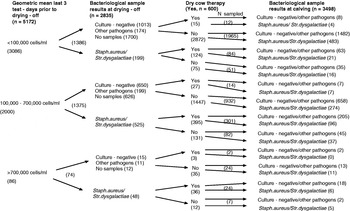
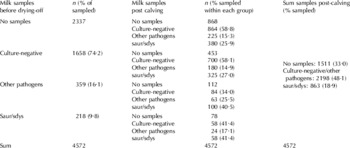
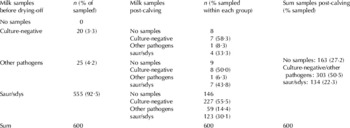
A total of 10 160 calving dates was registered during the study period. First-parity cows (n=4042) were excluded as they did not have any dry period, which left 6118 calving dates. Altogether 221 (3·6%) of these cows had no identified CMSCC test-day records, and additionally 725 (12·3%) had the last CMSCC test-day taken before the starting day of the trial. All these 946 cows were excluded. The complete dataset consisted of 5172 lactations, and treated and non-treated cows are presented in Fig. 1 and Tables 1a and 1b. A total of 2835 (54·8%) lactations had a bacteriological sample taken prior to drying-off and 600 lactations were treated; 172 received therapy A, 252 therapy B and 174 therapy C.
Flow-chart for the three classes of geometric mean of the three last CMSCC test results before drying-off in 5172 lactations, followed by bacteriological sampling results or no sampling before drying-off, dry cow therapy or not, and finally number of samples and sampling results at approximately 6 days into the next lactation.

Number of milk samples at drying-off for non-treated cows and their results at cow level compared with their results approximately 6 d post calving (saur/sdys=Staphylococcus aureus or Streptococcus dysgalactiae)

Number of milk samples at drying-off for treated cows and their results at cow level compared with their results approximately 6 d post-calving (saur/sdys=Staphylococcus aureus or Streptococcus dysgalactiae)

There were bacteriological samples available from 3498 (67·6%) lactations at approximately 6 d post calving and 437 (12·5%) treated cows and 3061 were from non-treated cows. The bacteriological results at cow level before drying-off and post-calving are presented in Tables 1a and 1b.
A total of 770 (14·9%) lactations had at least one CM recorded in the previous lactation, 322 (44·8%) were recorded as severe/moderate and 448 (58·2%) were recorded as mild. A total of 410 were included in the model for non-treated cows, and 96 in the model for treated cows.
Statistical models for non-treated cows
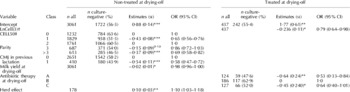
The number of culture-negative non-treated lactations at 6 d post calving were 1706 (55·7%) out of 3061. Significant risk factors for these cows were CM in the previous lactation, milk yield at drying-off, CMSCC >50 000 cells/ml and parity >3. The odds ratios (OR) with confidence intervals (CI) are presented in Table 2.
Multivariable logistic regression model estimates with Odds Ratio (OR) and 95% confidence interval (95% CI) for non-treated and treated cows at drying-off comparing culture-negative cows post calving with all other pathogens

† Geometric mean of the natural log of the last three samples before drying-off
‡ CELL50=composite milk somatic cell count >50 000 cells/ml (geometric mean of the last three test days) before drying-off
§ Clinical mastitis
* P<0·05; ** P<0·01; *** P<0·001
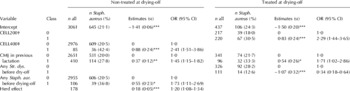
A total of 645 (21·1%) out of 3061 non-treated lactations had isolation of Staph. aureus in at least one quarter 6 d post calving. The significant risk factors were CMSCC >400 000 cells/ml before drying-off, isolation of Staph. aureus before drying-off and CM in the previous lactation. Values for OR and CI are shown in Table 3.
Multivariable logistic regression model estimates with Odds Ratio (OR) and 95% confidence interval (95% CI) for non-treated and treated cows at drying-off comparing isolation of Staphylococcus aureus in at least one quarter post calving with all other culture-positive and culture-negative lactations

† CELL200=composite milk somatic cell count >200 000 cells/ml (geometric mean of the last three test days) before drying off
‡ CELL400=composite milk somatic cell count >400 000 cells/ml (geometric mean of the last three test days) before drying off
§ Clinical mastitis
* P<0·05; ** P<0·01; *** P<0·001
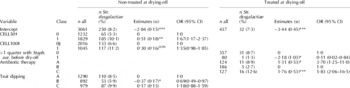
The number of Str. dysgalactiae (isolated in one or more quarters) positive non-treated lactations at 6 d post calving were 250 (8·2%) out of 3061. CMSCC >50 000 cells/ml at the end of the previous lactation and non-regular use of iodine PMTD were significant risk factors (Table 4). In addition there was also an increased OR if the CMSCC was >100 000 cells/ml (Table 4). The OR when comparing CMSCC >100 000 cells/ml with CMSCC <50 000 cells/ml was 1·67∗1·35=2·25.
Multivariable logistic regression model estimates with Odds Ratio (OR) and 95% confidence interval (95% CI) for non-treated and treated cows at drying-off comparing isolation of Str. dysgalactiae in at least one quarter post-calving with all other culture-positive and culture-negative lactation

† CELL50=composite milk somatic cell count >50 000 cells/ml (geometric mean of the last three test days) before drying off
‡ CELL100=composite milk somatic cell count >100 000 cells/ml (geometric mean of the last three test days) before drying off
§ Would be the association to level 51 000 to 100 000 according to hierarcical dummy variable as long as CELL50 is included in the model
* P<0·05; ** P<0·01; *** P<0·001
Statistical models for treated cows
The number of treated lactations that were culture-negative at 6 d post calving were 242 (55·3%) out of 437. There was a significant linear association between increased lnCMSCC and increased OR of being culture-positive after antibiotic therapy. Despite use of antibiotic therapy at drying-off, the odds for being culture-negative 6 d post calving was reduced by 14% (OR=0·86) if the cows had a CMSCC of 464 000 cells/ml prior to drying-off compared with a CMSCC of 78 000 cells/ml (the levels are equivalent to the mean log CMSCC ±1 sd) prior to drying-off. If short-acting lactation formula (A and C) was applied, the OR of being culture-negative 6 d post calving decreased by 0·53 to 0·64 compared with if long acting dry cow formula (B) was applied (Table 2).
A total of 106 (24·3%) out of 437 treated lactations had isolation of Staph. aureus in at least one quarter 6 days post calving. The significant risk factors were CMSCC >200 000 cells/ml at drying-off and CM in the previous lactation (Table 3). In addition, isolation of Str. dysgalactiae before drying-off was associated with a preventive factor for isolation of Staph. aureus approximately 6 d post calving.
The number of Str. dysgalactiae (isolated in one or more quarters) positive treated lactations at 6 d post-calving were 32 (7·3%) out of 437. Use of short-acting lactation treatment A and C was associated with 3·7-times and 5·8-times increased risk of Str. dysgalactiae isolation at 6 d post calving compared with dry cow formula treatment B (Table 4). In addition, isolation of Staph. aureus before drying-off was associated with a preventive factor for isolation of Str. dysgalactiae approximately 6 d post calving.
Discussion
These datasets are analysed at cow level since most of the independent variables, such as CMSCC, milk yield, CM and parity, are recorded at cow level. It is also of greater interest for the farmers and veterinarians to predict risk factors at cow level since the cow is the unit of milk production. Separate models for treated and non-treated cows were made since different risk factors for these two groups were expected, raising the possibility of confounding between findings at drying-off and therapy at drying-off. The non-treated group were excessive in size and risk factors for treated cows could be masked if both groups were included in the same model. The strength of this study is that the herds were randomly allocated to different antibiotic treatment prior to drying-off and teat dipping over a complete 2-year period. Randomizing of teat dipping and therapy at herd level would also avoid any interference between cows with different teat dipping and therapy appliance thus making it easier for the farmer to apply the correct regimen for all cows. Staph. aureus/Str. dysgalactiae problem herds might have different risk factors, but the number of herds included in the study should be large enough to reveal indications such as a herd clustering effect. Too few cows were included in the antibiotic treated groups and too few had isolation of Str. dysgalactiae at 6 d post calving models to reveal any herd cluster effect.
A difficulty encountered in cohort field studies is that some subjects will not be followed up for the full length of the study, and parts of the protocol may not be followed precisely. The longer the study, the more subjects will be lost or not be following the protocol. Losses to follow-up reduce the numbers supplying information, and thus weaken the analysis slightly. The risk for follow-ups to be lost for some reason related to the outcomes in this study is not likely.
Long-acting dry cow formula (group B) was given at cow level (to all four quarters), while short-acting lactation formula (group A and C) was given at quarter level (only infected quarters were treated unless more than two quarters were infected). Selective therapy at quarter level could be the reason why short-acting lactation formula gave an increased risk for isolation of Str. dysgalactiae post calving or a lower possibility of being culture-negative post-calving (Tables 2 and 4). This is in accordance with the meta-analysis conducted by Robert et al. (Reference Robert, Seegers and Bareille2006) who concluded that if selective therapy was used, it should be conducted at cow level and not selected at quarter level.
The present study showed no beneficial association between regular use of iodine PMTD/external teat sealant and being culture-negative or Staph. aureus positive 6 d post calving. However, there was a significant beneficial association (preventive effect) between regular use of iodine PMTD and isolation of Str. dysgalactiae 6 d post calving. These results are consistent with previous results, at herd and cow level, extracted from the same basic data material (Whist et al. Reference Whist, Østerås and Sølverød2007b, Reference Whist, Østerås and Sølverødc). One explanation could be that Staph. aureus isolates are established at drying-off and prevail during the dry period. The preventive effect of teat dipping would therefore fail. Antibiotic therapy is very effective against Str. dysgalactiae (Pankey et al. Reference Pankey, Barker, Twomey and Duirs1982; Ziv et al. Reference Ziv, Neriya and Storper1987) and the Str. dysgalactiae isolates post calving are probably new infections which regular use of iodine PMTD would prevent. External teat sealant showed no preventive effect in this study, and there was no significant interaction between therapy and the teat sealant either. Few published papers exist on the effect of an external teat dip in a natural exposed field trial. Trials where external teat sealant has been applied 7–10 d before expected calving have shown an effect on CM caused by environmental pathogens (Timms, Reference Timms2001). The reason why we did not get the same results in our trial could be that an external teat sealant is not effective against Staph. aureus and Str. dysgalactiae post calving.
There was a positive association between an increasing CMSCC prior to drying-off and recovery of Staph. aureus and Str.dysgalactiae post calving for treated cows (Table 2). In the non-treated model there was a significant association between lactations with a CMSCC >400 000 cells/ml prior to drying-off and increased risk of isolation of Staph. aureus post calving. This indicates that high CMSCC (>400 000 cells/ml) cows should receive antibiotic treatment prior to drying-off, and preferably long-acting dry cow formula, irrespective of the milk culture result at drying-off, or preferably culled. This limit is much lower than the 700 000 cells/ml limit set at the beginning of the trial which was in accordance with Østerås et al. (Reference Østerås, Edge and Martin1999).
The results from this study indicate that Staph. aureus/Str. dysgalactiae at drying-off was a protective factor against Str. dysgalactiae/Staph. aureus at 6 d post calving. From a microbiology standpoint it is difficult to interpret this observation, but one explanation could be that a Staph. aureus/Str. dysgalactiae infected quarter at drying-off has triggered the immune system locally so that protective factors exists at calving, but further research is needed to answer this question.
This study indicates that the risk factors for isolation of Staph. aureus and Str. dysgalactiae depend on the CMSCC at drying-off, CM in the previous lactation, use of antibiotics at drying-off and use of iodine PMTD. When advising farmers in decision-making processes, risk factors must be assessed before treatment or culling. Differences in risk factors for treated and non-treated cows should be expected since the effect of antibiotic therapy at drying-off should minimize the risk factors, which is an expected effect of antibiotics. For non-treated cows, CMSCC, CM, milk yield and parity will be risk factors, whilst for treated cows these risk factors are reduced to isolation of Staph. aureus/Str. dysgalactiae at drying-off and in addition CMSCC and CM for Staph. aureus and type of therapy for Str. dysgalactiae. If Str. dysgalactiae is the major pathogen in a herd, regular use of iodine PMTD and sampling of all cows with a CMSCC above 50 000 cells/ml prior to drying-off should be introduced since this will increase the risk of finding Str. dysgalactiae and thus reduce the number. Cows with a previous CM event and a CMSCC >400 000 cells/ml prior to drying-off should be culled or should receive long-acting dry cow formula irrespective of the milk culture result or they should be considered for culling postcalving and not treated.
The authors thank the participating farmers, veterinarians and laboratory workers for their help and support during the trial. We thank also Boehringer-Ingelheim, VetPharma and DeLaval for their contribution with support of free intramammaries and teat dips. The access to the data was given by the Norwegian DHRS and the Norwegian Cattle Health Services (for health data) in agreement number 8/2002. The study was financially supported by grants from the Research Council of Norway.