Introduction
With worldwide distribution, the protozoan Toxoplasma gondii and nematode Toxocara spp. are parasites that cause zoonoses that are most often asymptomatic, but are sometimes capable of causing eye infections, especially in humans (Glickman & Shofer, Reference Glickman and Shofer1987; Taylor et al., Reference Taylor, Keane, O'Connor, Mulvihill and Holland1988; Remington et al., Reference Remington, McLeod, Thulliez, Desmonts, Remington, Klein, Wilson and Baker2006). The parasites T. gondii and Toxocara cati use felids as definitive hosts, and Toxocara canis uses dogs as hosts (Beaver, Reference Beaver1956; Tenter et al., Reference Tenter, Heckeroth and Weiss2000). In both zoonoses, young animals are the main hosts and disseminators of these parasites (Beaver, Reference Beaver1956; Tenter et al., Reference Tenter, Heckeroth and Weiss2000).
Concomitant infection by these zoonoses may be common in humans because of the ingestion of T. gondii oocysts and embryonated eggs of Toxocara spp. in contaminated soil, water, fruit and vegetables (Safar et al., Reference Safar, Abd-El Ghaffar, Saffar, Makled, Habib, El Abiad and El Shabrawy1995; Jones et al., Reference Jones, Kruszon-Moran, Won, Wilson and Schantz2008). For Toxoplasma, cysts may be ingested in animal products, or congenital transplacental tachyzoite transmission may occur (Bonametti et al., Reference Bonametti, Passos, Silva and Bortoliero1997; Kravetz & Federman, Reference Kravetz and Federman2005).
An important clinical manifestation for both zoonoses is eye disease. Either congenital or postnatal ocular toxoplasmosis and chorioretinitis may present varying degrees of severity, depending on the strain, individual immunity and number of inflammatory foci. Notably, cysts inside the eyeball in the chronic phase are not susceptible to the action of specific chemotherapeutics (Vallochi et al., Reference Vallochi, Muccioli, Martins, Silveira, Belfort and Rizzo2005; Lopes et al., Reference Lopes, Silva, Ferro, Sousa, Firminot, Bernardes, Roque-Barreira and Pena2009). During acute relapses, tachyzoites can lead to the formation of new cysts, contributing to worsening of the clinical condition (Dubey, Reference Dubey2009). Severe forms of toxoplasmosis occur especially in infants born to mothers with acute toxoplasmosis and in immunosuppressed individuals (Remington et al., Reference Remington, McLeod, Thulliez, Desmonts, Remington, Klein, Wilson and Baker2006).
The clinical manifestations of toxocariasis depend on the number of embryonated eggs ingested, larval migration between organs and immune response of the host (Despommier, Reference Despommier2003). The most common signs or symptoms are cough, eosinophilia, respiratory distress, pulmonary infiltrates and eye disease, which is one of the most frequently diagnosed forms (Pawlowski, Reference Pawlowski2001; Despommier, Reference Despommier2003).
Castilho-Pelloso et al. (Reference Castilho-Pelloso, Falavigna and Falavigna-Guilherme2007) and Higa et al. (Reference Higa, Araújo, Tsuneto, Castilho-Pelloso, Garcia, Santana and Falavigna-Guilherme2010a) observed pregnant women who were suspected of T. gondii infection (among those treated in public services in north-western Paraná state), who were not always properly diagnosed or monitored. We performed the present study based on the high frequency of immunoglobulin G (IgG) anti-Toxocara spp. antibodies in children in the same region, the high soil contamination by Toxocara spp. eggs (Paludo et al., Reference Paludo, Falavigna, Elefant, Gomes, Baggio, Amadei and Falavigna-Guilherme2007; Tiyo et al., Reference Tiyo, Guedes, Falavigna and Falavigna-Guilherme2008; Colli et al., Reference Colli, Rubinsky-Elefant, Paludo, Falavigna, Guilherme, Mattia, Araújo, Ferreira, Previdelli and Falavigna-Guilherme2010; Mattia et al., Reference Mattia, Colli, Adami, Guilherme, Nishi, Rubinsky-Elefant, Marchioro, Gomes and Falavigna-Guilherme2012), and records of coccidia oocysts in soil in recreational areas in the region (Tiyo et al., Reference Tiyo, Guedes, Falavigna and Falavigna-Guilherme2008). The present study investigated the risk factors associated with toxoplasmosis and toxocariasis in children from cities in Paraná state in southern Brazil.
Materials and methods
Study sites and sample collection
The child population evaluated in the present study resided in urban areas in Paraná state, southern Brazil, in the area covered by the 15th Regional Health Center of Paraná state (15th RS/PR), from the municipalities of Astorga (23°13′57″S; 51°39′56″W), Colorado (22°50′15″S; 51°58′23″W), Mandaguari (23°32′51″S; 51°40′15″W), Mandaguaçu (23°20′50″S; 52°05′43″W), Marialva (23°29′06″S; 51°47′30″W), Maringá (23°25′31″S; 51°56′19″W), Nova Esperança (23°11′01″S; 52°12′17″W), Paiçandu (23°27′27″S; 52°02′55″W) and Sarandi (23°27′8″S, 51°51′10″W). The population of these municipalities corresponds to 84.6% of the population of the 15th RS/PR, and approximately 85% live in urban areas (IPARDES, 2013). The capital is Maringá, with 357,077 inhabitants (IPARDES, 2013). The study region has a subtropical humid mesothermal climate with hot summers, dry winters and occasional frosts (Silveira, Reference Silveira2003).
Blood samples (5 ml) were collected from children aged 1–12 years who were users of Public Health Services of municipalities that belong to the 15th RS/PR. The blood samples were sent to the Environmental and Food Parasitology Laboratory of the State University of Maringá, Paraná state, to prepare blood smears. The serum samples were stored at − 20°C until analysed.
To calculate the sample size, we considered the proportion of the child population of each municipality investigated from December 2009 to June 2011. A structured questionnaire was completed for each individual, containing data on the city of origin, onychophagic and geophagic habits, contact with pets, contact with sand or lawns, age and gender. We also recorded the occurrence of allergy, asthma, bronchitis, dermatitis, recurrent infection, pneumonia, sinusitis, inhalation, hospitalization and eye irritation.
Serology
The serological diagnosis was made qualitatively using indirect immunofluorescence to detect IgG anti-T. gondii antibodies (Wama® kit, WAMA Diagnostic Products Laboratories, Sao Carlos, Brazil). The serum samples were serially diluted 1:4, and were considered positive from the 1/64 titre (Vasconcelos et al., Reference Vasconcelos, Câmara, Silva, Vaz, Dantas, Lima, Sales and Júnior2007; Mioranza et al., Reference Mioranza, Meireles, Mioranza and Júnior2008). IgG antibodies to Toxocara spp. were assessed using an enzyme-linked immunosorbent assay (ELISA) with an excretory–secretory antigen (TES) of second-stage larvae of T. canis (De Savigny et al., Reference De Savigny, Voller and Woodruff1979; modified by Rubinsky-Elefant et al., Reference Rubinsky-Elefant, Hoshino-Shimizu, Sanchez, Jacob and Ferreira2006). The results are expressed as the Reactivity Index (RI = optical density of the sample/optical density of the borderline reactive serum) and reactive samples were considered as those that showed RI ≥ 1.
Eosinophilia was considered to be present when eosinophils were ≥ 600/mm3 (0.60 × 10⁹/litre) according to the reference limits for age and gender (Henry, Reference Henry2008). The degree of eosinophilia was classified based on Naveira (Reference Naveira1960): non-eosinophilia ( ≥ 1% and ≤ 4%) and eosinophilia (>4%), in total leucocytes counted.
Data analysis
A multiple logistic regression analysis was performed to evaluate the possible variables associated with seropositivity of the individuals (P < 0.05) using two models, one for T. gondii and another for Toxocara spp. We included in the logistic regression variables with P≤ 0.2. Among the seropositive samples, we considered gender, age and origin of the individual in a bivariate analysis. The statistical software used was SAS 9.1 (SAS Institute, Cary, North Carolina, USA).
Results and discussion
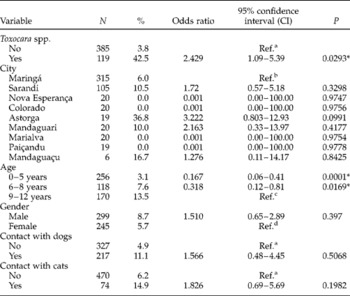
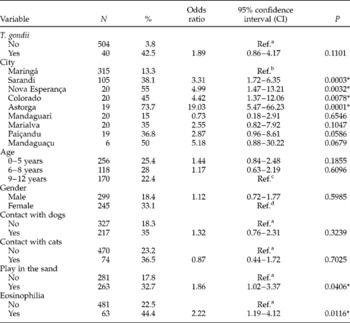
Of the 544 children from the nine cities, 17 (3.2%) were co-infected with T. gondii and Toxocara spp. Of this total, 40 (7.4%) of the children were positive for antibodies to T. gondii, and 136 (25%) were positive for antibodies to Toxocara spp., equally distributed between genders. The multivariate analysis indicated that the presence of antibodies to Toxocara spp. increased the risk of T. gondii infection (P= 0.029; table 1), and the opposite was not observed (table 2). Considering the variables associated with the presence of antibodies to T. gondii, children aged 1–8 years were less infected than children aged 9–12 years. The other variables were not associated with seropositivity (table 1). Children who lived in Sarandi, Nova Esperança, Colorado and, especially, Astorga were more likely to have IgG antibodies to Toxocara spp. compared with children who lived in Maringá. The contact of children with sand also increased the risk of infection by Toxocara spp. 1.86 times, and children with positive serology had more eosinophilia compared with those with non-reactive serology to Toxocara spp. (table 2).
The occurrence of IgG antibodies (%) to Toxoplasma gondii in children from nine cities in southern Brazil relative to age, gender, location and contact with dogs and cats; N=number of children.

*Level of significant difference with P < 0.05.Ref., reference variables:
a no reference as this is expected to be a risk factor plus contact with dogs/cats;
b Maringá as the largest city is used as a benchmark;
c children aged 9–12 years have the highest prevalences;
d women have the lowest prevalences.
The occurrence of IgG antibodies (%) to Toxocara spp. in children from nine cities in southern Brazil relative to age, gender, location, and contact with dogs and cats; N=number of children.

*Level of significant difference with P < 0.05. Ref., reference variables:
a no reference as this is expected to be a risk factor plus contact with dogs/cats;
b Maringá as the largest city is used as a benchmark;
c children aged 9–12 years have the lowest prevalences;
d women have the highest prevalences.
In the present study, we found the presence of both parasites, but greater seropositivity was observed for IgG antibodies to Toxocara compared with the frequency of IgG antibodies to T. gondii. The latter was more prevalent in older children. The prevalence of human infection by T. gondii, especially in adults, is almost always higher than human toxocariasis (Zarkovic et al., Reference Zarkovic, MacMurray, Deva, Ghosh, Whitley and Guest2007). Notably, the population investigated in the present study included children aged 1–12 years. According to the literature, the frequency of anti-Toxocara in younger populations is usually higher (Chieffi et al., Reference Chieffi, Ueda, Camargo, de Souza, Guedes, Gerbi, Spir and Moreira1990; Radman et al., Reference Radman, Archelli, Fonrouge, Guardis and Linzitto2000; Jones et al., Reference Jones, Kruszon-Moran, Won, Wilson and Schantz2008; Colli et al., Reference Colli, Rubinsky-Elefant, Paludo, Falavigna, Guilherme, Mattia, Araújo, Ferreira, Previdelli and Falavigna-Guilherme2010).
Children had higher seropositivity for toxocariasis, especially younger children, which can be explained by close contact with soil at this age, thus increasing the risk of infection by Toxocara spp. Toxoplasma gondii presents other forms of contamination (Kravetz & Federman, Reference Kravetz and Federman2005). Previous studies developed by our research group revealed a high frequency of Toxocara spp. eggs in sand and lawns in recreational areas in the same municipalities examined in the present study (Tiyo et al., Reference Tiyo, Guedes, Falavigna and Falavigna-Guilherme2008; Colli et al., Reference Colli, Rubinsky-Elefant, Paludo, Falavigna, Guilherme, Mattia, Araújo, Ferreira, Previdelli and Falavigna-Guilherme2010; Mattia et al., Reference Mattia, Colli, Adami, Guilherme, Nishi, Rubinsky-Elefant, Marchioro, Gomes and Falavigna-Guilherme2012) and the presence of coccidia oocysts (Tiyo et al., Reference Tiyo, Guedes, Falavigna and Falavigna-Guilherme2008).
The detection of co-infection with T. gondii and Toxocara spp. in the present study was slightly higher than the results reported by Jones et al. (Reference Jones, Kruszon-Moran, Won, Wilson and Schantz2008), who investigated children aged 6–11 years (1.8%). However, these authors reported that the sampling of the child population was unsatisfactory. Few studies have evaluated human co-infection with these parasites (Safar et al., Reference Safar, Abd-El Ghaffar, Saffar, Makled, Habib, El Abiad and El Shabrawy1995; Zarkovic et al., Reference Zarkovic, MacMurray, Deva, Ghosh, Whitley and Guest2007; Jones et al., Reference Jones, Kruszon-Moran, Won, Wilson and Schantz2008; Guneratne et al., Reference Guneratne, Mendis, Bandara and Fernando2011).
The increased risk for co-infection can be explained by the behaviour of the children and common mode of exposure, such as soil, water, fruit and vegetables contaminated with oocysts of T. gondii or embryonated eggs of Toxocara spp. (Safar et al., Reference Safar, Abd-El Ghaffar, Saffar, Makled, Habib, El Abiad and El Shabrawy1995; Jones et al., Reference Jones, Kruszon-Moran, Won, Wilson and Schantz2008). When referring to Toxocara spp., the immune response tends to decrease years after primary infection. For toxoplasmosis, antibodies persist throughout life, with the common occurrence of acute relapse (Higa et al., Reference Higa, Ramos, Suetake, Antoniassi, Mantovan, Castilho-Pelloso and Guilherme2010b).
Although the city of Maringá is a reference as it has the best infrastructure in the region, including health, leisure, education and economy, with a lower poverty rate than other regions (IPARDES, 2013), its recreational areas have soils that are often contaminated with Toxocara spp. eggs (Tiyo et al., Reference Tiyo, Guedes, Falavigna and Falavigna-Guilherme2008). Children in this area had seropositivity for both parasites but at a lower rate than other municipalities. Infection with both parasites, T. gondii and Toxocara spp., reveals the need for preventive measures, such as public guidance about the modes of infection, parasite control in pets, and cleaning and monitoring recreational areas. These measures will assist in the control of these zoonoses and prevent human morbidity.
Financial support
Fundação Araucária and Coordination for the Improvement of Higher Education Personnel (CAPES) (grant no. 421/09 UEM/Fund Araucaria).
Conflict of interest
None.
Ethical standards
The authors assert that all procedures contributing to this work comply with the ethical standards of the Standing Committee on Ethics in Research Involving Humans (EDITAL N°.022/2009-COPEP) and with the Helsinki Declaration of 1975, as revised in 2008, and has been approved by the Committee of Ethics in Research Involving Human Subjects of the State University of Maringá (Opinion #667/2009) and the Secretariats of Health and Education of the respective municipalities.