Introduction
Exposure to traumatic events capable of producing posttraumatic stress disorder (PTSD) and other forms of psychological impairment is, sadly, not uncommon. A comprehensive epidemiological study surveying the U.S. general population found that 60.7% of men and 51.2% of women reported exposure to at least one traumatic event,Reference Kessler, Sonnega and Bromet1 while other studies have reported rates of trauma exposure as high as 90% in the U.S. general population.Reference Breslau2 Studies investigating the lifetime prevalence of trauma-related sequelae have also consistently found high rates of PTSD (6.8%).Reference Kessler, Chiu, Demler and Walters3 Left untreated, PTSD is often chronic and has pernicious effects on relational and occupational functioning.Reference Kessler4 Accordingly, the development of efficacious treatments has been a major focus for trauma researchers over the past few decades and has led to the creation of evidence-based interventions.Reference Foa, Keane, Friedman and Cohen5
To date, the most supported intervention for PTSD is cognitive behavioral therapy (CBT).6–8 Considered the “gold standard” of PTSD treatment, CBT typically entails a brief course (7–15 sessions) of structured psychotherapy that provides education on PTSD and introduces skills that are practiced between sessions. CBT is composed of two primary treatment components: cognitive therapy, which promotes the identification and restructuring of distorted, distress-inducing thoughts, and behavior therapy, which targets avoidance symptoms known to perpetuate PTSD.
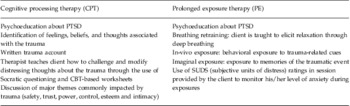
Cognitive processing therapy (CPT)Reference Resick, Galovski and Uhlmansiek9, Reference Chard10 and prolonged exposure (PE)Reference Foa, Dancu and Hembree11 are the two leading trauma-specific CBT protocols and demonstrate equivalent efficacy in randomized clinical trials, despite placing opposite emphasis on the respective CBT components.Reference Resick, Williams, Suvak, Monson and Gradus12 In CPT, clinicians rely primarily on cognitive processing techniques for reducing PTSD symptomsReference Resick and Schnicke13 by working with clients to address inconsistencies between trauma-generated thoughts and pre-existing belief systems. In contrast, PE clinicians rely primarily on emotional processingReference Foa and Kozak14 through systematic exposure to memories and physical reminders of the trauma to reduce symptoms. This approach is theorized to promote habituation (a gradual reduction in the fear response) by experientially teaching clients that stimuli are no longer harmful. (See Table 1 for additional details of CPT and PE.) CBT for PTSD may also be practiced in a less standardized format.Reference Zayfert and Becker15 In such cases, treatment still consists of the therapeutic components described above (i.e., psychoeducation coupled with cognitive and emotional processing), but clinicians do not adhere to a structured protocol.
Primary treatment components of cognitive processing therapy and prolonged exposure therapy

In addition to CBT, another empirically supported PTSD intervention is eye movement desensitization and reprocessing (EMDR).Reference Shapiro16 EMDR is similar to exposure-based CBT, but has clients complete an additional dual-attention task by engaging in back-and-forth eye movements while focusing on trauma memories. Although EMDR has garnered considerable empirical support,Reference Ponniah and Hollon7 it has also been the subject of much controversy,Reference McNally17 mostly due to the lack of evidence demonstrating that the eye movement component contributes to treatment outcomes.Reference Cahill, Carrigan and Frueh18
Relative to CBT and EMDR, all other PTSD interventions have markedly less empirical support. These include present-centered therapy, stress inoculation training, hypnotherapy, psychodynamic therapy, and interpersonal psychotherapy. To date, these treatments have either only been compared with a wait-list control condition or have been found to be less efficacious than CBT.Reference Ponniah and Hollon7 Accordingly, CBT remains the “gold standard” for PTSD treatment. Consistent with this claim, treatment guidelines offered by a number of prominent mental health organizations8, 19–22 support the use of CBT as the preferred front-line intervention for PTSD.
Although the existing literature has consistently demonstrated efficacy for cognitive-behavioral PTSD treatments, a number of questions remain. For instance, it is unclear how well findings generalize to cross-cultural, multi-ethnic, or community populations that have greater psychological comorbidity.Reference Benedek, Friedman, Zatzick and Ursano20, Reference Bisson, Ehlers and Matthews23 In addition, although research supports the use of selective serotonin reuptake inhibitors (SSRIs) for treating PTSD,Reference Ipser and Stein24 the efficacy of combination treatments that pair pharmacotherapy with cognitive-behavioral interventions requires further analysis. Thus, although the evidence base for CBT is strong, more research is needed to enhance existing therapies and guide treatment planning. With this in mind, we chose to conduct a review of the most recent cognitive-behavioral PTSD treatment research. In so doing, our aims were to identify emerging lines of investigation and make recommendations for future research.
To examine the research on CBT for PTSD, a comprehensive literature search was conducted for PTSD treatment studies published from 2009–2012. Search criteria were specifically defined to identify a circumscribed set of recent, methodologically rigorous studies to present the current treatment conventions in CBT for PTSD and highlight emerging trends. Criteria required the following: (1) that participants meet diagnostic criteria for PTSD at pretreatment, (2) that studies contain a control condition, (3) that the treatment sample be composed of adults, (4) that studies be peer-reviewed, and (5) that PTSD be assessed using a continuous, validated measure. Using PsycInfo, a keyword title search was conducted for the following terms: PTSD, treatment, trial, efficacy, CBT, cognitive behavioral, and effectiveness.
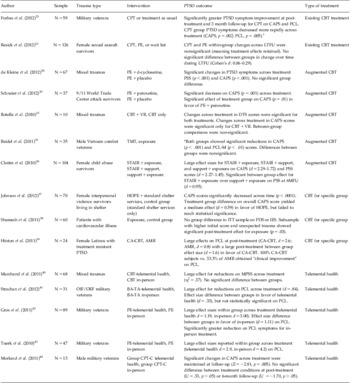
Fourteen controlled studies were identified that matched our search criteria. Inspection of these studies revealed 4 general lines of research: (1) investigations of existing CBT treatments, (2) investigations of existing treatments augmented with unique components, (3) investigations of new treatments tailored to meet the needs of specific trauma groups, and (4) investigations of telemental health CBT. Discussion of the reviewed studies focuses specifically on treatment effects for PTSD symptoms, as tested using intent to treat (ITT) analysis (i.e., with all participants randomized in a study, regardless of treatment completion status). Study details are referenced in Table 2.
Recent controlled studies of cognitive behavioral treatments for PTSD

Notes: Results are for ITT analyses unless otherwise noted with *.
1Authors did not specify type of effect size.
D = Cohen's d effect size, CPT = cognitive processing therapy, PE = prolonged exposure, CBT = cognitive behavioral therapy, PSS = Posttraumatic Symptom Scale, VR = virtual reality, CAPS = Clinician Administered PTSD Scale, PCL = PTSD Checklist, DTS = Davidson Trauma Scale, TMT = trauma management therapy, STAIR = skills training in affect and interpersonal regulation, 6MFU = 6-month follow-up, IES = Impact of Event Scale, CA-CBT = culturally adapted cognitive behavioral therapy, AMR = applied muscle relaxation, PCL = PTSD Symptom Checklist, BA-TA = behavioral activation and therapeutic exposure, MPSS = Modified PTSD Symptom Scale.
Investigations of Existing CBT Treatments
Two recent controlled studies add to the collection of research supporting CPT and PE. In the first study, Forbes etal.Reference Forbes, Lloyd and Nixon25 conducted a randomized controlled effectiveness trial of CPT for military-related PTSD by testing whether CPT remains efficacious when administered in a less structured community setting. This is an important question, as it addresses the extent to which clinical trial results generalize to “real world” contexts and heterogeneous groups. Treatment-seeking veterans were randomized to receive 12 60-min sessions of CPT (n = 30) or treatment as usual (TAU; n = 29). Consistent with the results of a previous clinical trial of CPT conducted with military veterans,Reference Monson, Schnurr and Resick26 ITT analysis found greater improvement for participants receiving CPT over TAU at post-treatment and at 3-month follow-up, suggesting that CBT's therapeutic effects remain successful when offered in a less structured, community-based setting with clinicians from varied backgrounds and experience levels.
In the second study, by Resick etal.,Reference Resick, Williams, Suvak, Monson and Gradus12 long-term follow-up results were presented for a sample of adult female rape survivors. Participants were originally treated as part of a randomized controlled trial (RCT) that compared CPT, PE, and a wait-list control.Reference Resick, Pallavi, Weaver, Astin and Feuer27 Assessments were completed on 73.7% of the ITT sample (N = 126) 5–10 years after initial participation in treatment. Results revealed that PTSD symptom reductions reported in the original study were maintained through the long-term follow-up (LTFU) period, and there were no significant differences on sustained symptom improvement between CPT and PE.
Results from these two studies contribute to the existing research on CPT and PE in several important ways. The study by Forbes etal.Reference Forbes, Lloyd and Nixon25 provides information regarding the ability of CPT to remain effective when provided in a less structured, community-based setting, supporting the generalizability of CPT to different treatment contexts. The second study, by Resick etal.,Reference Resick, Williams, Suvak, Monson and Gradus12 builds on existing efficacy studies of CPT and PE to describe the long-term positive benefits of these treatments in a sample of adult female rape survivors. Thus, these studies move beyond circumscribed treatment trials to address larger questions of treatment effectiveness in community settings and long-term maintenance of treatment gains for CPT and PE in the treatment of PTSD.
Investigations of Treatments Augmented with Unique Components
Other recent studies have examined CBT augmented with supplemental treatment components, both psychosocial and pharmacological. De Kleine etal.Reference de Kleine, Hendriks, Kusters, Broekman and van Minnen28 tested whether d-cycloserine, an N-methyl-D-aspartate (NMDA) agonist theorized to facilitate emotional processing, enhances the effects of PE. Participants presenting with mixed traumas were randomized to receive PE plus 50 mg of d-cycloserine (n = 33) or PE plus placebo (n = 34). Based on ITT analysis, self-reported and clinician-assessed PTSD symptoms significantly decreased throughout treatment. No between-group difference emerged, but exploratory post-hoc analysis indicated that d-cycloserine led to greater symptom reduction for participants with more severe pretreatment PTSD who required longer treatment. These equivocal results are surprising, given that previous studies have found d-cycloserine to enhance the efficacy of exposure-based treatment for other anxiety disordersReference Otto, McHugh and Kantak29 and suggests that further research is needed.
Schneier etal.Reference Schneier, Neria and Pavlicova30 also augmented exposure-based CBT (PE) with a medication supplement. Specifically, these authors randomized a sample of 9/11 World Trade Center survivors to 10 sessions of PE plus paroxetine, a SSRI (n = 19), or PE plus placebo (n = 18). Results revealed that the active treatment group reported greater improvement in PTSD symptoms and a higher rate of remission. Although limited by its relatively small sample size, this study provides important evidence in favor of combination treatment.
Additionally, CBT has also been augmented with different modalities of psychotherapy. Building on preliminary research supporting the use of virtual reality (VR) therapy as a form of exposure-based PTSD treatment,Reference Difede, Cukor and Jayasinghe31, Reference Gerardi, Rothbaum, Ressler, Heekin and Rizzo32 Botella etal.Reference Botello, García-Palacios and Guillen33 compared the use of CBT plus VR therapy to a CBT only condition. These authors failed to find a significant main effect; however, notable methodological limitations were discussed (e.g., small sample size [N = 10], lack of standardized treatment length). Thus, more research is needed to determine whether virtual reality technology can be used to enhance the efficacy of exposure-based CBT.
Additional efforts to supplement exposure-based therapy include pairing it with social-emotional rehabilitation to form a multicomponent CBT for PTSD called trauma management therapy (TMT).Reference Frueh, Turner, Beidel, Mirabella and Jones34 TMT incorporates exposure with group social skills training to address topics relevant to veterans with PTSD (e.g., anger management, communication issues). Recently, Beidel etal.Reference Beidel, Frueh, Uhde, Wong and Mentrowski35 conducted a RCT in which TMT (n = 18 randomized, 14 completers) was compared to an exposure plus nonspecific group therapy condition (n = 17 randomized, 16 completers) in a sample of male veterans with combat-related PTSD. Treatment completer analysis revealed that both groups showed significant reductions in clinician-rated and self-reported PTSD symptoms; however, a between-groups effect was not found. Despite this null effect, the TMT group did show significant increases in self-reported social activity, which is an important finding that underscores the need for trauma researchers to assess a broad range of outcomes.
Last, Cloitre etal.Reference Cloitre, Stovall-McClough and Nooner36 conducted a three-arm RCT to investigate the efficacy of an intervention that pairs exposure-based CBT with skills training in affect and interpersonal regulation (STAIR). STAIR was developed to address clinicians’ concerns that exposure-based treatments for PTSD may be less efficacious among individuals with certain comorbid issues, namely personality disorder symptomatology. In their study, Cloitre etal.Reference Cloitre, Stovall-McClough and Nooner36 compared STAIR plus exposure treatment with two other conditions: STAIR plus supportive counseling and supportive counseling plus exposure. Results revealed large within-groups effect sizes for all three conditions on clinician-assessed and self-reported PTSD symptoms. Between-groups effect size comparisons revealed a significant advantage for STAIR/exposure at 3- and 6-month follow-up assessments. A significant difference in treatment dropout rate was also discovered, such that the STAIR/exposure treatment reported less attrition than the support/exposure condition. Results from this study are quite promising, and suggest a potential benefit for the addition of affective and interpersonal skills training to standard exposure treatment.
Investigations of Treatments Tailored to Specific Groups
Three studies matching our search criteria point to another emerging trend in the CBT for PTSD literature: tailoring treatments to specific groups. First, Johnson etal.Reference Johnson, Zlotnick and Perez37 tested a new shelter-based treatment for intimate partner violence (IPV) survivors called helping to overcome PTSD through empowerment (HOPE). HOPE is a present-centered therapy that seeks to establish safety and stabilization and to challenge maladaptive cognitions. HOPE combined with standard shelter services (HOPE: n = 35) was compared to standard services alone (control; n = 35) in a RCT design. ITT analysis revealed a significant between-groups difference on one PTSD symptom cluster score (emotional numbing) in favor of HOPE. In addition, a between-groups difference in overall PTSD symptoms yielded a medium effect in favor of HOPE, but failed to reach statistical significance. Results suggest that the format of this CBT treatment may assist IPV survivors in making positive present-centered adjustments, but is less effective in remediating overall PTSD symptoms compared to traditional CBT for PTSD.
In a second study, conventional PE treatment was adapted to address the concerns of patients with PTSD resulting from acute cardiovascular incidents.Reference Shemesh, Annunziato and Weatherley38 Modifications included an abbreviated treatment length (3–5 exposure sessions) and elimination of out-of-session exposure assignments. These changes were made to increase participants’ tolerance of the intervention and limit potential aggravation of health conditions. Shemesh etal.Reference Shemesh, Annunziato and Weatherley38 compared the modified PE treatment to a control group receiving 1–3 medical treatment educational sessions. Indices of sympathetic activity (pulse and blood pressure) were carefully monitored to ensure participants’ safety and served as the primary outcomes for this study. Accordingly, the study was not properly powered to detect differences on secondary psychiatric outcomes, and differences in PTSD symptoms were not significant. However, post-hoc analysis revealed that a subsample of participants with higher initial PTSD symptoms did show an effect in favor of the active treatment. Thus, although replication is needed, findings from this study are encouraging.
In the last study, a CBT intervention tailored to meet the unique needs of female Latinas with treatment-resistant PTSD was piloted. Hinton etal.Reference Hinton, Hofmann, Rivera, Otto and Pollack39 randomized 24 participants to receive either a culturally adapted form of CBT (CA-CBT; n = 12) modified to include issues unique to female Latinas (see study for full details) or a course of applied muscle relaxation (n = 12). Both groups demonstrated large within-groups effects on self-reported PTSD symptoms at post-treatment, and a large between-groups effect was also observed in favor of CA-CBT. Taken together, these studies demonstrate that tailoring CBT interventions to the unique needs of specific trauma groups represents a promising line of emerging research. Future efforts will need to build upon these findings by recruiting larger samples and comparing tailored treatments (e.g., CA-CBT) to non-tailored CBT control conditions.
Investigations of Telemental Health
The most prevalent type of treatment study found using the study search criteria was in the area of telemental health. In contrast to traditional psychotherapy, telemental health involves the provision of psychotherapy remotely, most commonly through video teleconferencing. Several studies directly compared telemental health to the corresponding, in-person delivery of specific individual treatments, including CBT emphasizing exposure, education, and cognitive restructuringReference Marchand, Beaulieu-Prévost and Guay40; behavioral activation and therapeutic exposure treatment (BA-TA)Reference Strachan, Gros, Ruggiero, Lejuez and Acierno41; and PE.Reference Gros, Yoder, Tuerk, Lozano and Acierno42, Reference Tuerk, Yoder, Ruggiero, Gros and Acierno43 Results revealed that all participants showed significant decreases in PTSD over the course of treatment, demonstrating the ability of telemental health treatments to produce clinically significant reductions in PTSD symptoms. However, effect size comparisons generally favored in-person therapy.
An additional study conducted by Morland etal.Reference Morland, Hynes, Mackintosh, Resick and Chard44 appears to be the only RCT investigating the telemental health delivery of group treatment for PTSD. Subjects were randomized to receive group CPT treatment administered in-person or via teleconference. Significant changes in clinician-rated PTSD symptoms occurred across treatment and were maintained at follow-up. No significant difference occurred between treatment conditions, suggesting that the telemental health administration of group CPT is as efficacious as its face-to-face counterpart.
In summary, these studies indicate initial promise for CBT for PTSD administered via telemental health, but effects of treatment were often strongest when delivered in-person. Therefore, in-person therapy remains the preferred modality of treatment. In addition, it is important to note that the reviewed studies had small sample sizes that were not always adequately powered for non-inferiority analysis. Thus, findings will need to be replicated using more methodologically rigorous designs.
Conclusions
A systematic review of CBT for PTSD treatment studies published from 2009–2012 identified 4 emerging lines of study. Taken together, this newest body of literature suggests that CPT and PE are equally efficacious among female sexual assault survivors, and that both treatments lead to long-term symptom remission.Reference Resick, Williams, Suvak, Monson and Gradus12 In addition, it appears that the effectiveness of these treatments generalizes to community populations, which are likely more heterogeneous than RCT samples.Reference Forbes, Lloyd and Nixon25 These studies support the ongoing use of specific, manualized CBT interventions for PTSD.
Other notable findings include evidence that CBT/SSRI combination treatments may result in greater PTSD symptom reduction than CBT alone. CBT can also be effectively tailored to meet the idiosyncratic needs of specific trauma groups, including those with prominent Axis II symptomatology,Reference Cloitre, Stovall-McClough and Nooner36 those recovering from acute cardiovascular events,Reference Shemesh, Annunziato and Weatherley38 and female trauma-survivors identifying as Latina.Reference Hinton, Hofmann, Rivera, Otto and Pollack39 However, mixed or nonsignificant findings for many of the augmented CBT studies indicate that more treatment does not always result in better outcomes. Accordingly, researchers must continue to identify components with which to augment CBT that yield significant benefits above and beyond those associated with standard CBT interventions.
Last, we found that the most prevalent type of recently published, controlled PTSD treatment research has been in the area of telemental health.Reference Marchand, Beaulieu-Prévost and Guay40–Reference Morland, Hynes, Mackintosh, Resick and Chard44 Studies in this area suggest that the telemental health equivalents of evidence-based PTSD treatments are effective at reducing PTSD symptomatology but tend to be less effective than their face-to-face counterparts. Thus, although useful for circumventing a variety of treatment barriers, it appears optimal to administer CBT for PTSD in person rather than via phone or teleconference.
Although much progress has been made in the CBT for PTSD literature in the past three years, a number of areas warrant further study. In particular, there have been relatively few comparisons of PE and CPT, and it remains unknown whether these treatments are equally efficacious among male trauma survivors or survivors whose index event is not sexual assault. There is also a noticeable lack of studies investigating group CBT for PTSD treatments, which is problematic given their increasing use in settings such as the Department of Veterans Affairs.
Limitations of this review include confining our search to recent, controlled treatment studies that were identified using a circumscribed set of search terms. Although we feel this requirement enhances the quality and validity of results presented, it means that open trials that examined innovative treatment options were not discussed and that additional studies meeting our search criteria may not have been identified. Many of the studies reviewed also contain relatively small sample sizes and were not always powered sufficiently to detect between-groups effects. In conclusion, this review continues to support the use of cognitive-behavioral treatments as an effective method for reducing PTSD symptoms. Specific manualized versions of CBT for PTSD (i.e., CPT and PE) have further demonstrated their long-term effectiveness and flexibility for use in community settings. Additionally, the collection of reviewed studies indicates that scientist-practitioners have continued to advance CBT treatments by augmenting them with additional components, adapting them to specific groups, and providing novel modalities of treatment (e.g., telemental health CBT). These adapted forms of CBT for PTSD must continue to be tested using rigorous criteria to further confirm their utility.