




No CrossRef data available.
Article contents
Assessing quality of end-of-life hospital care in a southern European regional health service
Published online by Cambridge University Press: 25 October 2005
Abstract
Objectives: During the final period of life, patients with cancer in the Basque Country are given treatment in different types of hospital care. This study compared the quality of care according to the type of care in one of the autonomous communities in Spain.
Methods: A retrospective study was carried out of cancer patients who died in conventional hospital services, home hospitalization services, and palliative care units. In addition to hospital stay and readmission number, variables based on the recommendations of Spanish Society for Palliative Care were studied.
Results: End-of-life was diagnosed in 57 percent of a sample of 486 patients, 3 days before death (median). The use of symptom control scales was only documented in the clinical records of eight patients. Sociofamily evaluation was not found. Patients in conventional hospital services were less frequently diagnosed with end-of-life and agony and were significantly different from the rest in the reasons for admission, symptoms assessed, drugs used, administration routes, and dosage forms. Pain was evaluated in 50 percent of the patients and was better controlled in palliative care units. Patients not diagnosed with agony (52 percent) were more frequently not given specific treatment.
Conclusions: End-of-life in cancer patients was diagnosed too late. The quality of care in palliative care units and by home hospitalization service was better than that in conventional hospitalization. Nevertheless, there were areas for improvement in the three modalities of care.
Information
- Type
- GENERAL ESSAYS
- Information
- International Journal of Technology Assessment in Health Care , Volume 21 , Issue 4 , October 2005 , pp. 464 - 470
- Copyright
- © 2005 Cambridge University Press
Interest in palliative care has extended worldwide. In a monograph about National Cancer Control Programs (30) published by the World Health Organization, pain relief and palliative care were added to the classic approaches to cancer control based on primary prevention, early detection, diagnosis, and treatment. This new approach emphasizes both the importance of life, death being treated as a natural occurrence (20), and the need of establishing a process that does not speed up or postpone its arrival. A model of care is being proposed in which therapies that try to modify the disease gradually lose intensity as the disease develops. The provision of palliative care is increased as the person nears the end-of-life, including support for the family throughout this period, and continues after the death of the patient with bereavement counseling (30).
During recent years, sensitivity with regard to the different kinds of situations that accompany end-of-life has increased in Spain. More precisely, in the Basque Country, several palliative care units (PCU) focused on the specific care of these patients and home hospitalization services (HHS) have been put into operation. These units offer an alternative to conventional hospital care models. Nevertheless, the idea that palliative care should be limited to the care process in the last days of a patient's life prevails.
Previous studies have shown that hospital-based palliative care units attained better symptom control (5;21;23;24), a greater reduction in the anxiety of patients (28), and a greater likelihood of them contacting social services (17) than the clinical services of acute care hospitals. The importance of hospital professionals attending to patients at home has also been analyzed (7). Lastly, other studies focused on hospital use (13) or on the compliance with quality standards (2) in patients with cancer at end-of-life admitted to teaching hospitals. However, there is no scientific evidence concerning the quality of palliative care in Spain. In this study, we compared the quality of the care provided to patients at end-of-life in conventional hospital units with that provided by hospital units specifically focused on these types of patients and home hospitalization services.
PATIENTS AND METHODS
A descriptive survey was carried out retrospectively to evaluate the quality of care received during the hospital stay when death occurred. Cancer patients at the end-of-life who received conventional hospital care were compared with those who were attended in units more focused on the care of these patients. Additionally, a retrospective monitoring of patients during the last 6 months of life was carried out to identify the date at which end-of-life had been diagnosed and to estimate the number of admissions and days spent in care. The study period covered the first 6 months of the year 1997. The study was carried out in twelve acute care hospitals, five home hospitalization services, and two palliative care units of Osakidetza/Basque Health Service. Conventional hospitalization included all the different services provided at acute care hospitals that dealt with oncology patients. Palliative care units were specific units located in long and medium-term hospitals (hospital for patients with chronic diseases). Home hospitalization services were teams of hospital professionals (doctors and nurses) who provide care at home.
The study subjects were selected from the Hospital Discharge Register. A stratified random sample was selected from all cancer patients who died in the hospital during the study period, according to type of care and hospital. Sample size (11) was calculated to estimate a proportion of 0.50, with a sampling error of 0.05, and a confidence level of 95 percent.
The medical records of study subjects were reviewed and then transcribed in an ad hoc questionnaire, with special attention to selected variables according to recommendations established by the Spanish Society for Palliative Care (16), and by the Edmonton General Hospital (18). Data of end-of-life diagnosis, drug administration routes (oral, subcutaneous, and dural, which are recommended versus intravenous), feeding methods (oral, which is recommended versus feeding tube, parenteral, and total diet), the use of symptom assessment scales, psychological and sociofamily appraisal, typification of pain, dosage forms for opioids (“at regular intervals” which is recommended versus “as required”), combined use of opioids and laxatives, and agony diagnosis. In addition, hospital stay, number of readmissions, symptoms assessed, drugs used, and sedation were recorded.
In the absence of a specific diagnosis of “end-of-life,” this diagnosis was deduced when the medical record suggested the absence of curative treatment by notes such as “do not do anything,” “terminal situation,” or “only treat if in pain.”
Data analysis included the calculation for absolute and relative frequencies for categorical variables, and the mean and standard deviation (SD) or the median and interquartile range (IR) for quantitative variables. The hypothesis testing for proportions was the chi-squared test. For the median comparison, the Mann-Whitney test was used. All the calculations were made with the SAS statistics package.
RESULTS
The study included 486 patients with a median age of 67 years (IR:18), 67 percent of which were men. The place of death, in order of frequency, was conventional hospitalization (63 percent), palliative care units (24 percent), and home hospitalization services (13 percent). The proportion of men was greater in conventional hospitalization and palliative care units, but there were no age differences between patients in the three care settings.
Neoplasms of the lung, colon–rectum, genitourinary system, and stomach, represented more than 50 percent of total cancer sites. Patients in PCUs were more frequently affected by lung cancer. Nevertheless, the colon–rectum and stomach neoplasms were significantly less frequent.
The most frequently assessed symptoms were pain, dyspnea, and vomiting. Both pain and vomiting were much less frequent in palliative care units, and the administration of analgesics was substantially higher. The most commonly administered drugs were opiates at regular intervals, laxatives, antibiotics, and corticoids.
Sedation was more common in conventional hospitalization. The median duration of the sedation was 1 day (IR:2), there being no differences between types of care (Table 1).

Differences were observed in the reasons for admission. In conventional hospitalization, patients were admitted for a variety of causes, such as progressive deterioration, pain, or dyspnea, whereas all patients in home hospitalization services and 74 percent of those in the palliative care units were admitted for symptom control (Figure 1).

Reasons for admission to hospital stay when deathoccurred, distributed according to hospital care model (Basque Country, Spain).
The end-of-life diagnosis rate was significantly higher in HHS and PCU than conventional hospitalization. The median time between the end-of-life diagnosis date and death was 3 days (IR:10).
Differences in drug administration routes clearly showed that, in conventional hospitalization, intravenous drug administration was predominant, the use of oral and subcutaneous routes was scarce, and the combined administering of opioids and laxatives was significantly smaller. In the three different types of care settings, no differences were found in the type of feeding. The agony process was diagnosed in half of the patients, and frequency of agony diagnosis in PCUs was significantly higher than in HHS and conventional hospitalization (Table 2).

Pain was registered in 50 percent of patients. Home hospitalization services and palliative care units preferably prescribed opiates “at regular intervals.” In conventional hospitalization, however, the prescription of opioids “as required” and the use of nonopioids analgesics was more frequent (Table 3).

The use of pain control records and their typification was only documented in the medical records of eight patients, and the psychological and sociofamily appraisal was not found.
At the moment of agony, the administering of opiates “at regular intervals,” antianxiety agents, and neuroleptics was significantly higher in patients with an agony diagnosis. On the other hand, no specific treatment was given to those patients who had not been diagnosed with agony (Table 4). During this stage, the only change observed in the pattern of treatment was the general increase in the administering of opiates “at regular intervals.”

A subanalysis was made, stratified according to sex, to determine whether there were significant differences between men and women in the quality of care. It was found that pain was significantly higher in women, and the number of patients treated with opiates at regular intervals was also higher in the feminine sex. No differences were found in the remaining care-related variables.
During the last 6 months of life, the median of admissions in conventional hospitalization was two (IR:1) and the median hospital stay was 24 days. The values of IR were from 14 to 43 days, which means that 25 percent of patients remained in the hospital more than 43 days. In home hospitalization services, the behavior was very similar. The median of admissions was two (IR:1), and the median of stay was 27 days. However, in palliative care units, 97 percent of patients had one admission with a median stay of 8 days.
DISCUSSION
This study demonstrates that the diagnosis of the end-of-life stage was performed too late in the course of the original disease (cancer), as it was left to the last days of life, and depending on the type of care, the quality of health care was different. For the first time in Spain, this survey set out the differences between hospital care models that attend to patients at the end-of-life.
One of the basic findings of this survey was the short amount of time between the diagnosis of end-of-life and death. It is practically impossible to plan a care program for patients and their families 3 days before death. In other geographical areas, there is also the certainty that the referral of patients with cancer to palliative care occurs too late (3). One of the main reasons for this is the difficulty of establishing a boundary between the curative and palliative approach. Fortunately, for some time now, work has been done on models that take into consideration the biological situation and also the respect of the patient's autonomy (22).
The most frequent reasons for admission to the hospital during the last hospital stay, that is, to control pain and other symptoms and progressive deterioration, are in agreement with those found in other studies (14;24). The use of different terms was observed according to the type of care, which might reflect the different approach to end-of-life in conventional hospitalization and the other care models. Whereas the term “progressive deterioration” seems to suggest a passive attitude, the term “symptom control” conveys a more active attitude toward obtaining the highest level of comfort possible for the patient.
The differences found in prescribed treatments between conventional hospitalization and the palliative care units were described in a comparative study made in United Kingdom, where it was seen that quality standards were met less frequently in general hospitals (24). As in the case of other studies carried out in different geographical areas (2), pain was the most common symptom and appeared in half of the patients. A review of the literature provides heterogeneous information about the management of pain. Thus the studies carried out in acute care hospitals (6;15) have provided a pain prevalence range of 31 to 80 percent. It should be pointed out that, as shown in the scientific evidence, specialist hospital-based palliative care services control pain the best (21). The causes most commonly described as being responsible for deficient pain control are linked to process components and not therefore to structural resources (5), specifically, the insufficient use of measurement scales and strong opioids, and suboptimal patients pain knowledge.
The incidence of sedation estimated in this survey is not high (26;27) (reported frequency, 5 to 52 percent) (4), as even the incidence corresponding to conventional hospitalization comes within the range observed (22) in Spanish palliative care units. The low frequency of agony diagnosis, when there are symptoms and signs that characterize (25) this situation clearly is also a relevant finding, because it may involve the decision “not to do anything.” The generalized increase in the use of opioids, on reaching the moment of agony, in all types of care, has been pointed out previously (12).
During the last 6 months of life, the patients stayed in acute care settings for longer periods of time than in other settings. The most important reason could be that family relies on the physician who treats the oncology process. The mean of days spent in conventional hospitalization (30) was higher than that found in Australian (14) and London (19) hospitals. However, in the Swedish study (1), which was carried out in a county where there were no specialized units, they found that the period of stay was higher than that of the hospitals of Osakidetza/Basque Health Service. The aforementioned argument is based on the hypothesis that home care during the end-of-life, provided by trained personnel, reduces the periods of hospitalization in acute care hospitals (8;10;19).
Although the orientation of this survey was retrospective, that at end-of-life most patients were admitted to control their symptoms, especially pain, was well documented. This finding might indicate that the patients had not been provided with the palliative care the situation required. For this reason, the need to improve the hospital care given to these patients is clear, as is the fact that efforts must be directed, first, toward those centers that provide personal assistance without specific training in palliative care. To provide adequate care, health service professionals must have both the appropriate attitude and aptitude. Therefore, they must acquire knowledge to provide palliative care both at the first level, as well as at the second and third levels (29).
The virtual absence of symptom evaluation scales, psychological and sociofamily assessment, and typification of the pain may be due either to a lack of documentation in medical records or to it not being included in the clinical practice of the center. On the other hand, as the conventional hospitalization sample was the largest, individual estimations were more accurate than the others. The opposite occurred with home hospitalization services, and it is possible that, on some occasions, the existing differences have not been detected.
Finally, it is important to emphasize the need to continue research work into palliative care to collect more evidence on the effectiveness of the services and care techniques. That it is more difficult to carry out randomized clinical trials in this field does not mean that the study should not be carried out with descriptive and observational designs (9). In the same way, part of this research should be oriented toward the patients with chronic diseases other than cancer.
Policy Implications
An improvement in health care quality would be to ensure that the same intensity of care at the different settings is applied when a program for patients at the end-of-life is implemented. Also, the principles of palliative care should be applied as early as possible during a chronic and fatal illness. Medical education programs, coordination of resources, and research that considers the opinion and beliefs of patients and families are necessary.
CONTACT INFORMATION
Elena Aldasoro, MD, PhD (ealdasoro-san@ej-gv.es), Researcher, Service of Studies and Research, Department of Health of Basque Government, 1, Donostia-San Sebastián, Vitoria-Gasteiz, Spain 01010
Adelina Pérez Alonso, MD, MSc (lperez@sscc.osakidetza.net), Staff, Department of Specialized Health Care, Osakidetza/Basque Health Service, 45 Alava, Vitoria-Gasteiz, Spain 01006
Laureano Ribacoba, MD (lribacoba@mvi.es), Staff, Department of Internal Medicine, Mutua Vizcaya Industrial, 10, Ercilla, Bibao, Spain 48009
Santiago Esnaola, MD, MSc (reuni-san@ej-gv.es), Chief, Service of Surveys and Research, Department of Health of Basque Government, 1, Donostia-San Sebastián, Vitoria-Gasteiz, Spain 01010
Maite Olaizola, MD (mcpal@chdo.osakidetza.net), Team Coordinator, Department of Palliative Care, Jose Antonio Carrera, MD (jcarrera@chdo.osakidetza.net), Chief, Hospital Home Service, Donostia Hospital, 10 Paseo de Beguiristain, Donostia-San Sebastián, Spain 20014
Ana Bañuelos, MD (abanuelos@hmar.osakidetza.net), Clinical Fellow, Section of Palliative Medicine, Santa Marina Hospital, 41, Ctra. Santa Marina, Bilbao, Spain 48004
Rosa Rico, MD, MSc (rosarico-osteba@ej-gv.es), Researcher, Basque Office for Health Technology Assessment, Department of Health of Basque Government, 1, Donostia-San Sebastián, Vitoria-Gasteiz, Spain 01010
The authors express their gratitude to the staff of the Basque Department of Health and Osakidetza/Basque Health Service who have collaborated in this survey and especially thank Eduardo Clavé for their valuable comments.
Source of funding: this study has received a grant from the Commissioned Research Programme coordinated by Basque Office of Technology Assessment in Health Department.
References
Axelsson B,
Christensen SB.
1997
Medical care utilization by incurable cancer patients in a Swedish county.
Eur J Surg Oncol.
23:
145–
150.Google Scholar
Chan A,
Woodruff RK.
1991
Palliative care in a general teaching hospital. 1. Assessment of needs.
Med J Aust.
155:
597–
599.Google Scholar
Costantini M,
Toscani F,
Gallucci M, et al.
1999
Terminal cancer patients and timing of referral to palliative care: A multicenter prospective cohort study.
J Pain Symptom Manage.
18:
243–
252.Google Scholar
Cowan JD,
Palmer TW.
2002
Practical guide to palliative sedation.
Curr Oncol Rep.
4:
424–
429.Google Scholar
Critchley P,
Jadad AR,
Taniguchi A, et al.
1999
Are some palliative care delivery systems more effective and efficient than others? A systematic review of comparative studies. Review. [62 refs].
J Palliat Care.
15:
40–
47.Google Scholar
De Wit R,
Van Dam F,
Vielvoye-Kerkmeer A,
Mattern C,
Abu-Saad HH.
1999
The treatment of chronic cancer pain in cancer hospital in The Netherlands.
J Pain Symptom Manage.
17:
333–
350.Google Scholar
Grande GE,
Todd CJ,
Barclay SI,
Farquhar MC.
2000
A randomized controlled trial of a hospital at home service for the terminally ill.
Palliat Med.
14:
375–
385.Google Scholar
Hearn J,
Higginson IJ.
1998
Do specialist palliative care teams improve outcomes for cancer patients? A systematic literature review.
Palliat Med.
12:
317–
332.Google Scholar
Hinkka H,
Kosunen E,
Kellokumpu-Lehtinen P,
Lammi UK.
2001
Assessment of pain control in cancer patients during the last week of life: Comparison of health centre wards and a hospice.
Support Care Cancer.
9:
428–
434.Google Scholar
Hulley SP,
Cumming SR.
1988.
Designing clinical research.
Baltimore:
Williams and Wilkins;
Jordhoy MS,
Fayers P,
Saltnes T, et al.
2000
A palliative-care intervention and death at home: A cluster randomized trial.
Lancet.
356:
888–
893.Google Scholar
Kiely MT,
Alison DL.
2000
Palliative care activity in a medical oncology unit: The implications for oncology training.
Clin Oncol (R Coll Radiol).
12:
179–
181.Google Scholar
Llamas KJ,
Pickhaver AM,
Piller NB.
2001
Mainstreaming palliative care for patients in the acute hospital setting.
Palliat Med.
15:
207–
212.Google Scholar
Lozano A.
1995
La atención del paciente agónico en cuidados paliativos. En: La atención hospitalaria al enfermo moribundo.
Quadern CAPS.
23:
38–
40.Google Scholar
Ministerio de Sanidad y Consumo. Cuidados Paliativos.
1993.
Recomendaciones de la Sociedad Española de Cuidados Paliativos.
Madrid:
Ministerio de Sanidad y Consumo;
Mor V,
Masterson-Allen S.
1990
A comparison of hospice vs conventional care of the terminally ill cancer patient.
Oncology (Williston Park).
4:
85–
91.Google Scholar
Pereira J,
Bruera E.
1997.
Manual de cuidados paliativos de Edmonton.
Edmonton:
Alberta;
Raftery JP,
Addington-Hall JM,
MacDonald LD, et al.
1996
A ramdomized controlled trial of the cost-effectiveness of a district co-ordinating service for terminally ill cancer patients.
Palliat Med.
10:
151–
161.Google Scholar
Salisbury C,
Bosanquet N,
Wilkinson EK, et al.
1999
The impact of different models of specialist palliative care on patients' quality of life: A systematic literature review.
Palliat Med.
13:
3–
17.Google Scholar
Sanz Ortiz J.
2001
Final de la vida:? ‘puede ser confortable?’.
Med Clin (Barc).
116:
186–
190.Google Scholar
Seale C.
1991
A comparison of hospice and conventional care.
Soc Sci Med.
32:
147–
152.Google Scholar
Seamark DA,
Williams S,
Hall M,
Lawrence CJ,
Gilbert J.
1998
Palliative terminal cancer care in community hospitals and a hospice: A comparative study.
Br J Gen Pract.
48:
1312–
1316.Google Scholar
Societat Valenciana de Medicina Familiar i Comunitaria.
2001.
Atención domiciliaria al paciente con cáncer los últimos días de vida.
Madrid:
Astamedica;
Sykes N,
Thorns A.
2003
Sedative use in the last week of life and the implications for end-of-life decision making.
Arch Intern Med.
163:
341–
344.Google Scholar
Tschann JM,
Kaufman SR,
Micco GP.
2003
Family involvement in end-of-life hospital care.
J Am Geriatric Soc.
51:
835–
840.Google Scholar
Viney LL,
Walker BM,
Robertson T,
Lilley B,
Ewan C.
1994
Dying in palliative care units and in hospital: A comparison of the quality of life of terminal cancer patients.
J Consult Clin Psychol.
62:
157–
164.Google Scholar
Von Gunten CF.
2002
Secondary and tertiary palliative care in US hospitals.
JAMA.
287:
875–
881.Google Scholar
World Health Organization.
2002.
National Cancer Control Programmes. Policies and managerial guidelines.
Geneva:
World Health Organization;

Age, Sex, Tumor Locations, Symptoms Assessed, Drugs Used, and Sedation during Hospital Stay when Death Occurred (Basque Country, Spain)

Reasons for admission to hospital stay when deathoccurred, distributed according to hospital care model (Basque Country, Spain).
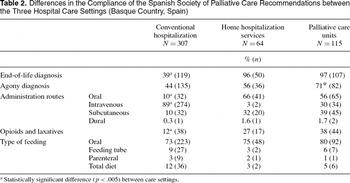
Differences in the Compliance of the Spanish Society of Palliative Care Recommendations between the Three Hospital Care Settings (Basque Country, Spain)
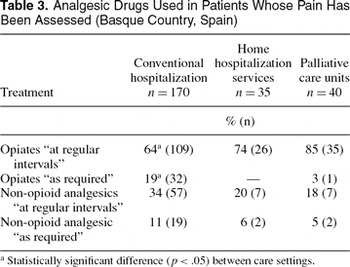
Analgesic Drugs Used in Patients Whose Pain Has Been Assessed (Basque Country, Spain)
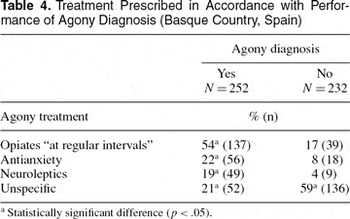
Treatment Prescribed in Accordance with Performance of Agony Diagnosis (Basque Country, Spain)
 You have
Access
- 4
- Cited by