In the early morning hours of 26 December 2003, a massive earthquake measuring 6.3 on the Richter scale struck the city of Bam, Iran. Its effects were devastating: approximately 26,000 to 40,000 of the city's 100,000 residents were killed. The survivors faced the destruction of 70–90 per cent of the city's housing infrastructure (Montazeri et al. Reference Montazeri2005).Footnote 1 More than forty-four countries sent aid, including the United States, which contributed eight plane loads of medical and humanitarian supplies as well as several dozen teams of experts to the relief effort.
While the US response to the 2003 Bam earthquake was seemingly analogous to that of any foreign actor offering aid and support, a priori, it was not obvious whether the United States would send any humanitarian aid at all – or whether Iran would accept it. The previous year, then-President George W. Bush had famously declared that Iran was one of three countries that comprised the ‘Axis of Evil’ (Heradstveit and Bonham Reference Heradstveit and Bonham2007). At the time of the earthquake, US–Iranian relations were particularly strained by the issue of the latter's nuclear weapons program.Footnote 2 Indeed, given the broader context of contentious bilateral relations, the process of transferring aid from the United States to Iran entailed greater intentionality than normal. To initiate the flow of any aid, President Bush was obliged to institute a special 90-day measure to ease US sanctions on IranFootnote 3 – which had been in place since 1979 and continues to be enforced to this day.Footnote 4 For Iran's part, accepting US aid meant allowing US military planes to land on its soil, which it had spent the previous 20 years prohibiting.Footnote 5 For a country that had undergone a revolution in part because the US military was perceived as having had too much domestic influence, it was far from obvious that such an act would be perceived as benign.Footnote 6
Yet, the Bam earthquake led not only to an increase in US humanitarian aid to Iran, (albeit temporarily); it was followed by other types of aid as well. Figure 1 shows that after 2004, aid commitments to ‘strengthen civil society’ increased markedly and consistently, peaking with the creation of the 2006 ‘Iran Democracy Fund’.Footnote 7 Meanwhile, US aid for a variety of developmental purposes (that is, economic and development policy and planning, infectious disease control, social/welfare services) also increased sporadically following 2003. This is particularly noteworthy given that Iran has generally been barred from receiving US foreign aid since the US State Department designated it a ‘state sponsor of terrorism’ in 1984 (Samore Reference Samore2015).Footnote 8 Why did the US send humanitarian aid to Iran despite objectively hostile extant relations? Was this event sui generis or is it possible to observe other dyadic pairs acting in a similar fashion? If so, does the occurrence of a natural disaster also lead donors to distribute other types of aid to strategic opponents?
US aid commitments to Iran, 2002–2013

Answering these questions has important implications for our understanding of how donors use foreign aid. Enhancing this understanding is especially pressing given that the occurrence of natural disasters is likely to increase with changing climate conditions. Previous studies have found that donors are more likely to allocate aid to strategic allies; thus a more nuanced understanding of what drives foreign aid allocations is necessary to answer these questions. To do this, we begin by first disaggregating foreign aid into three types: humanitarian, civil society and development aid. Humanitarian aid is meant as a stop-gap measure to help recipient countries return to their status quo, while the latter two types of aid are targeted towards catalyzing long-term change. Specifically, civil society aid is often used to improve governance outcomes, which give donors an avenue through which to wade into the domestic politics of recipient states (Henderson Reference Henderson2002; Ottaway and Carothers Reference Ottaway and Carothers2000; Resnick Reference Resnick2012; Spina and Raymond Reference Spina and Raymond2014). Meanwhile, development aid is primarily focused on promoting economic development.
We show that following a natural disaster, donor countries give more humanitarian aid to strategic opponents. We argue that this is because donors use natural disasters as an opportunity to ingratiate themselves with countries they have historically shared hostile relations with. Additionally, we find that while natural disasters prompt donors to increase civil society aid to strategic opponents for similar reasons, they conversely push donors to give more development aid to strategic allies. In all, we argue that while donors do use aid to promote their strategic interests, the tactics they employ to do so are highly context dependent. We evaluate these claims using a new measure of strategic interest that: (1) accounts for the indirect ties states share and (2) incorporates a variety of dimensions of strategic interest.
In what follows, we first give a brief overview of the existing literature on natural disasters and foreign aid allocations before outlining our hypotheses. We then introduce our new measure of strategic interest, and present our empirical analysis of how natural disasters condition foreign aid allocation decisions.
Extant Motivations for Foreign AId
Natural disasters can lead to the destruction or impairment of physical and social infrastructure, and the devastating loss of human lives. For example, the 1985 Mexico City Earthquake, one of the most catastrophic natural disasters in modern times, killed at least 10,000 peopleFootnote 9 and cost around $9 billion.Footnote 10 While the resulting destruction prompted the Mexican Government to institute a number of regulatory measures to limit future damage, 32 years later, Mexico City's 2017 earthquake still resulted in the deaths of at least 360Footnote 11 and the recovery effort could cost more than $2 billion.Footnote 12 Even more devastating was the 2004 Indian Ocean earthquake (the fourth largest since the 1900s) and tsunami which led to the deaths of more than 200,000 people across thirteen countries, causing around $7.5 billion in damage.Footnote 13 The most expensive natural disasters include the 2008 Sichuan earthquake ($191 billion)Footnote 14 and the 2011 Thai floods ($45 billion).Footnote 15
Few countries are spared the devastation that natural disasters can wreak. Between 1980 and 2004, approximately 7,000 natural disasters led to the deaths of around 2 million people and negatively affected the lives of an additional 5 billion (Guha-Sapir, Below and Hoyois Reference Guha-Sapir, Below and Hoyois2009). The economic costs are also considerable and rising – the direct economic damage from natural disasters between 1980–2012 are estimated to be $3.8 trillion (Gitay et al. Reference Gitay2013).
While dealing with the immediate and long-term damage wrought by natural disasters can seriously drain any country's resources, developing countries find it especially difficult to cope. Often, their physical infrastructure cannot withstand natural disasters, and their institutional infrastructure frequently lacks the resilience or capacity necessary to deal with the long and complex process of rebuilding. In general, when natural disaster strikes, developing countries are likely to experience more serious physical damage and have less state capacity to recover from it. For example, prior to its 2010 earthquake, Haiti had no building codes and many of its buildings were not designed to withstand even a mild earthquake.Footnote 16 Meanwhile, the lack of government leadership and low state capacity, along with other factors, has meant that Haiti has yet to fully recover 7 years after the disaster (Hartberg, Proust and Bailey Reference Hartberg, Proust and Bailey2011).Footnote 17
From a purely tactical perspective, natural disasters represent an opportune time to inflict harm on a strategic adversary, particularly if it is a developing country, as both government officials and public resources are fully engaged in responding to the emergency. Yet anecdotal evidence suggests that strategic adversaries rarely take advantage of this opportunity to overtly initiate hostile actions, at least as far as can be openly observed.Footnote 18 Many of the deadliest natural disasters (which should give foreign opponents the best opportunity to inflict harm) do not seem to have been followed up by hostile overtures. For instance, Taiwan did not use the 1976 Tangshan earthquake, believed to be the largest earthquake in the twentieth century by death toll, as an opportunity to inflict further harm on China. Similarly, India did not use the occasion of either the 1970 Bhola cyclone in then East Pakistan (the deadliest tropical cyclone ever recorded)Footnote 19 or the 1991 Bangladesh cyclone to initiate hostile gestures.
Context matters, of course. There are different rules of engagement depending on whether one has a contentious or actively hostile relationship with another country. In the former context, though taking pre-emptive action against a strategic opponent may lead to short-term gains, it could very well lead to long-term losses, especially since it would be well out of the realm of socially acceptable behavior in response to a natural disaster. But even by this hard-nosed logic, we might expect countries to simply do nothing when tragedy befalls their strategic opponents. Such behavior would fit well with the larger literature that investigates donor motivations for allocating foreign aid. Indeed, a large body of evidence suggests that donors overwhelmingly prioritize their own self-interests over recipient need when dispensing aid,Footnote 20 and under certain conditions have seen such efforts pay off (Bueno de Mesquita and Smith Reference Bueno de Mesquita and Smith2016; Carter and Stone Reference Carter and Stone2015; De Mesquita and Smith Reference Bueno de Mesquita and Smith2009).
Yet, much anecdotal evidence suggests that rather than jockeying for a more favorable strategic perch or doing nothing, natural disasters encourage the flow of aid from strategic opponents. For example, during the famine that ravaged North Korea from 1994 to 1998, the United States, South Korea, Japan and the European Union stepped up as the primary donors of food aid (Noland Reference Noland2004). Meanwhile, Taiwan was one of the biggest donors to China in the aftermath of the 2008 Sichuan earthquake.Footnote 21 Taiwan also actively contributed to the rescue effort,Footnote 22 and further offered to share the technical expertise it developed from its own devastating earthquake experience in 1999.Footnote 23
Do these anecdotes of non-strategic behavior indicate a systemic pattern or one-off exceptions to the rule of strategic self-interest? If the former, what could explain this seemingly humanitarian turn of behavior? Finding an answer to these questions in the current literature is difficult. For one, in evaluating the relative roles that donor interest and recipient need play in foreign aid allocation, what researchers refer to as recipient need may be more precisely understood as ‘developmental need’ and as such, targeted towards addressing chronic poverty. To that end, development need is frequently measured using gross domestic product (GDP), gross national product per capita,Footnote 24 or occasionally with more holistic measures of social outcomes such as the Physical Quality of Life Index,Footnote 25 average life expectancyFootnote 26 or daily caloric intake.Footnote 27
Only a small body of research investigates the degree to which aid is given in response to acute crises, such as natural disasters, which we refer to here as humanitarian need. Considering that around 11 per cent of official development assistance (ODA) was officially categorized as being given for humanitarian reasons in 2015, the systematic failure to include natural disasters as a potential driver of foreign aid is puzzling.Footnote 28 The existing evidence suggests that humanitarian aid has only a null or small effect on foreign aid allocations. For instance, Bermeo (Reference Bermeo2008) finds no relationship between the number of people affected by disasters and the allocation of bilateral aid for France, Japan, the UK and the US.Footnote 29 Similarly, David (Reference David2011) finds no statistically significant relationship between development aid flows and climatic or human disasters. David does find evidence of increased development aid following geological disasters, but the effect is substantively small and only found with a 2-year lag.Footnote 30 Yang (Reference Yang2008) also finds that ODA increases after a hurricane, but only with a 2-year lag.Footnote 31 In this article, we not only seek to investigate whether donors give more aid in response to natural disasters, but to explain why they might do so.
How Natural disasters affect Foreign Aid Allocations
Only in the twentieth century has expending public resources to relieve the human suffering of foreigners shifted from being virtually inconceivable to relatively commonplace. The devastation wrought by the two world wars was particularly instrumental in bringing about this change. However, such aid was strictly intended to serve as a temporary transfer to facilitate a return to the status quo, rather than a long-term commitment to ‘development’ as such. The turn toward promoting development was instead fostered by ongoing Cold War hostilities, which simultaneously promoted the use of aid to further a donor's strategic goals while also building a new norm of rich countries aiding poor countries (Lancaster Reference Lancaster2008).
The role of mitigating disaster and suffering on the one hand and furthering strategic interest on the other are thus essential elements of modern conceptions of foreign aid. This history also suggests that humanitarian aid, even if only initially meant to serve as a temporary expedient, may lead to the establishment of aid with longer-term strategic goals. Whether this pattern exists more generally – and if so, whether it is driven primarily by strategic or humanitarian concerns – is unclear. The role of the Cold War in formulating the concept of foreign aid dictated that recipients of humanitarian aid were generally within a particular strategic bloc, making it difficult to untangle strategic from humanitarian drivers.
As such, looking at how natural disasters affect foreign aid allocation is not only interesting in its own right; it also provides an exogenous factor with which to identify the role of donor interest and recipient need in explaining patterns of aid commitments. To that end, we develop a set of hypotheses about how natural disasters affect foreign aid allocations. To better untangle the varying potential drivers, we disaggregate foreign aid into three types: humanitarian, civil society and development aid. In doing so, we seek to offer a more nuanced understanding of the principle drivers of foreign aid allocations.
Short-term Humanitarian Responses to Natural Disasters
Responding to a natural disaster quickly and efficiently is often crucial to saving lives and alleviating human suffering, as services like electricity, gas, water and telecommunications may all be disrupted in the immediate aftermath. The timely deployment of humanitarian aid is the first response that donors can offer to countries struck by natural disaster. In what follows, we develop three hypotheses about how the interaction between strategic interests and natural disaster severity can affect humanitarian aid allocation.
We draw first from recent research in behavioral economics, which underscores the idea that different social contexts lead to varying behavior in identical situations (Do Reference Do2011; Kahneman Reference Kahneman2003).Footnote 32 Natural disasters may reorient the social context of a dyadic relationship to encourage donors to increase aid to their strategic opponents. That is, the loss of human life and destruction of infrastructure caused by a natural disaster can temporarily emphasize the human aspect of a bilateral relationship as opposed to the political, economic and military aspects that generally define foreign relations between two countries.
Moreover, if natural disasters have a humanizing effect, then we might expect strategic opponents to be particularly sensitive to it. That is, given that strategic opponents are more likely to ‘otherize’ each other, dyadic opponents must traverse a greater gap than dyadic allies to humanize the ‘other’ (de Buitrago Reference de Buitrago2012). On balance then, we would expect that donors do not discriminate between strategic opponents and strategic allies when dispensing aid. For example, historically hostile relations between the United States and Cuba may mean that they ‘otherize’ each other much more than in the US–Japan relationship, increasing the potential for Cubans to be humanized according to American public opinion. As such, we might expect American aid to Cuba to rise to the overall level it would provide to Japan in the event of similar natural disasters.
That is not to say that natural disasters can always bridge the divide among strategic opponents. For example, India and Pakistan have had an uneasy history of accepting aid from each other following natural disasters.Footnote 33 In general, we contend only that natural disasters may make it more likely that a strategic adversary will contribute aid by temporarily reframing the context of bilateral relations. An understanding of how the interaction between natural disasters and strategic interests affects humanitarian aid allocations based on social context thus leads us to the following hypothesis:
Hypothesis 1A Donors who are strategic opponents of the recipient are more likely than strategic allies to be sensitive to the humanizing effect of natural disasters. As such, following natural disasters, donors are likely to send similar amounts of humanitarian aid to strategic allies and strategic opponents.
Realist scholars offer an alternative perspective which proclaims that ‘foreign aid is today and will remain for some time an instrument of political power’ (Liska Reference Liska1960). According to this logic, donors commit aid to recipient countries primarily to further their own strategic interests. Previous studies of the drivers of foreign aid have put forward strong substantive evidence to support this viewpoint (Alesina and Dollar Reference Alesina and Dollar2000; Bermeo Reference Bermeo2008; Berthélemy Reference Berthélemy2006; De Mesquita and Smith Reference Bueno de Mesquita and Smith2007; Dreher, Nunnenkamp and Schmaljohann Reference Dreher, Nunnenkamp and Schmaljohann2015; Maizels and Nissanke Reference Maizels and Nissanke1984; McKinlay and Little Reference McKinlay and Little1979; Schraeder, Hook and Taylor Reference Schraeder, Hook and Taylor1998; Stone Reference Stone2006). With regards to the interaction between natural disasters and strategic interests, it is in the donor's self-interest to commit more humanitarian aid to their strategic allies rather than opponents in the event of a natural disaster. A naive reading of the logic of realism would lead to the following hypothesis regarding how the interaction between natural disasters and strategic aid affects humanitarian aid allocations:
Hypothesis 1B Donors are driven by self-interest; in the event of natural disasters, donors are likely to send less humanitarian aid to their strategic opponents than to their strategic allies.
A more sophisticated realist perspective, however, suggests that natural disasters may present donors with a strategic opportunity to improve relations with their strategic opponents. As suggested in Hypothesis 1A, social context does matter, but only to the extent that it limits the acceptable set of responses to natural disasters to the allocation of humanitarian aid (as opposed to, for example, the use of hostile overtures). However, donors may still seek to work within this framework of humanitarian altruism to further their own interests.
Indeed, disaster-afflicted countries appear to be sensitive to the possibility that accepting humanitarian aid from strategic opponents may come with strings attached. In 1999 for example, Venezuela experienced catastrophic flash floods and debris flows in Vargas State, which killed up to 10 per cent of the Vargas population (Wieczorek et al. Reference Wieczorek2001). US troops helped in the relief efforts by running helicopter rescue missions and working to provide clean water. However, consistent with his antagonism toward US hegemony in the region, President Hugo Chavez declined US assistance in rebuilding a critical highway, saying that while ‘he would accept American equipment if Venezuelan soldiers operated it…he did not want US troops in his country’.Footnote 34 Meanwhile, Iran categorically refused any aid from Israel following the 2003 Bam earthquake, though the Israeli Government still encouraged its citizens to donate privately.Footnote 35 Indeed, even the United States first turned down Russian aid for Hurricane Katrina before ultimately accepting it.Footnote 36 More recently, Venezuelan leader Nicolas Maduro refused humanitarian aid to alleviate the country's food crisis based on the reasoning that such aid is ‘merely a pretext for regime change’, demonstrating that (1) some political actors also suspect that humanitarian aid may be strategically driven and that (2) the use of humanitarian aid for strategic purposes may extend beyond natural disasters (as this particular crisis was largely the result of political missteps).Footnote 37
There is also anecdotal evidence to suggest that aid given under such circumstances can also serve to humanize and improve public perceptions of donors. For example, in the wake of US and South Korean aid for the North Korean famine, one refugee summarized his reaction to the US Institute for Peace in this way: ‘We were taught all these years that the South Koreans and Americans were our enemies. Now we see they are trying to feed us. We are wondering who our real enemies are’ (Natsios Reference Natsios1999, 9). Andrabi and Das (Reference Andrabi and Das2017), moreover, find that following the inflow of international aid sent to alleviate the damage inflicted by an earthquake in Pakistan in 2005, trust in Europeans and Americans was much higher among the affected population. This evidence suggests that, at least in certain contexts, humanitarian aid can help improve relations with strategic opponents.
Note that the underlying assumption is that the donor country is ultimately motivated to further its own strategic interests. A priori, the donor country cannot know whether such overtures of humanitarian aid will improve relations with the recipient government, improve perceptions among the recipient population or both. A natural disaster merely provides the donor country a window of opportunity to do so, thus potentially giving it more latitude to further its strategic goals. Improving relations with the recipient government may, on the margin, deter recipient governments from taking actions that conflict with donor interests. Meanwhile, improving perceptions of the donor country among the recipient population may also limit the extent to which a still-hostile recipient government may enact policies that directly counter donor interests. Here, however, we are primarily interested in investigating whether donors are driven by this possibility when allocating aid, leading to our third hypothesis:
Hypothesis 1C Donors view natural disasters as a strategic opportunity to improve their relations with strategic opponents and are thus likely to send more humanitarian aid to strategic opponents than to strategic allies.
Long-term Responses to Natural Disasters
Donor countries may dispense aid to immediately address the natural disaster at hand and to further their longer-term objectives. Here, we distinguish between civil society aid and development aid. Civil society aid is designed to support non-governmental organizations and their programs in order to empower grassroots advocacy and improve governance and government accountability. Development aid is targeted toward promoting long-term economic development in a recipient country, often through building infrastructure like roads and hospitals as well as through the promotion of human capital via technical training and education. Below, we develop hypotheses regarding how the interaction between strategic interest and natural disasters can affect the allocation of both types of aid.
Natural Disasters as Strategic Opportunities
Donors generally distribute aid to civil society not only for its intrinsic value but also, and arguably primarily, for its perceived instrumental value in either promoting democratization (Ottaway and Carothers Reference Ottaway and Carothers2000; Robinson Reference Robinson1995) or economic development (Kral et al. Reference Kral2013). However, we distinguish between civil society aid and development aid because while donors may commit civil society aid to promote economic development, supporting civil society is an inherently political act.Footnote 38 From supporting the growth of government watchdogs to increasing the domestic capacity for grassroots advocacy, whether intentionally or not, donors can exert influence over a recipient's domestic politics by directing funds to civil society.
Thus if, as following realist logic, foreign aid is used to promote donor interests, then donor governments should be especially inclined to increase the allocation of civil society aid. With respect to natural disasters, countries may be motivated to give more civil society aid to their strategic opponents because the temporary suspension of the normal dynamics of the relationship represents a unique opportunity to increase this type of aid and initiate a shift in the nature of the bilateral relationship (as in Hypothesis 1C). Donors can seize on a country's inherent vulnerability following a natural disaster to decide to strategically increase their civil society aid so as to increase their chances of exerting domestic influence over the recipient country.
For example, following the 2004 Indian Ocean earthquake and tsunami, the United States began committing aid to civil society groups in Somalia. Though the initial amount was small in absolute terms, considering that no aid was given to civil society in Somalia prior to the natural disaster, and that such aid has since steadily grown over the past decade, this represented a substantial change in US aid commitments to the country.Footnote 39 Given that the United States had closed its embassy in Somalia in 1991 and only re-established a diplomatic presence in the country in 2018,Footnote 40 it seems plausible to interpret this as strategic gambit on the United States’ part to gain a foothold in Somalia; if so, the move appears to have been successful. Before jumping to conclusions, however, note that the United States also increased civil society aid to Indonesia at the same time.Footnote 41 Given that Indonesia was affected much more severely by the earthquake than SomaliaFootnote 42 but had also enjoyed much closer ties to the United States, it would be difficult to substantiate our proposed mechanism based on anecdotal evidence alone. We thus test the following hypothesis through statistical modelling:
Hypothesis 2 Natural disasters present an opportunity for donors to exert influence over recipients who are their strategic opponents. Therefore donors are more likely to send additional civil society aid to their strategic opponents.
If, on the contrary, donors are purely driven by the potential intrinsic or instrumental payoffs of supporting civil society, then donors should be no more motivated to support the civil society of their strategic opponents than that of their strategic allies, and we should find no support for this hypothesis.
Natural Disasters and Development Aid
Whereas humanitarian aid provides stop-gap measures to address the immediate aftermath of a natural disaster, development aid seeks to build the conditions for long-term, sustainable economic growth. We expect donor countries are more likely to give this type of aid to countries that they want to see economically develop and prosper, namely, their strategic allies. This accords with the simpler notion of realism, similar to Hypothesis 1B, that countries will seek to support allies rather than opponents irrespective of the number of natural disasters. This results in the following hypothesis.
Hypothesis 3 Donors are more likely to send greater development aid to their strategic allies irrespective of the number of natural disasters.
If, on the contrary, donors seek only to promote development according to recipient need and without regard to any potential benefits to themselves, then donors should be no more motivated to support the development of their strategic allies over that of their strategic opponents, and we should find no support for this hypothesis.
Measuring Strategic Relationships
One reason for evaluating the motivations for aid rather than aid outcomes is that aid given for strategic reasons may still further development objectives, albeit incidentally, while aid allocated for humanitarian purposes may also bring unexpected strategic benefits (Maizels and Nissanke Reference Maizels and Nissanke1984). However, evaluating the motivations behind the provision of aid is not straightforward: any given aid project may provide assistance to the recipient country and strategic benefits to the donor country.
Thus when investigating whether strategic considerations (and, by extension, the interaction between strategic considerations and humanitarian need) affect foreign aid considerations, we must construct a reliable measure of strategic interest. Unfortunately, we find that Alesina and Dollar's (Reference Alesina and Dollar2000, 35) observation that ‘the measurement of what a “strategic interest” is varies from study to study and is occasionally tautological’ still holds true. Indeed, strategic interest has alternately been operationalized as: trade intensity (Bermeo 2008; Berthélemy and Tichit Reference Berthélemy and Tichit2004; Hoeffler and Outram Reference Hoeffler and Outram2011), UN voting scores (Alesina and Dollar Reference Alesina and Dollar2000; Dreher and Fuchs Reference Dreher and Fuchs2015; Hoeffler and Outram Reference Hoeffler and Outram2011; Weder and Alesina Reference Weder and Alesina2002), arms transfers (Maizels and Nissanke Reference Maizels and Nissanke1984), colonial legacy (Alesina and Dollar Reference Alesina and Dollar2000; Bermeo 2008; Berthélemy 2006; Berthélemy and Tichit Reference Berthélemy and Tichit2004; Carnegie and Marinov Reference Carnegie and Marinov2017), alliances (Bermeo 2008; Schraeder, Hook and Taylor Reference Schraeder, Hook and Taylor1998), regional dummies (Bermeo 2008; Berthélemy 2006; Maizels and Nissanke Reference Maizels and Nissanke1984), bilateral dummies (Alesina and Dollar Reference Alesina and Dollar2000; Berthélemy 2006; Berthélemy and Tichit Reference Berthélemy and Tichit2004)Footnote 43 or some combination of the above.Footnote 44
Such inconsistency in the operationalization of strategic interest is not simply a matter of using different variables to measure the same concept; different variables are used to measure different dimensions of the underlying concept. However, while a dyad's strategic bilateral relationship is quite multifaceted, to date, there has not been a readily available measure of strategic relationships that captures these various dimensions in the same way that measures of other complex concepts do.Footnote 45 To address this problem, we create a new measure of strategic interest that can account for different dimensions of strategic interest.
A New Measure of Strategic Relationships
To generate a measure of strategic relationships, we adopt a latent variable approach that enables us to estimate a relational measure of interest between countries by taking into account the direct and indirect ways in which states are connected across three dimensions of state relations: dyadic alliances, UN voting and joint membership in intergovernmental organizations (IGOs). Each of these dimensions provides a distinct representation of the strategic relationships between countries in the international system and has been commonly employed in the foreign aid literature. Alliances largely capture the strategic and military aspect of dyadic relationships. In contrast, joint membership in IGOs reflects the dyadic relationship across many diverse issue areas expressed across correspondingly many fora, while UN voting is better able to capture this relationship in a centralized forum.
To estimate a measure of strategic interest across these dimensions, we take a network-based approach that allows us to leverage the direct and indirect ways in which states are connected to one another. To do this we employ a latent factor model as described in (Hoff 2005). The model is structured as follows:
 $$\eqalign{&Y = {\bf u}_i^T {\bf u}_j + \epsilon _{ij}, \;\;{\rm where} \cr &\quad {\bf u}_i\in {\rm {\opf R}}^{R = 2}, \;i\in \{ {1, \;\ldots , \;n} \} } $$
where Y is a n × n undirected sociomatrix in which y ij designates whether there is a link (for example, an alliance) between i and j. The goal of the model is to provide a projection of the systematic variation in Y in a two-dimensional social space.Footnote 46 More precisely, the types of systematic variation that we are interested in include the concepts of (a) transitivity, (b) balance and (c) clusterability. Formally, a set of three countries ijk is said to be transitive if, for whenever y ij = 1 and y jk = 1, we also observe that y ik = 1. This follows the logic of ‘a friend of a friend is a friend’. Meanwhile, the relationships between ijk are said to be balanced if y ij × y jk × y ki > 0. Conceptually, if the relationship between i and j is ‘positive’, then both will relate to another unit k identically, either both positive or both negative. Finally, relationships between ijk are said to be clusterable if they are balanced or if all the relations are negative. It is a relaxation of the concept of balance and seeks to capture groups in which the measurements are positive within groups and negative between groups.
Third-order dependencies suggest that information about the way in which a pair of actors interacts with a third actor also tells us something about their relationship, even if we cannot directly observe it (Minhas, Hoff and Ward Reference Minhas, Hoff and Ward2019). Such dependencies seem especially relevant for our purposes, as one cannot understand the strategic relationship between two countries without taking into account their respective relationships with other countries. The importance of accounting for these dynamics has long been acknowledged in the foreign aid literature. Trumbull and Wall (Reference Trumbull and Wall1994, 877) for example, note that ‘donors do make their decisions with knowledge of what each other are doing, and may actually act cooperatively. Any study that ignores the interrelationship of donor behavior risks problems with simultaneity bias’. However, prior studies have largely overlooked this critique.
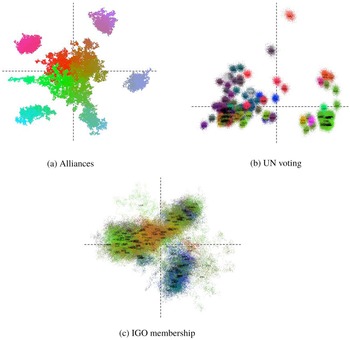
The main advantage of calculating the latent space of different dyadic variables as opposed to using alternative specifications such as the S Score algorithmFootnote 47 is that it allows us to better account for indirect ties that states share. This framework accounts for indirect ties because the latent factor model takes patterns such as transitivity into account. As a result, the relationship between two actors can be inferred even if no direct interaction between them is observed. We employ this latent factor model for every year for each of our three measures.Footnote 48 Figure 2 presents a visualization of the resultant latent space we calculated for each variable for the year 2005.
Latent spaces for components of strategic interest measure during 2005

Countries that cluster together in this two-dimensional latent space are more likely to interact with each other. The plots for alliances, UN voting and IGO membership suggest that there is distinct clustering among countries. Moreover, these clusters are different across the three measures, suggesting that each variable indeed captures different aspects of strategic interest.
After estimating the latent spaces for these components, we estimate the distance between each dyadic pair for the three components for each year. We then combine them in a principal component analysis (PCA) to reduce the dimensionality of our measure while retaining as much variance as possible to maximize our explanatory power. We estimate the PCA of these variables for each year separatelyFootnote 49 and use the first principal component for each year as our measure of strategic interest. For more information about how this PCA was conducted, please see the Appendix. The end result of this process is a measure of strategic interest that takes into account indirect ties while also accounting for multiple dimensions in which states interact with one another.Footnote 50
Data
Aid Flows
Our data for foreign aid flows is taken from the AidData project (Tierney et al. Reference Tierney2011). This database includes information on over a million aid activities from the 1940s to the present. We use the country-level aggregated version of this database to create a directed-dyadic dataset of total aid dollars committed. In this analysis, we focus on Organisation for Economic Co-operation and Development (OECD) donor countries as they both are the best able and have the strongest incentives to provide foreign aid to advance their strategic interests. In the final tally, our dataset includes the eighteen most active sendersFootnote 51 and 167 receivers of aid flows from 1975 to 2005. Accounting for all possible senders of aid during this time frame is difficult because of the amount of missing data. We deal with missing data by employing a multiple imputation method developed by Hoff (Reference Hoff2007) and shown to have good performance by Hollenbach et al. (Reference Hollenbach2014).
We use AidData's sector coding scheme to disaggregate bilateral ODA into humanitarian aid, development aid and civil society aid.Footnote 52 Our measure of humanitarian aid encompasses aid given for emergency response, reconstruction relief, and disaster prevention and preparedness sectors. Civil society aid is measured as aid to three sectors: government and civil society, women, and support to non-governmental organizations and governmental organizations. Finally, development aid is defined as aid given to the following sectors: education, other infrastructure and services, and other development aid; health, economic infrastructure and services; agriculture, forestry and fishing, and food aid; water sanitation, environmental protection; industry, mining and construction; and debt relief. We note that bilateral ODA often represents only one channel through which donors may allocate foreign aid, and that an increasing number of articles have highlighted the need to account for the heterogeneity of aid channels donors may use when estimating drivers of foreign aid (Buthe and Cheng Reference Büthe, Cheng, Moschella and Weaver2013; Dietrich Reference Dietrich2013; Nunnenkamp and Öhler Reference Nunnenkamp and Öhler2011). Here, we focus solely on bilateral aid in order to maintain greater comparability with previous studies.
Strategic Interest
As previously stated, we created our measure of strategic relationships by conducting a PCA on the latent distances for alliances, UN voting and joint IGO membership. Data for alliances was retrieved from the Correlates of War (COW) Formal Alliance dataset (Gibler Reference Gibler2009). Following Bueno de Mesquita (Reference Bueno de Mesquita1975) and Signorino and Ritter (Reference Signorino and Ritter1999), we distinguish between different types of alliances with the following weighting scheme: 0 = no alliance, 1 = entente, 2 = neutrality or nonaggression pact, 3 = mutual defense pact.
UN voting data was obtained from the United Nations General Assembly Data set (Strezhnev and Voeten Reference Strezhnev and Voeten2012). We calculate the proportion of times two states agree out of the total number of votes they both voted on. Agreement means both vote yes, both vote no or both abstain. This measure is similar to the ‘voting similarity index’ readily available from the dataset except the voting similarity index does not account for mutual abstentions.
IGO voting data was obtained from the COW International Governmental Organizations Data Set (Pevehouse, Nordstrom and Warnke Reference Pevehouse, Nordstrom and Warnke2010). A total of 529 IGOs across a broad swath of topics, including trade, communications, and health and security, are represented in this dataset. Dyads were coded 1 if they belonged to the same IGO as a full member or an associate member, and 0 if one or both of them was an observer, had no membership, was not yet a state or was missing data.Footnote 53
Natural Disasters
Almost all previous empirical work on natural disasters relies on the publicly available Emergency Events Database (EM-DAT) maintained by the Center for Research on the Epidemiology of Disasters at the Catholic University of Louvain, Belgium. EM-DAT defines a disaster as a natural situation or event that overwhelms local capacity and/or necessitates a request for external assistance. For a disaster to be entered into the EM-DAT database, at least one of the following criteria must be met: (1) 10 or more people are reported killed, (2) 100 people are reported affected, (3) a state of emergency is declared or (4) a call for international assistance is issued. We use a count of the number of natural disasters a country has experienced per year as our measure of natural disaster severity.
Additional Covariates
In addition to our dyadic strategic relationship measures, we include a number of covariates to capture the characteristics of aid recipients. For our measure of political institutions, we use Polity IV data available from the Center for Systemic Peace (Gurr, Marshall and Jaggers Reference Gurr, Marshall and Jaggers2010). Polity IV captures differences in regime characteristics on a 21-point scale ranging from −10 (hereditary monarchy) to +10 (consolidated democracy), rescaling it to range from 1 to 21 for greater ease of interpretation. We also controlled for colonial history using the Colonial History Data Set from the Issue Correlates of War Project (Hensel Reference Hensel2009). This variable is coded 1 when the receiver in a sender–receiver dyad is a former colony of the sender and 0 otherwise.
For our measures of developmental need, we use (1) log GDP per capita and (2) life expectancy at birth. Both of these measures are extracted from the World Bank (Reference World Bank2013). Finally, we control for the incidence of civil war in a recipient country as it affects the donor country's ability to dispense aid. We do so with data retrieved from the Uppsala Conflict Data Program/International Peace Research Institute Armed Conflict Database (Gleditsch et al. Reference Gleditsch2002). We code as a civil war any armed conflict in which either (a) ‘internal armed conflict occurs between the government of a state and one or more internal opposition group(s) without intervention from other states’ or (b) ‘internationalized internal armed conflict occurs between the government of a state and one or more internal opposition group(s) with intervention from other states (secondary parties) on one or both sides’.
Analysis
Estimation Method
To model aid flows using our directed-dyadic panel dataset, we utilize a hierarchical model. We include random intercepts in our model for every dyad and year:
 $$\eqalign{{\rm Log}( {\rm Aid}) _{sr, t} &= \beta _1( {\rm Pol}.\;{\rm Strat}.\;{\rm Distanc}{\rm e}_{sr, t-1}) + \beta_2 ({\rm No. Disasters}_{r,t-1}) \cr & \quad + \beta_3 ({\rm Pol.\ Strat.\ Interest}_{sr,t-1} \times {\rm No.\ Disasters}_{r,t-1}) \cr & \quad + \beta_4({\rm Colony}_{sr,t-1})+\beta_5({\rm Polity}_{r,t-1}) \cr & \quad + \beta_6 {\rm Log}({\rm GDP\ per\ capita}_{r,t-1})+\beta_7({\rm Life\ Expect}_{r,t-1}) \cr & \quad + \beta_8 ({\rm Civil\ War}_{r,t-1})\cr & \quad + \delta_{s,r}+\rho_t } $$
where δ s,r and ρ t are the sender–receiver and year random effects, respectively.Footnote 54 We use one-year lags because while our natural disaster data is pinpointed to the day, we do not have correspondingly fine-grained data on foreign aid distributions. Thus we take a conservative approach and lag by one year to guarantee that the aid is committed after the incidence of a natural disaster.
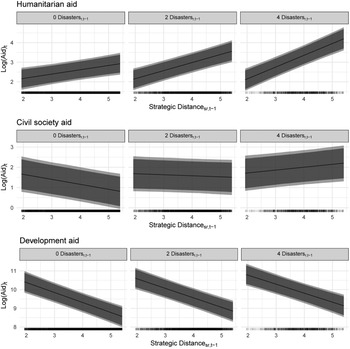
The results of this analysis are shown below in a coefficient plot in Figure 3. We test Hypotheses 1A, 1B and 1C using Humanitarian Aid as the dependent variable. The results show a positive and statistically significant relationship between the interaction of Strategic Distance and No. Disasters. To interpret these results, Figure 4 (‘Humanitarian Aid’ panel) plots the substantive effect of this interaction term on Humanitarian Aid over the range of Strategic Distance for different levels of natural disaster severity.
Coefficient plots for the main analyses with interaction terms across each dependent variable
Note: dependent variables include Humanitarian Aid, Civil Society Aid and Development Aid.

Simulated substantive effect plots, all dependent variables
Note: plots given for each dependent variable (Humanitarian Aid, Civil Society Aid and Development Aid) for different levels of natural disaster severity across the range of the strategic distance measure. A rug plot is provided below each panel.

The rising slope between strategic interest and humanitarian aid as the number of natural disasters increases shows that the more natural disasters a country experiences, the more likely it is to receive humanitarian aid from a strategic adversary. These results are consistent with Hypothesis 1C, which suggests that donors may be more likely to dispense humanitarian aid to their strategic adversaries because such disasters present unique opportunities to improve bilateral relations. When natural disasters are particularly severe, donors may dispense a great deal more aid to strategic opponents compared to strategic allies to further their strategic interests.
The results do not support Hypothesis 1A. We would have expected there to be a downward sloping relationship between strategic interest and humanitarian aid when there are no natural disasters. However, if natural disasters had a humanizing effect on strategic opponents, then we would have expected the slope between strategic interest and humanitarian aid to flatten as the number of natural disasters increased, which we do not find.
Nor do we find support for Hypothesis 1B, which hypothesizes that donors are more likely to give to their strategic allies in the wake of a natural disaster to further their own self-interest. If this were the case, we would have expected the parameter estimate for the interaction term between Strategic Interest and No. Disasters to be negative, which it is not. Moreover, we would have expected to observe a downward-sloping relationship between strategic interest and humanitarian interest as the number of natural disasters increases. This is clearly not evidenced in the ‘Humanitarian Aid’ panel in Figure 4.
Meanwhile, we test Hypothesis 2 by examining the effect of the interaction between Strategic Interest and No. Disasters on civil society aid. In Figure 3, we find a positive and significant relationship between this interaction and civil society aid. The substantive effects plot (in the ‘Civil Society Aid’ panel in Figure 4) also suggests that donors are more likely to target aid to civil society in their strategic adversaries the more natural disasters that country experiences, supporting Hypothesis 2. These results provide support for the idea that donors may be acting to take advantage of vulnerable recipients to mold the relationship to their interests.
Finally, we test Hypothesis 3 by analyzing how the interaction between strategic interest and natural disasters affects development aid allocation. Figure 3 demonstrates that this coefficient is not statistically significant. However, examining the substantive significance in Figure 4 (‘Development Aid’ panel), we can see that the relationship between strategic interest and development aid allocation is consistently downward sloping. This suggests that donors tend to give more development aid to strategic allies than to strategic opponents, showing strong support for Hypothesis 3. These results indicate that, irrespective of natural disaster intensity, development aid is reserved for strategic allies of donor countries and does not alter donors’ strategic calculus.
Overall, we believe we have found strong evidence that context heavily conditions the role of strategic interest in aid allocation. That is, we find donors are more likely to give both more humanitarian and civil society aid to strategic opponents that experience natural disasters. Our findings are consistent with the argument that they do so in order to take advantage of the opportunities natural disasters provide to improve their relationships with these opponents. These results are all the more interesting given that, consistent with prior studies, we also find that donors are more likely to give development aid to strategic allies irrespective of the number of natural disasters a recipient country experiences. This suggests that donor countries strategically use different types of aid to further their interests in different contexts.
Persistence of Foreign aid Allocation Over Time
How persistent are these estimated effects? To answer this question, we re-estimate the original models for different lag lengths of the main interaction and constituent terms.Footnote 55 These models are estimated separately for each lag length (1, 3 and 5 years). The simulated effects when using different lags for the interactions and constituent terms are shown in Figures 5, 6 and 7 for the outcome variables Humanitarian Aid, Civil Society Aid and Development Aid, respectively.
Simulated substantive effect plots for Humanitarian Aid
Note: figure includes varying lags of the variables of interest and different levels of natural disaster severity across the range of the strategic distance measure.

Simulated substantive effect plots for Civil Society Aid
Note: figure includes varying lags of the variables of interest and different levels of natural disaster severity across the range of the strategic distance measure.

Simulated substantive effect plots for Development Aid
Note: figure includes varying lags of the variables of interest and different levels of natural disaster severity across the range of the strategic distance measure.

Figure 5 shows that the interaction between strategic interest and natural disasters is persistent until approximately five years after a natural disaster. This suggests that donors seek to use natural disasters as a tactic to improve relations with strategic opponents for a number of years after the initial disaster (supporting Hypothesis 1C).
Figure 6 shows that the interaction between strategic interest and natural disasters positively affects the allocation of civil society aid, but only for a short time following a natural disaster. One way to interpret these results is that donors recognize the difficulty of trying to influence domestic politics through civil society aid relatively quickly, and thus waste relatively little time in pursuing such attempts. Another interpretation is that civil society aid is actually rather effective, and as such, recipients’ governments are likely to push back against allowing it in fairly short order. Teasing out the exact mechanism would be a fruitful area for future research.
Last, Figure 7 extends the earlier finding that the interaction between strategic interest and natural disasters has little effect on development aid across a variety of different lags. This result further suggests that there is strong support for Hypothesis 3 – that donor counties focus on reserving development aid for strategic allies.
Robustness Checks
We ran a number of checks to test the robustness of our findings. We discuss these checks briefly here and in full in the Appendix. Our findings are robust to different operationalizations of the disaster variable, including when using a binary variable for the number of disasters and when using the number killed in natural disasters. We also run model specifications with lagged dependent variables for both our main models as well as for models that analyze the persistence of foreign aid over time, and our findings remain robust and substantively unchanged.
We also examined whether our results hold across different sub-samples of our data. For instance, Bermeo's (Reference Bermeo2017, Reference Bermeo2018) recent work suggests that it is increasingly in donors’ self-interest to promote development against negative spillovers from developing countries in the post-2001 era. If a similar logic predominates in the event of a natural disaster, we would expect it to wash out any consideration of more traditional self-interest on the part of the donor. That is, if the prevention of negative spillovers was donors’ only concern, then we would expect them to give the most to countries for which the potential negative spillovers from natural disasters would be greatest. We would thus not expect to find any statistically significant relationship between more traditional strategic interest concerns and humanitarian aid in the event of a natural disaster. Given that, we test whether our findings hold when we restrict our sample to after 2001 and find that they do (see the Appendix). Numerous studies also suggest that aid became less tied to security concerns after the end of the Cold War (Clist Reference Clist2009; Fleck and Kilby Reference Fleck and Kilby2010). Therefore we re-ran our analysis restricting the sample to the post-Cold War period; our results remain robust (see the Appendix).
Finally, we explored whether donors may find it easier to funnel aid to strategic allies through pre-existing channels in the wake of natural disasters. If this is the case, then our finding that donors give more to strategic opponents through humanitarian aid channels may simply be an artifact of how different aid pipelines are labeled. We investigated whether this was a possibility by assessing (1) how aid composition changes depending on whether a recipient country is a strategic ally or opponent (2) and whether strategic allies are more likely to receive more overall aid. We find no evidence that our findings are a function of a labeling effect (for more details see the Appendix).
Note that a potentially important covariate that we do not control for in our analysis is the role of the media and public opinion. While Eisensee and Strömberg (Reference Eisensee and Strömberg2007) and Strömberg (Reference Strömberg2007) find that news coverage of a natural disaster is a big factor in shaping US humanitarian aid allocation, Olsen, Carstensen and Høyen (Reference Olsen, Carstensen and Høyen2003) find that media coverage has only a limited effect on shaping humanitarian aid across a larger cross-section of donors. Other studies suggest that public opinion can help shape aid allocation (Bryant et al. Reference Bryant2018), including whether aid is given bilaterally or multilaterally (Milner and Tingley Reference Milner and Tingley2013). This work strengthens our findings to the extent that they suggest that increased media coverage and public opinion pushes donors to give purely based on humanitarian motivations, which is in line with Hypothesis 1A. If so, then this constitutes a harder test of Hypothesis 1C. All of these studies have either been conducted in select countries or select cross sections of time; the data needed to test these propositions over a large panel of countries over time is not available, and would be prohibitively costly to collect. Further research on how media coverage and public opinion affect aid allocation following a natural disaster is an important avenue for future research.
Discussion
Our analysis suggests that a more nuanced understanding of the drivers of foreign aid is needed. While recent work has shown that accounting for the channel of aid delivery can go a long way toward understanding aid allocation decisions (Dietrich Reference Dietrich2013; Dietrich Reference Dietrich2016), we show that following natural disasters, donor countries direct more humanitarian aid to strategic opponents than allies. We argue that donor countries may allocate foreign aid in this way because they see natural disasters as an opportunity to improve relations with their strategic opponents. Our lag models demonstrate that these findings are surprisingly persistent.
Moreover, we find that natural disasters affect how donor countries allocate aid for both short- and long-term purposes. Donors are more likely to distribute civil society aid to strategic adversaries when they experience more natural disasters. Since civil society aid involves engagement and intervention in the domestic politics of a recipient country, an increase in this type of assistance indicates a greater desire to increase donor influence over a recipient country compared to development aid.
In addition, we find that donors are more likely to give development aid to strategic allies relative to strategic opponents irrespective of exogenous shocks such as natural disasters. Why might donors pursue a sophisticated realist strategy for humanitarian and civil society aid but a naive one for development aid? We argue that in this case, context matters: what may further strategic interest in one situation may not work for another. It is nevertheless useful to note that almost 60 per cent of the total aid flowing from donor countries can be categorized as development aid. This suggests that donors who seek to develop better relations with traditional strategic opponents by dispersing humanitarian and civil society aid recognize the inherent risks associated with this strategy and invest accordingly.
These results should be of particular interest as climate change continues to increase the incidence and intensity of natural disasters. They suggest that while countries that experience natural disasters can expect humanitarian aid even from their strategic adversaries, such help can also open the doors to efforts to influence domestic politics in line with the interests of donors who have historically been antagonistic.
Supplementary material
Replication material and instructions are available at https://github.com/s7minhas/foreignAid and in the BJPS Data Archive on Dataverse at https://doi.org/10.7910/DVN/T24N31. Online appendices are available at https://doi.org/10.1017/S000712341900070X.
Acknowledgements
Alphabetical order signifies equal authorship; all mistakes are our own. We are grateful for the helpful comments we received from Tim Büthe, Tobias Rommel, Gina Reinhardt, Tobias Heinrich, Alice Iannantuoni and Matthew Winters. Earlier versions of this article were presented at the International Political Economy Society Conference 2018; the Midwest Political Science Association, 2018 and; the International and Studies Association Annual Convention 2015 and we are grateful for the helpful feedback that we received there. We would also like to thank the comments and suggestions we received from our three anonymous reviewers on how to strengthen this article.